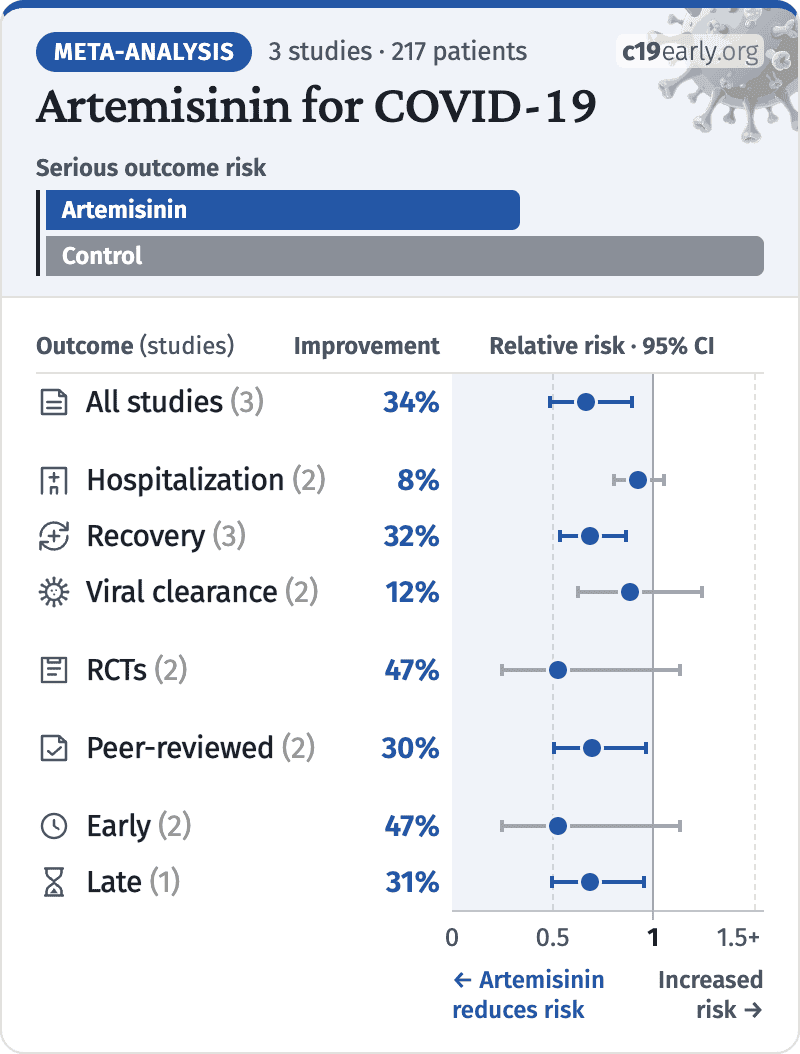
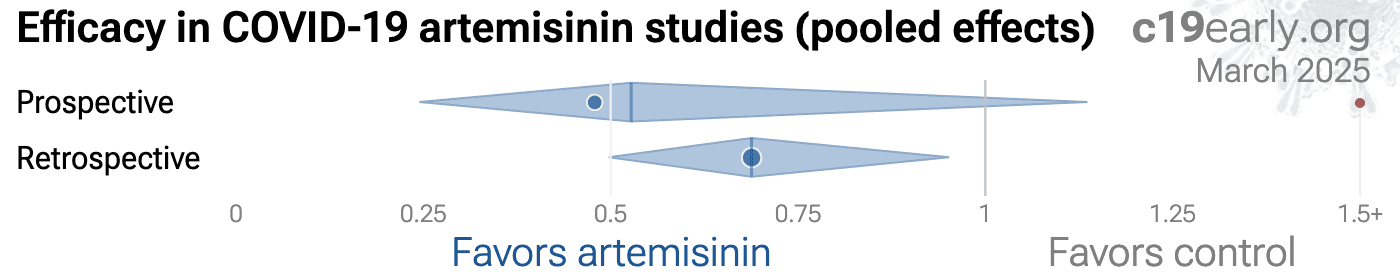
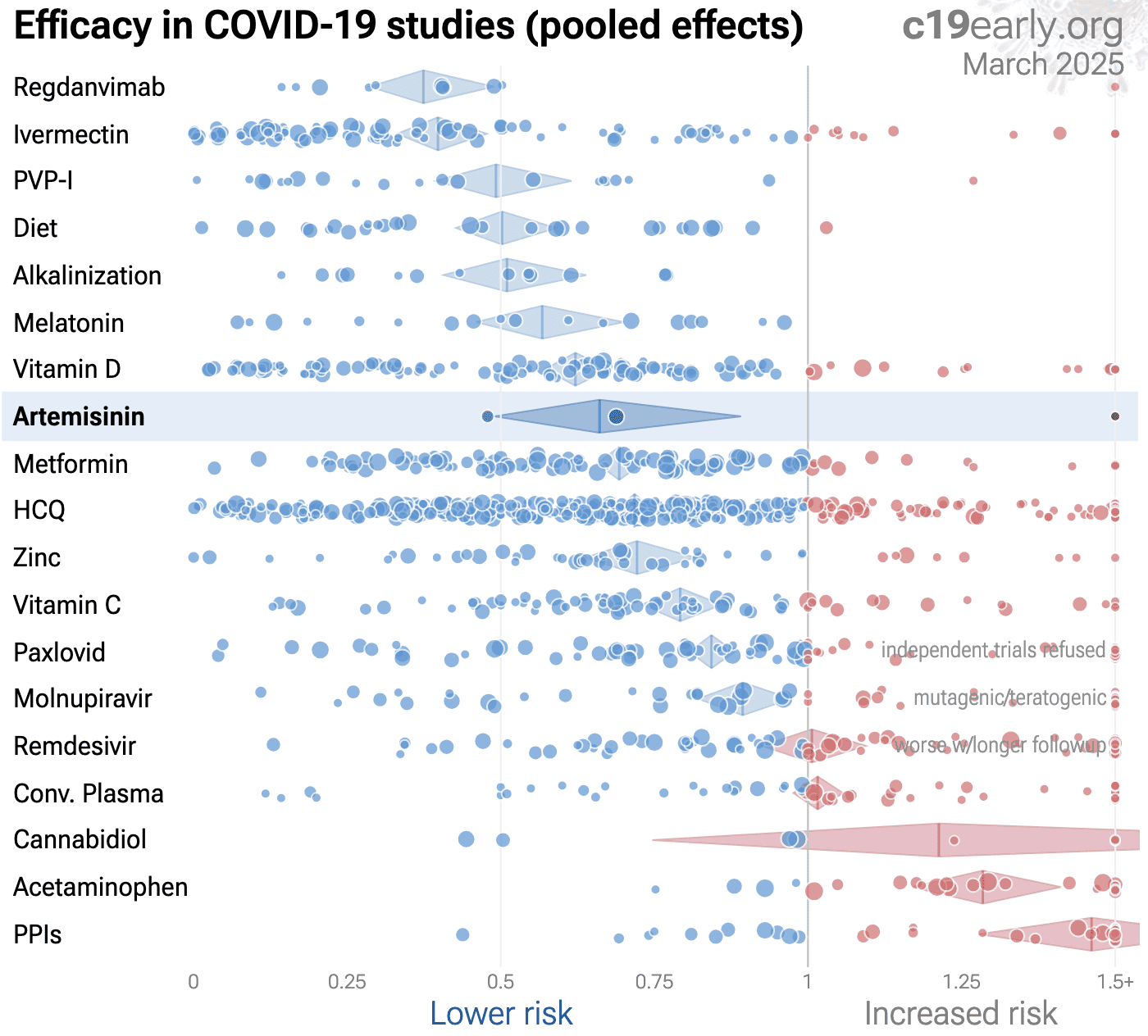
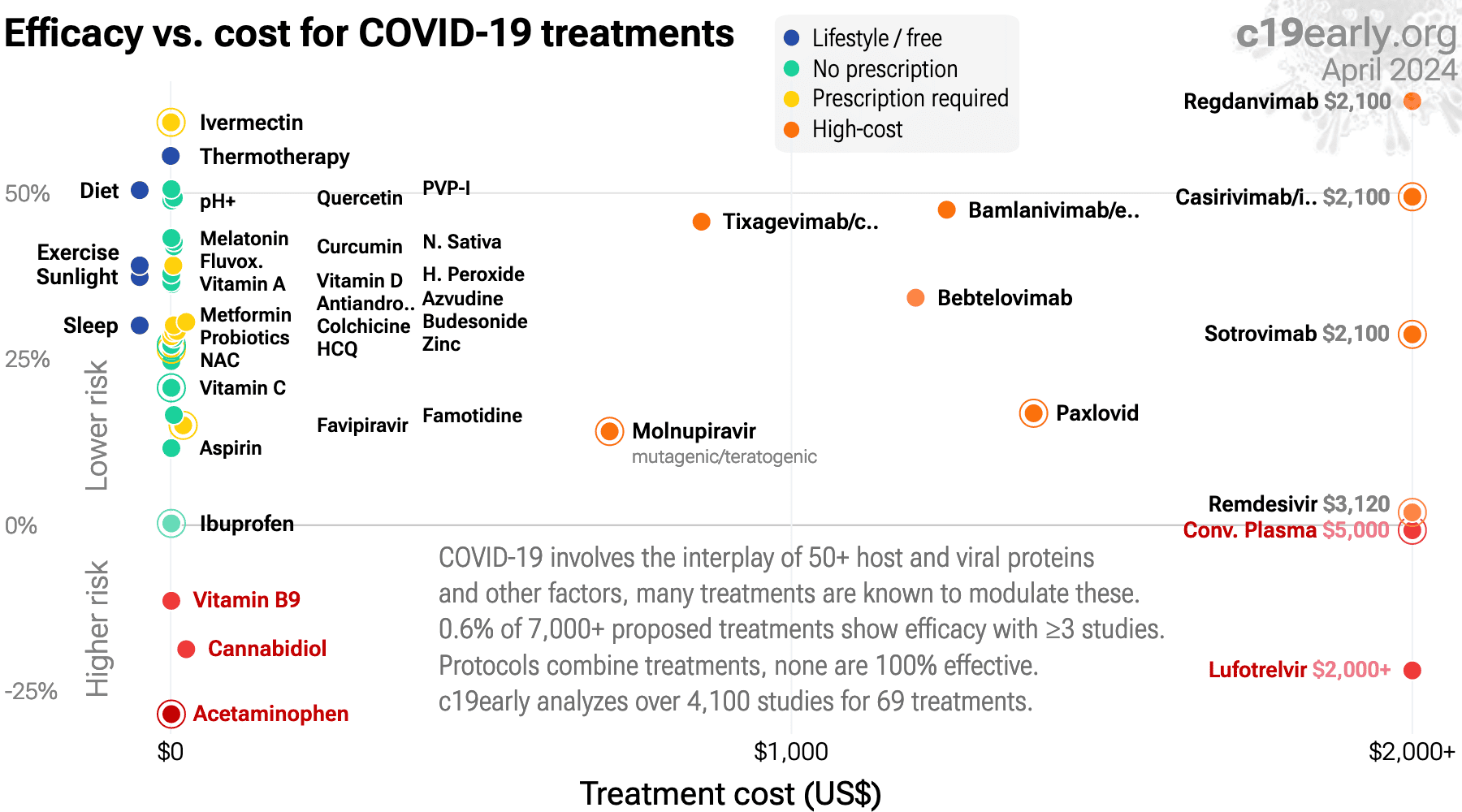
A summary of study results is below. Please submit
updates and corrections at the bottom of this page.
A summary of study results is below. Please submit
updates and corrections at https://c19early.org/artmeta.html.
Effect extraction follows pre-specified rules as detailed above
and gives priority to more serious outcomes.
For pooled analyses, the first (most serious) outcome is used, which may
differ from the effect a paper focuses on.
Other outcomes are used in outcome specific analyses.
|
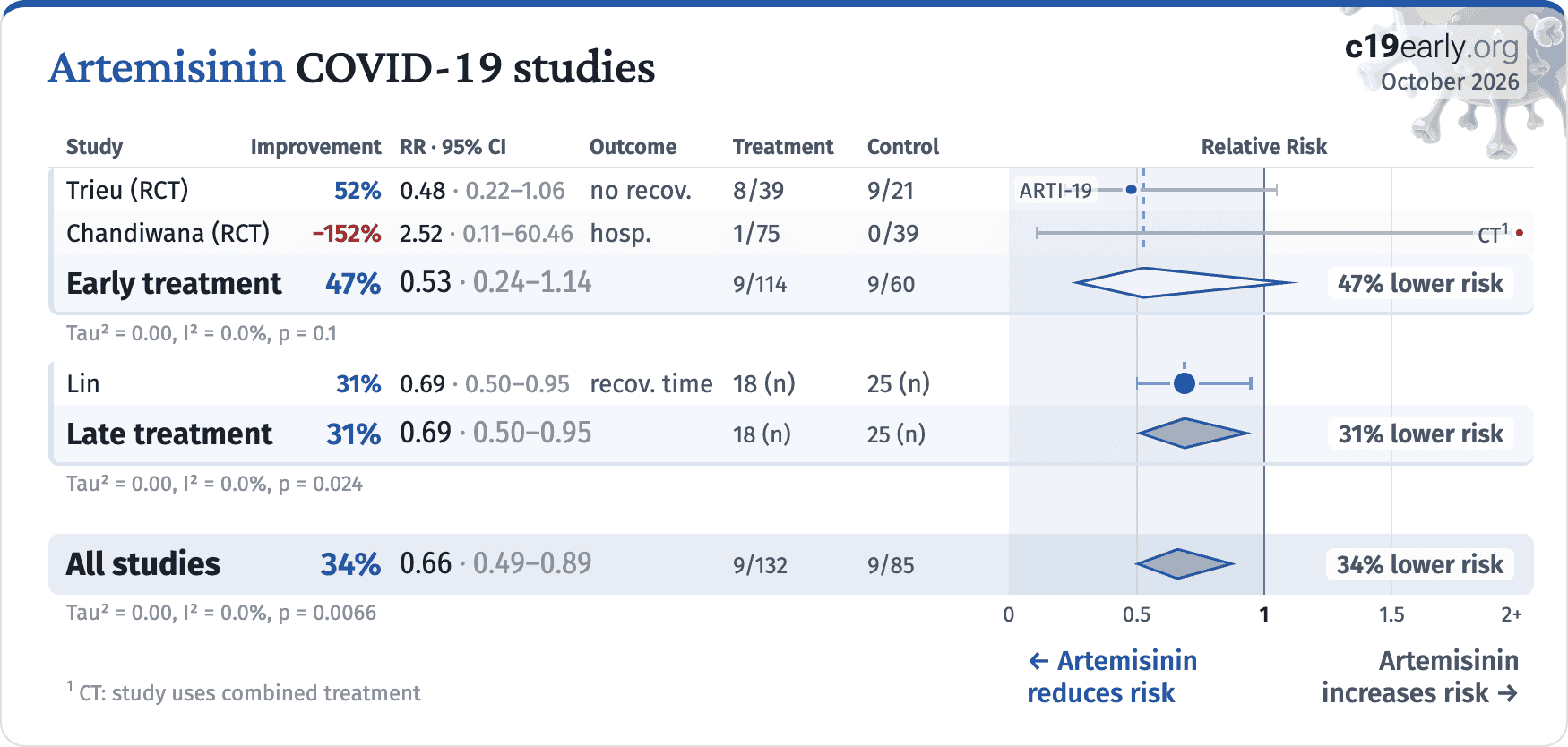
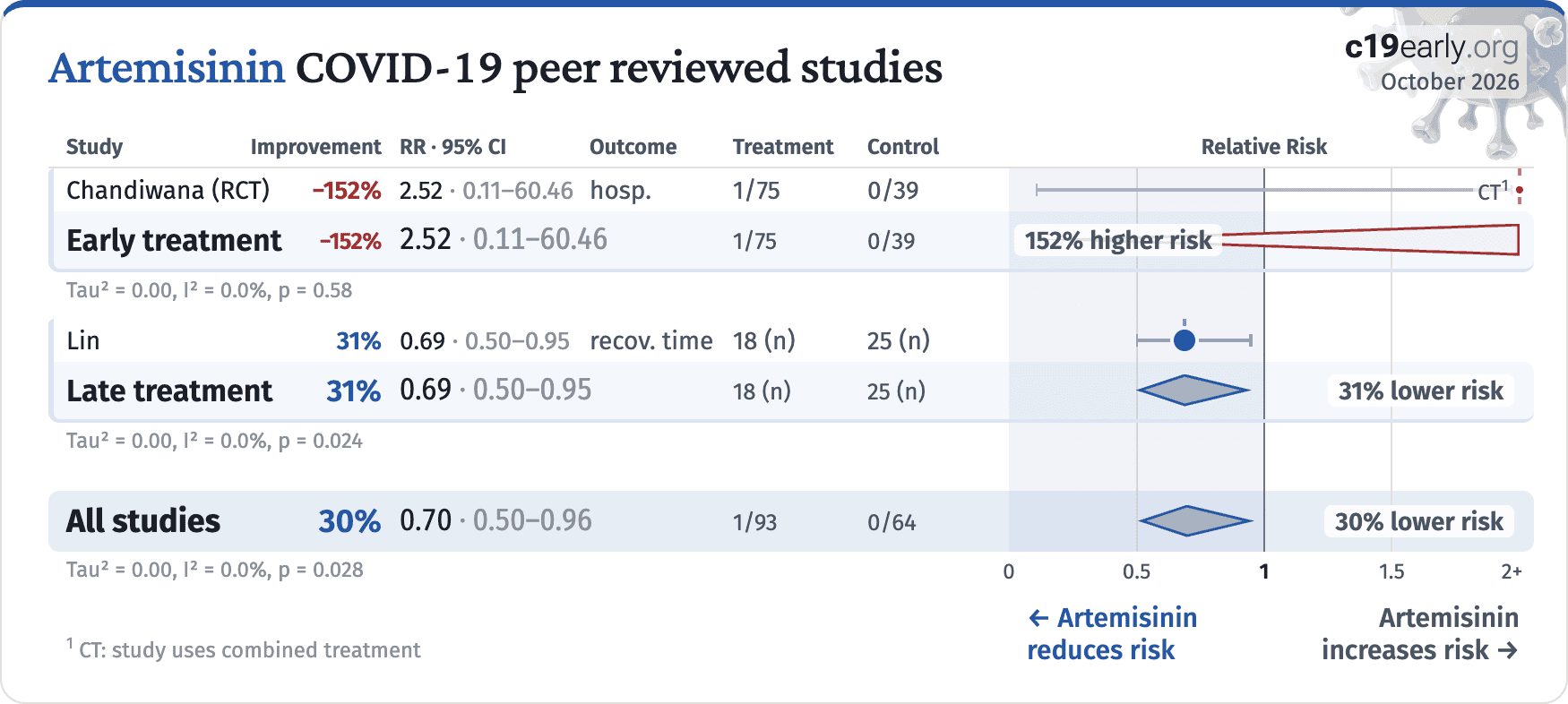
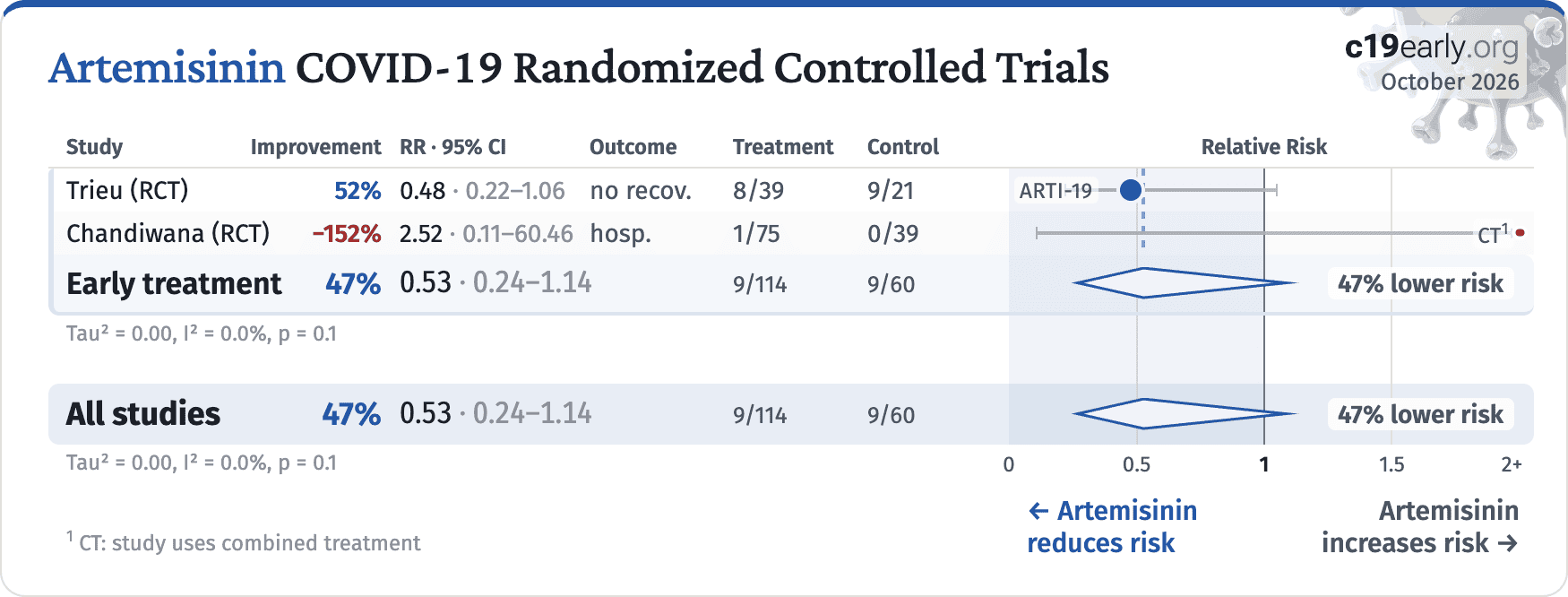
Chandiwana, 11/1/2022, Randomized Controlled Trial, South Africa, peer-reviewed, mean age 34.9, 16 authors, study period 3 September, 2020 - 23 August, 2021, this trial uses multiple treatments in the treatment arm (combined with amodiaquine or pyronaridine) - results of individual treatments may vary, trial NCT04532931 (history).
|
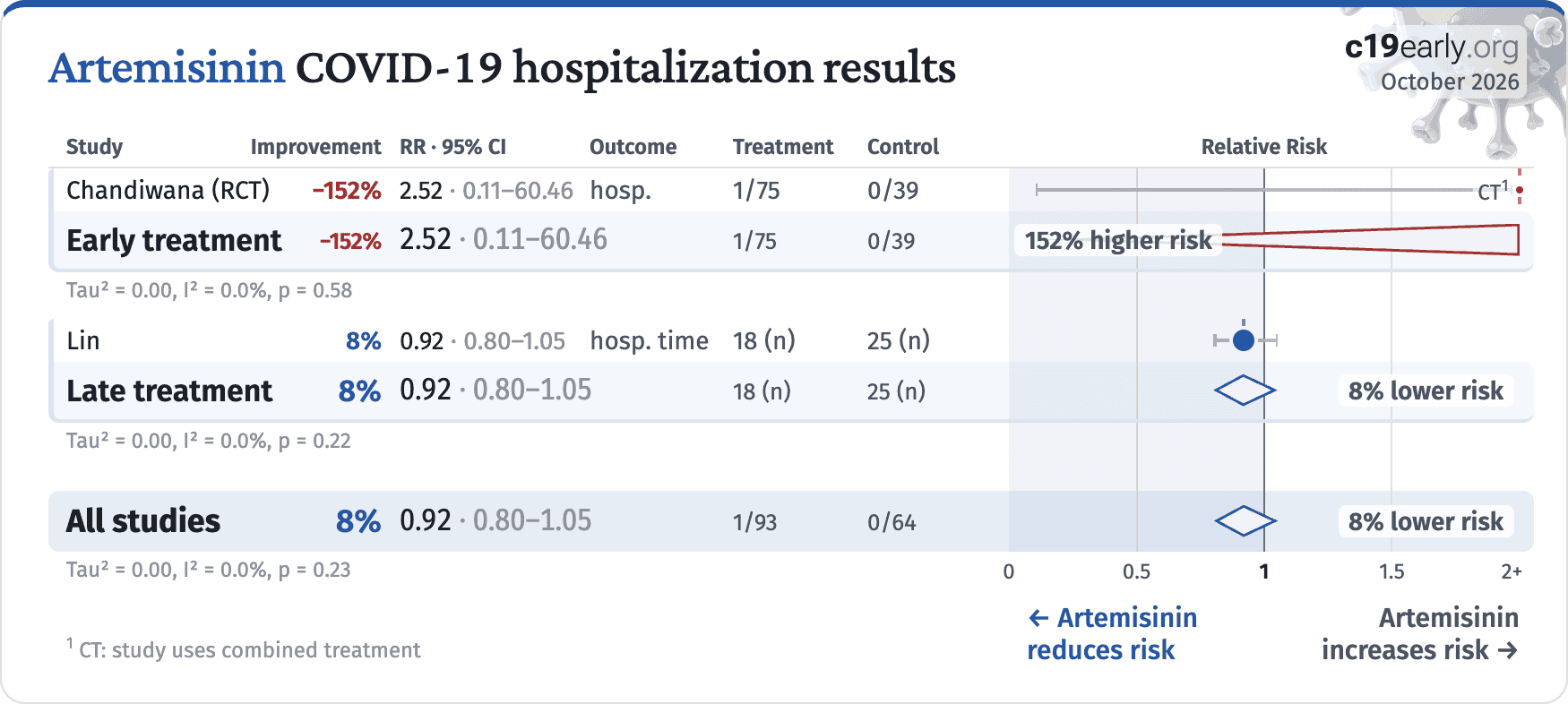
risk of hospitalization, 152.0% higher, RR 2.52, p = 1.00, treatment 1 of 75 (1.3%), control 0 of 39 (0.0%), continuity correction due to zero event (with reciprocal of the contrasting arm).
|
|
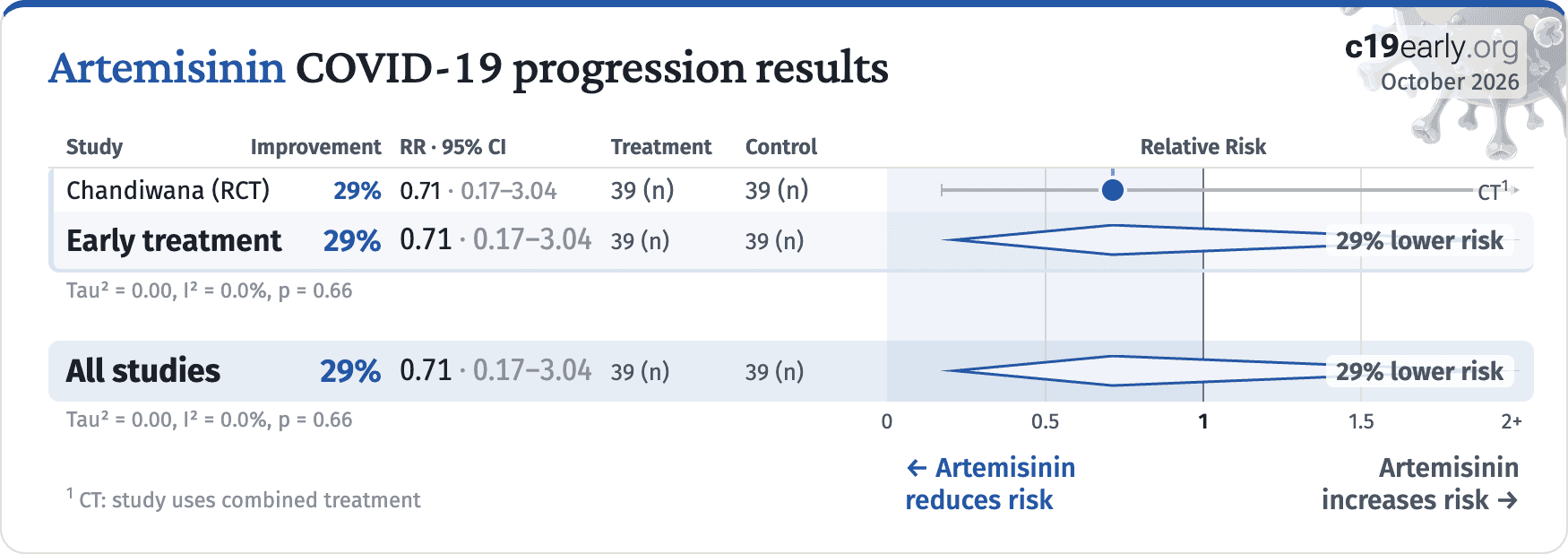
risk of progression, 28.7% lower, RR 0.71, p = 0.66, treatment 39, control 39, adjusted per study, both artesunate arms.
|
|
risk of progression, 31.0% higher, OR 1.31, p = 0.73, treatment 39, control 39, adjusted per study, ASAQ, day 28, Table S9, RR approximated with OR.
|
|
risk of progression, 71.0% lower, OR 0.29, p = 0.22, treatment 36, control 39, adjusted per study, PA, day 28, Table S9, RR approximated with OR.
|
|
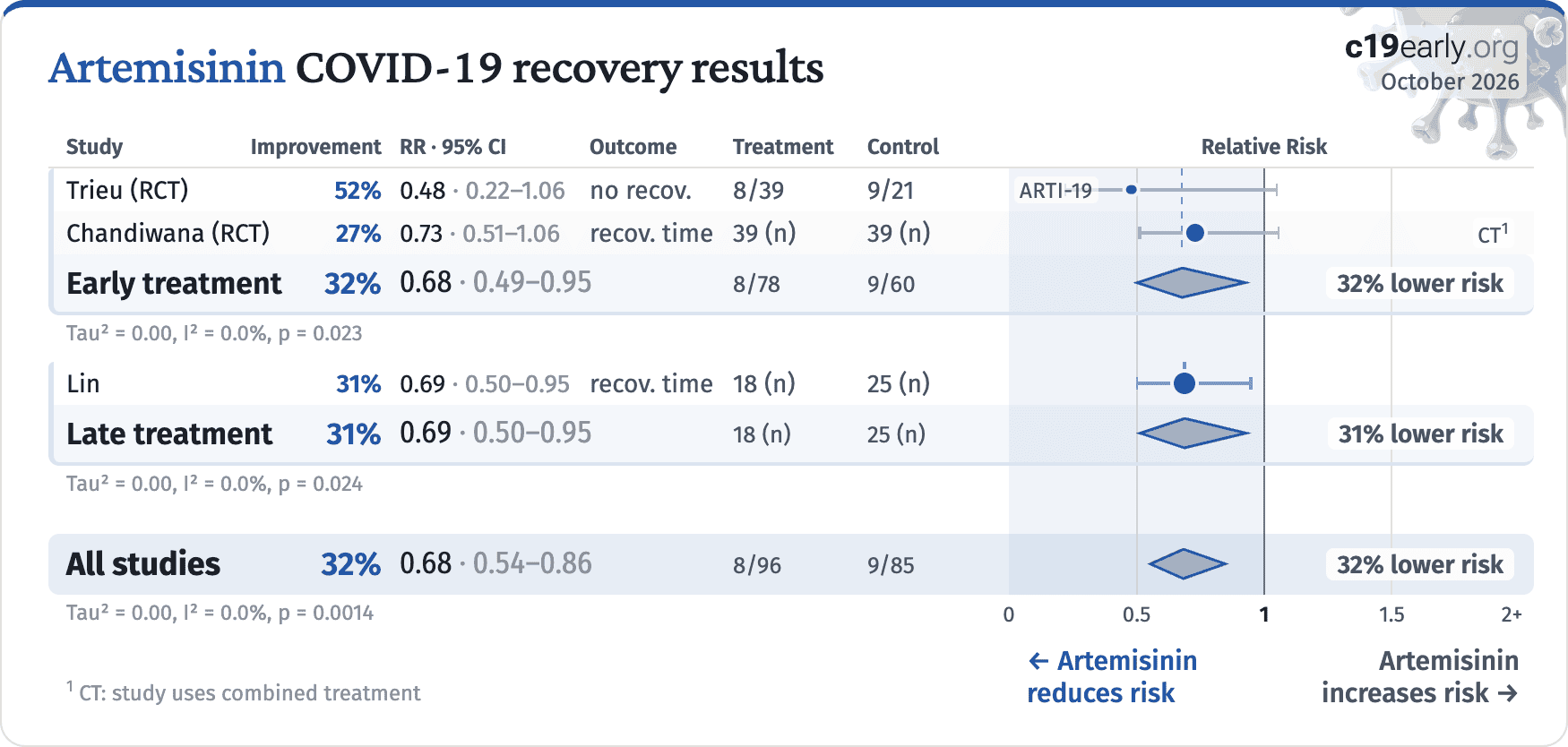
time to WHO zero score, 26.8% lower, HR 0.73, p = 0.10, treatment 39, control 39, both artesunate arms.
|
|
time to WHO zero score, 22.5% lower, HR 0.78, p = 0.33, treatment 39, control 39, inverted to make HR<1 favor treatment, ASAQ, Cox proportional hazards, Table S10.
|
|
time to WHO zero score, 31.0% lower, HR 0.69, p = 0.17, treatment 36, control 39, inverted to make HR<1 favor treatment, PA, Cox proportional hazards, Table S10.
|
|
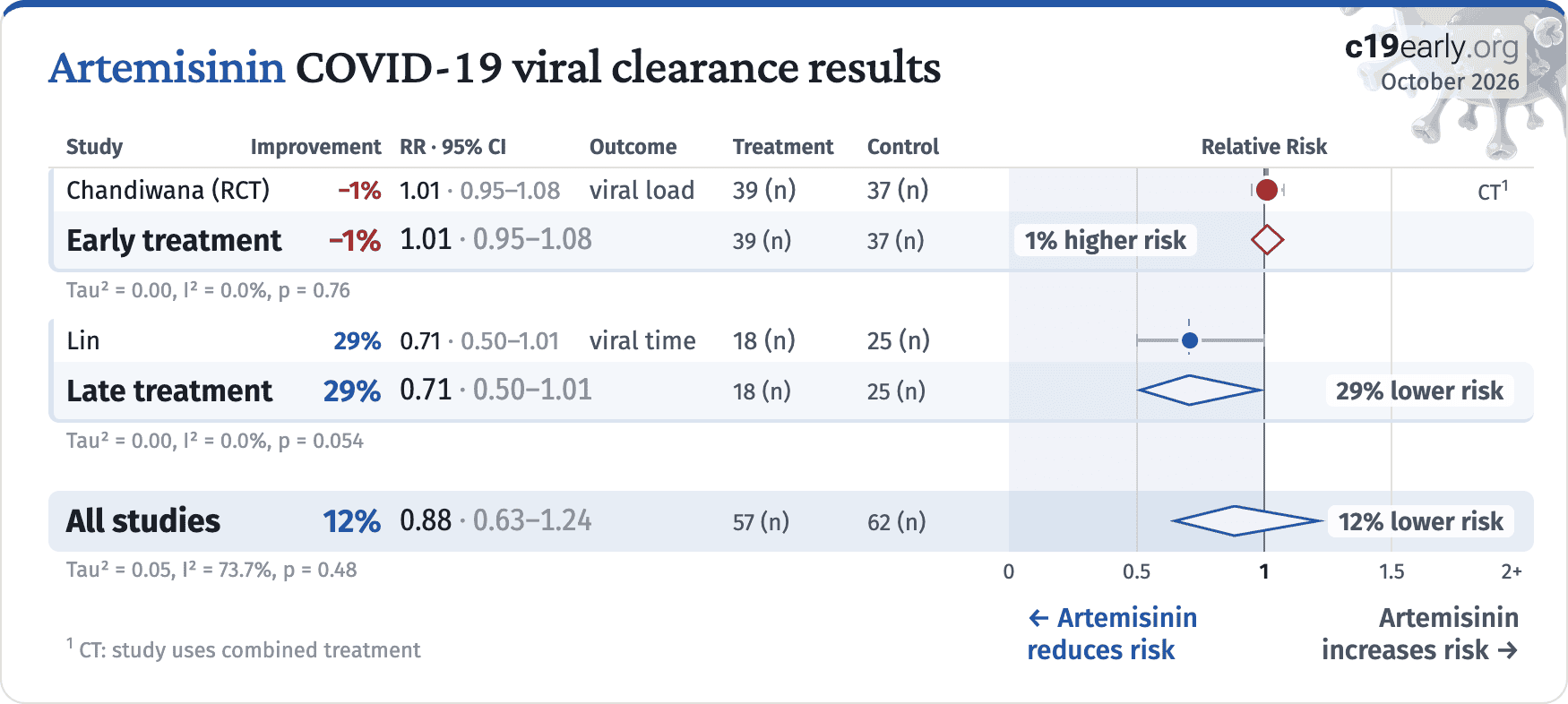
viral load, 1.1% higher, relative load 1.01, p = 0.76, treatment 39, control 37, both artesunate arms.
|
|
viral load, 4.6% higher, relative load 1.05, p = 0.02, treatment mean 3.25 (±0.26) n=39, control mean 3.4 (±0.27) n=37, ASAQ, day 14, Table S7.
|
|
viral load, 2.3% lower, relative load 0.98, p = 0.23, treatment mean 3.48 (±0.29) n=36, control mean 3.4 (±0.27) n=37, PA, day 14, Table S7.
|
|
risk of no viral clearance, 34.3% higher, RR 1.34, p = 0.18, treatment 39, control 38, adjusted per study, both artesunate arms.
|
|
risk of no viral clearance, 25.0% higher, RR 1.25, p = 0.48, treatment 24 of 39 (61.5%), control 25 of 38 (65.8%), adjusted per study, inverted to make RR<1 favor treatment, ASAQ.
|
|
risk of no viral clearance, 44.9% higher, RR 1.45, p = 0.25, treatment 23 of 33 (69.7%), control 25 of 38 (65.8%), adjusted per study, inverted to make RR<1 favor treatment, PA.
|
|
Trieu, 2/1/2021, Randomized Controlled Trial, India, preprint, median age 44.5, 7 authors, study period 8 October, 2020 - 21 November, 2020, trial CTRI/2020/09/028044 (ARTI-19).
|
risk of no recovery, 52.1% lower, RR 0.48, p = 0.08, treatment 8 of 39 (20.5%), control 9 of 21 (42.9%), NNT 4.5, day 5.
|
Effect extraction follows pre-specified rules as detailed above
and gives priority to more serious outcomes.
For pooled analyses, the first (most serious) outcome is used, which may
differ from the effect a paper focuses on.
Other outcomes are used in outcome specific analyses.
|
Fowler, 5/18/2024, Randomized Controlled Trial, Canada, trial NCT04330690 (history) (CATCO).
|
Estimated 966 patient RCT with results unknown and over 2 years late.
|
Gyanwali, 12/1/2022, Randomized Controlled Trial, Nepal, trial NCT05273242 (history).
|
Estimated 400 patient RCT with results unknown and over 3 years late.
|
|
Lin, 4/28/2020, retrospective, China, peer-reviewed, 9 authors.
|
recovery time, 31.2% lower, relative time 0.69, p = 0.02, treatment mean 3.33 (±1.91) n=18, control mean 4.84 (±2.19) n=25.
|
|
recovery time, 27.9% lower, relative time 0.72, p = 0.04, treatment mean 5.39 (±2.36) n=18, control mean 7.48 (±3.78) n=25, lung lesion absorption start.
|
|
recovery time, 17.2% lower, relative time 0.83, p = 0.03, treatment mean 14.11 (±4.16) n=18, control mean 17.04 (±4.42) n=25, lung lesion absorption greater than 70%.
|
|
hospitalization time, 8.2% lower, relative time 0.92, p = 0.22, treatment mean 16.56 (±3.71) n=18, control mean 18.04 (±3.97) n=25.
|
|
time to viral-, 29.3% lower, relative time 0.71, p = 0.05, treatment mean 4.72 (±2.16) n=18, control mean 6.68 (±3.76) n=25.
|