Global HCQ/CQ studies
November 9, 2026
@CovidAnalysis
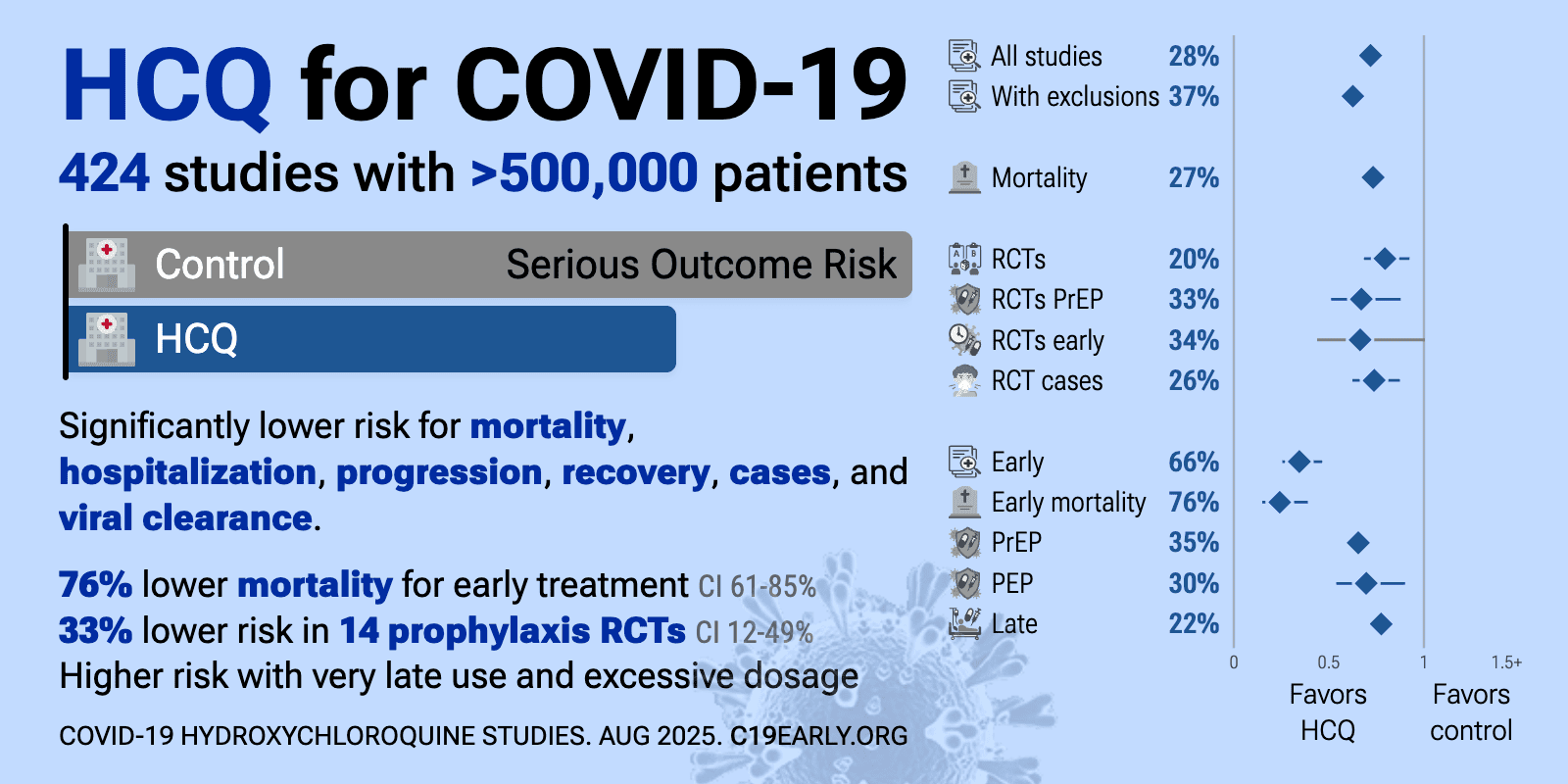
Late treatment and high dosages may be harmful, while early treatment and
prophylaxis shows lower risk.
The largest RCT from Oxford/MORU shows 57% lower symptomatic PCR+ cases,
p = 0.00024
1.
Negative evaluations typically ignore treatment delay.
Direct clinical measurement shows therapeutic levels are reached in the lung
2.
HCQ/CQ was
adopted
in 59 countries.
Recent:Pasquier Amal Strub-Wourgaft McCullough.
|
|
|
|
Covid Analysis |
Hydroxychloroquine reduces COVID-19 risk: real-time meta-analysis of 426 studies (c19hcq hcqmeta) (Version 316) |
|
Early treatment shows 66% [55‑75%] lower risk with pooled effects in 38 studies. Results are similar for higher quality studies and for peer-reviewed studies. The 17 mortality and 17 hospitalization results show 76% [61�.. |
|
Hazan et al., NCT04335084 |
A Randomized, Double-Blind, Placebo-Controlled Phase IIa Study of Hydroxychloroquine, Vitamin C, Vitamin D, and Zinc for the Prevention of COVID-19 Infection |
|
47% fewer cases (p=0.22).
RCT 172 medical workers in the USA shower lower COVID-19 cases with HCQ prophylaxis without statistical significance. All patients received vitamin C, vitamin D, and zinc. |
|
Sharma et al., Research Square, doi:10.21203/rs.3.rs-11342547/v1 |
Association of In-Hospital Antimalarial–Macrolide Therapy With 3–6-Month Cardiac Electrophysiological Outcomes in Survivors of Severe COVID-19: A Matched Retrospective Cohort Study |
|
Retrospective 86 severe COVID-19 survivors with 43 receiving combined HCQ/CQ plus azithromycin/clarithromycin treatment and 43 matched untreated patients, showing no significant difference in QTc prolongation or clinically significant arr.. |
|
Pasquier, D., Clinical and Translational Science, doi:10.1111/cts.70622 |
Preclinical and Clinical Evidence on Chloroquine or Hydroxychloroquine in Covid‐19 |
|
Discussion of preclinical and clinical evidence for CQ/HCQ in COVID-19. Author challenges claims that CQ/HCQ could not work in human respiratory cells, noting that TMPRSS2 is only co-expressed in ~20% of ACE2-carrying cells, with cathepsi.. |
|
Amal et al., European Journal of Clinical Pharmacology, doi:10.1007/s00228-026-04066-y |
Exploring the long-term hydroxychloroquine’s effects on COVID-19 outcomes in patients with autoimmune diseases: a systematic review and meta-analysis |
|
Meta analysis of 17 studies with 229,142 autoimmune patients treated with HCQ, showing significantly lower mortality with HCQ use. |
|
Moussa Saley et al., IJID Regions, doi:10.1016/j.ijregi.2026.100897 |
Home care for COVID-19 patients: Niger’s experience; about 2,037 cases in the city of Niamey |
|
Retrospective 2,037 COVID-19 outpatients in Niger receiving home-based care, showing a 95% recovery rate and 0.7% mortality. 98.7% received hydroxychloroquine and/or azithromycin treatment. Only 3.9% required hospitalization. |
|
Pinatel et al., Molecular Human Reproduction, doi:10.1093/molehr/gaag015 |
SARS-CoV-2 infects human primary cytotrophoblasts mainly through a non-canonical entry route |
|
In vitro study showing that human primary cytotrophoblasts are permissive to SARS-CoV-2 infection, with potential implications for antiviral treatment during pregnancy. Authors tested primary villous cytotrophoblasts isolated from term pl.. |
|
Ozhan et al., Scientific Reports, doi:10.1038/s41598-025-31048-4 |
Evaluation of the cardiopulmonary effects of repurposed COVID-19 therapeutics in healthy rats |
|
Animal study analyzing potential cardiopulmonary harm with molnupiravir (MOL), favipiravir (FAVI), hydroxychloroquine (HCQL), and dexamethasone (DEX) in healthy Wistar albino rats. In summary: Data suggests molnupiravir may have the highe.. |
|
Winters et al., Trials, doi:10.1186/s13063-025-09300-z |
Approval delays in multi-country COVID-19 trials: the case of COPCOV and the risk of therapeutic inertia |
|
Analysis of bureaucratic approval delays in the multi-country COVID-19 COPCOV trial, showing a median decision time of 104 days across 76 countries, despite expedited emergency review processes. The trial missed critical early COVID-19 wa.. |
|
Shang et al., Molecular & Cellular Proteomics, doi:10.1016/j.mcpro.2025.101314 |
Identification of Cathepsin L as the molecular target of hydroxychloroquine with chemical proteomics |
|
In vitro study showing that hydroxychloroquine (HCQ) inhibits SARS-CoV-2 variants through direct binding to cathepsin L (CTSL), with enhanced efficacy against Omicron BA.1 compared to Delta in VeroE6 and Huh7 cells. Authors developed a cl.. |
|
Abdel-Salam Elgohary et al., Scientific Reports, doi:10.1038/s41598-025-23660-1 |
Safety and efficacy of different therapeutic regimens in Egyptian adults with moderate COVID-19 infection (EVEREST): a real-world retrospective study |
|
Retrospective 310 hospitalized moderate COVID-19 patients showing shorter hospitalization and fewer progressive CT chest changes with antiviral combinations sofosbuvir/daclatasvir plus ivermectin, sofosbuvir/ledipasvir plus hydroxychloroq.. |
|
Pasquier, D., Nature Communications, doi:10.1038/s41467-025-60478-x |
On meta-analytic models and the effect of hydroxychloroquine use in COVID-19 |
|
Meta-analytic re-analysis of randomized COVID-19 trials (mortality in inpatients; hospitalization in outpatients) showing that hydroxychloroquine (HCQ) does not significantly increase inpatient mortality once Hartung-Knapp scale factors a.. |
|
Hobbs et al., Scientific Reports, doi:10.1038/s41598-025-09275-6 |
The PRINCIPLE randomised controlled open label platform trial of hydroxychloroquine for treating COVID19 in community based patients at high risk |
|
PRINCIPLE RCT 413 outpatients patients showing significantly faster recovery with HCQ. Publication was delayed over 5 years. Treatment was very late, with 25% of patients ≥10 days from onset. There was no significant difference for hospit.. |
|
Mothae et al., Virology, doi:10.1016/j.virol.2025.110607 |
SARS-CoV-2 host-pathogen interactome: insights into more players during pathogenesis |
|
Review of SARS-CoV-2 host-pathogen interactions during viral pathogenesis, focusing on protein-protein interactions that facilitate viral entry, replication, immune evasion, assembly, and release. Authors comprehensively analyze how SARS-.. |
|
Kulkarni-Munshi et al., Journal of Ayurveda and Integrative Medicine, doi:10.1016/j.jaim.2025.101135 |
Ashwagandha, Withania somnifera (L.) Dunal, for the prophylaxis against SARS-CoV-2 infection: A multicentric randomized hydroxychloroquine controlled clinical trial in Indian health care workers |
|
61% fewer cases (p=0.28).
RCT 400 healthcare workers in India comparing HCQ and withania somnifera (WS) for COVID-19 prophylaxis, showing 2 cases for HCQ and 5 for WS. Both treatments had comparable safety profiles, with mostly mild gastrointestinal adverse events. |
|
Yadav et al., American Journal of Respiratory and Critical Care Medicine, doi:10.1164/ajrccm.2025.211.Abstracts.A2672 |
Ultrastructural Alteration of Bronchoalveolar Lavage of COVID19 Induced Acute Respiratory Distress Syndrome Patients Reveals the Selective Cellular Infectivity, Impact of Hydroxy-Chloroquine, and Syncytial Formation in the Lung |
|
Ultrastructural examination of broncho-alveolar lavage from 79 intubated ARDS patients showing that prior HCQ prophylaxis correlated with markedly fewer intracellular virions, preserved airway cilia, and granulocytes packed with degrading.. |
|
Gkioulekas et al., The Japanese Journal of Antibiotics, doi:10.11553/antibiotics.78.1_35 |
Critical appraisal of multidrug therapy in the ambulatory management of patients with COVID-19 and hypoxemia Part II: Causal inference using the Bradford Hill criteria |
|
Critical appraisal of three case series totaling 119 COVID-19 patients with hypoxemia treated with ivermectin-based multidrug protocols in the United States, Zimbabwe, and Nigeria, showing reduced hospitalization and mortality. Authors ap.. |
|
Gkioulekas, Ph.D. et al., The Japanese Journal of Antibiotics, doi:10.11553/antibiotics.78.1_2 |
Critical appraisal of multidrug therapy in the ambulatory management of patients with COVID-19 and hypoxemia Part I. Evidence supporting the strength of association |
|
Critical appraisal of 119 COVID-19 hypoxemic patients treated with ivermectin-based multidrug protocols in the United States, Zimbabwe, and Nigeria, showing significant hospitalization rate reduction and mortality rate reduction compared .. |
|
Geçkalan et al., Journal of Health Sciences and Medicine, doi:10.32322/jhsm.1625339 |
Can hydroxychloroquine and azithromycin combination cause cardiac rhythm disturbances in children with COVID-19 pneumonia? |
|
Retrospective 24 pediatric COVID-19 pneumonia patients showing no cardiac rhythm disturbances or QTc prolongation with hydroxychloroquine and azithromycin combination therapy. |
|
Alqahtani et al., Journal of Clinical Medicine, doi:10.3390/jcm14061915 |
Outcomes of COVID-19 During the First Wave in Saudi Arabia: An Observational Study of ICU Cases from a Single Hospital |
|
134% higher mortality (p=0.03).
Retrospective 185 COVID-19 ICU patients in Saudi Arabia showing higher mortality with HCQ in unadjusted results, and no significant difference with azithromycin. |
|
He et al., Frontiers of Medicine, doi:10.1007/s11684-025-1123-9 |
Low dose of hydroxychloroquine is associated with reduced COVID-19 mortality: a multicenter study in China |
|
66% lower mortality (p<0.0001), 25% lower ventilation (p=0.05), 41% lower progression (p=0.21), and 31% improvement (p=0.005).
PSM retrospective 53,030 hospitalized patients in China showing low dose HCQ treatment associated with significantly lower all-cause mortality, mechanical ventilation, acute heart injury, and acute kidney injury, with benefits consistent .. |
|
Brouqui et al., Center for Open Science, doi:10.31219/osf.io/tc8hk_v2 |
Expression of concern regarding the notice of retraction of the article "Hydroxychloroquine and azithromycin as a treatment for COVID-19: results from an open-label, non-randomized clinical trial. |
|
Response to the retraction of [Gautret]. Authors note the study followed proper protocols and that concerns about patient enrollment timing, control group selection, and PCR interpretation methods do not justify retraction. Authors note .. |
|
Monsalve et al., Journal of Translational Autoimmunity, doi:10.1016/j.jtauto.2025.100280 |
NETosis: A key player in autoimmunity, COVID-19, and long COVID |
|
Review of neutrophil extracellular traps (NETs) and their role in autoimmunity, COVID-19, and long COVID. Authors explain that NETosis is a process where neutrophils release web-like structures (NETs) containing DNA, proteases, and enzyme.. |
|
Patel et al., RMD Open, doi:10.1136/rmdopen-2024-005114 |
Patients with systemic autoimmune rheumatic diseases remain at risk for hospitalisation for COVID-19 infection in the Omicron era (2022–2024): a retrospective cohort study |
|
43% lower hospitalization (p=0.03) and 51% lower severe cases (p=0.06).
Retrospective 2,061 systemic autoimmune rheumatic disease patients showing lower risk of COVID-19 hospitalization with antimalarial therapy (HCQ/CQ) compared with patients not on immunomodulatory treatment. Authors split the patients not .. |
|
Dinoi et al., Biomedicines, doi:10.3390/biomedicines13030535 (date from preprint) |
Retrospective Clinical Investigation into the Association Between Abnormal Blood Clotting, Oral Anticoagulant Therapy, and Medium-Term Mortality in a Cohort of COVID-19 Patients |
|
48% lower mortality (p=0.06).
Retrospective 247 non-survivors and 247 matched survivors in hospitalized COVID-19 patients in Italy showing results for several treatments. |
|
He et al., IJC Heart & Vasculature, doi:10.1016/j.ijcha.2024.101574 |
Clinical characteristics and risk factors for in-hospital mortality of COVID-19 patients in Hubei Province: A multicenter retrospective study |
|
53% lower mortality (p<0.0001).
Retrospective 53,030 COVID-19 patients from 138 hospitals in Hubei, China showing lower mortality with metformin. |
|
Xie et al., Cellular & Molecular Biology Letters, doi:10.1186/s11658-024-00659-6 |
The role of reactive oxygen species in severe acute respiratory syndrome coronavirus 2 (SARS-COV-2) infection-induced cell death |
|
Review of the effects of reactive oxygen species (ROS) on cell death pathways in SARS-CoV-2 infection. SARS-CoV-2 induces oxidative stress and ROS generation which can lead to several types of regulated cell death including NETosis, ferro.. |
|
Sundaresh et al., Ophthalmology Journal, doi:10.5603/oj.93780 |
Ocular safety of hydroxychloroquine when used as prophylaxis against COVID-19 in healthcare workers at a tertiary care center in India |
|
Analysis of 61 healthcare workers in India showing no significant correlation between short-term high-dose hydroxychloroquine use for COVID-19 prophylaxis and adverse effects on color vision, contrast sensitivity, macular thickness, retin.. |
|
Kim et al., Scientific Reports, doi:10.1038/s41598-024-76871-3 |
One-year mortality and associated factors in older hospitalized COVID-19 survivors: a Nationwide Cohort Study in Korea |
|
15% lower mortality (p=0.62).
Retrospective 63,369 hospitalized COVID-19 survivors aged 60 years or older in Korea, showing lower 1-year mortality with macrolides (including azithromycin), higher 1-year mortality with corticosteroids (including dexamethasone and.. |
|
Wang et al., Expert Review of Anti-infective Therapy, doi:10.1080/14787210.2024.2413419 |
The efficacy and safety of hydroxychloroquine at different doses and courses for COVID-19 prevention: a systematic review and network meta-analysis |
|
Meta-analysis of 20 RCTs with 12,372 participants showing lower SARS-CoV-2 cases with HCQ without statistical significance overall, but with significance for 200-400mg daily, and for 5-8 weeks duration. Authors note that only 23 of 263 re.. |
|
Gkioulekas et al., Tasman Medical Journal, 6:4 |
Use of hydroxychloroquine in multidrug protocols for SARS-CoV-2 |
|
Review of the use of HCQ in multidrug protocols for SARS-CoV-2 treatment. Authors report that HCQ played an important role in preventing hospitalizations and deaths due to COVID-19, particularly in 2020 with more virulent strains. They di.. |
|
Gortler et al., Brownstone Journal |
Those Published “17,000 Hydroxychloroquine Deaths” Never Happened |
|
Review of a retracted study that claimed hydroxychloroquine (HCQ) for COVID-19 caused 17,000 deaths. Author highlights that the study was based on unreliable data and contradicted the well-established safety profile of HCQ. The article cr.. |
|
Schilling et al., PLOS Medicine, doi:10.1371/journal.pmed.1004428 |
Evaluation of hydroxychloroquine or chloroquine for the prevention of COVID-19 (COPCOV): A double-blind, randomised, placebo-controlled trial |
|
57% fewer symptomatic cases (p=0.0002).
RCT 4,652 low-risk participants, published days after completion, showing 57% lower PCR confirmed COVID-19 cases with HCQ/CQ prophylaxis, p = 0.00024. This was the original primary outcome of the trial and is the most reliable result. As.. |
|
Boretti et al., Coronaviruses, doi:10.2174/0126667975327612240902104505 |
Correct Use of HCQ Did Not Cause Extra Fatalities in COVID-19 Infection |
|
Critical analysis challenging a recent meta-analysis claiming hydroxychloroquine (HCQ) use caused excess deaths in COVID-19 treatment. The authors argue the meta-analysis relied on flawed data, ignored positive evidence, and failed to acc.. |
|
Gortler et al., Brownstone Journal |
Trump’s 63 Million Doses of Hydroxychloroquine Could Have Been Great for America |
|
Review of the safety and efficacy of HCQ for the treatment and prevention of COVID-19, with a focus on the political and media landscape surrounding its use. Author reports that the FDA's decision to revoke HCQ's emergency use authorizati.. |
|
Rutskaya-Moroshan et al., Medicina, doi:10.3390/medicina60091377 |
Clinical Characteristics, Prognostic Factors, and Outcomes of COVID-19 in Autoimmune Rheumatic Disease Patients: A Retrospective Case–Control Study from Astana, Kazakhstan |
|
38% lower severe cases (p=1) and 24% lower hospitalization (p=1).
Retrospective case-control study of 140 COVID-19 patients with autoimmune rheumatic diseases (AIRDs) and 140 matched controls showing higher rates of hospitalization, oxygen therapy, and mechanical ventilation with AIRDs. For the AIRD pat.. |
|
Azimi Pirsaraei et al., Cureus, doi:10.7759/cureus.66798 |
Anticoagulant Use in COVID-19 Patients: A Longitudinal Study From Zanjan, Iran |
|
39% lower mortality (p=0.16).
Retrospective 831 hospitalized COVID-19 patients showing lower mortality with HCQ in unadjusted results, without statistical significance. |
|
Enyeji et al., Viral Immunology, doi:10.1089/vim.2024.0034 |
Effective Treatment of COVID-19 Infection with Repurposed Drugs: Case Reports |
|
Review of the successful treatment of COVID-19 using existing medications including HCQ, AZ, ivermectin, famotidine, monoclonal antibodies, and others. Authors note that the typical treatment of severe viral infections with multiple thera.. |
|
Brouqui et al., Acta Scientific Microbiology, doi:10.31080/ASMI.2024.07.1413 |
SARS-CoV 2 Viral Clearance in 1276 Patients: Associated Factors and the Role of Treatment with Hydroxychloroquine and Azithromycin |
|
15% improved viral clearance (p=0.04).
Retrospective 1,276 hospitalized patients showing significantly faster viral clearance with HCQ. Authors also perform a meta-analysis of 9 studies, with 1,461 HCQ-treated patients and 958 controls, showing significantly faster viral clear.. |
|
Asaba et al., Journal of Inflammation Research, doi:10.2147/jir.s474707 |
Interplay of TLR4 and SARS-CoV-2: Unveiling the Complex Mechanisms of Inflammation and Severity in COVID-19 Infections |
|
Review suggesting that the SARS-CoV-2 spike protein interacts with TLR4 to induce hyperinflammation and severe COVID-19. The spike protein binds TLR4 with high affinity, triggering inflammatory signaling cascades. SARS-CoV-2 infection may.. |
|
Azalbert et al., Archives of Microbiology & Immunology, doi:10.26502/ami.936500179 |
Erroneous Assessment of The Effect of Hospital Treatment – The Misleading Creation of 17000 Deaths and its Consequences for Good Medical Practice |
|
Critical analysis showing erroneous conclusions from a flawed mathematical model estimating excess deaths due to HCQ use for COVID-19 during the first wave. The model used an odds ratio based mainly on studies with excessively high HCQ do.. |
|
Değirmenci et al., Journal of Controversies in Obstetrics & Gynecology and Pediatrics, doi:10.51271/JCOGP-0035 |
Is vitamin D level important in pregnant women with COVID-19? |
|
43% lower hospitalization (p=0.76).
Retrospective 125 pregnant women hospitalized with COVID-19 in Turkey, showing no significant difference in hospitalization length with HCQ, and longer hospitalization with lopinavir/ritonavir use. |
|
Hitti et al., Immunology, doi:10.1111/imm.13835 |
Hydroxychloroquine attenuates double-stranded RNA-stimulated hyper-phosphorylation of tristetraprolin/ZFP36 and AU-rich mRNA stabilization |
|
In vitro study showing that HCQ reduces inflammation by inhibiting the double-stranded RNA-stimulated phosphorylation of tristetraprolin (TTP) and decreasing the stability of AU-rich mRNAs. This suggests that HCQ could mitigate excessive .. |
|
Dey et al., Journal of College of Medical Sciences-Nepal, doi:10.3126/jcmsn.v20i2.43302 |
Hydroxy Chloroquine Prophylaxis Experience in Doctor Community with COVID-19 in West Bengal |
|
92% lower mortality (p=0.09), 27% fewer moderate/severe cases (p=0.39), and 16% lower hospitalization (p=0.55).
Retrospective 117 COVID-19 positive doctors in India showing lower mortality and severity with HCQ prophylaxis, without statistical significance in unadjusted results without group details. Results do not include the risk of positive cases. |
|
Pejler et al., Journal of Allergy and Clinical Immunology, doi:10.1016/j.jaci.2024.05.031 |
Blockade of endolysosomal acidification suppresses TLR3-mediated pro-inflammatory signaling in airway epithelial cells |
|
In vitro study showing that blocking endolysosomal acidification with bafilomycin A1, monensin, or niclosamide suppresses TLR3-mediated pro-inflammatory signaling in human small airway epithelial cells (HSAECs) stimulated with TLR3 agonis.. |
|
Yan et al., ChemBioChem, doi:10.1002/cbic.202400404 |
Super-resolution imaging reveals the mechanism of endosomal acidification inhibitors against SARS-CoV-2 infection |
|
In vitro study showing that endosomal acidification inhibitors like HCQ minimize SARS-CoV-2 infection by blocking viral internalization and RNA release in cells expressing ACE2. Authors utilized super-resolution structured illumination mi.. |
|
Thorp et al., Integrative Medicine, 23:2 |
Global COVID-19 Pandemic Outcomes: A Cross-Country Comparison Study of Policy Strategies |
|
Retrospective study of 108 countries showing negative correlations between hydroxychloroquine/ivermectin use and mortality. Higher ivermectin index scores (r=-0.23, p=0.018) and hydroxychloroquine index scores (r=-0.15, p=0.125) were corr.. |
|
Han et al., Journal of Thoracic Disease, doi:10.21037/jtd-23-1043 |
The efficacy and safety of hydroxychloroquine for COVID-19 prophylaxis and clinical assessment: an updated meta-analysis of randomized trials |
|
Meta analysis of 9 RCTs with 7,825 participants showing significantly lower COVID-19 cases with HCQ prophylaxis. Authors only cover the period until January 2022. The very long publication delay may be due to the reported difficulty publi.. |
|
Scheim et al., Viruses, doi:10.3390/v16040647 |
Back to the Basics of SARS-CoV-2 Biochemistry: Microvascular Occlusive Glycan Bindings Govern Its Morbidities and Inform Therapeutic Responses |
|
Review of the biochemical underpinnings of the severe morbidities of COVID-19, focusing on the binding of the SARS-CoV-2 spike protein (SP) to sialylated glycans on host cell surfaces. Authors highlight how the SP attaches particularly ti.. |
|
Strub-Wourgaft et al., ANTICOV |
An open-label, multicentre, randomised, adaptive platform trial of the safety and efficacy of several therapies, including antiviral therapies, versus control in mild/moderate cases of COVID-19 |
|
91% lower progression (p=1) and 93% lower hospitalization (p=0.62).
RCT 1,942 patients testing HCQ, lopinavir/ritonavir, nitazoxanide/ciclesonide, ivermectin/ASAQ, and fluoxetine/budesonide compared wirth paracetamol. Control patients were assigned to paracetamol as needed for fever or pain, however treat.. |
|
Azhar et al., Pakistan Journal of Medical Sciences, doi:10.12669/pjms.40.5.8757 |
Effectiveness of early pharmaceutical interventions in symptomatic COVID-19 patients: A randomized clinical trial |
|
71% lower mortality (p=0.03), 4% greater improvement (p=0.64), and 10% improved viral clearance (p=0.52).
RCT 471 mild COVID-19 patients in Pakistan showing no significant differences in clinical improvement and viral clearance between HCQ, azithromycin, oseltamivir, and combinations. Mortality was significantly lower in HCQ vs. non-HCQ arms... |
|
Lounnas et al., Archives of Microbiology & Immunology, doi:10.26502/ami.936500153 |
An Independent Analysis of a Retrospective Cohort of 30,423 Covid-19 Patients Treated at IHU-Mediterranean in Marseille, France: Part 1, Efficacy of early Treatment with Hydroxychloroquine and Azithromycin |
|
58% lower combined mortality/ICU admission (p<0.0001).
Independent analysis of the IHU-Mediterranean data [Brouqui] with 30,423 COVID-19 patients showing significantly lower risk of ICU admission or death with early treatment of hydroxychloroquine plus azithromycin (HCQ-AZ), and with azithrom.. |
|
Kumar et al., Cells, doi:10.3390/cells13050369 |
Pre-Infection Innate Immunity Attenuates SARS-CoV-2 Infection and Viral Load in iPSC-Derived Alveolar Epithelial Type 2 Cells |
|
In vitro study showing interindividual variability in iPSC-derived alveolar epithelial type 2 cells' susceptibility to SARS-CoV-2 infection and postinfection viral load. Results indicate AT2s mount an antiviral interferon response, though.. |
|
González-Paz et al., ACS Omega, doi:10.1021/acsomega.3c06968 |
Biophysical Analysis of Potential Inhibitors of SARS-CoV-2 Cell Recognition and Their Effect on Viral Dynamics in Different Cell Types: A Computational Prediction from In Vitro Experimental Data |
|
In silico study showing that nafamostat, camostat, chloroquine, hydroxychloroquine, telmisartan, and captopril may be beneficial for COVID-19 by inhibiting SARS-CoV-2 cell entry and replication in multiple cell types expressing ACE2 and T.. |
|
Liu et al., Lupus, doi:10.1177/09612033241230736 |
Factors affecting different COVID-19 outcomes in patients with systemic lupus erythematosus during the second pandemic wave of COVID-19 in China |
|
39% lower severe cases (p=0.26).
Retrospective 301 consecutive SLE patients with COVID-19, showing lower risk of severe outcomes with HCQ use, with statistical significance in multivariable adjusted model 1 but not model 2. |
|
Donida et al., BMC Infectious Diseases, doi:10.1186/s12879-024-09034-4 |
First COVID-19 wave in the province of Bergamo, Italy: epidemiological and clinical characteristics, outcome and management of the first hospitalized patients |
|
47% lower mortality (p=0.1).
Retrospective 723 hospitalized COVID-19 patients in Italy showing lower mortality with antirheumatic disease therapy, without statistical significance. Authors do not specify what medications are included, only mentioning HCQ/CQ which may.. |
|
Fincham et al., BMC Medical Research Methodology, doi:10.1186/s12874-023-02110-4 |
Exploring trial publication and research waste in COVID-19 randomised trials of hydroxychloroquine, corticosteroids, and vitamin D: a meta-epidemiological cohort study |
|
Analysis of 357 HCQ, vitamin D, and corticosteroid COVID-19 RCTs registered before the end of 2021, showing that 70% had not published results as of October 2022. 70% of HCQ, 65% of vitamin D, and 72% of corticosteroid trials had not publ.. |
|
Chouhdari et al., Social Determinants of Health, doi:10.22037/sdh.v10i1.43032 |
The prophylactic effect of hydroxychloroquine on the severity of COVID-19 infection in an asymptomatic population: A randomized clinical trial |
|
80% lower hospitalization (p=0.25) and 43% fewer cases (p=0.005).
RCT of 1,000 people showing lower risk of COVID-19 infection with HCQ prophylaxis. There was no significant difference in side effects or adherence, no severe side effects, and blinding was well maintained. There are now PrEP RCTs, showi.. |
|
AlShehhi et al., PLOS ONE, doi:10.1371/journal.pone.0291373 |
Utilizing machine learning for survival analysis to identify risk factors for COVID-19 intensive care unit admission: A retrospective cohort study from the United Arab Emirates |
|
43% lower ICU admission (p=0.001).
Retrospective 1,787 hospitalized COVID-19 patients in the United Arab Emirates, identifying hydroxychloroquine as reducing the risk of ICU admission in a machine learning model. Only unadjusted quantitative results are provided, which als.. |
|
Pradelle et al., Biomedicine & Pharmacotherapy, doi:10.1016/j.biopha.2023.116055 |
RETRACTED: Deaths induced by compassionate use of hydroxychloroquine during the first COVID-19 wave: an estimate |
|
This study was retracted due to unreliable data and invalid assumptions. Highly flawed analysis using an incorrect estimate of mortality from [Axfors] [Axfors] assign 89% weight to the RECOVERY and SOLIDARITY trials, producing the same r.. |
|
Mehrizi et al., Frontiers in Public Health, doi:10.3389/fpubh.2023.1280434 |
Drug prescription patterns and their association with mortality and hospitalization duration in COVID-19 patients: insights from big data |
|
26% lower mortality (p<0.0001).
Retrospective study of 917,198 hospitalized COVID-19 cases covered by the Iran Health Insurance Organization over 26 months showing that antithrombotics, corticosteroids, and antivirals reduced mortality while diuretics, antibiotics, and.. |
|
Salesi et al., Immunopathologia Persa, doi:10.34172/ipp.2023.40568 |
Clinical signs, symptoms, and severity of COVID-19 in patients with rheumatic diseases during the COVID-19 epidemic |
|
85% lower severe cases (p=0.003) and 18% fewer moderate/severe cases (p=0.35).
Retrospective study of 77 outpatients with rheumatic diseases diagnosed with COVID-19, showing lower risk of severe COVID-19 with HCQ use in unadjusted results. |
|
Huang et al., Journal of Translational Autoimmunity, doi:10.1016/j.jtauto.2023.100227 |
Effect of traditional therapeutics on prevalence and clinical outcomes of coronavirus disease 2019 in Chinese patients with autoimmune diseases |
|
43% lower hospitalization (p=0.09) and 6% more cases (p=0.25).
Retrospective 432 autoimmune disease patients in China showing lower hospitalization with HCQ without statistical significance (OR 0.566, p=0.085) in unadjusted results, slightly higher COVID-19 cases without statistical significance, and.. |
|
Rabe et al., BMJ Open, doi:10.1136/bmjopen-2022-071072 |
Impact of SARS-CoV-2 infection on patients with systemic lupus erythematosus in England prior to vaccination: a retrospective observational cohort study |
|
29% fewer cases (p=0.22).
Retrospective cohort of 6,145 SLE patients showing lower incidence of COVID-19 for patients receiving HCQ/CQ (antimalarials), without statistical significance. Groups were not matched and results may be influenced by factors such as disea.. |
|
Soltani et al., The Journal of Tehran University Heart Center, doi:10.18502/jthc.v18i3.14114 |
The Association between Acute Cardiac Injury and Outcomes of Hospitalized Patients with COVID-19: Long-term Follow-up Results from the Sina Hospital COVID-19 Registry, Iran |
|
Retrospective 1,413 hospitalized COVID-19 patients evaluating the association between acute cardiac injury (ACI) and outcomes. Authors include a multivariable analysis showing lower risk of ACI with HCQ and higher risk with remdesivir, wi.. |
|
Flynn et al., Biology Methods and Protocols, doi:10.1093/biomethods/bpad033 |
Crowdsourcing Temporal Transcriptomic Coronavirus Host Infection Data: resources, guide, and novel insights |
|
Ensemble transcriptomic analyses showing that HCQ exhibited strong inverse correlations to SARS-CoV-1 infected lung early temporal meta-signatures at 1, 2, and 4 days post-infection. This suggests HCQ may help counteract pathogenic proces.. |
|
Varan et al., Adıyaman Üniversitesi Sağlık Bilimleri Dergisi, doi:10.30569/adiyamansaglik.1313270 |
Effects of hydroxychloroquine and azithromycin use on ECG parameters due to COVID-19 in pediatric patient population |
|
Safety analysis with 23 pediatric COVID-19 patients examining the effects of hydroxychloroquine (HCQ), with or without azithromycin (AZ), on electrocardiogram (ECG) parameters. Most patients were mildly symptomatic or asymptomatic. Baseli.. |
|
Scirocco et al., Lupus Science & Medicine, doi:10.1136/lupus-2023-000945 |
COVID-19 prognosis in systemic lupus erythematosus compared with rheumatoid arthritis and spondyloarthritis: results from the CONTROL-19 Study by the Italian Society for Rheumatology |
|
41% lower combined mortality/intubation (p=0.38).
Retrospective 103 SLE and 524 RA patients in Italy, showing significantly lower mortality/ventilation with HCQ use for SLE patients, and no significant difference for RA patients in unadjusted results. Authors did not include HCQ in multi.. |
|
Souza-Silva et al., Arquivos Brasileiros de Cardiologia, doi:10.36660/abc.20220935 |
Dados de Vida Real sobre o Uso da Hidroxicloroquina ou da Cloroquina Combinadas ou Não à Azitromicina em Pacientes com Covid-19: Uma Análise Retrospectiva no Brasil |
|
5% higher mortality (p=0.68), 21% higher ventilation (p=0.08), 9% higher ICU admission (p=0.31), and 12% longer hospitalization (p=0.03).
Retrospective 7,580 hospitalized patients in Brazil, showing longer hospitalization, and no significant difference in mortality, mechanical ventilation, and ICU admission with HCQ treatment. Authors note confounding by indication due to s.. |
|
Meeus et al., New Microbes and New Infections, doi:10.1016/j.nmni.2023.101172 |
Efficacy and safety of in-hospital treatment of Covid-19 infection with low-dose hydroxychloroquine and azithromycin in hospitalized patients: A retrospective controlled cohort study |
|
36% lower mortality (p=0.005).
Retrospective 352 hospitalized COVID-19 patients in Belgium and 3,533 control patients from the contemporaneous Belgian Collaborative Group, showing significantly lower mortality with HCQ treatment. The survival benefit was consistent in .. |
|
Burhan et al., PLOS ONE, doi:10.1371/journal.pone.0290964 |
Characteristics and outcomes of patients with severe COVID-19 in Indonesia: Lessons from the first wave |
|
1% higher mortality (p=0.91).
Retrospective 559 COVID-19 ICU patients in Indonesia, showing no difference in mortality with HCQ in unadjusted results. |
|
Ali et al., Journal of Clinical Medicine, doi:10.3390/jcm12186079 |
SARS-CoV-2 Syncytium under the Radar: Molecular Insights of the Spike-Induced Syncytia and Potential Strategies to Limit SARS-CoV-2 Replication |
|
Review of the molecular mechanisms of SARS-CoV-2 spike-induced syncytia formation and potential anti-fusogenic therapeutic strategies. The SARS-CoV-2 spike protein interacts with the ACE2 receptor on adjacent cells, triggering abnormal fu.. |
|
Mohd Abd Razak et al., Natural Product Communications, doi:10.1177/1934578X231188861 |
In Vitro Anti-SARS-CoV-2 Activities of Curcumin and Selected Phenolic Compounds |
|
In vitro study showing that of 9 phenolic compounds tested, only curcumin inhibited SARS-CoV-2 cytopathic effects in infected monkey kidney Vero E6 cells. Curcumin showed antiviral activity against wildtype, alpha, delta, and omicron vari.. |
|
Hidekawa et al., Frontiers in Immunology, doi:10.3389/fimmu.2023.1227403 |
Protective effect of hydroxychloroquine on infections in patients with systemic lupus erythematosus: an observational study using the LUNA registry |
|
68% lower hospitalization (p=0.007).
Non-COVID-19 study showing significantly lower risk of severe infections with HCQ among 925 SLE patients. Infections included pulmonary, urinary tract, skin and soft tissue, intra-abdominal, gastroenteritis, sepsis, infectious arthritis, .. |
|
Zhou et al., BMJ Open Respiratory Research, doi:10.1136/bmjresp-2023-001674 |
Repurposed drug studies on the primary prevention of SARS-CoV-2 infection during the pandemic: systematic review and meta-analysis |
|
Meta analysis with many errors/limitations/biases, including many missing studies, use of unadjusted results, use of non-symptomatic results, and use of all-cause instead of COVID-19 hospitalization. For HCQ, there are , including . Note .. |
|
Alkafaas et al., Virology Journal, doi:10.1186/s12985-023-02160-6 |
A study on the effect of natural products against the transmission of B.1.1.529 Omicron |
|
Review of natural products for SARS-CoV-2 omicron including an in silico study showing quercetin, curcumin, ascorbic acid, nigellidine, and chloroquine among many compounds docked to the ACE2 metallopeptidase domain. Quercetin, curcumin, .. |
|
Shu-Han Lin et al., Journal of Microbiology, Immunology and Infection, doi:10.1016/j.jmii.2023.08.001 |
Inhalable Chitosan-Based Hydrogel as a Mucosal Adjuvant for Hydroxychloroquine in the Treatment for SARS-CoV-2 Infection in a Hamster Model |
|
Hamster study showing intranasal administration of HCQ + chitosan oligosaccharide (COS) resulted in higher HCQ concentrations in the lungs compared to HCQ alone, suggesting COS enhanced lung absorption of HCQ. COS + HCQ led to earlier and.. |
|
Alsmadi et al., AAPS PharmSciTech, doi:10.1208/s12249-023-02627-3 |
The In Vitro, In Vivo, and PBPK Evaluation of a Novel Lung-Targeted Cardiac-Safe Hydroxychloroquine Inhalation Aerogel |
|
Analysis of a novel inhaled formulation of HCQ showing sustained drug release, higher lung bioavailability, longer residence time, faster absorption, and lower cardiac enzyme levels compared to oral HCQ. Inhaled formulations may help prev.. |
|
Chaudhary et al., Scientific Reports, doi:10.1038/s41598-023-39941-6 |
Impact of prophylactic hydroxychloroquine on ultrastructural impairment and cellular SARS-CoV-2 infection in different cells of bronchoalveolar lavage fluids of COVID-19 patients |
|
Ex vivo analysis of HCQ showing preferential protection for early target cell types in the lung, consistent with the increased efficacy seen with early treatment. Authors analyze various cell types in bronchoalveolar lavage fluid from COV.. |
|
Afşin et al., Acta Clinica Croatica, doi:10.20471/acc.2023.62.01.13 |
Factors affecting prognosis and mortality in severe COVID-19 pneumonia patients |
|
17% lower mortality (p=0.5).
Retrospective 80 hospitalized severe COVID-19 patients in Turkey, showing no significant difference with HCQ treatment in unadjusted results. All patients received favipiravir. |
|
Ganesh et al., CMAJ Open, doi:10.9778/cmajo.20220248 |
Patient-reported outcomes of neurologic and neuropsychiatric symptoms in mild COVID-19: a prospective cohort study |
|
37% improvement (p=0.15).
Long term neurologic and neuropsychiatric followup for a 7 day delayed treatment RCT showing lower risk of symptoms with treatment, without statistical significance. When a patient reported a symptom, they were asked whether they were sti.. |
|
Wen et al., Journal of Molecular Cell Biology, doi:10.1093/jmcb/mjad048 |
Cholinergic α7 nAChR signaling suppresses SARS-CoV-2 infection and inflammation in lung epithelial cells |
|
In vitro and mouse study showing that activating α7 nAChR with the agonist GTS-21 reduced oxidative stress and inflammation, and reduced live virus infection in lung epithelial cells. The results provide some mechanistic insight into how .. |
|
Shamsi et al., Canadian Journal of Infectious Diseases and Medical Microbiology, doi:10.1155/2023/5205188 |
Survival and Mortality in Hospitalized Children with COVID-19: A Referral Center Experience in Yazd, Iran |
|
39% higher mortality (p=0.51).
Retrospective 183 hospitalized pediatric COVID-19 patients in Iran, showing no significant difference in mortality with in unadjusted results. |
|
Kamga Kapchoup et al., Frontiers in Pharmacology, doi:10.3389/fphar.2023.1128382 |
In vitro effect of hydroxychloroquine on pluripotent stem cells and their cardiomyocytes derivatives |
|
In vitro study of HCQ with mouse and human pluripotent stem cells and their cardiomyocyte derivatives. Results suggest HCQ has differential dose-dependent effects in mouse vs. human stem cell-derived cardiomyocytes. At lower concentration.. |
|
Klebanov et al., Journal of Drugs in Dermatology, doi:10.36849/jdd.6593 |
Antimalarials are not Effective as Pre-Exposure Prophylaxis for COVID-19: A Retrospective Matched Control Study |
|
31% lower mortality (p=0.8) and 6% more cases (p=0.7).
Retrospective 3,074 patients with antimalarial prescriptions and 58,955 matched controls, showing no significant differences with antimalarial prophylaxis for PCR+ cases (99% HCQ). Authors provide only PCR+ and mortality outcomes, and do .. |
|
Finkelstein et al., Studies in Health Technology and Informatics, doi:10.3233/SHTI230489 |
The Efficacy of Long-Term Hydroxychloroquine Use in the Prevention of COVID-19: A Retrospective Cohort Study |
|
21% fewer cases (p=0.0007).
PSM retrospective SLE/RA patients in the USA, showing lower COVID-19 cases with HCQ prophylaxis. |
|
Milan Bonotto et al., Antiviral Research, doi:10.1016/j.antiviral.2023.105655 |
Cathepsin inhibitors nitroxoline and its derivatives inhibit SARS-CoV-2 infection |
|
In vitro study showing that CatB inhibitors including nitroxoline and its derivatives significantly impair SARS-CoV-2 infection. Authors use HCQ as a control. HCQ can indirectly inhibit CatB by elevating the pH of endosomes. Other researc.. |
|
Brouqui et al., New Microbes and New Infections, doi:10.1016/j.nmni.2023.101155 |
There is no such thing as a Ministry of Truth and why it is important to challenge conventional “wisdom” - A personal view |
|
Discussion of censorship in scientific journals and the media; fraudulent, false, and misleading information used to justify censorship and the termination of trials; harassment of highly cited and respected researchers reporting life-sav.. |
|
Cárdenas-Jaén et al., Gastroenterología y Hepatología (English Edition), doi:10.1016/j.gastre.2023.05.002 |
Gastrointestinal symptoms and complications in patients hospitalized due to COVID-19, an international multicentre prospective cohort study (TIVURON project) |
|
56% lower severe cases (p=0.13).
Retrospective 829 hospitalized COVID-19 patients in Spain focused on gastrointestinal symptoms, showing lower risk of severe COVID-19 with HCQ treatment in bivariate analysis, without statistical significance. |
|
de Gonzalo-Calvo et al., Respiratory Research, doi:10.1186/s12931-023-02462-x |
A blood microRNA classifier for the prediction of ICU mortality in COVID-19 patients: a multicenter validation study |
|
38% lower mortality (p=0.23).
Retrospective 491 ICU patients in Spain showing lower mortality with HCQ without statistical significance in unadjusted results. |
|
Hong et al., BMJ Open, doi:10.1136/bmjopen-2022-065305 |
Safety and efficacy of hydroxychloroquine as prophylactic against COVID-19 in healthcare workers: a meta-analysis of randomised clinical trials |
|
Meta analysis of 10 RCTs showing lower COVID-19 cases with HCQ, without statistical significance. This analysis is missing [Nasri, Seet]. Statistically significant efficacy is seen with analysis of all PrEP studies at the time. There are .. |
|
Wade et al., Value in Health, doi:10.1016/j.jval.2023.03.2056 |
Variation in Demographic Characteristics, Socioeconomic Status, Clinical Presentation and Selected Treatments in Mortality Among Patients with a Diagnosis of COVID-19 in the United States |
|
Retrospective analysis of mortality for COVID-19 patients in the USA. Authors do not provide adjusted results, preventing any strong evidence. However it is notable that, despite comparable treatment frequencies, the mortality for patient.. |
|
Alqatari et al., Journal of Medicine and Life, doi:10.25122/jml-2023-0037 |
COVID-19 in patients with rheumatological diseases in the Eastern Province of Saudi Arabia |
|
89% lower ventilation (p=0.13), 64% lower ICU admission (p=0.14), and 64% lower severe cases (p=0.14).
Retrospective 34 rheumatological disease patients with COVID-19 in Saudi Arabia, showing lower risk of severe cases with HCQ use in unadjusted results, without statistical significance. |
|
Rathod et al., The Journal of the Association of Physicians of India, doi:10.5005/japi-11001-0263 |
Risk Factors associated with COVID-19 Patients in India: A Single Center Retrospective Cohort Study |
|
73% lower mortality (p=0.02).
Retrospective 565 COVID-19 patients in India, showing lower mortality with HCQ+AZ treatment. Most patients (66%) had mild disease at baseline. |
|
Rudraraju et al., Stem Cell Reports, doi:10.1016/j.stemcr.2023.05.007 |
Parallel use of human stem cell lung and heart models provide insights for SARS-CoV-2 treatment |
|
In vitro study showing that SARS-CoV-2 cell entry differs across cell types. ACE2 was required for infection in both lung and cardiac cells, but TMPRSS2 cleavage was required in lung cells, while the endosomal pathway was required in card.. |
|
Dulcey et al., Journal of Clinical Rheumatology, doi:10.1097/RHU.0000000000001986 |
Long-Term Hydroxychloroquine and Its Association with Covid-19 Infection, a Cohort Study from a South American Hospital |
|
21% fewer cases (p=0.27).
PSM retrospective 322 rheumatological patients on HCQ and 645 matched controls, showing lower risk of COVID-19 with treatment, without statistical significance. Authors mention lower mortality with HCQ but do not provide details. Only an .. |
|
Gutte et al., Indian Journal of Community Medicine, doi:10.4103/ijcm.ijcm_663_22 |
QTc Interval of Healthcare Workers from India: Baseline and Effect of Hydroxychloroquine Prophylaxis during the COVID-19 Pandemic |
|
Prospective study of 250 healthcare workers in India, showing no signficant change in QTc interval with HCQ prophylaxis. |
|
Souza Neves, F., Infectious Disorders - Drug Targets, doi:10.2174/1871526523666230522114836 |
Does Widespread Use of Hydroxychloroquine Reduce the Transmissibility of SARS-CoV-2 / COVID-19? An Ecological Correlational Study |
|
Analysis of 7 states in Brazil showing that consumption of HCQ was a significant negative predictor of the COVID-19 effective reproduction number (Rt), and that higher HCQ consumption was associated with faster decline of Rt, suggesting a.. |
|
Yilgwan et al., Nigerian Medical Journal, 64:2 |
Clinical profile and Predictors of Outcomes of Hospitalized Patients with Laboratory-Confirmed Severe Acute Respiratory Syndrome Coronavirus 2 in Nigeria: A Retrospective Analysis of 13 High Burden States in Nigeria |
|
93% lower mortality (p<0.0001).
Retrospective 3,462 hospitalized COVID-19 patients across 13 states in Nigiera, showing lower mortality with HCQ. Authors note that the improved results compared with many other late stage studies may be related to the dose and experience.. |
|
AlQadheeb et al., Clinical Infection in Practice, doi:10.1016/j.clinpr.2023.100229 |
Impact of common comorbidities on antimicrobial consumption and mortality amongst critically ill COVID-19 patients: A retrospective two center study in Saudi Arabia |
|
35% lower mortality (p=0.0001).
Retrospective 848 ICU patients in Saudi Arabia, showing lower mortality with HCQ in unadjusted results. |
|
Galgate et al., Journal of Coastal Life Medicine, 11:2 |
Formulation and Evaluation of Hydroxychloroquine Sulfate Nasal Spray for SARS Covid 19 Virus |
|
Formulation and testing of a HCQ nasal spray for improved bioavailability and prolonged release. |
|
Said et al., Journal of Multidisciplinary Healthcare, doi:10.2147/JMDH.S403700 |
Profiles of Independent-Comorbidity Groups in Senior COVID-19 Patients Reveal Low Fatality Associated with Standard Care and Low-Dose Hydroxychloroquine over Antivirals |
|
78% lower mortality (p<0.0001).
Retrospective 750 COVID-19 patients in Saudi Arabia, showing lower mortality with HCQ treatment in unadjusted results. Authors note that the poor results in some other trials may be related to increased dosages and later treatment. |
|
Loo et al., Pharmaceutical Research, doi:10.1007/s11095-023-03520-1 |
Recent Advances in Inhaled Nanoformulations of Vaccines and Therapeutics Targeting Respiratory Viral Infections |
|
Review of nanoformulations for inhaled therapeutics for respiratory viral infections including COVID-19. Inhaled formulations can deliver treatment directly to the respiratory tract, enabling higher concentrations while minimising systemi.. |
|
Sen et al., The Lancet Rheumatology, doi:10.1016/S2665-9913(23)00066-8 |
Post-COVID-19 condition in patients with autoimmune rheumatic diseases: the COVID-19 Vaccination in Autoimmune Diseases (COVAD) study |
|
40% lower long COVID (p=0.08).
Retrospective 755 autoimmune rheumatic disease patients, showing lower risk of PASC (long COVID) with HCQ use, without statistical significance. |
|
Hempenius et al., Pharmacoepidemiology and Drug Safety, doi:10.1002/pds.5632 |
Bias in observational studies on the effectiveness of in hospital use of hydroxychloroquine in COVID-19 |
|
Analysis of 33 observational studies for HCQ, showing wide variation in the risk of bias according to ROBINS-I assessments. |
|
Oujnin, A., Актуальні питання створення нових лікарських засобів: матеріали XXIX міжнар. наук.-практ.конф. молодих вчених та студентів, м. Харків, 19-21 квіт. 2023, 118-119 |
Falsification of chloroquine antimalarials: realities and methods of detection |
|
Discussion of falsified chloroquine and proposals for detection. Author reports that antimalarial drugs, particularly chloroquine, represent an estimated 9.5% of all falsified antimalarials globally, affecting countries across Africa, Asi.. |
|
Guimarães Silva et al., ACTA MEDICA IRANICA, doi:10.18502/acta.v61i2.12533 |
Are Non-Structural Proteins From SARS-CoV-2 the Target of Hydroxychloroquine? An in Silico Study |
|
In silico study showing that hydroxychloroquine (HCQ) binds to several SARS-CoV-2 non-structural proteins (NSPs) and human hemoglobin, suggesting potential therapeutic effects but also possible negative interactions. Authors found that HC.. |
|
Krishnan et al., The American Journal of Tropical Medicine and Hygiene, doi:10.4269/ajtmh.22-0705 |
Predictors of Mortality among Patients Hospitalized with COVID-19 during the First Wave in India: A Multisite Case-Control Study |
|
40% lower mortality (p=0.05).
Case control study with 2,431 hospitalized COVID-19 patients in India, showing lower mortality with HCQ treatment, without statistical significance. |
|
Brouqui et al., New Microbes and New Infections, doi:10.1016/j.nmni.2023.101188 (date from preprint) |
Outcomes after early treatment with hydroxychloroquine and azithromycin: An analysis of a database of 30,423 COVID-19 patients |
|
71% lower mortality (p<0.0001).
Retrospective 30,423 patients in France, showing significantly loewer mortality with HCQ+AZ treatment. Efficacy was greater for outpatients vs. inpatients. Data is publicly available at Science Data Bank [doi.org] and DRYAD [doi.org]. An .. |
|
Ho et al., Malaysian Journal of Medicine and Health Sciences, doi:10.47836/mjmhs.19.2.3 |
Hydroxychloroquine for COVID-19: A Single Center, Retrospective Cohort Study |
|
890% higher progression (p=0.03).
Retrospective 325 hospitalized COVID-19 patients in Malaysia, showing higher progression with HCQ, however the groups are not comparable. 17 HCQ vs. 3 control patients had severity category ≥3 at baseline (7 vs. 0 for severity ≥4). |
|
Hansen et al., Cell Chemical Biology, doi:10.1016/j.chembiol.2023.02.010 |
Getting in on the action: New tools to see SARS-CoV-2 infect a cell |
|
Discussion of [Miao], an in vitro study showing that the antiviral compounds bafilomycin a1 (BafA1), ammonium chloride (NH4Cl), chloroquine (CQ), hydroxychloroquine (HCQ), and dynasore trap SARS-CoV-2 on the cell surface, preventing viral.. |
|
Miao et al., Cell Chemical Biology, doi:10.1016/j.chembiol.2023.02.001 |
SIM imaging resolves endocytosis of SARS-CoV-2 spike RBD in living cells |
|
In vitro study showing that the antiviral compounds bafilomycin a1 (BafA1), ammonium chloride (NH4Cl), chloroquine (CQ), hydroxychloroquine (HCQ), and dynasore trap SARS-CoV-2 on the cell surface, preventing viral entry through the endocy.. |
|
Aweimer et al., Scientific Reports, doi:10.1038/s41598-023-31944-7 |
Mortality rates of severe COVID-19-related respiratory failure with and without extracorporeal membrane oxygenation in the Middle Ruhr Region of Germany |
|
40% lower mortality (p=0.12).
Retrospective 149 patients under invasive mechanical ventilation in Germany showing no significant difference in mortality with HCQ in unadjusted results. |
|
Chevalier et al., Frontiers in Medicine, doi:10.3389/fmed.2023.1152587 |
CovAID: Identification of factors associated with severe COVID-19 in patients with inflammatory rheumatism or autoimmune diseases |
|
35% lower mortality (p=0.19) and 19% lower hospitalization (p=0.36).
Retrospective 1,213 rheumatic disease patients in France, showing lower risk of mortality and severe cases with HCQ use in univariate analysis, without statistical significance. |
|
Brouqui et al., Authorea, Inc., doi:10.22541/au.167948825.59270994/v1 |
Viral clearance in patients with COVID-19: associated factors and the role of antiviral treatment |
|
15% improved viral clearance (p=0.04).
Retrospective 1,276 patients in France, showing faster viral clearance with HCQ treatment. |
|
Million et al., Preprints, doi:10.20944/preprints202303.0325.v1 |
Cardiovascular Safety of Hydroxychloroquine-Azithromycin in 424 COVID-19 Patients |
|
Retrospective 424 consecutive patients in France showing that HCQ+AZ treatment was safe for early stage COVID-19 treatment with the protocol used, which excluded 11 patients for contraindications. Treatment contraindications were the pres.. |
|
Spivak et al., Microbiology Spectrum, doi:10.1128/spectrum.04674-22 |
A Randomized Clinical Trial Testing Hydroxychloroquine for Reduction of SARS-CoV-2 Viral Shedding and Hospitalization in Early Outpatient COVID-19 Infection |
|
73% higher hospitalization (p=0.54), 20% improved recovery (p=0.19), and 17% improved viral clearance (p=0.19).
Delayed publication of an early terminated late treatment RCT with low-risk (no mortality) outpatients in the USA, showing no significant differences with HCQ. Authors do not provide symptom onset data, but the subgroup analysis suggests .. |
|
Mathew et al., Rheumatology Advances in Practice, doi:10.1093/rap/rkad025 |
Predictors of COVID-19 severity and outcomes in Indian patients with rheumatic diseases: a prospective cohort study |
|
20% lower mortality (p=0.8), no change in hospitalization (p=0.94), and 40% lower severe cases (p=0.37).
Prospective study of 64 rheumatic disease patients with COVID-19, showing no significant difference in outcomes with HCQ use. |
|
Llanos-Cuentas et al., BMC Research Notes, doi:10.1186/s13104-023-06281-7 |
Hydroxychloroquine to prevent SARS-CoV-2 infection among healthcare workers: early termination of a phase 3, randomised, open-label, controlled clinical trial |
|
69% more cases (p=0.46).
Early terminated healthcare worker PrEP RCT with only 68 patients and 8 cases, showing no significant difference with HCQ. No information on symptoms per group, case severity, or the timing of cases is provided. |
|
Delgado et al., Research Square, doi:10.21203/rs.3.rs-2596201/v1 |
Investigational medications in 9,638 hospitalized patients with severe COVID-19: lessons from the “fail-and-learn” strategy during the first two waves of the pandemic in 2020 |
|
26% lower mortality (p=0.002).
PSM retrospective 9,638 patients in the USA, showing significantly lower mortality with HCQ in early 2020 (1,157 HCQ patients), and no significant difference in late 2020 (82 HCQ patients). The few patients treated in the later period may.. |
|
Alshamrani et al., Saudi Pharmaceutical Journal, doi:10.1016/j.jsps.2023.02.004 |
Comprehensive evaluation of six interventions for hospitalized patients with COVID-19: A propensity score matching study |
|
50% lower mortality (p=0.18), 37% lower progression (p=0.21), 9% shorter ICU admission (p=0.66), and 3% longer hospitalization (p=0.7).
PSM retrospective 29 hospitals in Saudi Arabia, finding lower mortality with HCQ, without reaching statistical significance (described by authors as "no impact"). |
|
Nasri et al., Advanced Biomedical Research, doi:10.4103/abr.abr_104_21 |
Efficacy of hydroxychloroquine in pre-exposure severe acute respiratory syndrome coronavirus 2 prophylaxis among high-risk healthcare workers: A multicenter study |
|
92% fewer symptomatic cases (p=0.03).
RCT 143 healthcare workers in Iran, showing lower cases with HCQ prophylaxis, statistically significant only for moderate/severe cases. Baseline details are not provided. |
|
Alam et al., Preprints, doi:10.20944/preprints202301.0341.v1 |
Towards Predicting Length of Stay and Identification of Cohort Risk Factors Using Self-Attention Based Transformers and Association Mining: Covid-19 as Phenotype |
|
Deep learning model for the prediction of hospitalization time for COVID-19 based on 311 patients in Saudi Arabia. Authors report shorter hospitalization time for HCQ and favipiravir, but do not provide details. |
|
Viglione et al., The Gazette of Medical Sciences, doi:10.46766/thegms.pubheal.22120905 |
Intravenous high dose vitamin C and ozonated saline effective treatment for Covid-19: The Evolution of Local Standard of Care |
|
Retrospective 479 high risk outpatients in the USA treated with a protocol including intravenous vitamin C, vitamin D, zinc, quercetin, bromelain, lactoferrin, HCQ, ivermectin, ozonated saline, azithromycin, ceftriaxone, methylprednisolon.. |
|
Asadi et al., Journal of Pharmaceutical Policy and Practice, doi:10.1186/s40545-023-00511-w |
Effectiveness of different treatment regimens on patients with COVID-19, hospitalized in Sanandaj hospitals: a retrospective cohort study |
|
Retrospective 660 hospitalized patients in Iran comparing 6 different drug regimens: 1. HCQ or CQ+AZ, 2. interferons (ReciGen/Ziphron) or interferon + Kaletra (lopinavir/ritonavir), 3. atazanavir, 4. remdesivir, 5. favipiravir, and 6. cor.. |
|
Hawari et al., Journal of Aerosol Medicine and Pulmonary Drug Delivery, doi:10.1089/jamp.2022.0062 |
Safety, Tolerability, and Pharmacokinetics of Nebulized Hydroxychloroquine: A Pilot Study in Healthy Volunteers |
|
Analysis of a nebulized HCQ formulation with 12 healthy patients, showing low systemic concentrations and supporting efficacy, safety, and tolerability. |
|
Nguyen et al., Bioinformatics and Biology Insights, doi:10.1177/11779322221149622 |
The Potential of Ameliorating COVID-19 and Sequelae From Andrographis paniculata via Bioinformatics |
|
In silico study identifying multiple compounds including andrographolide, quercetin, and hydroxychloroquine (used as a reference) as promising inhibitors of SARS-CoV-2. Authors note the potential synergistic effect of multiple compounds. |
|
Dhibar et al., Scientific Reports, doi:10.1038/s41598-022-26053-w |
The ‘myth of Hydroxychloroquine (HCQ) as post-exposure prophylaxis (PEP) for the prevention of COVID-19’ is far from reality |
|
27% fewer symptomatic cases (p=0.32) and 21% fewer cases (p=0.21).
Low dose low-risk patient HCQ PEP RCT, showing lower symptomatic cases with treatment, without statistical significance. There were no moderate or severe cases. HCQ 800mg on day one followed by 400mg once weekly for 3 weeks. |
|
Mitjà et al., Clinical and Translational Science, doi:10.1111/cts.13468 |
Hydroxychloroquine for treatment of non-hospitalized adults with COVID-19: A meta-analysis of individual participant data of randomized trials |
|
33% improved viral clearance (p=0.02).
Extremely high COI (includes authors of trials playing a key role in the suppression of treatment, and funded by the Gates Foundation) IPD meta analysis of 11 HCQ outpatient treatment and prophylaxis trials, showing significantly improved.. |
|
Genton et al., NCT04385264 |
#StayHome: Early Hydroxychloroquine to Reduce Secondary Hospitalisation and Household Transmission in COVID-19 (#StayHome) |
|
Estimated 800 patient HCQ early treatment RCT with results not reported over 3 years after estimated completion. |
|
Higgins et al., JAMA, doi:10.1001/jama.2022.23257 |
Long-term (180-Day) Outcomes in Critically Ill Patients With COVID-19 in the REMAP-CAP Randomized Clinical Trial |
|
51% higher mortality (p=0.06).
Long-term followup for the REMAP-CAP very late stage ICU trial, showing higher risk with HCQ, not quite reaching statistical significance. |
|
Shukla et al., The Lancet Regional Health - Southeast Asia, doi:10.1016/j.lansea.2022.100129 |
An observational multi-centric COVID-19 sequelae study among health care workers |
|
5% lower long COVID (p=0.78).
Retrospective 679 healthcare workers post COVID-19 discharge, 76 using HCQ prophylaxis, showing no significant difference in PASC. |
|
Charif et al., Cureus, doi:10.7759/cureus.32462 |
Predictive Factors of Death and the Clinical Profile of Hospitalized Covid-19 Patients in Morocco: A One-Year Mixed Cohort Study |
|
27% lower mortality (p=0.0005).
Retrospective 615 hospitalized COVID-19 patients in Morocco, showing lower mortality with HCQ in unadjusted results. |
|
Shahrin et al., Life, doi:10.3390/life12122047 |
Hospital-Based Quasi-Experimental Study on Hydroxychloroquine Pre-Exposure Prophylaxis for COVID-19 in Healthcare Providers with Its Potential Side-Effects |
|
88% more cases (p=0.09).
Retrospective 230 low risk healthcare workers taking HCQ prophylaxis, and 106 that declined, showing higher cases without statistical significance. No case severity information is provided. The point estimate favored HCQ when excluding th.. |
|
Alosaimi et al., Pharmaceuticals, doi:10.3390/ph15121456 |
Analyzing the Difference in the Length of Stay (LOS) in Moderate to Severe COVID-19 Patients Receiving Hydroxychloroquine or Favipiravir |
|
400% higher mortality (p=0.49), 43% shorter hospitalization (p=0.63), and 29% higher hospital discharge (p=0.74).
Retrospective 200 hospitalized COVID-19 patients in Saudi Arabia, showing no significant difference in outcomes between HCQ and favipiravir. |
|
Landsteiner de Sampaio Amêndola et al., Journal of Clinical Medicine, doi:10.3390/jcm11226865 |
COVID-19 Infection in Rheumatic Patients on Chronic Antimalarial Drugs: A Systematic Review and Meta-Analysis |
|
24% lower mortality (p=0.01) and 20% lower hospitalization (p=0.04).
Systematic review and meta analysis of 20 studies on HCQ use in rheumatic disease patients, showing significantly lower mortality and hospitalization with HCQ prophylaxis. |
|
Bubenek-Turconi et al., European Journal of Anaesthesiology, doi:10.1097/EJA.0000000000001776 |
Clinical characteristics and factors associated with ICU mortality during the first year of the SARS-Cov-2 pandemic in Romania |
|
22% lower mortality (p=0.01).
Prospective study of 9,058 COVID-19 ICU patients in Romania, showing lower mortality with HCQ treatment. |
|
Sukumar et al., F1000Research, doi:10.12688/f1000research.109023.1 |
The Frontline War: A Case-control study of risk factors for COVID-19 among health care workers |
|
38% fewer cases (p=0.3).
Case control study of healthcare workers in India, showing lower risk of cases with HCQ prophylaxis, without statistical significance. While authors comment negatively, as may be required for publication, and this study alone is not stati.. |
|
Patel et al., Seminars in Arthritis and Rheumatism, doi:10.1016/j.semarthrit.2022.152108 |
Factors Associated with COVID-19 Breakthrough Infection Among Vaccinated Patients with Rheumatic Diseases: A Cohort Study |
|
41% fewer cases (p=0.02).
Retrospective 11,468 vaccinated rheumatic disease patients, showing lower risk of COVID-19 cases with HCQ/CQ (antimalarial) treatment compared with all other treatments, statistically significant for 6 treatments. |
|
Assad, H., Current Issues in Pharmacy and Medical Sciences, doi:10.2478/cipms-2022-0020 |
Pharmacotherapy prescribing pattern and outcome for hospitalized patients with severe and critical COVID-19 |
|
60% lower mortality (p=0.002).
Retrospective 346 hospitalized patients in Iraq, showing lower mortality with HCQ in unadjusted results. HCQ results are only provided within the 93% of patients treated with enoxaparin. |
|
Cosentino et al., Journal of Clinical Medicine, doi:10.3390/jcm11206138 |
Early Outpatient Treatment of COVID-19: A Retrospective Analysis of 392 Cases in Italy |
|
Retrospective 392 outpatients in Italy showing 0.2% mortality with early treatment, compared with >3% in Italy at the time. Treatment varied for individual patients and included HCQ, vitamin D, vitamin C, vitamin A, zinc, quercetin, bromh.. |
|
Isnardi et al., Clinical Rheumatology, doi:10.1007/s10067-022-06393-8 |
Sociodemographic and clinical factors associated with poor COVID-19 outcomes in patients with rheumatic diseases: data from the SAR-COVID Registry |
|
34% lower mortality (p=0.23), 48% lower severe cases (p=0.02), and 17% lower hospitalization (p=0.09).
Retrospective 1,915 rheumatic disease patients with COVID-19 in Argentina, showing lower mortality, severe oxygen requirement, and hospitalization with CQ/HCQ (antimalarial) use in unadjusted results, statistically significant only for se.. |
|
Obrișcă et al., Biomedicines, doi:10.3390/biomedicines10102423 |
Characteristics of SARS-CoV-2 Infection in an Actively Monitored Cohort of Patients with Lupus Nephritis |
|
87% fewer cases (p=0.01).
Prospective analysis of 95 Lupus Nephritis patients in Romania, showing lower risk of COVID-19 with HCQ use. |
|
Go et al., Frontiers in Pharmacology, doi:10.3389/fphar.2022.935370 |
Hydroxychloroquine, azithromycin and methylprednisolone and in hospital survival in severe COVID-19 pneumonia |
|
55% lower mortality (p=0.03).
Retrospective 759 hospitalized patients in the USA, showing lower mortality with combined HCQ+AZ+methylprednisolone treatment compared to methylprednisolone monotherapy. |
|
Yuan et al., Communications Biology, doi:10.1038/s42003-022-03841-8 |
Hydroxychloroquine blocks SARS-CoV-2 entry into the endocytic pathway in mammalian cell culture |
|
In vitro study showing that HCQ blocks SARS-CoV-2 entry into the endocytic pathway, and that HCQ was more effective with higher cholesterol. High cholesterol drives ACE2 association with rafts/endosomes, enabling more efficient SARS-CoV-2.. |
|
Gentry et al., The American Journal of the Medical Sciences, doi:10.1016/j.amjms.2022.08.006 |
Development of SARS-CoV-2 infection in patients with rheumatic conditions on hydroxychloroquine monotherapy vs. patients without rheumatic conditions: a retrospective, propensity-matched cohort study |
|
12% lower mortality (p=0.99), 12% lower hospitalization (p=0.81), and 14% more cases (p=0.57).
Updated version of [Gentry] showing no significant difference in outcomes with HCQ use. The previous version is more informative because authors previously analyzed rheumatic disease patients, while they now compare rheumatic disease pati.. |
|
Núñez-Gil et al., Anti-Infective Agents, doi:10.2174/2211352520666220514112951 |
Hydroxychloroquine and Mortality in SARS-Cov-2 Infection; The HOPE- Covid-19 Registry. |
|
53% lower mortality (p<0.0001).
PSM retrospective 6,217 hospitalized patients in Spain, showing lower mortality with HCQ. The higher efficacy reported with obesity is consistent with the greater efficacy predicted for higher cholesterol [Yuan]. |
|
Sahebari et al., Reumatologia/Rheumatology, doi:10.5114/reum.2022.119039 |
Influence of biologic and conventional disease-modifying antirheumatic drugs on COVID-19 incidence among rheumatic patients during the first and second wave of the pandemic in Iran |
|
56% fewer cases (p=0.02).
Retrospective 512 rheumatic disease patients in Iran, showing lower risk of COVID-19 with HCQ use. |
|
Oku et al., Modern Rheumatology, doi:10.1093/mr/roac104 |
Risk factors for hospitalization or mortality for COVID-19 in patients with rheumatic diseases: Results of a nation-wide JCR COVID-19 registry in Japan |
|
92% lower mortality (p=1) and 12% lower hospitalization (p=0.34).
Retrospecttive 220 COVID-19 patients with rheumatic disease in Japan, showing lower mortality and hospitalization with HCQ prophylaxis, without statistical significance. |
|
Flores-Chavez et al., Clinical and Experimental Rheumatology, doi:10.55563/clinexprheumatol/pt3syo |
SARS-CoV-2 infection in 898 patients with Sjögren’s syndrome: characteristics associated with poor outcomes |
|
Retrospective 898 patients with Sjögren’s disease, showing a lower risk of worse outcomes with HCQ compared to corticosteroids, immunosuppressive agents, and B-cell depleting agents. |
|
Babayigit et al., Frontiers in Medicine, doi:10.3389/fmed.2022.894126 |
The association of antiviral drugs with COVID-19 morbidity: The retrospective analysis of a nationwide COVID-19 cohort |
|
112% higher ventilation (p=0.21), 53% higher ICU admission (p=0.33), and 17% longer hospitalization (p=0.05).
Retrospective 1,472 hospitalized patients in Turkey, showing a higher risk of ICU admission and ventilation with HCQ, without statistical significance. |
|
Bowen et al., Open Forum Infectious Diseases, doi:10.1093/ofid/ofac436 |
Reduction in risk of death among patients admitted with COVID-19 between first and second epidemic waves in New York City |
|
20% lower mortality (p=0.007).
Retrospective 4,631 hospitalized patients in New York, showing higher mortality with remdesivir, and lower mortality with HCQ. Authors suggest that increased mortality during the first epidemic wave was partly due to strain on hospital re.. |
|
Gkioulekas et al., COVID, doi:10.3390/covid2080084 |
Statistical Analysis Methods Applied to Early Outpatient COVID-19 Treatment Case Series Data |
|
Retrospective analysis of case series data from 3,164 high-risk COVID-19 outpatients treated with early multidrug protocols similar to the McCullough protocol, including hydroxychloroquine, ivermectin, zinc, azithromycin, vitamin C, vitam.. |
|
Loucera et al., Virology Journal, doi:10.1186/s12985-023-02195-9 (date from preprint) |
Real-world evidence with a retrospective cohort of 15,968 COVID-19 hospitalized patients suggests 21 new effective treatments |
|
69% lower mortality (p=0.0002).
Retrospective 15,968 COVID-19 hospitalized patients in Spain, showing lower mortality with existing use of several medications including metformin, HCQ, azithromycin, aspirin, vitamin D, vitamin C, and budesonide. Since only hospitalized .. |
|
Lyashchenko et al., British Journal of Clinical Pharmacology, doi:10.1111/bcp.15489 |
Systemic Exposure to Hydroxychloroquine and its relationship with outcome in severely ill COVID-19 patients in New York City |
|
48% higher mortality (p<0.0001).
Retrospective very late stage hospitalized patients in New York during the first wave, showing no significant relationship between HCQ levels and outcomes. Authors note that the patients with data were the sickest patients. |
|
García-Albéniz et al., European Journal of Epidemiology, doi:10.1007/s10654-022-00891-4 (date from preprint) |
Systematic review and meta-analysis of randomized trials of hydroxychloroquine for the prevention of COVID-19 |
|
28% fewer cases (p=0.003).
Systematic review and meta-analysis of HCQ prophylaxis RCTs showing a statistically significant reduction in cases for pre-exposure prophylaxis. For PEP trials there were very long treatment delays - in one trial about a third of particip.. |
|
de Reus et al., PLOS ONE, doi:10.1371/journal.pone.0272034 |
Tolerability and pharmacokinetic evaluation of inhaled dry powder hydroxychloroquine in healthy volunteers |
|
Tolerability and pharmacokinetic evaluation of an inhaled dry powder formulation of HCQ. Inhaled HCQ was generally well-tolerated, with only minor adverse effects. Pulmonary function tests found no significant drop in FEV1 after inhalatio.. |
|
Becetti et al., Qatar Medical Journal, doi:10.5339/qmj.2022.37 |
Prevalence of coronavirus disease 2019 in a multiethnic cohort of patients with autoimmune rheumatic diseases in Qatar |
|
37% fewer cases (p=0.17).
Retrospective 700 patients with autoimmune rheumatic disease in Qatar, showing lower risk of COVID-19 with HCQ use, without statistical significance. For patients having close contact with COVID-19 cases, there was a statistically signifi.. |
|
Polo et al., Clinical Microbiology and Infection, doi:10.1016/j.cmi.2022.07.006 |
Daily tenofovir disoproxil fumarate/emtricitabine and hydroxychloroquine for pre-exposure prophylaxis of COVID-19: a double-blind placebo controlled randomized trial in healthcare workers |
|
51% fewer symptomatic cases (p=0.73) and 27% fewer cases (p=0.31).
Early terminated healthcare worker prophylaxis RCT in Spain, showing lower risk of symptomatic cases with both HCQ and tenofovir disoproxil fumarate/emtricitabine, without statistical significance due to the small number of events. |
|
Xu et al., Rapid Communications in Mass Spectrometry, doi:10.1002/rcm.9358 |
A study of impurities in the repurposed COVID-19 drug hydroxychloroquine sulfate by UHPLC-Q/TOF-MS and LC-SPE-NMR |
|
Analysis of HCQ from two manufacturers showing 9 different impurities, with significantly different concentrations for each manufacturer. |
|
Hawari et al., NCT05113810 |
The Potential Use of Nebulized Hydroxychloroquine for the Treatment of COVID-19 |
|
Estimated 110 patient HCQ nebulized late treatment RCT with results not reported over 4 years after estimated completion. |
|
Patel et al., medRxiv, doi:10.1101/2022.07.13.22277606 |
Factors Associated with COVID-19 Breakthrough Infection in the Pre-Omicron Era Among Vaccinated Patients with Rheumatic Diseases: A Cohort Study |
|
46% fewer cases (p=0.001).
Retrospective 11,468 vaccinated rheumatic disease patients in the USA, showing lower risk of COVID-19 with HCQ/CQ use compared with all other treatments. Adjusted results are only provided with respect to specific other treatments. |
|
Malundo et al., IJID Regions, doi:10.1016/j.ijregi.2022.07.009 |
Predictors of Mortality among inpatients with COVID-19 Infection in a Tertiary Referral Center in the Philippines |
|
24% higher mortality (p=0.32).
Retrospective 1,215 hospitalized patients in the Phillipines, showing no significant difference in outcomes with remdesivir or HCQ use in unadjusted results subject to confounding by indication. |
|
Yadav et al., Indian Journal of Community Medicine, doi:10.4103/ijcm.ijcm_684_21 |
Hydroxychloroquine/chloroquine prophylaxis among health-care workers: Was it really preventive? – Evidence from a multicentric cross-sectional study |
|
20% lower seropositivity (p=0.1).
Retrospective 2,224 healthcare workers in India, showing lower risk of seropositivity with HCQ prophylaxis, without statistical significance. |
|
Elshafie et al., Expert Review of Anti-infective Therapy, doi:10.1080/14787210.2022.2098113 |
RETRACTED: Ivermectin Role in COVID-19 Treatment (IRICT): single center, adaptive, randomized, double-blind, placebo controlled, clinical trial |
|
This study was retracted due to data integrity and validity concerns [tandfonline.com]. Data in this study was anomalous, for example at day 14 ivermectin simultaneously showed 4x greater chance of recovery and 26x greater mortality. Figu.. |
|
Raabe et al., medRxiv, doi:10.1101/2022.07.01.22277058 |
Hydroxychloroquine pre-exposure prophylaxis to prevent SARS-CoV-2 among health care workers at risk for SARS-CoV-2 exposure: A nonrandomized controlled trial |
|
82% fewer symptomatic cases (p=0.17).
Small prophylaxis study with 130 healthcare workers in the USA, showing lower symptomatic cases with HCQ prophylaxis, without statistical significance. HCQ participants were significantly older. The only symptomatic HCQ patient reported h.. |
|
Osawa et al., The Journal of Critical Care Medicine, doi:10.2478/jccm-2022-0015 |
Characteristics and risk factors for mortality in critically ill patients with COVID-19 receiving invasive mechanical ventilation: the experience of a private network in Sao Paulo, Brazil |
|
29% lower mortality (p=0.07).
Retrospective 215 mechanically ventilated COVID-19 patients in Brazil, 71 treated with HCQ, showing lower mortality with treatment in unadjusted results, without statistical significance. Authors note HCQ was used more toward the start of.. |
|
Ghanem-Zoubi et al., NCT04438837 |
Hydroxychloroquine Post-Exposure Prophylaxis for Coronavirus Disease (COVID-19) Among Health-Care Workers |
|
Estimated 582 participant HCQ prophylaxis RCT with results not reported over 4 years after estimated completion. |
|
Nimitvilai et al., Journal of Global Infectious Diseases, doi:10.4103/jgid.jgid_281_21 |
A randomized controlled trial of combined ivermectin and zinc sulfate versus combined hydroxychloroquine, darunavir/ritonavir, and zinc sulfate among adult patients with asymptomatic or mild coronavirus-19 infection |
|
50% worse viral clearance (p=0.12).
RCT low-risk patients in Thailand comparing HCQ, darunavir/ritonavir, and zinc, with ivermectin and zinc, showing no significant differences. All patients recovered. 65% of patients were asymptomatic at baseline, 26% were PCR- at baseline.. |
|
Jitobaom et al., BMC Pharmacology and Toxicology, doi:10.1186/s40360-022-00580-8 (date from preprint) |
Synergistic anti-SARS-CoV-2 activity of repurposed anti-parasitic drug combinations |
|
In vitro study showing a strong synergistic effect of combinations of ivermectin, niclosamide, and chloroquine, with >10x reduction in IC50 compared to individual drugs. |
|
Tirupakuzhi Vijayaraghavan et al., BMJ Open, doi:10.1136/bmjopen-2021-059540 |
Hydroxychloroquine plus personal protective equipment versus personal protective equipment alone for the prevention of laboratory-confirmed COVID-19 infections among healthcare workers: a multicentre, parallel-group randomised controlled trial from India |
|
196% higher progression (p=1), 52% lower hospitalization (p=0.62), and 14% fewer cases (p=0.73).
Low-dose prophylaxis RCT with low-risk healthcare workers in India, showing no significant differences. Symptomatic case results are not provided. Followup was over 6 months, however treatment ended after 3 months. 21% of patients discont.. |
|
Silva et al., Frontiers in Cellular and Infection Microbiology, doi:10.3389/fcimb.2022.899702 |
Clinical-Epidemiology Aspect of Inpatients With Moderate or Severe COVID-19 in a Brazilian Macroregion: Disease and Countermeasures |
|
46% higher mortality (p=0.22).
Retrospective 395 hospitalized patients in Brazil, showing higher mortality with HCQ treatment, without statistical significance. |
|
Gkioulekas et al., Authorea, Inc., doi:10.22541/au.164745391.17821933/v2 |
Frequentist and Bayesian analysis methods for case series data and application to early outpatient COVID-19 treatment case series of high risk patients |
|
Hybrid statistical framework for evaluating treatment protocols. COVID-19 treatment protocols often use risk stratification, multiple treatments, and customization based on the disease stage and the patient. Authors find strong evidence f.. |
|
Hong et al., PLOS ONE, doi:10.1371/journal.pone.0267645 |
Use of combined treatment of 3rd-generation cephalosporin, azithromycin and antiviral agents on moderate SARS-CoV-2 patients in South Korea: A retrospective cohort study |
|
25% faster recovery (p=0.45), 13% longer hospitalization (p=0.75), and no change in viral clearance (p=0.99).
Retrospective 25 hospitalized patients treated with cephalosporin, azithromycin, and HCQ, and 217 SOC patients in South Korea, reporting no significant differences. 5 patients receiving lopinavir/ritonavir and HCQ >5 days were excluded fo.. |
|
Bassets-Bosch et al., Anales de Pediatría, doi:10.1016/j.anpedi.2021.01.006 |
Negativización de PCR a SARS-CoV-2 en muestra respiratoria en pacientes con necesidad de asistencia recurrente |
|
29% faster viral clearance (p=0.45).
Retrospective 15 pediatric patients in Spain, showing faster viral clearance with HCQ+AZ, without statistical significance. Treatment time and details are not provided. |
|
Satti et al., Cureus, doi:10.7759/cureus.24382 |
Characteristics and Obstetric Outcomes in Women With Autoimmune Rheumatic Disease During the COVID-19 Pandemic in Qatar |
|
61% fewer cases (p=0.04).
Retrospective 80 consecutive pregnant patients with autoimmune rheumatic diseases in Qatar, showing lower risk of COVID-19 cases with HCQ prophylaxis. |
|
Faísca et al., Pharmaceutics, doi:10.3390/pharmaceutics14040877 |
Enhanced In Vitro Antiviral Activity of Hydroxychloroquine Ionic Liquids against SARS-CoV-2 |
|
In vitro study showing improved antiviral activity with ionic formulations of HCQ. |
|
Roy-García et al., medRxiv, doi:10.1101/2022.04.06.22273531 |
Efficacy and Safety of Fixed Combination of Hydroxychloroquine with Azithromycin Versus Hydroxychloroquine and Placebo in Patients with Mild COVID-19: Randomized, double blind, Placebo controlled trial |
|
407% higher hospitalization (p=0.24).
Small early terminated RCT in Mexico with 31 HCQ and 31 control patients, showing higher progression with treatment. There were no hospitalizations in the HCQ and control groups. HCQ patients were older, 38 vs. 32. There were no differenc.. |
|
Hafez et al., Antibiotics, doi:10.3390/antibiotics11040498 |
Antiviral Used among Non-Severe COVID-19 Cases in Relation to Time till Viral Clearance: A Retrospective Cohort Study |
|
12% faster viral clearance (p=0.59).
Retrospective hospitalized patients in the United Arab Emirates, showing no significant difference in viral clearance with different combinations of HCQ, AZ, favipiravir, and lopinavir/ritonavir. |
|
Walbi et al., Journal of International Medical Research, doi:10.1177/03000605221090363 |
Effect of chronic hydroxychloroquine use on COVID-19 risk in patients with rheumatoid arthritis and systemic lupus erythematosus: a multicenter retrospective cohort |
|
Retrospective RA/SLE patients in Saudi Arabia. Numbers in this paper are contradictory. Figure 1 and the introduction to the results indicate 304 HCQ users, while Table 1 and later in the results shows 207 (arms switched). The subsequent .. |
|
Delandre et al., Pharmaceuticals, doi:10.3390/ph15040445 |
Antiviral Activity of Repurposing Ivermectin against a Panel of 30 Clinical SARS-CoV-2 Strains Belonging to 14 Variants |
|
In vitro study with 30 COVID-19 strains from 14 variants, showing stronger efficacy with ivermectin compared to CQ and remdesivir, and relatively homogeneous efficacy with ivermectin regardless of strain/variant, in contrast to results fo.. |
|
Avezum et al., The Lancet Regional Health - Americas, doi:10.1016/j.lana.2022.100243 |
Hydroxychloroquine versus placebo in the treatment of non-hospitalised patients with COVID-19 (COPE – Coalition V): A double-blind, multicentre, randomised, controlled trial |
|
1% lower mortality (p=1), 32% higher ventilation (p=0.79), 16% lower ICU admission (p=0.61), and 23% lower hospitalization (p=0.18).
Outpatient RCT with 687 HCQ and 682 control patients in Brazil, showing lower hospitalization with treatment, not reaching statistical significance. Higher efficacy was seen with treatment <4 days from onset, RR 0.60 (p = 0.15). The assoc.. |
|
Gagneux-Brunon et al., Trials, doi:10.1186/s13063-021-05329-y |
Acceptability of a COVID-19 pre-exposure prophylaxis trial with hydroxychloroquine in French healthcare workers during the first wave of COVID-19 pandemic |
|
118 participant HCQ prophylaxis RCT with results not reported over 4 years after completion. |
|
MacFadden et al., Open Forum Infectious Diseases, doi:10.1093/ofid/ofac156 |
Screening Large Population Health Databases for Potential COVID-19 Therapeutics: A Pharmacopeia-Wide Association Study (PWAS) of Commonly Prescribed Medications |
|
12% fewer cases (p=0.01).
Retrospective 26,121 cases and 2,369,020 controls ≥65yo in Canada, showing lower cases with chronic use of HCQ. |
|
AlQahtani et al., Scientific Reports, doi:10.1038/s41598-022-08794-w |
Randomized controlled trial of favipiravir, hydroxychloroquine, and standard care in patients with mild/moderate COVID-19 disease |
|
4% improved recovery (p=0.94) and 47% improved viral clearance (p=0.13).
RCT with 54 favipiravir, 51 HCQ, and 52 SOC hospitalized patients in Bahrain, showing no significant differences. Viral clearance improved with both treatments, but did not reach statistical significance with the small sample size. |
|
Oztas et al., Journal of Medical Virology, doi:10.1002/jmv.27731 |
Frequency and Severity of COVID-19 in Patients with Various Rheumatic Diseases Treated Regularly with Colchicine or Hydroxychloroquine |
|
215% higher hospitalization (p=0.36), 40% more symptomatic cases (p=0.44), and 5% more cases (p=0.88).
Retrospective 317 HCQ users and 333 household contacts, showing higher risk with HCQ. |
|
Ragonnet et al., Future Pharmacology, doi:10.3390/futurepharmacol2010007 |
Drug Repositioning in Intensive Care Patients and Pharmacokinetic Variability: The Illustration of Hydroxychloroquine |
|
Comparison of two HCQ dosing regimens, showing high inter-individual variability of HCQ concentrations (as in [Ruiz]), and significantly better plasma concentrations for the dosing regimen including a loading dose. |
|
Ebongue et al., Travel Medicine and Infectious Disease, doi:10.1016/j.tmaid.2022.102292 |
Factors predicting in-hospital all-cause mortality in COVID 19 patients at the Laquintinie Hospital Douala, Cameroon |
|
43% lower mortality (p=0.04).
Retrospective 580 hospitalized COVID+ patients in Cameroon, showing lower mortality with HCQ+AZ treatment. |
|
Uyaroğlu et al., Acta Medica, doi:10.32552/2022.ActaMedica.719 |
Comparison of Favipiravir to Hydroxychloroquine Plus Azithromycin in the Treatment of Patients with Non-critical COVID-19: A Single-center, Retrospective, Propensity Score-matched Study |
|
200% higher mortality (p=1), 67% lower ICU admission (p=1), and 10% shorter hospitalization (p=0.9).
PSM retrospective 260 late stage hospitalized COVID-19 pneumonia patients in Turkey, showing no significant difference between favipiravir and HCQ. |
|
Salehi et al., Research Square, doi:10.21203/rs.3.rs-1362678/v1 |
Risk factors of death in mechanically ventilated COVID-19 patients: a retrospective multi-center study |
|
14% higher mortality (p=0.44).
Retrospective 125 mechanically ventilated ICU patients in Iran, showing no significant difference with HCQ treatment in unadjusted results. |
|
Azaña Gómez et al., Medicina Clínica, doi:10.1016/j.medcli.2022.01.008 |
Mortality risk factors in patients with SARS-CoV-2 infection and atrial fibrillation: Data from the SEMI-COVID-19 registry |
|
36% lower mortality (p<0.0001).
Retrospective 1,816 COVID-19 patients with atrial fibrillation in Spain, showing lower mortality with HCQ treatment. |
|
Tsanovska et al., Infectious Disorders - Drug Targets, doi:10.2174/1871526522666220303121209 |
Hydroxychloroquine (HCQ) treatment for hospitalized patients with COVID-19 |
|
58% lower mortality (p=0.03), 74% lower ventilation (p=0.0007), and 70% lower ICU admission (p=0.0004).
PSM prospective study of 260 COVID-19 patients in Bulgaria, showing lower mortality, ventilation, and ICU admission with HCQ treatment. |
|
Soto et al., PLOS ONE, doi:10.1371/journal.pone.0264789 |
Mortality and associated risk factors in patients hospitalized due to COVID-19 in a Peruvian reference hospital |
|
6% higher mortality (p=0.46).
Retrospective 1,418 very late stage (46% mortality) patients in Peru, showing no significant difference with HCQ. There is strong confounding by indication, for example 48% of patients with baseline SpO2 <70% were treated compared with 22.. |
|
Rouamba et al., International Journal of Infectious Diseases, doi:10.1016/j.ijid.2022.02.034 |
Assessment of Recovery Time, Worsening and Death, among COVID-19 inpatients and outpatients, under treatment with Hydroxychloroquine or Chloroquine plus Azithromycin Combination in Burkina Faso |
|
80% lower mortality (p<0.0001), 20% lower progression (p=0.43), and 31% faster viral clearance (p=0.26).
Retrospective 863 COVID-19 patients in Burkina Faso, showing lower mortality, lower progression for outpatients, and faster viral clearance with HCQ/CQ treatment. Only the lower mortality was statistically significant. NCT04445441. |
|
Opdam et al., Clinical Pharmacology & Therapeutics, doi:10.1002/cpt.2551 |
Identification of Risk Factors for COVID-19 Hospitalization in Patients with Anti-Rheumatic Drugs: Results from a Multicenter Nested Case Control Study |
|
45% lower hospitalization (p=0.18).
Retrospective 81 cases and 396 controls among rheumatic disease patients in the Netherlands, showing lower risk of hospitalization with HCQ prophylaxis, without statistical significance. |
|
Hall et al., The Annals of Thoracic Surgery, doi:10.1016/j.athoracsur.2022.01.043 |
Multi-institutional Analysis of 505 COVID-19 Patients Supported with ECMO: Predictors of Survival |
|
11% lower mortality (p=0.31).
Retrospective 505 ECMO patients showing no significant difference in mortality in unadjusted results. |
|
Ugarte-Gil et al., Annals of the Rheumatic Diseases, doi:10.1136/annrheumdis-2021-221636 |
Characteristics associated with poor COVID-19 outcomes in individuals with systemic lupus erythematosus: data from the COVID-19 Global Rheumatology Alliance |
|
44% lower severe cases (p=0.007).
Retrospective 1,606 SLE patients showing lower risk of severe COVID-19 outcomes with HCQ/CQ use. |
|
Beaumont et al., Infectious Diseases Now, doi:10.1016/j.idnow.2022.02.001 |
Factors associated with hospital admission and adverse outcome for COVID-19: role of social factors and medical care |
|
14% lower combined mortality/intubation (p=0.55).
Retrospective 296 hospitalized patients in France, showing no significant difference with HCQ treatment. |
|
Albanghali et al., Journal of Infection and Public Health, doi:10.1016/j.jiph.2022.02.001 |
Clinical Characteristics and Treatment Outcomes of Mild to Moderate Covid-19 Patients in Saudi Arabia: A Single Centre Study |
|
35% higher mortality (p=0.46).
Retrospective 811 hospitalized COVID+ patients in Saudi Arabia, showing higher mortality with HCQ treatment in unadjusted results subject to confounding by indication. |
|
Fernández-Cruz et al., Clinical Infection in Practice, doi:10.1016/j.clinpr.2022.100137 |
Higher mortality of hospitalized haematologic patients with COVID-19 compared to non-haematologic is driven by thrombotic complications and development of ARDS: An age-matched cohorts study |
|
27% lower mortality (p=0.47).
Retrospective 71 hospitalized haematologic patients in Spain, showing lower mortality with HCQ treatment in unadjusted results and without statistical significance. |
|
Omma et al., The Journal of Infection in Developing Countries, doi:10.3855/jidc.14933 |
Hydroxychloroquine shortened hospital stay and reduced intensive care unit admissions in hospitalized COVID-19 patients |
|
28% lower mortality (p=0.3), 50% lower ICU admission (p=0.004), and 17% shorter hospitalization (p=0.007).
Retrospective 393 hospitalized COVID-19 patients in Turkey, showing lower ICU admission and shorter hospitalization time with HCQ. There was no significant difference for mortality. Severity was higher in the HCQ group with greater baseli.. |
|
Erden et al., Bratislava Medical Journal, doi:10.4149/BLL_2022_018 |
COVID-19 outcomes in patients with antiphospholipid syndrome: a retrospective cohort study |
|
75% lower hospitalization (p=0.23).
Retrospective 9 COVID-19 patients with antiphospholipid syndrome in Turkey, showing no significant differences based on existing HCQ treatment. |
|
Lavilla Olleros et al., PLOS ONE, doi:10.1371/journal.pone.0261711 |
Use of glucocorticoids megadoses in SARS-CoV-2 infection in a spanish registry: SEMI-COVID-19 |
|
36% lower mortality (p<0.0001).
Retrospective 14,921 hospitalized patients in Spain, showing lower mortality with HCQ treatment. |
|
Alwafi et al., Cureus, doi:10.7759/cureus.21442 |
Negative Nasopharyngeal SARS-CoV-2 PCR Conversion in Response to Different Therapeutic Interventions |
|
15% improved viral clearance (p=0.65).
Retrospective 93 hospitalized patients in Saudi Arabia, 45 treated with CQ/HCQ, showing no significant difference in viral clearance. More patients treated with CQ/HCQ had severe cases at baseline (20% vs. 2%). |
|
Tu et al., Infectious Diseases & Immunity, doi:10.1097/ID9.0000000000000037 |
Risk Factors for Severity and Mortality in Adult Patients Confirmed with COVID-19 in Sierra Leone: A Retrospective Study |
|
17% lower mortality (p=0.81).
Retrospective 180 hospitalized COVID-19 patients in Sierra Leone, showing no significant difference with HCQ treatment in unadjusted results, however HCQ was significantly more likely to be used for severe patients (33% vs. 12%). |
|
Tyson et al., Journal of Independent Medicine, doi:10.71189/JIM/2025/V01N02A06 (date from preprint) |
Low Rates of Hospitalization and Death in 4376 COVID-19 Patients Treated With Early Ambulatory Medical and Supportive Care: A Case Series and Observational Study |
|
98% lower mortality (p<0.0001) and 99% lower hospitalization (p<0.0001).
Retrospective 4,376 patients with mild/moderate COVID-19 in the USA treated with multiple medications including HCQ/ivermectin, zinc, azithromycin, budesonide, and dexamethasone (exact treatments specific to each patient), showing signifi.. |
|
AbdelGhaffar et al., PLOS ONE, doi:10.1371/journal.pone.0262348 |
Prediction of mortality in hospitalized Egyptian patients with Coronavirus disease-2019: A multicenter retrospective study |
|
100% lower mortality (p<0.0001).
Retrospective 3,712 hospitalized patients in Egypt, showing lower mortality with HCQ treatment in unadjusted results. According to the official treatment protocol, HCQ was recommended with higher risk and/or more serious cases. |
|
Juneja et al., Journal of Basic and Clinical Physiology and Pharmacology, doi:10.1515/jbcpp-2021-0221 |
Hydroxychloroquine pre-exposure prophylaxis provides no protection against COVID-19 among health care workers: a cross-sectional study in a tertiary care hospital in North India |
|
142% higher severe cases (p=0.59) and 6% more cases (p=0.67).
Retrospective 2,200 healthcare workers in India, 996 taking HCQ prophylaxis, showing no significant differences. There were large differences in the occupation of participants and therefore exposure, and the authors make no adjustments. |
|
Pineda et al., NCT04954040 |
Prevention and Treatment With Hydroxychloroquine + Azithromycin of Acute Respiratory Syndrome Induced by COVID-19 (AMBUCOV) |
|
Estimated 132 patient HCQ early treatment RCT with results not reported over 4 years after estimated completion. |
|
Aston et al., NCT04334382 |
Hydroxychloroquine vs. Azithromycin for Outpatients in Utah With COVID-19 (HyAzOUT) |
|
Estimated 1,550 patient HCQ early treatment RCT with results not reported over 4 years after estimated completion. |
|
Al Ansari et al., NCT04437693 |
Post Exposure Prophylaxis in Healthcare Workers Exposed to COVID-19 Patients (HCQ-COVID19) |
|
Estimated 500 participant HCQ prophylaxis RCT with results not reported over 4 years after estimated completion. |
|
McKinnon et al., International Journal of Infectious Diseases, doi:10.1016/j.ijid.2021.12.343 |
Safety and Tolerability of Hydroxychloroquine in healthcare workers and first responders for the prevention of COVID-19: WHIP COVID-19 Study |
|
2% fewer symptomatic cases (p=1) and 51% fewer cases (p=0.6).
HCQ prophylaxis RCT with 201 weekly HCQ patients, 197 daily HCQ patients, and 200 control patients, concluding the prophylaxis is safe. There were no grade 3 or 4 AEs, SAEs, ER visits, or hospitalizations. There was only 4 confirmed cases.. |
|
Abayomi et al., Trials, doi:10.1186/s13063-021-05675-x |
A multi-centre, randomized, double-blind, placebo-controlled clinical trial of the efficacy and safety of chloroquine phosphate, hydroxychloroquine sulphate and lopinavir/ritonavir for the treatment of COVID-19 in Lagos State: study protocol for a randomized controlled trial |
|
Estimated 800 patient HCQ early treatment RCT with results not reported over 5 years after estimated completion. Registry updates indicate recruiting started in June 2020 with estimated completion in December 2020. In August 2021 the regi.. |
|
Rao et al., Expert Review of Anti-infective Therapy, doi:10.1080/14787210.2022.2015326 |
Hydroxychloroquine as pre-exposure prophylaxis against COVID-19 infection among healthcare workers: a prospective cohort study |
|
11% fewer cases (p=0.68).
Prospective PrEP study with low risk healthcare workers in India showing RR=0.89 [0.53-1.52]. There were no significant adverse effects. Only mean age and gender distribution are provided for baseline characteristics, no severity informat.. |
|
Ferreira et al., Revista da Associação Médica Brasileira, doi:10.1590/1806-9282.20210661 |
Outcomes associated with Hydroxychloroquine and Ivermectin in hospitalized patients with COVID-19: a single-center experience |
|
151% higher mortality (p=0.03) and 46% higher combined mortality/intubation (p=0.23).
Retrospective 230 hospitalized patients in Brazil showing higher mortality with HCQ treatment. Authors note that the treatments were more likely to be offered to sicker patients. Authors note that they do not know if treatment was started.. |
|
Calderón et al., PAMJ - Clinical Medicine, doi:10.11604/pamj-cm.2021.7.15.30981 |
Treatment with hydroxychloroquine vs nitazoxanide in patients with COVID-19: brief report |
|
215% higher mortality (p=0.38), 652% higher ventilation (p=0.15), 145% higher ICU admission (p<0.0001), and 107% longer hospitalization (p=0.007).
Planned RCT of HCQ vs. HCQ+nitazoxanide which was aborted due to the retracted Surgisphere paper. Authors retrospectively analyze a small set of HCQ vs. nitazoxanide patients (which were protocol deviations in the planned RCT), showing re.. |
|
Ahmed et al., BioMed Research International, doi:10.1155/2021/1676914 |
Factors Affecting the Incidence, Progression, and Severity of COVID-19 in Type 1 Diabetes Mellitus |
|
99% fewer cases (p=0.08).
Retrospective type 1 diabetes patients in Saudi Arabia showing reduced risk of cases with HCQ prophylaxis. |
|
Samajdar et al., Journal of the Association of Physicians India, 69:11 |
Ivermectin and Hydroxychloroquine for Chemo-Prophylaxis of COVID-19: A Questionnaire Survey of Perception and Prescribing Practice of Physicians vis-a-vis Outcomes |
|
75% fewer cases (p<0.0001).
Physician survey in India with 164 ivermectin prophylaxis, 129 HCQ prophylaxis, and 81 control patients, showing significantly lower COVID-19 cases with treatment. Details of the treatment and control groups and the definition of cases ar.. |
|
Schmidt et al., JAMA Network Open, doi:10.1001/jamanetworkopen.2021.34330 |
Association Between Androgen Deprivation Therapy and Mortality Among Patients With Prostate Cancer and COVID-19 |
|
333% higher mortality (p=0.0001) and 613% higher severe cases (p<0.0001).
Retrospective 1,106 prostate cancer patients, showing higher mortality with HCQ treatment. |
|
Cortez et al., Western Pacific Surveillance and Response Journal, doi:10.5365/wpsar.2021.12.4.852 |
Clinical characteristics and outcomes of COVID-19 patients in a tertiary hospital in Baguio City, Philippines |
|
15% lower mortality (p=1).
Retrospective 280 hospitalized patients in the Philippines, 25 treated with HCQ, not showing any significant differences in unadjusted results. |
|
Chechter et al., Heliyon, doi:10.1016/j.heliyon.2023.e15337 (date from preprint) |
Evaluation of patients treated by telemedicine in the beginning of the COVID-19 pandemic in São Paulo, Brazil: A non-randomized clinical trial preliminary study |
|
95% lower hospitalization (p=0.004).
Prospective study of 187 telemedicine patients in Brazil. 74 presenting with moderate symptoms were offered treatment with HCQ+AZ, 12 did not accept HCQ (taking AZ only), forming a control group. There was lower hospitalization and improv.. |
|
Sarhan et al., Journal of Infection and Public Health, doi:10.1016/j.jiph.2021.10.024 |
Efficacy of the early treatment with tocilizumab-hydroxychloroquine and tocilizumab-remdesivir in severe COVID-19 Patients |
|
26% lower mortality (p=0.39), 26% higher hospital discharge (p=0.39), and 25% longer hospitalization (p=0.06).
Small 108 patient RCT comparing HCQ vs. remdesivir in very late stage treatment. All patients received tocilizumab. There were significant unadjusted baseline differences in ventilation and ICU admission. REC-H-PhBSU-21011. |
|
Perrella et al., Viruses, doi:10.3390/v13102052 |
Pre-Exposure Prophylaxis with Hydroxychloroquine Does Not Prevent COVID-19 nor Virus Related Venous Thromboembolism |
|
71% higher ventilation (p=0.28), 33% higher ARDS (p=0.7), and 476% more cases (p<0.0001).
Retrospective 8,811 HCQ users and 17,514 control patients, showing higher risk of COVID-19 for HCQ users. There were 12 cases for the 8,811 HCQ patients. There is no count for the control group that produces the reported unadjusted OR 4.9.. |
|
González et al., Trials, doi:10.1186/s13063-020-04557-y |
Hydroxychloroquine efficacy and safety in preventing SARS-CoV-2 infection and COVID-19 disease severity during pregnancy (COVID-Preg): a structured summary of a study protocol for a randomised placebo controlled trial |
|
129 participant HCQ early treatment and prophylaxis RCT with results not reported over 5 years after completion. |
|
Shousha et al., World Journal of Gastroenterology, doi:10.3748/wjg.v27.i40.6951 |
Hepatic and gastrointestinal disturbances in Egyptian patients infected with coronavirus disease 2019: A multicentre cohort study |
|
12% lower mortality (p=0.87).
Retrospective 547 hospitalized COVID+ patients in Egypt, showing no significant differences with CQ/HCQ treatment in unadjusted analysis. Treatments were applied according to patient conditions, demographics, and comorbidities as per the .. |
|
Guglielmetti et al., Scientific Reports, doi:10.1038/s41598-021-00243-4 |
Treatment for COVID-19—a cohort study from Northern Italy |
|
28% lower mortality (p=0.1).
Retrospective 600 hospitalized patients in Italy, showing lower mortality with HCQ treatment, without reaching statistical significance (p = 0.1). |
|
Pileggi et al., Advances in Rheumatology, doi:10.1186/s42358-021-00217-0 |
Chronic use of hydroxychloroquine did not protect against COVID-19 in a large cohort of patients with rheumatic diseases in Brazil |
|
10% more cases (p=0.53).
Cross-sectional study of 5,166 rheumatic disease patients on HCQ and 4,423 non-rheumatic disease household contacts in Brazil showing no significant difference in COVID-19 diagnosis. The analysis in this study is not logical. Rheumatic di.. |
|
Belmont et al., ClinicalTrials.gov, NCT04354870 |
COVID-19 PrEP HCW HCQ Study |
|
79% fewer symptomatic cases (p=0.21).
Prospective study of HCQ prophylaxis in the USA, with 56 HCQ patients and 24 control patients, showing no significant differences. NCT04354870 |
|
Atipornwanich et al., SSRN Electronic Journal, doi:10.2139/ssrn.3936499 |
Various Combinations of Favipiravir, Lopinavir-Ritonavir, Darunavir-Ritonavir, High-Dose Oseltamivir, and Hydroxychloroquine for the Treatment of COVID-19: A Randomized Controlled Trial (FIGHT-COVID-19 Study) |
|
56% lower mortality (p=0.07), 54% lower progression (p=0.02), and 7% faster viral clearance (p=0.51).
RCT 320 patients in Thailand, showing significantly lower progression with HCQ for moderate/severe patients, and faster viral clearance with mild patients (statistically significant for 800mg). There are two sets of results - for moderate.. |
|
Fung et al., PLoS ONE, doi:10.1371/journal.pone.0266922 (date from preprint) |
Effect of common maintenance drugs on the risk and severity of COVID-19 in elderly patients |
|
13% lower mortality (p=0.15), 3% lower hospitalization (p=0.63), and 9% fewer cases (p=0.02).
Retrospective database analysis of 374,229 patients in the USA, showing no significant difference with HCQ use, however authors do not adjust for the very different baseline risk for systemic autoimmune disease patients. Other research sh.. |
|
Babalola et al., Journal of Infectious Diseases and Epidemiology, doi:10.23937/2474-3658/1510233 (date from preprint) |
A Randomized Controlled Trial of Ivermectin Monotherapy Versus Hydroxychloroquine, Ivermectin, and Azithromycin Combination Therapy in Covid-19 Patients in Nigeria |
|
55% lower hospital discharge (p=0.2) and 10% improved viral clearance (p=0.78).
Small RCT with 61 patients in Nigeria, all patients treated with ivermectin, zinc, and vitamin C, showing no significant improvements in recovery with the addition of HCQ+AZ. |
|
Nanni et al., Trials, doi:10.1186/s13063-020-04527-4 |
PROTECT Trial: A cluster-randomized study with hydroxychloroquine versus observational support for prevention or early-phase treatment of Coronavirus disease (COVID-19): A structured summary of a study protocol for a randomized controlled trial |
|
Estimated 2,300 participant HCQ early treatment and prophylaxis RCT with results not reported over 5 years after estimated completion. |
|
Panda et al., Clinical Pharmacology: Advances and Applications, doi:10.2147/CPAA.S325083 |
Antiviral Combination Clinically Better Than Standard Therapy in Severe but Not in Non-Severe COVID-19 |
|
48% lower mortality (p=0.45).
RCT 111 patients in India in 5 groups: severe patients: a) standard treatment, b) hydroxychloroquine + ribavirin + standard treatment, or c) lopinavir + ritonavir + ribavirin + standard treatment, and non-severe: a) standard treatment or .. |
|
Menardi et al., PharmAdvances, doi:10.36118/pharmadvances.2021.15 |
A retrospective analysis on pharmacological approaches to COVID-19 patients in an Italian hub hospital during the early phase of the pandemic |
|
35% lower mortality (p=0.12).
Retrospective 277 hospitalized patients in Italy, showing lower mortality with HCQ treatment, not reaching statistical significance, and subject to confounding by indication. |
|
Guillaume et al., Rheumatology and Therapy, doi:10.1007/s40744-021-00373-1 |
Antirheumatic Drug Intake Influence on Occurrence of COVID-19 Infection in Ambulatory Patients with Immune-Mediated Inflammatory Diseases: A Cohort Study |
|
2% higher hospitalization (p=1) and 3% more cases (p=0.96).
Retrospective 459 SLE, RA, SjS, or PsA patients in France, showing no significant difference with HCQ treatment. However, the statistical analysis shows significant mismatches with prior research, which may be due to overfitting with the .. |
|
Uygen et al., Northern Clinics of Istanbul, doi:10.14744/nci.2021.65471 |
Effect of Hydroxychloroquine Use on the Length Of Hospital Stay in Children Diagnosed With Covid 19 |
|
12% faster viral clearance (p=0.05).
Retrospective 40 pediatric hospitalized patients, 15 treated with HCQ, showing 7.2 vs. 8.2 days until PCR-, not quite reaching statistical significance. |
|
Çivriz Bozdağ et al., Turk. J. Haematol., doi:10.4274/tjh.galenos.2021.2021.0287 |
Clinical Characteristics and Outcome of COVID-19 in Turkish Hematological Malignancy Patients |
|
399% higher mortality (p=0.003).
Retrospective 340 patients with hematological malignancy in Turkey, showing higher mortality with HCQ treatment. Confounding by time is likely because more HCQ patients were earlier in time when overall treatment protocols were significan.. |
|
Alotaibi et al., International Journal of General Medicine, 2021:14 |
Effectiveness and Safety of Favipiravir Compared to Hydroxychloroquine for Management of Covid-19: A Retrospective Study |
|
134% higher mortality (p=0.05).
Retrospective hospitalized patients in Saudi Arabia, showing lower mortality with favipiravir compared to HCQ, not quite reaching statistical significance. Authors do not indicate the factors behind which therapy was chosen. May be subjec.. |
|
Agarwal et al., medRxiv, doi:10.1101/2021.09.13.21262971 |
Low dose hydroxychloroquine prophylaxis for COVID-19 - a prospective study |
|
27% lower progression (p=0.21) and 5% more cases (p=0.81).
Small prophylaxis trial with 29 low dose HCQ and 455 control healthcare workers in India, showing no statistically significant differences. |
|
Accinelli et al., Travel Medicine and Infectious Disease, doi:10.1016/j.tmaid.2021.102163 |
Hydroxychloroquine / azithromycin in COVID-19: The association between time to treatment and case fatality rate |
|
Retrospective 1,265 outpatients in Peru treated with HCQ+AZ showing mortality associated with treatment delay. Mortality was six times lower than the national average. |
|
Sawanpanyalert et al., Southeast Asian Journal of Tropical Medicine and Public Health, 52:4 |
Assessment of outcomes following implementation of antiviral treatment guidelines for COVID-19 during the first wave in Thailand |
|
42% lower progression (p=0.37).
Retrospective 744 hospitalized patients in Thailand, showing lower risk of a poor outcome for favipiravir treatment within 4 days of symptom onset. Early treatment with CQ/HCQ and lopinavir/ritonavir or darunavir/ritonavir also showed low.. |
|
Boretti, A., Journal of Taibah University Medical Sciences, doi:10.1016/j.jtumed.2021.08.005 |
Pharmacotherapy for Covid-19 infection in the countries of the Cooperation Council for the Arab States |
|
Review of country COVID-19 treatment guidelines suggesting that early use of antivirals is a determing factor in the countries with lower mortality. |
|
Karruli et al., Microbial Drug Resistance, doi:10.1089/mdr.2020.0489 |
Multidrug-Resistant Infections and Outcome of Critically Ill Patients with Coronavirus Disease 2019: A Single Center Experience |
|
5% lower mortality (p=1).
Retrospective 32 ICU patients, showing no significant difference with HCQ treatment in unadjusted results. |
|
Darcis et al., International Journal of Infectious Diseases, doi:10.1016/j.ijid.2021.07.016 |
Long-term clinical follow-up of patients suffering from moderate-to-severe COVID-19 infection: a monocentric prospective observational cohort study |
|
32% lower long COVID (p=0.58).
Prospective observational study of 199 hospitalized COVID-19 patients in Belgium showing a high prevalence of persistent symptoms including dyspnea and fatigue at 6 months after discharge. Pulmonary function tests revealed reduced diffusi.. |
|
Cordtz et al., Journal of Clinical Medicine, doi:10.3390/jcm10173842 |
Incidence of COVID-19 Hospitalisation in Patients with Systemic Lupus Erythematosus: A Nationwide Cohort Study from Denmark |
|
40% lower hospitalization (p=0.39).
Retrospective 2,533 SLE patients in Denmark showing no significant difference in hospitalization risk for COVID-19 cases with HCQ treatment. |
|
Wang et al., Journal of Virology, doi:10.1128/jvi.00600-21 |
Viral and Host Transcriptomes in SARS-CoV-2-Infected Human Lung Cells |
|
In vitro study showing that additional treatment with high levels of cholesterol enhanced viral replication, and that inhibition of host cell cholesterol metabolism promotes SARS-CoV-2 infection. Using RNA-sequencing, authors find SARS-Co.. |
|
Rodrigues et al., International Journal of Antimicrobial Agents, doi:10.1016/j.ijantimicag.2021.106428 |
Hydroxychloroquine plus azithromycin early treatment of mild COVID-19 in outpatient setting: a randomized, double-blinded, placebo-controlled clinical trial evaluating viral clearance |
|
14% improved viral clearance (p=0.15).
RCT 84 low risk patients, 42 treated with HCQ/AZ, showing no significant differences. There was only one hospitalization which was in the treatment arm. |
|
Naggie et al., International Journal of Infectious Diseases, doi:10.1016/j.ijid.2023.01.019 (date from preprint) |
Hydroxychloroquine for pre-exposure prophylaxis of COVID-19 in health care workers: A randomized, multicenter, placebo-controlled trial (HERO-HCQ) |
|
24% fewer symptomatic cases (p=0.18).
HCQ prophylaxis RCT reporting statistically significant lower cases when pooling results with the COVID PREP RCT, OR 0.74 [0.55-1.0] p = 0.046. There were no significant safety issues. The trials were both terminated early resulting in a .. |
|
Patil et al., Research Square, doi:10.21203/rs.3.rs-805748/v1 |
A Prospective Longitudinal Study Evaluating The Influence of Immunosuppressives and Other Factors On COVID-19 in Autoimmune Rheumatic Diseases |
|
66% lower mortality (p=0.1) and 9% fewer cases (p=0.43).
Prospective study of 9,212 autoimmune rheumatic disease patients showing lower mortality with HCQ, without reaching statistical significance. Authors incorrectly state "HCQ use did not influence occurrence of COVID-19 (RR = 0.909, CI.. |
|
Navya et al., Informatics in Medicine Unlocked, doi:10.1016/j.imu.2021.100714 |
A computational study on hydroxychloroquine binding to target proteins related to SARS-COV-2 infection |
|
In silico analysis showing that HCQ binds to multiple targets related to SARS-CoV-2 infection, including the ACE2 receptor, α7 nicotinic acetylcholine receptor, α1D-adrenergic receptor, and topoisomerase III β, suggesting that HCQ may int.. |
|
McCullough et al., NCT04333225 |
Hydroxychloroquine in the Prevention of COVID-19 Infection in Healthcare Workers |
|
52% fewer cases (p=0.01).
Prospective study with 221 healthcare workers, showing lower risk of COVID-19 with HCQ prophylaxis. |
|
Eldeen et al., Microbes and Infectious Diseases, doi:10.21608/mid.2021.85877.1177 |
Comparative study between the therapeutic effect of remdesivir versus hydroxychloroquine in COVID-19 hospitalized patients |
|
Small study comparing 25 HCQ and 25 remdesivir hospitalized patients, reporting faster viral clearance with remdesivir. The article proof is missing the results for the HCQ group. Confounding by time is likely - remdesivir patients were a.. |
|
Tai et al., Pharmaceutics, doi:10.3390/pharmaceutics13081260 |
Nebulised Isotonic Hydroxychloroquine Aerosols for Potential Treatment of COVID-19 |
|
Analysis of HCQ solutions suitable for nebulization for COVID-19. |
|
Shabani et al., Pulmonary Pharmacology & Therapeutics, doi:10.1016/j.pupt.2021.102069 |
Evaluation of the Prophylactic Effect of Hydroxychloroquine on People in Close-Contact with Patients with Covid-19 |
|
59% fewer symptomatic cases (p=0.63) and 6% more cases (p=1).
Small non-randomized PEP study with 51 HCQ patients, showing no significant difference in cases. This paper contains multiple data inconsistencies and mathematical impossibilities. The number of COVID-19 cases in the control group is repo.. |
|
Stricker et al., Journal of Infection and Public Health, doi:10.1016/j.jiph.2021.08.001 |
Hydroxychloroquine Pre-Exposure Prophylaxis for COVID-19 in Healthcare Workers from India: A Meta-Analysis |
|
75% lower mortality (p<0.0001).
Meta analysis of 11 HCQ PrEP studies in India covering 7,616 healthcare workers, showing significantly lower cases with treatment. |
|
Özuygur Ermiş et al., Turkish Journal of Medical Sciences, doi:10.3906/sag-2009-64 |
The Efficacy of Hydroxychloroquine and Azithromycin Combination Therapy on Hospital Mortality in COVID 19 Pneumonia Patients |
|
Retrospective 370 hospitalized patients, 222 receiving HCQ+AZ and 148 receiving HCQ, showing mortality OR 0.61 [0.23-1.59], p = 0.31 for the addition of AZ. |
|
Bhatt et al., medRxiv, doi:10.1101/2021.08.02.21260750 |
Hydroxychloroquine Prophylaxis against Coronavirus Disease-19: Practice Outcomes among Health-Care Workers |
|
49% more cases (p=0.02).
Observational study of 927 low-risk healthcare workers in India, 731 volunteering for weekly HCQ prophylaxis, showing higher cases with treatment in unadjusted results. Clinical outcome was in the protocol, however no information on which.. |
|
Alghamdi et al., Saudi Pharmaceutical Journal, doi:10.1016/j.jsps.2021.08.008 |
Clinical characteristics and treatment outcomes of severe (ICU) COVID-19 patients in Saudi Arabia: A single centre study |
|
39% higher mortality (p=0.52).
Retrospective 171 ICU patients in Saudi Arabia showing no significant difference for HCQ treatment in unadjusted results. |
|
Barra et al., medRxiv, doi:10.1101/2021.07.30.21261220 |
COVID-19 in hospitalized patients in 4 hospitals in San Isidro, Buenos Aires, Argentina |
|
11% lower mortality (p=1).
Retrospective 668 hospitalized patients in Argentina, 18 treated with HCQ, not showing a significant difference in unadjusted results. |
|
Sobngwi et al., Cureus, doi:10.7759/cureus.45619 (date from preprint) |
Doxycycline vs Hydroxychloroquine + Azithromycin in the Management of COVID-19 Patients: An Open-Label Randomized Clinical Trial in Sub-Saharan Africa (DOXYCOV) |
|
52% improved recovery (p=0.44) and 3% improved viral clearance (p=0.88).
RCT 194 mild/asymptomatic low-risk patients in Cameroon, 97 treated with HCQ+AZ and 97 treated with doxycycline, showing 2.1% symptomatic patients at day 10 with HCQ+AZ, versus 4.3% with doxycycline, without statistical significance. Ther.. |
|
Küçükakkaş et al., Research Square, doi:10.21203/rs.3.rs-43812/v1 |
The effect of hydroxychloroquine against SARS-CoV-2 infection in rheumatoid arthritis patients |
|
43% higher ICU admission (p=1).
Retrospective 17 rheumatoid arthritis COVID-19+ patients, 7 on HCQ treatment, showing no significant differences. They study reports only including hospitalized patients, but the results include non-hospitalized patients. Results do not r.. |
|
Alhamlan et al., medRxiv, doi:10.1101/2021.07.13.21260428 |
Epidemiology and Clinical Characteristics in Individuals with Confirmed SARS-CoV-2 Infection During the Early COVID-19 Pandemic in Saudi Arabia |
|
52% higher mortality (p=0.58).
Retrospective hospitalized patients in Saudi Arabia showing higher mortality with most treatments although not reaching statistical significance. Confounding by indication, time, or other factors is likely (a 19x higher risk with lopinavi.. |
|
Barrat-Due et al., Annals of Internal Medicine, doi:10.7326/M21-0653 |
Evaluation of the Effects of Remdesivir and Hydroxychloroquine on Viral Clearance in COVID-19 |
|
120% higher mortality (p=0.35).
Small RCT in Norway showing no significant differences with HCQ treatment. Add-on trial to WHO Solidarity. |
|
Tamura et al., Diabetology & Metabolic Syndrome, doi:10.1186/s13098-021-00695-8 |
Outcome and death risk of diabetes patients with Covid-19 receiving pre-hospital and in-hospital metformin therapies |
|
299% higher mortality (p=0.04).
Retrospective 188 hospitalized patients in Brazil, showing higher risk of mortality with HCQ. Relatively few patients received HCQ. The results are likely subject to confounding by indication with treatment more likely for severe cases, a.. |
|
Arabi et al., Intensive Care Medicine |
Lopinavir-ritonavir and hydroxychloroquine for critically ill patients with COVID-19: REMAP-CAP randomized controlled trial |
|
44% higher mortality (p=0.01).
Very late stage RCT with 50 ICU patients treated with HCQ, 255 lopinavir-ritonavir patients, and 27 combined therapy patients, showing higher mortality with all treatments. Authors do not report results for patients in the moderate state,.. |
|
Roger et al., Anaesthesia Critical Care & Pain Medicine, doi:10.1016/j.accpm.2021.100931 |
French Multicentre Observational Study on SARS-CoV-2 infections Intensive care initial management: the FRENCH CORONA Study |
|
no change in mortality (p=0.94).
Prospective study of 966 ICU patients in France, 289 treated with HCQ, showing no significant difference with treatment. Time based confounding is likely because HCQ became increasingly controversial and less used over the time covered, w.. |
|
Jacobs et al., The Annals of Thoracic Surgery, doi:10.1016/j.athoracsur.2021.06.026 |
Multi-institutional Analysis of 200 COVID-19 Patients treated with ECMO:Outcomes and Trends |
|
7% lower mortality (p=0.74).
Prospective study of 200 ECMO patients showing no significant difference in unadjusted results for HCQ treatment. Time based confounding is likely because HCQ became increasingly controversial and less used over the time covered (as shown.. |
|
Shaw et al., Journal of Drugs in Dermatology, doi:10.36849/JDD.5843 |
COVID-19 in Individuals Treated With Long-Term Hydroxychloroquine: A Propensity Score-Matched Analysis of Cicatricial Alopecia Patients |
|
13% fewer cases (p=0.006).
PSM retrospective 144 alopecia patients in the USA, showing lower risk of COVID-19 with HCQ prophylaxis. The supplemental appendix is not available. |
|
Granados-Montiel et al., BMJ Open, doi:10.1136/bmjopen-2020-045190 |
New prophylaxis regimen for SARS-CoV-2 infection in health professionals with low doses of hydroxychloroquine and bromhexine: a randomised, double-blind placebo clinical trial (ELEVATE Trial) |
|
Estimated 214 participant HCQ + bromhexine prophylaxis RCT with results not reported over 5 years after estimated completion. |
|
Taieb et al., Journal of Clinical Medicine, doi:10.3390/jcm10132954 |
Hydroxychloroquine and Azithromycin Treatment of Hospitalized Patients Infected with SARS-CoV-2 in Senegal from March to October 2020 |
|
39% higher hospital discharge (p=0.02).
Retrospective 926 patients in Senegal, 674 treated with HCQ+AZ, showing significantly higher hospital discharge at day 15 with treatment. |
|
Gerlovin et al., American Journal of Epidemiology, doi:10.1093/aje/kwab183 |
Pharmacoepidemiology, Machine Learning and COVID-19: An intent-to-treat analysis of hydroxychloroquine, with or without azithromycin, and COVID-19 outcomes amongst hospitalized US Veterans |
|
22% higher mortality (p=0.18) and 55% higher ventilation (p=0.02).
Retrospective 1,769 hospitalized patients in the USA showing no significant differences for HCQ, and higher intubation for HCQ+AZ. |
|
Yadav et al., Research Square, doi:10.21203/rs.3.rs-628277/v1 |
Repurposing the Combination Drug of Favipiravir, Hydroxychloroquine and Oseltamivir as a Potential Inhibitor Against SARS-CoV-2: A Computational Study |
|
In silico study showing stronger inhibition of SAR-CoV-2 for HCQ+favipiravir+oseltamivir compared to any of these alone or combinations of two of these drugs. |
|
Schwartz et al., CMAJ Open, doi:10.9778/cmajo.20210069 |
Assessing the efficacy and safety of hydroxychloroquine as outpatient treatment of COVID-19: a randomized controlled trial |
|
37% improved recovery (p=0.15).
Small early terminated late treatment RCT showing no significant differences. The HCQ group was a median of 7 days from symptom onset at baseline, which may not include the delay delivering the medication. From the 4 HCQ hospitalizations,.. |
|
Purwati et al., PLOS One, doi:10.1371/journal.pone.0252302 |
An in vitro study of dual drug combinations of anti-viral agents, antibiotics, and/or hydroxychloroquine against the SARS-CoV-2 virus isolated from hospitalized patients in Surabaya, Indonesia |
|
In vitro study of combinations of drugs showing antiviral efficacy of HCQ alone and in combination with AZ, favipiravir, and doxycycline. No high levels of cytotoxicity were observed, and authors conclude that using a combination of drugs.. |
|
Turrini et al., Vaccines, doi:10.3390/vaccines9060640 |
Clinical Course and Risk Factors for In-Hospital Mortality of 205 Patients with SARS-CoV-2 Pneumonia in Como, Lombardy Region, Italy |
|
10% lower mortality (p=0.15).
Retrospective 205 patients in Italy, 160 treated with HCQ, showing lower mortality with treatment in multivariate analysis, but not reaching statistical significance. |
|
Saib et al., PLOS ONE, doi:10.1371/journal.pone.0252388 |
Lack of efficacy of hydroxychloroquine and azithromycin in patients hospitalized for COVID-19 pneumonia: A retrospective study |
|
125% higher combined mortality/intubation (p=0.23).
203 hospitalized patients in France, not showing significant differences with treatment. Confounding by indication is likely. Authors do not discuss confounding. |
|
Singh et al., medRxiv, doi:10.1101/2021.06.06.21258091 |
Safety and efficacy of antiviral therapy alone or in combination in COVID-19 - a randomized controlled trial (SEV COVID Trial) |
|
48% lower mortality (p=0.45) and 14% improved recovery (p=0.76).
Very small early terminated RCT in India, showing lower mortality but without statistical significance with the very small sample size. Time since symptom onset is not provided. The recovery percentage for non-severe group B (86.7%) does .. |
|
Badyal et al., Journal of the Association of Physicians of India, 69:6, June 2021 |
Hydroxychloroquine for SARS CoV2 Prophylaxis in Healthcare Workers – A Multicentric Cohort Study Assessing Effectiveness and Safety |
|
60% fewer cases (p<0.0001).
Prophylaxis study with 12,089 Indian healthcare workers, showing lower risk of COVID-19 cases with treatment, and increasingly lower risk for longer durations of HCQ prophylaxis. The appendices are not currently available. |
|
Lagier et al., Therapeutics and Clinical Risk Management, doi:10.2147/TCRM.S364022 |
Outcomes of 2,111 COVID-19 hospitalised patients treated with 2 hydroxychloroquine/azithromycin and other regimens in Marseille, France: a 3 monocentric retrospective analysis |
|
32% lower mortality (p=0.004).
Retrospective 2,011 hospitalized patients in France, median age 67, showing lower mortality with HCQ+AZ, and further benefit with the addition of zinc. |
|
Byakika-Kibwika et al., Research Square, doi:10.21203/rs.3.rs-506195/v1 |
Safety and Efficacy of Hydroxychloroquine for Treatment of Non-Severe COVID-19 in Adults in Uganda: A Randomized Open Label Phase II Clinical Trial |
|
no change in recovery (p=0.91) and 29% improved viral clearance (p=0.47).
Small 105 patient RCT in Uganda showing no significant differences. No mortality was reported. The patients were very young (median age 32), recovering in a median time of 3 days with standard of care, so there is little room for a treatm.. |
|
Sivapalan et al., European Respiratory Journal, doi:10.1183/13993003.00752-2021 |
Azithromycin and hydroxychloroquine in hospitalised patients with confirmed COVID-19–a randomised double-blinded placebo-controlled trial |
|
92% lower mortality (p=0.32), 22% higher ICU admission (p=1), and 8% lower hospital discharge (p=0.36).
Early terminated late stage (8 days from onset, 59% on oxygen) RCT not showing statistically significant differences. NNF20SA0062834. |
|
Kara et al., NCT04411433 |
Efficacy and Safety of Hydroxychloroquine and Favipiravir in the Treatment of Mild to Moderate COVID-19 |
|
1,008 patient HCQ early treatment RCT with results not reported over 5 years after completion. |
|
Chauffe et al., NCT04363450 |
Hydroxychloroquine as Prophylaxis for COVID-19 in Healthcare Workers (HCQPreP) |
|
Estimated 1,700 participant HCQ prophylaxis RCT with results not reported over 5 years after estimated completion. |
|
Korkmaz et al., Authorea, doi:10.22541/au.162257516.68665404/v1 |
The effect of Hydroxychloroquine use due to rheumatic disease on the risk of Covid-19 infection and its course |
|
82% lower mortality (p=0.19) and 94% fewer cases (p<0.0001).
Retrospective 683 patients in a rheumatology department, 384 chronic HCQ users and 299 control patients, showing no mortality for HCQ users vs. 2 deaths in the control group, and significantly fewer cases for HCQ users. |
|
Kamstrup et al., International Journal of Infectious Diseases, doi:10.1016/j.ijid.2021.05.076 |
Hydroxychloroquine as a primary prophylactic agent against sars-cov-2 infection: a cohort study |
|
44% higher hospitalization (p=0.25) and 10% fewer cases (p=0.23).
Retrospective HCQ users in Denmark, not showing a significant difference, however authors do not adjust for the very different baseline risk for systemic autoimmune disease patients. Authors appear unaware of research in the area, for exa.. |
|
Ramírez-García et al., Archivos de Medicina Universitaria, 3:1 |
Hydroxychloroquine and Tocilizumab in the Treatment of COVID-19: A Longitudinal Observational Study |
|
67% lower mortality (p<0.0001) and 6% higher ICU admission (p=1).
Retrospective 403 hospitalized patients in Spain, showing lower mortality with treatment, however authors do not adjust for the differences between the groups. Confounding by indication is likely. |
|
Smith et al., medRxiv, doi:10.1101/2021.05.28.21258012 |
Observational Study on 255 Mechanically Ventilated Covid Patients at the Beginning of the USA Pandemic |
|
27% lower mortality (p=0.002).
Retrospective 255 mechanical ventilation patients in USA, showing that weight-adjusted HCQ+AZ improved survival by over 100%. QTc prolongation did not correlate with cumulative HCQ dose or HCQ serum level. Although authors mention immorta.. |
|
Ali et al., Journal of Pharmaceutical Research International, doi:10.9734/jpri/2020/v32i830468 |
Optimizing the Use of Hydroxychloroquine in the Management of COVID-19 Given Its Pharmacological Profile |
|
Review of the mechanisms of action, pharmacokinetics and toxicity of HCQ, recommending use as early as possible with a loading dose in 3-4 divided doses to minimize toxicity, and daily maintenance divided into two doses, continued until r.. |
|
Million et al., Reviews in Cardiovascular Medicine, doi:10.31083/j.rcm2203116 (date from preprint) |
Early Treatment with Hydroxychloroquine and Azithromycin in 10,429 COVID-19 Outpatients: A Monocentric Retrospective Cohort Study |
|
83% lower mortality (p=0.0007), 44% lower ICU admission (p=0.18), and 4% lower hospitalization (p=0.77).
Retrospective 10,429 outpatients in France, 8,315 treated with HCQ+AZ a median of 4 days from symptom onset, showing significantly lower mortality with treatment. |
|
Syed et al., Cureus, doi:10.7759/cureus.20572 (date from preprint) |
Pre-exposure Prophylaxis With Various Doses of Hydroxychloroquine Among Healthcare Personnel With High-Risk Exposure to COVID-19: A Randomized Controlled Trial |
|
60% more symptomatic cases (p=0.41) and 92% more cases (p=0.12).
Small PrEP RCT of low risk healthcare workers, showing no significant differences. Symptomatology and disease severity results in tables 3 and 4 appear inconsistent. Jaffer Bin Baqar, the only author from the Department of Statistics, was.. |
|
Rojas-Serrano et al., PLOS ONE, doi:10.1371/journal.pone.0261980 (date from preprint) |
Hydroxychloroquine for prophylaxis of COVID-19 in health workers: A randomized clinical trial |
|
82% fewer symptomatic cases (p=0.12).
Early terminated HCQ PrEP RCT with 62 HCQ and 65 placebo patients, showing 82% lower cases with treatment, p = 0.12. If the trial is continued and the same event rate is observed, statistical significance will be reached after adding abou.. |
|
Drancourt et al., Viruses, doi:10.3390/v13050890 |
SARS-CoV-2 Persistent Viral Shedding in the Context of Hydroxychloroquine-Azithromycin Treatment |
|
Retrospective 3,737 patients in France, showing lower risk of persistent viral shedding with HCQ+AZ treatment. |
|
Sammartino et al., PLOS One, doi:10.1371/journal.pone.0251262 |
Predictors for inpatient mortality during the first wave of the SARS-CoV-2 pandemic: A retrospective analysis |
|
240% higher mortality (p=0.002).
Retrospective 1,108 hospitalized patients in New York showing significantly higher mortality with HCQ treatment. Time based confounding is very likely because HCQ became increasingly controversial and less used over the time covered (Mar .. |
|
Vigbedor et al., Journal of Applied Pharmaceutical Science, doi:10.7324/JAPS.2021.110825 |
Review of four major biomolecular target sites for COVID-19 and possible inhibitors as treatment interventions |
|
Review of major target sites in SARS-CoV-2 and the host organism along with potential inhibitors. |
|
Kayembe et al., Biomedical Research and Clinical Reviews, doi:10.31579/2692-9406/065 |
Our experience of using Hydroxychloroquine and Azithromycin in the treatment of COVID-19: an observational study from Kinshasa, Democratic Republic of Congo |
|
47% lower mortality (p=0.03).
Retrospective 1,235 COVID-19 patients in the DRC, showing lower risk with combined HCQ+AZ treatment. After propensity score matching, treated patients showed significantly better clinical outcomes at day 10 and significantly lower mortali.. |
|
De Rosa et al., Journal of Clinical Medicine, doi:10.3390/jcm10091951 |
Risk Factors for Mortality in COVID-19 Hospitalized Patients in Piedmont, Italy: Results from the Multicenter, Regional, CORACLE Registry |
|
35% lower mortality (p=0.02).
Retrospective 1,538 hospitalized patients in Italy, showing only HCQ associated with reduced mortality. Authors analyze mortality amongst those that were alive at day 7 to avoid survival time bias due to drug recording requiring a minimum.. |
|
Moraes et al., NCT04384458 |
Comparative Study of Hydroxychloroquine and Ivermectin in COVID-19 Prophylaxis |
|
Estimated 400 participant HCQ vs. ivermectin prophylaxis RCT with results not reported over 5 years after estimated completion. |
|
Borrie et al., NCT04397328 |
COVID-19 PEP- High-risk Individuals in Long-term and Specialized Care - Canada |
|
Estimated 336 participant HCQ prophylaxis RCT with results not reported over 5 years after estimated completion. |
|
James et al., NCT04352933 |
PROLIFIC ChemoprophylaxisTrial (COVID-19) |
|
Estimated 500 participant HCQ prophylaxis RCT with results not reported over 5 years after estimated completion. The number of patients enrolled is unknown - enrollment started May 11 and the trial was suspended based on an MHRA decision .. |
|
Kaur et al., Medical Hypotheses, doi:10.1016/j.mehy.2021.110539 |
Folic acid as placebo in controlled clinical trials of hydroxychloroquine prophylaxis in COVID-19: Is it scientifically justifiable? |
|
Authors suggest that folic acid is inappropriate as a placebo in clinical trials for COVID-19 because evidence suggests folic acid may have anti-COVID-19 effects. Specifically, folic acid is predicted to bind to multiple SARS-CoV-2 protei.. |
|
Çiyiltepe et al., South. Clin. Ist. Euras., doi:10.14744/scie.2021.89847 |
The Effect of Pre-admission Hydroxychloroquine Treatment on COVID-19-Related Intensive Care Follow-up in Geriatric Patients |
|
3% lower mortality (p=0.85).
Retrospective 147 ICU patients in Turkey, showing no significant difference in outcomes based on HCQ treatment before ICU admission. This is not very informative, for example we do not know if HCQ treated patients were much less likely to.. |
|
Bosaeed et al., Infect. Dis. Ther., doi:10.1007/s40121-021-00496-6 |
Favipiravir and Hydroxychloroquine Combination Therapy in Patients with Moderate to Severe COVID19 (FACCT Trial): An Open-Label, Multicenter, Randomized, Controlled Trial |
|
4% lower mortality (p=0.91), 8% higher ventilation (p=0.78), 31% higher ICU admission (p=0.24), and 29% slower recovery (p=0.29).
RCT 254 very late stage (93% on oxygen, 17% in ICU at baseline) hospitalized patients in Saudi Arabia not showing significant differences with HCQ+favipiravir treatment. Only SaO2 < 94% patients were eligible, however the actual SaO2 of e.. |
|
Haji Aghajani et al., Journal of Medical Virology, doi:10.1002/jmv.27053 |
Decreased in-hospital mortality associated with aspirin administration in hospitalized patients due to severe COVID-19 |
|
19% lower mortality (p=0.09).
Retrospective 991 hospitalized patients in Iran focusing on aspirin use but also showing results for HCQ, remdesivir, and favipiravir. |
|
Kokturk et al., Respiratory Medicine, doi:10.1016/j.rmed.2021.106433 |
The predictors of COVID-19 mortality in a nationwide cohort of Turkish patients |
|
4% higher mortality (p=0.97).
Retrospective 1,500 hospitalized late stage (median SaO2 87.7) patients in Turkey, showing no significant difference in mortality with treatment. |
|
Réa-Neto et al., Scientific Reports, doi:10.1038/s41598-021-88509-9 |
An open-label randomized controlled trial evaluating the efficacy of chloroquine/hydroxychloroquine in severe COVID-19 patients |
|
57% higher mortality (p=0.2), 115% higher ventilation (p=0.03), and 147% worse recovery (p=0.02).
Early terminated very late stage (99% on oxygen, 81% in ICU, 18% on mechanical ventilation at baseline) RCT with 24 CQ patients, 29 HCQ, and 52 control patients, showing worse clinical outcomes with treatment. NCT04420247. |
|
Mohandas et al., Clinical Epidemiology and Global Health, doi:10.1016/j.cegh.2021.100751 |
Clinical review of COVID-19 patients presenting to a quaternary care private hospital in South India: A retrospective study |
|
81% higher mortality (p=0.007).
Retrospective 3,345 hospitalized patients in India, 11.5% treated with HCQ, showing unadjusted higher mortality with treatment. Confounding by indication and time based confounding (due to declining use over the period when overall treatm.. |
|
Corradini et al., Internal and Emergency Medicine, doi:10.1007/s11739-021-02742-8 |
Clinical factors associated with death in 3044 COVID-19 patients managed in internal medicine wards in Italy: results from the SIMI-COVID-19 study of the Italian Society of Internal Medicine (SIMI) |
|
70% lower mortality (p<0.0001).
Retrospective 3,044 hospitalized COVID-19 patients in Italy, showing HCQ significantly associated with survival in light, mild, and moderate cases in multivariable analysis, but not in severe cases. |
|
Toya et al., SSRN |
A Cross-Country Analysis of the Determinants of COVID-19 Fatalities |
|
Country based analysis finding lower mortality with the use of HCQ. |
|
Reis et al., JAMA Network Open, doi:10.1001/jamanetworkopen.2021.6468 |
Effect of Early Treatment With Hydroxychloroquine or Lopinavir and Ritonavir on Risk of Hospitalization Among Patients With COVID-19 The TOGETHER Randomized Clinical Trial |
|
24% lower hospitalization (p=0.57), 10% worse viral clearance (p=0.09), and 3% improvement (p=1).
Early terminated RCT in Brazil showing lower mortality and hospitalization with HCQ, but not reaching statistical significance. Although the title includes "early treatment", treatment was late, with most patients being over 5 days from t.. |
|
Zhang et al., Cell Death & Differentiation, doi:10.1038/s41418-021-00782-3 |
SARS-CoV-2 spike protein dictates syncytium-mediated lymphocyte elimination |
|
In vitro study showing that SARS-CoV-2 spike protein induces rapid cell fusion and formation of syncytia that internalize and kill lymphocytes, potentially contributing to lymphocytopenia in COVID-19 patients. A bi-arginine motif in the s.. |
|
Alzahrani et al., Rheumatology International , doi:10.1007/s00296-021-04857-9 |
Clinical characteristics and outcome of COVID-19 in patients with rheumatic diseases |
|
59% lower mortality (p=1), 81% lower ventilation (p=0.54), and 33% lower severe cases (p=0.7).
Retrospective 47 rheumatic disease patients not finding significant differences with HCQ. |
|
Alegiani et al., Rheumatology, doi:10.1093/rheumatology/keab348 |
Risk of COVID-19 hospitalization and mortality in rheumatic patients treated with hydroxychloroquine or other conventional DMARDs in Italy |
|
8% higher mortality (p=0.64) and 18% lower hospitalization (p=0.03).
Retrospective database analysis case control study of rheumatic patients. When compared with other cDMARDs, HCQ users had significantly lower hospitalization, however there was no significant difference in mortality. Results differ signif.. |
|
Seet et al., International Journal of Infectious Diseases, doi:10.1016/j.ijid.2021.04.035 |
Positive impact of oral hydroxychloroquine and povidone-iodine throat spray for COVID-19 prophylaxis: an open-label randomized trial |
|
35% fewer symptomatic cases (p=0.05) and 32% fewer cases (p=0.009).
Prophylaxis RCT in Singapore with 3,037 low risk patients, showing lower serious cases, lower symptomatic cases, and lower confirmed cases of COVID-19 with all treatments (ivermectin, HCQ, PVP-I, and Zinc + vitamin C) compared to vitamin .. |
|
Gadhiya et al., BMJ Open, doi:10.1136/bmjopen-2020-042549 |
Clinical characteristics of hospitalised patients with COVID-19 and the impact on mortality: a single-network, retrospective cohort study from Pennsylvania state |
|
5% higher mortality (p=0.89).
Retrospective 283 patients in the USA showing higher mortality with all treatments (not statistically significant). Confounding by indication is likely. In the supplementary appendix, authors note that the treatments were usually given fo.. |
|
Mulhem et al., BMJ Open, doi:10.1136/bmjopen-2020-042042 |
3219 hospitalised patients with COVID-19 in Southeast Michigan: a retrospective case cohort study |
|
28% higher mortality (p=0.1).
Retrospective database analysis of 3,219 hospitalized patients in the USA. Very different results in the time period analysis (Table S2), and results significantly different to other studies for the same medications (e.g., heparin OR 3.06.. |
|
Mokhtari et al., International Immunopharmacology, doi:10.1016/j.intimp.2021.107636 |
Clinical outcomes of patients with mild COVID-19 following treatment with hydroxychloroquine in an outpatient setting |
|
70% lower mortality (p<0.0001) and 35% lower hospitalization (p<0.0001).
Retrospective 28,759 adult outpatients with mild COVID-19 in Iran, 7,295 treated with HCQ, showing significantly lower hospitalization and mortality with treatment. |
|
Edington et al., European Journal of Internal Medicine, doi:10.1016/j.ejim.2021.03.028 |
Safety of treatment with chloroquine and hydroxychloroquine: A ten-year systematic review and meta-analysis |
|
Safety analysis of CQ and HCQ covering 46 RCTs with 23,132 patients, showing no mortality attributed to CQ/HCQ. Authors conclude that the data reinforces that CQ and HCQ have a good safety profile though caution is advised when using high.. |
|
Morales-Asencio et al., NCT04400019 |
Prevention of COVID19 Infection in Nursing Homes by Chemoprophylaxis With Hydroxychloroquine |
|
Estimated 1,930 participant HCQ prophylaxis nursing home RCT with results not reported over 5 years after estimated completion. |
|
Alghamdi et al., Antibiotics, doi:10.3390/antibiotics10040365 |
Clinical Efficacy of Hydroxychloroquine in Patients with COVID-19: Findings from an Observational Comparative Study in Saudi Arabia |
|
7% higher mortality (p=0.88).
Retrospective 775 hospitalized patients in Saudi Arabia showing no significant difference. There was no adjustment for severity or comorbidities. Confounding by indication is likely. |
|
Faruqui et al., Indian J. Med. Res., doi:10.4103/ijmr.IJMR_2294_20 |
Safety of hydroxychloroquine in healthcare workers for COVID-19 prophylaxis |
|
Retrospective 1303 health care workers finding that HCQ prophylaxis was well tolerated. 20% reported an adverse event, mostly gastrointestinal. 1.5% received treatment for adverse effects, with none requiring hospitalization. |
|
Dev et al., Transactions of The Royal Society of Tropical Medicine and Hygiene, doi:10.1093/trstmh/trab047 |
Risk factors and frequency of COVID-19 among healthcare workers at a tertiary care centre in India: a case–control study |
|
26% fewer cases (p=0.003).
Retrospective case control study of 3,100 healthcare workers in India showing lower cases with HCQ prophylaxis, and an inverse association between the number of HCQ doses taken and the risk of COVID-19 cases. Low risk population with no m.. |
|
Barry et al., International Journal of Infectious Diseases, doi:10.1016/j.ijid.2021.03.058 |
Clinical Characteristics and Outcomes of Hospitalized COVID-19 Patients in a MERS-CoV Referral Hospital during the Peak of the Pandemic |
|
99% lower mortality (p=0.6).
605 hospitalized patients in Saudi Arabia showing no mortality with HCQ (only 6 patients received HCQ). |
|
Stewart et al., PLoS ONE, doi:10.1371/journal.pone.0248128 |
COVID-19 Evidence Accelerator: A parallel analysis to describe the use of Hydroxychloroquine with or without Azithromycin among hospitalized COVID-19 patients |
|
28% higher mortality (p=0.03) and 29% higher ventilation (p=0.09).
Retrospective analysis of seven databases in the USA, showing higher mortality with treatment. Results contradict strong evidence from the RECOVERY/SOLIDARITY trials, suggesting substantial confounding by indication. Time based confoundin.. |
|
Dang et al., bioRxiv, doi:10.1101/2021.03.16.435741 |
Structural basis of anti-SARS-CoV-2 activity of hydroxychloroquine: specific binding to NTD/CTD and disruption of LLPS of N protein |
|
Microscopy/spectroscopy study showing that HCQ binds to both N-terminal domain and C-terminal domain of SARS-CoV-2 nucleocapsid protein to inhibit their interactions with nucleic acids and disrupt NA-induced liquid-liquid phase separation.. |
|
Roy et al., medRxiv, doi:10.1101/2021.03.08.21252883 |
Outcome of Different Therapeutic Interventions in Mild COVID-19 Patients in a Single OPD Clinic of West Bengal: A Retrospective study |
|
2% faster recovery (p=0.96).
Retrospective database analysis of 56 mild COVID-19 patients, all treated with vitamin C, vitamin D, and zinc, comparing ivermectin + doxycycline (n=14), AZ (n=13), HCQ (n=14), and SOC (n=15), finding that all groups recover quickly, and .. |
|
Vivanco-Hidalgo et al., Eurosurveillance, doi:10.2807/1560-7917.ES.2021.26.9.2001202 |
Incidence of COVID-19 in patients exposed to chloroquine and hydroxychloroquine: results from a population-based prospective cohort in Catalonia, Spain, 2020 |
|
46% higher hospitalization (p=0.1) and 8% more cases (p=0.5).
Retrospective database analysis of chronic HCQ users and matched control patients, failing to match or adjust for the very different baseline risk for systemic autoimmune disease patients. Other research shows that the risk of COVID-19 fo.. |
|
Martin-Vicente et al., medRxiv, doi:10.1101/2021.03.08.21253121 |
Absent or insufficient anti-SARS-CoV-2 S antibodies at ICU admission are associated to higher viral loads in plasma, antigenemia and mortality in COVID-19 patients |
|
59% lower mortality (p=0.41).
Retrospective 92 ICU patients with almost all treated with HCQ and only one non-HCQ treated patient that died, showing unadjusted non-statistically significant lower mortality with treatment. |
|
Salvador et al., Cureus, doi:10.7759/cureus.13687 |
Clinical Features and Prognostic Factors of 245 Portuguese Patients Hospitalized With COVID-19 |
|
33% lower mortality (p=0.1), 448% higher ventilation (p=0.003), and 17% lower combined mortality/intubation (p=0.21).
Prospective study of 245 hospitalized patients, 121 treated with HCQ, showing lower (non-statistically significant) mortality and higher ventilation at 30 days. Confounding by indication is likely. |
|
Rubio-Sánchez et al., Advances in Laboratory Medicine / Avances en Medicina de Laboratorio, doi:10.1515/almed-2021-0017 |
Prognostic factors for the severity of SARS-CoV-2 infection |
|
40% lower severe cases (p=0.02).
Retrospective 197 hospitalized COVID-19 patients in Spain, showing lower progression to pneumonia with HCQ in unadjusted results. |
|
Pham et al., Rheumatology Advances in Practice, doi:10.1093/rap/rkab014 |
Failure of chronic hydroxychloroquine in preventing severe complications of COVID-19 in patients with rheumatic diseases |
|
20% lower mortality (p=0.77) and 35% higher ICU admission (p=0.61).
Tiny retrospective database analysis of hospitalized COVID-19 patients with rheumatologic disease containing 14 chronic HCQ and 28 control patients. Patients are very poorly matched. Bias against HCQ is clear in the abstract which mention.. |
|
Thakar et al., Indian J. Med. Res., doi:10.4103/ijmr.IJMR_3665_20 |
Chloroquine nasal drops in asymptomatic & mild COVID-19: An exploratory randomized clinical trial |
|
Small RCT for CQ nasal drops suggesting efficacy in preventing infection, while no significant difference was seen for patients that already had mild COVID-19. |
|
Bhandari et al., International Journal of Medicine and Public Health, doi:10.5530/ijmedph.2021.1.4 |
A Preventive Study on Hydroxychloroquine Prophylaxis against COVID-19 in Health Care Workers at a Tertiary Care Center in North India |
|
Retrospective 4,239 healthcare workers using HCQ prophylaxis showing no mortality, 8 mild symptomatic cases, and 85 asymptomatic cases, with the cases occuring mostly in the first week. |
|
Bobrowski et al., Molecular Therapy, doi:10.1016/j.ymthe.2020.12.016 |
Synergistic and Antagonistic Drug Combinations against SARS-CoV-2 |
|
In silico and in vitro study showing both synergistic and antagonistic drug combinations against SARS-CoV-2 in Vero E6 cells. Authors screened 73 combinations of 32 drugs and identified 16 synergistic and 8 antagonistic combinations. Nita.. |
|
Shang et al., Virology Journal, doi:10.1186/s12985-021-01515-1 |
Inhibitors of endosomal acidification suppress SARS-CoV-2 replication and relieve viral pneumonia in hACE2 transgenic mice |
|
In vitro and mouse study showing that endosomal acidification inhibitors chloroquine, bafilomycin A1, and NH4CL suppress SARS-CoV-2 replication and relieve viral pneumonia. Authors found that these compounds significantly reduced SARS-CoV.. |
|
Mordmüller et al., NCT04342221 |
Hydroxychloroquine for COVID-19 (COV-HCQ) |
|
30 patient HCQ late treatment RCT with results not reported over 5 years after completion. |
|
Amaravadi et al., medRxiv, doi:10.1101/2021.02.22.21252228 |
Hydroxychloroquine for SARS-CoV-2 positive patients quarantined at home: The first interim analysis of a remotely conducted randomized clinical trial |
|
60% improved recovery (p=0.13).
Tiny early-terminated 34 patient RCT for outpatient treatment showing faster recovery with treatment (not statistically significant). All patients recovered (3 control patients recovered after crossover to the treatment arm) - as per prot.. |
|
Tanriverdi et al., Turkish Journal of Medical Sciences, doi:10.3906/sag-2005-82 |
Hydroxychloroquine plus azithromycin and early hospital admission are beneficial in COVID-19 patients: Turkish experience with real-life data |
|
Retrospective 83 hospitalized patients in Turkey confirming that earlier treatment is better, and showing that the addition of AZ to HCQ reduced hospitalization time. |
|
Giraud-Gatineau et al., Research Square, doi:rs.3.rs-251817/v1 |
The Need for Early Management in Patients With COVID-19 |
|
Review of early treatment of COVID-19 at IHU Méditerranée Infection in France, including HCQ+AZ treatment, comparing outcomes to those for all of France. Age-standardized mortality was lower with early treatment for all periods of the epi.. |
|
Beltran Gonzalez et al., Infectious Disease Reports, doi:10.3390/idr14020020 (date from preprint) |
Efficacy and Safety of Ivermectin and Hydroxychloroquine in Patients with Severe COVID-19: A Randomized Controlled Trial |
|
63% lower mortality (p=0.27) and 25% lower progression (p=0.57).
RCT late stage severe condition (93% SOFA ≥ 2, 96% APACHE ≥ 8) high comorbidity hospitalized patients in Mexico with 33 HCQ and 37 control patients not finding significant differences. NCT04391127. |
|
Bae et al., Viruses 2021, doi:10.3390/v13020329 |
Recent Hydroxychloroquine Use Is Not Significantly Associated with Positive PCR Results for SARS-CoV-2: A Nationwide Observational Study in South Korea |
|
30% fewer cases (p=0.18).
Retrospective database analysis of prior HCQ usage in South Korea, showing non-statistically significantly lower mortality and cases with treatment. |
|
Lamback et al., The Brazilian Journal of Infectious Diseases, doi:10.1016/j.bjid.2021.101549 |
Hydroxychloroquine with azithromycin in patients hospitalized for mild and moderate COVID-19 |
|
9% lower mortality (p=0.83), 20% higher ICU admission (p=0.61), and 12% shorter hospitalization.
Retrospective 193 hospitalized patients in Brazil not finding a significant difference with HCQ. The control group was composed of patients refusing HCQ or with contraindications. Time based confounding is very likely because HCQ became m.. |
|
Awad et al., American Journal of Health-System Pharmacy, doi:10.1093/ajhp/zxab056 |
Impact of hydroxychloroquine on disease progression and ICU admissions in patients with SARS-CoV-2 infection |
|
19% higher mortality (p=0.6), 461% higher ventilation (p<0.0001), and 463% higher ICU admission (p<0.0001).
This paper has inconsistent values - the number of treatment and control patients differs in the text and Table 1, we have used treatment 188 and control 148. Retrospective 336 hospitalized patients in the USA showing higher mortality, IC.. |
|
Gül et al., NCT04981379 |
Clinical Trial For Early SARS-CoV-2 (COVID-19) Treatment |
|
1,120 patient HCQ early treatment RCT with results not reported over 5 years after completion. |
|
Mahto et al., American Journal of Blood Research, 11:1 |
Seroprevalence of IgG against SARS-CoV-2 and its determinants among healthcare workers of a COVID-19 dedicated hospital of India |
|
27% lower IgG positivity (p=0.38).
Retrospective 689 healthcare workers in India, showing no significant difference in IgG positivity with HCQ prophylaxis in unadjusted results. |
|
Baguiya et al., Journal of Infectious Diseases and Epidemiology, doi:10.23937/2474-3658/1510192 |
Effect of Hydroxychloroquine or Chloroquine and Azithromycin on COVID-19 Patients' Recovery and Mortality: Evidence from a Hospital Based Retrospective Cohort Study Conducted in Burkina Faso |
|
44% lower mortality (p=0.14) and 3% improved recovery (p=0.91).
Retrospective 208 hospitalized COVID-19 patients in Burkina Faso showing lower mortality with HCQ/CQ+AZ treatment, without statistical significance. There was no difference for recovery. |
|
Lora-Tamayo et al., Journal of Infection, doi:10.1016/j.jinf.2021.02.011 |
Early Lopinavir/ritonavir does not reduce mortality in COVID-19 patients: results of a large multicenter study |
|
50% lower mortality (p<0.0001).
Lopinavir/ritonavir retrospective study also showing univariate results for HCQ, with significantly lower mortality. |
|
Desai et al., J. Clinical Medicine, doi:10.3390/jcm10040686 |
The Use of Antiviral Agents against SARS-CoV-2: Ineffective or Time and Age Dependent Result? A Retrospective, Observational Study among COVID-19 Older Adults |
|
Retrospective 143 COVID-19 hospitalized patients >65yo, showing adjusted OR for antiviral treatment starting within 6 days of 0.44 [0.2-0.9], p = 0.02, compared to treatment started later. |
|
Lounnas e al., Archives of Microbiology & Immunology, doi: |
Revisiting a Meta-analysis Shows that Hydroxychloroquine with Azithromycin may be Efficient in Covid-19 patients |
|
Analysis of the Fiolet meta analysis and correction of bias evaluation, showing HCQ RR 0.45 [0.31-0.59], and HCQ+AZ RR 0.34 [0.06-0.61]. |
|
Purwati et al., Biochemistry Research International, doi:10.1155/2021/6685921 |
A Randomized, Double-Blind, Multicenter Clinical Study Comparing the Efficacy and Safety of a Drug Combination of Lopinavir/Ritonavir-Azithromycin, Lopinavir/Ritonavir-Doxycycline, and Azithromycin-Hydroxychloroquine for Patients Diagnosed with Mild to Moderate COVID-19 Infections |
|
66% improved viral clearance (p<0.0001).
RCT 754 patients comparing HCQ+AZ along with other treatment groups using lopinavir/ritonavir and doxycycline to a control group taking AZ, finding significantly faster viral clearance with all treatment groups. (The labels in Figure 2 ap.. |
|
Fitzgerald et al., medRxiv, doi:10.1101/2021.02.03.21251069 |
Risk Factors for Infection and Health Impacts of the COVID-19 Pandemic in People with Autoimmune Diseases |
|
9% fewer cases (p=0.54).
Retrospective 4666 people with autoimmune or inflammatory conditions, showing HCQ adjusted risk of COVID-19 OR 0.91 [0.68-1.23]. Results are not adjusted for the significantly different risk of COVID-19 depending on the type and severity .. |
|
Hernandez-Cardenas et al., medRxiv, doi:10.1101/2021.02.01.21250371 |
Hydroxychloroquine for the treatment of severe respiratory infection by COVID-19: a randomized controlled trial |
|
12% lower mortality (p=0.66).
Very late stage RCT with 214 patients, mean SpO2 65%, 162 on mechanical ventilation, showing no significant difference in mortality. Patients not intubated at baseline show greater improvement, HR 0.43 [0.09-2.03]. Table 4 shows different.. |
|
Ouedraogo et al., Revue des Maladies Respiratoires, doi:10.1016/j.rmr.2021.02.001 |
Factors associated with the occurrence of acute respiratory distress and death in patients with COVID-19 in Burkina Faso |
|
33% lower mortality (p=0.38) and 68% lower severe cases (p=0.001).
Retrospective 456 patients in Burkina Faso showing lower risk of ARDS (p=0.001) and mortality (p=0.38) with HCQ. |
|
Alexander et al., medRxiv, doi:10.1101/2021.01.28.21250706 |
Early Multidrug Outpatient Treatment of SARS-CoV-2 Infection (COVID-19) and Reduced Mortality Among Nursing Home Residents |
|
Review of studies on treatment of COVID-19 for nursing home residents, concluding that there is a large >60% mortality risk reduction associated with multidrug treatment using two or more intracellular anti-infectives (HCQ and either AZM .. |
|
Ubaldo et al., Critical Care Research and Practice, doi:10.1155/2021/7510306 |
COVID-19: A Single-Center ICU Experience of the First Wave in the Philippines |
|
18% lower mortality (p=0.64).
Retrospective ICU patients in the Philippines showing unadjusted HCQ RR 0.82, p = 0.64. |
|
Abu-Helalah et al., NCT04597775 |
Chemoprevention Clinical Trial of COVID-19: Hydroxychloroquine Post Exposure Prophylaxis (APCC-19) |
|
Estimated 93 participant HCQ prophylaxis RCT with results not reported over 5 years after estimated completion. |
|
Naderi et al., Immunopathologia Persa, doi:10.34172/ipp.2021.29 |
Prophylactic effects of hydroxychloroquine on the incidence of COVID-19 in patients with rheumatic arthritis: an observational cohort study |
|
Prospective observational study of 215 RA patients treated with HCQ showing 9 cases, 1 hospitalization (without ICU/intubation), and no mortality. |
|
Roig et al., Revista Espanola de Quimioterapia, doi:10.37201/req/130.2020 |
Clinical and pharmacological data in COVID-19 hospitalized nonagenarian patients |
|
16% lower mortality (p=0.76).
Retrospective 79 hospitalized nonagenarian patients showing unadjusted HCQ mortality RR 0.84, p = 0.76. |
|
Raoult, D., Clinical Microbiology and Infection, doi:10.1016/j.cmi.2020.10.012 |
Rational for meta-analysis and randomized treatment: the COVID-19 example |
|
Discussion of the analysis of studies evaluating hydroxychloroquine for COVID-19. Author argues that several critical factors are often overlooked in clinical studies: confirmation of diagnosis, disease stage at treatment initiation, drug.. |
|
Di Castelnuovo et al., Journal of Healthcare Engineering, doi:10.1155/2021/5556207 (date from preprint) |
Disentangling the Association of Hydroxychloroquine Treatment with Mortality in Covid-19 Hospitalized Patients through Hierarchical Clustering |
|
40% lower mortality (p<0.0001).
Retrospective 4,396 hospitalized patients in Italy showing significantly lower mortality with HCQ treatment, and identifying greater efficacy for a subgroup of patients in clustering analysis. |
|
Strangfeld et al., Annals of the Rheumatic Diseases, doi:10.1136/annrheumdis-2020-219498 |
Factors associated with COVID-19-related death in people with rheumatic diseases: results from the COVID-19 Global Rheumatology Alliance physician-reported registry |
|
48% lower mortality (p<0.0001).
Retrospective 3,729 rheumatic disease patients showing lower risk of mortality with HCQ/CQ use (HCQ/CQ vs. no DMARD therapy). |
|
Trefond et al., Revue du Rhumatisme, doi:10.1016/j.rhum.2021.09.004 (date from preprint) |
Effet d’un traitement par hydroxychloroquine prescrit comme traitement de fond de rhumatismes inflammatoires chroniques ou maladies auto-immunes systémiques sur les tests diagnostiques et l’évolution de l’infection à SARS CoV-2: étude de 871 patients |
|
17% higher mortality (p=0.8), 78% higher combined mortality/ICU admission (p=0.21), and 45% higher hospitalization (p=0.12).
Retrospective 71 chronic HCQ patients compared with 191 matched controls, analyzing only those with a highly suspected or confirmed diagnosis of COVID-19. No significant difference was found in outcomes, however matching failed with extre.. |
|
Eftekhar et al., medRxiv, doi:10.1101/2021.01.16.21249941 |
Hydroxychloroquine and azithromycin: As a double edge sword for COVID-19? |
|
Retrospective 172 hospitalized patients, 83% treated and HCQ+AZ and 17% with HCQ, not finding a significant difference in QTc prolongation, but recommending careful monitoring for the use of HCQ+AZ; especially in males, patients with high.. |
|
Dabbous et al., Archives of Virology, doi:10.1007/s00705-021-04956-9 |
RETRACTED: Efficacy of favipiravir in COVID-19 treatment: a multi-center randomized study |
|
This study was retracted. |
|
Hussein et al., Journal of Molecular Structure, doi:10.1016/j.molstruc.2021.129979 |
Molecular Docking Identification for the efficacy of Some Zinc Complexes with Chloroquine and Hydroxychloroquine against Main Protease of COVID-19 |
|
Molecular dynamics analysis recommending Zn (CQ) Cl2(H2O) and Zn (HCQ) Cl2(H2O) as potential inhibitors for COVID-19 Mpro. Zn (HCQ) Cl2(H2O) exhibited a strong binding to the main protease receptor, forming eight hydrogen bonds. |
|
Zelenko, Z., Preprint |
Nebulized Hydroxychloroquine for COVID-19 Treatment: 80x Improvement in Breathing |
|
Report on the use of nebulized HCQ showing much more rapid improvement compared to tablets, with 95% of patients experiencing improved breathing within 1 hour. Author notes that the effectiveness of HCQ is time and dose dependent, with a .. |
|
Cifuentes et al., Medicina Clínica (English Edition), doi:10.1016/j.medcle.2020.10.012 |
Incidence of COVID-19 in patients under chronic treatment with hydroxychloroquine |
|
Retrospective 3,817 chronic HCQ patients showing 4.4% COVID-19 positive rate, 1.3% severe. There is no comparison with a control group. Authors note that there was a 3.6% incidence among 2,032,863 patients in one of the regions (Castilla .. |
|
Li et al., Science China Life Sciences, doi:10.1007/s11427-020-1871-4 |
Evaluation of the efficacy and safety of hydroxychloroquine in comparison with chloroquine in moderate and severe patients with COVID-19 |
|
50% higher hospital discharge (p=0.09).
Small RCT comparing HCQ and CQ in China with 88 very late stage (17.6 days from onset to hospitalization and ~10 days to randomization) patients. The primary clinical outcomes (TTCR and TTCI) were not significantly different. Authors note.. |
|
Khoubnasabjafari et al., Postgraduate Medical Journal, doi:10.1136/postgradmedj-2020-139561 |
Prevalence of COVID-19 in patients with rheumatoid arthritis (RA) already treated with hydroxychloroquine (HCQ) compared with HCQ-naive patients with RA: a multicentre cross-sectional study |
|
17% fewer cases (p=0.59).
Survey analysis of 1,858 RA patients in Iran, showing no significant difference in cases with HCQ prophylaxis. |
|
Li et al., Research Square, doi:10.21203/rs.3.rs-119202/v1 |
Treatment of COVID-19 patients with hydroxychloroquine or chloroquine: A retrospective analysis |
|
40% slower viral clearance (p=0.06).
Small retrospective database analysis of 37 late stage patients hospitalized in an intensive care center in China, not finding a significant difference in viral shedding. Pateints were all in serious condition. There was only one death ho.. |
|
Rangel et al., Journal of the American Academy of Dermatology, doi:10.1016/j.jaad.2020.10.098 |
Chronic Hydroxychloroquine Therapy and COVID-19 Outcomes: A Retrospective Case-Control Analysis |
|
25% lower mortality (p=0.77) and 22% lower hospitalization (p=0.29).
Retrospective 50 COVID-19 patients that take chronic HCQ, compared to a matched sample of patients not taking chronic HCQ, showing lower mortality and ICU admission, and shorter hospitalization for HCQ patients, but not statistically sign.. |
|
Yegerov et al., medRxiv, doi:10.1101/2021.01.06.20249091 |
Epidemiological and Clinical Characteristics, and Virologic Features of COVID-19 Patients in Kazakhstan: a Nation-Wide, Retrospective, Cohort Study |
|
95% lower mortality (p=1).
Retrospective 1,072 hospitalized patients in Kazakhstan showing no mortality for HCQ treated patients, however only 23 patients received treatment - this result is not statistically significant. |
|
Baildya et al., Journal of Molecular Structure, doi:10.1016/j.molstruc.2021.129891 |
Inhibitory capacity of Chloroquine against SARS-COV-2 by effective binding with Angiotensin converting enzyme-2 receptor: An insight from molecular docking and MD-simulation studies |
|
Molecular docking study of 16 drugs showing CQ had the highest binding affinity with ACE2, and molecular dynamics study of the docked CQ-ACE2 structure. Authors conclude that CQ binds reasonably strongly with ACE2 and the stable ACE2-CQ m.. |
|
Noureddine et al., Journal of King Saud University - Science, doi:10.1016/j.jksus.2020.101334 |
Quantum chemical studies on molecular structure, AIM, ELF, RDG and antiviral activities of hybrid hydroxychloroquine in the treatment of COVID-19: molecular docking and DFT calculations |
|
In silico analysis of hydroxychloroquine and hydroxychloroquine sulfate predicting that hydroxychloroquine sulfate is more stable and effective for COVID-19. |
|
Gautret et al., International Journal of Antimicrobial Agents, doi:10.1016/j.ijantimicag.2020.106236 |
Safety profile of hydroxychloroquine and azithromycin combined treatment in COVID-19 patients |
|
Report on the safety of HCQ+AZ with 3,737 COVID-19 patients. 138 had contraindications and treatment was discontinued in 12 cases due to QTc prolongation. There were no cases of torsade de pointe or sudden death. |
|
Sarfaraz et al., medRxiv, doi:10.1101/2020.12.28.20248920 |
Determinants of in-hospital mortality in COVID-19; a prospective cohort study from Pakistan |
|
45% higher mortality (p=0.07).
Retrospective 186 hospitalized patients in Pakistan showing unadjusted HCQ mortality RR 1.45, p = 0.07. Confounding by indication is likely. |
|
Lotfy et al., Turk. Thorac. J., doi:10.5152/TurkThoracJ.2021.20180 |
Use of Hydroxychloroquine in Patients with COVID-19: A Retrospective Observational Study |
|
25% higher mortality (p=0.76), 41% higher ventilation (p=0.34), and 17% higher ICU admission (p=0.53).
Retrospective 202 patients in Saudi Arabia not showing significant differences with treatment. No information is provided on how patients were selected for treatment, there may be significant confounding by indication. Time varying confou.. |
|
Sands et al., International Journal of Infectious Diseases, doi:10.1016/j.ijid.2020.12.060 |
No clinical benefit in mortality associated with hydroxychloroquine treatment in patients with COVID-19 |
|
70% higher mortality (p=0.01).
Retrospective database analysis of 1,669 patients in the US showing OR 1.81, p = 0.01. Confounding by indication is likely. COVID-19 was determined via PCR+ results, therefore authors include patients asymptomatic for COVID-19, but in th.. |
|
Okasha et al., NCT04361318 |
Hydroxychloroquine and Nitazoxanide Combination Therapy for COVID-19 |
|
Estimated 100 patient HCQ early treatment RCT with results not reported over 5 years after estimated completion. |
|
Mahale et al., Indian Journal of Critical Care Medicine, doi:10.5005/jp-journals-10071-23599 |
A Retrospective Observational Study of Hypoxic COVID-19 Patients Treated with Immunomodulatory Drugs in a Tertiary Care Hospital |
|
29% lower mortality (p=0.36).
Retrospective 134 hospitalized COVID-19 patients in India, showing no significant difference with HCQ treatment in unadjusted results. |
|
Matada et al., Bioorganic & Medicinal Chemistry, doi:10.1016/j.bmc.2020.115973 |
A comprehensive review on the biological interest of quinoline and its derivatives |
|
Review of quinolone and derivatives, natural and drug sources, and biological activity. |
|
Psevdos et al., Open Forum Infectious Diseases, doi:10.1093/ofid/ofaa439.721 |
Corona Virus Disease-19 (COVID-19) in a Veterans Affairs Hospital at Suffolk County, Long Island, New York |
|
63% higher mortality (p=0.52).
Retrospective 67 hospitalized patients in the USA showing non-statistically significant unadjusted increased mortality with HCQ. Confounding by indication is likely. Time varying confounding is likely. HCQ became controversial and was sus.. |
|
Texeira et al., Open Forum Infectious Diseases, doi:10.1093/ofid/ofaa439.560 |
Characteristics and outcomes of COVID-19 patients admitted to a regional health system in the southeast |
|
79% higher mortality (p=0.1).
Retrospective 161 hospitalized patients in the USA showing non-statistically significant unadjusted increased mortality with HCQ. Confounding by indication is likely. Time varying confounding is likely. HCQ became controversial and was su.. |
|
Vernaz et al., Swiss Medical Weekly, doi:10.4414/smw.2020.20446 |
Early experimental COVID-19 therapies: associations with length of hospital stay, mortality and related costs |
|
15% lower mortality (p=0.71) and 49% longer hospitalization (p=0.002).
Retrospective 840 hospitalized patients in Switzerland showing non-statistically significant lower mortality with HCQ but significantly longer hospitalization times. Confounding by indication is likely. PSM fails to adjust for severity wi.. |
|
McCullough et al., Reviews in Cardiovascular Medicine, doi:10.31083/j.rcm.2020.04.264 |
Multifaceted highly targeted sequential multidrug treatment of early ambulatory high-risk SARS-CoV-2 infection (COVID-19) |
|
Review urging early treatment of COVID-19 with sequential multidrug treatment that has been shown to be safe and effective. Proposed treatment includes zinc, vitamin D & C, quercetin, and depending on age, comorbidities, and symptoms may .. |
|
Procter et al., Reviews in Cardiovascular Medicine, doi:10.31083/j.rcm.2020.04.260 |
Clinical outcomes after early ambulatory multidrug therapy for high-risk SARS-CoV-2 (COVID-19) infection |
|
Retrospective 922 outpatients, with 320 treated early due to age>50 or comorbidities, showing 2.2% hospitalization and 0.3% death, which authors note is considerably lower than reported in other studies in their region. At least two of zi.. |
|
Güner et al., Journal of Infection and Public Health, doi:10.1016/j.jiph.2020.12.017 |
Comparing ICU Admission Rates of Mild/Moderate COVID-19 Patients Treated with Hydroxychloroquine, Favipiravir, and Hydroxychloroquine plus Favipiravir |
|
77% lower ICU admission (p=0.16).
Retrospective 824 hospitalized patients in Turkey showing lower ICU admission for HCQ vs. favipiravir. |
|
Cordtz et al., Rheumatology, doi:10.1093/rheumatology/keaa897 |
Incidence and severeness of COVID-19 hospitalisation in patients with inflammatory rheumatic disease: a nationwide cohort study from Denmark |
|
Retrospective 58,052 rheumatic disease patients in Denmark showing that RA patients have a higher risk of COVID-19 hospitalization in general. HCQ treated patients show lower risk, although this is not statistically significant with only .. |
|
Chari et al., Blood, doi:10.1182/blood.2020008150 |
Clinical features associated with COVID-19 outcome in multiple myeloma: first results from the International Myeloma Society data set |
|
33% lower mortality (p=0.17).
Retrospective multiple myeloma patients showing lower mortality with HCQ treatment, unadjusted RR 0.67, p = 0.17 (data is in the supplementary material). |
|
Su et al., BioScience Trends, doi:10.5582/bst.2020.03340 |
Efficacy of early hydroxychloroquine treatment in preventing COVID-19 pneumonia aggravation, the experience from Shanghai, China |
|
85% lower progression (p=0.006), 24% faster improvement (p=0.02), and 36% improved viral clearance (p=0.001).
85% lower disease progression with early use of HCQ. Retrospective 616 patients in China showing adjusted progression HR 0.15, p = 0.006. |
|
Taccone et al., The Lancet Regional Health - Europe, doi:10.1016/j.lanepe.2020.100019 |
The role of organizational characteristics on the outcome of COVID-19 patients admitted to the ICU in Belgium |
|
25% lower mortality (p=0.02).
Retrospective 1,747 ICU patients in Belgium showing lower mortality with HCQ, multivariate mixed effects analysis HCQ aOR 0.64 [0.45-0.92]. |
|
Cangiano et al., Aging, doi:10.18632/aging.202307 |
Mortality in an Italian nursing home during COVID-19 pandemic: correlation with gender, age, ADL, vitamin D supplementation, and limitations of the diagnostic tests |
|
73% lower mortality (p=0.03).
73% lower mortality with HCQ. Analysis of 98 PCR+ nursing home residents in Italy, mean age 90, showing HCQ mortality RR 0.27, p = 0.03. Subject to confounding by contraindication. The paper provides the p value for regression but not the.. |
|
Huh et al., International Journal of Infectious Diseases, doi:10.1016/j.ijid.2020.12.041 |
Association of prescribed medications with the risk of COVID-19 infection and severity among adults in South Korea |
|
97% higher progression (p=0.11) and 6% fewer cases (p=0.82).
Retrospective database analysis with 17 cases for existing HCQ users and 5 severe cases, showing no significant difference for cases and higher risk for severe cases. However, HCQ users are likely systemic autoimmune disease patients and .. |
|
Matangila et al., PLoS ONE, doi:10.1371/journal.pone.0244272 |
Clinical characteristics of COVID-19 patients hospitalized at Clinique Ngaliema, a public hospital in Kinshasa, in the Democratic Republic of Congo: A retrospective cohort study |
|
55% lower mortality (p=0.21).
55% lower death with HCQ+AZ. Retrospective 160 hospitalized patients in the Democratic Republic of Congo, 92% receiving HCQ+AZ, showing adjusted OR 0.24 [0.03-2.2]. |
|
Signes-Costa et al., Archivos de Bronconeumología, doi:10.1016/j.arbres.2020.11.012 |
Prevalence and 30-day mortality in hospitalized patients with COVID-19 and prior lung diseases |
|
47% lower mortality (p=0.0005).
47% lower mortality with HCQ/CQ. Retrospective 1,271 patients with lung disease in Canada, China, Cuba, Ecuador, Germany, Italy and Spain, 83% treated with HCQ/CQ. Multivariable Cox regression HCQ/CQ mortality hazard ratio HR 0.53, p < 0... |
|
Gönenli et al., Infectious Diseases and Clinical Microbiology, doi:10.36519/idcm.2022.111 (date from preprint) |
Analysis of the Prophylactic use of Hydroxychloroquine at the Beginning of the COVID-19 Pandemic Among Physicians |
|
30% lower progression (p=0.77) and 19% more cases (p=0.58).
Small prophylaxis survey showing lower, but not statistically significant, progression to pneumonia (3 of 148 HCQ, 12 of 416 control), RR 0.70, p = 0.77. There was a higher incidence of cases with HCQ, OR 1.19, p = 0.58, which may be due .. |
|
De Luna et al., medRxiv, doi:10.1101/2020.12.11.20247437 |
Clinical and Demographic Characteristics of COVID-19 Patients Admitted in a Tertiary Care Hospital in the Dominican Republic |
|
105% higher mortality (p=0.69).
Retrospective 150 patients in the Dominican Republic, 132 treated with HCQ, showing higher mortality with treatment in unadjusted results. Confounding by indication is likely. |
|
Sofian et al., Wiener Medizinische Wochenschrift, doi:10.1007/s10354-020-00793-8 |
SARS-CoV-2, a virus with many faces: a series of cases with prolonged persistence of COVID-19 symptoms |
|
Report on a series of 10 patients experiencing prolonged COVID-19 symptoms that were given HCQ 250mg bid for 5 days, with resolution of symptoms in all cases, and patients reporting they felt much better 2 days after treatment initiation. |
|
Orioli et al., Diabetes & Metabolic Syndrome: Clinical Research & Reviews, doi:10.1016/j.dsx.2020.12.020 |
Clinical characteristics and short-term prognosis of in-patients with diabetes and COVID-19: A retrospective study from an academic center in Belgium |
|
13% lower mortality (p=1).
Small retrospective study of 73 diabetic patients in Belgium, 55 HCQ patients, showing HCQ RR 0.87, p = 1.0. |
|
Naseem et al., medRxiv, doi:10.1101/2020.12.13.20247254 |
Predicting mortality in SARS-COV-2 (COVID-19) positive patients in the inpatient setting using a Novel Deep Neural Network |
|
33% lower mortality (p=0.34).
Retrospective 1,214 hospitalized patients in Pakistan, 77 HCQ patients, showing 33% lower mortality with HCQ, multivariate Cox HR 0.67, p = 0.34. |
|
Tan et al., Virus Research, doi:10.1016/j.virusres.2020.198262 |
A retrospective comparison of drugs against COVID-19 |
|
35% shorter hospitalization (p=0.04).
Retrospective 333 patients in China, with only 8 HCQ patients, showing shorter duration of hospitalization with HCQ. |
|
Levi et al., NCT04355052 |
Open Label Study to Compare Efficacy, Safety and Tolerability of Hydroxychloroquine Combined With Azithromycin Compared to Hydroxychloroquine Combined With Camostat Mesylate and to "no Treatment" in SARS CoV 2 Virus (COSTA) |
|
Estimated 250 patient HCQ late treatment RCT with results not reported over 5 years after estimated completion. |
|
Bielza et al., Journal of the American Medical Directors Association, doi:10.1016/j.jamda.2020.12.003 |
Clinical characteristics, frailty and mortality of residents with COVID-19 in nursing homes of a region of Madrid |
|
22% lower mortality (p=0.09).
Retrospective 630 elderly patients in Spain showing lower mortality with HCQ treatment, unadjusted relative risk RR 0.78, p = 0.09. HCQ was used more often with patients that were hospitalized (24% versus 3% use in the nursing homes). Med.. |
|
Sogut et al., The American Journal of Emergency Medicine, doi:10.1016/j.ajem.2020.12.014 |
Safety and efficacy of hydroxychloroquine in 152 outpatients with confirmed COVID-19: A pilot observational study |
|
Safety study of 152 outpatients concluding that HCQ is safe for COVID-19, was well tolerated, and was not associated with a risk of ventricular arrhythmia due to drug-induced QTc interval prolongation. |
|
Jung et al., Clinical Microbiology and Infection, doi:10.1016/j.cmi.2020.12.003 |
Effect of hydroxychloroquine pre-exposure on infection with SARS-CoV-2 in rheumatic disease patients: A population-based cohort study |
|
59% lower mortality (p=1) and 13% more cases (p=0.86).
Retrospective cohort study of RA and SLE patients not showing a significant difference in PCR+ cases. PCR+ does not distinguish asymptomatic cases or severity. There was only one death which was in the control group. No other information .. |
|
Rosenthal et al., JAMA Network Open, doi:10.1001/jamanetworkopen.2020.29058 |
Risk Factors Associated With In-Hospital Mortality in a US National Sample of Patients With COVID-19 |
|
8% higher mortality (p=0.13).
Retrospective database analysis of 64,781 hospitalized patients in the USA, showing lower mortality with vitamin C or vitamin D (authors do not distinguish between the two), and higher mortality with zinc and HCQ, statistically significan.. |
|
Alqassieh et al., F1000Research, doi:10.12688/f1000research.27419.1 |
Clinical characteristics and predictors of the duration of hospital stay in COVID-19 patients in Jordan |
|
18% shorter hospitalization (p=0.11).
Prospective observational study of 131 COVID-19 patients in Jordan, showing 18% shorter hospital stay with HCQ, p = 0.11. |
|
Italian Council of State, 7/21 |
Consiglio di Stato, sì all'uso dell'idrossiclorachina per la cura del Covid |
|
Consiglio di Stato ruling in Italy re-establishes the right of Italian MDs to prescribe HCQ, which was suspended after the retracted Lancet study. |
|
Johnston et al., eClinicalMedicine, doi:10.1016/j.eclinm.2021.100773 (date from preprint) |
Hydroxychloroquine with or Without Azithromycin for Treatment of Early SARS-CoV-2 Infection Among High-Risk Outpatient Adults: A Randomized Clinical Trial |
|
30% lower hospitalization (p=0.73), 2% improved recovery (p=0.95), and 29% faster viral clearance.
Small early terminated late treatment RCT comparing vitamin C + folic acid, HCQ + folic acid, and HCQ+AZ, showing non-statistically significantly lower hospitalization with HCQ/HCQ+AZ, and faster viral clearance with HCQ. Enrollment was a.. |
|
Agusti et al., Enfermedades Infecciosas y Microbiología Clínica, doi:10.1016/j.eimc.2020.10.023 |
Efficacy and safety of hydroxychloroquine in healthcare professionals with mild SARS-CoV-2 infection: prospective, non-randomized trial |
|
68% lower progression (p=0.21) and 32% faster viral clearance.
Small trial of low dose HCQ for healthcare workers with mild SARS-CoV-2 showing 68% lower progression to pneumonia, p = 0.21, and faster, but not statistically significant viral clearance. There were no ICU admissions or deaths. Prospecti.. |
|
Guglielmetti et al., Journal of Infection and Public Health, doi:10.1016/j.jiph.2020.11.012 |
Severe COVID-19 pneumonia in Piacenza, Italy – a cohort study of the first pandemic wave |
|
35% lower mortality (p=0.22).
Retrospective 218 hospitalized patients in Italy showing non-statistically significant 35% lower mortality with HCQ, hazard ratio aHR 0.65 [0.33-1.30]. |
|
WellStar, NCT04429867 |
Hydroxychloroquine Use in Hospitalized Patients With COVID-19: Impact on Progression to Severe or Critical Disease |
|
Estimated 700 patient HCQ late treatment RCT with results not reported over 5 years after estimated completion. |
|
Barnabas et al., Annals of Internal Medicine, doi:10.7326/M20-6519 |
Hydroxychloroquine for Post-exposure Prophylaxis to Prevent Acute Respiratory Syndrome Coronavirus 2 (SARS-CoV-2) Infection: A Randomized Trial |
|
27% more cases (p=0.33).
Early terminated PEP RCT comparing HCQ and vitamin C with 781 low-risk patients (83% household contacts), reporting no significant differences. Different results were reported at IDWeek from the AIM results. The study enrolled people with.. |
|
Ozturk et al., Nephrology Dialysis Transplantation, doi:10.1093/ndt/gfaa271 |
Mortality analysis of COVID-19 infection in chronic kidney disease, haemodialysis and renal transplant patients compared with patients without kidney disease: a nationwide analysis from Turkey |
|
44% lower mortality (p=0.14).
Retrospective 1210 hospitalized patients in Turkey focused on chronic kidney disease, haemodialysis and renal transplant patients, but also showing lower mortality with HCQ. Subject to confounding by indication. |
|
Modrák et al., medRxiv, doi:10.1101/2020.12.03.20239863 |
Detailed disease progression of 213 patients hospitalized with Covid-19 in the Czech Republic: An exploratory analysis |
|
59% lower mortality (p=0.04).
Retrospective 213 hospitalized patients in Czech Republic showing lower mortality with HCQ. Subject to confounding by indication. |
|
Peng et al., Nephrology Dialysis Transplantation, doi:10.1093/ndt/gfaa288 |
Early versus late acute kidney injury among patients with COVID-19—a multicenter study from Wuhan, China |
|
11% lower progression (p=0.63).
Retrospective 4020 hospitalized patients in China showing non-statistically significant lower risk of acute kidney injury with HCQ. |
|
Wiseman et al., medRxiv, doi:10.1101/2020.11.29.20235218 |
Effective post-exposure prophylaxis of Covid-19 is associated with use of hydroxychloroquine: Prospective re-analysis of a public dataset incorporating novel data |
|
42% fewer cases (p=0.04).
6th independent analysis showing efficacy from the Boulware PEP trial. This prospective analysis corrects an error in the NEJM paper where shipping delays are omitted (still not corrected). 42% reduction in COVID-19 (9.6% vs. 16.5%), RR 0.. |
|
Capsoni et al., Research Square, doi:10.21203/rs.3.rs-113418/v1 |
CPAP Treatment In COVID-19 Patients: A Retrospective Observational Study In The Emergency Department |
|
40% lower ventilation (p=0.3).
Small 52 patient retrospective study of patients with acute respiratory failure showing lower rates of intubation with HCQ. |
|
Aboulenain et al., HCA Healthcare Journal of Medicine, doi:10.36518/2689-0216.1169 |
The Effect of Hydroxychloroquine on In-Hospital Mortality in COVID-19 |
|
15% higher mortality (p=0.72).
Retrospective 175 hospitalized COVID-19 patients in the USA, showing no significant difference in mortality with HCQ. Authors note that "patients treated with HCQ in our cohort were more likely to be sicker at baseline". |
|
Abdulrahman et al., medRxiv, doi:10.1101/2020.11.25.20234914 |
The efficacy and safety of hydroxychloroquine in COVID19 patients : a multicenter national retrospective cohort |
|
17% lower mortality (p=1) and 75% higher combined mortality/intubation (p=0.24).
Retrospective analysis of acute care patients in Bahrain not showing a significant effect of HCQ. Confounding by indication is likely. Matching appears not to have matched for baseline severity. 17.5% of HCQ patients required oxygen while.. |
|
Abd-Elsalam et al., Biological Trace Element Research, doi:10.1007/s12011-020-02512-1 |
RETRACTED: Do Zinc Supplements Enhance the Clinical Efficacy of Hydroxychloroquine?: a Randomized, Multicenter Trial |
|
191 patient RCT in Egypt comparing the addition of zinc to HCQ, showing no significant difference. No information on baseline zinc values was recorded. For several issues with this trial, see [osf.io]. See also [link.springer.com]. The pr.. |
|
Lambermont et al., Critical Care Explorations, doi:10.1097/CCE.0000000000000305 |
Predictors of Mortality and Effect of Drug Therapies in Mechanically Ventilated Patients With Coronavirus Disease 2019: A Multicenter Cohort Study |
|
32% lower mortality (p=0.46).
Retrospective 247 mechanically ventilated patients showing lower mortality with HCQ, but not statistically significant on multiple Cox regression. The paper gives the p value for multiple Cox (0.46) and simple Cox (0.02), but does not spe.. |
|
Ruiz et al., International Journal of Antimicrobial Agents, doi:10.1016/j.ijantimicag.2020.106247 |
Hydroxychloroquine lung pharmacokinetics in critically ill patients infected with COVID-19 |
|
HCQ lung pharmacokinetic study confirming that lung concentrations can be much higher than plasma and exceed predicted EC50 values. The median lung epithelial lining fluid concentration was 38 times higher than plasma concentrations. 22 C.. |
|
Rodriguez-Gonzalez et al., International Journal of Antimicrobial Agents, doi:10.1016/j.ijantimicag.2020.106249 |
COVID-19 in hospitalized patients in Spain: a cohort study in Madrid |
|
23% lower mortality (p=0.26).
Retrospective 1255 patients in Spain showing lower mortality with HCQ. Subject to confounding by indication. |
|
van Halem et al., BMC Infectious Diseases, doi:10.1186/s12879-020-05605-3 |
Risk factors for mortality in hospitalized patients with COVID-19 at the start of the pandemic in Belgium: a retrospective cohort study |
|
32% lower mortality (p=0.05).
Retrospective 319 hospitalized patients in Belgium showing significantly lower mortality with HCQ. |
|
Burdick et al., Journal of Clinical Medicine, doi:10.3390/jcm9123834 |
Is Machine Learning a Better Way to IdentifyCOVID-19 Patients Who Might Benefit fromHydroxychloroquineTreatment?—The IDENTIFY Trial |
|
59% higher mortality (p=0.12).
290 patient observational trial in the USA, not showing a significant difference with HCQ treatment overall, but showing significantly lower mortality in a subgroup of patients where HCQ is expected to be beneficial based on a machine lea.. |
|
Abbas et al., Int. J. Clin. Pract., doi:10.1111/ijcp.13856 |
Assessment of COVID-19 Treatment containing both Hydroxychloroquine and Azithromycin: A Natural Clinical Trial |
|
Prospective study of 161 hospitalized patients in Iraq showing HCQ+AZ appears to help recovery. Most mortality was in patients that were already in critical condition on admission and died before treatment could be effective. |
|
Qin et al., Thrombosis Research, doi:10.1016/j.thromres.2020.11.020 |
Low molecular weight heparin and 28-day mortality among patients with coronavirus disease 2019: A cohort study in the early epidemic era |
|
34% lower mortality (p=0.61).
Low molecular weight heparin study also showing results for HCQ treatment, unadjusted HCQ mortality relative risk RR 0.66, p = 0.61. |
|
Revollo et al., Journal of Antimicrobial Chemotherapy, doi:10.1093/jac/dkaa477 |
Hydroxychloroquine pre-exposure prophylaxis for COVID-19 in healthcare workers |
|
23% fewer cases (p=0.52).
Retrospective PrEP analysis with 69 healthcare workers on PrEP HCQ, and 418 control. Authors report PCR and IgG results, with no baseline results for either. Authors note they "identified 69 HCWs receiving HCQ" while providing n.. |
|
Omrani et al., eClinicalMedicine, doi:10.1016/j.eclinm.2020.100645 |
Randomized double-blinded placebo-controlled trial of hydroxychloroquine with or without azithromycin for virologic cure of non-severe Covid-19 |
|
12% lower hospitalization (p=1), 26% improved recovery (p=0.58), and 10% worse viral clearance (p=0.13).
Low risk patient RCT for HCQ+AZ and HCQ vs. control, not showing any significant differences. Authors note that the results are not applicable to higher risk patients, that positive PCR may simply reflect detection of inactive (non-infect.. |
|
Falcone et al., Open Forum Infectious Diseases, doi:10.1093/ofid/ofaa563 |
Role of low-molecular weight heparin in hospitalized patients with SARS-CoV-2 pneumonia: a prospective observational study |
|
65% lower mortality (p=0.2).
Prospective observational study of 315 hospitalized patients in Italy showing 65% lower mortality with HCQ. The median treatment delay was 6 days for survivors and 6.5 days for non-survivors. Mortality relative risk: RR 0.35, p = 0.2, pro.. |
|
Budhiraja et al., medRxiv, doi:10.1101/2020.11.16.20232223 |
Clinical Profile of First 1000 COVID-19 Cases Admitted at Tertiary Care Hospitals and the Correlates of their Mortality: An Indian Experience |
|
65% lower mortality (p<0.0001).
Retrospective 976 hospitalized patients with 834 treated with HCQ+AZ showing HCQ mortality relative risk RR 0.35, p < 0.0001. Note that in this case HCQ was recommended for mild/moderate cases, so more severe cases may not have received H.. |
|
Boari et al., Bioscience Reports, doi:10.1042/BSR20203455 |
Prognostic factors and predictors of outcome in patients with COVID-19 and related pneumonia: a retrospective cohort study |
|
55% lower mortality (p=0.001).
Retrospective 258 hospitalized patients in Italy showing lower mortality with HCQ treatment, unadjusted relative risk RR 0.455, p<0.001. Data is in the supplementary appendix. |
|
Hofmann-Winkler et al., Critical Care Explorations, doi:10.1097/CCE.0000000000000284 |
Camostat Mesylate May Reduce Severity of Coronavirus Disease 2019 Sepsis: A First Observation |
|
140% higher mortality (p=0.55), 157% longer ICU admission, and 125% worse recovery.
Retrospective 11 critically ill COVID-19 ICU patients with organ failure treated with camostat mesylate (6 patients) or HCQ (5 patients). Over an 8 day period, the severity of COVID-19 decreased in the camostat group as measured by a decl.. |
|
Sheshah et al., Diabetes Research and Clinical Practice, doi:10.1016/j.diabres.2020.108538 |
Prevalence of Diabetes, Management and Outcomes among Covid-19 Adult Patients Admitted in a Specialized Tertiary Hospital in Riyadh, Saudi Arabia |
|
80% lower mortality (p=0.001).
Retrospective 300 hospitalized patients in Saudi Arabia showing HCQ adjusted odds ratio aOR 0.12, p < 0.001. |
|
Simova et al., New Microbes and New Infections, doi:10.1016/j.nmni.2020.100813 |
Hydroxychloroquine for prophylaxis and treatment of COVID-19 in health care workers |
|
94% lower hospitalization (p=0.01) and 96% improved viral clearance (p=0.001).
100% reduction in hospitalization and cases with early treatment using HCQ+AZ+zinc. Brief report on healthcare workers in Bulgaria. 0 hospitalizations with treatment vs. 2 for control 0 PCR+ at day 14 with treatment vs. 3 for control 33 t.. |
|
Simova et al., New Microbes and New Infections, doi:10.1016/j.nmni.2020.100813 |
Hydroxychloroquine for prophylaxis and treatment of COVID-19 in health care workers |
|
93% fewer cases (p=0.01).
100% reduction in cases with HCQ+zinc post-exposure prophylaxis. Brief report for healthcare workers in Bulgaria. 0 cases with treatment vs. 3 for control. 156 treatment patients and 48 control patients. No serious adverse events. This pa.. |
|
Tchounga et al., Journal of Pharmaceutical and Biomedical Analysis, doi:10.1016/j.jpba.2020.113761 |
Composition analysis of falsified chloroquine phosphate samples seized during the COVID-19 pandemic |
|
Analysis of fake CQ tablets finding: - no CQ in six samples, substituted with metronidazole (at sub-therapeutic levels) or paracetamol. - trace levels of paracetamol and chloramphenicol in four and two samples respectively. - CQ levels to.. |
|
Águila-Gordo et al., Revista Española de Geriatría y Gerontología, doi:10.1016/j.regg.2020.09.006 |
Mortality and associated prognostic factors in elderly and very elderly hospitalized patients with respiratory disease COVID-19 |
|
67% lower mortality (p=0.1).
67% lower mortality with HCQ. Retrospective 416 elderly patients in Spain showing adjusted HCQ mortality hazard ratio HR 0.33, p = 0.1. |
|
Khamis et al., International Journal of Infectious Diseases, doi:10.1016/j.ijid.2020.11.008 |
Randomized Controlled Open Label Trial on the Use of Favipiravir Combined with Inhaled Interferon beta-1b in Hospitalized Patients with Moderate to Severe COVID-19 Pneumonia |
|
Small 89 patient RCT comparing favipiravir and inhaled interferon with HCQ for moderate to severe COVID-19 pneumonia, not finding significant differences. |
|
Rodriguez et al., Medicina Intensiva, doi:10.1016/j.medine.2020.05.005 |
Severe infection due to the SARS-CoV-2 coronavirus: Experience of a tertiary hospital with COVID-19 patients during the 2020 pandemic |
|
59% lower mortality (p=0.23).
Small prospective study of 43 hospitalized patients with 39 taking HCQ, showing unadjusted mortality relative risk RR 0.41, p=0.23. |
|
Self et al., JAMA, doi:10.1001/jama.2020.22240 |
Effect of Hydroxychloroquine on Clinical Status at 14 Days in Hospitalized Patients With COVID-19: A Randomized Clinical Trial |
|
6% higher mortality (p=0.85) and 3% worse 7-point scale results (p=0.87).
Early terminated very late stage (65% on supplemental oxygen) RCT with 242 HCQ and 237 control patients showing no significant difference in outcomes. For the subgroup not on supplemental oxygen at baseline (relatively early treatment), t.. |
|
Brown et al., Annals of the American Thoracic Society, doi:10.1513/AnnalsATS.202008-940OC |
Hydroxychloroquine vs. Azithromycin for Hospitalized Patients with COVID-19 (HAHPS): Results of a Randomized, Active Comparator Trial |
|
Small early terminated very late stage (86% on oxygen, 44% enrolled in the ICU) RCT comparing HCQ vs. AZ, not finding a significant difference between the two treatments. There is no comparison with a control group. HCQ patients not in th.. |
|
Núñez-Gil et al., Internal and Emergency Medicine, doi:10.1007/s11739-020-02543-5 |
Mortality risk assessment in Spain and Italy, insights of the HOPE COVID-19 registry |
|
8% lower mortality (p=0.005).
Retrospective database study of 1,021 patients in Ecuador, Germany, Italy, and Spain, showing HCQ propensity score adjusted mortality odds ratio aOR 0.88, p=0.005. |
|
Mathai et al., Journal of Marine Medical Society, doi:10.4103/jmms.jmms_115_20 |
Hydroxychloroquine as pre-exposure prophylaxis against COVID-19 in health-care workers: A single-center experience |
|
90% fewer cases (p<0.0001).
90% reduction in cases with HCQ pre-exposure prophylaxis. Retrospective 604 healthcare workers. |
|
Datta et al., Journal of Vaccines & Vaccination, S6:1000002 |
No Role of HCQ in COVID-19 Prophylaxis: A Survey amongst Indian Doctors |
|
22% fewer cases (p=0.47).
Survey of Indian doctors not finding a significant effect of HCQ prophylaxis. |
|
Dhibar et al., International Journal of Antimicrobial Agents, doi:10.1016/j.ijantimicag.2020.106224 |
Post Exposure Prophylaxis with Hydroxychloroquine (HCQ) for the Prevention of COVID-19, a Myth or a Reality? The PEP-CQ Study |
|
44% fewer symptomatic cases (p=0.21) and 50% fewer cases (p=0.04).
Low dose prospective PEP study with 132 HCQ patients and 185 control patients, showing significantly lower COVID-19 cases with treatment. There were no serious adverse events. HCQ 800mg on day one followed by 400mg once weekly for 3 weeks. |
|
Maldonado et al., Nefrología, doi:10.1016/j.nefro.2020.09.002 |
COVID-19 incidence and outcomes in a home dialysis unit in Madrid (Spain) at the height of the pandemic |
|
91% lower mortality (p=0.17).
Very small retrospective of 12 dialysis patients showing 1/11 deaths with HCQ and 1/1 without HCQ. |
|
Rodriguez-Nava et al., Mayo Clinic Proceedings: Innovations, Quality & Outcomes, doi:10.1016/j.mayocpiqo.2020.10.007 |
Clinical characteristics and risk factors for mortality of hospitalized patients with COVID-19 in a community hospital: A retrospective cohort study |
|
6% higher mortality (p=0.77).
Retrospective 313 patients, mostly critical stage and mostly requiring respiratory support, showing unadjusted RR 1.06, p = 0.77. Confounding by indication likely. |
|
Salazar et al., The American Journal of Pathology, doi:10.1016/j.ajpath.2020.10.008 |
Significantly Decreased Mortality in a Large Cohort of Coronavirus Disease 2019 (COVID-19) Patients Transfused Early with Convalescent Plasma Containing High-Titer Anti–Severe Acute Respiratory Syndrome Coronavirus 2 (SARS-CoV-2) Spike Protein IgG |
|
37% higher mortality (p=0.28).
Convalescent plasma study also showing mortality based on HCQ treatment, unadjusted hazard ratio uHR 1.37, p = 0.28. Confounding by indication is likely. |
|
Cadegiani et al., New Microbes and New Infections, doi:10.1016/j.nmni.2021.100915 (date from preprint) |
Early COVID-19 Therapy with azithromycin plus nitazoxanide, ivermectin or hydroxychloroquine in Outpatient Settings Significantly Improved COVID-19 outcomes compared to Known outcomes in untreated patients |
|
81% lower mortality (p=0.21), 95% lower ventilation (p=0.0008), and 98% lower hospitalization (p<0.0001).
Comparison of HCQ, nitazoxanide, and ivermectin showing similar effectiveness for overall clinical outcomes in COVID-19 when used before seven days of symptoms, and overwhelmingly superior compared to the untreated COVID-19 population, ev.. |
|
Behera et al., PLOS ONE, doi:10.1371/journal.pone.0247163 (date from preprint) |
Role of ivermectin in the prevention of SARS-CoV-2 infection among healthcare workers in India: A matched case-control study |
|
28% fewer cases (p=0.29).
Retrospective matched case-control prophylaxis study for HCQ, ivermectin, and vitamin C with 372 healthcare workers, showing lower COVID-19 incidence for all treatments, with statistical significance reached for ivermectin. HCQ OR 0.56, p.. |
|
López et al., Annals of Pediatrics, doi:10.1016/j.anpedi.2020.10.017 |
Telemedicine follow-ups for COVID-19: experience in a tertiary hospital |
|
64% lower progression (p=0.02).
Retrospective 72 pediatric patients showing HCQ associated with a shorter duration of fever (p=0.023), less progression (p=0.016), and fewer return visits to the ER (p=0.017). |
|
Niwas et al., Advances in Respiratory Medicine, doi:10.5603/ARM.a2020.0139 |
Clinical outcome, viral response and safety profile of chloroquine in COVID-19 patients — initial experience |
|
29% faster recovery (p=0.008).
Retrospective 12 hospitalized patients in India treated with CQ and 17 controls, showing faster recovery with treatment. There was no significant difference in viral clearance. The CQ group mean age was 41.3 vs. 47.6 for controls. |
|
Szente Fonseca et al., Travel Medicine and Infectious Disease, doi:10.1016/j.tmaid.2020.101906 |
Risk of Hospitalization for Covid-19 Outpatients Treated with Various Drug Regimens in Brazil: Comparative Analysis |
|
64% lower hospitalization (p=0.0008).
64% lower hospitalization with HCQ. Retrospective 717 patients in Brazil with early treatment, adjusted OR 0.32, p=0.00081, for HCQ versus no medication, and OR 0.45, p=0.0065, for HCQ vs. anything else. Note that results for prednisone m.. |
|
Tehrani et al., International Journal of Infectious Diseases, doi:10.1016/j.ijid.2020.10.071 |
Risk factors for mortality in adult COVID-19 patients: frailty predicts fatal outcome in older patients |
|
13% lower mortality (p=0.63).
Retrospective 255 hospitalized patients, 65 treated with HCQ, showing unadjusted RR 0.87, p=0.63. Confounding by indication is likely. |
|
Arleo et al., medRxiv, doi:10.1101/2020.10.26.20219154 |
Clinical Course and Outcomes of coronavirus disease 2019 (COVID-19) in Rheumatic Disease Patients on Immunosuppression: A case Cohort Study at a Single Center with a Significantly Diverse Population |
|
50% lower mortality (p=0.67).
Retrospective hospitalized rheumatic disease patients showing 50% lower mortality for patients on HCQ. |
|
Choi et al., International Journal of Infectious Diseases, doi:10.1016/j.ijid.2020.10.062 |
Comparison of antiviral effect for mild-to-moderate COVID-19 cases between lopinavir/ritonavir versus hydroxychloroquine: A nationwide propensity score-matched cohort study |
|
22% slower viral clearance (p=0.0001).
Health insurance database analysis failing to adjust for disease severity and not finding a significant difference in time to PCR- for LPV/r and HCQ. There are large differences in severity across groups. Authors did PSM but chose not to .. |
|
Frontera et al., Research Square, doi:10.21203/rs.3.rs-94509/v1 |
Treatment with Zinc is Associated with Reduced In-Hospital Mortality Among COVID-19 Patients: A Multi-Center Cohort Study |
|
37% lower mortality (p=0.02).
Retrospective 3,473 hospitalized patients showing lower mortality with HCQ+zinc. There is an error in the analysis for zinc alone and HCQ alone - 1,097 zinc alone + 2,299 HCQ alone + 1,006 both = 4,402, which is more than the total number.. |
|
Goenka et al., SSRN, doi:10.2139/ssrn.3689618 |
Seroprevalence of COVID-19 Amongst Health Care Workers in a Tertiary Care Hospital of a Metropolitan City from India |
|
87% lower IgG positivity (p=0.03).
Study of SARS-CoV-2-IgG antibodies in 1122 health care workers in India finding 87% lower positives for adequate HCQ prophylaxis, 1.3% HCQ versus 12.3% for no HCQ prophylaxis. Adequate prophylaxis is defined as 400mg 1/wk for >6 weeks. |
|
Coll et al., American Journal of Transplantation, doi:10.1111/ajt.16369 |
Covid-19 in transplant recipients: the spanish experience |
|
46% lower mortality (p<0.0001).
Retrospective 652 transplant recipient patients in Spain showing 46% lower mortality for patients treated with HCQ, unadjusted relative risk RR 0.54, p<0.0001. |
|
Lano et al., Clinical Kidney Journal, 13:5, October 2020, 878–888, doi:10.1093/ckj/sfaa199 |
Risk factors for severity of COVID-19 in chronic dialysis patients from a multicentre French cohort |
|
33% lower mortality (p=0.28) and 39% lower combined mortality/ICU admission (p=0.23).
33% lower mortality with HCQ+AZ, p=0.28. Retrospective 122 French dialysis patients. 69% lower combined mortality/ICU, p=0.11, for the subgroup not requiring O2 on diagnosis (slightly earlier treatment). |
|
Dubee et al., Clinical Microbiology and Infection, doi:10.1016/j.cmi.2021.03.005 (date from preprint) |
Hydroxychloroquine in mild-to-moderate COVID-19: a placebo-controlled double blind trial |
|
46% lower mortality (p=0.21) and 26% lower combined mortality/intubation (p=0.48).
Small early terminated late stage (60% on oxygen) RCT in France showing 46% lower mortality. mortality at 28 days relative risk RR 0.54 [0.21-1.42] combined mortality/intubation at 28 days relative risk RR 0.74 [0.33-1.70] If not stopped .. |
|
Ñamendys-Silva et al., Heart & Lung, doi:10.1016/j.hrtlng.2020.10.013 |
Outcomes of patients with COVID-19 in the Intensive Care Unit in Mexico: A multicenter observational study |
|
32% lower mortality (p=0.19).
Retrospective 164 ICU patients in Mexico showing 32% lower mortality with HCQ+AZ and 37% lower with CQ. HCQ+AZ vs. neither HCQ or CQ relative risk RR 0.68, p = 0.03 CQ vs. neither HCQ or CQ relative risk RR 0.63, p = 0.02 HCQ+AZ or CQ vs... |
|
IHU Marseille, 10/19 |
Meta-analysis on chloroquine derivatives and COVID-19 mortality |
|
Updated meta analysis of 41 studies showing CQ/HCQ OR 0.57, p<0.0001 from clinical studies. For big data studies authors find inconsistent results and OR 0.83, p=0.0014, and for all studies combined OR 0.72, p<0.0001. |
|
Solh et al., medRxiv, doi:10.1101/2020.10.16.20214130 |
Clinical course and outcome of COVID-19 acute respiratory distress syndrome: data from a national repository |
|
18% higher mortality (p=0.17).
Retrospective database analysis of 7,816 Veterans Affairs hospitalized patients analyzing progression to ARDS and 30-day mortality from ARDS. Confounding by indication is likely. Chronological bias is likely, with HCQ more likely to be us.. |
|
Mohana et al., International Journal of Infectious Diseases, doi:10.1016/j.ijid.2020.10.031 (date from preprint) |
Hydroxychloroquine Safety Outcome within Approved Therapeutic Protocol for COVID-19 Outpatients in Saudi Arabia |
|
Safety study of 2,733 patients in Saudi Arabia showing HCQ in mild to moderate cases in an outpatient setting, within the protocol recommendation and inclusion/exclusion criteria, is safe, highly tolerable, and has minimal side effects. N.. |
|
Burney et al., NCT04370015 |
Hydroxychloroquine Chemoprophylaxis for COVID-19 Infection in High-risk Healthcare Workers |
|
Estimated 374 participant HCQ prophylaxis RCT with results not reported over 6 years after estimated completion. |
|
Guisado-Vasco et al., eClinicalMedicine, doi:10.1016/j.eclinm.2020.100591 |
Clinical characteristics and outcomes among hospitalized adults with severe COVID-19 admitted to a tertiary medical center and receiving antiviral, antimalarials, glucocorticoids, or immunomodulation with tocilizumab or cyclosporine: A retrospective observational study (COQUIMA cohort) |
|
20% lower mortality (p=0.36).
Retrospective 607 patients showing significantly lower mortality with early outpatient HCQ use, without statistical significance. |
|
SOLIDARITY Trial Consortium, NEJM, doi:10.1056/NEJMoa2023184 (date from preprint) |
Repurposed antiviral drugs for COVID-19; interim WHO SOLIDARITY trial results |
|
19% higher mortality (p=0.23).
WHO SOLIDARITY open-label trial with 954 very late stage (64% on oxygen/ventilation) HCQ patients, mortality relative risk RR 1.19 [0.89-1.59], p=0.23. HCQ dosage very high as in RECOVERY, 1.6g in the first 24 hours, 9.6g total over 10 da.. |
|
Annie et al., Pharmacotherapy, doi:10.1002/phar.2467 |
Hydroxychloroquine in hospitalized COVID-19 patients: Real world experience assessing mortality |
|
4% lower mortality (p=0.83).
Retrospective database analysis with PSM not including COVID-19 severity, finding mortality OR 0.95 [0.62-1.46] for HCQ, and 1.24 [0.70-2.22] for HCQ+AZ. Confounding by indication likely. |
|
Sili et al., medRxiv, doi:10.1101/2020.10.09.20209775 |
Factors associated with progression to critical illness in 28 days among COVID-19 patients: results from a tertiary care hospital in Istanbul, Turkey |
|
Analysis of hospitalized patients in Turkey showing HCQ was given to 99.2% of patients and the incidence of critical illness was lower than most studies. Authors note "whether HCQ administration lowered the rates of critical illness .. |
|
Aparisi et al., medRxiv, doi:10.1101/2020.10.06.20207092 |
Low-density lipoprotein cholesterol levels are associated with poor clinical outcomes in COVID-19 |
|
63% lower mortality (p=0.008).
Retrospective 654 hospitalized patients focused on low-density lipoprotein cholesterol levels, also showing results for HCQ with 605 HCQ patients, unadjusted 30 day mortality relative risk RR 0.37, p = 0.008. |
|
Soto-Becerra et al., medRxiv, doi:10.1101/2020.10.06.20208066 |
Real-World Effectiveness of hydroxychloroquine, azithromycin, and ivermectin among hospitalized COVID-19 patients: Results of a target trial emulation using observational data from a nationwide Healthcare System in Peru |
|
18% lower mortality (p<0.0001).
Retrospective database study of 5683 patients, 692 received HCQ/CQ+AZ, 200 received HCQ/CQ, 203 received ivermectin, 1600 received AZ, 358 received ivermectin+AZ, and 2630 received standard of care. This study includes anyone with ICD-10 .. |
|
Ader et al., medRxiv, doi:10.1101/2022.02.16.22271064 |
An open-label randomized, controlled trial of the effect of lopinavir/ritonavir, lopinavir/ritonavir plus IFN-beta-1a and hydroxychloroquine in hospitalized patients with COVID-19 - Final results from the DisCoVeRy trial |
|
15% higher mortality (p=0.7) and 24% improved viral clearance (p=0.68).
Early terminated very late stage (95% on oxygen at baseline) DISCOVERY trial. 4% more patients were on ventilation at baseline in the HCQ group. This preprint presents more recent results than the earlier journal article. |
|
Mori et al., Journal of Microbiology, Immunology and Infection, doi:10.1016/j.jmii.2020.09.003 |
Triple therapy with hydroxychloroquine, azithromycin, and ciclesonide for COVID-19 pneumonia |
|
Small case study of 5 patients in Japan showing improvement with HCQ+AZ+ciclesonide. |
|
Prodromos et al., New Microbes and New Infections, doi:10.1016/j.nmni.2020.100776 |
Hydroxychloroquine is effective, and consistently so used early, for Covid-19: A systematic review |
|
Meta analysis of 43 studies reporting: "HCQ was found consistently effective against COVID-19 when used early, in the outpatient setting. It was found overall effective also including inpatient studies. No unbiased study found worse .. |
|
Nachega et al., The American Journal of Tropical Medicine and Hygiene, doi:10.4269/ajtmh.20-1240 |
Clinical Characteristics and Outcomes of Patients Hospitalized for COVID-19 in Africa: Early Insights from the Democratic Republic of the Congo |
|
28% lower mortality (p=0.17) and 26% greater improvement (p=0.13).
Retrospective 766 hospitalized patients in DRC showing mortality reduced from 29% to 11%, and improvement at 30 days increased from 65% to 84%. Mortality cox regression adjusted hazard ratio aHR 0.26, p < 0.001 Risk of no improvement adju.. |
|
Almazrou et al., Saudi Pharmaceutical Journal, doi:10.1016/j.jsps.2020.09.019 |
Comparing the impact of Hydroxychloroquine based regimens and standard treatment on COVID-19 patient outcomes: A retrospective cohort study |
|
65% lower ventilation (p=0.16) and 21% lower ICU admission (p=0.78).
Retrospective 161 hospitalized patients in Saudi Arabia showing lower ventilation and ICU admission with HCQ, but not statistically significant with the small sample sizes. |
|
Sow et al., NCT04501965 |
Phytomedicines Versus Hydroxychloroquine as an Add on Therapy to Azithromycin in Asymptomatic Covid-19 Patients (PHYTCOVID-19) |
|
231 patient HCQ vs. phytomedicines early treatment RCT with results not reported over 6 years after completion. |
|
Yadav et al., ResearchGate, doi:10.13140/RG.2.2.34411.77603 |
Sero-survey for health-care workers provides corroborative evidence for the effectiveness of Hydroxychloroquine prophylaxis against COVID-19 infection |
|
82% lower hospitalization (p=0.01) and 42% fewer cases (p=0.05).
ICMR seroprevalence survey of 500 healthcare workers in India, 279 taking HCQ prophylaxis, showing a significantly lower risk with treatment, and lower severity. |
|
Polat et al., Medical Journal of Bakirkoy, 16:3, 280-6, doi:10.5222/BMJ.2020.50469 |
Hydroxychloroquine Use on Healthcare Workers Exposed to COVID-19 - A Pandemic Hospital Experience |
|
57% fewer cases (p=0.03).
Small prophylaxis study of 208 healthcare workers in Turkey, 138 with high risk exposure received HCQ, while 70 with low and medium risk exposure did not. COVID-19 cases were lower in the treatment group, relative risk RR 0.43, p = 0.026... |
|
Ayerbe et al., Internal and Emergency Medicine, doi:10.1007/s11739-020-02505-x |
The association of treatment with hydroxychloroquine and hospital mortality in COVID-19 patients |
|
52% lower mortality (p=0.001).
2075 hospital patients in Spain showing HCQ reduces mortality 52%, odds ratio OR 0.39, p<0.001, after adjustment for age, gender, temperature > 37 °C, and saturation of oxygen < 90% treatment with azithromycin, steroids, heparin, tocilizu.. |
|
Ladapo et al., medRxiv, doi:10.1101/2020.09.30.20204693 |
Randomized Controlled Trials of Early Ambulatory Hydroxychloroquine in the Prevention of COVID-19 Infection, Hospitalization, and Death: Meta-Analysis |
|
24% lower combined death/hospitalization/cases (p=0.03).
Meta analysis of prophylactic and early treatment RCTs, 24% reduction in cases, hospitalization or death with HCQ, RR 0.76, p=0.025. No serious adverse cardiac events were reported. 5,577 patients. The Boulware study provides a breakdown .. |
|
Abella et al., JAMA Internal Medicine, doi:10.1001/jamainternmed.2020.6319 |
Efficacy and Safety of Hydroxychloroquine vs Placebo for Pre-exposure SARS-CoV-2 Prophylaxis Among Health Care Workers |
|
5% fewer cases (p=1).
Very small early-terminated underpowered PrEP RCT with 64/61 HCQ/control patients and only 8 infections, HCQ infection rate 6.3% versus control 6.6%, RR 0.95 [0.25 - 3.64]. There was no hospitalization or death, no significant difference .. |
|
Lammers et al., International Journal of Infectious Diseases, doi:10.1016/j.ijid.2020.09.1460 |
Early hydroxychloroquine but not chloroquine use reduces ICU admission in COVID-19 patients |
|
32% lower combined mortality/ICU admission (p=0.02).
Observational study 1,064 hospitalized patients in the Netherlands, 53% reduced risk of transfer to the ICU for mechanical ventilation with HCQ treatment starting on the first day of admission. Weighted propensity score adjusted hazard ra.. |
|
Dabbous et al., Scientific Reports, doi:10.1038/s41598-021-85227-0 (date from preprint) |
RETRACTED: Safety and efficacy of favipiravir versus hydroxychloroquine in management of COVID-19: A randomised controlled trial |
|
This paper has been retracted [nature.com]. |
|
Luco, J., Trends Med, doi:10.15761/TiM.1000268 |
Hydroxychloroquine as post-exposure prophylaxis for Covid-19: Why simple data analysis can lead to the wrong conclusions from well-designed studies |
|
Reanalysis of Boulware et al. PEP trial data showing statistically significant improvements with HCQ. |
|
Gasperetti et al., EP Europace, doi:10.1093/europace/euaa216
|
Arrhythmic safety of hydroxychloroquine in COVID-19 patients from different clinical settings |
|
Safety study of 649 patients finding that HCQ administration is safe for short-term treatment for patients with COVID-19 infection regardless of the clinical setting of delivery, causing only modest QTc prolongation and no directly attrib.. |
|
Shoaibi et al., medRxiv, doi:10.1101/2020.09.23.20199463 |
Comparative Effectiveness of Famotidine in Hospitalized COVID-19 Patients |
|
15% lower mortality (p=0.001).
Retrospective database analysis focused on famotidine but also showing results for HCQ users, with unadjusted mortality RR 0.85, p<0.001 (13.6% vs. 16.1%). |
|
Ulrich et al., Open Forum Infectious Diseases, doi:10.1093/ofid/ofaa446 |
Treating Covid-19 With Hydroxychloroquine (TEACH): A Multicenter, Double-Blind, Randomized Controlled Trial in Hospitalized Patients |
|
6% higher mortality (p=1) and 173% higher ICU admission (p=0.13).
Small RCT on very late stage use of HCQ, with 48% on oxygen at baseline. 67 HCQ patients, 61 control. Baseline states were not comparable - 82% more HCQ patients had the highest severity at baseline, there was 32% more male HCQ patients, .. |
|
Serrano et al., Ann. Oncol., 2020, Sep, 31, S1026, doi:10.1016/j.annonc.2020.08.1830 |
COVID-19 and lung cancer: What do we know? |
|
43% lower mortality (p=0.15).
Small retrospective study of 22 lung cancer patients, 14 treated with HCQ+AZ, showing HCQ+AZ mortality relative risk RR 0.57, p = 0.145. |
|
Gentry et al., Lancet Rheumatology, doi:10.1016/S2665-9913(20)30305-2 |
Long-term hydroxychloroquine use in patients with rheumatic conditions and development of SARS-CoV-2 infection: a retrospective cohort study |
|
91% lower mortality (p=0.1) and 21% fewer cases (p=0.27).
Retrospective patients with rheumatologic conditions showing zero of 10,703 COVID-19 deaths for HCQ patients versus 7 of 21,406 propensity matched control patients (not statistically significant). The average age of HCQ patients is slight.. |
|
Rajasingham et al., Clinical Infectious Diseases, doi:10.1093/cid/ciaa1571 |
Hydroxychloroquine as pre-exposure prophylaxis for COVID-19 in healthcare workers: a randomized trial |
|
27% fewer cases (p=0.07).
PrEP RCT showing lower cases with HCQ prophylaxis. The trial was halted after 47% enrollment, p HR 0.66/0.68 for full medication adherence, 0.72/0.74, p = 0.18/0.22 overall (1x/2x dosing). Efficacy for first responders was higher, OR 0.32.. |
|
Grau-Pujol et al., Trials, doi:10.1186/s13063-021-05758-9 |
Pre-exposure prophylaxis with hydroxychloroquine for COVID-19: a double-blind, placebo-controlled randomized clinical trial |
|
11% fewer cases (p=1).
Small PrEP RCT showing that PrEP with HCQ is safe at the dosage used. There were no deaths, hospitalizations, or serious adverse events. The paper states: "Among all trial participants at the end of the first month (n=253), only one .. |
|
Lofgren et al., Open Forum Infectious Diseases, doi:10.1093/ofid/ofaa500 (date from preprint) |
Safety of Hydroxychloroquine among Outpatient Clinical Trial Participants for COVID-19 |
|
Analysis of 2,795 outpatients not showing significant safety concerns with HCQ. No deaths were related to HCQ. There was one serious event requiring hospitalization, identical to the frequency with placebo. |
|
Axfors et al., Nature, doi:10.1038/s41467-021-22446-z |
Mortality outcomes with hydroxychloroquine and chloroquine in COVID-19 from an international collaborative meta-analysis of randomized trials |
|
Meta analysis assigning 89% weight to the RECOVERY and SOLIDARITY trials, producing the same result. These trials used excessively high non-patient-customized dosage in very sick late stage patients, results are not generalizable to typic.. |
|
Karatza et al., Xenobiotica |
Optimization of hydroxychloroquine dosing scheme based on COVID-19 patients’ characteristics: a review of the literature and simulations |
|
Analysis of HCQ dosing, suggesting that high initial doses followed by low and sparse doses may offer significant benefits to patients by decreasing the viral load without reaching levels considered to produce adverse effects. For instanc.. |
|
Ashinyo et al., Pan African Medical Journal, 37:1, doi:10.11604/pamj.supp.2020.37.1.25718 |
Clinical characteristics, treatment regimen and duration of hospitalization among COVID-19 patients in Ghana: a retrospective cohort study |
|
33% shorter hospitalization (p=0.03).
Retrospective 307 hospital patients in Ghana showing 33% reduction in hospitalization time with HCQ, 29% reduction with HCQ+AZ, and 37% reduction with CQ+AZ. |
|
Lauriola et al., Clinical and Translational Science, doi:10.1111/cts.12860 |
Effect of combination therapy of hydroxychloroquine and azithromycin on mortality in COVID-19 patients |
|
74% lower mortality (p=0.001).
Retrospective 377 patients, 73% reduction in mortality with HCQ+AZ, adjusted hazard ratio HR 0.27 [0.17-0.41]. Mean age 71.8. No serious adverse events. Subject to incomplete adjustment for confounders. |
|
Sulaiman et al., medRxiv, doi:10.1101/2020.09.09.20184143 |
The Effect of Early Hydroxychloroquine-based Therapy in COVID-19 Patients in Ambulatory Care Settings: A Nationwide Prospective Cohort Study |
|
64% lower mortality (p=0.01), 44% lower combined mortality/ICU admission (p=0.02), 37% lower ICU admission (p=0.13), and 39% lower hospitalization (p<0.0001).
Observational prospective 5,541 patients, adjusted HCQ mortality odds ratio OR 0.36, p = 0.012. Adjusted hospitalization OR 0.57, p < 0.001. Zinc supplementation was used in all cases. Early treatment in ambulatory fever clinics in Saudi .. |
|
Pellegrini et al., COVID-SHIELD, ACTRN12620000501943 |
Effectiveness of Prophylactic Hydroxychloroquine on incidence of COVID-19 infection in Front-line Health and Allied Health Care Workers: The COVID-SHIELD Trial |
|
Estimated 2,250 participant HCQ prophylaxis RCT with results not reported over 6 years after estimated completion. The lead investigators are Prof. Marc Pellegrini and Prof. Ian Wicks [centenary.org.au, findanexpert.unimelb.edu.au, viin.o.. |
|
Heberto et al., IJC Heart & Vasculature, doi:10.1016/j.ijcha.2020.100638 |
Implications of myocardial injury in Mexican hospitalized patients with coronavirus disease 2019 (COVID-19) |
|
54% lower mortality (p=0.04) and 65% lower ventilation (p=0.008).
Observational prospective 254 hospitalized patients, HCQ+AZ mortality odds ratio OR 0.36, p = 0.04. Ventilation OR 0.20, p = 0.008. |
|
Alamdari et al., The Tohoku Journal of Experimental Medicine, doi:10.1620/tjem.252.73 |
Mortality Risk Factors among Hospitalized COVID-19 Patients in a Major Referral Center in Iran |
|
55% lower mortality (p=0.03).
Retrospective 459 patients in Iran with 93% treated with HCQ, showing HCQ mortality RR 0.45, p = 0.028. HCQ was the only antiviral that showed a significant difference. There was relatively few control patients and the result is subject t.. |
|
Kirenga et al., BMJ Open Respiratory Research, doi:10.1136/bmjresp-2020-000646 |
Characteristics and outcomes of admitted patients infected with SARS-CoV-2 in Uganda |
|
26% faster recovery (p=0.2).
Prospective 56 patients in Uganda, 29 HCQ and 27 control, showing 25.6% faster recovery with HCQ, 6.4 vs. 8.6 days (p = 0.20). There was no ICU admission, mechanical ventilation, or death. Treatment delay is not specified but at least a p.. |
|
Rentsch et al., The Lancet Rheumatology, doi:10.1016/S2665-9913(20)30378-7 (date from preprint) |
Effect of pre-exposure use of hydroxychloroquine on COVID-19 mortality: a population-based cohort study in patients with rheumatoid arthritis or systemic lupus erythematosus using the OpenSAFELY platform |
|
3% higher mortality (p=0.83).
Observational database study of RA/SLE patients in the UK, 194,637 RA/SLE patients with 30,569 having ≥2 HCQ prescriptions in the prior 6 months, HCQ HR 1.03 [0.80-1.33] (HR 0.78 before adjustments). 70 patients with HCQ prescriptions die.. |
|
Laplana et al., PLOS ONE, doi:10.1371/journal.pone.0243598 |
Lack of protective effect of chloroquine derivatives on COVID-19 disease in a Spanish sample of chronically treated patients |
|
56% more cases (p=0.24).
Survey of 319 autoimmune disease patients taking CQ/HCQ with 5.3% COVID-19 incidence, compared to a control group from the general population (matched on age, sex, and region, but not adjusted for autoimmune disease), with 3.4% incidence... |
|
IHU, Expert Review of Clinical Immunology |
Natural history and therapeutic options for COVID-19 |
|
Review of the current state of knowledge regarding the natural history of and therapeutic options for COVID-19. Treatment with an oral combination of hydroxychloroquine, azithromycin and zinc may represent the best current therapeutic opt.. |
|
Synolaki et al., medRxiv, doi:10.1101/2020.09.05.20184655 |
The Activin/Follistatin-axis is severely deregulated in COVID-19 and independently associated with in-hospital mortality |
|
24% lower mortality (p=0.27).
Retrospective 117 patients showing lower mortality for HCQ patients, without statistical significance. Version 1 of this paper stated: "HCQ, AZ, [and ...] were found to be independently associated with survival when treatment commenc.. |
|
Furtado et al., The Lancet, doi:10.1016/S0140-6736(20)31862-6 |
Azithromycin in addition to standard of care versus standard of care alone in the treatment of patients admitted to the hospital with severe COVID-19 in Brazil (COALITION II): a randomised clinical trial |
|
Small RCT comparing the addition of AZ for very late stage patients on ventilation or oxygen. One notable result is that even within this extremely late stage population, results suggest increased efficacy with the addition of AZ for pati.. |
|
Wang et al., Phytomedicine, doi:10.1016/j.phymed.2020.153333 |
Chloroquine and hydroxychloroquine as ACE2 blockers to inhibit viropexis of 2019-nCoV Spike pseudotyped virus |
|
In vitro study providing novel insights into the molecular mechanism of CQ/HCQ treatment, showing that CQ and HCQ both inhibit the entrance of 2019-nCoV into cells by blocking the binding of the virus with ACE2. |
|
Heras et al., European Geriatric Medicine, doi:10.1007/s41999-020-00432-w (date from preprint) |
COVID-19 mortality risk factors in older people in a long-term care center |
|
96% lower mortality (p=0.004).
Retrospective 100 COVID+ elderly nursing home patients, HCQ+AZ mortality 11.4% vs. control 61.9%, RR 0.18, p<0.001. Median age 85. |
|
de la Iglesia et al., medRxiv, doi:10.1101/2020.08.31.20185314 |
Hydroxycloroquine for pre-exposure prophyylaxis for SARS-CoV-2 |
|
43% more cases (p=0.15).
Analysis of autoimmune disease patients on HCQ, compared to a control group from the general population (matched on age and sex, but not adjusted for autoimmune disease), showing non-significant differences between groups. Other research .. |
|
Hecel et al., Pharmaceuticals, 13:9, 228, doi:10.3390/ph13090228 |
Zinc(II)—The Overlooked Éminence Grise of Chloroquine’s Fight against COVID-19? |
|
Review of zinc as an inhibitor of SARS-CoV-2′s RNA-dependent RNA polymerase, and zinc ionophores including CQ/HCQ, showing the latest evidence for zinc and CQ/HCQ having antiviral, and in particular anticoronaviral action. |
|
Elbazidi et al., New Microbes and New Infections, doi:10.1016/j.nmni.2020.100749 |
Pandemic and social changes, political fate |
|
Analysis of US states and countries. Country analysis shows a significant correlation between the dates of decisions to adopt/decline HCQ, and corresponding trend changes in CFR. US state analysis shows a significant correlation between C.. |
|
Sarwar et al., NCT04346667 |
Post-Exposure Prophylaxis for Asymptomatic SARS-CoV-2 COVID-19 Patients With Choloroquine Compounds (PEACE) |
|
125 participant HCQ prophylaxis RCT with results not reported over 6 years after completion. |
|
Sarwar et al., NCT04351191 |
Prophylaxis of Exposed COVID-19 Individuals With Mild Symptoms Using Choloroquine Compounds (PRECISE) |
|
137 patient HCQ early treatment RCT with results not reported over 6 years after completion. |
|
Albani et al., J, Clinical Medicine, doi:10.3390/jcm9092800 |
Impact of Azithromycin and/or Hydroxychloroquine on Hospital Mortality in COVID-19 |
|
18% lower mortality (p=0.15) and 9% higher ICU admission (p=0.7).
Retrospective 1376 hospitalized patients in Italy, 211 treated with HCQ and 166 with HCQ+AZ. |
|
Fried et al., Clinical Infectious Disease, doi:10.1093/cid/ciaa1268 |
Patient Characteristics and Outcomes of 11,721 Patients with COVID19 Hospitalized Across the United States |
|
27% higher mortality (p=0.001).
Database analysis of 11,721 hospitalized patients, 4,232 on HCQ. Strong evidence for confounding by indication and compassionate use of HCQ. 24.9% of HCQ patients were on mechanical ventilation versus 12.2% control. Ventilation mortality .. |
|
Ferri et al., Clinical Rheumatology, doi:10.1007/s10067-020-05334-7 |
COVID-19 and rheumatic autoimmune systemic diseases: report of a large Italian patients series |
|
63% fewer cases (p=0.02).
Analysis of 1641 systemic autoimmune disease patients showing csDMARD (HCQ etc.) RR 0.37, p=0.015. csDMARDs include HCQ, CQ, and several other drugs, so the effect of HCQ/CQ alone could be higher. This study also confirms that the risk of.. |
|
Fiolet et al., Clinical Microbiology and Infection |
Effect of hydroxychloroquine with or without azithromycin on the mortality of COVID-19 patients: a systematic review and meta-analysis |
|
Meta analysis of late stage studies (and one early treatment study with only 2 deaths), showing HCQ RR 0.83 [0.65-1.06], before exclusions RR 0.80 [0.65-1.0]. Authors claim "HCQ alone is not effective", but the result directly c.. |
|
Piñana et al., Experimental Hematology & Oncology, doi:10.1186/s40164-020-00177-z |
Risk factors and outcome of COVID-19 in patients with hematological malignancies |
|
36% lower mortality (p=0.11).
Retrospective study of 367 hematology patients with COVID-19 in Spain. Among 216 patients with very severe COVID-19, there was significantly lower mortality with azithromycin treatment. Mortality was also lower with HCQ, but without stati.. |
|
Ip et al., BMC Infectious Diseases, doi:10.1186/s12879-021-05773-w (date from preprint) |
Hydroxychloroquine in the treatment of outpatients with mildly symptomatic COVID-19: A multi-center observational study |
|
55% lower mortality (p=0.43) and 37% lower hospitalization (p=0.04).
Retrospective 1,274 outpatients, 47% reduction in hospitalization with HCQ with propensity matching, HCQ OR 0.53 [0.29-0.95]. Sensitivity analyses revealed similar associations. Adverse events were not increased (2% QTc prolongation event.. |
|
Di Castelnuovo et al., European Journal of Internal Medicine, doi:10.1016/j.ejim.2020.08.019 |
Use of hydroxychloroquine in hospitalised COVID-19 patients is associated with reduced mortality: Findings from the observational multicentre Italian CORIST study |
|
30% lower mortality (p<0.0001).
Retrospective 3,451 hospitalized patients, 30% reduction in mortality with HCQ after propensity adjustment, HR 0.70 [0.59 - 0.84]. |
|
Connor et al., NCT04352946 |
HEalth Care Worker pROphylaxis Against COVID-19: The HERO Trial (HERO) |
|
Estimated 374 participant HCQ prophylaxis RCT with results not reported over 6 years after estimated completion. |
|
Catteau et al., International Journal of Antimicrobial Agents, doi:10.1016/j.ijantimicag.2020.106144 |
Low-dose Hydroxychloroquine Therapy and Mortality in Hospitalized Patients with COVID-19: A Nationwide Observational Study of 8075 Participants |
|
32% lower mortality (p<0.0001).
Retrospective 8,075 hospitalized patients, 4,542 low-dose HCQ, 3,533 control. 35% lower mortality for HCQ (17.7% vs. 27.1%), adjusted HR 0.68 [0.62-0.76]. Low-dose HCQ monotherapy was independently associated with lower mortality in hospi.. |
|
Pasquini et al., Journal of Antimicrobial Chemotherapy, doi:10.1093/jac/dkaa321 |
Effectiveness of remdesivir in patients with COVID-19 under mechanical ventilation in an Italian ICU |
|
16% lower mortality (p=0.34).
Retrospective 51 ICU patients under mechanical ventilation, 33 treated with HCQ, showing unadjusted lower mortality with treatment. |
|
Ly et al., International Journal of Antimicrobial Agents, doi:10.1016/j.ijantimicag.2020.106219 (date from preprint) |
Pattern of SARS-CoV-2 infection among dependant elderly residents living in retirement homes in Marseille, France, March-June 2020 |
|
56% lower mortality (p=0.02).
Retrospective analysis of retirement homes, HCQ+AZ ≥ 3 days mortality OR 0.37, p=0.02. 1,690 elderly residents (mean age 83), 226 infected residents, 116 treated with HCQ+AZ ≥ 3 days. Detection via mass screening also showed significant i.. |
|
Lane et al., The Lancet Rheumatology, doi:10.1016/S2665-9913(20)30276-9 |
Risk of hydroxychloroquine alone and in combination with azithromycin in the treatment of rheumatoid arthritis: a multinational, retrospective study |
|
Retrospective study of RA patients using HCQ vs. sulfasalazine (another DMARD). HCQ treatment showed no increased risk in the short term (up to 30 days) among patients with RA. Long term use was associated with excess cardiovascular morta.. |
|
Gonzalez et al., medRxiv, doi:10.1101/2020.08.18.20172874 |
The Prognostic Value of Eosinophil Recovery in COVID-19: A Multicentre, Retrospective Cohort Study on Patients Hospitalised in Spanish Hospitals |
|
27% lower mortality (p=0.06).
Retrospective study focused on eosinophil recovery with 9,644 hospitalized patients in Spain, showing lower mortality for HCQ (14.7% vs 29.2%, p<0.001), and AZ (15.3% vs. 18.4%, p<0.001). With a multivariate model including potential conf.. |
|
Dubernet et al., Journal of Global Antimicrobial Resistance, doi:10.1016/j.jgar.2020.08.001 |
A comprehensive strategy for the early treatment of COVID-19 with azithromycin/hydroxychloroquine and/or corticosteroids: results of a retrospective observational study in the French overseas department of Reunion Island |
|
88% lower ICU admission (p=0.008).
Retrospective analysis of 36 hospitalized patients showing HCQ/AZ associated with lower ICU admission, p=0.008. Median age 66, no mortality. Confounding by indication, however it was patients with hypoxemic pneumonia that were treated wit.. |
|
Prodromos, C., New Microbes and New Infections, doi:10.1016/j.nmni.2020.100747 |
Hydroxychloroquine is protective to the heart, not harmful: A systematic review |
|
Review concluding that HCQ/AZ does not cause Torsade de Pointes or related deaths, HCQ decreases cardiac events, and HCQ should not be restricted in use for COVID-19 patients because of fear of cardiac mortality. |
|
Pinato et al., Cancer Discovery, doi:10.1158/2159-8290.CD-20-0773 |
Clinical portrait of the SARS-CoV-2 epidemic in European cancer patients |
|
59% lower mortality (p=0.0001).
Retrospective 890 cancer patients with COVID-19, adjusted mortality HR for HCQ/CQ 0.41, p<0.0001. Confirmed SARS-CoV-2 infection was required, which may help focus on more severe cases. Analysis with Cox proportional hazard model. Potenti.. |
|
El-Sherbiny et al., NCT04477083 |
Development and Validation of "Ready-to-Use" Inhalable Forms of Hydroxychloroquine for Treatment of COVID-19 |
|
Estimated 40 patient HCQ inhaled late treatment RCT with results not reported over 6 years after estimated completion. |
|
Peters et al., Clinical Microbiology and Infection, doi:10.1016/j.cmi.2020.10.004 (date from preprint) |
Outcomes of Persons With COVID-19 in Hospitals With and Without Standard Treatment With (Hydroxy)chloroquine |
|
9% higher mortality (p=0.57).
Retrospective study of HCQ use in 9 hospitals in the Netherlands, showing no significant difference in mortality with HCQ/CQ. Late stage (admitted to hospital with positive test or CT scan abnormalities). 4 of 7 hospitals started treatmen.. |
|
Abd-Elsalam et al., American Journal of Tropical Medicine and Hygiene, doi:10.4269/ajtmh.20-0873 |
RETRACTED: Hydroxychloroquine in the Treatment of COVID-19: A Multicenter Randomized Controlled Study |
|
This study was retracted. |
|
Roomi et al., J. Medical Internet Research, doi:10.2196/21758 |
Efficacy of hydroxychloroquine and tocilizumab in patients with COVID-19: A single-center retrospective chart review |
|
38% higher mortality (p=0.54).
Retrospective 176 hospitalized patients (144 HCQ, 32 control) showing no significant differences with HCQ or TCZ. Confounding by indication may be significant. |
|
Pablos et al., Annals of the Rheumatic Diseases, doi:10.1136/annrheumdis-2020-218296 |
Clinical outcomes of hospitalised patients with COVID-19 and chronic inflammatory and autoimmune rheumatic diseases: a multicentric matched cohort study |
|
126% higher severe cases (p=0.002).
Retrospective 228 rheumatic disease and 228 non-rheumatic disease hospitalized COVID-19 patients in Spain, showing higher risk of severe COVID-19 with HCQ treatment. |
|
Tarek et al., European Journal of Drug Metabolism and Pharmacokinetics, doi:10.1007/s13318-020-00640-6 |
Pharmacokinetic Basis of the Hydroxychloroquine Response in COVID-19: Implications for Therapy and Prevention |
|
In silico analysis of HCQ treatment showing concluding that HCQ may affect viral clearance if administered early enough when the virus is still confined to the pharyngeal cavity; HCQ's effects against SARS-CoV-2 might be exerted more thro.. |
|
Bakhshaliyev et al., J. Electrocardiology, doi:10.1016/j.jelectrocard.2020.08.008 |
The effect of 5-day course of hydroxychloroquine and azithromycin combination on QT interval in non-ICU COVID19(+) patient |
|
Safety study of 109 patients showing 5 days of HCQ+AZ did not lead to clinically significant QT prolongation or other conduction delays compared to baseline ECG in non-ICU patients. |
|
Saleemi et al., medRxiv, doi:10.1101/2020.08.05.20151027 |
Time to negative PCR from symptom onset in COVID-19 patients on Hydroxychloroquine and Azithromycin - A real world experience |
|
21% slower viral clearance (p=0.05).
Retrospective 65 HCQ+AZ, 20 control patients, showing median time to negative PCR of 23 days for HCQ+AZ vs. 19 days for control. Confounding by indication. 100% of non-HCQ group had mild disease vs. 63% of the HCQ+AZ group. More comorbidi.. |
|
Lopez et al., International Journal of Antimicrobial Agents, doi:j.ijantimicag.2020.106136 |
Effects of Hydroxychloroquine on Covid-19 in Intensive Care Unit Patients: Preliminary Results |
|
Small retrospective study of 29 ICU patients comparing those with HCQ plasma concentration within target to those with a concentration below the target value, with no significant differences found. Mortality in the on-target group was 0% .. |
|
Salvarani et al., Arthritis & Rheumatology, doi:10.1002/art.41475 |
Susceptibility to COVID-19 in Patients Treated With Antimalarials: A Population-Based Study in Emilia-Romagna, Northern Italy |
|
6% fewer cases (p=0.75).
Comparison of CQ/HCQ users with the general population in a region of Italy, showing no significant difference in the probability of COVID-19. CQ/HCQ users were mostly systemic autoimmune disease patients and authors do not adjust for the.. |
|
McCullough et al., The American Journal of Medicine, doi:10.1016/j.amjmed.2020.07.003 |
Pathophysiological Basis and Rationale for Early Outpatient Treatment of SARS-CoV-2 (COVID-19) Infection |
|
Review of pathophysiological principles related to early outpatient treatment and therapeutic approaches including reduction of reinoculation, combination antiviral therapy, immunomodulation, antiplatelet/antithrombotic therapy, and admin.. |
|
Watanabe et al., Open Letter |
Concerns regarding the misinterpretation of statistical hypothesis testing in clinical trials for COVID-19 |
|
Open letter signed by 38 professors and doctors regarding misinterpretation of statistics in HCQ RCTs. Authors note [veja.abril.com.br] that data from RCTs for early treatment in outpatients to date actually show favorable effects, especi.. |
|
Singer et al., Annals of the Rheumatic Diseases, doi:10.1136/annrheumdis-2020-218500 |
Hydroxychloroquine ineffective for COVID-19 prophylaxis in lupus and rheumatoid arthritis |
|
9% more cases (p=0.62).
Comparison of the percentage of SLE/RA patients on immunosuppressants that were taking HCQ, for COVID-19 diagnosis versus other infections or outpatient visits, finding a similar percentage in each case. No mortality of severity informati.. |
|
Kalligeros et al., Journal of Global Antimicrobial Resistance, doi:10.1016/j.jgar.2020.07.018 |
Hydroxychloroquine use in hospitalised patients with COVID-19: An observational matched cohort study |
|
67% higher mortality (p=0.57).
Small retrospective database analysis of 36 patients receiving HCQ not showing significant differences. Confounding by indication is likely. |
|
Kamran et al., medRxiv, doi:10.1101/2020.07.30.20165365 |
Clearing the fog: Is HCQ effective in reducing COVID-19 progression: A randomized controlled trial |
|
5% lower progression (p=1) and 26% improved viral clearance (p=0.001).
Study of 349 low-risk hospitalized patients with 151 non-consenting or ineligible patients used as controls. SOC included zinc, vitamin C and vitamin D. A statistically significant improvement in PCR negativity is shown at day 7 with HCQ .. |
|
Berenguer et al., Clinical Microbiology and Infection, doi:10.1016/j.cmi.2020.07.024 |
Characteristics and predictors of death among 4035 consecutively hospitalized patients with COVID-19 in Spain |
|
18% lower mortality (p=0.0001).
Retrospective 4035 hospitalized patients in Spain showing reduced mortality with HCQ (data is in the supplementary appendix). |
|
Yu et al., Science China Life Sciences, 2020 Aug 3, doi:10.1007/s11427-020-1782-1 |
Beneficial effects exerted by hydroxychloroquine in treating COVID-19 patients via protecting multiple organs |
|
85% lower mortality (p=0.02).
Early treatment subset - for patients that started HCQ treatment early only 1.4% died versus 3.9% for HCQ started late and 9.1% for control patients. Retrospective 2,882 patients in China, median age 62, 278 receiving HCQ, median 10 days .. |
|
Yu et al., Science China Life Sciences, 2020 Aug 3, doi:10.1007/s11427-020-1782-1 |
Beneficial effects exerted by hydroxychloroquine in treating COVID-19 patients via protecting multiple organs |
|
83% lower progression (p=0.05).
Retrospective 2,882 patients in China, median age 62, 278 receiving HCQ, median 10 days post hospitalization, showing that HCQ treatment can reduce systemic inflammation and inhibit the cytokine storm, thus protecting multiple organs from.. |
|
Davido et al., International Journal of Antimicrobial Agents, 2020, doi:10.1016/j.ijantimicag.2020.106129 |
Impact of medical care including anti-infective agents use on the prognosis of COVID-19 hospitalized patients over time |
|
55% lower combined intubation/hospitalization (p=0.04).
Retrospective of 132 hospitalized patients. HCQ+AZ(52)/AZ(28) significantly reduced death/ICU, HR=0.45, p=0.04. Adjusted for Charlson Comorbidity Index (including age), obesity, O2, lymphocyte count, and treatments. Mean delay from admiss.. |
|
Sheaff, R., bioRxiv, doi:10.1101/2020.08.02.232892 |
A New Model of SARS-CoV-2 Infection Based on (Hydroxy)Chloroquine Activity |
|
In vitro study presenting a new theory on SARS-CoV-2 infection and why HCQ/CQ provides benefits, which potentially explains the observed relationships with smoking, diabetes, obesity, age, and treatment delay, and confirms the importance .. |
|
Bernabeu-Wittel et al., J. Gerontol. A Biol. Sci. Med. Sci., doi:10.1093/gerona/glaa192 |
Effectiveness of a On-Site Medicalization Program for Nursing Homes with COVID-19 Outbreaks |
|
94% lower mortality (p=0.001).
Retrospective 272 nursing home residents showing significantly improved survival after establishing a treatment program including HCQ with or without lopinavir/ritonavir and with the addition of adjuvant and antimicrobial treatments depen.. |
|
Ajili et al., NCT04377646 |
A Study of Hydroxychloroquine and Zinc in the Prevention of COVID-19 Infection in Military Healthcare Workers (COVID-Milit) |
|
Estimated 660 participant HCQ prophylaxis RCT with results not reported over 6 years after estimated completion. |
|
Mežnar et al., NCT04355026 |
Use of Bromhexine and Hydroxychloroquine for Treatment of COVID-19 Pneumonia |
|
Estimated 90 patient HCQ late treatment RCT with results not reported over 6 years after estimated completion. |
|
Mazzitelli et al., Travel Medicine and Infectious Disease, 37, doi:10.1016/j.tmaid.2020.101826 |
Apparent inefficacy of hydroxychloroquine combined with azithromycin on SARS-CoV-2 clearance in an incident cohort of geriatric patients with COVID-19 |
|
Report on HCQ+AZ use in 41 elderly high-risk patients. 29 of 30 patients with treatment ≥5 days survived. Only 10% were PCR negative after one week, however the Ct value is not specified. |
|
D'Arminio Monforte et al., International Journal of Infectious Diseases, doi:10.1016/j.ijid.2020.07.056 |
Effectiveness of Hydroxychloroquine in COVID-19 disease: A done and dusted situation? |
|
34% lower mortality (p=0.12).
Retrospective 539 COVID-19 hospitalized patients in Milan, with treatment a median of 1 day after admission, showing lower mortality with HCQ and with HCQ+AZ, with statistical significance only for HCQ+AZ. |
|
BaŞaran et al., Turk. J. Med. Sci., doi:10.3906/sag-2006-173 |
Outcome of Non-Critical COVID-19 Patients with Early Hospitalization and Early Antiviral Treatment Outside the ICU |
|
Observational study of 174 hospitalized patients in Turkey, median age 45.4, 23 treated with HCQ, 113 with HCQ+AZ, and 32 with regimens including favipiravir. 75% reduction in the median time to clinical improvement for HCQ+AZ vs. FAV, RR.. |
|
Novartis, NCT04358081 |
Hydroxychloroquine Monotherapy and in Combination With Azithromycin in Patients With Moderate and Severe COVID-19 Disease |
|
79% lower mortality (p=0.26), 79% higher hospital discharge (p=0.26), 79% greater improvement (p=0.26), and 61% worse viral clearance (p=0.6).
Early terminated RCT with only 20 patients. |
|
Santos et al., Clinical Rheumatology, doi:10.1007/s10067-020-05301-2 |
Determinants of COVID-19 disease severity in patients with underlying rheumatic disease |
|
92% lower mortality (p=0.19).
Prospective study of 38 hospitalized rheumatic disease patients with COVID-19 in Spain, showing no mortality with existing HCQ use compared to 32% without, not reaching statistical significance. Authors also report on the use of HCQ/CQ af.. |
|
Santos et al., Clinical Rheumatology, doi:10.1007/s10067-020-05301-2 |
Determinants of COVID-19 disease severity in patients with underlying rheumatic disease |
|
26% lower mortality (p=0.6).
Prospective study of 38 hospitalized rheumatic disease patients with COVID-19 in Spain, showing no mortality with existing HCQ use compared to 32% without, not reaching statistical significance. Authors also report on the use of HCQ/CQ af.. |
|
Mitjà et al., NEJM, doi:10.1056/NEJMoa2021801 (date from preprint) |
A Cluster-Randomized Trial of Hydroxychloroquine as Prevention of Covid-19 Transmission and Disease |
|
46% lower mortality (p=0.39), 17% lower hospitalization (p=0.71), and 32% fewer cases (p=0.27).
For positive symptomatic cases, a greater effect is seen for nursing home residents, RR=0.49 [0.21 - 1.17], vs. overall 0.89, possibly because the exposure events are identified faster in this context, versus home exposure where testing o.. |
|
Khurana et al., medRxiv, doi:10.1101/2020.07.21.20159301 |
Prevalence and clinical correlates of COVID-19 outbreak among healthcare workers in a tertiary level hospital |
|
51% fewer cases (p=0.02).
Study of hospital health care workers showing HCQ prophylaxis reduces COVID-19 significantly, OR 0.30, p=0.02. 94 positive health care workers with a matched sample of 87 testing negative. Full course prophylaxis was important in this stu.. |
|
Cavalcanti et al., NEJM, doi:10.1056/NEJMoa2019014 |
Hydroxychloroquine with or without Azithromycin in Mild-to-Moderate Covid-19 |
|
16% lower mortality (p=0.77) and 28% higher hospitalization (p=0.3).
Late stage RCT of 667 hospitalized patients with up to 14 days of symptoms at enrollment and receiving up to 4 liters per minute supplemental oxygen, not finding a significant effect after 15 days. Authors note: "the trial cannot def.. |
|
Kadnur et al., Journal of Family Medicine and Primary Care, doi:10.4103/jfmpc.jfmpc_1177_21 |
Hydroxychloroquine pre-exposure prophylaxis for COVID-19 among healthcare workers: Initial experience from India |
|
62% fewer cases (p=0.01).
Prophylaxis study with 334 low-risk healthcare workers in India, showing significantly lower risk of cases with treatment. Symptomatic patients received PCR results, but only some asymptomatic patients did, so there may have been addition.. |
|
Ou et al., PLOS Pathogens, doi:10.1371/journal.ppat.1009212 (date from preprint) |
Hydroxychloroquine-mediated inhibition of SARS-CoV-2 entry is attenuated by TMPRSS2 |
|
In vitro analysis showing that HCQ efficiently blocks viral entry mediated by cathepsin L, but not by TMPRSS2, and that a combination of HCQ and a TMPRSS2 inhibitor prevents SARS-CoV-2 infection more potently than either drug alone. |
|
Hoffmann et al., Nature, (2020), doi:10.1038/s41586-020-2575-3 |
Chloroquine does not inhibit infection of human lung cells with SARS-CoV-2 |
|
The title of this paper does not appear to match the results. Fig. 1b @100uM shows CQ results in a ~4.5 fold decrease (on a linear scale) in extracellular virus, p=0.05, after 24 hours (we do not see the supplementary data at this time so.. |
|
Rivera et al., Cancer Discovery, doi:10.1158/2159-8290.CD-20-0941 |
Utilization of COVID-19 Treatments and Clinical Outcomes among Patients with Cancer: A COVID-19 and Cancer Consortium (CCC19) Cohort Study |
|
2% higher mortality (p=0.92).
Retrospective cancer patients, showing adjusted OR 1.03 [0.62-1.73] for HCQ. The study reports the number of HCQ+AZ patients but they do not provide results for HCQ+AZ (only HCQ + any other treatment). Significant confounding by indicatio.. |
|
Kelly et al., British Journal of Clinical Pharmacology, doi:10.1111/bcp.14482 |
Clinical outcomes and adverse events in patients hospitalised with COVID-19, treated with off-label hydroxychloroquine and azithromycin |
|
143% higher mortality (p=0.03).
Retrospective 82 hospitalized patients HCQ/AZ, 52 SOC, not finding statistically significant differences. Confounding by indication - authors note that the HCQ/AZ patients were more severely ill, and do not attempt to adjust for confounde.. |
|
Bernaola et al., medRxiv, doi:10.1101/2020.07.17.20155960 |
Observational Study of the Efficiency of Treatments in Patients Hospitalized with Covid-19 in Madrid |
|
17% lower mortality (p<0.0001).
HCQ HR 0.83 [0.77-0.89] based on propensity score matched retrospective analysis of 1,645 hospitalized patients. Prednisone HR 0.85 [0.82-0.88], 14 other medications showed either no signicant benefit or a negative effect. |
|
Krishnan et al., Journal of Clinical Anesthesia, doi:10.1016/j.jclinane.2020.110005 |
Clinical comorbidities, characteristics, and outcomes of mechanically ventilated patients in the State of Michigan with SARS-CoV-2 pneumonia |
|
20% lower mortality (p=0.48).
Retrospective 152 mechanically ventilated patients in the USA showing unadjusted lower mortality with vitamin C, vitamin D, HCQ, and zinc treatment, statistically significant only for vitamin C. |
|
Desbois et al., Research Square, doi:10.21203/rs.3.rs-41653/v1 |
Prevalence and clinical features of COVID-19 in a large cohort of 199 patients with sarcoidosis |
|
17% fewer cases (p=1).
Retrospective 199 sarcoidosis patients showing non-statistically significant HCQ RR 0.83, p=1.0. |
|
Risch, H., American Journal of Epidemiology, July 20, 2020, doi:10.1093/aje/kwaa152 |
Response to: “Early Outpatient Treatment of Symptomatic, High-Risk Covid-19 Patients” and “Re: Early Outpatient Treatment of Symptomatic, High-Risk Covid-19 Patients that Should be Ramped-Up Immediately as Key to the Pandemic Crisis” |
|
Updated meta analysis including 7 new studies of high-risk outpatients, for a total of 12 studies, all showing significant benefit. |
|
Watanabe, M., arXiv.org, arXiv:2007.09477 |
Efficacy of Hydroxychloroquine as Prophylaxis for Covid-19 |
|
Secondary analysis of Boulware et al.'s PEP trial and treatment delay-response data, confirming that HCQ is effective when used early, p<0.01. The effectiveness found is especially notable considering the limitations of the study. Treatme.. |
|
McGrail et al., medRxiv, doi:10.1101/2020.07.17.20156521 |
COVID-19 Case Series at UnityPoint Health St. Luke’s Hospital in Cedar Rapids, IA |
|
70% higher mortality (p=0.69).
HCQ+AZ early in the epidemic had a fairly good success rate with few complications, 86% of HCQ patients survived and 92% of HCQ+AZ patients. Patients not receiving either had 93% survival but were not considered comparable because the tre.. |
|
Lyngbakken et al., Nature Communications, doi:10.1038/s41467-020-19056-6 |
A pragmatic randomized controlled trial reports lack of efficacy of hydroxychloroquine on coronavirus disease 2019 viral kinetics |
|
4% lower mortality (p=1) and 71% improved viral reduction rate (p=0.51).
Small RCT of nasopharyngeal viral load not showing significant differences. The rate of reduction for HCQ was 0.24 [0.03-0.46] RNA copies/mL/24h, and 0.14 [-0.10-0.37] for the control group (71% faster with HCQ but not statistically signi.. |
|
Hong et al., Infection & Chemotherapy, 2020, doi:10.3947/ic.2020.52.3.396 |
Early Hydroxychloroquine Administration for Rapid Severe Acute Respiratory Syndrome Coronavirus 2 Eradication |
|
65% improved viral clearance (p=0.001).
HCQ 1-4 days from diagnosis was the only protective factor against prolonged viral shedding found, OR 0.111, p=0.001. 57.1% viral clearance with 1-4 days delay vs. 22.9% for 5+ days delayed treatment. Authors report that early administrat.. |
|
Skipper et al., Annals of Internal Medicine, doi:10.7326/M20-4207 |
Hydroxychloroquine in Nonhospitalized Adults With Early COVID-19: A Randomized Trial |
|
37% lower combined mortality/hospitalization (p=0.58), 49% lower hospitalization (p=0.38), and 20% improved recovery (p=0.21).
Update: we have not received details for treatment delay. An author reports that treatment initiation time was not recorded [ osf.io ] . Conflicting estimates are provided in a comment of the article and independent analysis, with reports.. |
|
Mitjà et al., Clinical Infectious Diseases, ciaa1009, doi:10.1093/cid/ciaa1009 |
Hydroxychloroquine for Early Treatment of Adults with Mild Covid-19: A Randomized-Controlled Trial |
|
16% lower hospitalization (p=0.64), 34% improved recovery (p=0.38), and 2% improved viral clearance.
This paper has conflicting values, table S2 shows 12 control hospitalizations, while table 2 shows 11. The original report for this paper had more conflicting values, with values reported in Table 2 and the abstract corresponding to 12 co.. |
|
Rowland Yeo et al., Clinical Pharmacology & Therapeutics, doi:10.1002/cpt.1955 |
Impact of Disease on Plasma and Lung Exposure of Chloroquine, Hydroxychloroquine and Azithromycin: Application of PBPK Modeling |
|
In silico study using physiologically-based pharmacokinetic modeling to demonstrate that accumulation of chloroquine (CQ), hydroxychloroquine (HCQ), and azithromycin (AZ) in the lungs is sensitive to changes in lung pH, which can be affec.. |
|
Gupta et al., JAMA Intern. Med., doi:10.1001/jamainternmed.2020.3596 |
Factors Associated With Death in Critically Ill Patients With Coronavirus Disease 2019 in the US |
|
6% higher mortality (p=0.41).
Analysis of 2,215 intensive care unit patients showing no significant differences with this very late stage use of HCQ. |
|
Kavanagh et al., Med. Hypotheses, doi:10.1016/j.mehy.2020.110110 |
Inhaled hydroxychloroquine to improve efficacy and reduce harm in the treatment of COVID-19 |
|
Proposal to use an inhaled formulation of HCQ which has passed safety studies in clinical trials for the treatment of asthma. Authors advocate for early treatment or prophylaxis of COVID-19, using HCQ as an inhaled aerosol, to deliver the.. |
|
Trullàs et al., Research Square, doi:10.21203/rs.3.rs-39421/v1 |
High in-hospital mortality due to COVID-19 in a community hospital in Spain: a prospective observational study |
|
36% lower mortality (p=0.12).
Retrospective 100 hospitalized patients in Spain showing lower mortality with HCQ+AZ. |
|
Chowdhury et al., Eurasian Journal of Medicine and Oncology, doi:10.14744/ejmo.2021.16263 |
A Randomized Trial of Ivermectin-Doxycycline and Hydroxychloroquine-Azithromycin therapy on COVID19 patients |
|
Small 116 patient RCT comparing ivermectin+doxycycline and HCQ+AZ, not showing a significant difference in time to PCR negative or symptom resolution. Time to symptomatic recovery was 5.93 days for ivermectin+doxycycline vs. 6.99 days for.. |
|
Lecronier et al., Critical Care, 24:418, 2020, doi:10.1186/s13054-020-03117-9 |
Comparison of hydroxychloroquine, lopinavir/ritonavir, and standard of care in critically ill patients with SARS-CoV-2 pneumonia: an opportunistic retrospective analysis |
|
42% lower mortality (p=0.24), 6% lower treatment escalation (p=0.73), and 15% improved viral clearance (p=0.61).
Retrospective 80 ICU patients, 22 SOC, 20 lopinavir/ritonavir, 38 HCQ. 28 day mortality 24% (HCQ) versus 41% (SOC), a 41% decrease, but not statistically significant due to very small sample sizes. No statistically significant differences.. |
|
Cravedi et al., American Journal of Transplantation, doi:10.1111/ajt.16185 |
COVID-19 and kidney transplantation: Results from the TANGO International Transplant Consortium |
|
53% higher mortality (p=0.17).
Analysis of 144 hospitalized kidney transplant patients showing HCQ mortality HR 1.53, p = 0.17. Subject to confounding by indication. |
|
Chen et al., PLoS ONE, doi:10.1371/journal.pone.0242763 |
A Multicenter, randomized, open-label, controlled trial to evaluate the efficacy and tolerability of hydroxychloroquine and a retrospective study in adult patients with mild to moderate Coronavirus disease 2019 (COVID-19) |
|
24% improved viral clearance (p=0.71).
2 very small studies with hospitalized patients in Taiwan. RCT with 21 treatment and 12 SOC patients. No mortality, or serious adverse effects. Median time to negative RNA 5 days versus 10 days SOC, p=0.4. Risk of PCR+ at day 14, RR 0.76,.. |
|
Chen et al., PLoS ONE, doi:10.1371/journal.pone.0242763 |
A Multicenter, randomized, open-label, controlled trial to evaluate the efficacy and tolerability of hydroxychloroquine and a retrospective study in adult patients with mild to moderate Coronavirus disease 2019 (COVID-19) |
|
29% worse viral clearance (p=0.7).
2 very small studies with hospitalized patients in Taiwan. RCT with 21 treatment and 12 SOC patients. No mortality, or serious adverse effects. Median time to negative RNA 5 days versus 10 days SOC, p=0.4. Risk of PCR+ at day 14, RR 0.76,.. |
|
Rivera-Izquierdo et al., Medicina Clínica, doi:10.1016/j.medcli.2020.06.025 |
Agentes terapéuticos utilizados en 238 pacientes hospitalizados por COVID-19 y su relación con la mortalidad |
|
19% lower mortality (p=0.75).
Retrospective 238 hospitalized patients in Spain showing lower mortality with HCQ, adjusted hazard ratio aHR 0.81 [0.24-2.76]. |
|
Raoult et al., Preprint |
Hydroxychloroquine and Azithromycin as a Treatment of COVID-19: Results of an Open-Label Non-Randomized Clinical Trial: Response to David Spencer (Elsevier) |
|
Updated meta analysis showing significant reductions in mortality and viral shedding. Mortality OR 0.53 [0.4-0.71] for clinical studies, 0.92 big data studies, 18,211 patients. Persistent viral shedding OR 0.47 [0.28-0.79], 4,540 patients. |
|
Smith et al., NCT04358068 |
Evaluating the Efficacy of Hydroxychloroquine and Azithromycin to Prevent Hospitalization or Death in Persons With COVID-19 |
|
64% lower hospitalization (p=1) and 10% slower recovery.
Early terminated NIAID RCT for HCQ. Patients >60 were only in the HCQ arm. 57% of patients were high risk in the HCQ arm vs. 22% for control. Treatment started up to 20 days after symptoms. |
|
Marzolini et al., Antimicrobial Agents and Chemotherapy, doi:10.1128/AAC.01177-20 |
Effect of Systemic Inflammatory Response to SARS-CoV-2 on Lopinavir and Hydroxychloroquine Plasma Concentrations |
|
Study of lopinivar and HCQ plasma concentrations and CRP levels in late stage (treatment initiation median 8 days from onset) COVID-19 patients. The median HCQ plasma concentration was 171 ng/ml, which authors suggest indicates that HCQ l.. |
|
Li et al., Cell Death & Disease volume 11, doi:10.1038/s41419-020-2721-8 |
Is hydroxychloroquine beneficial for COVID-19 patients? |
|
Review of the anti-inflammatory, antiviral, and protective vascular effects of CQ and HCQ, noting that HCQ may be preferable for COVID-19 due to fewer side effects. |
|
Gnegel et al., The American Journal of Tropical Medicine and Hygiene, doi:10.4269/ajtmh.20-0363 |
Identification of Falsified Chloroquine Tablets in Africa at the Time of the COVID-19 Pandemic |
|
Analysis of chloroquine tablets from Cameroon and the Democratic Republic of Congo showing the absence of the stated active ingredient chloroquine in 4 out of 5 samples, and the presence of undeclared ingredients paracetamol and metronida.. |
|
Goldstein, L., Preprint, July 7, 2020 |
Hydroxychloroquine-based COVID-19 Treatment, A Systematic Review of Clinical Evidence and Expert Opinion from Physicians’ Surveys |
|
85% of globally surveyed physicians recognized HCQ as at least partially effective in treating COVID-19, according to Sermo W3. More than half of the surveyed US physicians would take the drug or give it to family members early or even be.. |
|
An et al., medRxiv, doi:10.1101/2020.07.04.20146548 |
Treatment Response to Hydroxychloroquine and Antibiotics for mild to moderate COVID-19: a retrospective cohort study from South Korea |
|
3% faster viral clearance (p=0.92).
Retrospective of hospitalized patients with 31 HCQ patients and 195 standard treatment patients, not showing a significant difference in terms of viral clearance or recovery. There was no mortality in either group. "It is notable tha.. |
|
Niriella et al., Trials, doi:10.1186/s13063-020-04659-7 |
Hydroxychloroquine for post-exposure prophylaxis of COVID-19 among naval personnel in Sri Lanka: study protocol for a randomized, controlled trial |
|
402 participant HCQ prophylaxis RCT with results not reported over 6 years after completion. Authors note 283 patients completed the trial, but no results are available to date. |
|
Derwand et al., International Journal of Antimicrobial Agents, doi:10.1016/j.ijantimicag.2020.106214 (date from preprint) |
COVID-19 Outpatients – Early Risk-Stratified Treatment with Zinc Plus Low Dose Hydroxychloroquine and Azithromycin: A Retrospective Case Series Study |
|
79% lower mortality (p=0.12) and 82% lower hospitalization (p=0.001).
79% lower mortality and 82% lower hospitalization with early HCQ+AZ+Z. No cardiac side effects. Retrospective 518 patients (141 treated, 377 control). The study compares outcomes with untreated patients in the same community without detai.. |
|
Zhong et al., Lancent Rheumatology, doi:10.1016/S2665-9913(20)30227-7 |
COVID-19 in patients with rheumatic disease in Hubei province, China: a multicentre retrospective observational study |
|
91% fewer cases (p=0.04).
Rheumatic disease patients on HCQ had a lower risk of COVID-19 than those on other disease-modifying anti-rheumatic drugs, OR 0.09 (0.01-0.94), p=0.044 after adjusting for age, sex, smoking, systemic lupus erythematosus, infection in othe.. |
|
Arshad et al., International Journal of Infectious Diseases, doi:10.1016/j.ijid.2020.06.099 |
Treatment with Hydroxychloroquine, Azithromycin, and Combination in Patients Hospitalized with COVID-19 |
|
51% lower mortality (p=0.009).
HCQ decreases mortality from 26.4% to 13.5% (HCQ) or 20.1% (HCQ+AZ). Propensity matched HCQ HR 0.487, p=0.009. Michigan 2,541 patients retrospective. Before propensity matching the HCQ group average age is 5 years younger and the percenta.. |
|
Samuel et al., Heart Rhythm, doi:10.1016/j.hrthm.2020.06.033 |
Incidence of arrhythmias and electrocardiographic abnormalities in symptomatic pediatric patients with PCR positive SARS-CoV-2 infection including drug induced changes in the corrected QT interval (QTc) |
|
In pediatric patients with PCR positive active COVID-19 infection, significant arrhythmias are infrequent, but occur at an incidence higher than expected in a general pediatric population. Comorbidities are not more common in patients wit.. |
|
Martinez-Lopez et al., Blood Cancer Journal, doi:10.1038/s41408-020-00372-5 |
Multiple Myeloma and SARS-CoV-2 Infection: Clinical Characteristics and Prognostic Factors of Inpatient Mortality |
|
33% lower mortality (p=0.2).
Retrospective 167 multiple myeloma patients in Spain, showing no significant difference in mortality with HCQ treatment in unadjusted results without group details. |
|
Mikami et al., J. Gen. Intern. Med., doi:10.1007/s11606-020-05983-z |
Risk Factors for Mortality in Patients with COVID-19 in New York City |
|
47% lower mortality (p<0.0001).
HCQ decreases mortality, HR 0.53 (CI 0.41-0.67). IPTW adjustment does not significantly change HR 0.53 (0.41-0.68). Retrospective 6,000 patients in New York City. |
|
Komissarov et al., medRxiv, doi:10.1101/2020.06.30.20143289 |
Hydroxychloroquine has no effect on SARS-CoV-2 load in nasopharynx of patients with mild form of COVID-19 |
|
25% worse viral load (p=0.45).
Small late stage (7-10 days post symptoms) study of nasal swab RNA with 12 control and 33 patients, showing no significant differences (significant reduction in viral load is seen in both groups). The groups are not comparable, with signi.. |
|
Sosa-García et al., Cir Cir. 2020, 88:5, 569-575, doi:10.24875/CIRU.20000675 |
Experience in the management of severe COVID-19 patients in an intensive care unit |
|
11% higher mortality (p=1).
Small retrospective study of 56 ICU patients in Mexico showing HCQ RR 1.1, p = 1.0. |
|
Ferreira et al., Journal of Medical Virology, doi:10.1002/jmv.26286 (date from preprint) |
Chronic treatment with hydroxychloroquine and SARS-CoV-2 infection |
|
47% fewer cases (p<0.0001).
Chronic treatment with HCQ provides protection against COVID, odds ratio 0.51 (0.37-0.70). The actual benefit is likely to be larger becasue research shows that the risk of COVID-19 for systemic autoimmune disease patients is much higher .. |
|
Mfeukeu-Kuate et al., medRxiv, doi:10.1101/2020.06.24.20139386 |
Electrocardiographic safety of daily Hydroxychloroquine 400mg plus Azithromycin 250mg as an ambulatory treatment for COVID-19 patients in Cameroon |
|
No life-threatening modifications of the QT interval was observed in non-severe COVID-19 patients treated ambulatory with HCQ+AZ. 51 relatively young patients 39 +/- 11. |
|
Farooq et al., NCT04328272 |
Effectiveness of Hydroxychloroquine in Covid-19 Patients (Covid) |
|
Estimated 75 patient HCQ late treatment RCT with results not reported over 6 years after estimated completion. |
|
Gendebien et al., Annals of the Rheumatic Diseases, doi:10.1136/annrheumdis-2020-218244 |
Systematic analysis of COVID-19 infection and symptoms in a systemic lupus erythematosus population: correlation with disease characteristics, hydroxychloroquine use and immunosuppressive treatments |
|
4% fewer cases (p=0.93).
Small study of SLE patients taking HCQ with a phone survey for COVID-19 suggestive symptoms. There was 2 hospitalizations (group not identified) and no ICU or death cases. A similar percentage of suspected infections were reported for HCQ.. |
|
Lagier et al., Travel Medicine and Infectious Disease, doi:10.1016/j.tmaid.2020.101791 |
Outcomes of 3,737 COVID-19 patients treated with hydroxychloroquine/azithromycin and other regimens in Marseille, France: A retrospective analysis |
|
59% lower mortality (p=0.05).
Early treatment leads to significantly better clinical outcome and faster viral load reduction. Matched sample mortality HR 0.41 p-value 0.048. Retrospective 3,737 patients. This study includes both outpatients and hospitalized patients. |
|
Bousquet et al., Aging, 12:12, 11306-11313, doi:10.18632/aging.103583 |
ADL-dependency, D-Dimers, LDH and absence of anticoagulation are independently associated with one-month mortality in older inpatients with Covid-19 |
|
43% lower mortality (p=0.15).
Observational prospective 108 hospitalized patients 65 and older, showing HCQ mortality OR 0.49, p = 0.15. |
|
Isaksen et al., medRxiv, doi:10.1101/2020.06.19.20135475 |
Chloroquine, but not hydroxychlorquine, prolongs the QT interval in a primary care population |
|
Safety analysis in patients without COVID-19, finding a small increase in QTc associated with use of CQ, but not HCQ. Authors also study mortality (n=3,368), with HCQ hazard ratio 0.67 [0.43-1.05]. |
|
Fontana et al., Clinical Kidney Journal, 13:3, 334–339, doi:10.1093/ckj/sfaa084 |
SARS-CoV-2 infection in dialysis patients in northern Italy: a single-centre experience |
|
50% lower mortality (p=0.53).
Very small observational study of 15 dialysis patients showing HCQ mortality RR 0.50, p = 0.53. |
|
Chen et al., medRxiv, doi:10.1101/2020.06.19.20136093 |
Efficacy and safety of chloroquine or hydroxychloroquine in moderate type of COVID-19: a prospective open-label randomized controlled study |
|
20% faster recovery (p=0.51) and 71% faster viral clearance (p=0.0004).
RCT 48 hospitalized patients in China showing faster clinical recovery and viral clearance with CQ/HCQ. |
|
Faíco-Filho et al., Braz J Microbiol, doi:10.1007/s42770-020-00395-x (date from preprint) |
No benefit of hydroxychloroquine on SARS-CoV-2 viral load reduction in non-critical hospitalized patients with COVID-19 |
|
81% improved viral reduction rate (p=0.4).
Viral load comparison for 34 HCQ and 32 control patients hospitalized with moderate COVID-19. All patients recovered limiting the room for beneficial effects. While not achieving statistical significance, results show faster recovery with.. |
|
SMSH Sawai Man Singh Hospital, India |
HCQ beneficial as preventive drug: SMS doctors told ICMR |
|
PrEP with 4,300 very high risk healthcare workers in a hospital with up to 500+ COVID patients at a time, only 1% cases, all recovered. |
|
NIH, study not available yet |
NIH halts clinical trial of hydroxychloroquine |
|
NIH halts late stage trial reporting no harm and no benefit. 470 patients. |
|
Sbidian et al., medRxiv, doi:10.1101/2020.06.16.20132597 |
Hydroxychloroquine with or without azithromycin and in-hospital mortality or discharge in patients hospitalized for COVID-19 infection: a cohort study of 4,642 in-patients in France |
|
5% higher mortality (p=0.74) and 20% higher hospital discharge (p=0.002).
Retrospective of 4,642 hospitalized patients in France showing significantly faster discharge with HCQ and HCQ+AZ. No significant effect is seen on 28-day mortality, however many more control patients are still in hospital at 28 days. Oth.. |
|
Kaptein et al., bioRxiv, doi:10.1101/2020.06.19.159053 |
Favipiravir at high doses has potent antiviral activity in SARS-CoV-2−infected hamsters, whereas hydroxychloroquine lacks activity |
|
Animal study with Syrian hamsters, showing treatment of SARS-CoV-2-infected hamsters with favipiravir or HCQ (with and without AZ). Treatment with HCQ alone resulted in a very modest reduction of 0.3 log10 viral RNA copies/mg lung, and no.. |
|
Treluyer et al., PREP-COVID, NCT04344379 |
Prevention of SARS-CoV-2 in Hospital Workers s Exposed to the Virus (PREP-COVID) |
|
122 participant HCQ prophylaxis RCT with results not reported over 6 years after completion. |
|
Paccoud et al., Clinical Infectious Diseases, doi:10.1093/cid/ciaa791 |
Compassionate use of hydroxychloroquine in clinical practice for patients with mild to severe Covid-19 in a French university hospital |
|
11% lower mortality (p=0.88).
Retrospective of 89 hospitalized patients, survival HR 0.89 [0.23-3.47], not statistically significant. Authors note that unmeasured confounders may have persisted and the study may be underpowered. |
|
Capucci et al., J. Cardiovasc. Med. 21, 922–923, doi:10.2459/JCM.0000000000001061 |
Low hospitalization rate without severe arrhythmias: a prospective survey on 350 patients early home treated with hydroxychloroquine during COVID-19 pandemic |
|
Prospective analysis of early treatment of 350 patients in Italy (without waiting for PCR results), showing low hospitalization rates and no serious adverse events. From 274 patients treated with HCQ, 16 required hospitalization (5.8%). M.. |
|
Xue et al., Journal of Medical Virology, June 17, 2020, doi:10.1002/jmv.26193 |
Hydroxychloroquine treatment in COVID-19: a descriptive observational analysis of 30 cases from a single center in Wuhan, China |
|
30 hospitalized patients. Early use of HCQ is more effective, 43% reduction in progression from moderate to severe. "Early" is relative here, within 7 days of hospitalization. |
|
Luo et al., Annals of Oncology, 31:10, 1386-1396, doi:10.1016/j.annonc.2020.06.007 |
COVID-19 in patients with lung cancer |
|
2% higher mortality (p=0.99).
Analysis of hospitalized lung cancer patients with 35 of 48 taking HCQ, mortality OR 1.03, p = 0.99. |
|
Kim et al., Korean J Intern Med, doi:10.3904/kjim.2020.224 |
Lopinavir-ritonavir versus hydroxychloroquine for viral clearance and clinical improvement in patients with mild to moderate coronavirus disease 2019 |
|
Small retrospective study of hospitalized patients with 31 lopinavir-ritonavir and 34 HCQ patients, HCQ 400mg once per day, finding no significant difference in clinical response, but more rapid viral clearance with lopinavir-ritonavir. |
|
Huang et al., Annals of the Rheumatic Diseases, doi:10.1136/annrheumdis-2020-217425 |
Clinical characteristics of 17 patients with COVID-19 and systemic autoimmune diseases: a retrospective study |
|
80% lower hospitalization (p=0.001).
Analysis of 1255 COVID-19 patients in Wuhan Tongji Hospital finding 0.61% with systemic autoimmune diseases, much lower than authors expected (3%-10%). Authors hypothesise that protective factors, such as CQ/HCQ use, reduce hospitalization. |
|
Scherrmann, AAPS J 22, 86 (2020), doi:10.1208/s12248-020-00465-w |
Intracellular ABCB1 as a Possible Mechanism to Explain the Synergistic Effect of Hydroxychloroquine-Azithromycin Combination in COVID-19 Therapy |
|
Proposes a new mechanism supporting the synergistic interaction between HCQ+AZ. |
|
Giacomelli et al., Journal of Medical Virology, doi:10.1002/jmv.26407 (date from preprint) |
Early administration of lopinavir/ritonavir plus hydroxychloroquine does not alter the clinical course of SARS-CoV-2 infection: a retrospective cohort study |
|
Late stage study of hospitalized patients comparing treatment starting within 5 days versus later. Note that "early" here is only relative - all patients are hospitalized so this is "late" and "very late". Th.. |
|
Wang et al., medRxiv, doi:10.1101/2020.06.11.20128926 |
Comorbidity and Sociodemographic determinants in COVID-19 Mortality in an US Urban Healthcare System |
|
6% lower mortality (p=0.63).
Database analysis of 7,592 patients in NYC, showing adjusted HCQ mortality odds ratio OR 0.96, p = 0.82, and HCQ+AZ OR 0.94, p = 0.63 |
|
Otea et al., medRxiv, doi:10.1101/2020.06.10.20101105 |
A short therapeutic regimen based on hydroxychloroquine plus azithromycin for the treatment of COVID-19 in patients with non-severe disease. A strategy associated with a reduction in hospital admissions and complications. |
|
80 moderate cases, HCQ+AZ appears to reduce serious complications and death. Moderate treated cases resulted in hospitalization at the same rate as mild untreated cases suggesting efficacy. |
|
Pirnay et al., Hosp. Pharm. and Clinician, doi:10.1016/j.phclin.2020.06.001 |
Beneficial effect of Hydroxychloroquine-Azithromycin combination in the treatment of elderly patients with Covid-19: results of an observational study |
|
68 very high risk nursing home residents, median age 86, HCQ+AZ early treatment within 2.5 days onset, 2 stopped due to QTc. Only 7 died, significantly less than other nursing homes in France and the same as the median death for the same .. |
|
Bhattacharya et al., medRxiv, doi:10.1101/2020.06.09.20116806 |
Pre exposure Hydroxychloroquine use is associated with reduced COVID19 risk in healthcare workers |
|
81% fewer cases (p=0.001).
HCQ reduced cases from 38% to 7%. 106 people. No serious adverse effects. |
|
Borba et al., NCT04342650 |
Phase IIb Study to Evaluate the Efficacy and Safety of Chloroquine Diphosphate in the Treatment of Patients With Comorbidities, Without Severe Acute Respiratory Syndrome, Under the New Coronavirus (SARS-CoV2): a Double-blind, Randomized, Placebo-controlled Clinical Trial |
|
152 patient HCQ early treatment RCT with results not reported over 6 years after completion. |
|
Roussel et al., New Microbes and New Infections, Volume 38, doi:10.1016/j.nmni.2020.100710
|
Influence of conflicts of interest on public positions in the COVID-19 era, the case of Gilead Sciences |
|
Shows a correlation (Spearman test, p = 0.017) between the amount received from Gilead Sciences and public opposition to the use of HCQ in France. |
|
Million et al., New Microbes and New Infections, doi:10.1016/j.nmni.2020.100709 |
Clinical Efficacy of Chloroquine derivatives in COVID-19 Infection: Comparative metaanalysis between the Big data and the real world |
|
[H]CQ effective and reduces mortality by a factor 3. Meta analysis of 20 studies. |
|
Horby et al., NEJM, doi:10.1056/NEJMoa2022926 (press release 6/5) |
Effect of Hydroxychloroquine in Hospitalized Patients with COVID-19: Preliminary results from a multi-centre, randomized, controlled trial |
|
9% higher mortality (p=0.15) and 15% higher ventilation (p=0.19).
RECOVERY trial finds no significant benefit for very late stage (9 days after symptom onset) very sick patients. Results may be due to the unusually high dosage used (9.2g total over 10 days) [twitter.com, twitter.com]. Authors do not rep.. |
|
Boulware et al., NEJM, June 3 2020, doi:10.1056/NEJMoa2016638 |
A Randomized Trial of Hydroxychloroquine as Postexposure Prophylaxis for Covid-19 |
|
17% fewer cases (p=0.35).
Remote post-exposure prophylaxis RCT claiming "[HCQ] did not prevent illness compatible with Covid-19 or confirmed infection when used as postexposure prophylaxis within 4 days after exposure". However, treatment was not within 4 days, th.. |
|
Al-Kofahi et al., Clin. Pharmacol. Ther., Jun 1, 2020, doi:10.1002/cpt.1874 |
Finding the Dose for Hydroxychloroquine Prophylaxis for COVID-19: The Desperate Search for Effectiveness |
|
Analysis of HCQ dosing regimens, recommending: PrEP: 800mg loading dose followed by 400mg 2 or 3 times weekly to maintain weekly troughs above EC50 in >50% of patients at steady-state. PEP: 800mg loading dose followed in 6 hours by 600mg,.. |
|
Guérin et al., Asian Journal of Medicine and Health, doi:10.9734/ajmah/2020/v18i730224 (date from preprint) |
Azithromycin and Hydroxychloroquine Accelerate Recovery of Outpatients with Mild/Moderate COVID-19 |
|
65% faster recovery (p=0.0001).
Mean clinical recovery time reduced from 26 days (SOC) to 9 days, p<0.0001 (HCQ+AZ) or 13 days, p<0.0001 (AZ). No cardiac toxicity. Small retrospective study of 88 patients with case control analysis with matched patients. |
|
Rogado et al., Lung Cancer, doi:10.1016/j.lungcan.2020.05.034 |
Covid-19 and lung cancer: A greater fatality rate? |
|
92% lower mortality (p=0.02).
Retrospective 17 hospitalized lung cancer patients showing lower mortality with HCQ+AZ treatment. |
|
Chamieh et al., medRxiv 2020.05.28.20114835, doi:10.1101/2020.05.28.20114835 |
Viral Dynamics Matter in COVID-19 Pneumonia: the success of early treatment with hydroxychloroquine and azithromycin in Lebanon |
|
HCQ+AZ potentially explains 94.7% success in treating a fairly complex cohort. |
|
Chatterjee et al., Indian Journal of Medical Research, doi:10.4103/ijmr.IJMR_2234_20 |
Healthcare workers & SARS-CoV-2 infection in India: A case-control investigation in the time of COVID-19 |
|
67% fewer cases (p=0.001).
4+ doses of HCQ associated with a significant decline in the odds of getting infected, dose-response relationship exists. |
|
Huang et al., National Science Review, doi:10.1093/nsr/nwaa113 |
Preliminary evidence from a multicenter prospective observational study of the safety and efficacy of chloroquine for the treatment of COVID-19 |
|
67% faster viral clearance (p=0.0001).
197 CQ patients, 176 control. Mean time to undetectable viral RNA and duration of fever significantly reduced. No serious adverse events. |
|
Watson et al., Zenodo, doi:10.5281/zenodo.3871094 |
An open letter to Mehra et al and The Lancet |
|
Discussion of [Mehra] which had multiple serious concerns including implausible data, inability to verify data source and integrity, incompatibility with government reports, inadequate confounding adjustment, and refusal to share data fo.. |
|
Goldman et al., NEJM, doi:10.1056/NEJMoa2015301 |
Remdesivir for 5 or 10 Days in Patients with Severe Covid-19 |
|
22% lower mortality (p=0.46).
Study focused on remdesivir but with results for HCQ in the supplementary appendix, showing 9% death with HCQ versus 12% control, unadjusted relative risk uRR 0.78, p = 0.46. |
|
Kuderer et al., Lancet, June 20, 2020, doi:10.1016/S0140-6736(20)31187-9 (date from preprint) |
Clinical impact of COVID-19 on patients with cancer (CCC19): a cohort study |
|
5% higher mortality (p=0.88).
Retrospective 928 cancer patients, showing higher mortality with HCQ+AZ. The relative risks of different treatments suggest significant confounding by indication. Authors note that HCQ+AZ might not be the cause of increased mortality, but.. |
|
Gianfrancesco et al., Annals of the Rheumatic Diseases, 79:7, 859-866, doi:10.1136/annrheumdis-2020-217871 |
Characteristics associated with hospitalisation for COVID-19 in people with rheumatic disease: data from the COVID-19 Global Rheumatology Alliance physician-reported registry |
|
3% lower hospitalization (p=0.82).
Analysis of rheumatic disease patients showing no significant association between antimalarial therapy and hospitalisation, OR=0.94 [0.57-1.57], p=0.82 after adjustments. |
|
Risch, H., American Journal of Epidemiology, kwaa093, 27 May 2020, doi:10.1093/aje/kwaa093 |
Early Outpatient Treatment of Symptomatic, High-Risk Covid-19 Patients that Should be Ramped-Up Immediately as Key to the Pandemic Crisis |
|
Five studies, including two controlled clinical trials, have demonstrated significant outpatient treatment efficacy. |
|
Rahman et al., Biological Trace Element Research, doi:10.1007/s12011-020-02194-9 |
Can Zn Be a Critical Element in COVID-19 Treatment? |
|
Review of the potential benefits of zinc treatment for COVID-19. Zinc plays important roles in enhancing both innate and adaptive immunity against viral infections. The authors propose that zinc could inhibit SARS-CoV-2 replication by dir.. |
|
Ip et al., PLoS ONE, doi:10.1371/journal.pone.0237693 |
Hydroxychloroquine and Tocilizumab Therapy in COVID-19 Patients - An Observational Study |
|
1% lower mortality (p=0.93).
Retrospective study of late stage use on 2,512 hospitalized patients showing no significant differences in associated mortality for patients receiving any HCQ during the hospitalization (HR, 0.99 [95% CI, 0.80-1.22]), HCQ alone (HR, 1.02 .. |
|
Hraiech et al., Ann. Intensive Care, doi:10.1186/s13613-020-00678-4 |
Lack of viral clearance by the combination of hydroxychloroquine and azithromycin or lopinavir and ritonavir in SARS-CoV-2-related acute respiratory distress syndrome |
|
65% lower mortality (p=0.21) and 3% worse viral clearance (p=1).
Retrospective 45 ICU patients, 17 treated with HCQ+AZ, showing no significant difference in viral clearance after 6 days, or mortality 6 days from ARDS. |
|
ICMR, Indian Council of Medical Research |
Revised advisory on the use of Hydroxychloroquine (HCQ) as prophylaxis for SARS-CoV-2 infection |
|
Healthcare workers on HCQ prophylaxis less likely to get COVID. Significant dose-response relationship. Extends recommended HCQ prophylaxis to asymptomatic household contacts of cases and frontline workers. Degree of benefit not quantified. |
|
Mehra et al., The Lancet, May 22, 2020, doi: 10.1016/S0140-6736(20)31180-6 |
RETRACTED: Hydroxychloroquine or chloroquine with or without a macrolide for treatment of COVID-19: a multinational registry analysis |
|
Implausible data [zenodo.org]. This paper was retracted. |
|
Luo et al., The American Journal of Tropical Medicine and Hygiene, doi:10.4269/ajtmh.20-0375 |
Metformin Treatment Was Associated with Decreased Mortality in COVID-19 Patients with Diabetes in a Retrospective Analysis |
|
32% lower mortality (p=0.72).
Retrospective 283 COVID-19+ diabetes patients in China, showing non-statistically significant lower mortality with HCQ/CQ treatment. |
|
Arshad et al., Clinical Pharmacology & Therapeutics, doi:10.1002/cpt.1909 |
Prioritization of Anti-SARS-Cov-2 Drug Repurposing Opportunities Based on Plasma and Target Site Concentrations Derived from their Established Human Pharmacokinetics |
|
Pharmacokinetic analysis predicting that ivermectin, HCQ, CQ, and azithromycin will achieve lung concentrations well over 10 times higher than the reported EC50. Nitazoxanide had a lung tissue Cmax/EC50 of 7.8. |
|
Singh et al., medRxiv, doi:10.1101/2020.05.12.20099028 |
Outcomes of Hydroxychloroquine Treatment Among Hospitalized COVID-19 Patients in the United States- Real-World Evidence From a Federated Electronic Medical Record Network |
|
5% lower mortality (p=0.72) and 19% lower ventilation (p=0.26).
EHR analysis of 3,372 hospitalized COVID-19 patients not showing a significant difference for mortality or the risk of mechanical ventilation. Subject to the limitations of EHR analysis. Misclassification is possible. Confounding by indic.. |
|
Kim et al., medRxiv, doi:10.1101/2020.05.13.20094193 |
Treatment Response to Hydroxychloroquine, Lopinavir/Ritonavir, and Antibiotics for Moderate COVID 19: A First Report on the Pharmacological Outcomes from South Korea |
|
51% shorter hospitalization (p=0.01) and 56% faster viral clearance (p=0.005).
Retrospective of 97 moderate cases. Time to viral clearance significantly shorter for HCQ+antibiotic. Preprint withdrawn pending peer review. |
|
Ahmad et al., doi:10.1101/2020.05.18.20066902 |
Doxycycline and Hydroxychloroquine as Treatment for High-Risk COVID-19 Patients: Experience from Case Series of 54 Patients in Long-Term Care Facilities |
|
54 patients in long term care facilities. 6% death with HCQ+AZ compared to 22% using a naive indirect comparison. |
|
Macias et al., medRxiv, doi:10.1101/2020.05.16.20104141 |
Similar incidence of Coronavirus Disease 2019 (COVID-19) in patients with rheumatic diseases with and without hydroxychloroquine therapy |
|
26% lower hospitalization (p=1) and 49% more cases (p=0.53).
Very small retrospective study of rheumatic disease patients. The sample size is too small for statistical significance (HCQ 0.5-4.0%, no-HCQ 0.4-2.7%). Confirmed cases were 1 HCQ and 2 no-HCQ, confirmed+likely cases were 1 HCQ and 3 no-H.. |
|
Yu et al., Science China Life Sciences, 2020 May 15, 1-7, doi:10.1007/s11427-020-1732-2 |
Low Dose of Hydroxychloroquine Reduces Fatality of Critically Ill Patients With COVID-19 |
|
60% lower mortality (p=0.002).
Retrospective, 550 critically ill patients. 19% fatality for HCQ versus 47% for non-HCQ, RR 0.395, p=0.002. The levels of inflammatory cytokine IL-6 were significantly reduced from 22.2 pg/mL to 5.2 pg/mL (p<0.05) at the end of the treatm.. |
|
Mahévas et al., BMJ 2020, doi:10.1136/bmj.m1844 |
Clinical efficacy of hydroxychloroquine in patients with covid-19 pneumonia who require oxygen: observational comparative study using routine care data |
|
20% higher mortality (p=0.75).
Observational study of 181 patients with advanced disease requiring oxygen showing no benefit for HCQ. The power of the study is too low to support the conclusions [bmj.com]. None of the 15 patients receiving HCQ+AZ were transferred to in.. |
|
Okour et al., Journal of Pharmacokinetics and Pharmacodynamics, May 13, 2020, doi:10.1007/s10928-020-09689-x |
Hydroxychloroquine and azithromycin as potential treatments for COVID-19; clinical status impacts the outcome |
|
Odds of PCR-positive decrease by 53% for each unit increase in HCQ log-concentration. Similarly, the odds decrease by 61%, and by 12% for each day increase, and for azithromycin co-treatment, respectively. Computes the minimum HCQ concent.. |
|
Cassione et al., Annals of the Rheumatic Diseases, doi:10.1136/annrheumdis-2020-217717 |
COVID-19 infection in a northern-Italian cohort of systemic lupus erythematosus assessed by telemedicine |
|
50% more cases (p=0.59).
Survey of 165 SLE patients, 127 on HCQ. 8 patients with suspected COVID-19 and 4 confirmed cases. No mortality, one ICU case. 7 patients had no symptoms despite contact with a COVID-19 patient. No adjustment for concomitant medications or.. |
|
Shabrawishi et al., medRxix, doi:10.1101/2020.05.08.20095679 |
Negative nasopharyngeal SARS-CoV-2 PCR conversion in response to different therapeutic interventions |
|
15% improved viral clearance (p=0.66).
Retrospective 93 hospitalized patients in Saudi Arabia showing a non-statistically significant 15% reduction in PCR positive results at day 5, RR 0.85, p = 0.65. The treatment group had significantly more severe illness and significantly .. |
|
Rosenberg et al., JAMA, May 11, 2020, doi:10.1001/jama.2020.8630 |
Association of Treatment With Hydroxychloroquine or Azithromycin With In-Hospital Mortality in Patients With COVID-19 in New York State |
|
35% higher mortality (p=0.31).
Retrospective observational late stage study showing no significant differences but calling for clinical trials. Zervos et al. [ijidonline.com] point out serious limitations that they say should be corrected on the record: patients receiv.. |
|
Alberici et al., Kidney Int., 98:1, 20-26, July 1, 2020, doi:10.1016/j.kint.2020.04.030 (date from preprint) |
A report from the Brescia Renal COVID Task Force on the clinical characteristics and short-term outcome of hemodialysis patients with SARS-CoV-2 infection |
|
43% lower mortality (p=0.12).
Analysis of 94 hemodialysis COVID-19 positive patients, showing lower mortality with HCQ treatment, not reaching statistical significance. |
|
Grassin-Delyle et al., Clinical Infectious Diseases, doi:10.1093/cid/ciaa546 |
Chloroquine Inhibits the Release of Inflammatory Cytokines by Human Lung Explants |
|
On human lung parenchymal explants, CQ concentration clinically achievable in the lung (100µM) inhibited the lipopolysaccharide-induced release of TNF-ɑ (by 76%), IL-6 (by 68%), CCL2 (by 72%), and CCL3 (by 67%). In addition to antiviral a.. |
|
Carlucci et al., Journal of Medical Microbiology, doi: 10.1099/jmm.0.001250 (date from preprint) |
Zinc sulfate in combination with a zinc ionophore may improve outcomes in hospitalized COVID-19 patients |
|
Retrospective 932 patients showing that the addition of zinc to HCQ+AZ reduced mortality / transfer to hospice, ICU admission, and the need for ventilation. |
|
Konig et al., Annals of the Rheumatic Diseases, doi:10.1136/annrheumdis-2020-217690 |
Baseline use of hydroxychloroquine in systemic lupus erythematosus does not preclude SARS-CoV-2 infection and severe COVID-19 |
|
3% lower hospitalization (p=0.88).
Analysis of 80 SLE patients diagnosed with COVID-19, showing the frequency of hospitalisation did not differ between individuals using an antimalarial versus non-users (55% (16/29) vs 57% (29/51), p=ns. Authors suggest that the dosage use.. |
|
Derendorf, H., International Journal of Antimicrobial Agents, 7 May 2020, doi:10.1016/j.ijantimicag.2020.106007 |
Excessive lysosomal ion-trapping of hydroxychloroquine and azithromycin |
|
Discusses pharmacokinetic properties of HCQ+AZ as a potential underlying mechanism of the observed antiviral effects. |
|
Geleris et al., NEJM, May 7, 2020, doi:10.1056/NEJMoa2012410 |
Observational Study of Hydroxychloroquine in Hospitalized Patients with Covid-19 |
|
4% higher combined mortality/intubation (p=0.76).
Before propensity matching, 38 control patients had hypertension. After propensity matching, 146 patients had hypertension (Table 1). Even if all propensity matched control patients had hypertension, the control prevalence would only be 1.. |
|
Sermo, 5/7 |
Sermo reports: COVID-19 treatment trends over 6 weeks and 33,700 interviews: Usage, efficacy and safety perceptions of most-used therapies |
|
HCQ used by 55% of physicians worldwide for COVID. Survey of 6,150 physicians. |
|
Maisonnasse et al., Nature, 2020, doi:10.1038/s41586-020-2558-4 (date from preprint) |
Hydroxychloroquine use against SARS-CoV-2 infection in non-human primates |
|
Monkey study which reports no effect of HCQ or HCQ+AZ. However, there are several signs of effectiveness despite the very small sample sizes and 100% recovery of all treated and control monkeys. 58% reduction in lung lesions: the final da.. |
|
Membrillo de Novales et al., Preprints, doi:10.20944/preprints202005.0057.v1 |
Early Hydroxychloroquine Is Associated with an Increase of Survival in COVID-19 Patients: An Observational Study |
|
55% lower mortality (p=0.002).
166 patients hospitalised with COVID-19, HCQ increased survival 1.4 - 1.8 times when patients admitted in early stages. Early is relative to hospital admission here - all patients were in relatively serious condition. |
|
Million et al., Travel Med Infect Dis., 2020 May 5, doi:10.1016/j.tmaid.2020.101738 |
Early Treatment of COVID-19 Patients With Hydroxychloroquine and Azithromycin: A Retrospective Analysis of 1061 Cases in Marseille, France |
|
Retrospective 1061 patients. HCQ+AZ safe and results in a low fatality rate. |
|
Gendelman et al., Autoimmunity Reviews, 19:7, July 2020, doi:10.1016/j.autrev.2020.102566 |
Continuous Hydroxychloroquine or Colchicine Therapy Does Not Prevent Infection With SARS-CoV-2: Insights From a Large Healthcare Database Analysis |
|
8% fewer cases (p=0.88).
Very small study of rheumatic disease/autoimmune disorder patients showing no significant difference but with only 3 chronic HCQ patient cases. Only considers people tested at a time when primarily symptomatic cases were tested. Other res.. |
|
Mitchell et al., SSRN, doi:10.2139/ssrn.3586954 |
Markedly Lower Rates of Coronavirus Infection and Fatality in Malaria-Endemic Regions – A Clue As to Treatment? |
|
99% lower mortality (p=0.0001).
Analysis of COVID-19 amongst 2.4B people shows a wide counterintuitive disparity between well-developed and less-developed countries, with more affluent countries about one hundred times more likely to be infected and die due to COVID-19... |
|
Mallat et al., Medicine (Baltimore), doi:10.1097/MD.0000000000023720 (date from preprint) |
Hydroxychloroquine is associated with slower viral clearance in clinical COVID-19 patients with mild to moderate disease: A retrospective study |
|
203% slower viral clearance (p=0.02).
Very small retrospective analysis of 34 patients finding slower binary PCR viral clearance with HCQ. No information on severity for treatment versus control is provided. No deaths, ICU admission, or mechanical ventilation. Binary PCR does.. |
|
Mercuro et al., JAMA Cardiol., May 1, 2020, doi:10.1001/jamacardio.2020.1834 |
Risk of QT Interval Prolongation Associated With Use of Hydroxychloroquine With or Without Concomitant Azithromycin Among Hospitalized Patients Testing Positive for Coronavirus Disease 2019 (COVID-19) |
|
Study of 90 hospitalized patients given HCQ, 53 also receiving AZ, 53% hypertension, 29% diabetes mellitus, baseline median QTc 473ms for HCQ, and 442ms for HCQ+AZ. Median change for HCQ+AZ ΔQTc of 23ms vs. 5.5ms for HCQ. Other factors su.. |
|
Bessière et al., JAMA Cardiol., May 1, 2020, doi:10.1001/jamacardio.2020.1787 |
Assessment of QT Intervals in a Case Series of Patients With Coronavirus Disease 2019 (COVID-19) Infection Treated With Hydroxychloroquine Alone or in Combination With Azithromycin in an Intensive Care Unit |
|
Study of 40 very serious condition ICU patients, 75% required invasive mechanical ventilation, 63% received vasoactive drugs, 50% received other treatments favoring QT prolongation. HCQ with or w/o AZ was given to 45% and 55% respectively.. |
|
Seydi, Teller Report, 5/2 |
Coronavirus: a study in Senegal confirms the effectiveness of hydroxychloroquine |
|
Preliminary results of Senegal trial with 181 patients showing faster recovery with HCQ, and even faster recovery with HCQ+AZ. |
|
Kim et al., NCT04307693 |
Comparison of Lopinavir/Ritonavir or Hydroxychloroquine in Patients With Mild Coronavirus Disease (COVID-19) |
|
65 patient HCQ early treatment RCT with results not reported over 6 years after completion. This trial was terminated early but should still report results. While the trial may be underpowered when considered alone, results still contribu.. |
|
Meo et al., Eur. Rev. Med. Pharmacol. Sci. 2020, 24 (8), 4539-4547, doi:10.26355/eurrev_202004_21038 |
Efficacy of chloroquine and hydroxychloroquine in the treatment of COVID-19 |
|
Analysis of COVID-19 and malaria, finding that COVID-19 is highly pandemic in countries where malaria is least pandemic, and vice versa, suggesting that CQ/HCQ (widely used for malaria) are protective for COVID-19. This paper also include.. |
|
Sánchez-Álvarez et al., Nefrología, doi:10.1016/j.nefroe.2020.04.002 |
Status of SARS-CoV-2 infection in patients on renal replacement therapy. Report of the COVID-19 Registry of the Spanish Society of Nephrology (SEN) |
|
46% lower mortality (p=0.005).
Analysis of 868 patients on renal replacement therapy. Statistically significant reduction in mortality with HCQ for patients on dialysis (OR 0.47, p=0.005). No statistically significant change was found for transplant patients (the resul.. |
|
Saleh et al., Circulation: Arrhythmia and Electrophysiology, doi:10.1161/CIRCEP.120.008662 |
The Effect of Chloroquine, Hydroxychloroquine and Azithromycin on the Corrected QT Interval in Patients with SARS-CoV-2 Infection |
|
201 hospitalized patients. No serious side effects of HCQ. No instances of Torsade de pointes, or arrhythmogenic death were reported. They report that although use of these medications resulted in QT prolongation, clinicians seldom need t.. |
|
Klimke et al., Med. Hypotheses, doi:10.1016/j.mehy.2020.109783 |
Hydroxychloroquine as an aerosol might markedly reduce and even prevent severe clinical symptoms after SARS-CoV-2 infection |
|
Proposal to use HCQ as an aerosol in order to reach sufficient therapeutic levels at the alveolar epithelial cells. Authors suggest this will reduce adverse drug reactions compared with oral application, and the increase in tolerability e.. |
|
Auld et al., Critical Care Medicine, doi:10.1097/ccm.0000000000004457 |
ICU and ventilator mortality among critically ill adults with COVID-19 |
|
3% higher mortality (p=1).
Retrospective 217 critically ill patients, 114 receiving HCQ, showing no significant difference in mortality. |
|
Andreani et al., Microbial Pathogenesis, doi:10.1016/j.micpath.2020.104228 |
In vitro testing of combined hydroxychloroquine and azithromycin on SARS-CoV-2 shows synergistic effect |
|
In vitro study showing that HCQ and AZ have a synergistic effect on SARS-CoV-2 at concentrations compatible with that obtained in human lung. |
|
Ashraf et al., medRxiv doi:10.1101/2020.04.20.20072421 |
COVID-19 in Iran, a comprehensive investigation from exposure to treatment outcomes |
|
68% lower mortality (p=0.15).
Small limited trial with 100 patients concluding that HCQ improved clinical outcome, OR 0.016 [0.002-0.11] in regression analysis. |
|
Mo et al., Journal of Southern Medical University, doi:10.12122/j.issn.1673-4254.2020.04.22 |
Chloroquine phosphate: therapeutic drug for COVID-19 |
|
Review of chloroquine phosphate in the treatment of COVID-19. Authors summarize the antiviral potential of chloroquine phosphate, emphasizing its inclusion in China's diagnostic and treatment guidelines for COVID-19. The drug has shown an.. |
|
Izoulet, M., SSRN, doi:10.2139/ssrn.3575899 |
Countries which Primarily Use Antimalarial Drugs As COVID-19 Treatment See Slower Dynamic of Daily Deaths |
|
85% lower mortality (p=0.001).
Compares the dynamics of daily deaths in the 10 days following the 3rd death in countries using and not using [H]CQ, showing dramatically lower death in [H]CQ countries. This paper does not attempt to account for population age and other .. |
|
Magagnoli et al., Med (2020), doi:10.1016/j.medj.2020.06.001 (date from preprint) |
Outcomes of hydroxychloroquine usage in United States veterans hospitalized with Covid-19 |
|
11% lower mortality (p=0.74).
Retrospective 807 hospitalized patients, no statistically significant reduction in mortality or the need for mechanical ventilation with HCQ or HCQ+AZ, or for death with HCQ+AZ, HR 1.83, p=0.009 for HCQ mortality. The preprint notes that .. |
|
Lee et al., International Journal of Antimicrobial Agents, 2020, Apr 17, doi:10.1016/j.ijantimicag.2020.105988 |
Can Post-Exposure Prophylaxis for COVID-19 Be Considered as an Outbreak Response Strategy in Long-Term Care Hospitals? |
|
Post exposure prophylaxis of 211 high-risk people after major exposure event in a long term care hospital, showing no positive cases after 14 days. |
|
Borba et al., JAMA Network Open, doi:10.1001/jamanetworkopen.2020.8857 |
Chloroquine diphosphate in two different dosages as adjunctive therapy of hospitalized patients with severe respiratory syndrome in the context of coronavirus (SARS-CoV-2) infection: Preliminary safety results of a randomized, double-blinded, phase IIb clinical trial (CloroCovid-19 Study) |
|
Comparison of typical CQ dosage with high dosage CQ (600mg CQ twice daily for 10 days), showing higher mortality with high dosage, OR 2.8 [0.9 - 8.5] when controlled by age in multivariate analysis. Increased incidence of prolonged QT and.. |
|
Esper et al., Prevent Senior Institute, São Paulo, Brazil |
Empirical treatment with hydroxychloroquine and azithromycin for suspected cases of COVID-19 followed-up by telemedicine |
|
64% lower hospitalization (p=0.02).
636 patients. HCQ+AZ reduced hospitalization 79% when used within 7 days (65% overall). Non-randomized. |
|
Brufsky, A., J. Medical Virology, doi:10.1002/jmv.25887 |
Hyperglycemia, hydroxychloroquine, and the COVID-19 pandemic |
|
Theory on the effectiveness of HCQ. HCQ has been shown to block the polarization of macrophages to an M1 inflammatory subtype and is predicted to interfere with glycosylation of a number of proteins involved in the humoral immune response.. |
|
Tang et al., BMJ 2020, 369, doi:10.1136/bmj.m1849 |
Hydroxychloroquine in patients with mainly mild to moderate coronavirus disease 2019: open label, randomised controlled trial |
|
21% improved viral clearance (p=0.51).
150 patient very late stage RCT showing no significant difference. Treatment was very late, an average of 16.6 days after symptom onset. Data favorable to HCQ was deleted in the second version, see analysis [mediterranee-infection.com]. .. |
|
Gao et al., Biosci Trends, May 21, 2020, 14:2, 156-158, doi:10.5582/bst.2020.03072, Epub Apr 13, 2020 |
Update on Use of Chloroquine/Hydroxychloroquine to Treat Coronavirus Disease 2019 (COVID-19) |
|
Increasing evidence from completed clinical studies shows CQ and HCQ effective (HCQ more effective). |
|
Barbosa et al., Preprint |
Clinical outcomes of hydroxychloroquine in hospitalized patients with COVID-19: a quasi-randomized comparative study |
|
147% higher mortality (p=0.58).
Small retrospective study with 63 patients (32 treated with HCQ), showing no effectiveness, however the baseline state of each arm significantly differs. This preprint was submitted to NEJM but has not been published several months later. |
|
Gautret et al., Travel Medicine and Infectious Disease, doi:10.1016/j.tmaid.2020.101663 |
Clinical and microbiological effect of a combination of hydroxychloroquine and azithromycin in 80 COVID-19 patients with at least a six-day follow up: A pilot observational study |
|
Pilot study suggesting improvement with HCQ+AZ and recommending further study. 80 patients with relatively mild cases, no control group, and no attempt to analyze confounding factors. |
|
Lover, medRxiv, doi:10.1101/2020.03.22.20040949 |
Quantifying treatment effects of hydroxychloroquine and azithromycin for COVID-19: a secondary analysis of an open label non-randomized clinical trial (Gautret et al., 2020) |
|
Secondary analysis of Gautret et al. showing "modest to no impact of HCQ treatment, with more significant effects from [HCQ+AZ]". |
|
Derwand et al., Medical Hypotheses, doi:10.1016/j.mehy.2020.109815 (date from preprint) |
Does zinc supplementation enhance the clinical efficacy of chloroquine/hydroxychloroquine to win today's battle against COVID-19? |
|
Hypothesis that HCQ/CQ + zinc will be more effective than HCQ/CQ alone for COVID-19. |
|
Fantini et al., Int J Antimicrob Agents, 55:5, doi:10.1016/j.ijantimicag.2020.105960 |
Structural and molecular modelling studies reveal a new mechanism of action of chloroquine and hydroxychloroquine against SARS-CoV-2 infection |
|
In silico analysis confirming the antiviral properties of CQ, showing a new mechanism of action of CQ, and showing that HCQ is more potent than CQ. |
|
Huang et al., Journal of Molecular Cell Biology, doi:10.1093/jmcb/mjaa014 |
Treating COVID-19 with Chloroquine |
|
92% improved recovery (p=0.02) and 83% lower pneumonia (p=0.22).
22 patients. All CQ patients discharged by day 14 versus 50% of lopinavir/ritonavir patients. Symptom onset was very different - 2.5 days for CQ vs. 6.5 days for lopinavir/ritonavir. |
|
Chen et al., medRxiv, doi:10.1101/2020.03.22.20040758 |
Efficacy of hydroxychloroquine in patients with COVID-19: results of a randomized clinical trial |
|
57% lower pneumonia (p=0.04).
62 patients. RCT showing significantly faster recovery with HCQ. 13% progressed to severe cases in the control group, versus 0% for the treatment group. Significant improvement seen in pneumonia on chest CT for 61% of treated patients and.. |
|
Clementi et al., Front. Microbiol., 10 July 2020, doi:10.3389/fmicb.2020.01704 (date from preprint) |
Combined Prophylactic and Therapeutic Use Maximizes Hydroxychloroquine Anti-SARS-CoV-2 Effects in vitro |
|
In vitro study showing greater inhibition for combined pre and post-exposure treatment for Vero E6 and Caco-2 cells. |
|
Molina et al., Médecine et Maladies Infectieuses, 50:4, doi:10.1016/j.medmal.2020.03.006 (date from preprint) |
No evidence of rapid antiviral clearance or clinical benefit with the combination of hydroxychloroquine and azithromycin in patients with severe COVID-19 infection |
|
Report on 11 patients treated with HCQ with no control group. Authors suggest there is no evidence of benefit for HCQ based on PCR+ results for 8/10 patients at day 5-6. Binary PCR evaluation with an unknown Ct. Binary PCR does not distin.. |
|
Zhong Nanshan, 3/26 |
Efficacy and safety of chloroquine for treatment of COVID-19. An open-label, multi-center, non-randomized trial |
|
80% improved viral clearance (p=0.0001).
197 patients. CQ effective. Day 10 viral RNA negative 91.4% HCQ versus 57.4% control. Median time to negative test 3 days versus 9 days for control. |
|
Pagliano et al., Clin. Infect. Dis., 2020 Mar 24, doi:10.1093/cid/ciaa320 |
Is Hydroxychloroquine a Possible Post-Exposure Prophylaxis Drug to Limit the Transmission to Health Care Workers Exposed to COVID19? |
|
CQ and HCQ inhibit replication at early stages of infection, no similar effect reported for other drugs which are only able to interfere after cell infection. Large volume of existing data on safety. (8/23: we corrected the classification.. |
|
Hu et al., Nature Nanotechnology, 15, 247–249, 2020, doi:10.1038/s41565-020-0674-9 |
Insights from nanomedicine into chloroquine efficacy against COVID-19 |
|
CQ is known in nanomedicine research for the investigation of nanoparticle uptake in cells, and may have potential for the treatment of COVID-19. |
|
ICMR, Indian Council of Medical Research |
Advisory on the use of hydroxy-chloroquine as prophylaxis for SARS-CoV-2 infection |
|
Recommends HCQ for prophylaxis in asymptomatic healthcare workers as found effective in vitro and in vivo. |
|
Hu et al., Shanghai Combined Task Force on COVID-19 |
Shanghai Experience of COVID-19 Management |
|
Clinical studies of HCQ with 184 cases and 21 hospitals show HCQ is effective. |
|
Liu et al., Cell Discovery 6, 16 (2020), doi:10.1038/s41421-020-0156-0 |
Hydroxychloroquine, a less toxic derivative of chloroquine, is effective in inhibiting SARS-CoV-2 infection in vitro |
|
In vitro study showing that HCQ is effective in vitro and less toxic than CQ. In addition to direct antiviral activity, HCQ is a safe and successful anti-inflammatory agent that has been used extensively in autoimmune diseases and can sig.. |
|
Gautret et al., International Journal of Antimicrobial Agents, doi:10.1016/j.ijantimicag.2020.105949 (date from preprint) |
Hydroxychloroquine and azithromycin as a treatment of COVID-19: results of an open-label non-randomized clinical trial |
|
66% improved viral clearance (p=0.001).
HCQ was significantly associated with reduction / elimination of viral load, which was enhanced with AZ. Responses to this paper have raised methodological issues [sciencedirect.com, sciencedirect.com, sciencedirect.com]. There are unadju.. |
|
Sahraei et al., International Journal of Antimicrobial Agents, April 2020, 55:4, doi:10.1016/j.ijantimicag.2020.105945 |
Aminoquinolines against coronavirus disease 2019 (COVID-19): chloroquine or hydroxychloroquine |
|
Discussion of mechanisms of action, CQ vs. HCQ, early studies, safety. |
|
Todaro et al., 3/13 |
An Effective Treatment for Coronavirus (COVID-19) |
|
Discussion of existing research, treatment guidelines, and mechanisms of action for CQ and HCQ, recommending use. |
|
Devaux et al., International Journal of Antimicrobial Agents, doi:10.1016/j.ijantimicag.2020.105938 |
New insights on the antiviral effects of chloroquine against coronavirus: what to expect for COVID-19? |
|
Discusses mechanisms of CQ interference with the SARS-CoV-2 replication cycle. |
|
Cortegiani et al., J. Crit. Care, June 2020, 57:279-283, doi:10.1016/j.jcrc.2020.03.005, Epub Mar 10, 2020 |
A Systematic Review on the Efficacy and Safety of Chloroquine for the Treatment of COVID-19 |
|
Review of six articles and 23 ongoing clinical trials in China recommending research and clinical use adhering to MEURI. |
|
Yao et al., Clin. Infect. Dis., 2020 Mar 9, doi:10.1093/cid/ciaa237 |
In Vitro Antiviral Activity and Projection of Optimized Dosing Design of Hydroxychloroquine for the Treatment of Severe Acute Respiratory Syndrome Coronavirus 2 (SARS-CoV-2) |
|
In vitro study showing that HCQ is more potent than CQ in vitro for inhibiting SARS-CoV-2. Simulates HCQ concentration in lung fluid and provides dosing recommendations. See also [academic.oup.com, sciencedirect.com]. |
|
Chen et al., J. Zhejiang University (Med Sci), doi:10.3785/j.issn.1008-9292.2020.03.03 |
A pilot study of hydroxychloroquine in treatment of patients with common coronavirus disease-19 (COVID-19) |
|
29% lower progression (p=0.57) and 100% worse viral clearance (p=1).
30 moderate hospitalized cases, all recovered. Time to RNA negative comparable. Less frequent radiological progression with HCQ but not statistically significant. One HCQ patient developed to a severe case. Treatment group 4 years older a.. |
|
Colson et al., Int J. Antimicrob Agents, doi: 10.1016/j.ijantimicag.2020.105932. Epub 2020 Mar 4. |
Chloroquine and Hydroxychloroquine as Available Weapons to Fight COVID-19 |
|
Recommending CQ and HCQ for COVID-19 based on 20 clinical studies in China and a strong rationale for use. |
|
Jiang et al., Chin. J. Tuberc. Respir. Dis., 2020, 43, doi:10.3760/cma.j.issn.1001-0939.2020.0019 |
Expert Consensus on Chloroquine Phosphate for the Treatment of Novel Coronavirus Pneumonia |
|
Early trials in China show CQ results in shorter hospital stays and improved patient outcomes. |
|
Gao et al., BioScience Trends, 2020, doi:10.5582/bst.2020.01047 |
Breakthrough: Chloroquine phosphate has shown apparent efficacy in treatment of COVID-19 associated pneumonia in clinical studies |
|
Results from 15 clinical trials in China showing CQ is effective. |
|
Sun, Y., deputy head of the China National Center for Biotechnology Development |
Antimalarial drug confirmed effective on COVID-19 |
|
HCQ under clinical trials in >10 hospitals in China and has shown fairly good efficacy. |
|
Xia et al., ChiCTR2000029741 |
Efficacy of Chloroquine and Lopinavir/ Ritonavir in mild/general novel coronavirus (CoVID-19) infections: a prospective, open-label, multicenter randomized controlled clinical study |
|
38% improved viral clearance (p=0.17).
Early results from a very small trial, reported within the application for a later trial. Very minimal details are provided, but we include this as the earliest published result. For COVID-19 patients with pneumonia the viral negative con.. |
|
Wang et al., Cell Res. 30, 269–271, doi:10.1038/s41422-020-0282-0 |
Remdesivir and chloroquine effectively inhibit the recently emerged novel coronavirus (2019-nCoV) in vitro |
|
In vitro study showing that Remdesivir and CQ potently blocked SARS-CoV-2 infection. |
|
Chhonker et al., Journal of Chromatography B, Analytical Technologies in the Biomedical and Life Sciences, 22 Nov 2017, 1072:320-327
doi:10.1016/j.jchromb.2017.11.026 |
Simultaneous quantitation of hydroxychloroquine and its metabolites in mouse blood and tissues using LC-ESI-MS/MS: An application for pharmacokinetic studies |
|
Presents a method for quantification of HCQ in mouse blood and tissues. They show a lung concentration significantly higher than other organs, and about 30 times the blood concentration. |
|
Al-Bari, M., Pharmacology Research & Perspectives, doi:10.1002/prp2.293 |
Targeting endosomal acidification by chloroquine analogs as a promising strategy for the treatment of emerging viral diseases |
|
Review of the use of chloroquine analogs for endosomal low pH dependent viruses including Ebola, Marburg, dengue, Chikungunya, SARS, and HIV. |
|
Browning, D., Pharmacology of Chloroquine and Hydroxychloroquine, 2014, 35-63, doi:10.1007/978-1-4939-0597-3_2 |
Pharmacology of Chloroquine and Hydroxychloroquine |
|
Review of the pharmacology of CQ and HCQ. Some notable points: - HCQ and CQ are equipotent but CQ is more toxic, the therapeutic ratio is higher for HCQ. - Concentrations in different tissues can vary >10x, in particular the concentration.. |
|
de Wilde et al., Antimicrobial Agents and Chemotherapy, Jul 2014, 58:8, 4875-4884, doi:10.1128/AAC.03011-14 |
Screening of an FDA-Approved Compound Library Identifies Four Small-Molecule Inhibitors of Middle East Respiratory Syndrome Coronavirus Replication in Cell Culture |
|
CQ inhibits SARS-CoV, MERS-CoV, and HCoV-229E-GFP replication in the low-micromolar range. |
|
Yan et al., Cell Research, 23, 300–302, doi:10.1038/cr.2012.165 |
Anti-malaria drug chloroquine is highly effective in treating avian influenza A H5N1 virus infection in an animal model |
|
CQ, a known autophagy inhibitor that is in clinical use, can efficiently ameliorate acute lung injury and dramatically improve the survival rate in mice infected with live avian influenza A H5N1 virus. |
|
Keyaerts et al., Antimicrob. Agents Chemother, August 2009, 53(8), doi:10.1128/AAC.01509-08 |
Antiviral Activity of Chloroquine against Human Coronavirus OC43 Infection in Newborn Mice |
|
CQ inhibits HCoV-OC43 replication in HRT-18 cells. A lethal HCoV-OC43 infection in newborn C57BL/6 mice can be treated with CQ acquired transplacentally or via maternal milk. The highest survival rate (98.6%) was found when mother mice we.. |
|
Kono et al., Antiviral Research, 77:2, doi:10.1016/j.antiviral.2007.10.011 |
Inhibition of human coronavirus 229E infection in human epithelial lung cells (L132) by chloroquine: Involvement of p38 MAPK and ERK |
|
CQ significantly decreased viral replication of HCoV-229E at concentrations lower than in clinical usage. CQ affects the activation of p38 mitogen-activated protein kinase (MAPK) and extracellular signal-regulated kinase (ERK). p38 MAPK i.. |
|
Savarino et al., Lancet Infect. Dis., doi:10.1016/S1473-3099(06)70361-9 |
New insights into the antiviral effects of chloroquine |
|
Update to 2003 paper. Hypothesis of CQ inhibiting SARS replication has been confirmed in two in vitro studies. CQ affected an early stage of SARS replication. |
|
Vincent et al., Virol. J. 2:69, 2005, doi:10.1186/1743-422X-2-69 |
Chloroquine is a potent inhibitor of SARS coronavirus infection and spread |
|
In vitro study for SARS-CoV-1. CQ has strong antiviral effects on SARS CoV infection when cells treated either before or after exposure, suggesting prophylactic and treatment use. Describes three mechanisms by which the drug might work an.. |
|
Keyaerts et al., Biochem. Biophys. Res. Comm., 323:1, 8 October 2004, doi:10.1016/j.bbrc.2004.08.085 |
In vitro inhibition of severe acute respiratory syndrome coronavirus by chloroquine |
|
In vitro study for SARS-CoV-1. IC50 of CQ for antiviral activity (8.8) is significantly lower than cytostatic activity CC50 (261.3), selectivity index of 30. IC50 for inhibition of SARS-CoV in vitro approximates the plasma concentrations .. |
|
Savarino et al., Lancet Infect. Dis., doi:10.1016/S1473-3099(03)00806-5 |
Effects of chloroquine on viral infections: an old drug against today's diseases |
|
Discussion/review noting that CQ exerts antiviral effects, inhibiting the replication of several viruses including members of the flaviviruses, retroviruses, and coronaviruses. Notes that CQ has immunomodulatory effects, suppressing the.. |
|
Burrows, E., Medical Record, 97:6, 235, Feb 7, 1920 |
A confirmatory report upon the abortive action of quinine dihydrochloride |
|
Quinine was found to be effective for the Spanish Flu in 1918. |
|
Yeo, B., 1901 |
A manual of medical treatment or clinical therapeutics |
|
Quinine is refered to as "the remedy that is most deserving of confidence in the treatment of influenza". |
|
Mossé, Lancet, Nov 3, 1894 |
Pathogenesis and Treatment of Influenza |
|
Lancet study showing quinine protected rabbits from influenza and recommending use for prophylaxis and treatment. |
|
Le Grelot, 1890 |
Quinine use for the Russian influenza pandemic in 1889-1890 |
|
Quinine and antipyrine, a bitherapy for minimizing death during the Russian influenza pandemic of 1889-1890 (around 40,000 deaths in France at the beginning of 1890). |
|
Edwin Wiley Grove, 1889 |
Laxative Bromo Quinine |
|
Quinine was considered effective for respiratory infections as early as 1889. |
For search methods, inclusion criteria, effect extraction
criteria (more serious outcomes have priority), PRISMA answers, and
statistical methods see
methods.
Studies with preprints and journal versions are listed under the earlier
preprint date.
References