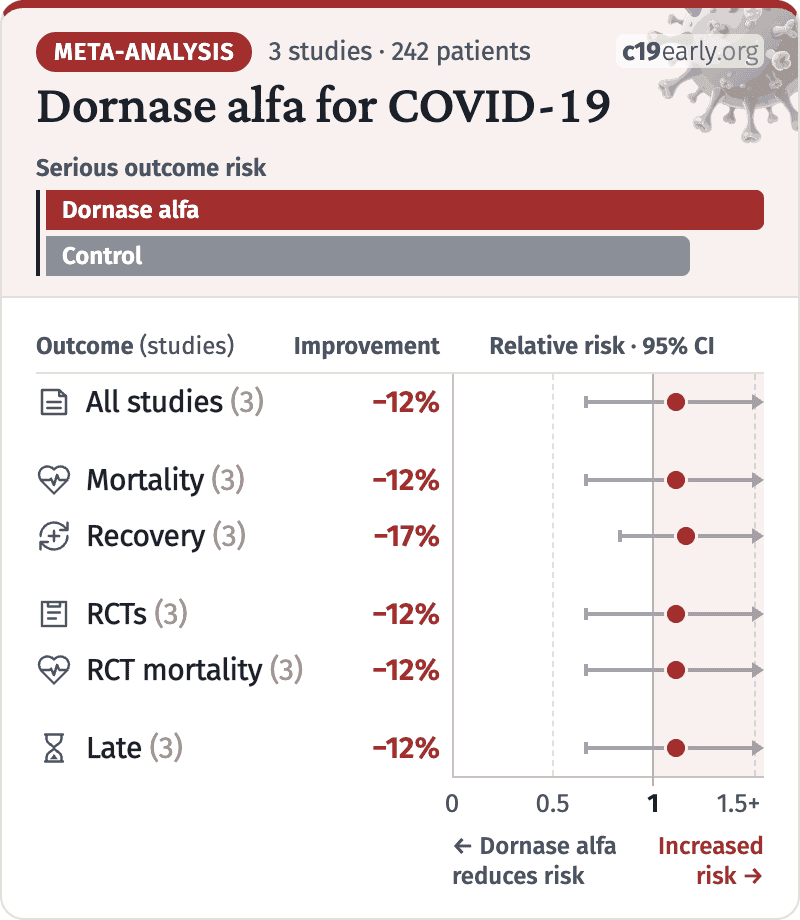
A summary of study results is below. Please submit
updates and corrections at the bottom of this page.
A summary of study results is below. Please submit
updates and corrections at https://c19early.org/dnasemeta.html.
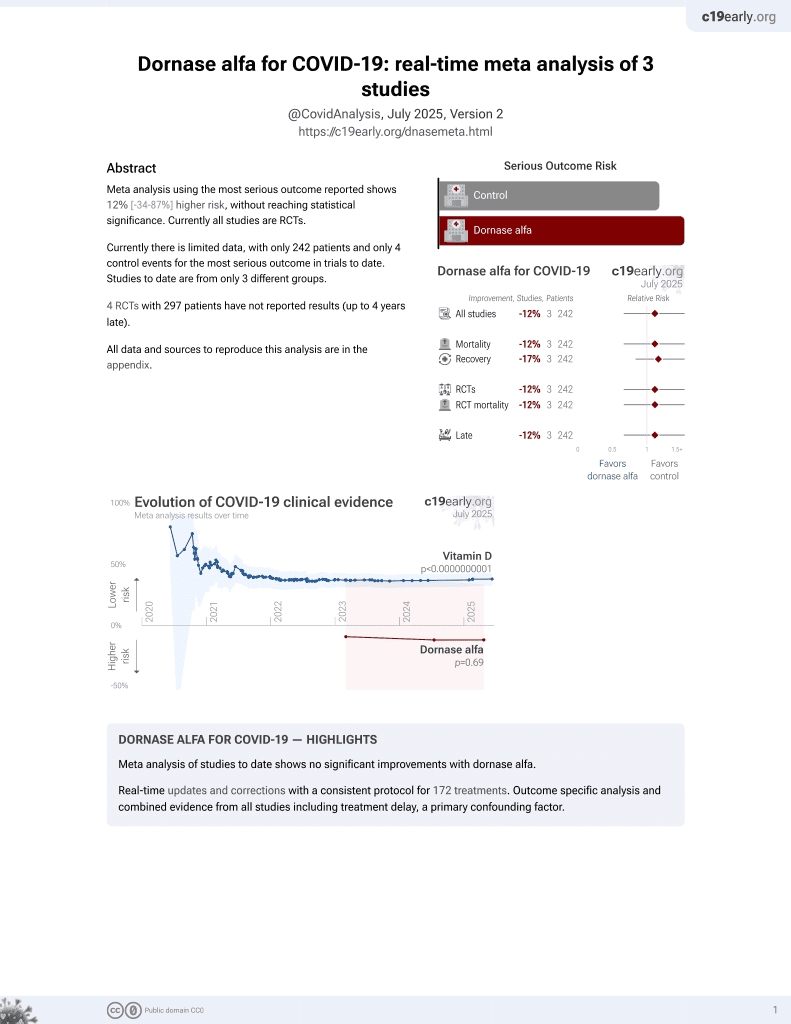
Effect extraction follows pre-specified rules as detailed above
and gives priority to more serious outcomes.
For pooled analyses, the first (most serious) outcome is used, which may
differ from the effect a paper focuses on.
Other outcomes are used in outcome specific analyses.
|
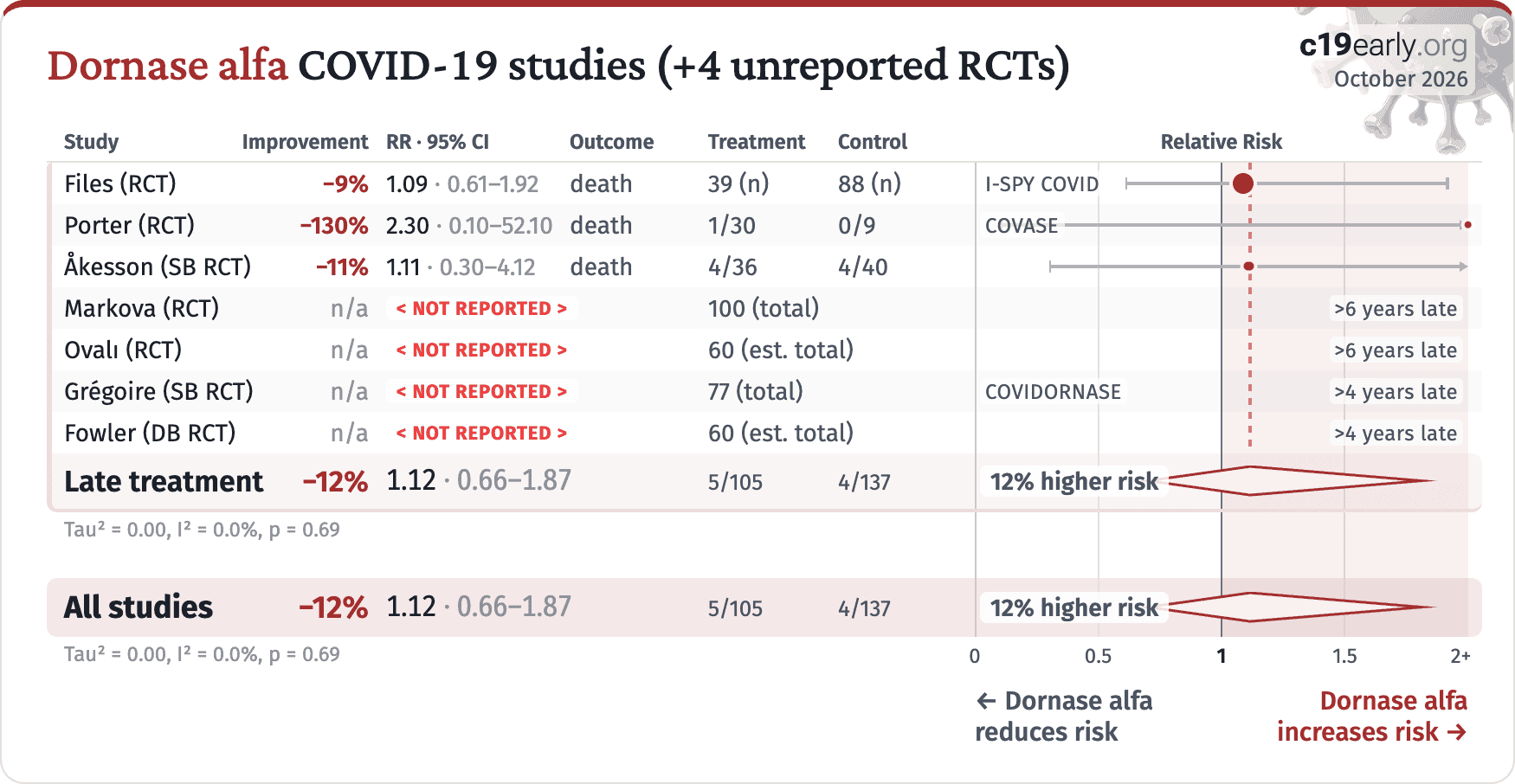
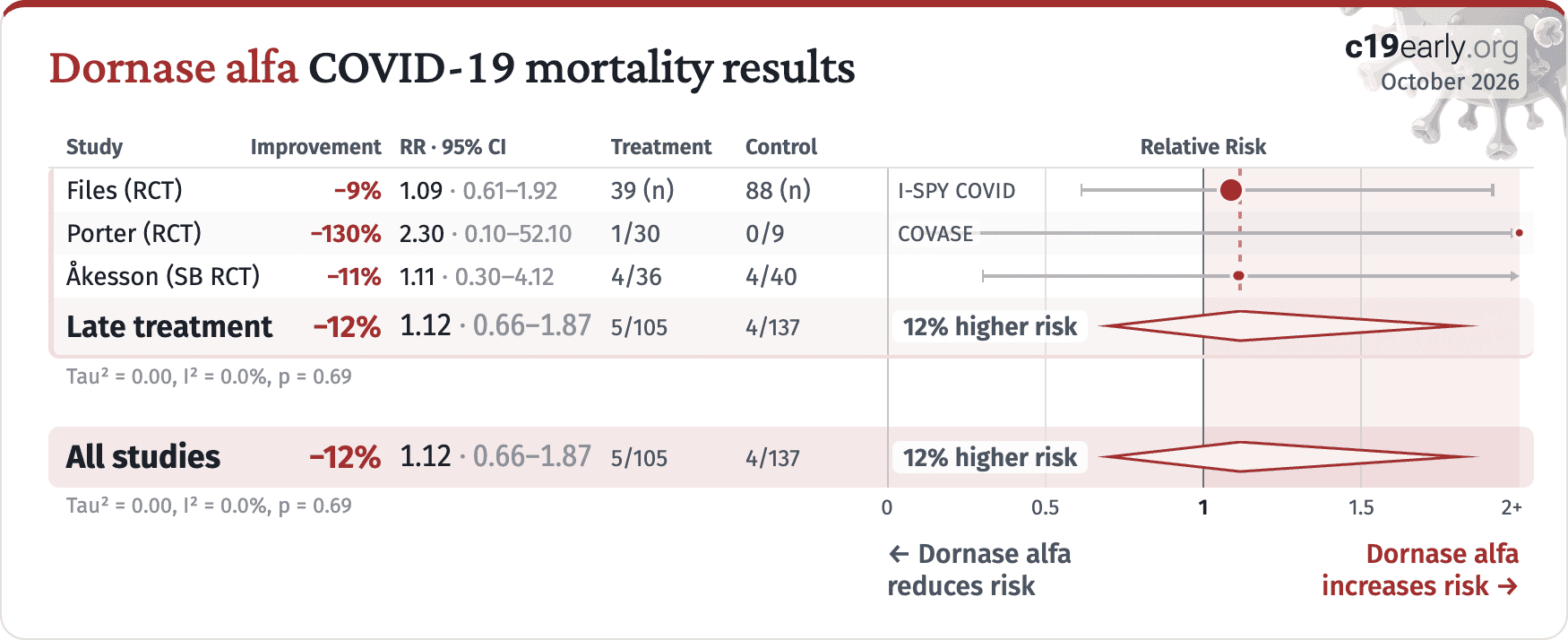
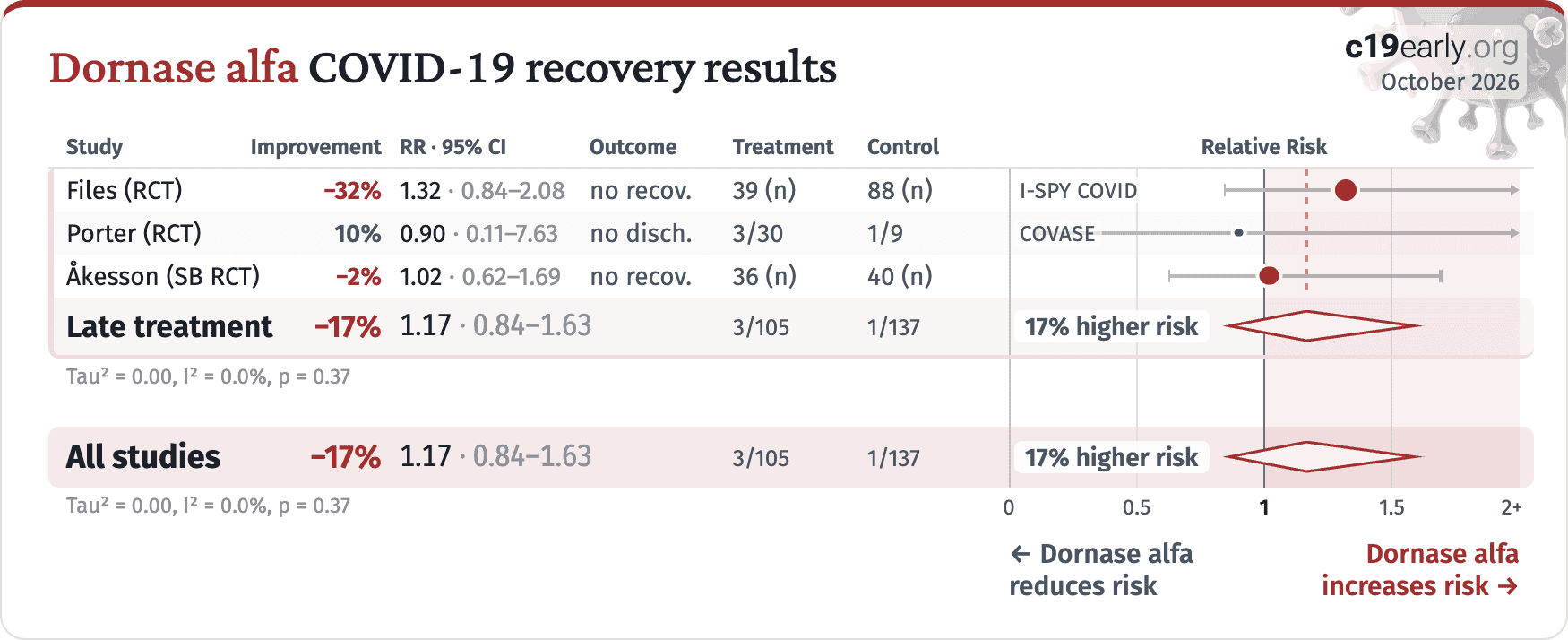
Files, 3/3/2023, Randomized Controlled Trial, USA, peer-reviewed, 91 authors, study period 30 July, 2020 - 11 June, 2021, average treatment delay 9.5 days, trial NCT04488081 (history) (I-SPY COVID).
|
risk of death, 9.0% higher, HR 1.09, p = 0.78, treatment 39, control 88, adjusted per study, day 60.
|
|
risk of no recovery, 31.6% higher, HR 1.32, p = 0.24, treatment 39, control 88, adjusted per study, inverted to make HR<1 favor treatment, day 60.
|
Fowler, 12/31/2021, Double Blind Randomized Controlled Trial, placebo-controlled, USA, trial NCT04402944 (history).
|
Estimated 60 patient RCT with results unknown and over 4 years late.
|
Grégoire, 12/20/2021, Single Blind Randomized Controlled Trial, France, trial NCT04355364 (history) (COVIDORNASE).
|
77 patient RCT with results unknown and over 4 years late.
|
Markova, 7/20/2020, Randomized Controlled Trial, Russia, trial NCT04459325 (history).
|
100 patient RCT with results unknown and over 6 years late.
|
Ovalı, 9/25/2020, Randomized Controlled Trial, Turkey, trial NCT04432987 (history).
|
Estimated 60 patient RCT with results unknown and over 6 years late.
|
|
Porter, 7/16/2024, Randomized Controlled Trial, United Kingdom, peer-reviewed, mean age 56.8, 25 authors, study period June 2020 - October 2021, trial NCT04359654 (history) (COVASE).
|
risk of death, 130.0% higher, RR 2.30, p = 1.00, treatment 1 of 30 (3.3%), control 0 of 9 (0.0%), continuity correction due to zero event (with reciprocal of the contrasting arm), COVASE randomized patients.
|
|
risk of death, 53.0% lower, HR 0.47, p = 0.49, treatment 30, control 69, including non-randomized patients.
|
|
risk of no hospital discharge, 10.0% lower, RR 0.90, p = 1.00, treatment 3 of 30 (10.0%), control 1 of 9 (11.1%), NNT 90, COVASE randomized patients.
|
|
Åkesson, 4/24/2025, Single Blind Randomized Controlled Trial, placebo-controlled, Sweden, peer-reviewed, mean age 60.5, 11 authors, study period 4 June, 2020 - 11 January, 2022, trial NCT04541979 (history).
|
risk of death, 11.1% higher, RR 1.11, p = 1.00, treatment 4 of 36 (11.1%), control 4 of 40 (10.0%).
|
|
risk of no recovery, 2.0% higher, HR 1.02, p = 0.94, treatment 36, control 40, inverted to make HR<1 favor treatment, resolution of hypoxia, Kaplan-Meier, primary outcome.
|