An All-Oral Antiviral Combination Strategy against COVID-19 Enabled by the Synergistic Mechanism of Action of Auranofin and Remdesivir
et al., Elsevier BV, doi:10.2139/ssrn.6942990, Jun 2026
Preclinical study (in vitro and mouse model) demonstrating synergistic antiviral efficacy of auranofin and GS-621763 (an oral prodrug of remdesivir) against SARS-CoV-2.
Gérard, Zhou, Wu, Kamo, Choi, Kim show increased risk of acute kidney injury, Leo, Briciu, Muntean, Petrov, Arch show increased risk of liver injury, Negru, Cheng, Mohammed, Kwok, Zhu show increased risk of cardiac disorders, and Kwok, Merches, Akinci, Tang, Bagheri show increased risk of mitochondrial toxicity with remdesivir.

1.
Gérard et al., Remdesivir and Acute Renal Failure: A Potential Safety Signal From Disproportionality Analysis of the WHO Safety Database, Clinical Pharmacology & Therapeutics, doi:10.1002/cpt.2145.
2.
Zhou et al., Acute Kidney Injury and Drugs Prescribed for COVID-19 in Diabetes Patients: A Real-World Disproportionality Analysis, Frontiers in Pharmacology, doi:10.3389/fphar.2022.833679.
3.
Wu et al., Acute Kidney Injury Associated With Remdesivir: A Comprehensive Pharmacovigilance Analysis of COVID-19 Reports in FAERS, Frontiers in Pharmacology, doi:10.3389/fphar.2022.692828.
4.
Kamo et al., Association of Antiviral Drugs for the Treatment of COVID-19 With Acute Renal Failure, In Vivo, doi:10.21873/invivo.13637.
5.
Choi et al., Comparative effectiveness of combination therapy with nirmatrelvir–ritonavir and remdesivir versus monotherapy with remdesivir or nirmatrelvir–ritonavir in patients hospitalised with COVID-19: a target trial emulation study, The Lancet Infectious Diseases, doi:10.1016/S1473-3099(24)00353-0.
6.
Kim et al., Investigating the Safety Profile of Fast‐Track COVID‐19 Drugs Using the FDA Adverse Event Reporting System Database: A Comparative Observational Study, Pharmacoepidemiology and Drug Safety, doi:10.1002/pds.70043.
7.
Leo et al., Hepatocellular liver injury in hospitalized patients affected by COVID-19: Presence of different risk factors at different time points, Digestive and Liver Disease, doi:10.1016/j.dld.2021.12.014.
8.
Briciu et al., Evolving Clinical Manifestations and Outcomes in COVID-19 Patients: A Comparative Analysis of SARS-CoV-2 Variant Waves in a Romanian Hospital Setting, Pathogens, doi:10.3390/pathogens12121453.
9.
Muntean et al., Effects of COVID-19 on the Liver and Mortality in Patients with SARS-CoV-2 Pneumonia Caused by Delta and Non-Delta Variants: An Analysis in a Single Centre, Pharmaceuticals, doi:10.3390/ph17010003.
10.
Petrov et al., The Effect of Potentially Hepatotoxic Medicinal Products on Alanine Transaminase Levels in COVID-19 Patients: A Case–Control Study, Safety and Risk of Pharmacotherapy, doi:10.30895/2312-7821-2025-458.
11.
Arch et al., Evaluation of the effectiveness of remdesivir in treating severe COVID-19 using data from the ISARIC WHO Clinical Characterisation Protocol UK: a prospective, national cohort study, medRxiv, doi:10.1101/2021.06.18.21259072.
12.
Negru et al., Comparative Pharmacovigilance Analysis of Approved and Repurposed Antivirals for COVID-19: Insights from EudraVigilance Data, Biomedicines, doi:10.3390/biomedicines13061387.
13.
Cheng et al., Cardiovascular Safety of COVID-19 Treatments: A Disproportionality Analysis of Adverse Event Reports from the WHO VigiBase, Infectious Diseases and Therapy, doi:10.1007/s40121-025-01225-z.
14.
Mohammed et al., Bradycardia associated with remdesivir treatment in coronavirus disease 2019 patients: A propensity score-matched analysis, Medicine, doi:10.1097/MD.0000000000044501.
15.
Kwok et al., Remdesivir induces persistent mitochondrial and structural damage in human induced pluripotent stem cell-derived cardiomyocytes, Cardiovascular Research, doi:10.1093/cvr/cvab311.
16.
Zhu et al., Cardiovascular Risks of COVID-19 Therapeutics: Integrated Analysis of FAERS, Electronic Health Records, and Transcriptomics, Pharmaceuticals, doi:10.3390/ph19040574.
17.
Merches et al., The potential of remdesivir to affect function, metabolism and proliferation of cardiac and kidney cells in vitro, Archives of Toxicology, doi:10.1007/s00204-022-03306-1.
18.
Akinci et al., Elucidation of remdesivir cytotoxicity pathways through genome-wide CRISPR-Cas9 screening and transcriptomics, bioRxiv, doi:10.1101/2020.08.27.270819.
Khatun et al., 17 Jun 2026, USA, preprint, 4 authors.
Contact: shashankt@iisc.ac.in.
Abstract:
reprint not peer reviewe
A
D
% Spike positive cells
120-
100-
reprint not peer reviewe
reprint not peer reviewe
reprint not peer reviewe
Time (min)
30
10
20
40
50
60
70
reprint not peer reviewe
reprint not peer reviewe
A
reprint not peer reviewe
A
reprint not peer reviewe
A
B
reprint not peer reviewe
1
2
3
4
5
6
7
8
9
10
11
12
13
14
15
16
17
18
19
20
21
22
23
24
25
26
27
28
29
30
31
32
33
An all-oral antiviral combination strategy against COVID-19 enabled by the synergistic mechanism of action of Auranofin and Remdesivir. Oyahida Khatun 1,2† , Rohan Narayan 1,2† , Santhosh Kambaiah Nagaraj 1,2† , Rishad Shiraz 1,2 , Abinaya Kaliappan 1,2 , Sumandeep Kaur 1,2 , Ankur Singh 4 , Siva Sanmugam 3 , Gudepalya Renukaiah Rudramurthy 3 , Chakenahalli Naveenkumar 3 , Shridhar Narayanan 3 , Radha Krishan Shandil 3 , Shailly Tomar 4 , Shashank Tripathi 1,2* 1 Emerging Viral Pathogens Laboratory, Infosys Wing, Centre for Infectious Disease Research, Indian Institute of Science, Bengaluru, 560012, India. 2 Department of Microbiology and Cell Biology, Division of Biological Sciences, Indian Institute of Science, Bengaluru, 560012, India. 3 Foundation for Neglected Disease Research, KIADB Industrial Area, Doddaballapur, Bengaluru, 561203 4 Molecular Virology Lab, Department of Bioscience and Bioengineering, Indian Institute of Technology Roorkee, 247667, Uttarakhand, India † These authors contributed equally. *Corresponding author. Contact: shashankt@iisc.ac.in Summary Background: Auranofin, an FDA-approved oral anti-rheumatic drug, was previously shown by our group to restrict SARS-CoV-2 replication and pathology in preclinical models, 1 a finding subsequently validated by multiple independent research groups. Despite this corroboration, the precise mechanism of action (MOA) underlying Auranofin's antiviral efficacy remained poorly defined. Methods: Auranofin's MOA was systematically characterised through biochemical drugprotein interaction, and competition assays with purified viral main protease (MPro) and Spike receptor binding domain (RBD). Time-of-addition, imaging, and reporter assays mapped its effects on viral entry, endosomal trafficking, MPro activity, polymerase activity, NF-κB signalling, and syncytia formation. Antiviral synergy with nucleoside analogues (Remdesivir, Molnupiravir) and the MPro inhibitor Nirmatrelvir were assessed in cell culture. The oral Auranofin-GS-621763 combination was subsequently validated in K18-hACE2 mice infected with the SARS-CoV-2 Delta variant. Preprint not peer reviewed
1
2
3
4
5
6
7
8
9
10
11
12
13
14
15
16
17
18
19
20
21
22
23
24
25
26
27
28
29
30
31
32
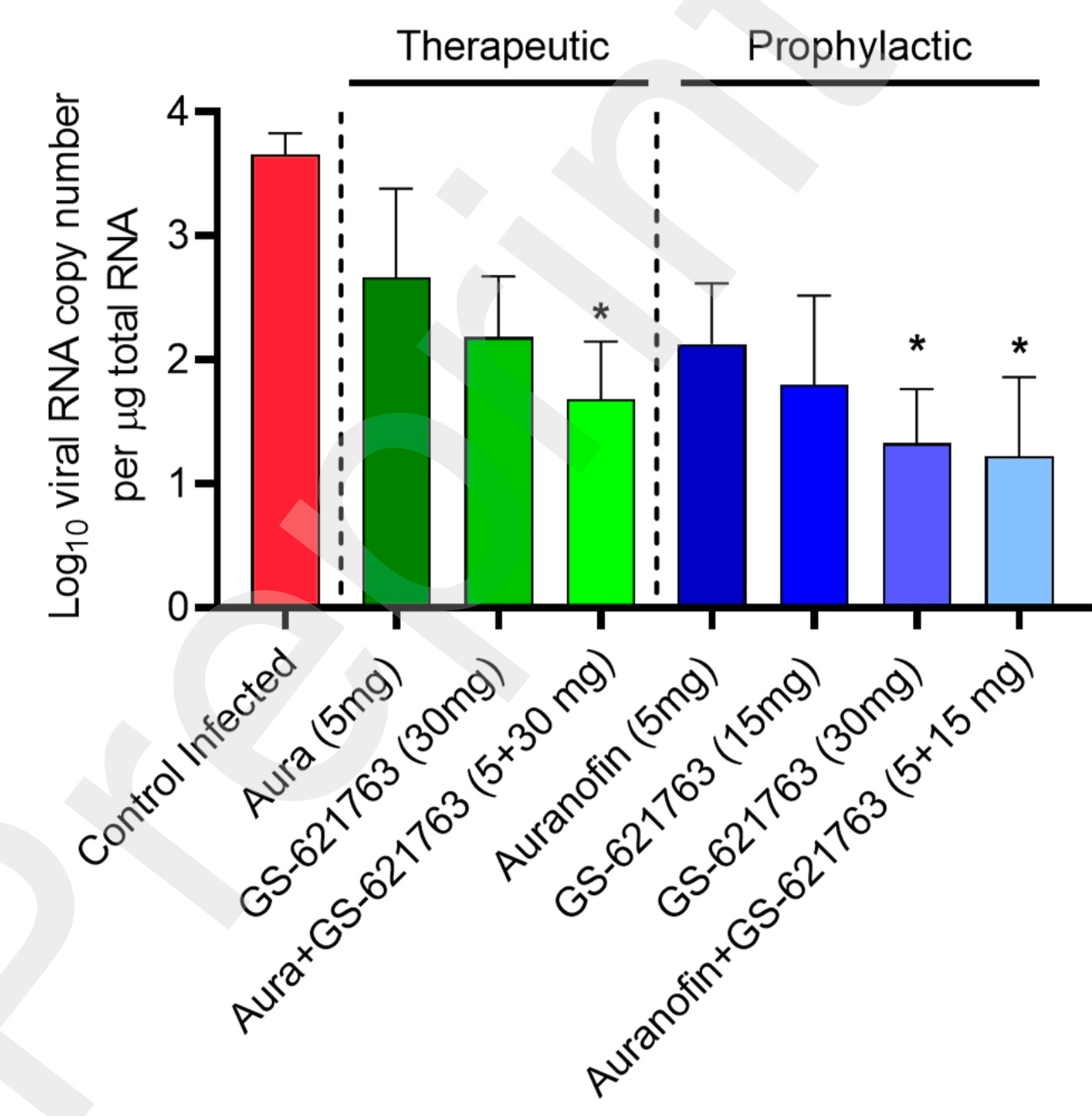
Findings: Auranofin directly binds and inhibits SARS-CoV-2 MPro while simultaneously targeting multiple stages of the viral life cycle, disrupting endosomal trafficking, suppressing Spike S1/S2 proteolytic processing, impairing syncytia formation, and attenuating NF-κBdriven proinflammatory signalling. In cell culture, Auranofin demonstrated robust synergy with Remdesivir but competed with the MPro inhibitor Nirmatrelvir, informing rational combination design. In vivo, the oral Auranofin-Remdesivir regimen outperformed monotherapy, markedly reducing viral replication, inflammatory ..
DOI record:
{
"DOI": "10.2139/ssrn.6942990",
"URL": "http://dx.doi.org/10.2139/ssrn.6942990",
"abstract": "<jats:p>Background: Auranofin, an FDA-approved oral anti-rheumatic drug, was previously shown by our group to restrict SARS-CoV-2 replication and pathology in preclinical models,1 a finding subsequently validated by multiple independent research groups. Despite this corroboration, the precise mechanism of action (MOA) underlying Auranofin's antiviral efficacy remained poorly defined.<br><br>Methods: Auranofin's MOA was systematically characterised through biochemical drug-protein interaction, and competition assays with purified viral main protease (MPro) and Spike receptor binding domain (RBD). Time-of-addition, imaging, and reporter assays mapped its effects on viral entry, endosomal trafficking, MPro activity, polymerase activity, NF-κB signalling, and syncytia formation. Antiviral synergy with nucleoside analogues (Remdesivir, Molnupiravir) and the MPro inhibitor Nirmatrelvir were assessed in cell culture. The oral Auranofin-GS-621763 combination was subsequently validated in K18-hACE2 mice infected with the SARS-CoV-2 Delta variant.<br><br>Findings: Auranofin directly binds and inhibits SARS-CoV-2 MPro while simultaneously targeting multiple stages of the viral life cycle, disrupting endosomal trafficking, suppressing Spike S1/S2 proteolytic processing, impairing syncytia formation, and attenuating NF-κB-driven proinflammatory signalling. In cell culture, Auranofin demonstrated robust synergy with Remdesivir but competed with the MPro inhibitor Nirmatrelvir, informing rational combination design. In vivo, the oral Auranofin-Remdesivir regimen outperformed monotherapy, markedly reducing viral replication, inflammatory cytokine responses, and lung pathology with improved clinical outcomes.<br><br>Interpretation: These findings establish a multi-target antiviral MOA of Auranofin, providing a clear mechanistic rationale for its combination with Remdesivir. This all-oral antiviral combination regimen can be deployed in non-clinical settings, offering a practical strategy to meaningfully enhance existing COVID-19 frontline therapy.</jats:p>",
"author": [
{
"ORCID": "https://orcid.org/0000-0001-6080-2660",
"affiliation": [],
"authenticated-orcid": true,
"family": "Khatun",
"given": "Oyahida",
"role": [
{
"role": "author",
"vocabulary": "crossref"
}
],
"sequence": "first"
},
{
"ORCID": "https://orcid.org/0000-0003-2237-8090",
"affiliation": [],
"authenticated-orcid": true,
"family": "Narayan",
"given": "Rohan",
"role": [
{
"role": "author",
"vocabulary": "crossref"
}
],
"sequence": "additional"
},
{
"ORCID": "https://orcid.org/0000-0002-5702-9248",
"affiliation": [],
"authenticated-orcid": true,
"family": "Tripathi",
"given": "Shashank",
"role": [
{
"role": "author",
"vocabulary": "crossref"
}
],
"sequence": "additional"
},
{
"affiliation": [],
"family": "PDF",
"given": "See",
"role": [
{
"role": "author",
"vocabulary": "crossref"
}
],
"sequence": "additional"
}
],
"container-title": [],
"content-domain": {
"crossmark-restriction": false,
"domain": []
},
"created": {
"date-parts": [
[
2026,
6,
17
]
],
"date-time": "2026-06-17T20:33:07Z",
"timestamp": 1781728387000
},
"deposited": {
"date-parts": [
[
2026,
6,
17
]
],
"date-time": "2026-06-17T20:33:07Z",
"timestamp": 1781728387000
},
"group-title": "SSRN",
"indexed": {
"date-parts": [
[
2026,
6,
17
]
],
"date-time": "2026-06-17T20:55:36Z",
"timestamp": 1781729736805,
"version": "3.54.5"
},
"is-referenced-by-count": 0,
"issued": {
"date-parts": [
[
2026
]
]
},
"member": "78",
"original-title": [],
"posted": {
"date-parts": [
[
2026
]
]
},
"prefix": "10.2139",
"published": {
"date-parts": [
[
2026
]
]
},
"publisher": "Elsevier BV",
"reference-count": 0,
"references-count": 0,
"relation": {},
"resource": {
"primary": {
"URL": "https://www.ssrn.com/abstract=6942990"
}
},
"score": 1,
"short-title": [],
"source": "Crossref",
"subject": [],
"subtitle": [],
"subtype": "preprint",
"title": "An All-Oral Antiviral Combination Strategy against COVID-19 Enabled by the Synergistic Mechanism of Action of Auranofin and Remdesivir",
"type": "posted-content"
}