Molecular Quantum and Logic Process of Consciousness—Vitamin D Big-Data in COVID-19—A Case for Incorporating Machine Learning In Medicine
et al., European Journal of Biomedical and Pharmaceutical sciences, doi:10.5281/zenodo.10435649, Dec 2023
Vitamin D for COVID-19
8th treatment shown to reduce risk in
October 2020, now with p < 0.0000000001 from 138 studies, recognized in 18 countries.
No treatment is 100% effective.
Protocols combine treatments.
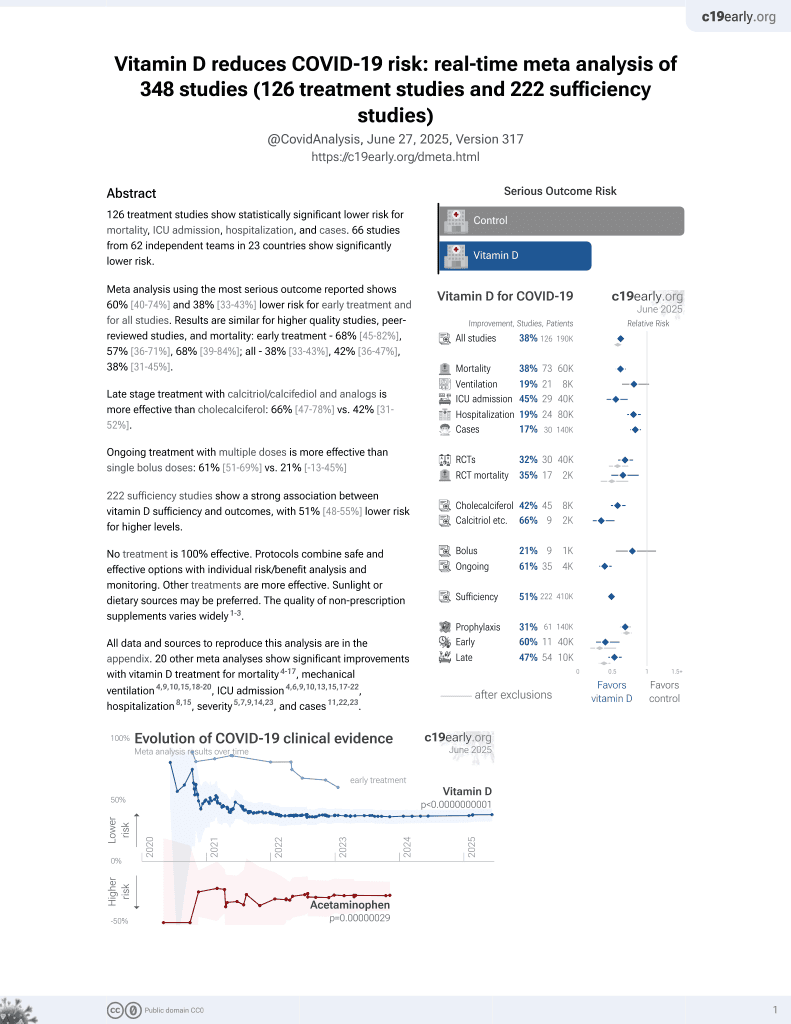
Review of the integration of vitamin D data into machine learning for COVID-19-related healthcare decision-making. Authors highlight the role of vitamin D deficiency in increasing vulnerability to SARS-CoV-2 and argue that integrating vitamin D data with machine learning could expedite the approval of cost-effective therapies like calcifediol.
1.
Younes, S., The influence of micronutrients on olfactory dysfunction associated with COVID-19 and long COVID, Next Research, doi:10.1016/j.nexres.2026.101727.
2.
Jaurrieta-Largo et al., A Machine Learning Approach to Understanding the Genetic Role in COVID-19 Prognosis: The Influence of Gene Polymorphisms Related to Inflammation, Vitamin D, and ACE2, International Journal of Molecular Sciences, doi:10.3390/ijms26167975.
3.
Al-Khrasani et al., Do vitamins halt the COVID-19-evoked pro-inflammatory cytokines involved in the development of neuropathic pain?, Biomedicine & Pharmacotherapy, doi:10.1016/j.biopha.2025.118346.
4.
Kow et al., Vitamin D and COVID‐19: How much more evidence do we need?, Nutrition in Clinical Practice, doi:10.1002/ncp.11349.
5.
Bigman et al., A Comprehensive Scoping Review on Diet and Nutrition in Relation to Long COVID-19 Symptoms and Recovery, Nutrients, doi:10.3390/nu17111802.
6.
Hewison, M., COVID-19 and our understanding of vitamin D and immune function, The Journal of Steroid Biochemistry and Molecular Biology, doi:10.1016/j.jsbmb.2025.106710.
7.
Wimalawansa, S., Vitamin D Deficiency Meets Hill’s Criteria for Causation in SARS-CoV-2 Susceptibility, Complications, and Mortality: A Systematic Review, Nutrients, doi:10.3390/nu17030599.
8.
Sanduzzi Zamparelli et al., Immune-Boosting and Antiviral Effects of Antioxidants in COVID-19 Pneumonia: A Therapeutic Perspective, Life, doi:10.3390/life15010113.
9.
Fazli et al., Possible Link between Gut Microbiota, Diet, and COVID-19 Infection, Journal of Medical Bacteriology, 12:4, jmb.tums.ac.ir/index.php/jmb/article/view/525.
10.
Wojciulik et al., The impact of genetic polymorphism on course and severity of the SARS-CoV-2 infection and COVID-19 disease, Przeglad Epidemiologiczny, doi:10.32394/pe/194862.
11.
Wimalawansa (B), S., Unveiling the Interplay—Vitamin D and ACE-2 Molecular Interactions in Mitigating Complications and Deaths from SARS-CoV-2, Biology, doi:10.3390/biology13100831.
12.
Santa et al., Comparative analysis of COVID-19 responses in Japan and Africa: diet, phytochemicals, vitamin D, and gut microbiota in reducing mortality—A systematic review and meta-analysis, Frontiers in Nutrition, doi:10.3389/fnut.2024.1465324.
13.
Kaushal, A., Nutraceuticals and pharmacological to balance the transitional microbiome to extend immunity during COVID-19 and other viral infections, Journal of Translational Medicine, doi:10.1186/s12967-024-05587-9.
14.
Mu et al., Anti-inflammatory and Nutritional Interventions Against SARS-CoV-2: A Comprehensive Review, Journal of Agriculture and Food Research, doi:10.1016/j.jafr.2024.101422.
15.
Wimalawansa (C), S., Unlocking Insights: Navigating COVID-19 Challenges and Emulating Future Pandemic Resilience Strategies with Strengthening Natural Immunity, Heliyon, doi:10.1016/j.heliyon.2024.e34691.
16.
Imran et al., Therapeutic Role of Vitamin D in COVID-19 Patients, Clinical Nutrition Open Science, doi:10.1016/j.nutos.2024.07.004.
17.
Grant, W., Vitamin D and viral infections: Infectious diseases, autoimmune diseases, and cancers, Advances in Food and Nutrition Research, doi:10.1016/bs.afnr.2023.12.007.
18.
Polonowita et al., Molecular Quantum and Logic Process of Consciousness—Vitamin D Big-Data in COVID-19—A Case for Incorporating Machine Learning In Medicine, European Journal of Biomedical and Pharmaceutical sciences, doi:10.5281/zenodo.10435649.
19.
Gomaa et al., Pharmacological evaluation of vitamin D in COVID-19 and long COVID-19: recent studies confirm clinical validation and highlight metformin to improve VDR sensitivity and efficacy, Inflammopharmacology, doi:10.1007/s10787-023-01383-x.
20.
Gotelli et al., Understanding the immune-endocrine effects of vitamin D in SARS-CoV-2 infection: a role in protecting against neurodamage?, Neuroimmunomodulation, doi:10.1159/000533286.
21.
Cutolo et al., Involvement of the secosteroid vitamin D in autoimmune rheumatic diseases and COVID-19, Nature Reviews Rheumatology, doi:10.1038/s41584-023-00944-2.
22.
Schloss et al., Nutritional deficiencies that may predispose to long COVID, Inflammopharmacology, doi:10.1007/s10787-023-01183-3.
23.
Arora et al., Global Dietary and Herbal Supplement Use during COVID-19—A Scoping Review, Nutrients, doi:10.3390/nu15030771.
24.
Nicoll et al., COVID-19 Prevention: Vitamin D Is Still a Valid Remedy, Journal of Clinical Medicine, doi:10.3390/jcm11226818.
25.
Foshati et al., Antioxidants and clinical outcomes of patients with coronavirus disease 2019: A systematic review of observational and interventional studies, Food Science & Nutrition, doi:10.1002/fsn3.3034.
26.
Quesada-Gomez et al., Vitamin D Endocrine System and COVID-19: Treatment with Calcifediol, Nutrients, doi:10.3390/nu14132716.
27.
DiGuilio et al., Micronutrient Improvement of Epithelial Barrier Function in Various Disease States: A Case for Adjuvant Therapy, International Journal of Molecular Sciences, doi:10.3390/ijms23062995.
28.
Grant (B) et al., A Narrative Review of the Evidence for Variations in Serum 25-Hydroxyvitamin D Concentration Thresholds for Optimal Health, Nutrients, doi:10.3390/nu14030639.
29.
Shaw Stewart et al., Temperature dependent viral tropism: understanding viral seasonality and pathogenicity as applied to the avoidance and treatment of endemic viral respiratory illnesses, Reviews in Medical Virology, doi:10.1002/rmv.2241.
30.
Shah Alam et al., The role of vitamin D in reducing SARS-CoV-2 infection: An update, International Immunopharmacology, doi:10.1016/j.intimp.2021.107686.
31.
Griffin et al., Perspective: Vitamin D supplementation prevents rickets and acute respiratory infections when given as daily maintenance but not as intermittent bolus: implications for COVID-19, Clinical Medicine, doi:10.7861/clinmed.2021-0035.
32.
Kohlmeier et al., When Mendelian randomisation fails, BMJ Nutrition, Prevention & Health, doi:10.1136/bmjnph-2021-000265.
33.
Brenner, H., Vitamin D Supplementation to Prevent COVID-19 Infections and Deaths—Accumulating Evidence from Epidemiological and Intervention Studies Calls for Immediate Action, Nutrients, doi:10.3390/nu13020411.
34.
Mercola et al., Evidence Regarding Vitamin D and Risk of COVID-19 and Its Severity, Nutrients 2020, 12:11, 3361, doi:10.3390/nu12113361.
35.
Basha et al., Is the shielding effect of cholecalciferol in SARS CoV-2 infection dependable? An evidence based unraveling, Clinical Epidemiology and Global Health, doi:10.1016/j.cegh.2020.10.005.
36.
Xu et al., The importance of vitamin d metabolism as a potential prophylactic, immunoregulatory and neuroprotective treatment for COVID-19, Journal of Translational Medicine, doi:10.1186/s12967-020-02488-5.
37.
Alexander et al., Early Nutritional Interventions with Zinc, Selenium and Vitamin D for Raising Anti-Viral Resistance Against Progressive COVID-19, Nutrients, doi:10.3390/nu12082358.
38.
Andrade et al., Vitamin A and D deficiencies in the prognosis of respiratory tract infections: A systematic review with perspectives for COVID-19 and a critical analysis on supplementation, SciELO preprints, doi:10.1590/SciELOPreprints.839.
39.
Grant (C) et al., Evidence that Vitamin D Supplementation Could Reduce Risk of Influenza and COVID-19 Infections and Deaths, Nutrients, 12:4, 988, doi:10.3390/nu12040988.
40.
McCullough et al., Daily oral dosing of vitamin D3 using 5000 TO 50,000 international units a day in long-term hospitalized patients: Insights from a seven year experience, The Journal of Steroid Biochemistry and Molecular Biology, doi:10.1016/j.jsbmb.2018.12.010.
41.
EFSA, Scientific Opinion on the substantiation of health claims related to vitamin D and normal function of the immune system and inflammatory response (ID 154, 159), maintenance of normal muscle function (ID 155) and maintenance of normal cardiovascular function (ID 159) pursuant to Article 13(1) of Regulation (E, EFSA Journal, doi:10.2903/j.efsa.2010.1468.
42.
EFSA (B), Scientific Opinion on the substantiation of a health claim related to vitamin D and contribution to the normal function of the immune system pursuant to Article 14 of Regulation (EC) No 1924/2006, EFSA Journal, doi:10.2903/j.efsa.2015.4096.
Polonowita et al., 25 Dec 2023, peer-reviewed, 2 authors.
SEE PROFILE
doi:10.5281/zenodo.10435649
This manuscript explores the rapid realization of benefits through integrating vitamin D big data into artificial intelligence/machine learning, offering a paradigm for expedited medical decision-policy and making formulation. Leveraging advanced deep learning techniques, we propose synthesizing extensive data sets, enabling the approval of repurposed, cost-effective compounds. This would facilitate economically sustainable policies and algorithms that directly benefit patients. This innovative approach improves clinical
References
Annonymus, Vitamin D for COVID-19: real-time analysis of all 300 studies
Anonymus, Vitamin D for COVID-19: real-time analysis of all 300 studies
Arora, Wang, Weaver, Zhang, Cantorna, Novel insight into the role of the vitamin D receptor in the development and function of the immune system, J Steroid Biochem Mol Biol, doi:10.1016/j.jsbmb.2022.106084
Asraf, Islam, Haque, Islam, Deep Learning Applications to Combat Novel Coronavirus (COVID-19) Pandemic, SN Comput Sci, doi:10.1007/s42979-020-00383-w
Bertalanffy, General System Theory: Foundations, Development, Applications
Bogliolo, Cereda, Klersy, Stefano, Lobascio et al., Vitamin D 25OH deficiency and mortality in moderate to severe COVID-19: A multi-center Prospective observational study, Front Nutr, doi:10.3389/fnut.2022.934258
Borges, Martini, Rogero, Current perspectives on vitamin D, immune system, and chronic diseases, Nutrition, doi:10.1016/j.nut.2010.07.022
Brefczynski-Lewis, Lutz, Schaefer, Levinson, Davidson, Neural correlates of attentional expertise in long-term meditation practitioners, Proc Natl Acad Sci U S A, doi:10.1073/pnas.0606552104
Bui, Zhu, Hawkins, Cortez-Resendiz, Bellon, Vitamin D regulation of the immune system and its implications for COVID-19: A mini review, SAGE Open Med
Cereda, Bogliolo, De Stefano, Caccialanza, A brief discussion of the benefit and mechanism of vitamin D supplementation on coronavirus disease 2019, Curr Opin Clin Nutr Metab Care, doi:10.1097/MCO.0000000000000701
Cesur, Atasever, Ozoran, Impact of vitamin D3 supplementation on COVID-19 vaccine response and immunoglobulin G antibodies in deficient women: A randomized controlled trial, Vaccine, doi:10.1016/j.vaccine.2023.03.046
Charoenngam, Holick, Immunologic Effects of Vitamin D on Human Health and Disease, Nutrients, doi:10.3390/nu12072097
Chauss, Freiwald, Mcgregor, Yan, Wang et al., Autocrine vitamin D signaling switches off pro-inflammatory programs of T(H)1 cells, Nat Immunol, doi:10.1038/s41590-021-01080-3
Ck, Probability in ancient India Handbook of the Philosophy of Science
Corneil, Emre, Elisabetta, Matthew, Rodney, Real-time inference in a VLSI spiking neural network, doi:10.1109/ISCAS.2012.6271788
Cutting, The right cerebral hemisphere and psychiatric disorders
Dana, Nasirian, Vaseghi, Heshmat-Ghahdarijani, Ataei et al., Vitamin D level in laboratorcy confirmed COVID-19 and disease progression, Eurasian J Med, doi:10.5152/eurasianjmed.2022.21088
Delanghe, Speeckaert, Speeckaert, Behind the scenes of vitamin D binding protein: more than vitamin D binding, Best Pract Res Clin Endocrinol Metab, doi:10.1016/j.beem.2015.06.006
Diosi, Models for universal reduction of macroscopic quantum fluctuations, Phys Rev A Gen Phys, doi:10.1103/physreva.40.1165
Douglas, Martin, Neocortex
Douglas, Martin, Neuronal circuits of the neocortex, Annu Rev Neurosci, doi:10.1146/annurev.neuro.27.070203.144152
Ekwaru, Zwicker, Holick, Giovannucci, Veugelers, The importance of body weight for the dose response relationship of oral vitamin D supplementation and serum 25hydroxyvitamin D in healthy volunteers, PLoS One, doi:10.1371/journal.pone.0111265
Ghelani, Alesi, Mousa, Vitamin D and COVID-19: An Overview of Recent Evidence, Int J Mol Sci, doi:10.3390/ijms221910559
Gibbons, Norton, Mccullough, Meltzer, Lavigne et al., Association between vitamin D supplementation and COVID-infection and 19 mortality, Sci Rep, doi:10.1038/s41598-022-24053-4
Gilani, Bin-Jumah, Nadeem, Kazmi, Vitamin D attenuates COVID-19 complications via modulation of proinflammatory cytokines, antiviral proteins, and autophagy, Expert Rev Anti Infect Ther, doi:10.1080/14787210.2021.1941871
Gonzalez-Estevez, Turrubiates-Hernandez, Herrera-Jimenez, Sanchez-Zuno, Herrera-Godina et al., Association of Food Intake Quality with Vitamin D in SARS-CoV-2 Positive Patients from Mexico: A Cross-Sectional Study, International journal of environmental research and public health, doi:10.3390/ijerph18147266
Hameroff, Penrose, Orchestrated reduction of quantum coherence in brain microtubules: a model for consciousness
Hastie, Pell, Sattar, Vitamin D and COVID-19 infection and mortality in UK Biobank, Eur J Nutr, doi:10.1007/s00394-020-02372-4
Hernandez, Recalde, Gonzalez-Zamora, Bilbao-Malave, Saenz De Viteri et al., Anti-Inflammatory and Anti-Oxidative Synergistic Effect of Vitamin D and Nutritional Complex on Retinal Pigment Epithelial and Endothelial Cell Lines against Age-Related Macular Degeneration, Nutrients, doi:10.3390/nu13051423
Hutter, Blum, Quraishi, Bittner, Camargo et al., Association between preoperative 25-hydroxyvitamin D level and hospital-acquired infections following Roux-en-Y gastric bypass surgery, JAMA Surg, doi:10.1001/jamasurg.2013.3176
Israel, Cicurel, Feldhamer, Stern, Dror et al., Vitamin D deficiency is associated with higher risks for SARS-CoV-2 infection and COVID-19 severity: a retrospective case-control study, Intern Emerg Med, doi:10.1007/s11739-021-02902-w
Jain, Chaurasia, Sengar, Singh, Mahor et al., Analysis of vitamin D level among asymptomatic and critically ill COVID-19 patients and its correlation with inflammatory markers, Sci Rep, doi:10.1038/s41598-020-77093-z
Jeng, Yamshchikov, Judd, Blumberg, Martin et al., Alterations in vitamin D status and anti-microbial peptide levels in patients in the intensive care unit with sepsis, J Transl Med, doi:10.1186/1479-5876-7-28
Junior, Azevedo, Paes, Lima, Campos Guerra et al., Chronic diseases, chest computed tomography, and laboratory tests as predictors of severe respiratory failure and death in elderly Brazilian patients hospitalized with COVID-19: a prospective cohort study, BMC geriatrics, doi:10.1186/s12877-022-02776-3
Kaufman, Niles, Kroll, Bi, Holick et al., -CoV-2 positivity rates circulating 25 associated with -hydroxyvitamin D levels, PLoS One, doi:10.1371/journal.pone.0239252
Kelsey, Katoch, Ray, Mitra, Chakraborty et al., Vitamin D3 regulates the formation and degradation of gap junctions in androgen-responsive human prostate cancer cells, PLoS One, doi:10.1371/journal.pone.0106437
Loizzo, Meditation research, past, present, and future: perspectives from the Nalanda contemplative science tradition, Ann N Y Acad Sci, doi:10.1111/nyas.12273
Lutz, Greischar, Rawlings, Ricard, Davidson, Long-term meditators selfinduce high-amplitude gamma synchrony during mental practice, Proc Natl Acad Sci U S A, doi:10.1073/pnas.0407401101
Malek Mahdavi, A brief review of interplay between vitamin D and angiotensin-converting enzyme 2: Implications for a potential treatment for COVID-19, Rev Med Virol, doi:10.1002/rmv.2119
Mcgilchrist, Master and his emissary: The divided brain and the making of the western world: The divided brain and making of the westerm world
Mcgregor, Kazemian, Afzali, An autocrine Vitamin D-driven Th1 shutdown program can be exploited for COVID-19, doi:10.1101/2020.07.18.210161v1
Newton, Philosophiae Naturalis Principia Mathematica
Olbrich, Pavon, Rosso, Molinos, De Felipe et al., Association of human beta-defensin-2 serum levels and sepsis in preterm neonates, Pediatr Crit Care Med, doi:10.1097/PCC.0b013e3182975e0f
Ozturk, Eraslan, Akpinar, Karamanlioglu Silte, Ozkan Unlu et al., Is there a relationship between vitamin D levels, inflammatory parameters, and clinical severity of COVID-19 infection?, Bratislavske lekarske listy, doi:10.4149/BLL_2022_065
Penrose, Mermin, The emperor's new mind: Concerning computers, minds, and the laws of physics
Polonowita, The validity and reliability of the high sensitivity cognitive screen: a replication study
Polonowita, Wimalawansa, Sj, Impact of Withholding Cost-Effective Early Treatments, Such as Vitamin D, on COVID-19: An Analysis Using an Innovative Logical Paradigm, Wold J. Adanced Pharma. Life Sci
Quraishi, De Pascale, Needleman, Nakazawa, Kaneki et al., Effect of Cholecalciferol Supplementation on Vitamin D Status and Cathelicidin Levels in Sepsis: A Randomized, Placebo-Controlled Trial, Crit Care Med, doi:10.1097/CCM.0000000000001148
Raisi-Estabragh, Martineau, Curtis, Moon, Darling et al., Vitamin D and coronavirus disease 2019 (COVID-19): rapid evidence review, Aging Clin Exp Res, doi:10.1007/s40520-021-01894-z
Raisi-Estabragh, Mccracken, Bethell, Cooper, Cooper et al., Greater risk of severe COVID-19 in Black, Asian and Minority Ethnic populations is not explained by cardiometabolic, socioeconomic or behavioural factors, or by 25(OH)-vitamin D status: study of Wimalawansa et al, European Journal of Biomedical and Pharmaceutical Sciences www, doi:10.1093/pubmed/fdaa095
Raju, Cultural Foundations of Mathematics: The Nature of Mathematical Proof and the Transmission of the Calculus from India to Europe in the 16th Century
Raju, Probability in ancient India
Raju, Time towards a consistent theory; Fundamental theories of physics
Rescher, Quasi-truth-Functional systems of propositional logic, J. Symbolic Logic
Sanchez-Zuno, Gonzalez-Estevez, Matuz-Flores, Macedo-Ojeda, Hernandez-Bello et al., Vitamin D Levels in COVID-19 Outpatients from Western Mexico: Clinical Correlation and Effect of Its Supplementation, J Clin Med, doi:10.3390/jcm10112378
Science, 7-Detecting Multicollinearity Using Variance Inflation Factors
Shiravi, Saadatkish, Abdollahi, Miar, Khanahmad et al., Vitamin D can be effective on the prevention of COVID-19 complications: A narrative review on molecular aspects, Int J Vitam Nutr Res, doi:10.1024/0300-9831/a000676
Simpson, Jr, Der Mei, Taylor, The role of vitamin D in multiple sclerosis: biology and biochemistry, epidemiology and potential roles in treatment, Med Chem, doi:10.2174/1573406413666170921143600
Smaha, Kuzma, Brazdilova, Nachtmann, Jankovsky et al., Patients with COVID-19 pneumonia with 25(OH)D levels lower than 12 ng/ml are at increased risk of death, Int J Infect Dis, doi:10.1016/j.ijid.2022.01.044
Soltani-Zangbar, Mahmoodpoor, Dolati, Shamekh, Valizadeh et al., Serum levels of vitamin D and immune system function in patients with COVID-19 admitted to intensive care unit, Gene Rep, doi:10.1016/j.genrep.2022.101509
Styrzynski, Zhakparov, Schmid, Roqueiro, Lukasik et al., Machine learning successfully detects patients with COVID-19 prior to PCR results and predicts their survival based on standard laboratory parameters in an observational study, Infect Dis Ther, doi:10.1007/s40121-022-00707-8
Suda, Masuyama, Bouillon, Carmeliet, Physiological functions of vitamin D: what we have learned from global and conditional VDR knockout mouse studies, Curr Opin Pharmacol, doi:10.1016/j.coph.2015.04.001
Svensson, Nebel, Voss, Ekblad, Nilsson, Vitamin D-induced up-regulation of human keratinocyte cathelicidin anti-microbial peptide expression involves retinoid X receptor alpha, Cell Tissue Res, doi:10.1007/s00441-016-2449-z
Szeto, Zucker, Lasota, Rubin, Walker et al., Vitamin D Status and COVID-19 Clinical Outcomes in Hospitalized Patients, Endocr Res, doi:10.1080/07435800.2020.1867162
Tiwari, Dangore-Khasbage, Vitamin D and COVID-19: An update on evidence and potential therapeutic implications, Cureus, doi:10.7759/cureus.46121
Tomaszewska, Rustecka, Lipinska-Opalka, Piprek, Kloc et al., The role of vitamin D in COVID-19 and the impact of pandemic restrictions on vitamin D blood content, Frontiers in pharmacology, doi:10.3389/fphar.2022.836738
Tosoni, Cossari, Paratore, Impagnatiello, Passaro et al., Delta-Procalcitonin and Vitamin D Can Predict Mortality of Internal Medicine Patients with Microbiological Identified Sepsis
Veugelers, Pham, Ekwaru, Optimal Vitamin D Supplementation Doses that Minimize the Risk for Both Low and High Serum 25-Hydroxyvitamin D Concentrations in the General Population, Nutrients, doi:10.3390/nu7125527
Wee, Mokhtar, Ss; Singh, Yahaya, Leung et al., AHG Calcitriol supplementation ameliorates microvascular endothelial dysfunction in vitamin D-deficient diabetic rats by upregulating the vascular eNOS protein expression and reducing oxidative stress, Oxid Med Cell Longev, doi:10.1155/2021/3109294
White, Emerging roles of vitamin D-induced antimicrobial peptides in antiviral Innate immunity, Nutrients, doi:10.3390/nu14020284
Wimalawansa, ACE inhibitors and angiotensin receptor blockers reduce the complications associated with COVID-19 infection, World J. Pharma Res, doi:10.17605/OSF.IO/2ME36
Wimalawansa, Biology of vitamin D, J steroids Horm Sci, doi:10.24105/2157-7536.10.198
Wimalawansa, Controlling chronic diseases and acute infections with vitamin D sufficiency, Nutrients, doi:10.3390/nu15163623
Wimalawansa, Non-musculoskeletal benefits of vitamin D, J Steroid Biochem Mol Biol, doi:10.1016/j.jsbmb.2016.09.016
Wimalawansa, None, European Journal of Biomedical and Pharmaceutical Sciences www, doi:10.1177/20503121211014073
Wimalawansa, Overcoming infections including COVID-19, by maintaining circulating 25(OH)D concentrations above 50 ng/mL, Pathology & Lab. Medicine Int
Wimalawansa, Overcoming infections including COVID-19, by maintaining circulating 25(OH)D concentrations above 50 ng/mL, Pathology & Lab. Medicine Int
Wimalawansa, Physiological basis for using vitamin D to improve health Biomedicines, doi:10.3390/biomedicines11061542
Wimalawansa, Physiological basis for using vitamin D to improve health, Biomedicines, doi:10.3390/biomedicines11061542
Wimalawansa, Polonowita, Boosting immunity with vitamin D for preventing complications and deaths from COVID-19
Wimalawansa, Rapidly Increasing Serum 25(OH)D Boosts the Immune System, against Infections-Sepsis and COVID-19, Nutrients, doi:10.3390/nu14142997
Wimalawansa, Razzaque, Al-Daghri, Calcium and Vitamin D in Human Health: Hype or Real?, J Steroid Biochem Mol Biol, doi:10.1016/j.jsbmb.2017.12.009
Wolf, Wimalawansa, Razzaque, Procalcitonin as a biomarker for critically ill patients with sepsis: Effects of vitamin D supplementation, The Journal of steroid biochemistry and molecular biology
Zhang, Yan, Meng, Hong, Shao et al., Antimicrobial peptides: mechanism of action, activity and clinical potential, Mil Med Res, doi:10.1186/s40779-021-00343-2
Zheng, Miao, Guo, Guo, Fan et al., Mechanism of COVID-19 Causing ARDS: Exploring the Possibility of Preventing and Treating SARS-CoV-2, Front Cell Infect Microbiol, doi:10.3389/fcimb.2022.931061
Zheng, Miao, Guo, Guo, Fan et al., Mechanism of COVID-19 causing ARDS: Exploring the possibility of treating SARS-CoV-2, Front Cell Infect Microbiol, doi:10.3389/fcimb.2022.931061
DOI record:
{
"DOI": "10.5281/ZENODO.10435649",
"URL": "https://zenodo.org/doi/10.5281/zenodo.10435649",
"abstract": "10.5281/zenodo.10435649\n\nABSTRACTThere are unique relations between statistics and logic operating in neural networks in the human brain. Like machine learning, big data and artificial intelligence (AI) techniques could emulate human brain functions rapidly and assist healthcare decisions, especially in emergencies like COVID-19. We explore published positive modulatory effects of vitamin D on the human immune system from randomized control clinical trials (RCTs) and meta-analyses taken as an example. The analysis confirmed a robust negative correlation between serum 25(OH)D concentration with increased susceptibility to symptomatic SARS-CoV-2, complications, hospitalization, and deaths. Instead of using available such data in mid-2020, regulators relied upon RCTs from big pharma. Utilizing advanced Machine Learning paradigms using cleaned data would have expedited proper decision-making, better guidance on patient management, and approval of cost-effective early therapies like vitamin D and calcifediol, reducing the cost of care and millions of hospitalizations and deaths from SARS-CoV-2. Using Catuskoti logic in AI, broader than Boolean logic would have enhanced unbiased decision-making and developed data-driven algorithms to control outbreaks. Scientific evidence existed in mid-2020 that vitamin D and calcifediol rapidly boost the immune system, thus preventing SARS-CoV-2-related complications and deaths. However, statistical misconceptions, lack of broader vision, and failure to use big data analysis and machine learning approaches prevented using generic agents as prophylactic and adjunct therapies. We present the argument for hypothesis generation in conjunction with innovation in machine learning, using Catuskoti-based XOR and XNOR circuits as a solution to expedite the categorization of vulnerability, developing practical algorithms, and rapid approvals of repurposed drugs for future pandemics. Such data-driven analyses through machine learning programs minimize conflicts of interest and expedite decision-making. In the future, big data can be analyzed using desktop computers, facilitating prompt and proper decision-making and expedited drug approvals, especially for generics. This approach will better manage future epidemics and pandemics—cost-effective early therapeutic interventions, preventing complications, hospitalizations, and deaths, and reducing healthcare burden and cost.",
"author": [
{
"family": "Athula K. Polonowita",
"given": "Sunil J. Wimalawansa"
}
],
"container-title": "Zenodo",
"copyright": "Creative Commons Attribution 4.0 International",
"id": "https://doi.org/10.5281/zenodo.10435649",
"issued": {
"date-parts": [
[
2023,
12,
25
]
]
},
"publisher": "Zenodo",
"title": "MOLECULAR QUANTUM AND LOGIC PROCESS OF CONSCIOUSNESS—VITAMIN D BIG-DATA IN COVID-19—A CASE FOR INCORPORATING MACHINE LEARNING IN MEDICINE",
"type": "article-journal"
}