Impact of the COVID-19 pandemic on the quality of medical products in Zimbabwe: a qualitative study based on key informant interviews with health system stakeholders
et al., BMJ Open, doi:10.1136/bmjopen-2022-068923, Jun 2023
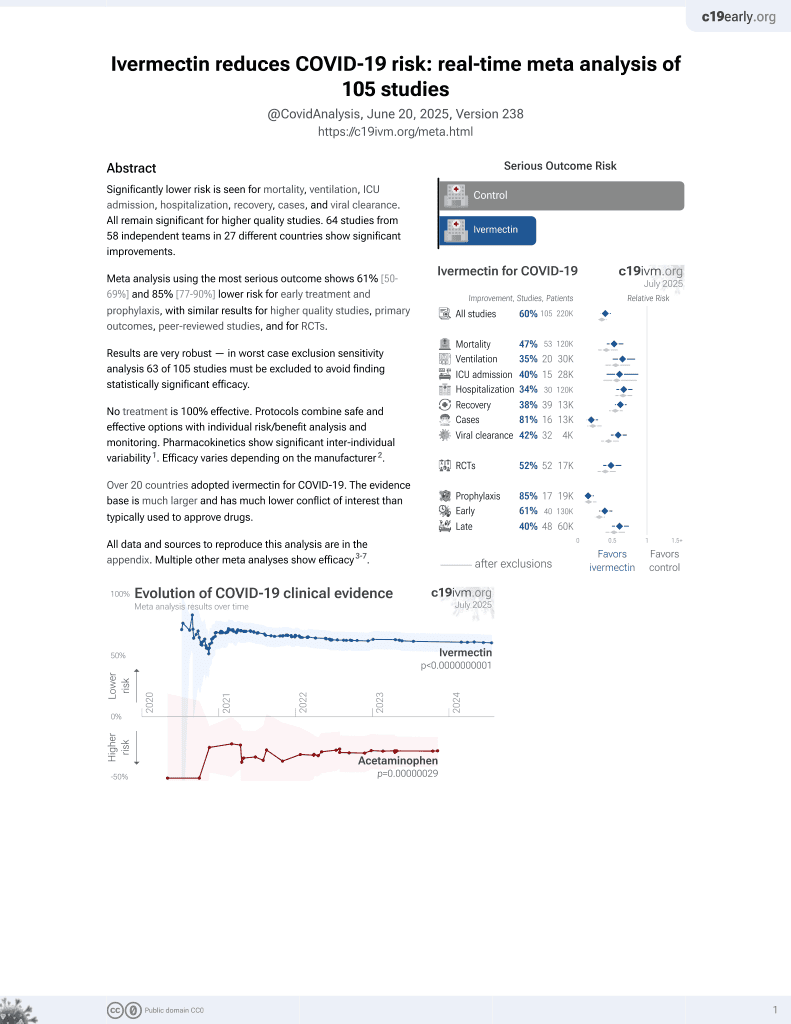
Ivermectin for COVID-19
4th treatment shown to reduce risk in
August 2020, now with p < 0.0000000001 from 106 studies, recognized in 24 countries.
No treatment is 100% effective.
Protocols combine treatments.
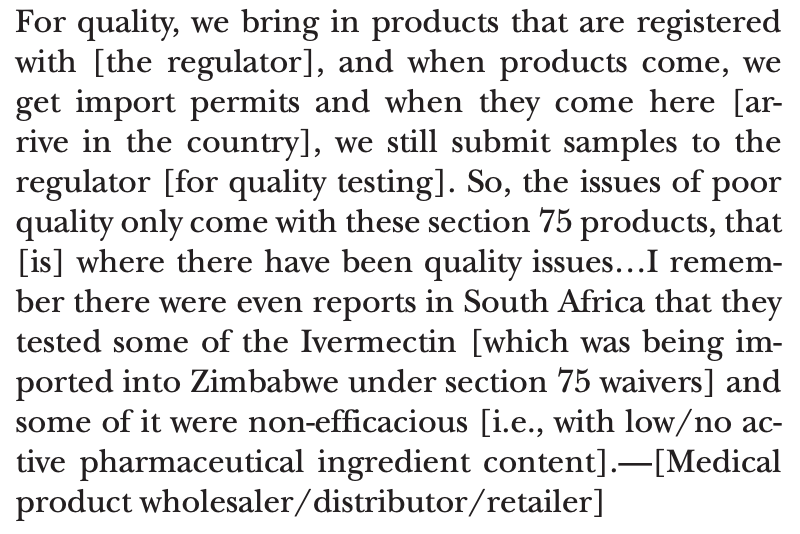
Review of the quality of medical products in Zimbabwe during the pandemic, noting reports of inauthentic ivermectin in South Africa that was tested and found to have low or no active ingredient.

1.
Aldous et al., Obedience to Authority in the COVID-19 Pandemic: Milgram's Lessons on Ivermectin Suppression, figshare, doi:10.6084/m9.figshare.33941086.
2.
Reich, S., Methodological Analysis of Bias Risks in Adaptive Multi-Arm Platform Trials: A Case-Series from Three COVID-19 Studies, Center for Open Science, doi:10.31222/osf.io/h5kc8_v1.
3.
Mothae et al., SARS-CoV-2 host-pathogen interactome: insights into more players during pathogenesis, Virology, doi:10.1016/j.virol.2025.110607.
4.
Zhang et al., Rho-GTPases subfamily: cellular defectors orchestrating viral infection, Cellular & Molecular Biology Letters, doi:10.1186/s11658-025-00722-w.
5.
Saha et al., Inhaled Dry Powder of Antiviral Agents: A Promising Approach to Treating Respiratory Viral Pathogens, Viruses, doi:10.3390/v17020252.
6.
Ulloa-Aguilar et al., The Nucleolus and Its Interactions with Viral Proteins Required for Successful Infection, Cells, doi:10.3390/cells13181591.
7.
Enyeji et al., Effective Treatment of COVID-19 Infection with Repurposed Drugs: Case Reports, Viral Immunology, doi:10.1089/vim.2024.0034.
8.
Wimalawansa, S., Unlocking Insights: Navigating COVID-19 Challenges and Emulating Future Pandemic Resilience Strategies with Strengthening Natural Immunity, Heliyon, doi:10.1016/j.heliyon.2024.e34691.
9.
Shouman et al., SARS-CoV-2-associated lymphopenia: possible mechanisms and the role of CD147, Cell Communication and Signaling, doi:10.1186/s12964-024-01718-3.
10.
Mehraeen et al., Treatments for Olfactory Dysfunction in COVID-19: A Systematic Review, International Archives of Otorhinolaryngology, doi:10.1055/s-0044-1786046.
11.
Scheim et al., Back to the Basics of SARS-CoV-2 Biochemistry: Microvascular Occlusive Glycan Bindings Govern Its Morbidities and Inform Therapeutic Responses, Viruses, doi:10.3390/v16040647.
12.
Yagisawa et al., Global trends in clinical trials of ivermectin for COVID-19—Part 2, The Japanese Journal of Antibiotics, doi:10.11553/antibiotics.77.1_45.
13.
Liu et al., Crosstalk between neutrophil extracellular traps and immune regulation: insights into pathobiology and therapeutic implications of transfusion-related acute lung injury, Frontiers in Immunology, doi:10.3389/fimmu.2023.1324021.
14.
Scheim (B) et al., Sialylated Glycan Bindings from SARS-CoV-2 Spike Protein to Blood and Endothelial Cells Govern the Severe Morbidities of COVID-19, International Journal of Molecular Sciences, doi:10.3390/ijms242317039.
15.
Yemeke et al., Impact of the COVID-19 pandemic on the quality of medical products in Zimbabwe: a qualitative study based on key informant interviews with health system stakeholders, BMJ Open, doi:10.1136/bmjopen-2022-068923.
16.
Kory, P., The Global War on Ivermectin, International Covid Summit III, European Parliament, Brussels, covid19criticalcare.com/wp-content/uploads/2023/05/GLOBAL-WAR-ON-IVERMECTIN-PARLIAMENT.pdf.
17.
Babalola et al., The Place of Ivermectin in the Management of Covid-19: State of the Evidence, Medical Research Archives, doi:10.18103/mra.v11i4.3778.
18.
Loo et al., Recent Advances in Inhaled Nanoformulations of Vaccines and Therapeutics Targeting Respiratory Viral Infections, Pharmaceutical Research, doi:10.1007/s11095-023-03520-1.
19.
Scheim (C), D., From Cold to Killer: How SARS-CoV-2 Evolved without Hemagglutinin Esterase to Agglutinate and Then Clot Blood Cells, Center for Open Science, doi:10.31219/osf.io/sgdj2.
20.
Kory (B), P., The Criminal Censorship of Ivermectin's Efficacy By The High-Impact Medical Journals - Part 1, Pierre Kory’s Medical Musings, pierrekory.substack.com/p/the-criminal-censorship-of-ivermectins.
21.
Al-kuraishy et al., Central effects of Ivermectin in alleviation of Covid-19-induced dysautonomia, Current Drug Targets, doi:10.2174/1389450123666220810102406.
22.
Schwartz, E., Does ivermectin have a place in the treatment of mild Covid-19?, New Microbes and New Infections, doi:10.1016/j.nmni.2022.100989.
23.
Marques et al., Ivermectin as a possible treatment for COVID-19: a review of the 2022 protocols, Brazilian Journal of Biology, doi:10.1590/1519-6984.258325.
24.
Semiz, S., SIT1 transporter as a potential novel target in treatment of COVID-19, Biomolecular Concepts, doi:10.1515/bmc-2021-0017.
25.
Zaidi et al., The mechanisms of action of ivermectin against SARS-CoV-2—an extensive review, The Journal of Antibiotics, doi:10.1038/s41429-021-00491-6.
26.
Behl et al., CD147-spike protein interaction in COVID-19: Get the ball rolling with a novel receptor and therapeutic target, Science of The Total Environment, doi:10.1016/j.scitotenv.2021.152072.
27.
Low et al., Repositioning Ivermectin for Covid-19 treatment: Molecular mechanisms of action against SARS-CoV-2 replication, Biochimica et Biophysica Acta (BBA) - Molecular Basis of Disease, doi:10.1016/j.bbadis.2021.166294.
28.
Fordham et al., The uses and abuses of systematic reviews, OSF Preprints, doi:10.31219/osf.io/mp4f2.
29.
Kow et al., Pitfalls in Reporting Sample Size Calculation Across Randomized Controlled Trials Involving Ivermectin for the treatment of COVID-19, American Journal of Therapeutics, doi:10.1097/MJT.0000000000001441.
30.
Santin et al., Ivermectin: a multifaceted drug of Nobel prize-honored distinction with indicated efficacy against a new global scourge, COVID-19, New Microbes and New Infections, doi:10.1016/j.nmni.2021.100924.
31.
Adegboro et al., A review of the anti-viral effects of ivermectin, African Journal of Clinical and Experimental Microbiology, doi:10.4314/ajcem.v22i3.2.
32.
Turkia, M., A Continuation of a Timeline of Ivermectin-Related Events in the COVID-19 Pandemic [June 30, 2021], ResearchGate, doi:10.13140/RG.2.2.16973.36326.
33.
Jagiasi et al., Variation in therapeutic strategies for the management of severe COVID-19 in India- A nationwide cross-sectional survey, The International Journal of Clinical Practice, doi:10.1111/ijcp.14574.
34.
Lind et al., Increase in Outpatient Ivermectin Dispensing in the US During the COVID-19 Pandemic: A Cross-Sectional Analysis, Journal of General Internal Medicine, doi:10.1007/s11606-021-06948-6.
35.
Wang et al., Minimum manufacturing costs, national prices and estimated global availability of new repurposed therapies for COVID-19, medRxiv, doi:10.1101/2021.06.01.21258147.
36.
Kory (C) et al., Review of the Emerging Evidence Demonstrating the Efficacy of Ivermectin in the Prophylaxis and Treatment of COVID-19, American Journal of Therapeutics, doi:10.1097/MJT.0000000000001377.
37.
DiNicolantonio et al., Anti-inflammatory activity of ivermectin in late-stage COVID-19 may reflect activation of systemic glycine receptors, Open Heart, doi:10.1136/openhrt-2021-001655.
38.
Turkia (B), M., A timeline of ivermectin-related events in the COVID-19 pandemic, Research Gate, www.researchgate.net/publication/350610718_A_Timeline_of_Ivermectin-Related_Events_in_the_COVID-19_Pandemic_April_3_2021.
39.
Wehbe et al., Repurposing Ivermectin for COVID-19: Molecular Aspects and Therapeutic Possibilities, Front. Immunol., doi:10.3389/fimmu.2021.663586.
40.
Yagisawa (B) et al., Global trends in clinical studies of ivermectin in COVID-19, The Japanese Journal of Antibiotics, 74-1, Mar 2021, jja-contents.wdc-jp.com/pdf/JJA74/74-1-open/74-1_44-95.pdf.
41.
Jans et al., The broad spectrum host-directed agent ivermectin as an antiviral for SARS-CoV-2 ?, Biochemical and Biophysical Research Communications, doi:10.1016/j.bbrc.2020.10.042.
42.
Kory (D) et al., Review of the Emerging Evidence Demonstrating the Efficacy of Ivermectin in the Prophylaxis and Treatment of COVID-19, Frontiers in Pharmacology, doi:10.3389/fphar.2021.643369.
43.
Formiga et al., Ivermectin: an award-winning drug with expected antiviral activity against COVID-19, J. Control Release, doi:10.1016/j.jconrel.2020.10.009.
44.
Scheim (D), D., Ivermectin for COVID-19 Treatment: Clinical Response at Quasi-Threshold Doses Via Hypothesized Alleviation of CD147-Mediated Vascular Occlusion, SSRN, doi:10.2139/ssrn.3636557.
45.
Turkia (C), M., FLCCC Alliance MATH+ ascorbic acid and I-MASK+ ivermectin protocols for COVID-19 — a brief review, ResearchGate, www.researchgate.net/profile/Mika_Turkia/publication/345694745_FLCCC_Alliance_MATH_ascorbic_acid_and_I-MASK_ivermectin_protocols_for_COVID-19_-_A_Brief_Review/links/5fab010f4585150781078260/FLCCC-Alliance-MATH-ascorbic-acid-and-I-MASK-ivermectin-protocols-for-COVID-19-A-Brief-Review.pdf.
46.
Jans (B) et al., Ivermectin as a Broad-Spectrum Host-Directed Antiviral: The Real Deal?, Cells 2020, 9:9, 2100, doi:10.3390/cells9092100.
47.
Elkholy et al., Ivermectin: A Closer Look at a Potential Remedy, Cureus, doi:10.7759/cureus.10378.
48.
DiNicolantonio (B) et al., Ivermectin may be a clinically useful anti-inflammatory agent for late-stage COVID-19, Open Heart, doi:10.1136/openhrt-2020-001350.
49.
Vora et al., White paper on Ivermectin as a potential therapy for COVID-19, Indian Journal of Tuberculosis, doi:10.1016/j.ijtb.2020.07.031.
Yemeke et al., 8 Jun 2023, peer-reviewed, 4 authors.
Impact of the COVID-19 pandemic on the quality of medical products in Zimbabwe: a qualitative study based on key informant interviews with health system stakeholders
BMJ Open, doi:10.1136/bmjopen-2022-068923
Objective To explore the impact of the Coronavirus disease 2019 (COVID-19) pandemic on the quality of medical products in Zimbabwe, including market risks for substandard and falsified products and impacts on quality assurance activities. Design Qualitative study based on in-depth key informant interviews. Setting Health system stakeholders across the medical product supply chain in Zimbabwe. Participants 36 key informants were interviewed between April and June 2021. Results We found that the COVID-19 pandemic disrupted quality assurance and regulatory activities of medical products in Zimbabwe, resulted in observations of poorquality personal protective equipment (PPE) and other COVID-19-related products and led to increased risks to quality. Risks to quality due to COVID-19-related disruptions included increased layers of agents in the supply chain and an influx of non-traditional suppliers. COVID-19-related movement restrictions reduced access to health facilities and thus may have increased the usage of the informal market where smuggled and unregistered medical products are sold with less oversight by the regulator. Most reports of poor-quality medical products were for PPE, such as masks and infrared thermometers, used for the COVID-19 response. Besides these reports, many participants stated that the quality of essential medicines in the formal sector, not related to COVID-19, had largely been maintained during the pandemic due to the regulator's stringent quality assurance process. Incentives for suppliers to maintain quality to retain large donor-funded contracts, and the need for local wholesalers and distributors to comply with quality-related aspects of distribution agreements with global manufacturers of brand-name medical products, mitigated threats to quality. Conclusions The COVID-19 pandemic presented opportunities and market risks for circulation of substandard and falsified medical products in Zimbabwe. There is a need for policymakers to invest in measures to safeguard the quality of medical products during emergencies and to build resiliency against future supply chain shocks.
Competing interests None declared. Patient and public involvement Patients and/or the public were involved in the design, or conduct, or reporting, or dissemination plans of this research. Refer to the Methods section for further details. Patient consent for publication Not applicable.
Ethics approval The study received ethical approval from the research ethics review boards at the University of North Carolina at Chapel Hill (IRB # 20-3065) and from the Medical Research Council of Zimbabwe (MRCZ/A/2596). Additional permission to interview key informants affiliated with the Ministry of Health and Child Care (MOHCC) was granted by the National Institute of Health Research within the MOHCC. Participants gave informed consent to participate in the study before taking part. Provenance and peer review Not commissioned; externally peer reviewed. Data availability statement Data are available on reasonable request. All data relevant to the study are included in the article or uploaded as online supplemental file. Study interview guide and codebook are available as article supplementary files. De-identified qualitative memos summarizing participant interviews are available upon reasonable request. Requests should be directed to the corresponding author. Supplemental material This content has been supplied by the author(s). It has not been vetted by BMJ Publishing Group Limited (BMJ) and may not have been peer-reviewed. Any opinions or recommendations discussed are solely those of..
References
Amimo, Lambert, Magit, A review of prospective pathways and impacts of COVID-19 on the accessibility, safety, quality, and Affordability of essential medicines and vaccines for universal health coverage in Africa, Global Health, doi:10.1186/s12992-021-00666-8
Bank, World Bank Country and Lending Groups
Beargie, Higgins, Evans, The economic impact of substandard and falsified Antimalarial medications in Nigeria, PLOS ONE, doi:10.1371/journal.pone.0217910
Borse, Cha, Chase, Responding to the surge of substandard and falsified health products triggered by the Covid-19 pandemic
Braun, Clarke, Using thematic analysis in psychology, Qualitative Research in Psychology, doi:10.1191/1478088706qp063oa
Braun, Clarke, What can "thematic analysis" offer health and wellbeing researchers, Int J Qual Stud Health Well-Being, doi:10.3402/qhw.v9.26152
Cucinotta, Vanelli, WHO declares COVID-19 a pandemic, Acta Biomed, doi:10.23750/abm.v91i1.9397
Evans, Higgins, Laing, Poor-quality Antimalarials further health inequities in Uganda, Health Policy Plan, doi:10.1093/heapol/czz012
Jackson, Higgins, Laing, Impact of substandard and falsified Antimalarials in Zambia: application of the SAFARI model, BMC Public Health, doi:10.1186/s12889-020-08852-w
Kaddu, 'amore, Clark, Strengthening Regulatory Systems To Improve Medical Product Quality in Low-and MiddleIncome Countries
Liu, Caputi, Dredze, Internet searches for Unproven COVID-19 therapies in the United States, JAMA Intern Med, doi:10.1001/jamainternmed.2020.1764
Maguire, Delahunt, Doing a thematic analysis: A practical, stepby-step guide
Makoni, COVID-19 worsens Zimbabwe's health crisis, Lancet, doi:10.1016/S0140-6736(20)31751-7
Marks, Thomas, Bakhet, Medical equipment donation in low-resource settings: a review of the literature and guidelines for surgery and anaesthesia in low-income and middle-income countries, BMJ Glob Health, doi:10.1136/bmjgh-2019-001785
Namey, Guest, Mckenna, Evaluating bang for the buck: A cost-effectiveness comparison between individual interviews and focus groups based on thematic saturation levels, Am J Eval, doi:10.1177/1098214016630406
Newton, Bond, 53 signatories from 20 countries. COVID-19 and risks to the supply and quality of tests, drugs, and vaccines, Lancet Glob Health, doi:10.1016/S2214-109X(20)30136-4
Newton, Bond, Adeyeye, COVID-19 and risks to the supply and quality of tests, drugs, and vaccines, Lancet Glob Health, doi:10.1016/S2214-109X(20)30136-4
Novakowski, Garcia-Gonzalez, Wrigglesworth, A Pharmacovigilance system for treatment access and medical donation programs: the Max foundation experience, doi:10.1186/s12992-018-0391-4
Nowell, Norris, White, Thematic analysis:striving to meet the trustworthiness criteria, Int J Qual Methods, doi:10.1177/1609406917733847
Ozawa, Evans, Bessias, Prevalence and estimated economic burden of substandard and falsified medicines in Low-and middle-income countries: A systematic review and meta-analysis, JAMA Netw Open, doi:10.1001/jamanetworkopen.2018.1662
Ozawa, Haynie, Bessias, Modeling the economic impact of substandard and falsified Antimalarials in the Democratic Republic of the Congo, Am J Trop Med Hyg, doi:10.4269/ajtmh.18-0334
Ozawa, Higgins, Nwokike, Modeling the health and economic impact of substandard and falsified medicines: A on June 16, 2023 by guest, Am J Trop Med Hyg, doi:10.4269/ajtmh.21-1133
Ozawa, Higgins, Yemeke, Importance of medicine quality in achieving universal health coverage, PLOS ONE, doi:10.1371/journal.pone.0232966
Pecchia, Health technology assessment of medical devices in low and middle income countries: study design and preliminary
Pecchia, Piaggio, Maccaro, The inadequacy of regulatory Frameworks in time of crisis and in low-resource settings: personal protective equipment and COVID-19, Health Technol, doi:10.1007/s12553-020-00429-2
Pisani, Nistor, Hasnida, Identifying market risk for substandard and falsified medicines: an analytic framework based on qualitative research in China, Indonesia, Turkey and Romania, Wellcome Open Res, doi:10.12688/wellcomeopenres.15236.1
Preston, Valdez, Bond, Strengthening medical product regulation in Low-and middle-income countries, PLOS Med, doi:10.1371/journal.pmed.1001327
Shiferie, Kassa, The scourge of substandard and falsified medical products gets worse with COVID-19 pandemic, Pan Afr Med J, doi:10.11604/pamj.2020.37.344.26322
Sithole, Mahlangu, Salek, Evaluation of the regulatory review process in Zimbabwe: challenges and opportunities, Ther Innov Regul Sci, doi:10.1007/s43441-020-00242-z
Sithole, Salek, Mahlangu, Comparison of the registration process of the medicines control authority of Zimbabwe with Australia, Expert Rev Clin Pharmacol, doi:10.1080/17512433.2022.1987883
Tesfaye, Abrha, Sinnollareddy, How do we combat bogus medicines in the age of the COVID-19 pandemic, Am J Trop Med Hyg, doi:10.4269/ajtmh.20-0903
Twesigye, Hafner, Guzman, Making the investment case for national regulatory authorities, J of Pharm Policy and Pract, doi:10.1186/s40545-021-00299-7
DOI record:
{
"DOI": "10.1136/bmjopen-2022-068923",
"ISSN": [
"2044-6055",
"2044-6055"
],
"URL": "http://dx.doi.org/10.1136/bmjopen-2022-068923",
"abstract": "<jats:sec><jats:title>Objective</jats:title><jats:p>To explore the impact of the Coronavirus disease 2019 (COVID-19) pandemic on the quality of medical products in Zimbabwe, including market risks for substandard and falsified products and impacts on quality assurance activities.</jats:p></jats:sec><jats:sec><jats:title>Design</jats:title><jats:p>Qualitative study based on in-depth key informant interviews.</jats:p></jats:sec><jats:sec><jats:title>Setting</jats:title><jats:p>Health system stakeholders across the medical product supply chain in Zimbabwe.</jats:p></jats:sec><jats:sec><jats:title>Participants</jats:title><jats:p>36 key informants were interviewed between April and June 2021.</jats:p></jats:sec><jats:sec><jats:title>Results</jats:title><jats:p>We found that the COVID-19 pandemic disrupted quality assurance and regulatory activities of medical products in Zimbabwe, resulted in observations of poor-quality personal protective equipment (PPE) and other COVID-19-related products and led to increased risks to quality. Risks to quality due to COVID-19-related disruptions included increased layers of agents in the supply chain and an influx of non-traditional suppliers. COVID-19-related movement restrictions reduced access to health facilities and thus may have increased the usage of the informal market where smuggled and unregistered medical products are sold with less oversight by the regulator. Most reports of poor-quality medical products were for PPE, such as masks and infrared thermometers, used for the COVID-19 response. Besides these reports, many participants stated that the quality of essential medicines in the formal sector, not related to COVID-19, had largely been maintained during the pandemic due to the regulator’s stringent quality assurance process. Incentives for suppliers to maintain quality to retain large donor-funded contracts, and the need for local wholesalers and distributors to comply with quality-related aspects of distribution agreements with global manufacturers of brand-name medical products, mitigated threats to quality.</jats:p></jats:sec><jats:sec><jats:title>Conclusions</jats:title><jats:p>The COVID-19 pandemic presented opportunities and market risks for circulation of substandard and falsified medical products in Zimbabwe. There is a need for policymakers to invest in measures to safeguard the quality of medical products during emergencies and to build resiliency against future supply chain shocks.</jats:p></jats:sec>",
"alternative-id": [
"10.1136/bmjopen-2022-068923"
],
"author": [
{
"ORCID": "http://orcid.org/0000-0002-1489-627X",
"affiliation": [],
"authenticated-orcid": false,
"family": "Yemeke",
"given": "Tatenda T",
"sequence": "first"
},
{
"ORCID": "http://orcid.org/0000-0003-3305-5836",
"affiliation": [],
"authenticated-orcid": false,
"family": "Umaru",
"given": "Farouk A",
"sequence": "additional"
},
{
"affiliation": [],
"family": "Ferrand",
"given": "Rashida A",
"sequence": "additional"
},
{
"ORCID": "http://orcid.org/0000-0001-7608-9038",
"affiliation": [],
"authenticated-orcid": false,
"family": "Ozawa",
"given": "Sachiko",
"sequence": "additional"
}
],
"container-title": "BMJ Open",
"container-title-short": "BMJ Open",
"content-domain": {
"crossmark-restriction": true,
"domain": [
"bmj.com"
]
},
"created": {
"date-parts": [
[
2023,
6,
8
]
],
"date-time": "2023-06-08T17:27:17Z",
"timestamp": 1686245237000
},
"deposited": {
"date-parts": [
[
2023,
6,
8
]
],
"date-time": "2023-06-08T17:27:39Z",
"timestamp": 1686245259000
},
"funder": [
{
"DOI": "10.13039/100010269",
"award": [
"206316_Z_17_Z"
],
"doi-asserted-by": "publisher",
"name": "Wellcome Trust"
},
{
"award": [
"N/A"
],
"name": "US Pharmacopeial Convention"
}
],
"indexed": {
"date-parts": [
[
2023,
6,
9
]
],
"date-time": "2023-06-09T04:31:21Z",
"timestamp": 1686285081173
},
"is-referenced-by-count": 0,
"issue": "6",
"issued": {
"date-parts": [
[
2023,
6
]
]
},
"journal-issue": {
"issue": "6",
"published-online": {
"date-parts": [
[
2023,
6,
8
]
]
},
"published-print": {
"date-parts": [
[
2023,
6
]
]
}
},
"language": "en",
"license": [
{
"URL": "http://creativecommons.org/licenses/by-nc/4.0/",
"content-version": "unspecified",
"delay-in-days": 7,
"start": {
"date-parts": [
[
2023,
6,
8
]
],
"date-time": "2023-06-08T00:00:00Z",
"timestamp": 1686182400000
}
}
],
"link": [
{
"URL": "https://syndication.highwire.org/content/doi/10.1136/bmjopen-2022-068923",
"content-type": "unspecified",
"content-version": "vor",
"intended-application": "similarity-checking"
}
],
"member": "239",
"original-title": [],
"page": "e068923",
"prefix": "10.1136",
"published": {
"date-parts": [
[
2023,
6
]
]
},
"published-online": {
"date-parts": [
[
2023,
6,
8
]
]
},
"published-print": {
"date-parts": [
[
2023,
6
]
]
},
"publisher": "BMJ",
"reference": [
{
"article-title": "WHO declares COVID-19 a pandemic",
"author": "Cucinotta",
"first-page": "157",
"journal-title": "Acta Biomed",
"key": "2023060810252180000_13.6.e068923.1",
"volume": "91",
"year": "2020"
},
{
"key": "2023060810252180000_13.6.e068923.2",
"unstructured": "United Nations office on drugs and crime . COVID-19-related trafficking of medical products as a threat to public health. United Nations, 2020."
},
{
"DOI": "10.1016/S2214-109X(20)30136-4",
"article-title": "COVID-19 and risks to the supply and quality of tests, drugs, and vaccines",
"author": "Newton",
"doi-asserted-by": "crossref",
"first-page": "e754",
"journal-title": "Lancet Glob Health",
"key": "2023060810252180000_13.6.e068923.3",
"volume": "8",
"year": "2020"
},
{
"key": "2023060810252180000_13.6.e068923.4",
"unstructured": "Borse NN , Cha J , Chase CG , et al . Responding to the surge of substandard and falsified health products triggered by the Covid-19 pandemic. Rockville, MD: United States Pharmacopeia (USP), 2021."
},
{
"key": "2023060810252180000_13.6.e068923.5",
"unstructured": "Medicine Quality Research Group . Medical Product Quality Report – COVID-19 Issues. University of Oxford, 2021."
},
{
"key": "2023060810252180000_13.6.e068923.6",
"unstructured": "World Health Organization . Definitions of Substandard and Falsified (SF) Medical Products. Geneva, Switzerland: World Health Organization, 2022. Available: https://www.who.int/teams/regulation-prequalification/incidents-and-SF/background/definitions"
},
{
"key": "2023060810252180000_13.6.e068923.7",
"unstructured": "World Health Organization . A study on the public health and socioeconomic impact of substandard and falsified medical products. Geneva: Switzerland World Health Organization, 2017."
},
{
"DOI": "10.1371/journal.pone.0217910",
"doi-asserted-by": "crossref",
"key": "2023060810252180000_13.6.e068923.8",
"unstructured": "Beargie SM , Higgins CR , Evans DR , et al . The economic impact of substandard and falsified Antimalarial medications in Nigeria. PLOS ONE 2019;14:e0217910. doi:10.1371/journal.pone.0217910"
},
{
"DOI": "10.4269/ajtmh.21-1133",
"article-title": "Modeling the health and economic impact of substandard and falsified medicines: A review of existing models and approaches",
"author": "Ozawa",
"doi-asserted-by": "crossref",
"first-page": "14",
"journal-title": "Am J Trop Med Hyg",
"key": "2023060810252180000_13.6.e068923.9",
"volume": "107",
"year": "2022"
},
{
"DOI": "10.1186/s12889-020-08852-w",
"doi-asserted-by": "crossref",
"key": "2023060810252180000_13.6.e068923.10",
"unstructured": "Jackson KD , Higgins CR , Laing SK , et al . Impact of substandard and falsified Antimalarials in Zambia: application of the SAFARI model. BMC Public Health 2020;20:1083. doi:10.1186/s12889-020-08852-w"
},
{
"DOI": "10.4269/ajtmh.18-0334",
"article-title": "Modeling the economic impact of substandard and falsified Antimalarials in the Democratic Republic of the Congo",
"author": "Ozawa",
"doi-asserted-by": "crossref",
"first-page": "1149",
"journal-title": "Am J Trop Med Hyg",
"key": "2023060810252180000_13.6.e068923.11",
"volume": "100",
"year": "2019"
},
{
"DOI": "10.1093/heapol/czz012",
"article-title": "Poor-quality Antimalarials further health inequities in Uganda",
"author": "Evans",
"doi-asserted-by": "crossref",
"first-page": "iii36",
"issue": "Supplement_3",
"journal-title": "Health Policy Plan",
"key": "2023060810252180000_13.6.e068923.12",
"volume": "34",
"year": "2019"
},
{
"DOI": "10.52439/KPEH5007",
"doi-asserted-by": "crossref",
"key": "2023060810252180000_13.6.e068923.13",
"unstructured": "World Health Organization . Health in 2015: from Mdgs, millennium development goals to Sdgs, sustainable development goals. 2015. doi:10.52439/KPEH5007"
},
{
"key": "2023060810252180000_13.6.e068923.14",
"unstructured": "World Health Organization . Universal health coverage (UHC). 2019. Available: https://www.who.int/en/news-room/fact-sheets/detail/universal-health-coverage-(uhc)"
},
{
"key": "2023060810252180000_13.6.e068923.15",
"unstructured": "World Health Organization . Sustainable development goals (Sdgs): goal 3. target 38. Geneva, Switzerland: WHO, 2019. Available: http://iris.wpro.who.int/handle/10665.1/12880"
},
{
"DOI": "10.1371/journal.pone.0232966",
"doi-asserted-by": "crossref",
"key": "2023060810252180000_13.6.e068923.16",
"unstructured": "Ozawa S , Higgins CR , Yemeke TT , et al . Importance of medicine quality in achieving universal health coverage. PLOS ONE 2020;15:e0232966. doi:10.1371/journal.pone.0232966"
},
{
"key": "2023060810252180000_13.6.e068923.17",
"unstructured": "World Health Organization . Full List of WHO Medical Product Alerts. Geneva, Switzerland: World Health Organization, 2021. Available: https://www.who.int/teams/regulation-prequalification/incidents-and-SF/full-list-of-who-medical-product-alerts"
},
{
"DOI": "10.12688/wellcomeopenres.15236.1",
"doi-asserted-by": "crossref",
"key": "2023060810252180000_13.6.e068923.18",
"unstructured": "Pisani E , Nistor AL , Hasnida A , et al . Identifying market risk for substandard and falsified medicines: an analytic framework based on qualitative research in China, Indonesia, Turkey and Romania. Wellcome Open Res 2019;4:70. doi:10.12688/wellcomeopenres.15236.1"
},
{
"DOI": "10.1001/jamanetworkopen.2018.1662",
"doi-asserted-by": "crossref",
"key": "2023060810252180000_13.6.e068923.19",
"unstructured": "Ozawa S , Evans DR , Bessias S , et al . Prevalence and estimated economic burden of substandard and falsified medicines in Low- and middle-income countries: A systematic review and meta-analysis. JAMA Netw Open 2018;1:e181662. doi:10.1001/jamanetworkopen.2018.1662"
},
{
"DOI": "10.1186/s40545-021-00299-7",
"doi-asserted-by": "crossref",
"key": "2023060810252180000_13.6.e068923.20",
"unstructured": "Twesigye G , Hafner T , Guzman J . Making the investment case for national regulatory authorities. J of Pharm Policy and Pract 2021;14. doi:10.1186/s40545-021-00299-7"
},
{
"DOI": "10.1371/journal.pmed.1001327",
"doi-asserted-by": "crossref",
"key": "2023060810252180000_13.6.e068923.21",
"unstructured": "Preston C , Valdez ML , Bond K . Strengthening medical product regulation in Low- and middle-income countries. PLOS Med 2012;9:e1001327. doi:10.1371/journal.pmed.1001327"
},
{
"key": "2023060810252180000_13.6.e068923.22",
"unstructured": "Kaddu G , D’Amore E , Clark APN . Strengthening Regulatory Systems To Improve Medical Product Quality in Low- and MiddleIncome Countries. Rockville, Maryland: U.S. Pharmacopeial Convention, 2018."
},
{
"key": "2023060810252180000_13.6.e068923.23",
"unstructured": "World Health Organization . Zimbabwe Medicines Quality Lab Gets WHO Approva. Geneva, Switzerland: World Health Organization, 2014. Available: https://www.who.int/medicines/news/zwe_med_quality_lab/en/"
},
{
"key": "2023060810252180000_13.6.e068923.24",
"unstructured": "Bank W . World Bank Country and Lending Groups. Washington, D.C: The World Bank, 2022. Available: https://datahelpdesk.worldbank.org/knowledgebase/articles/906519-world-bank-country-and-lending-groups"
},
{
"DOI": "10.1080/17512433.2022.1987883",
"article-title": "Comparison of the registration process of the medicines control authority of Zimbabwe with Australia, Canada, Singapore, and Switzerland: Benchmarking best practices",
"author": "Sithole",
"doi-asserted-by": "crossref",
"first-page": "109",
"journal-title": "Expert Rev Clin Pharmacol",
"key": "2023060810252180000_13.6.e068923.25",
"volume": "15",
"year": "2022"
},
{
"DOI": "10.1007/s43441-020-00242-z",
"article-title": "Evaluation of the regulatory review process in Zimbabwe: challenges and opportunities",
"author": "Sithole",
"doi-asserted-by": "crossref",
"first-page": "474",
"journal-title": "Ther Innov Regul Sci",
"key": "2023060810252180000_13.6.e068923.26",
"volume": "55",
"year": "2021"
},
{
"key": "2023060810252180000_13.6.e068923.27",
"unstructured": "Zimbabwe . Rcore Trainings: medicines control authority of Zimbabwe. 2021. Available: https://www.mcaz.co.zw/rcore-trainings/"
},
{
"DOI": "10.1016/S0140-6736(20)31751-7",
"doi-asserted-by": "crossref",
"key": "2023060810252180000_13.6.e068923.28",
"unstructured": "Makoni M . COVID-19 worsens Zimbabwe’s health crisis. Lancet 2020;396:.:S0140-6736(20)31751-7. doi:10.1016/S0140-6736(20)31751-7"
},
{
"DOI": "10.1177/1098214016630406",
"article-title": "Evaluating bang for the buck: A cost-effectiveness comparison between individual interviews and focus groups based on thematic saturation levels",
"author": "Namey",
"doi-asserted-by": "crossref",
"first-page": "425",
"journal-title": "Am J Eval",
"key": "2023060810252180000_13.6.e068923.29",
"volume": "37",
"year": "2016"
},
{
"key": "2023060810252180000_13.6.e068923.30",
"unstructured": "Maguire M , Delahunt B . Doing a thematic analysis: A practical, step-by-step guide. 2017;9."
},
{
"DOI": "10.1191/1478088706qp063oa",
"article-title": "Using thematic analysis in psychology",
"author": "Braun",
"doi-asserted-by": "crossref",
"first-page": "77",
"journal-title": "Qualitative Research in Psychology",
"key": "2023060810252180000_13.6.e068923.31",
"volume": "3",
"year": "2006"
},
{
"DOI": "10.3402/qhw.v9.26152",
"doi-asserted-by": "crossref",
"key": "2023060810252180000_13.6.e068923.32",
"unstructured": "Braun V , Clarke V . What can \"thematic analysis\" offer health and wellbeing researchers. Int J Qual Stud Health Well-Being 2014;9:26152. doi:10.3402/qhw.v9.26152"
},
{
"DOI": "10.1177/1609406917733847",
"article-title": "Thematic analysis:striving to meet the trustworthiness criteria",
"author": "Nowell",
"doi-asserted-by": "crossref",
"first-page": "1609406917733847",
"journal-title": "Int J Qual Methods",
"key": "2023060810252180000_13.6.e068923.33",
"volume": "16",
"year": "2017"
},
{
"key": "2023060810252180000_13.6.e068923.34",
"unstructured": "Medicines control authority of Zimbabwe . Import & export Harare. Zimbabwe: Medicines Control Authority of Zimbabwe, 2021. Available: https://www.mcaz.co.zw/licensing-and-enforcement/import-export/"
},
{
"DOI": "10.11604/pamj.2020.37.344.26322",
"doi-asserted-by": "crossref",
"key": "2023060810252180000_13.6.e068923.35",
"unstructured": "Shiferie F , Kassa E . The scourge of substandard and falsified medical products gets worse with COVID-19 pandemic. Pan Afr Med J 2020;37:344. doi:10.11604/pamj.2020.37.344.26322"
},
{
"DOI": "10.4269/ajtmh.20-0903",
"article-title": "How do we combat bogus medicines in the age of the COVID-19 pandemic",
"author": "Tesfaye",
"doi-asserted-by": "crossref",
"first-page": "1360",
"journal-title": "Am J Trop Med Hyg",
"key": "2023060810252180000_13.6.e068923.36",
"volume": "103",
"year": "2020"
},
{
"DOI": "10.1186/s12992-021-00666-8",
"doi-asserted-by": "crossref",
"key": "2023060810252180000_13.6.e068923.37",
"unstructured": "Amimo F , Lambert B , Magit A , et al . A review of prospective pathways and impacts of COVID-19 on the accessibility, safety, quality, and Affordability of essential medicines and vaccines for universal health coverage in Africa. Global Health 2021;17:42. doi:10.1186/s12992-021-00666-8"
},
{
"key": "2023060810252180000_13.6.e068923.38",
"unstructured": "Infectious Diseases Data Observatory . Medicine quality monitoring globe: infectious diseases data Observatory. 2022. Available: https://www.iddo.org/mqmglobe/"
},
{
"DOI": "10.1016/S2214-109X(20)30136-4",
"article-title": "COVID-19 and risks to the supply and quality of tests, drugs, and vaccines",
"author": "Newton",
"doi-asserted-by": "crossref",
"first-page": "e754",
"journal-title": "Lancet Glob Health",
"key": "2023060810252180000_13.6.e068923.39",
"volume": "8",
"year": "2020"
},
{
"DOI": "10.1007/s12553-020-00429-2",
"article-title": "The inadequacy of regulatory Frameworks in time of crisis and in low-resource settings: personal protective equipment and COVID-19",
"author": "Pecchia",
"doi-asserted-by": "crossref",
"first-page": "1375",
"journal-title": "Health Technol",
"key": "2023060810252180000_13.6.e068923.40",
"volume": "10",
"year": "2020"
},
{
"DOI": "10.1007/978-981-10-5122-7_57",
"doi-asserted-by": "crossref",
"key": "2023060810252180000_13.6.e068923.41",
"unstructured": "Pecchia L . Health technology assessment of medical devices in low and middle income countries: study design and preliminary. 2018:225–8. doi:10.1007/978-981-10-5122-7"
},
{
"DOI": "10.1001/jamainternmed.2020.1764",
"article-title": "Internet searches for Unproven COVID-19 therapies in the United States",
"author": "Liu",
"doi-asserted-by": "crossref",
"first-page": "1116",
"journal-title": "JAMA Intern Med",
"key": "2023060810252180000_13.6.e068923.42",
"volume": "180",
"year": "2020"
},
{
"DOI": "10.1136/bmjgh-2019-001785",
"doi-asserted-by": "crossref",
"key": "2023060810252180000_13.6.e068923.43",
"unstructured": "Marks IH , Thomas H , Bakhet M , et al . Medical equipment donation in low-resource settings: a review of the literature and guidelines for surgery and anaesthesia in low-income and middle-income countries. BMJ Glob Health 2019;4:e001785. doi:10.1136/bmjgh-2019-001785"
},
{
"DOI": "10.1186/s12992-018-0391-4",
"doi-asserted-by": "crossref",
"key": "2023060810252180000_13.6.e068923.44",
"unstructured": "Novakowski AK , Garcia-Gonzalez P , Wrigglesworth M , et al . A Pharmacovigilance system for treatment access and medical donation programs: the Max foundation experience. Global Health 2018;14:76. doi:10.1186/s12992-018-0391-4"
}
],
"reference-count": 44,
"references-count": 44,
"relation": {},
"resource": {
"primary": {
"URL": "https://bmjopen.bmj.com/lookup/doi/10.1136/bmjopen-2022-068923"
}
},
"score": 1,
"short-title": [],
"source": "Crossref",
"subject": [
"General Medicine"
],
"subtitle": [],
"title": "Impact of the COVID-19 pandemic on the quality of medical products in Zimbabwe: a qualitative study based on key informant interviews with health system stakeholders",
"type": "journal-article",
"update-policy": "http://dx.doi.org/10.1136/crossmarkpolicy",
"volume": "13"
}