Abstract: Acta Cardiol Sin 2026;42:87-98
Original Article
doi: 10.6515/ACS.202601_42(1).20250726A
General Cardiology
Cardiovascular Outcomes in COVID-19 Patients
Treated with Paxlovid: A Multicenter
Retrospective Study
Wei-Lun Chen,1 Victor Chien-Chia Wu,1,2 Chun-Li Wang,1,2 Yu-Ching Wang,3 Yu-Tung Huang,3 Chien-Hao Huang,2,4
Chih-Hsiang Chang,2,5 Shao-Wei Chen,2,3,6 Shang-Hung Chang,1,2,3,7 Cheng-Hsun Chiu8,9 and Pao-Hsien Chu1,2,10
Background: The Coronavirus disease 2019 (COVID-19) pandemic necessitated rapid advances in treatment, with
Paxlovid emerging as an effective oral antiviral. Despite its efficacy in reducing hospitalizations and mortality among
high-risk patients, the impact of Paxlovid on cardiovascular outcomes remains unclear, especially given the increased
cardiovascular risks associated with COVID-19.
Methods: We conducted a retrospective cohort study using data from the Chang Gung Memorial Hospital System
in Taiwan of patients admitted with COVID-19 from January 1, 2022 to December 31, 2022. Propensity score matching
was used to create comparable cohorts of patients treated with Paxlovid and those not treated with Paxlovid. The
primary outcomes were cardiovascular events and all-cause mortality within a 12-month follow-up period.
Results: The study analyzed 606 patients treated with Paxlovid and 1,809 matched patients who were not. Paxlovid
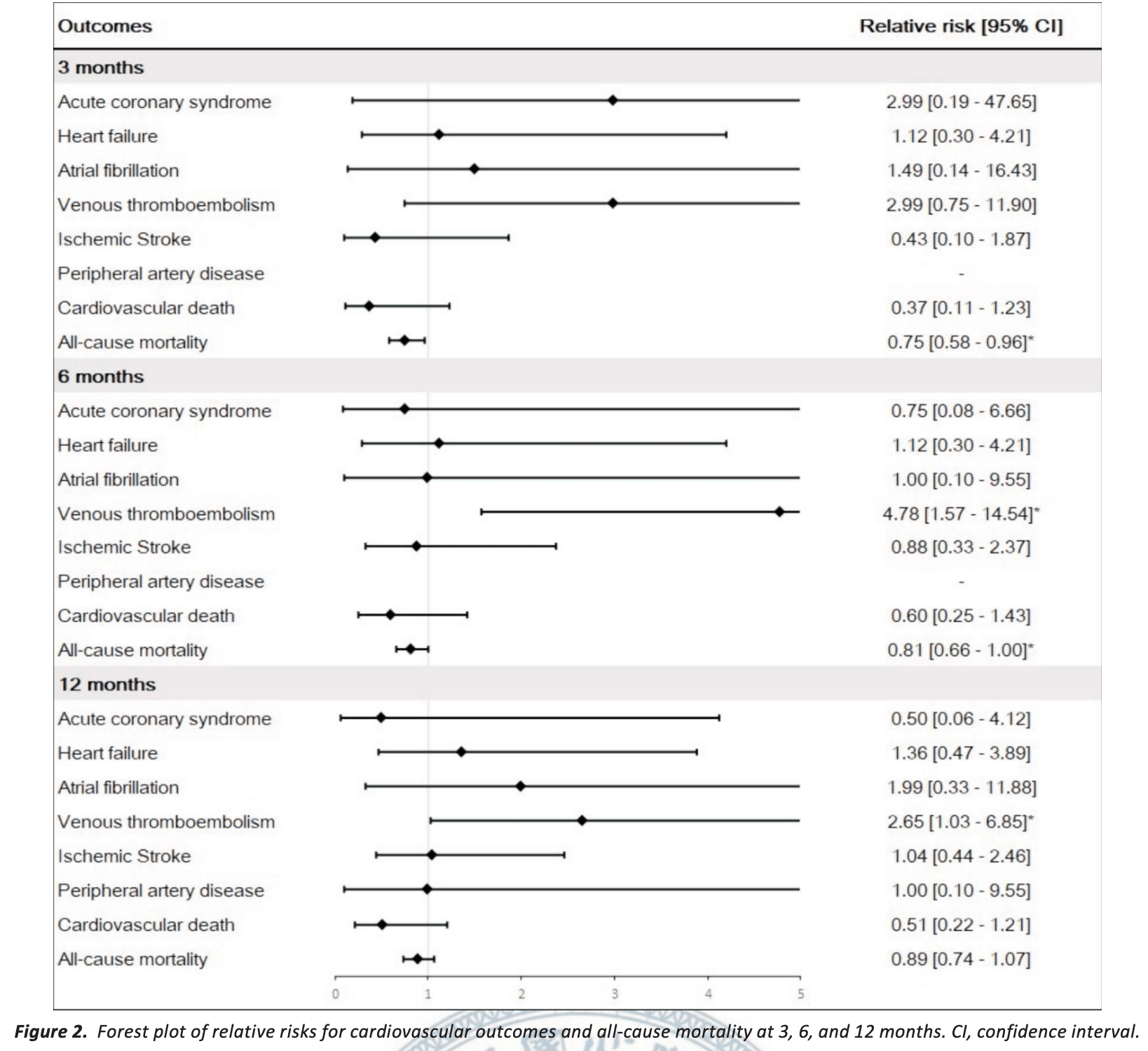
significantly reduced all-cause mortality at 3 months (relative risk [RR] 0.75, p = 0.0216) and 6 months (RR 0.81, p =
0.0492), but this effect was not sustained at 12 months (p = 0.2069). Notably, venous thromboembolism rates were
significantly higher in the Paxlovid group at 6 months (RR 4.78, p = 0.0057) and 12 months (RR 2.65, p = 0.0477).
Conclusions: While Paxlovid treatment resulted in significant short-term survival improvements among COVID-19
patients, it was also associated with a higher incidence of venous thromboembolic complications. These findings
highlight the need for careful patient selection and monitoring, particularly for those with preexisting cardiovascular
conditions.
Key Words:
Cardiovascular events · COVID-19 · Mortality · Outcome · Paxlovid
Abbreviations
CGMF
CGMH
CGRD
CI
COVID-19
DDI
ICD-9-CM
Received: June 3, 2025
Accepted: July 26, 2025
1
Division of Cardiology, Chang Gung Memorial Hospital, Linkou Medical
Center; 2College of Medicine, Chang Gung University; 3Center for Big
Data Analytics and Statistics; 4Division of Hepatology, Department of
Gastroenterology and Hepatology; 5Department of Nephrology, Kidney
Research Center; 6Department of Cardiothoracic and Vascular Surgery,
Chang Gung Memorial Hospital, Linkou Medical Center; 7Graduate
Institute of Nursing, Chang Gung University of Science and Technology;
8
Molecular Infectious Disease Research Center; 9Division of Pediatric
Infectious Diseases, Department of Pediatrics; 10Institute of Stem Cell
and Translational Cancer Research, Chang Gung Memorial Hospital,
Taoyuan, Taiwan.
Corresponding author: Dr. Pao-Hsien Chu, Division of Cardiology,
Chang Gung Memorial Hospital, Linkou Medical Center, No. 5, Fuxing
Street, Guishan District, Taoyuan 33305, Taiwan. Tel: 886-3-328-1200
ext. 8115; Fax: 886-3-328-1451; E-mail: taipei.chu@gmail.com
ICD-10-CM
IRB
RR
SARS-CoV-2
VTE
87
Chang Gung Medical Foundation
Chang Gung Memorial Hospital
Chang Gung Research Database
Confidence interval
Coronavirus disease 2019
Drug-drug interaction
International Classification of Diseases, Ninth
Revision, Clinical..
DOI record:
{
"DOI": "10.6515/ACS.202601_42(1).20250726A",
"URL": "",
"abstract": "",
"author": [
{
"literal": "Wei-Lun Chen"
},
{
"literal": "Victor Chien-Chia Wu"
},
{
"literal": "Chun-Li Wang"
},
{
"literal": "Yu-Ching Wang"
},
{
"literal": "Yu-Tung Huang"
},
{
"literal": "Chien-Hao Huang"
},
{
"literal": "Chih-Hsiang Chang"
},
{
"literal": "Shao-Wei Chen"
},
{
"literal": "Shang-Hung Chang"
},
{
"literal": "Cheng-Hsun Chiu"
},
{
"literal": "Pao-Hsien Chu"
}
],
"container-title": "Acta Cardiologica Sinica",
"issue": "1",
"issued": {
"date-parts": [
[
"2026",
"1",
"31"
]
]
},
"language": "en",
"page-first": "87",
"title": "Cardiovascular Outcomes in COVID-19 Patients Treated with Paxlovid: A Multicenter Retrospective Study",
"type": "article-journal",
"volume": "42"
}