Impact of Implementing More Restrictive Remdesivir Criteria Across a Multi-Hospital Health System
et al., Am. J. Health-Syst. Pharm., doi:10.1093/ajhp/zxaf258, Mar 2026
Retrospective 2,249 hospitalized COVID-19 patients showing lower mortality after restricting remdesivir use. Mortality reduced from 7.6% to 5.6% (p = 0.12) after restriction. No baseline details are provided and results are subject to confounding by time, however both periods were post-pandemic with comparable risk.
Gérard, Zhou, Wu, Kamo, Choi, Kim show increased risk of acute kidney injury, Leo, Briciu, Muntean, Petrov, Arch show increased risk of liver injury, Negru, Cheng, Mohammed, Kwok, Zhu show increased risk of cardiac disorders, and Kwok, Merches, Akinci, Tang, Bagheri show increased risk of mitochondrial toxicity with remdesivir.

1.
Gérard et al., Remdesivir and Acute Renal Failure: A Potential Safety Signal From Disproportionality Analysis of the WHO Safety Database, Clinical Pharmacology & Therapeutics, doi:10.1002/cpt.2145.
2.
Zhou et al., Acute Kidney Injury and Drugs Prescribed for COVID-19 in Diabetes Patients: A Real-World Disproportionality Analysis, Frontiers in Pharmacology, doi:10.3389/fphar.2022.833679.
3.
Wu et al., Acute Kidney Injury Associated With Remdesivir: A Comprehensive Pharmacovigilance Analysis of COVID-19 Reports in FAERS, Frontiers in Pharmacology, doi:10.3389/fphar.2022.692828.
4.
Kamo et al., Association of Antiviral Drugs for the Treatment of COVID-19 With Acute Renal Failure, In Vivo, doi:10.21873/invivo.13637.
5.
Choi et al., Comparative effectiveness of combination therapy with nirmatrelvir–ritonavir and remdesivir versus monotherapy with remdesivir or nirmatrelvir–ritonavir in patients hospitalised with COVID-19: a target trial emulation study, The Lancet Infectious Diseases, doi:10.1016/S1473-3099(24)00353-0.
6.
Kim et al., Investigating the Safety Profile of Fast‐Track COVID‐19 Drugs Using the FDA Adverse Event Reporting System Database: A Comparative Observational Study, Pharmacoepidemiology and Drug Safety, doi:10.1002/pds.70043.
7.
Leo et al., Hepatocellular liver injury in hospitalized patients affected by COVID-19: Presence of different risk factors at different time points, Digestive and Liver Disease, doi:10.1016/j.dld.2021.12.014.
8.
Briciu et al., Evolving Clinical Manifestations and Outcomes in COVID-19 Patients: A Comparative Analysis of SARS-CoV-2 Variant Waves in a Romanian Hospital Setting, Pathogens, doi:10.3390/pathogens12121453.
9.
Muntean et al., Effects of COVID-19 on the Liver and Mortality in Patients with SARS-CoV-2 Pneumonia Caused by Delta and Non-Delta Variants: An Analysis in a Single Centre, Pharmaceuticals, doi:10.3390/ph17010003.
10.
Petrov et al., The Effect of Potentially Hepatotoxic Medicinal Products on Alanine Transaminase Levels in COVID-19 Patients: A Case–Control Study, Safety and Risk of Pharmacotherapy, doi:10.30895/2312-7821-2025-458.
11.
Arch et al., Evaluation of the effectiveness of remdesivir in treating severe COVID-19 using data from the ISARIC WHO Clinical Characterisation Protocol UK: a prospective, national cohort study, medRxiv, doi:10.1101/2021.06.18.21259072.
12.
Negru et al., Comparative Pharmacovigilance Analysis of Approved and Repurposed Antivirals for COVID-19: Insights from EudraVigilance Data, Biomedicines, doi:10.3390/biomedicines13061387.
13.
Cheng et al., Cardiovascular Safety of COVID-19 Treatments: A Disproportionality Analysis of Adverse Event Reports from the WHO VigiBase, Infectious Diseases and Therapy, doi:10.1007/s40121-025-01225-z.
14.
Mohammed et al., Bradycardia associated with remdesivir treatment in coronavirus disease 2019 patients: A propensity score-matched analysis, Medicine, doi:10.1097/MD.0000000000044501.
15.
Kwok et al., Remdesivir induces persistent mitochondrial and structural damage in human induced pluripotent stem cell-derived cardiomyocytes, Cardiovascular Research, doi:10.1093/cvr/cvab311.
16.
Zhu et al., Cardiovascular Risks of COVID-19 Therapeutics: Integrated Analysis of FAERS, Electronic Health Records, and Transcriptomics, Pharmaceuticals, doi:10.3390/ph19040574.
17.
Merches et al., The potential of remdesivir to affect function, metabolism and proliferation of cardiac and kidney cells in vitro, Archives of Toxicology, doi:10.1007/s00204-022-03306-1.
18.
Akinci et al., Elucidation of remdesivir cytotoxicity pathways through genome-wide CRISPR-Cas9 screening and transcriptomics, bioRxiv, doi:10.1101/2020.08.27.270819.
Nicholson et al., 6 Mar 2026, retrospective, USA, peer-reviewed, 3 authors.
Abstract: PROFESSIONAL POSTERS
Impact of Implementing More Restrictive Remdesivir Criteria
Across a Multi-Hospital Health System
Type: Professional Posters
Topic: Infectious Diseases/HIV
Category: Evaluative Study
Primary Author: James P. Nicholson, PharmD, BCPS, Clinical
Pharmacy Manager, Methodist Medical Center of Oak Ridge
Conclusion: The implementation of more restrictive remdesivir
criteria at Covenant Health led to a signi"cant reduction in drug
utilization and generated over $500,000!in cost savings. Importantly,
these changes did not negatively impact clinical outcomes, including
length of stay, mortality, and 30-day readmissions. The cost savings
were consistent compared to a national benchmark, underscoring
the e#ectiveness of targeted stewardship interventions in optimizing
resource utilization in Covid-19!patients.
Co-Author(s): John W. Gilliam, Jesse T. Doers
Purpose: During the COVID-19!pandemic, Covenant Health
initially aligned its remdesivir use criteria with NIH guidelines. In
May 2024, the System Pharmacy and Therapeutics Committee,
following a recommendation from the COVID-19!Subcommittee,
approved more restrictive criteria. These limited remdesivir use to
immunocompromised patients with oxygen requirements within
48!hours of admission and within 10!days of symptom onset. The
updated criteria were implemented in the electronic medical record
in July 2024. This study aimed to evaluate the clinical and "nancial
impact of this change across the health system.
Methods: This retrospective, multi-center study compared remdesivir
use across eight acute care hospitals during two nine-month periods:
pre- (July 2023!to March 2024) and post- (July 2024!to March 2025)
implementation of more restrictive criteria. COVID-19!patients were
identi"ed using ICD-10!codes. Remdesivir data collected included the
number of patients that received the drug, the quantity of 100!mg
vials charged, and associated costs. Pharmacists reviewed remdesivir
orders and contacted providers to discontinue therapy when patients
did not meet the updated criteria. Clinical outcomes assessed
included length of stay, mortality, and 30-day readmission rates. Two
cost analyses were conducted: one adjusted total remdesivir costs
in the pre-implementation group to match the patient volume of
the post-implementation group, and the other compared remdesivir
cost per pharmacy-adjusted patient day with a national benchmark
of approximately 120!healthcare facilities. Data were obtained from
analytics platforms, and statistical analysis was performed using the
Student’s t-test.
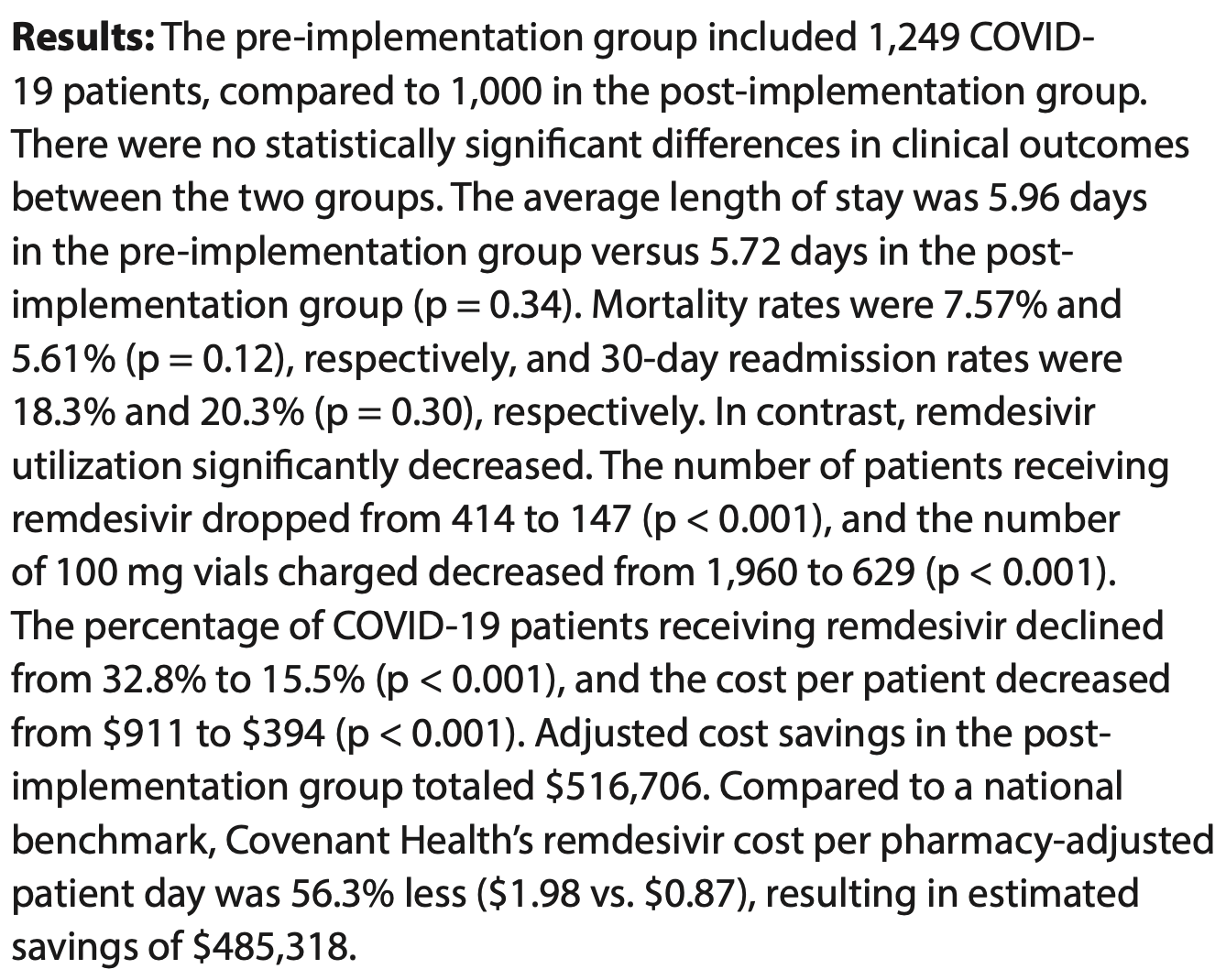
Results: The pre-implementation group included 1,249!COVID19!patients, compared to 1,000!in the post-implementation group.
There were no statistically signi"cant di#erences in clinical outcomes
between the two groups. The average length of stay was 5.96!days
in the pre-implementation group versus 5.72!days in the postimplementation group (p!=!0.34). Mortality rates were 7.57% and
5.61% (p!=!0.12), respectively, and 30-day readmission rates were
18.3% and 20.3% (p!=!0.30), respectively. In contrast, remdesivir
utilization signi"cantly decreased. The number of patients receiving
remdesivir dropped from 414!to 147!(p <!0.001), and the number
of 100!mg vials charged decreased from 1,960!to 629!(p <!0.001).
The percentage of COVID-19!patients receiving remdesivir declined
from 32.8% to 15.5% (p..
DOI record:
{
"DOI": "10.1093/ajhp/zxaf258",
"ISSN": [
"1079-2082",
"1535-2900"
],
"URL": "http://dx.doi.org/10.1093/ajhp/zxaf258",
"container-title": "American Journal of Health-System Pharmacy",
"content-domain": {
"crossmark-restriction": false,
"domain": []
},
"created": {
"date-parts": [
[
2026,
3,
6
]
],
"date-time": "2026-03-06T02:12:36Z",
"timestamp": 1772763156000
},
"deposited": {
"date-parts": [
[
2026,
3,
6
]
],
"date-time": "2026-03-06T02:12:36Z",
"timestamp": 1772763156000
},
"indexed": {
"date-parts": [
[
2026,
3,
6
]
],
"date-time": "2026-03-06T03:08:31Z",
"timestamp": 1772766511955,
"version": "3.50.1"
},
"is-referenced-by-count": 0,
"issue": "Supplement_2",
"issued": {
"date-parts": [
[
2026,
3,
6
]
]
},
"journal-issue": {
"issue": "Supplement_2",
"published-online": {
"date-parts": [
[
2026,
3,
6
]
]
},
"published-print": {
"date-parts": [
[
2026,
3,
6
]
]
}
},
"language": "en",
"license": [
{
"URL": "https://academic.oup.com/pages/standard-publication-reuse-rights",
"content-version": "vor",
"delay-in-days": 0,
"start": {
"date-parts": [
[
2026,
3,
6
]
],
"date-time": "2026-03-06T00:00:00Z",
"timestamp": 1772755200000
}
}
],
"link": [
{
"URL": "https://academic.oup.com/ajhp/article-pdf/83/Supplement_2/S1/67242989/zxaf258.pdf",
"content-type": "application/pdf",
"content-version": "vor",
"intended-application": "syndication"
},
{
"URL": "https://academic.oup.com/ajhp/article-pdf/83/Supplement_2/S1/67242989/zxaf258.pdf",
"content-type": "unspecified",
"content-version": "vor",
"intended-application": "similarity-checking"
}
],
"member": "286",
"original-title": [],
"page": "S1-S2907",
"prefix": "10.1093",
"published": {
"date-parts": [
[
2026,
3,
6
]
]
},
"published-online": {
"date-parts": [
[
2026,
3,
6
]
]
},
"published-other": {
"date-parts": [
[
2026,
3,
6
]
]
},
"published-print": {
"date-parts": [
[
2026,
3,
6
]
]
},
"publisher": "Oxford University Press (OUP)",
"reference-count": 0,
"references-count": 0,
"relation": {},
"resource": {
"primary": {
"URL": "https://academic.oup.com/ajhp/article/83/Supplement_2/S1/8507192"
}
},
"score": 1,
"short-title": [],
"source": "Crossref",
"subject": [],
"subtitle": [],
"title": "2025 ASHP Midyear Clinical Meeting Poster Abstracts",
"type": "journal-article",
"volume": "83"
}
Late treatment
is less effective
is less effective
