Identification of Compounds from Nigella Sativa as New Potential Inhibitors of 2019 Novel Coronasvirus (Covid-19): Molecular Docking Study
et al., ChemRxiv, doi:10.26434/chemrxiv.12055716.v1, Apr 2020
Nigella Sativa for COVID-19
No treatment is 100% effective.
Protocols combine treatments.
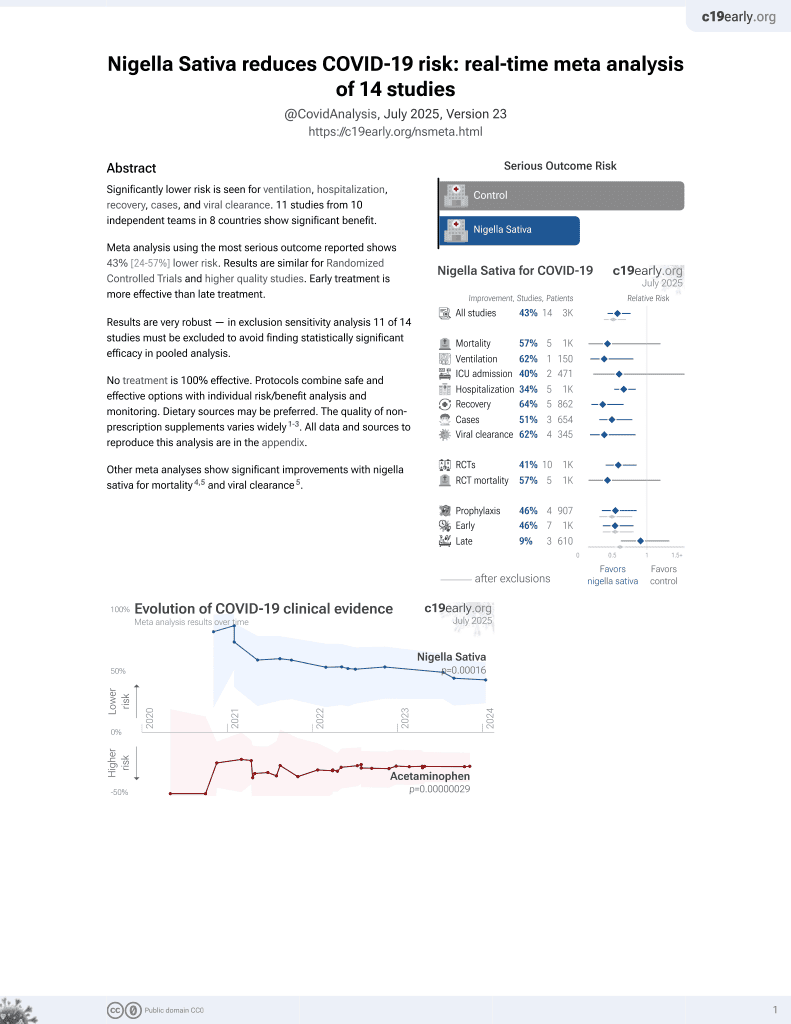
In silico study of compounds from nigella sativa identifying nigellidine and α-Hederin as potential compounds that inhibit SARS-CoV-2.
22 preclinical studies support the efficacy of nigella sativa for COVID-19:

1.
Rahman et al., In Silico Screening of Potential Drug Candidate against Chain a of Coronavirus Binding Protein from Major Nigella Bioactive Compounds, Asian Journal of Advanced Research and Reports, doi:10.9734/ajarr/2024/v18i7697.
2.
Zafar Nayak Snehasis, S., Molecular Docking to Discover Potential Bio-Extract Substitutes for Hydroxychloroquine against COVID-19 and Malaria, International Journal of Science and Research (IJSR), doi:10.21275/SR24323192940.
3.
Alkafaas et al., A study on the effect of natural products against the transmission of B.1.1.529 Omicron, Virology Journal, doi:10.1186/s12985-023-02160-6.
4.
Ali et al., Computational Prediction of Nigella sativa Compounds as Potential Drug Agents for Targeting Spike Protein of SARS-CoV-2, Pakistan BioMedical Journal, doi:10.54393/pbmj.v6i3.853.
5.
Miraz et al., Nigelladine A among Selected Compounds from Nigella sativa Exhibits Propitious Interaction with Omicron Variant of SARS-CoV-2: An In Silico Study, International Journal of Clinical Practice, doi:10.1155/2023/9917306.
6.
Sherwani et al., Pharmacological Profile of Nigella sativa Seeds in Combating COVID-19 through In-Vitro and Molecular Docking Studies, Processes, doi:10.3390/pr10071346.
7.
Khan et al., Inhibitory effect of thymoquinone from Nigella sativa against SARS-CoV-2 main protease. An in-silico study, Brazilian Journal of Biology, doi:10.1590/1519-6984.25066.
8.
Esharkawy et al., In vitro Potential Antiviral SARS-CoV-19- Activity of Natural Product Thymohydroquinone and Dithymoquinone from Nigela sativia, Bioorganic Chemistry, doi:10.1016/j.bioorg.2021.105587.
9.
Banerjee et al., Nigellidine (Nigella sativa, black-cumin seed) docking to SARS CoV-2 nsp3 and host inflammatory proteins may inhibit viral replication/transcription, Natural Product Research, doi:10.1080/14786419.2021.2018430.
10.
Rizvi et al., Identifying the Most Potent Dual-Targeting Compound(s) against 3CLprotease and NSP15exonuclease of SARS-CoV-2 from Nigella sativa: Virtual Screening via Physicochemical Properties, Docking and Dynamic Simulation Analysis, Processes, doi:10.3390/pr9101814.
11.
Mir et al., Identification of SARS-CoV-2 RNA-dependent RNA polymerase inhibitors from the major phytochemicals of Nigella sativa: An in silico approach, Saudi Journal of Biological Sciences, doi:10.1016/j.sjbs.2021.09.002.
12.
Hardianto et al., Exploring the Potency of Nigella sativa Seed in Inhibiting SARS-CoV-2 Main Protease Using Molecular Docking and Molecular Dynamics Simulations, Indonesian Journal of Chemistry, doi:10.22146/ijc.65951.
13.
Maiti et al., Active-site Molecular docking of Nigellidine to nucleocapsid/Nsp2/Nsp3/MPro of COVID-19 and to human IL1R and TNFR1/2 may stop viral-growth/cytokine-flood, and the drug source Nigella sativa (black cumin) seeds show potent antioxidant role in experimental rats, Research Square, doi:10.21203/rs.3.rs-26464/v1.
14.
Duru et al., In silico identification of compounds from Nigella sativa seed oil as potential inhibitors of SARS-CoV-2 targets, Bulletin of the National Research Centre, doi:10.1186/s42269-021-00517-x.
15.
Bouchentouf et al., Identification of Compounds from Nigella Sativa as New Potential Inhibitors of 2019 Novel Coronasvirus (Covid-19): Molecular Docking Study, ChemRxiv, doi:10.26434/chemrxiv.12055716.v1.
16.
Ali (B) et al., In vitro inhibitory effect of Nigella sativa L. extracts on SARS-COV-2 spike protein-ACE2 interaction, Current Therapeutic Research, doi:10.1016/j.curtheres.2024.100759.
17.
Bostancıklıoğlu et al., Nigella sativa, Anthemis hyaline and Citrus sinensis extracts reduce SARS-CoV-2 replication by fluctuating Rho GTPase, PI3K-AKT, and MAPK/ERK pathways in HeLa-CEACAM1a cells, Gene, doi:10.1016/j.gene.2024.148366.
Bouchentouf et al., 2 Apr 2020, preprint, 2 authors.
In silico studies are an important part of preclinical research, however results may be very different in vivo.
Identification of Compounds from Nigella Sativa as New Potential Inhibitors of 2019 Novel Coronasvirus (Covid-19): Molecular Docking Study
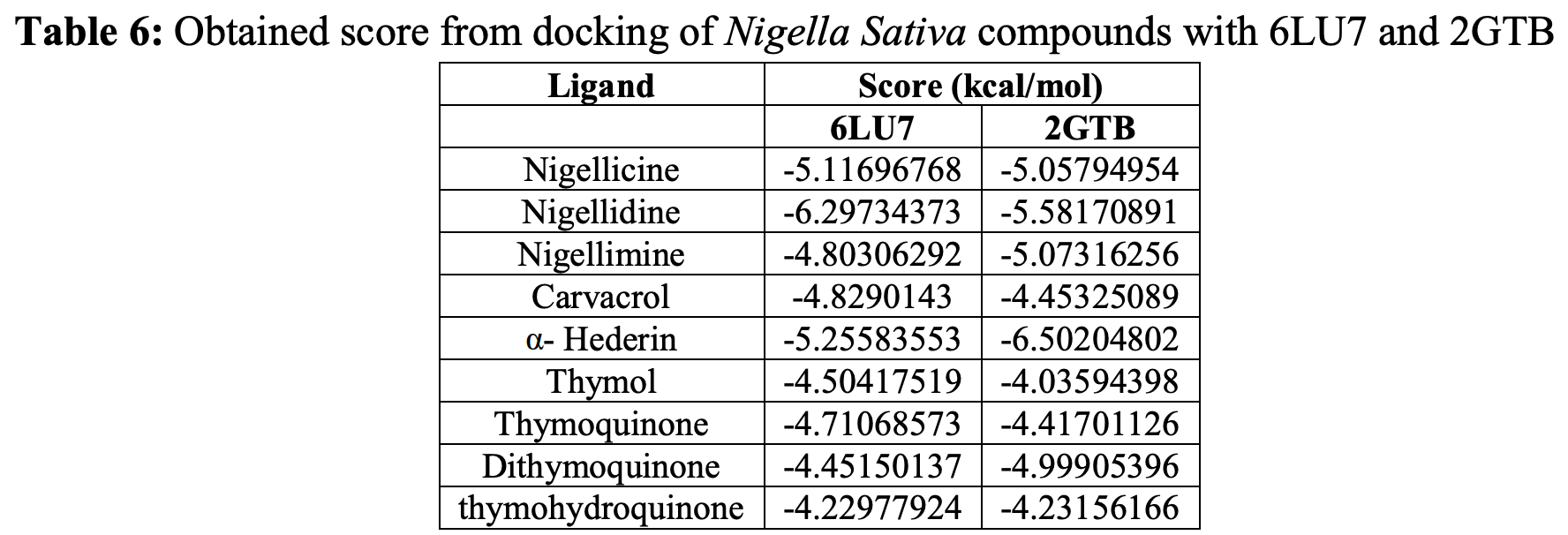
The spread of the global COVID-19 pandemic, the lack of specific treatment and the urgent situation requires use of all resources to remedy this scourge. In the present study, using molecular docking, we identify new probable inhibitors of COVID-19 by molecules from Nigella sativa L, which is highly reputed healing herb in North African societies and both Islamic and Christian traditions. The discovery of the M pro protease structure in COVID-19 provides a great opportunity to identify potential drug candidates for treatment. Focusing on the main proteases in CoVs (3CL pro /M pro ) (PDB ID 6LU7 and 2GTB); docking of compounds from Nigella Sativa and drugs under clinical test was performed using Molecular Operating Environment software (MOE). Nigelledine docked into 6LU7 active site gives energy complex about -6.29734373 Kcal/mol which is close to the energy score given by chloroquine (-6.2930522 Kcal/mol) and better than energy score given by hydroxychloroquine (-5.57386112 Kcal/mol) and favipiravir (-4.23310471 kcal/mol). Docking into 2GTB active site showed that α-Hederin gives energy score about-6.50204802 kcal/mol whcih is better energy score given by chloroquine (-6.20844936 kcal/mol), hydroxychloroquine (-5.51465893 kcal/mol)) and favipiravir (-4.12183571kcal/mol). Nigellidine and α-Hederin appeared to have the best potential to act as COVID-19 treatment. Further, researches are necessary to testify medicinal use of identified and to encourage preventive use of Nigella Sativa against coronavirus infection.
References
Amin, A Study of the Chemical Composition of Black Cumin Oil and Its Effect on Penetration Enhancement from Transdermal Formulations, Natural Product Research, doi:10.1080/14786410902940909
Aqil, Comparative Analysis of Essential Oil Composition of Iranian and Indian Nigella Sativa L. Extracted Using Supercritical Fluid Extraction and Solvent Extraction, Evidence-Based Complementary and Alternative Medicine, doi:10.17582/journal.pjz/2018.50.6.2223.2228
Asadbeigi, Traditional Effects of Medicinal Plants in the Treatment of Respiratory Diseases and Disorders: An Ethnobotanical Study in the Urmia, Asian Pacific Journal of Tropical Medicine, doi:10.1016/S1995-7645(14)60259-5
Chaachouay, Ethnobotanical and Ethnopharmacological Study of Medicinal and Aromatic Plants Used in the Treatment of Respiratory System Disorders in the Moroccan Rif, Ethnobotany Research and Applications
Gautret, Hydroxychloroquine and Azithromycin as a Treatment of COVID-19: Results of an Open-Label Non-Randomized Clinical Trial, doi:10.1016/j.ijantimicag.2020.105949
Hsu, An Evaluation of the Additive Effect of Natural Herbal Medicine on SARS or SARS-Like Infectious Diseases in 2003: A Randomized, Double-Blind, and Controlled Pilot Study, Evidence-Based Complementary and Alternative Medicine, doi:10.1002/minf.202000028
Hui, i 'WHO | World Health Organization
Isaacson, Ploegh, Ubiquitination, Ubiquitin-like Modifiers, and Deubiquitination in Viral Infection, Cell Host & Microbe, doi:10.1016/j.chom.2009.05.012
Karthikeyan, Vyas, Practical Chemoinformatics, doi:10.1007/978-81-322-1780-0
Khaerunnisa, Potential Inhibitor of COVID-19 Main Protease (M pro ) From Several Medicinal Plant Compounds by Molecular Docking Study, MEDICINE & PHARMACOLOGY, doi:10.20944/preprints202003.0226.v1
Khan, Chemical Composition of Nigella Sativa Linn: Part 2 Recent Advances, Inflammopharmacology, doi:10.1007/s10787-016-0262-7
Kokoska, Comparison of Chemical Composition and Antibacterial Activity of Nigella Sativa Seed Essential Oils Obtained by Different Extraction Methods, doi:10.4315/0362-028x-71.12.2475
Li Christopher, Corbeil, Williams, Labute, Variability in Docking Success Rates Due to Dataset Preparation, Journal of Computer-Aided Molecular Design, doi:10.1007/s10822-012-9570-1
Li, Nelfinavir Was Predicted to Be a Potential Inhibitor of 2019-NCov Main Protease by an Integrative Approach Combining Homology Modelling, Molecular Docking and Binding Free Energy Calculation, doi:10.1038/nature02145.xi'RCSBPDB-6LU7:TheCrystalStructureofCOVID-19
Lipinski, Experimental and Computational Approaches to Estimate Solubility and Permeability in Drug Discovery and Development Settings, Advanced Drug Delivery Reviews, doi:10.1016/s0169-409x(00)00129-0
Liu, Nelfinavir Was Predicted to Be a Potential Inhibitor of 2019-NCov Main Protease by an Integrative Approach Combining Homology Modelling, Molecular Docking and Binding Free Energy Calculation, doi:10.1016/j.jep.2013.08.056
Mukherjee, Inhibitors of SARS-3CLpro: Virtual Screening, Biological Evaluation, and Molecular Dynamics Simulation Studies, Journal of Chemical Information and Modeling, doi:10.1021/ci1004916
Paraskevis, Full-Genome Evolutionary Analysis of the Novel Corona Virus (2019-NCoV) Rejects the Hypothesis of Emergence as a Result of a Recent Recombination Event, Infection, Genetics and Evolution, doi:10.1016/j.meegid.2020.104212.v'WHO|WorldHealthOrganization
Singh, Emerging Novel Coronavirus (2019-NCoV)-Current Scenario, Evolutionary Perspective Based on Genome Analysis and Recent Developments, Veterinary Quarterly, doi:10.1080/01652176.2020.1727993
Vi, Zhang, In Silico Screening of Chinese Herbal Medicines with the Potential to Directly Inhibit 2019 Novel Coronavirus, Journal of Integrative Medicine, doi:10.1016/j.joim.2020.02.005
Vincent Madelain, Modeling Favipiravir Antiviral Efficacy against Emerging Viruses: From Animal Studies to Clinical Trials, TIP Revista Especializada En Ciencias Químico-Biológicas, doi:10.1002/psp4.12510
Xliii Christopher, Lipinski, García, Delgado, Giménez, Lead-and Drug-like Compounds: The Rule-of-Five Revolution, doi:10.1016/j.ddtec.2004.11.007
Xxvii, Tariq, Nigella Sativa Seeds: Folklore Treatment in Modern Day Medicine, Saudi Journal of Gastroenterology : Official Journal of the Saudi Gastroenterology Association, doi:10.4103/1319-3767.41725
DOI record:
{
"DOI": "10.26434/chemrxiv.12055716.v1",
"URL": "http://dx.doi.org/10.26434/chemrxiv.12055716.v1",
"abstract": "<jats:p>The spread of the global COVID-19 pandemic, the lack of specific treatment and the urgent situation requires use of all resources to remedy this scourge. In the present study, using molecular docking, we identify new probable inhibitors of COVID-19 by molecules from <jats:italic>Nigella sativa L</jats:italic>, which is highly reputed healing herb in North African societies and both Islamic and Christian traditions. The discovery of the M<jats:sup>pro</jats:sup> protease structure in COVID-19 provides a great opportunity to identify potential drug candidates for treatment. Focusing on the main proteases in CoVs (3CL<jats:sup>pro</jats:sup>/M<jats:sup>pro</jats:sup>) (PDB ID 6LU7 and 2GTB); docking of compounds from <jats:italic>Nigella Sativa</jats:italic> and drugs under clinical test was performed using Molecular Operating Environment software (MOE). Nigelledine docked into 6LU7 active site gives energy complex about -6.29734373 Kcal/mol which is close to the energy score given by chloroquine (-6.2930522 Kcal/mol) and better than energy score given by hydroxychloroquine (-5.57386112 Kcal/mol) and favipiravir (-4.23310471 kcal/mol). Docking into 2GTB active site showed that α- Hederin gives energy score about-6.50204802 kcal/mol whcih is better energy score given by chloroquine (-6.20844936 kcal/mol), hydroxychloroquine (-5.51465893 kcal/mol)) and favipiravir (-4.12183571kcal/mol). Nigellidine and α- Hederin appeared to have the best potential to act as COVID-19 treatment. Further, researches are necessary to testify medicinal use of identified and to encourage preventive use of <jats:italic>Nigella Sativa </jats:italic>against coronavirus infection.</jats:p>",
"accepted": {
"date-parts": [
[
2020,
4,
2
]
]
},
"author": [
{
"ORCID": "http://orcid.org/0000-0002-2725-9798",
"affiliation": [
{
"name": "Doctor Tahar Moulay University of Saida"
}
],
"authenticated-orcid": false,
"family": "Bouchentouf",
"given": "Salim",
"sequence": "first"
},
{
"ORCID": "http://orcid.org/0000-0002-6957-6708",
"affiliation": [],
"authenticated-orcid": false,
"family": "Missoum",
"given": "Noureddine",
"sequence": "additional"
}
],
"container-title": [],
"content-domain": {
"crossmark-restriction": false,
"domain": []
},
"created": {
"date-parts": [
[
2020,
4,
2
]
],
"date-time": "2020-04-02T08:19:37Z",
"timestamp": 1585815577000
},
"deposited": {
"date-parts": [
[
2021,
10,
21
]
],
"date-time": "2021-10-21T19:06:42Z",
"timestamp": 1634843202000
},
"group-title": "Chemistry",
"indexed": {
"date-parts": [
[
2024,
5,
1
]
],
"date-time": "2024-05-01T14:30:28Z",
"timestamp": 1714573828022
},
"is-referenced-by-count": 25,
"issued": {
"date-parts": [
[
2020,
4,
2
]
]
},
"license": [
{
"URL": "https://creativecommons.org/licenses/by-nc-nd/4.0/",
"content-version": "unspecified",
"delay-in-days": 0,
"start": {
"date-parts": [
[
2020,
4,
2
]
],
"date-time": "2020-04-02T00:00:00Z",
"timestamp": 1585785600000
}
}
],
"link": [
{
"URL": "https://chemrxiv.org/engage/api-gateway/chemrxiv/assets/orp/resource/item/60c7495c469df4070af43bbf/original/identification-of-compounds-from-nigella-sativa-as-new-potential-inhibitors-of-2019-novel-coronasvirus-covid-19-molecular-docking-study.pdf",
"content-type": "unspecified",
"content-version": "vor",
"intended-application": "similarity-checking"
}
],
"member": "316",
"original-title": [],
"posted": {
"date-parts": [
[
2020,
4,
2
]
]
},
"prefix": "10.26434",
"published": {
"date-parts": [
[
2020,
4,
2
]
]
},
"publisher": "American Chemical Society (ACS)",
"reference-count": 0,
"references-count": 0,
"relation": {},
"resource": {
"primary": {
"URL": "https://chemrxiv.org/engage/chemrxiv/article-details/60c7495c469df4070af43bbf"
}
},
"score": 1,
"short-title": [],
"source": "Crossref",
"subject": [],
"subtitle": [],
"subtype": "preprint",
"title": "Identification of Compounds from Nigella Sativa as New Potential Inhibitors of 2019 Novel Coronasvirus (Covid-19): Molecular Docking Study.",
"type": "posted-content"
}