Computational exploration of Andrographis paniculata herb compounds as potential antiviral agents targeting NSP3 (6W02) and NSP5 (7AR6) of SARS-COV-2
et al., GSC Biological and Pharmaceutical Sciences, doi:10.30574/gscbps.2023.25.2.0292, Nov 2023
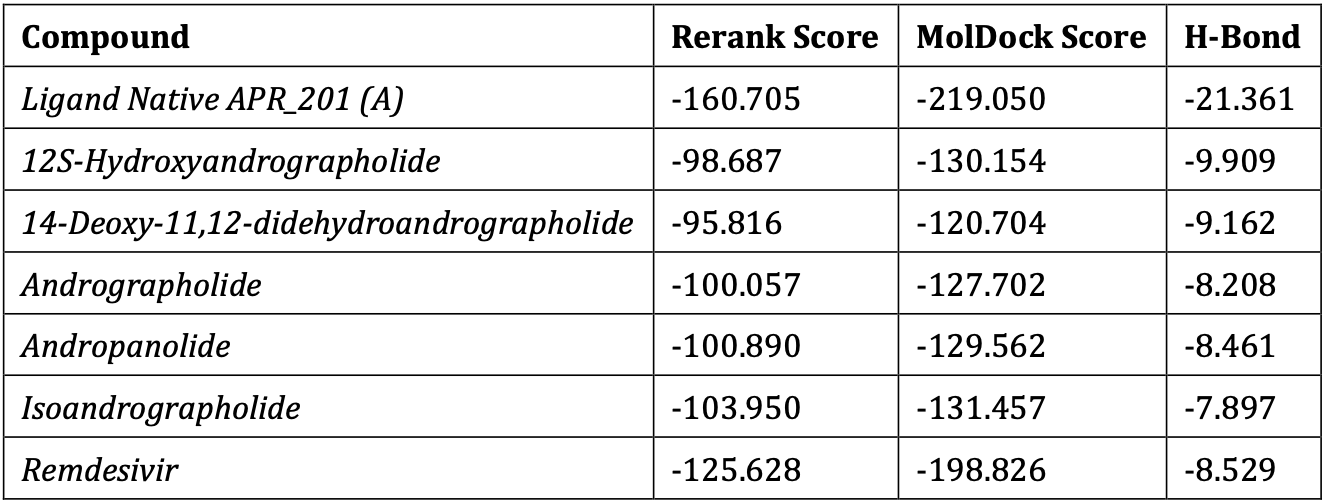
In silico screening of 41 phytochemicals from Andrographis paniculata suggests 5 compounds - 12S-Hydroxyandrographolide, 14-Deoxy-11,12-didehydroandrographolide, Andrographolide, Andropanolide, and Isoandrographolide - have potential as antiviral treatments for COVID-19. These compounds were predicted to have suitable physicochemical properties, low toxicity, and high potential antiviral and immunomodulatory activities. Molecular docking results show the compounds bind reasonably well to SARS-CoV-2 proteins NSP3 and NSP5, suggesting they may inhibit viral replication.
25 preclinical studies support the efficacy of andrographolide for COVID-19:
In vitro studies demonstrate inhibition of the MproA,18 protein.
In vitro studies demonstrate efficacy in Calu-3B,18, A549C,14, and HUVECD,18 cells.
Animal studies demonstrate efficacy in Sprague Dawley miceE,18 and Golden Syrian hamstersF,14.
Andrographolide inhibits Mpro in a dose-dependent manner18, reduces ACE2 levels in the lung tissue of mice in combination with baicalein18, inhibits binding between the SARS-CoV-2 spike protein and ACE218, alleviates lung inflammation and cytokine storm in mice18, and improves survival and reduces lung inflammation via anti-inflammatory effects in Syrian hamsters14.

1.
Zhang et al., Effects and Mechanisms of Andrographolide for COVID-19: A Network Pharmacology-Based and Experimentally Validated Study, Natural Product Communications, doi:10.1177/1934578X241288428.
2.
Thomas et al., Cheminformatics approach to identify andrographolide derivatives as dual inhibitors of methyltransferases (nsp14 and nsp16) of SARS-CoV-2, Scientific Reports, doi:10.1038/s41598-024-58532-7.
3.
Arifin et al., Computational exploration of Andrographis paniculata herb compounds as potential antiviral agents targeting NSP3 (6W02) and NSP5 (7AR6) of SARS-COV-2, GSC Biological and Pharmaceutical Sciences, doi:10.30574/gscbps.2023.25.2.0292.
4.
Bhattarai et al., Investigating the binding affinity of andrographolide against human SARS-CoV-2 spike receptor-binding domain through docking and molecular dynamics simulations, Journal of Biomolecular Structure and Dynamics, doi:10.1080/07391102.2023.2174596.
5.
Nguyen et al., The Potential of Ameliorating COVID-19 and Sequelae From Andrographis paniculata via Bioinformatics, Bioinformatics and Biology Insights, doi:10.1177/11779322221149622.
6.
Dassanayake et al., Molecular Docking and In-Silico Analysis of Natural Biomolecules against Dengue, Ebola, Zika, SARS-CoV-2 Variants of Concern and Monkeypox Virus, International Journal of Molecular Sciences, doi:10.3390/ijms231911131.
7.
Ningrum et al., Potency Of Andrographolide, L-Mimosine And Asiaticoside Compound As Antiviral For Covid-19 Based On In Silico Method, Proceedings Universitas Muhammadiyah Yogyakarta Undergraduate Conference, doi:10.18196/umygrace.v2i2.418.
8.
Ravichandran et al., Identification of Potential Semisynthetic Andrographolide Derivatives to Combat COVID-19 by Targeting the SARS-COV-2 Spike Protein and Human ACE2 Receptor– An In-silico Approach, Biointerface Research in Applied Chemistry, doi:10.33263/BRIAC132.155.
9.
Saeheng et al., In Silico Prediction of Andrographolide Dosage Regimens for COVID-19 Treatment, The American Journal of Chinese Medicine, doi:10.1142/S0192415X22500732.
10.
Khanal et al., Combination of system biology to probe the anti-viral activity of andrographolide and its derivative against COVID-19, RSC Advances, doi:10.1039/D0RA10529E.
11.
Rehan et al., A Computational Approach Identified Andrographolide as a Potential Drug for Suppressing COVID-19-Induced Cytokine Storm, Frontiers in Immunology, doi:10.3389/fimmu.2021.648250.
12.
Rajagopal et al., Activity of phytochemical constituents of Curcuma longa (turmeric) and Andrographis paniculata against coronavirus (COVID-19): an in silico approach, Future Journal of Pharmaceutical Sciences, doi:10.1186/s43094-020-00126-x.
13.
Dey et al., The role of andrographolide and its derivative in COVID-19 associated proteins and immune system, Research Square, doi:10.21203/rs.3.rs-35800/v1.
14.
Kongsomros et al., In vivo evaluation of Andrographis paniculata and Boesenbergia rotunda extract activity against SARS-CoV-2 Delta variant in Golden Syrian hamsters: Potential herbal alternative for COVID-19 treatment, Journal of Traditional and Complementary Medicine, doi:10.1016/j.jtcme.2024.05.004.
15.
Chaopreecha et al., Andrographolide attenuates SARS-CoV-2 infection via an up-regulation of glutamate-cysteine ligase catalytic subunit (GCLC), Phytomedicine, doi:10.1016/j.phymed.2024.156279.
16.
Li et al., Andrographolide suppresses SARS-CoV-2 infection by downregulating ACE2 expression: A mechanistic study, Antiviral Therapy, doi:10.1177/13596535241259952.
17.
Low et al., The wide spectrum anti-inflammatory activity of andrographolide in comparison to NSAIDs: a promising therapeutic compound against the cytokine storm, bioRxiv, doi:10.1101/2024.02.21.581396.
18.
Wan et al., Synergistic inhibition effects of andrographolide and baicalin on coronavirus mechanisms by downregulation of ACE2 protein level, Scientific Reports, doi:10.1038/s41598-024-54722-5.
19.
Siridechakorn et al., Inhibitory efficiency of Andrographis paniculata extract on viral multiplication and nitric oxide production, Scientific Reports, doi:10.1038/s41598-023-46249-y.
a.
The main protease or Mpro, also known as 3CLpro or nsp5, is a cysteine protease that cleaves viral polyproteins into functional units needed for replication. Inhibiting Mpro disrupts the SARS-CoV-2 lifecycle within the host cell, preventing the creation of new copies.
b.
Calu-3 is a human lung adenocarcinoma cell line with moderate ACE2 and TMPRSS2 expression and SARS-CoV-2 susceptibility. It provides a model of the human respiratory epithelium, but many not be ideal for modeling early stages of infection due to the moderate expression levels of ACE2 and TMPRSS2.
c.
A549 is a human lung carcinoma cell line with low ACE2 expression and SARS-CoV-2 susceptibility. Viral entry/replication can be studied but the cells may not replicate all aspects of lung infection.
d.
HUVEC (Human Umbilical Vein Endothelial Cells) are primary endothelial cells derived from the vein of the umbilical cord. They are used to study vascular biology, including inflammation, angiogenesis, and viral interactions with endothelial cells.
e.
An outbred multipurpose breed of albino mouse used extensively in medical research.
f.
A rodent model widely used in infectious disease research due to their susceptibility to viral infections and similar disease progression to humans.
Arifin et al., 9 Nov 2023, peer-reviewed, 5 authors.
In silico studies are an important part of preclinical research, however results may be very different in vivo.
Computational exploration of Andrographis paniculata herb compounds as potential antiviral agents targeting NSP3 (6W02) and NSP5 (7AR6) of SARS-COV-2
GSC Biological and Pharmaceutical Sciences, doi:10.30574/gscbps.2023.25.2.0292
The ongoing COVID-19 pandemic, caused by SARS-CoV-2, requires an urgent search for effective antiviral agents. NSP3 and NSP5, play critical roles in the replication and transcription. This study aimed to screening the physicochemical properties, toxicity, and antiviral potential of herbal compounds from Andrographis paniculata against NSP3 (6W02) and NSP5 (7AR6) of SARS-CoV-2. The herb compounds were obtained from the KNApSAcK Family and PubChem databases. Their interactions with Remdesivir, an FDA-approved antiviral for SARS-CoV-2, NSP3 and NSP5 were analyzed using molecular docking through Molegro Virtual Docker 6.0. There are 27 compounds out of a total of 41 herb compounds that meet the Veber Rule and have predicted good physicochemical properties. Moreover, 15 herb compounds predicted to be non-toxic based on GHS, not-mutagenic, not-carcinogenic, and not-allergenic to the skin. The screening results using PASS Online showed 5 compounds highly potential to be candidates for SARS-CoV-2 antivirals, namely: 12S-Hydroxyandrographolide, 14-Deoxy-11,12-didehydroandrographolide, Andrographolide, Andropanolide, and Isoandrographolide. Based on molecular docking results, it was found both Remdesivir and the herb compounds still required more energy than the native ligand on the 6W02 target protein. In contrast, for the 7AR6 target protein, both Remdesivir and herb compounds required less energy than the native ligand. In conclusion, A. paniculata herb compounds showed inhibitory activity on 6W02 and 7AR6 receptors, suggesting their potential as herbal treatments for SARS-CoV-2 antivirals by targeting the NSP3 and NSP5 proteins. Further validation through in vitro and in vivo studies is needed.
Disclosure of conflict of interest The authors declare that there are -conflicts of interest.
References
Bhal, LogP-Making sense of the value
Bitencourt-Ferreira, De Azevedo, Molegro Virtual Docker for docking, doi:10.1007/978-1-4939-9752-7_10
Cascella, Rajnik, Aleem, Dulebohn, Napoli, Features, evaluation, and treatment of coronavirus (COVID-19)
Chen, Oezguen, Urvil, Ferguson, Dann et al., Regulation of protein-ligand binding affinity by hydrogen bond pairing, Sci Adv [Internet, doi:10.1126/sciadv.1501240
Clark, Pietri, Hydrogen bonding [Internet
Drwal, Banerjee, Dunkel, Wettig, Preissner, ProTox: a web server for the in silico prediction of rodent oral toxicity, Nucleic Acids Res
Filimonov, Lagunin, Gloriozova, Rudik, Druzhilovskii et al., Prediction of the biological activity spectra of organic compounds using the Pass Online web resource, Chem Heterocycl Compd, doi:10.1007/s10593-014-1496-1
Intharuksa, Arunotayanun, Yooin, Sirisa-Ard, A comprehensive review of Andrographis paniculata (Burm. f.) Nees and its constituents as potential lead compounds for COVID-19 drug discovery, Molecules [Internet
Jackson, Farzan, Chen, Choe, Mechanisms of SARS-CoV-2 entry into cells, Nat Rev Mol Cell Biol
Lipinski, Lead-and drug-like compounds: the rule-of-five revolution, Drug Discov Today Technol
Mengist, Dilnessa, Structural basis of potential inhibitors targeting SARS-CoV-2 Main Protease, Front Chem, doi:10.3389/fchem.2021.622898/full
Montastruc, Thuriot, Durrieu, Hepatic disorders with the use of Remdesivir for Coronavirus 2019, Clin Gastroenterol Hepatol
Murugan, Pandian, Jeyakanthan, Computational investigation on Andrographis paniculata phytochemicals to evaluate their potency against SARS-CoV-2 in comparison to known antiviral compounds in drug trials, J Biomol Struct Dyn [Internet, doi:10.1080/07391102.2020.1777901
Narko, Permana, Prasetiawati, Soni, Khairiyah, Molecular Docking Study of Compounds from Bawang Dayak Bulbs (Eleutherine palmifolia (L) Merr.) as Cervical Anticancer Drugs, J Ilm Farm Bahari
Patel, Prajapati, Rao, Rawal, Saraf et al., Repurposing the antibacterial drugs for inhibition of SARS-CoV2-PLpro using molecular docking, MD simulation and binding energy calculation, Mol Divers [Internet, doi:10.1007/s11030-021-10325-0
Patil, Das, Stanley, Yadav, Sudhakar et al., Optimized hydrophobic interactions and hydrogen bonding at the target-ligand interface leads the pathways of drug-designing, PLoS One, doi:10.1371/journal.pone.0012029
Prasanna, Doerksen, Topological polar surface area: A useful descriptor in 2D-QSAR, Curr Med Chem [Internet
Prasetiyo, Kumala, Mumpuni, Tjandrawinata, Validation of structural-based virtual screening protocols with the PDB Code 3G0B and prediction of the activity of Tinospora crispa compounds as inhibitors of dipeptidylpeptidase-IV, Res Results Pharmacol
Ramírez, Caballero, Is it reliable to take the molecular docking top scoring position as the best solution without considering available structural data? Molecules, Internet
Sahoo, Kumar, Sruti, Mahapatra, Banik et al., Drug Repurposing Strategy (DRS): Emerging Approach to identify potential therapeutics for treatment of Novel Coronavirus infection, Front Mol Biosci, doi:10.3389/fmolb.2021.628144/full
Than, Van, The LibreTexts Libraries
Torres, Sodero, Jofily, Fp, Key topics in molecular docking for drug design, Int J Mol Sci
V'kovski, Kratzel, Steiner, Stalder, Thiel, Coronavirus biology and replication: implications for SARS-CoV-2, Nat Rev Microbiol
Veber, Johnson, Cheng, Smith, Ward et al., Molecular properties that influence the oral bioavailability of drug candidates, J Med Chem, doi:10.1021/jm020017n
Yan, Zheng, Zeng, He, Cheng, Structural biology of SARS-CoV-2: Open the door for novel therapies, Signal Transduct Target Ther [Internet
Yuan, Jiao, Qu, Yang, Liu, The development of COVID-19 treatment, Front Immunol, doi:10.3389/fimmu.2023.1125246/full
Yusoff, Osman, Hassan, Ali, Yoon et al., Synthesis and molecular docking studies of new dispiropyrrolidines on West Nile Virus NS2B-NS3 protease, Indones J Chem
DOI record:
{
"DOI": "10.30574/gscbps.2023.25.2.0292",
"ISSN": [
"2581-3250"
],
"URL": "http://dx.doi.org/10.30574/gscbps.2023.25.2.0292",
"abstract": "<jats:p>The ongoing COVID-19 pandemic, caused by SARS-CoV-2, requires an urgent search for effective antiviral agents. NSP3 and NSP5, play critical roles in the replication and transcription. This study aimed to screening the physicochemical properties, toxicity, and antiviral potential of herbal compounds from Andrographis paniculata against NSP3 (6W02) and NSP5 (7AR6) of SARS-CoV-2. The herb compounds were obtained from the KNApSAcK Family and PubChem databases. Their interactions with Remdesivir, an FDA-approved antiviral for SARS-CoV-2, NSP3 and NSP5 were analyzed using molecular docking through Molegro Virtual Docker 6.0. There are 27 compounds out of a total of 41 herb compounds that meet the Veber Rule and have predicted good physicochemical properties. Moreover, 15 herb compounds predicted to be non-toxic based on GHS, not-mutagenic, not-carcinogenic, and not-allergenic to the skin. The screening results using PASS Online showed 5 compounds highly potential to be candidates for SARS-CoV-2 antivirals, namely: 12S-Hydroxyandrographolide, 14-Deoxy-11,12-didehydroandrographolide, Andrographolide, Andropanolide, and Isoandrographolide. Based on molecular docking results, it was found both Remdesivir and the herb compounds still required more energy than the native ligand on the 6W02 target protein. In contrast, for the 7AR6 target protein, both Remdesivir and herb compounds required less energy than the native ligand. In conclusion, A. paniculata herb compounds showed inhibitory activity on 6W02 and 7AR6 receptors, suggesting their potential as herbal treatments for SARS-CoV-2 antivirals by targeting the NSP3 and NSP5 proteins. Further validation through in vitro and in vivo studies is needed.</jats:p>",
"author": [
{
"affiliation": [],
"family": "Miftah Saiful ‘Arifin",
"sequence": "first"
},
{
"affiliation": [],
"family": "Mohammad Reza Riandinata",
"sequence": "additional"
},
{
"affiliation": [],
"family": "Sri Winarsih",
"sequence": "additional"
},
{
"affiliation": [],
"family": "Zulvikar Syambani Ulhaq",
"sequence": "additional"
},
{
"affiliation": [],
"family": "Roihatul Muti’ah",
"sequence": "additional"
}
],
"container-title": "GSC Biological and Pharmaceutical Sciences",
"container-title-short": "GSC Biol. Pharm. Sci.",
"content-domain": {
"crossmark-restriction": false,
"domain": [
"www.gsconlinepress.com"
]
},
"created": {
"date-parts": [
[
2023,
11,
12
]
],
"date-time": "2023-11-12T07:19:31Z",
"timestamp": 1699773571000
},
"deposited": {
"date-parts": [
[
2023,
11,
12
]
],
"date-time": "2023-11-12T07:19:32Z",
"timestamp": 1699773572000
},
"indexed": {
"date-parts": [
[
2023,
11,
13
]
],
"date-time": "2023-11-13T00:35:27Z",
"timestamp": 1699835727715
},
"is-referenced-by-count": 0,
"issue": "2",
"issued": {
"date-parts": [
[
2023,
11,
30
]
]
},
"journal-issue": {
"issue": "2",
"published-online": {
"date-parts": [
[
2023,
11,
30
]
]
}
},
"link": [
{
"URL": "https://gsconlinepress.com/journals/gscbps/content/computational-exploration-andrographis-paniculata-herb-compounds-potential-antiviral-agents",
"content-type": "unspecified",
"content-version": "vor",
"intended-application": "similarity-checking"
}
],
"member": "12033",
"original-title": [],
"page": "129-140",
"prefix": "10.30574",
"published": {
"date-parts": [
[
2023,
11,
30
]
]
},
"published-online": {
"date-parts": [
[
2023,
11,
30
]
]
},
"publisher": "GSC Online Press",
"reference-count": 0,
"references-count": 0,
"relation": {},
"resource": {
"primary": {
"URL": "https://gsconlinepress.com/journals/gscbps/content/computational-exploration-andrographis-paniculata-herb-compounds-potential-antiviral-agents"
}
},
"score": 1,
"short-title": [],
"source": "Crossref",
"subject": [
"Microbiology (medical)",
"Immunology",
"Immunology and Allergy"
],
"subtitle": [],
"title": "Computational exploration of Andrographis paniculata herb compounds as potential antiviral agents targeting NSP3 (6W02) and NSP5 (7AR6) of SARS-COV-2",
"type": "journal-article",
"update-policy": "http://dx.doi.org/10.30574/gscbps.ourcrossmarkpolicy",
"volume": "25"
}