Clinical characteristics and outcomes of hospitalized kidney transplant recipients with COVID-19 infection in China during the Omicron wave: a single-center cohort study
Duo Lv, Xishao Xie, Qinyun Yang, Zhimin Chen, Guangjun Liu, Wenhan Peng, Rending Wang, Hongfeng Huang, Jianghua Chen, Jianyong Wu
doi:10.1631/jzus.B2300538
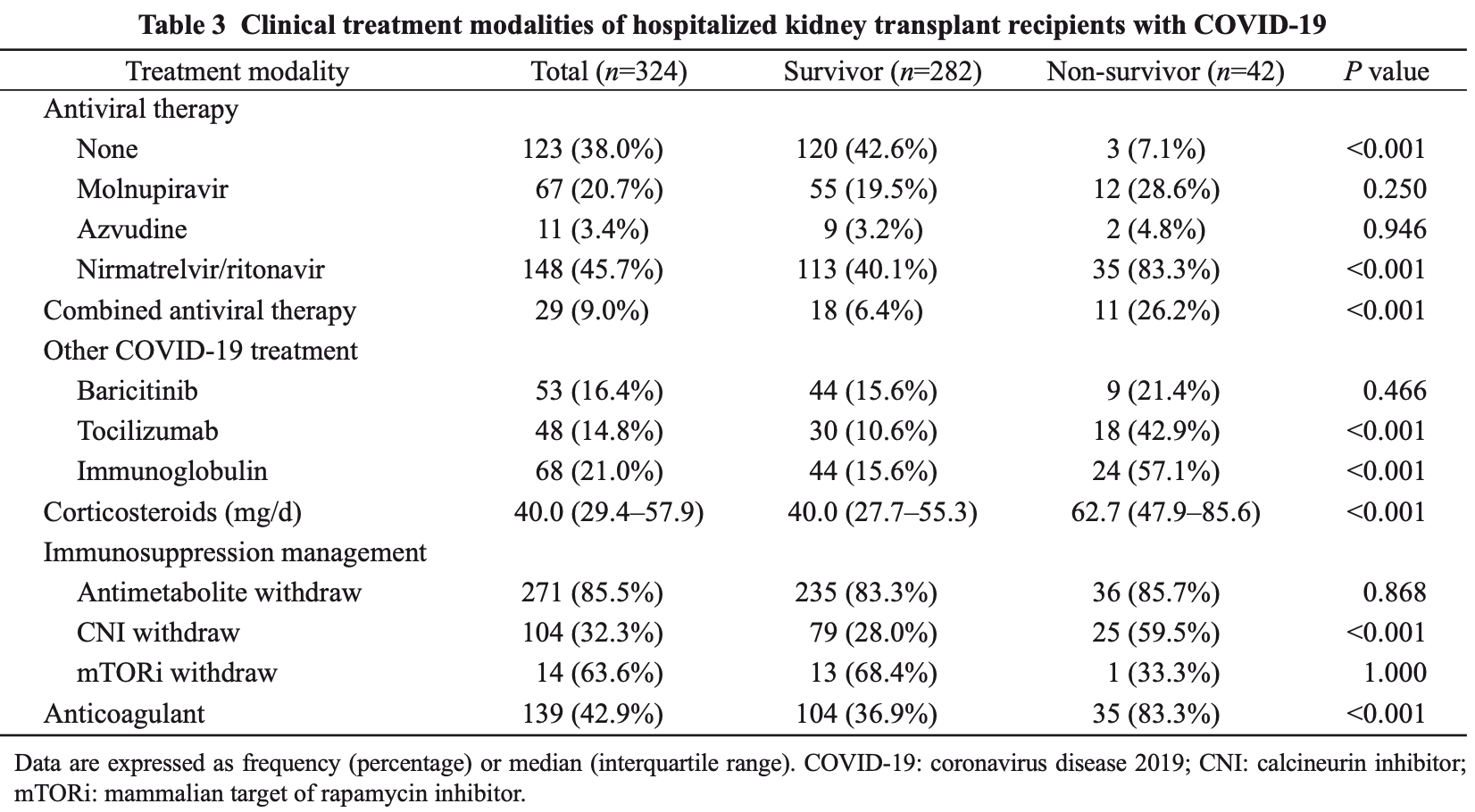
Background: Following the short-term outbreak of coronavirus disease 2019 in December 2022 in China, clinical data on kidney transplant recipients (KTRs) with COVID-19 are lacking. Methods: We conducted a single-center retrospective study to describe the clinical features, complications, and mortality rates of hospitalized KTRs infected with COVID-19 between Dec. 16, 2022 and Jan. 31, 2023. The patients were followed up until Mar. 31, 2023. Results: A total of 324 KTRs with COVID-19 were included. The median age was 49 years. The median time between the onset of symptoms and admission was 13 d. Molnupiravir, azvudine, and nirmatrelvir/ritonavir were administered to 67 (20.7%), 11 (3.4%), and 148 (45.7%) patients, respectively. Twenty-nine (9.0%) patients were treated with more than one antiviral agent. Forty-eight (14.8%) patients were treated with tocilizumab and 53 (16.4%) patients received baricitinib therapy. The acute kidney injury (AKI) occurred in 81 (25.0%) patients and 39 (12.0%) patients were admitted to intensive care units. Fungal infections were observed in 55 (17.0%) patients. Fifty (15.4%) patients lost their graft. The 28-d mortality rate of patients was 9.0% and 42 (13.0%) patients died by the end of follow-up. Multivariate Cox regression analysis identified that cerebrovascular disease, AKI incidence, interleukin (IL)-6 level of >6.8 pg/mL, daily dose of corticosteroids of >50 mg, and fungal infection were all associated with an increased risk of death for hospitalized patients. Conclusions: Our findings demonstrate that hospitalized KTRs with COVID-19 are at high risk of mortality. The administration of immunomodulators or the late application of antiviral drugs does not improve patient survival, while higher doses of corticosteroids may increase the death risk.
Author contributions Research idea and study design: Duo LV, Jianyong WU, and Jianghua CHEN; Data acquisition: Duo LV, Xishao XIE, Qinyun YANG, Zhimin CHEN, Guangjun LIU, Rending WANG, Wenhan PENG, and Hongfeng HUANG; Data analysis/ interpretation and statistical analysis: Duo LV and Xishao XIE; Supervision or mentorship: Jianyong WU and Jianghua CHEN. All the authors have read and approved the final manuscript, and therefore, have full access to all the data in the study and take responsibility for the integrity and security of the data.
Compliance with ethics guidelines Duo LV, Xishao XIE, Qinyun YANG, Zhimin CHEN, Guangjun LIU, Wenhan PENG, Rending WANG, Hongfeng HUANG, Jianghua CHEN, and Jianyong WU declare that they have no conflicts of interest. This study was approved by the Clinical Research Ethics Committee of the First Affiliated Hospital of Zhejiang University (expedition review No. 63 in 2023) . The Ethics Committee authorized the informed consent waiver. This study was performed in accordance with the Declaration of Helsinki.
Supplementary information Table S1
References
Avery, Update on COVID-19 therapeutics for solid organ transplant recipients, including the omicron surge, Transplantation,
doi:10.1097/TP.0000000000004200Berger, Hazzan, Kamar, Absence of mortality differences between the first and second COVID-19 waves in kidney transplant recipients, Kidney Int Rep,
doi:10.1016/j.ekir.2022.09.007Bernal, Gimeno, Alcaraz, Activating killercell immunoglobulin-like receptors are associated with the severity of coronavirus disease 2019, J Infect Dis,
doi:10.1093/infdis/jiab228Caillard, Anglicheau, Matignon, An initial report from the French SOT COVID Registry suggests high mortality due to COVID-19 in recipients of kidney transplants, Kidney Int,
doi:10.1016/j.kint.2020.08.005Chaudhuri, Sasaki, Karkar, Corticosteroids in COVID-19 and non-COVID-19 ARDS: a systematic review and meta-analysis, Intensive Care Med,
doi:10.1007/s00134-021-06394-2Daniel, Sekulic, Kudose, Kidney allograft biopsy findings after COVID-19, Am J Transplant,
doi:10.1111/ajt.16804Daoud, Alqassieh, Alkhader, Immunosuppression in kidney transplant recipients with COVID-19 infection -where do we stand and where are we heading?, Ren Fail,
doi:10.1080/0886022X.2021.1876730Fang, Li, Yu, Epidemiological, comorbidity factors with severity and prognosis of COVID-19: a systematic review and meta-analysis, Aging,
doi:10.18632/aging.103579Farkash, Wilson, Jentzen, Ultrastructural evidence for direct renal infection with SARS-CoV-2, J Am Soc Nephrol,
doi:10.1681/ASN.2020040432Favà, Cucchiari, Montero, Clinical characteristics and risk factors for severe COVID-19 in hospitalized kidney transplant recipients: a multicentric cohort study, Am J Transplant,
doi:10.1111/ajt.16246Gangneux, Dannaoui, Fekkar, Fungal infections in mechanically ventilated patients with COVID-19 during the first wave: the French multicentre MYCOVID study, Lancet Respir Med,
doi:10.1016/S2213-2600(21)00442-2Gupta, Wang, Hayek, Association between early treatment with tocilizumab and mortality among critically ill patients with COVID-19, JAMA Intern Med,
doi:10.1001/jamainternmed.2020.6252Gérard, Barbosa, Anglicheau, Association between maintenance immunosuppressive regimens and COVID-19 mortality in kidney transplant recipients, Transplantation,
doi:10.1097/TP.0000000000004254Hajibaratali, Amini, Dalili, Clinical outcomes of kidney recipients with COVID-19 (COVID-19 in kidney recipients), Transpl Immunol,
doi:10.1016/j.trim.2022.101772Hartzell, Bin, Benedetti, Evidence of potent humoral immune activity in COVID-19-infected kidney transplant recipients, Am J Transplant,
doi:10.1111/ajt.16261Jimeno, Ventura, Castellano, Prognostic implications of neutrophil-lymphocyte ratio in COVID-19, Eur J Clin Invest,
doi:10.1111/eci.13404Klopfenstein, Gendrin, Kadiane-Oussou, Tocilizumab in COVID-19 pneumonia: practical proposals based on a narrative review of randomised trials, Rev Med Virol,
doi:10.1002/rmv.2239Kremer, Pieters, Verhaar, A systematic review and meta-analysis of COVID-19 in kidney transplant recipients: lessons to be learned, Am J Transplant,
doi:10.1111/ajt.16742Kronbichler, Gauckler, Windpessl, COVID-19: implications for immunosuppression in kidney disease and transplantation, Nat Rev Nephrol,
doi:10.1038/s41581-020-0305-6Mahalingasivam, Su, Iwagami, COVID-19 and kidney disease: insights from epidemiology to inform clinical practice, Nat Rev Nephrol,
doi:10.1038/s41581-022-00570-3Mallhi, Khan, Alzarea, Incidence, risk factors and outcomes of acute kidney injury among COVID-19 patients: a systematic review of systematic reviews, Front Med,
doi:10.3389/fmed.2022.973030Masset, Gautier-Vargas, Cantarovich, Occurrence of de novo donor-specific antibodies after COVID-19 in kidney transplant recipients is low despite immunosuppression modulation, Kidney Int Rep,
doi:10.1016/j.ekir.2022.01.1072Mendoza, Ranganath, Chesdachai, Immunomodulators for severe coronavirus disease-2019 in transplant patients: do they increase the risk of secondary infection?, Transpl Infect Dis,
doi:10.1111/tid.14050Nab, Parker, Andrews, Changes in COVID-19-related mortality across key demographic and clinical subgroups in England from 2020 to 2022: a retrospective cohort study using the OpenSAFELY platform, Lancet Public Health,
doi:10.1016/S2468-2667(23)00079-8Nadim, Forni, Mehta, COVID-19associated acute kidney injury: consensus report of the 25th Acute Disease Quality Initiative (ADQI) Workgroup, Nat Rev Nephrol,
doi:10.1038/s41581-020-00356-5Nimmo, Gardiner, Ushiro-Lumb, The global impact of COVID-19 on solid organ transplantation: two years into a pandemic, Transplantation,
doi:10.1097/TP.0000000000004151Pereira, Aversa, Farr, Tocilizumab for severe COVID-19 in solid organ transplant recipients: a matched cohort study, Am J Transplant,
doi:10.1111/ajt.16314Pérez-Sáez, Blasco, Redondo-Pachón, Use of tocilizumab in kidney transplant recipients with COVID-19, Am J Transplant,
doi:10.1111/ajt.16192Saravolatz, Depcinski, Sharma, Molnupiravir and nirmatrelvir-ritonavir: oral coronavirus disease 2019 antiviral drugs, Clin Infect Dis,
doi:10.1093/cid/ciac180Singh, Oks, Husk, Impact of timing of tocilizumab use in hospitalized patients with SARS-CoV-2 infection, Respir Care,
doi:10.4187/respcare.08779Su, Yang, Wan, Renal histopathological analysis of 26 postmortem findings of patients with COVID-19 in China, Kidney Int,
doi:10.1016/j.kint.2020.04.003Talic, Shah, Wild, Effectiveness of public health measures in reducing the incidence of covid-19, SARS-CoV-2 transmission, and covid-19 mortality: systematic review and meta-analysis, BMJ,
doi:10.1136/bmj-2021-068302Tan, Tan, Tan, Long-term kidney function recovery and mortality after COVID-19-associated acute kidney injury: an international multi-centre observational cohort study, eClinicalMedicine,
doi:10.1016/j.eclinm.2022.101724Tu, Mo, Zhang, Effects of different corticosteroid therapy on severe COVID-19 patients: a meta-analysis of randomized controlled trials, Expert Rev Respir Med,
doi:10.1080/17476348.2021.1983429Van Grootveld, Van Der Beek, Janssen, Incidence, risk factors and pre-emptive screening for COVID-19 associated pulmonary aspergillosis in an era of immunomodulant therapy, J Crit Care,
doi:10.1016/j.jcrc.2023.154272Wagner, Griesel, Mikolajewska, Systemic corticosteroids for the treatment of COVID-19, Cochrane Database Syst Rev,
doi:10.1002/14651858Wang, Koff, Hao, Effect of nirmatrelvir/ ritonavir on calcineurin inhibitor levels: early experience in four SARS-CoV-2 infected kidney transplant recipients, Am J Transplant,
doi:10.1111/ajt.16997Weiss, Hendrickx, Stensgaard, Kidney transplant and dialysis patients remain at increased risk for succumbing to COVID-19, Transplantation,
doi:10.1097/TP.0000000000004462Willicombe, Thomas, Mcadoo, COVID-19 and calcineurin inhibitors: should they get left out in the storm?, J Am Soc Nephrol,
doi:10.1681/ASN.2020030348Zhang, Han, Wu, COVID-19 in the immunocompromised population: data from renal allograft recipients throughout full cycle of the outbreak in Hubei province, China, Chin Med J,
doi:10.1097/CM9.0000000000001538Zhou, Kuang, Ma, Application of extracorporeal therapies in critically ill COVID-19 patients, J Zhejiang Univ-Sci B (Biomed & Biotechnol),
doi:10.1631/jzusZhu, Gong, Liu, Coronavirus disease 2019 pneumonia in immunosuppressed renal transplant recipients: a summary of 10 confirmed cases in Wuhan, China, Eur Urol,
doi:10.1016/j.eururo.2020.03.039