Association between Paxlovid and mortality in severe COVID-19 patients: a retrospective cohort study
et al., The Journal of Infection in Developing Countries, doi:10.3855/jidc.21811, Jun 2026
Retrospective 1,219 hospitalized severe COVID-19 patients in China showing significantly lower 28-day mortality with paxlovid.
This study has several serious issues:
Immortal-time bias: follow-up began at hospital admission, but paxlovid exposure appears to have been defined by whether patients received treatment at any later point. Patients had to survive long enough to receive paxlovid, while early deaths would preferentially enter the untreated group, potentially creating a large artificial mortality benefit.
Adjustment for post-treatment variables: propensity matching and regression appear to include glucocorticoid use and duration, antibiotics, tocilizumab, and other treatments occurring after paxlovid initiation. Invasive ventilation and co-treatments are potentially after paxlovid initiation but not specified. Glucocorticoid duration is necessarily determined during follow-up, so adjusting or matching on it can introduce severe collider, mediator, and survival bias.
Confounding by treatment eligibility and contraindications: untreated patients were more likely to have renal failure and may have been unable to receive paxlovid because of kidney dysfunction, drug interactions, severe illness, inability to take oral medication, or treatment limitations. These same factors independently increase mortality and were not adequately measured or excluded.
Major baseline severity imbalance: before matching, untreated patients had worse oxygenation, higher neutrophils, procalcitonin and D-dimer, more renal failure, and potentially substantially more invasive ventilation, however timing is unclear. This is consistent with paxlovid being preferentially given to patients with a better prognosis.
Unmeasured treatment-selection and care-intensity confounding: paxlovid recipients also received more glucocorticoids, antibiotics, and tocilizumab. They may have differed in access to care, frailty, treatment preferences, resuscitation status, physician attention, and likelihood of receiving other beneficial interventions - factors not captured by the analysis.
Contradictory mortality counts: the matched Kaplan-Meier figure reports 41 paxlovid deaths versus 80 control deaths, while every complete subgroup breakdown in the next figure totals 44 versus 83.
Interaction p-values inconsistent with the data: recomputed approximate interaction p-values from the displayed counts do not match the reported ones - subgroups flagged as significant (onset, smoking, antibiotics, ventilation) have nearly identical, overlapping ORs (approximate interaction p-values calculated from the displayed counts are roughly 0.2-0.8), while two labeled non-significant have the most divergent ORs. The text's claim of greater benefit in smokers also contradicts its own figure (smokers had a higher OR).
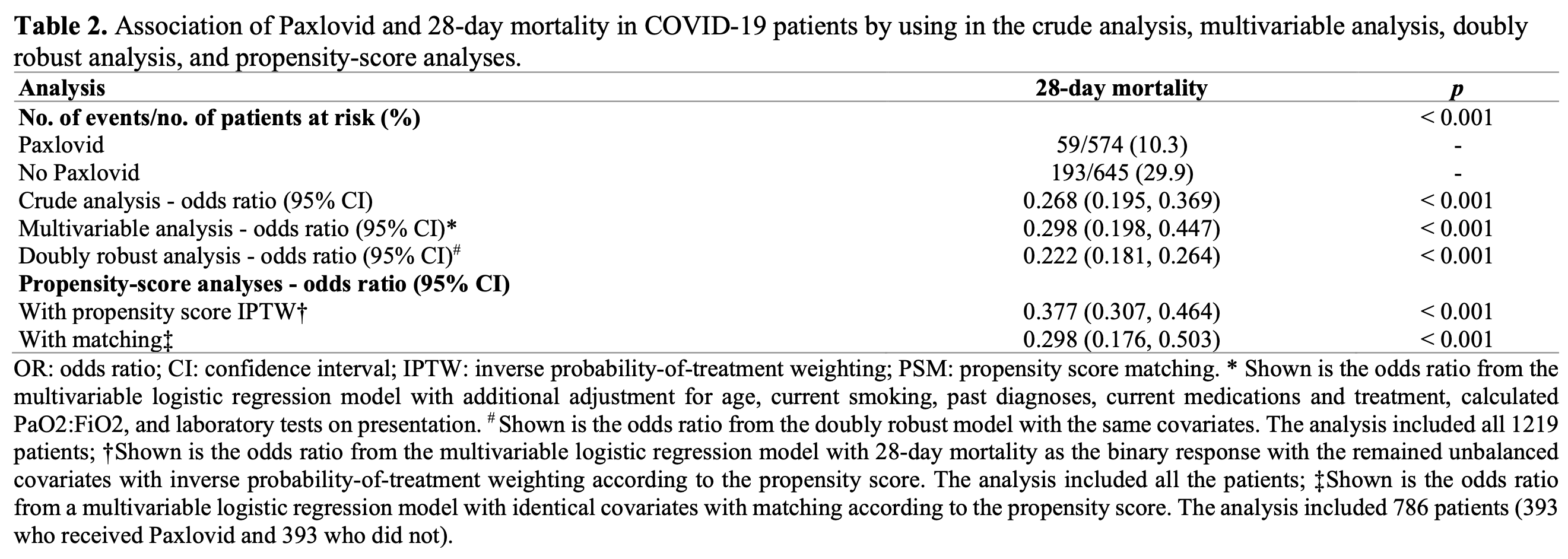
Unusually narrow doubly robust confidence interval: the doubly robust estimate is substantially more precise than the other analyses despite extensive modeling. Without the model specification, weight distribution, effective sample size, variance estimator, and imputation-pooling procedure, the interval cannot be independently evaluated and may underestimate uncertainty.
Large shift after adjustment in the matched cohort: the displayed matched counts imply a crude OR of approximately 0.471, whereas the reported covariate-adjusted matched OR is 0.298. Although odds-ratio non-collapsibility and adjustment for strong outcome predictors can produce such shifts even after matching, the magnitude warrants explanation, particularly because the adjustment set appears to include post-baseline variables.
Internally inconsistent Kaplan-Meier risk table: at several time points, the reported number at risk plus cumulative deaths exceeds the original 393 patients per group - for example, 387 at risk plus 11 deaths equals 398 paxlovid patients at day 4. Deaths in an interval can't exceed the drop in the at-risk count (censoring can't be negative). There are four impossible intervals: paxlovid day 0-4 (6 removed but 11 deaths) and day 24-28 (0 removed but 2 deaths); control day 0-4 (18 removed, 25 deaths) and day 12-16 (16 removed, 18 deaths). This indicates an error in the risk table, event counts, or time-point definitions.
Incorrect subgroup p-values: the reported confidence interval for the >5-day subgroup, OR 0.540 (95% CI 0.309-0.946), corresponds to approximately p=0.03, not p<0.001.
Inadequately defined paxlovid exposure: the paper does not report treatment start date, dose, renal adjustment, number of doses, course completion, adherence, prior outpatient use, or whether treatment began before or after clinical deterioration. A patient receiving one dose may have been classified the same as one completing a full course.
Site and calendar-time confounding: the study combined four hospitals without reporting hospital-specific treatment rates, mortality, ICU policies, or outcomes. Differences in paxlovid availability, clinical practice, staffing, and epidemic timing could be mistaken for a treatment effect.
Questionable length-of-stay analysis: length of stay appears to have been analyzed using logistic regression and reported as an odds ratio per hospital day. The model may have predicted paxlovid receipt from length of stay rather than estimating paxlovid’s effect on length of stay, and death creates substantial competing-risk and survival-bias problems.
Incomplete missing-data reporting: the authors state that multiple imputation was used but do not report which variables were missing, how much data were missing, the imputation model, or how imputation was combined with matching and weighting.
No safety analysis: despite off-label use in elderly, severely ill patients with renal and liver disease and extensive potential ritonavir drug interactions, the study reports no kidney injury, liver injury, cardiac events, treatment discontinuation, serious interactions, or other adverse outcomes.
No identified public protocol or prespecified analysis plan: no protocol, registry record, or statistical-analysis plan was identified in the article, its supplement, or targeted searches. This limits assessment of outcome switching, covariate selection, and whether subgroup analyses were prespecified.
Overall impact: the combination of immortal-time bias, adjustment for post-treatment variables, contraindication bias, baseline severity imbalance, and unmeasured treatment-selection bias could account for most or potentially all of the observed mortality association. The contradictory death counts, impossible risk-table values, and incorrect subgroup statistics further undermine confidence in the study.
Resistance. Variants may be resistant to paxlovid1-9. Use may promote the emergence of variants that weaken host immunity and potentially contribute to long COVID10. Confounding by contraindication. Hoertel et al. find that over 50% of patients that died had a contraindication for the use of Paxlovid11. Retrospective studies that do not exclude contraindicated patients may significantly overestimate efficacy. Black box warning. The FDA notes that severe, life-threatening, and/or fatal adverse reactions due to drug interactions have been reported in patients treated with paxlovid12. Kidney and liver injury. Studies show significantly increased risk of acute kidney injury13 and liver injury14,15. Viral rebound. Studies show significantly increased risk of replication-competent viral rebound16-18.

1.
Zhou et al., Nirmatrelvir-resistant SARS-CoV-2 variants with high fitness in an infectious cell culture system, Science Advances, doi:10.1126/sciadv.add7197.
2.
Moghadasi et al., Rapid resistance profiling of SARS-CoV-2 protease inhibitors, npj Antimicrobials and Resistance, doi:10.1038/s44259-023-00009-0.
3.
Jochmans et al., The Substitutions L50F, E166A, and L167F in SARS-CoV-2 3CLpro Are Selected by a Protease Inhibitor In Vitro and Confer Resistance To Nirmatrelvir, mBio, doi:10.1128/mbio.02815-22.
4.
Lopez et al., SARS-CoV-2 Resistance to Small Molecule Inhibitors, Current Clinical Microbiology Reports, doi:10.1007/s40588-024-00229-6.
5.
Zvornicanin et al., Molecular Mechanisms of Drug Resistance and Compensation in SARS-CoV-2 Main Protease: The Interplay Between E166 and L50, bioRxiv, doi:10.1101/2025.01.24.634813.
6.
Vukovikj et al., Impact of SARS-CoV-2 variant mutations on susceptibility to monoclonal antibodies and antiviral drugs: a non-systematic review, April 2022 to October 2024, Eurosurveillance, doi:10.2807/1560-7917.ES.2025.30.10.2400252.
7.
Deschenes et al., Functional and structural characterization of treatment-emergent nirmatrelvir resistance mutations at low frequencies in the main protease (Mpro) reveals a unique evolutionary route for SARS-CoV-2 to gain resistance, The Journal of Infectious Diseases, doi:10.1093/infdis/jiaf294.
8.
Zhou (B) et al., SARS-CoV-2 Mpro inhibitor ensitrelvir: asymmetrical cross-resistance with nirmatrelvir and emerging resistance hotspots, Emerging Microbes & Infections, doi:10.1080/22221751.2025.2552716.
9.
Chen et al., SARS-CoV-2 3CLpro mutations T21I and E166A confer differential resistance to simnotrelvir, bofutrelvir, and ensitrelvir, Journal of Virology, doi:10.1128/jvi.02223-25.
10.
Thomas et al., Nirmatrelvir-Resistant Mutations in SARS-CoV-2 Mpro Enhance Host Immune Evasion via Cleavage of NF-κB Essential Modulator, bioRxiv, doi:10.1101/2024.10.18.619137.
11.
Hoertel et al., Prevalence of Contraindications to Nirmatrelvir-Ritonavir Among Hospitalized Patients With COVID-19 at Risk for Progression to Severe Disease, JAMA Network Open, doi:10.1001/jamanetworkopen.2022.42140.
12.
FDA, Fact sheet for healthcare providers: emergency use authorization for paxlovid, www.fda.gov/media/155050/download.
13.
Kamo et al., Association of Antiviral Drugs for the Treatment of COVID-19 With Acute Renal Failure, In Vivo, doi:10.21873/invivo.13637.
14.
Wang et al., Development and validation of a nomogram to assess the occurrence of liver dysfunction in patients with COVID-19 pneumonia in the ICU, BMC Infectious Diseases, doi:10.1186/s12879-025-10684-1.
15.
Siby et al., Temporal Trends in Serious Adverse Events Associated with Oral Antivirals During the COVID-19 Pandemic: Insights from the FAERS Database (2020–2023), Open Forum Infectious Diseases, doi:10.1093/ofid/ofaf695.1825.
16.
Edelstein et al., SARS-CoV-2 virologic rebound with nirmatrelvir-ritonavir therapy, medRxiv, doi:10.1101/2023.06.23.23288598.
Liu et al., 30 Jun 2026, retrospective, China, peer-reviewed, 10 authors, study period 1 December, 2022 - 30 July, 2023.
Abstract:
Association between Paxlovid and mortality in severe COVID-19 patients: a retrospective cohort study
Bin Liu 1,2 # , Bo Xie 3 # , Li Jiang 2 # , Hongli Xia 4 , Chunmei Zhu 2 , Jing Hu 2 , Jing Cai 5 , Yan Zhang 6 , Mingjin Yang 2 , Yanchao Liang 1
1 Department of Respiratory and Critical Care Medicine, Zhuzhou Central Hospital, Zhuzhou Hospital Affiliated to Xiangya School of Medicine, Central South University, No.116, Changjiang South Road, Tianyuan District, Zhuzhou, Hunan, 412007, China
2 Department of Respiratory and Critical Care Medicine, The First Affiliated Hospital of Chongqing Medical University, No.1, Youyi Road, Yuzhong, Chongqing, 400016, China
3 Department of Scientific Research, Zhuzhou Central Hospital, Zhuzhou Hospital Affiliated to Xiangya School of Medicine, Central South University, Zhuzhou, 412007, Hunan, China
4 Department of General Practice, People's Hospital of Chongqing Hechuan, Chongqing 401520, China
5 Department of Endocrinology and Metabolism, Chengdu First People's Hospital, No.18, Wanxiang North Road, High-tech Zone, Chengdu, Sichuan, 610000, China
6 Digestive System Department, Chengdu Second People's Hospital, jinjiang District, Chengdu, Sichuan, 610017, China
# Authors contributed equally to this work.
Abstract
Introduction: With limited research on the clinical effectiveness of Paxlovid for hospitalized patients with severe COVID-19, this study aims to assess its impact on clinical outcomes, providing essential insights for patient care.
Methodology: We collected consecutive data from SARS-CoV-2-infected patients at four hospitals between December 2022 and July 2023. We compared patient characteristics, clinical parameters, and treatment regimens between the Paxlovid and control groups. Analyses included crude, multivariable, doubly robust, and propensity score methods to evaluate Paxlovid's impact on 28-day mortality and to identify subgroup interactions.
Results: Of 574 patients treated with Paxlovid, 10.3% died within 28 days, versus 29.9% of 645 untreated patients. Unadjusted analysis showed a significant Paxlovid-associated reduction in 28-day mortality (OR 0.268, 95% CI 0.195-0.369; p < 0.001), sustained after adjustment (adjusted OR 0.298, 95% CI 0.198-0.447; p < 0.001). Paxlovid significantly decreased mortality in patients with infection durations ≤ 5 days (OR 0.401, 95% CI 0.227-0.707, p < 0.001) and > 5 days (OR 0.540, 95% CI 0.309-0.946, p < 0.001). Hospital stays were longer with Paxlovid (median 11 vs. 10 days, p = 0.001), with no significant effect on ICU admission rates.
Conclusions: Our findings suggest that Paxlovid significantly reduces 28-day mortality in severe COVID-19 patients, irrespective of infection duration over 5 days.
Key words: Paxlovid; COVID-19; severe; mortality.
J Infect Dev Ctries 2026; 20(6):896-903 . doi:10.3855/jidc.21811
(Received 08 May 2025 - Accepted 20 November 2025)
Copyright © 2026 Liu et al . This is an open-access article distributed under the Creative Commons Attribution License, which permits unrestricted use, distribution, and reproduction in any medium, provided the original work is properly cited.
DOI record:
{
"DOI": "10.3855/jidc.21811",
"ISSN": [
"1972-2680"
],
"URL": "http://dx.doi.org/10.3855/jidc.21811",
"abstract": "<jats:p>Introduction: With limited research on the clinical effectiveness of Paxlovid for hospitalized patients with severe COVID-19, this study aims to assess its impact on clinical outcomes, providing essential insights for patient care.\nMethodology: We collected consecutive data from SARS-CoV-2-infected patients at four hospitals between December 2022 and July 2023. We compared patient characteristics, clinical parameters, and treatment regimens between the Paxlovid and control groups. Analyses included crude, multivariable, doubly robust, and propensity score methods to evaluate Paxlovid's impact on 28-day mortality and to identify subgroup interactions.\nResults: Of 574 patients treated with Paxlovid, 10.3% died within 28 days, versus 29.9% of 645 untreated patients. Unadjusted analysis showed a significant Paxlovid-associated reduction in 28-day mortality (OR 0.268, 95% CI 0.195-0.369; p < 0.001), sustained after adjustment (adjusted OR 0.298, 95% CI 0.198-0.447; p < 0.001). Paxlovid significantly decreased mortality in patients with infection durations ≤ 5 days (OR 0.401, 95% CI 0.227-0.707, p < 0.001) and > 5 days (OR 0.540, 95% CI 0.309-0.946, p < 0.001). Hospital stays were longer with Paxlovid (median 11 vs. 10 days, p = 0.001), with no significant effect on ICU admission rates.\nConclusions: Our findings suggest that Paxlovid significantly reduces 28-day mortality in severe COVID-19 patients, irrespective of infection duration over 5 days.</jats:p>",
"author": [
{
"ORCID": "https://orcid.org/0000-0002-0665-0376",
"affiliation": [],
"authenticated-orcid": false,
"family": "Liu",
"given": "Bin",
"role": [
{
"role": "author",
"vocabulary": "crossref"
}
],
"sequence": "first"
},
{
"affiliation": [],
"family": "Xie",
"given": "Bo",
"role": [
{
"role": "author",
"vocabulary": "crossref"
}
],
"sequence": "additional"
},
{
"affiliation": [],
"family": "Jiang",
"given": "Li",
"role": [
{
"role": "author",
"vocabulary": "crossref"
}
],
"sequence": "additional"
},
{
"affiliation": [],
"family": "Xia",
"given": "Hongli",
"role": [
{
"role": "author",
"vocabulary": "crossref"
}
],
"sequence": "additional"
},
{
"affiliation": [],
"family": "Zhu",
"given": "Chunmei",
"role": [
{
"role": "author",
"vocabulary": "crossref"
}
],
"sequence": "additional"
},
{
"affiliation": [],
"family": "Hu",
"given": "Jing",
"role": [
{
"role": "author",
"vocabulary": "crossref"
}
],
"sequence": "additional"
},
{
"affiliation": [],
"family": "Cai",
"given": "Jing",
"role": [
{
"role": "author",
"vocabulary": "crossref"
}
],
"sequence": "additional"
},
{
"affiliation": [],
"family": "Zhang",
"given": "Yan",
"role": [
{
"role": "author",
"vocabulary": "crossref"
}
],
"sequence": "additional"
},
{
"affiliation": [],
"family": "Yang",
"given": "Mingjin",
"role": [
{
"role": "author",
"vocabulary": "crossref"
}
],
"sequence": "additional"
},
{
"affiliation": [],
"family": "Liang",
"given": "Yanchao",
"role": [
{
"role": "author",
"vocabulary": "crossref"
}
],
"sequence": "additional"
}
],
"container-title": "The Journal of Infection in Developing Countries",
"container-title-short": "J Infect Dev Ctries",
"content-domain": {
"crossmark-restriction": false,
"domain": []
},
"created": {
"date-parts": [
[
2026,
7,
10
]
],
"date-time": "2026-07-10T18:02:50Z",
"timestamp": 1783706570000
},
"deposited": {
"date-parts": [
[
2026,
7,
10
]
],
"date-time": "2026-07-10T18:02:50Z",
"timestamp": 1783706570000
},
"indexed": {
"date-parts": [
[
2026,
7,
10
]
],
"date-time": "2026-07-10T18:17:44Z",
"timestamp": 1783707464113,
"version": "3.55.0"
},
"is-referenced-by-count": 0,
"issue": "06",
"issued": {
"date-parts": [
[
2026,
6,
30
]
]
},
"journal-issue": {
"issue": "06",
"published-online": {
"date-parts": [
[
2026,
6,
30
]
]
}
},
"license": [
{
"URL": "https://creativecommons.org/licenses/by/4.0",
"content-version": "unspecified",
"delay-in-days": 0,
"start": {
"date-parts": [
[
2026,
6,
30
]
],
"date-time": "2026-06-30T00:00:00Z",
"timestamp": 1782777600000
}
}
],
"link": [
{
"URL": "https://www.jidc.org/index.php/journal/article/download/21811/3912",
"content-type": "application/pdf",
"content-version": "vor",
"intended-application": "text-mining"
},
{
"URL": "https://www.jidc.org/index.php/journal/article/download/21811/3912",
"content-type": "unspecified",
"content-version": "vor",
"intended-application": "similarity-checking"
}
],
"member": "2222",
"original-title": [],
"page": "896-903",
"prefix": "10.3855",
"published": {
"date-parts": [
[
2026,
6,
30
]
]
},
"published-online": {
"date-parts": [
[
2026,
6,
30
]
]
},
"publisher": "Journal of Infection in Developing Countries",
"reference-count": 0,
"references-count": 0,
"relation": {},
"resource": {
"primary": {
"URL": "https://www.jidc.org/index.php/journal/article/view/21811"
}
},
"score": 1,
"short-title": [],
"source": "Crossref",
"subject": [],
"subtitle": [],
"title": "Association between Paxlovid and mortality in severe COVID-19 patients: a retrospective cohort study",
"type": "journal-article",
"volume": "20"
}
Late treatment
is less effective
is less effective
