RECOVER-VITAL: A Platform Protocol for Evaluation of Interventions for Viral Persistence, Viral Reactivation, and Immune Dysregulation in Post-Acute Sequelae of SARS-CoV-2 Infection (PASC)
et al., NCT05965726, RECOVER-VITAL, NCT05965726, Mar 2026
RCT 964 patients showing no difference in improvement of long COVID with 15-day or 25-day paxlovid compared with placebo.
Results appeared in the registry 15 months after primary completion, with no publication or announcement1. In the same month as the results appeared in the registry, they published a design paper that states: “While the STOP-PASC and PAX LC trials did not demonstrate a positive effect on Long COVID, the RECOVER-VITAL study remains a critical addition to the field and still has potential for demonstrating effect...”2.
A paper was published in August 20263.
Long COVID may stem from persistent viral infection and/or damage from prior infection. For viral persistence using a single first-generation 3CLpro inhibitor may not be very effective. Polytherapy including improved antivirals can have better tissue/variant coverage, target intracellular and extracellular virus, etc.
Thousands of compounds show SARS-CoV-2 antiviral activity, with many complementary and synergistic mechanisms4,5.
Even among high-profit 3CLpro inhibitors, paxlovid is unlikely to be the safest or most effective. Ensitrelvir is also approved in the USA now (PEP only), but it was ~4 years late - approved in Japan in 2022 and still an older-generation 3CLpro inhibitor - avoiding ritonavir but with its own inherent CYP3A inhibition. We cover 11 novel SARS-CoV-2 3CLpro inhibitors - 5 are approved in China. Olgotrelvir for example is one of the more advanced - dual inhibition of 3CLpro and human cathepsin L, targeting both viral replication and host-cell entry, and highly orally bioavailable without requiring ritonavir.
c19early.org
Long COVID - paxlovid or polytherapy?
Long COVID may be due to persistent viral infection or damage from prior infection. Should long COVID trials for viral persistence focus on a single high-profit older generation 3CLpro inhibitor, or on polytherapy with multiple antivirals?
| Paxlovid Monotherapy | Polytherapy | |
|---|---|---|
| Tissue coverage | Paxlovid has poor CNS penetration and may have limited penetration into some sanctuary sites (testes, possibly olfactory bulb, gut lamina propria) | Combined agents can provide superior tissue coverage |
| Variant coverage | Real-world efficacy has dropped with recent variants | Combining agents with different resistance profiles minimizes persisting quasispecies escape risk |
| Intracellular vs extracellular virus | Paxlovid targets actively replicating virus inside cells and may have little effect on defective or sequestered viral material producing antigen without full replication | Combining replication inhibitors with entry blockers or agents that target non-replicating persistence may be superior |
| Viral load in persistence | Viral load in persistence may be very low and monotherapy may not be sufficient | In chronic infections such as HIV and HCV, combination therapy has shown larger and more durable viral load reductions |
| Historical precedent | Viral reservoirs have not been successfully eradicated with monotherapy—HIV, HBV, HCV, HSV, CMV all require combination therapy | Polytherapy required for previous viruses |
c19early.org
Paxlovid long COVID treatment trials
| Trial | Outcome | Primary completion | Published | Delay |
|---|---|---|---|---|
| STOP-PASC (Stanford) | No benefit | August 2023 | June 2024 | ~10 Months |
| PAX LC (Yale) | No benefit | April 2024 | April 2025 | 12 months |
| RECOVER-VITAL (NIH) | No benefit | December 2024 | March 2026 | ~15 months |
| PROLIFIC (Karolinska) | Unreported | November 2024 | Late | 16+ months |
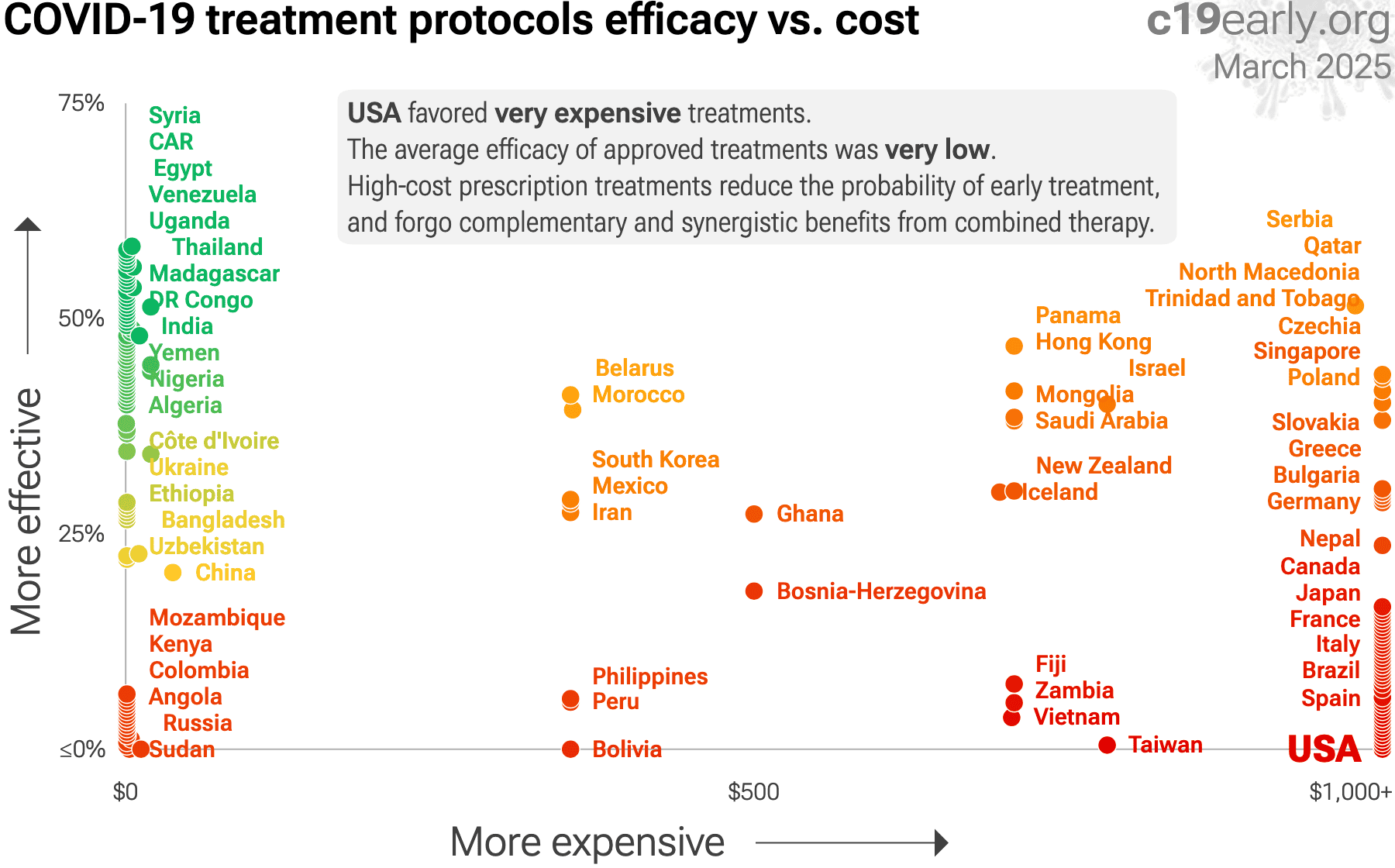
Standard of Care (SOC) for COVID-19 in the study country,
the USA, is very poor with very low average efficacy for approved treatments6.
Only expensive, high-profit treatments were approved for early treatment. Low-cost treatments were excluded, reducing the probability of early treatment due to access and cost barriers, and eliminating complementary and synergistic benefits seen with many low-cost treatments.
|
risk of no improvement, 8.9% higher, RR 1.09, p = 0.22, treatment 121, control 110, 25 day, all symptom clusters.
|
|
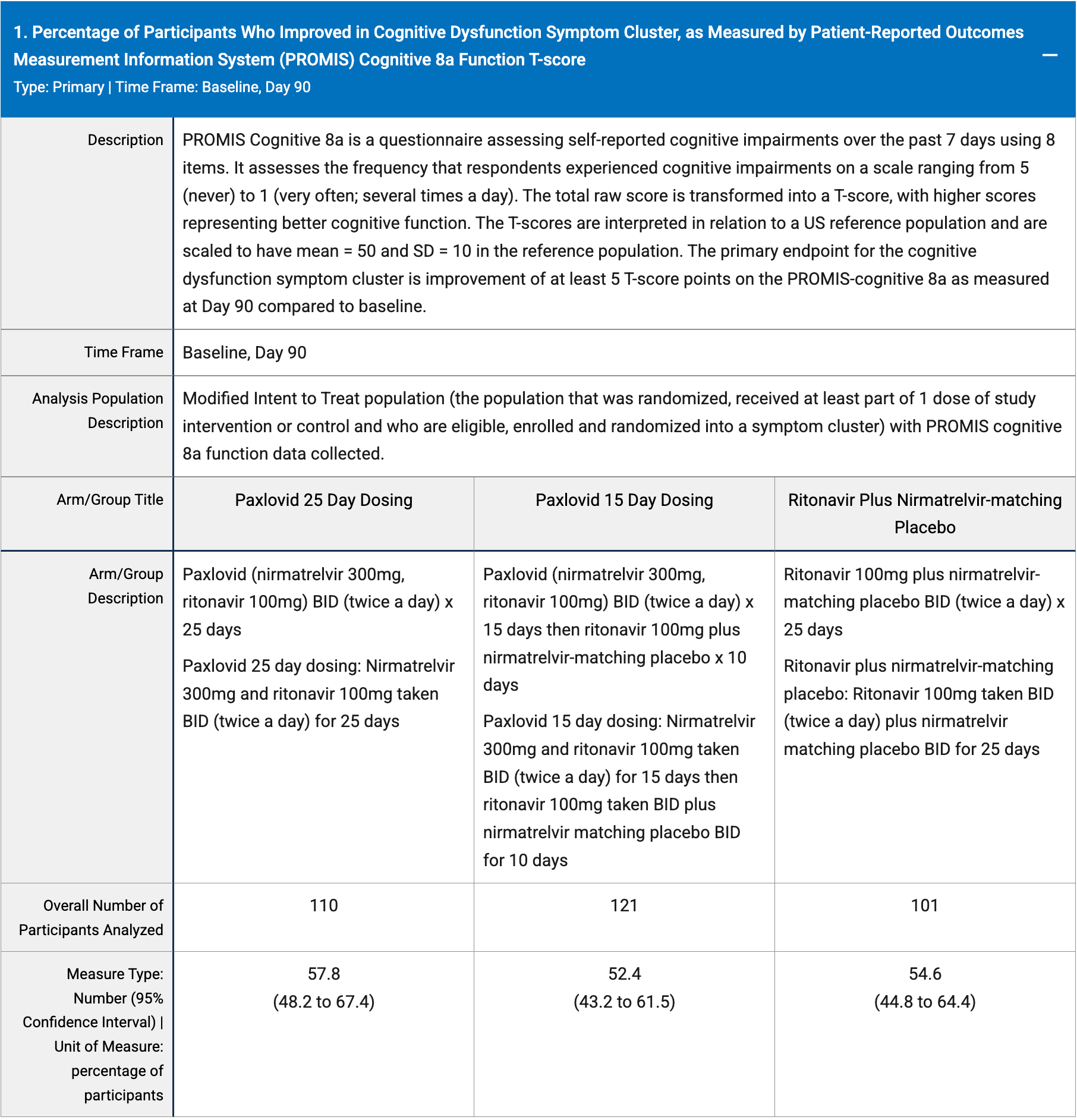
risk of no improvement, 7.0% lower, RR 0.93, p = 0.65, treatment 42.2 [32.6-51.8] n=110, control 45.4 [35.6-55.2] n=101, cognitive dysfunction, 25 day.
|
|
risk of no improvement, 21.0% higher, RR 1.21, p = 0.30, treatment 36.9 [28.5-45.3] n=121, control 30.5 [21.7-39.3] n=110, autonomic dysfunction, 25 day.
|
|
risk of no improvement, 11.7% higher, RR 1.12, p = 0.20, treatment 74.5 [66.4-82.7] n=112, control 66.7 [58.2-75.2] n=114, exercise intolerance, 25 day.
|
|
risk of no improvement, 0.4% higher, RR 1.00, p = 0.96, treatment 121, control 101, 15 day, all symptom clusters.
|
|
risk of no improvement, 4.8% higher, RR 1.05, p = 0.75, treatment 47.6 [38.5-56.8] n=121, control 45.4 [35.6-55.2] n=101, cognitive dysfunction, 15 day.
|
|
risk of no improvement, 0.3% higher, RR 1.00, p = 0.99, treatment 30.6 [21.7-39.5] n=103, control 30.5 [21.7-39.3] n=110, autonomic dysfunction, 15 day.
|
|
risk of no improvement, 1.3% lower, RR 0.99, p = 0.89, treatment 65.8 [56.7-74.8] n=105, control 66.7 [58.2-75.2] n=114, exercise intolerance, 15 day.
|
| Effect extraction follows pre-specified rules prioritizing more serious outcomes. Submit updates |
Zimmerman et al., 27 Mar 2026, Double Blind Randomized Controlled Trial, placebo-controlled, USA, preprint, 1 author, trial NCT05965726 (history) (RECOVER-VITAL).
Contact: kanecia.zimmerman@duke.edu.