Abstract: It is made available under a CC-BY-NC-ND 4.0 International license . is the author/funder, who has granted medRxiv a license to display the preprint in perpetuity. (which was not certified by peer review) medRxiv preprint doi: https://doi.org/10.64898/2026.06.08.26355201; this version posted June 10, 2026. The copyright holder for this preprint
- A Clinical Predictor of Lung Molecular Endotype Identifies Heterogeneity in Corticosteroid 1
- Response in Severe COVID-19: an Emulated Target Trial 2
3
- Benjamin J Sines, MD MSCR 1 *, Robert S Hagan MD PhD 1,4 , Xi Jiang PhD 2 , Ella Pavlechko
4
5
6
7
8
9
10
11
12
13
14
15
16
17
18
19
20
21
22
23
24
25
26
27
28
- PhD 2 , Scott McClain PhD 2 , Xin Hunt PhD 2 , Julia Florou-Moreno PhD 2 , Jake Acquadro 2 , Gabriel
- Risa 2 , Varunraj Valsaraj MS 2 , Jonathan C Schisler MS PhD 3† , Matthew C Wolfgang PhD 4†
- 1 Division of Pulmonary Critical Care Medicine, University of North Carolina at Chapel Hill,
- Chapel Hill, NC, United States
- 2 SAS Institute Inc, Cary, NC, United States
- 3 McAllister Heart Institute and the Department of Pharmacology, The University of North
- Carolina at Chapel Hill, Chapel Hill, NC, United States
- 4 Marsico Lung Institute and Department of Microbiology and Immunology, University of North
Carolina at Chapel Hill, Chapel Hill, NC, United States
†
Contributed equally as co-senior authors
Corresponding author:
Benjamin Sines, MD, MSCR Division of Pulmonary Diseases and Critical Care Medicine Department of Medicine University of North Carolina School of Medicine Bioinformatics 4103c 130 Mason Farm Road Chapel Hill, NC 27599 EM: benjamin\_sines@med.unc.edu
Conflict of Interest: The authors have declared that no conflict of interest exists. Word count: 3,524
It is made available under a CC-BY-NC-ND 4.0 International license . is the author/funder, who has granted medRxiv a license to display the preprint in perpetuity. (which was not certified by peer review) medRxiv preprint doi: https://doi.org/10.64898/2026.06.08.26355201; this version posted June 10, 2026. The copyright holder for this preprint
29
30
31
32
33
34
35
36
37
38
39
40
41
42
43
44
45
46
47
48
49
50
51
52
53
54
ABSTRACT
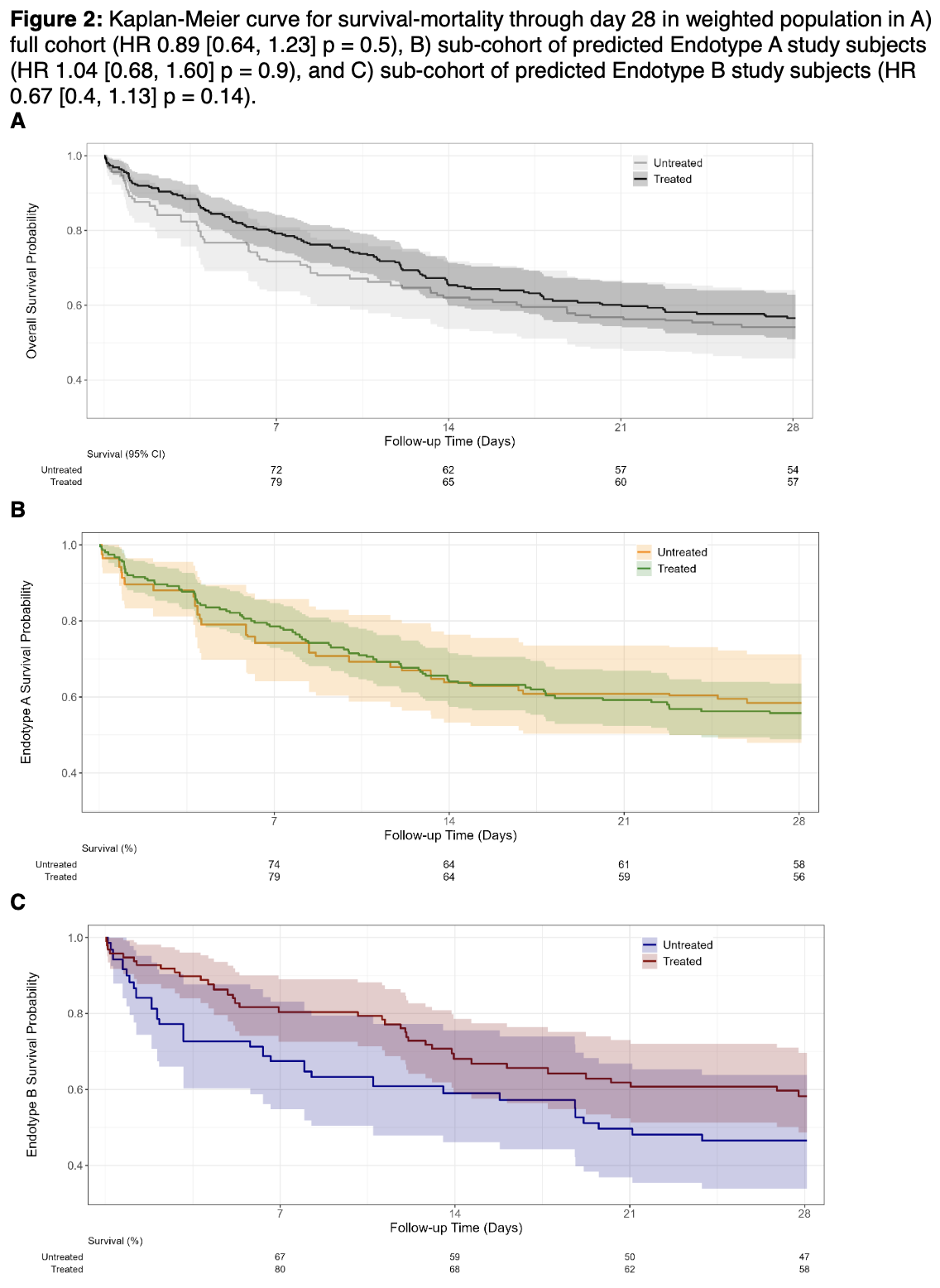
Background: Corticosteroids reduce mortality in severe COVID-19 requiring oxygen or invasive mechanical ventilation, yet emerging data suggest that SARS-CoV-2-associated acute lung injury is biologically heterogeneous and that treatment response may vary across molecularly defined disease states. Lung-derived molecular endotypes of severe COVID-19-associated acute lung injury have been described, but direct molecular profiling is not routinely available at the bedside. We evaluated whether a clinical predictor of previously defined lung molecular endotype identifies heterogeneity in corticosteroid treatment effect among mechanically ventilated patients with COVID-19. Methods: We utilized a single-center cohort of 5,000 patients with COVID-19 treated at the University of North Carolina Hospital between January 1, 2020, and December 31, 2022, to emulate a target trial assessing the effect of corticosteroid receipt on mortality, length of stay, and incident organ support. Confounding was addressed through inverse probability of treatment weighting (IPTW). Outcomes for severely ill patients requiring mechanical ventilation were compared to the RECOVERY trial results, with subsequent moderation analysis and stratified analysis by..
DOI record:
{
"DOI": "10.64898/2026.06.08.26355201",
"URL": "http://dx.doi.org/10.64898/2026.06.08.26355201",
"abstract": "<jats:title>ABSTRACT</jats:title>\n <jats:sec>\n <jats:title>Background</jats:title>\n <jats:p>Corticosteroids reduce mortality in severe COVID-19 requiring oxygen or invasive mechanical ventilation, yet emerging data suggest that SARS-CoV-2-associated acute lung injury is biologically heterogeneous and that treatment response may vary across molecularly defined disease states. Lung-derived molecular endotypes of severe COVID-19-associated acute lung injury have been described, but direct molecular profiling is not routinely available at the bedside. We evaluated whether a clinical predictor of previously defined lung molecular endotype identifies heterogeneity in corticosteroid treatment effect among mechanically ventilated patients with COVID-19.</jats:p>\n </jats:sec>\n <jats:sec>\n <jats:title>Methods</jats:title>\n <jats:p>We utilized a single-center cohort of 5,000 patients with COVID-19 treated at the University of North Carolina Hospital between January 1, 2020, and December 31, 2022, to emulate a target trial assessing the effect of corticosteroid receipt on mortality, length of stay, and incident organ support. Confounding was addressed through inverse probability of treatment weighting (IPTW). Outcomes for severely ill patients requiring mechanical ventilation were compared to the RECOVERY trial results, with subsequent moderation analysis and stratified analysis by clinically predicted lung molecular endotype and vaccination status. The primary outcome was 28-day mortality. Secondary Outcomes were time to discharge alive and progression to additional organ support.</jats:p>\n </jats:sec>\n <jats:sec>\n <jats:title>Results</jats:title>\n <jats:p>This emulated target trial showed a directionally favorable but non-statistically significant association between corticosteroid treatment and reduced 28-day mortality in patients requiring mechanical ventilation for SARS-CoV-2 infection. A clinical predictor of lung molecular endotype moderated the effect of corticosteroids on 28-day mortality (p-value for interaction 0.038) and identified distinct predicted endotype-specific treatment effect. Corticosteroid treatment was associated with lower 28-day mortality in the predicted Hyper-Inflammatory endotype (OR 0.62, 95% CI 0.39, 0.99) but not in the predicted Metabolic Dysregulation endotype (OR 1.15, 95% CI 0.82, 1.61). We did not detect significant effect modification by vaccination status (p-value for interaction 0.65), although inference was limited by the small, vaccinated subgroup (28-mortality OR 0.78, 95% CI 0.37, 1.65 in vaccinated vs 0.94, 95% CI 0.70, 1.26 in unvaccinated).</jats:p>\n </jats:sec>\n <jats:sec>\n <jats:title>Conclusions</jats:title>\n <jats:p>In this target trial emulation of mechanically ventilated patients with severe COVID-19, corticosteroid treatment showed a directionally favorable but non-statistically significant association with reduced 28-day mortality in the overall cohort. However, a clinical predictor of lung molecular endotype identified significant heterogeneity in treatment effect, with benefit concentrated in the predicted Hyper-Inflammatory endotype and no apparent benefit in the predicted Metabolic Dysregulation endotype. These findings support prospective validation of clinically deployable endotype-guided corticosteroid treatment strategies in acute lung injury and ARDS.</jats:p>\n </jats:sec>",
"accepted": {
"date-parts": [
[
2026,
6,
10
]
]
},
"author": [
{
"ORCID": "https://orcid.org/0000-0001-5606-0238",
"affiliation": [
{
"name": "Division of Pulmonary Critical Care Medicine, University of North Carolina at Chapel Hill, Chapel Hill, NC, United States"
}
],
"authenticated-orcid": false,
"family": "Sines",
"given": "Benjamin J",
"role": [
{
"role": "author",
"vocabulary": "crossref"
}
],
"sequence": "first"
},
{
"affiliation": [
{
"name": "Division of Pulmonary Critical Care Medicine, University of North Carolina at Chapel Hill, Chapel Hill, NC, United States"
},
{
"name": "Marsico Lung Institute and Department of Microbiology and Immunology, University of North Carolina at Chapel Hill, Chapel Hill, NC, United States"
}
],
"family": "Hagan",
"given": "Robert S",
"role": [
{
"role": "author",
"vocabulary": "crossref"
}
],
"sequence": "additional"
},
{
"affiliation": [
{
"name": "SAS Institute Inc, Cary, NC, United States"
}
],
"family": "Jiang",
"given": "Xi",
"role": [
{
"role": "author",
"vocabulary": "crossref"
}
],
"sequence": "additional"
},
{
"affiliation": [
{
"name": "SAS Institute Inc, Cary, NC, United States"
}
],
"family": "Pavlechko",
"given": "Ella",
"role": [
{
"role": "author",
"vocabulary": "crossref"
}
],
"sequence": "additional"
},
{
"affiliation": [
{
"name": "SAS Institute Inc, Cary, NC, United States"
}
],
"family": "McClain",
"given": "Scott",
"role": [
{
"role": "author",
"vocabulary": "crossref"
}
],
"sequence": "additional"
},
{
"affiliation": [
{
"name": "SAS Institute Inc, Cary, NC, United States"
}
],
"family": "Hunt",
"given": "Xin",
"role": [
{
"role": "author",
"vocabulary": "crossref"
}
],
"sequence": "additional"
},
{
"affiliation": [
{
"name": "SAS Institute Inc, Cary, NC, United States"
}
],
"family": "Florou-Moreno",
"given": "Julia",
"role": [
{
"role": "author",
"vocabulary": "crossref"
}
],
"sequence": "additional"
},
{
"affiliation": [
{
"name": "SAS Institute Inc, Cary, NC, United States"
}
],
"family": "Acquadro",
"given": "Jake",
"role": [
{
"role": "author",
"vocabulary": "crossref"
}
],
"sequence": "additional"
},
{
"affiliation": [
{
"name": "SAS Institute Inc, Cary, NC, United States"
}
],
"family": "Risa",
"given": "Gabriel",
"role": [
{
"role": "author",
"vocabulary": "crossref"
}
],
"sequence": "additional"
},
{
"affiliation": [
{
"name": "SAS Institute Inc, Cary, NC, United States"
}
],
"family": "Valsaraj",
"given": "Varunraj",
"role": [
{
"role": "author",
"vocabulary": "crossref"
}
],
"sequence": "additional"
},
{
"affiliation": [
{
"name": "McAllister Heart Institute and the Department of Pharmacology, The University of North Carolina at Chapel Hill, Chapel Hill, NC, United States"
}
],
"family": "Schisler",
"given": "Jonathan C",
"role": [
{
"role": "author",
"vocabulary": "crossref"
}
],
"sequence": "additional"
},
{
"affiliation": [
{
"name": "Marsico Lung Institute and Department of Microbiology and Immunology, University of North Carolina at Chapel Hill, Chapel Hill, NC, United States"
}
],
"family": "Wolfgang",
"given": "Matthew C",
"role": [
{
"role": "author",
"vocabulary": "crossref"
}
],
"sequence": "additional"
}
],
"container-title": [],
"content-domain": {
"crossmark-restriction": false,
"domain": []
},
"created": {
"date-parts": [
[
2026,
6,
10
]
],
"date-time": "2026-06-10T16:40:12Z",
"timestamp": 1781109612000
},
"deposited": {
"date-parts": [
[
2026,
6,
13
]
],
"date-time": "2026-06-13T08:00:22Z",
"timestamp": 1781337622000
},
"funder": [
{
"award": [
"5T32HL007106-45"
],
"award-info": [
{
"award-number": [
"5T32HL007106-45"
]
}
],
"id": [
{
"asserted-by": "publisher",
"id": "https://ror.org/001d55x84",
"id-type": "ROR"
}
]
}
],
"group-title": "Intensive Care and Critical Care Medicine",
"indexed": {
"date-parts": [
[
2026,
6,
13
]
],
"date-time": "2026-06-13T08:55:27Z",
"timestamp": 1781340927637,
"version": "3.54.1"
},
"institution": [
{
"name": "medRxiv"
}
],
"is-referenced-by-count": 0,
"issued": {
"date-parts": [
[
2026,
6,
10
]
]
},
"license": [
{
"URL": "http://creativecommons.org/licenses/by-nc-nd/4.0/",
"content-version": "vor",
"delay-in-days": 0,
"start": {
"date-parts": [
[
2026,
6,
10
]
],
"date-time": "2026-06-10T00:00:00Z",
"timestamp": 1781049600000
}
}
],
"link": [
{
"URL": "https://syndication.highwire.org/content/doi/10.64898/2026.06.08.26355201",
"content-type": "unspecified",
"content-version": "vor",
"intended-application": "similarity-checking"
}
],
"member": "54368",
"original-title": [],
"posted": {
"date-parts": [
[
2026,
6,
10
]
]
},
"prefix": "10.64898",
"published": {
"date-parts": [
[
2026,
6,
10
]
]
},
"publisher": "openRxiv",
"reference": [
{
"DOI": "10.1056/NEJMoa2021436",
"doi-asserted-by": "publisher",
"key": "2026061301001190000_2026.06.08.26355201v1.1"
},
{
"DOI": "10.1001/jama.2020.17022",
"doi-asserted-by": "publisher",
"key": "2026061301001190000_2026.06.08.26355201v1.2"
},
{
"DOI": "10.1126/science.abc8511",
"doi-asserted-by": "publisher",
"key": "2026061301001190000_2026.06.08.26355201v1.3"
},
{
"DOI": "10.1164/rccm.202105-1302oc",
"doi-asserted-by": "publisher",
"key": "2026061301001190000_2026.06.08.26355201v1.4"
},
{
"DOI": "10.1016/j.chest.2021.04.062",
"article-title": "Identification of Distinct Clinical Subphenotypes in Critically Ill Patients With COVID-19",
"doi-asserted-by": "crossref",
"first-page": "929",
"journal-title": "Chest",
"key": "2026061301001190000_2026.06.08.26355201v1.5",
"volume": "160",
"year": "2021"
},
{
"DOI": "10.1038/s41467-021-25040-5",
"doi-asserted-by": "publisher",
"key": "2026061301001190000_2026.06.08.26355201v1.6"
},
{
"DOI": "10.1016/S2213-2600(20)30366-0",
"article-title": "Prevalence of phenotypes of acute respiratory distress syndrome in critically ill patients with COVID-19: a prospective observational study",
"doi-asserted-by": "crossref",
"first-page": "1209",
"journal-title": "The Lancet Respiratory Medicine",
"key": "2026061301001190000_2026.06.08.26355201v1.7",
"volume": "8",
"year": "2020"
},
{
"key": "2026061301001190000_2026.06.08.26355201v1.8",
"unstructured": "Ozonoff, A. et al. Phenotypes of disease severity in a cohort of hospitalized COVID-19 patients: Results from the IMPACC study. eBioMedicine 83, 104208 (2022)."
},
{
"DOI": "10.3389/fimmu.2022.989556",
"doi-asserted-by": "publisher",
"key": "2026061301001190000_2026.06.08.26355201v1.9"
},
{
"DOI": "10.1001/jama.2023.3651",
"doi-asserted-by": "publisher",
"key": "2026061301001190000_2026.06.08.26355201v1.10"
},
{
"DOI": "10.1038/s41467-020-20139-7",
"doi-asserted-by": "publisher",
"key": "2026061301001190000_2026.06.08.26355201v1.11"
},
{
"DOI": "10.1371/journal.pone.0295418",
"article-title": "Heterogeneity of COVID-19 symptoms and associated factors: Longitudinal analysis of laboratory-confirmed COVID-19 cases in San Antonio",
"doi-asserted-by": "crossref",
"first-page": "e0295418",
"journal-title": "PLoS ONE",
"key": "2026061301001190000_2026.06.08.26355201v1.12",
"volume": "18",
"year": "2023"
},
{
"DOI": "10.1164/rccm.202308-1490OC",
"doi-asserted-by": "publisher",
"key": "2026061301001190000_2026.06.08.26355201v1.13"
},
{
"DOI": "10.1007/s00134-022-06869-w",
"article-title": "Coronavirus disease 2019 subphenotypes and differential treatment response to convalescent plasma in critically ill adults: secondary analyses of a randomized clinical trial",
"doi-asserted-by": "crossref",
"first-page": "1525",
"journal-title": "Intensive Care Med",
"key": "2026061301001190000_2026.06.08.26355201v1.14",
"volume": "48",
"year": "2022"
},
{
"DOI": "10.1164/rccm.202401-0232ED",
"article-title": "Understanding Heterogeneity in Acute Care Trials: Resource Availability Impacts Outcomes",
"doi-asserted-by": "crossref",
"first-page": "469",
"journal-title": "Am J Respir Crit Care Med",
"key": "2026061301001190000_2026.06.08.26355201v1.15",
"volume": "209",
"year": "2024"
},
{
"DOI": "10.1136/bmj.k4245",
"doi-asserted-by": "publisher",
"key": "2026061301001190000_2026.06.08.26355201v1.16"
},
{
"DOI": "10.1056/EVIDe2400054",
"doi-asserted-by": "crossref",
"key": "2026061301001190000_2026.06.08.26355201v1.17",
"unstructured": "Yarnell, C. J. & Fralick, M. Heterogeneity of Treatment Effect — An Evolution in Subgroup Analysis. NEJM Evidence 3, (2024)."
},
{
"DOI": "10.1164/rccm.202311-2011ST",
"doi-asserted-by": "publisher",
"key": "2026061301001190000_2026.06.08.26355201v1.18"
},
{
"DOI": "10.1016/S2213-2600(19)30417-5",
"article-title": "Dexamethasone treatment for the acute respiratory distress syndrome: a multicentre, randomised controlled trial",
"doi-asserted-by": "crossref",
"first-page": "267",
"journal-title": "The Lancet Respiratory Medicine",
"key": "2026061301001190000_2026.06.08.26355201v1.19",
"volume": "8",
"year": "2020"
},
{
"DOI": "10.1007/s00134-014-3287-7",
"doi-asserted-by": "publisher",
"key": "2026061301001190000_2026.06.08.26355201v1.20"
},
{
"DOI": "10.1016/j.amjmed.2020.03.012",
"article-title": "Hyperglycemia in Medically Critically Ill Patients: Risk Factors and Clinical Outcomes",
"doi-asserted-by": "crossref",
"first-page": "e568",
"journal-title": "The American Journal of Medicine",
"key": "2026061301001190000_2026.06.08.26355201v1.21",
"volume": "133",
"year": "2020"
},
{
"key": "2026061301001190000_2026.06.08.26355201v1.22",
"unstructured": "The Strengthening the Reporting of Observational Studies in Epidemiology (STROBE) Statement: Guidelines for Reporting Observational Studies. 18, (2024)."
},
{
"DOI": "10.1503/cmaj.200077",
"doi-asserted-by": "publisher",
"key": "2026061301001190000_2026.06.08.26355201v1.23"
},
{
"key": "2026061301001190000_2026.06.08.26355201v1.24",
"unstructured": "Hagan, R. et al. Multiple omic analysis from the lungs explains heterogeneity of ARDS with molecular pathways that suggest differential response to pharmacotherapy. manuscript in preparation 40 pages."
},
{
"key": "2026061301001190000_2026.06.08.26355201v1.25",
"unstructured": "Sines, B. Clinician-Informed Feature Engineering Improves Machine Learning Assignment of Molecular Endotypes in the Intensive Care Unit."
}
],
"reference-count": 25,
"references-count": 25,
"relation": {},
"resource": {
"primary": {
"URL": "http://medrxiv.org/lookup/doi/10.64898/2026.06.08.26355201"
}
},
"score": 1,
"short-title": [],
"source": "Crossref",
"subject": [],
"subtitle": [],
"subtype": "preprint",
"title": "A Clinical Predictor of Lung Molecular Endotype Identifies Heterogeneity in Corticosteroid Response in Severe COVID-19: an Emulated Target Trial",
"type": "posted-content"
}