An Open Label Randomized Controlled Trial of Ivermectin Plus Favipiravir-Based Standard of Care versus Favipiravir-Based Standard of Care for Treatment of Moderate COVID-19 in Thailand
et al., Infection & Chemotherapy, doi:10.3947/ic.2022.0127, TCTR20220427005, Dec 2022
RCT low-risk hospitalized patients in Thailand reporting no significant
difference with the addition of ivermectin to favipiravir based SOC. The trial was
registered
retrospectively1.
The primary outcome was WHO-category ordinal scale improvement of 2 points
at days 3, 7, 14, 21, for which only a single unspecified timepoint (when almost all
patients have recovered) is reported.
This trial has multiple critical issues:
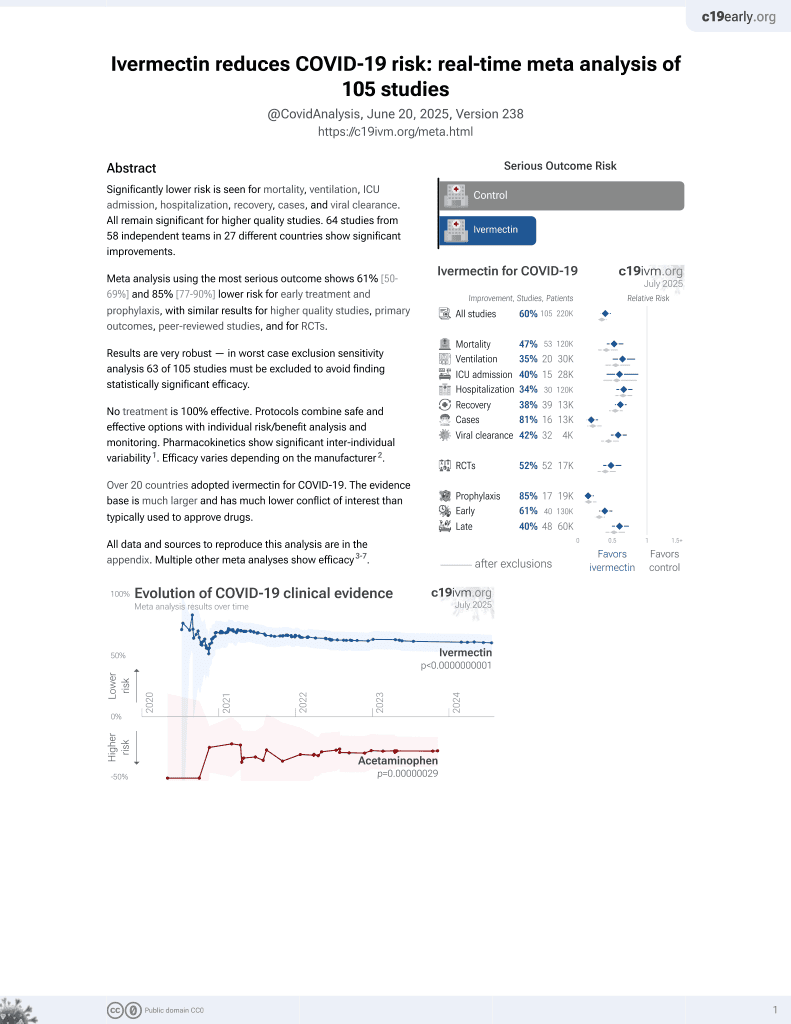
Ivermectin for COVID-19
4th treatment shown to reduce risk in
August 2020, now with p < 0.0000000001 from 106 studies, recognized in 24 countries.
No treatment is 100% effective. Protocols
combine treatments.
6,600+ studies for
220+ treatments. c19early.org
|
| CRITICAL | |
| CRITICAL | |
| CRITICAL | |
| CRITICAL | |
| CRITICAL | |
| CRITICAL | |
| CRITICAL | |
| CRITICAL | |
| CRITICAL | |
| CRITICAL | |
| CRITICAL | |
| CRITICAL | |
| CRITICAL | |
| SERIOUS | |
| SERIOUS | |
| SERIOUS | |
| MAJOR | |
| MAJOR | |
| MAJOR | |
| MINOR | |
| MINOR | |
| MINOR | |
| MINOR |
CRITICALRegistered day-specific primary outcomes not reported.
The trial registry specified the primary outcome (≥2-point improvement on the WHO ordinal scale) at days 3, 7, 14, and 21. The methods confirm patients were assessed at exactly those four points. However the publication reports only a single aggregate endpoint without specifying the time - it could be day 21 or at any time. Notably the illness-duration ranges up to 28 days, which exceeds the stated follow-up window and suggests potential unreported extended follow-up. There is no possibility of a significant difference after almost all patients have improved (with only one event in the control arm even zero events in the treatment arm is not statistically significant). Only the pre-registered outcomes at earlier time points could show a difference.
CRITICALTrial registered after enrollment begun; registry misidentified.
The trial was registered on April 27, 20221, however enrollment began in October 2021. The registry cannot demonstrate that the final outcomes and analysis plan were prospectively specified before viewing trial data. Registration was about six months after the first patient and about five weeks before the last. The paper states 'Clinicaltrials.gov Identifier: TCTR20220427005', however TCTR is the Thai Clinical Trials Registry, and the error also appears in PubMed.
CRITICALInstitutional conflict - treatment restricted by UNC Health.
An author involved in methodology and formal analysis, David Weber, was associated with UNC Health, which restricted ivermectin for COVID-19 in 2021 and named him as a contact for the policy2. Reporting positive results for ivermectin could result in substantial legal, moral, reputational, and career liability for the author and institution, especially in view of prior positive evidence at the time of restriction. ICMJE explicitly requires disclosure of such non-financial competing interests, however the paper claims 'no conflict of interest.' While most authors may be conflicted by following policies that restricted use, the conflict is significantly larger for individuals directly involved in the creation of such policies. Author would ideally have withdrawn from analysis and reporting of the study.
CRITICALReported relative risks are actually odds ratios.
Every effect estimate in the abstract and Table 2 is labelled a relative risk, but all four reproduce exactly as odds ratios with Woolf log-odds confidence limits. The primary-outcome figure reports improvement of 98.7% vs 99.4% with RR 0.487 (0.044-5.430), which is the odds ratio. For improvement the RR would be 0.993 (95% CI 0.972-1.015).
CRITICALReported statistical tests do not match stated methods.
The methods state that categorical variables were analyzed using Fisher exact tests, but reported p values systematically reproduce Pearson chi-square tests instead. This is particularly relevant for rare outcomes such as ICU admission, mortality, and mechanical ventilation where expected cell counts are small and Fisher exact testing would normally be preferred.
2-sd-impossible class=par>CRITICALBaseline oxygen SDs implausible for trial population and eligibility criteria.
Table 1 shows baseline SpO2 as 97.1 (SD 5.6) and 96.6 (SD 9.8). For a variable with a maximum of 100%, the maximum variance is (100 - mean)(mean - minimum). An SD of 9.8 with a mean of 96.6 requires saturations at or below 68.4% even in the most extreme two-point distribution. The paper claims 'moderate' patients, the protocol excluded hypoxia requiring high-flow oxygen or ventilation (WHO category 5+), and 97.5%/98.8% of patients were WHO 3-4.
CRITICALIllness-duration results contains impossible median, range exceeding follow-up, and no effect estimate.
Median illness duration is reported as 5.0 days (range 3-28) versus 5.2 days (range 3-28). A median of 5.2 is not possible with whole-day data. The 28-day maximum exceeds the stated 21-day follow-up window (assessments at days 3, 7, 14, 21). Authors assert that all pre-specified secondary outcomes appear in Table 2, but illness duration is absent from Table 2 and no CI, IQR, or effect estimate is given anywhere.
CRITICALBaseline p value cannot be reproduced.
The reported smoking comparison (34/157 vs 21/160) gives p=0.132 in Table 1, but standard unadjusted analyses produce substantially different values (0.045 by Pearson chi-square and 0.054 by Fisher exact test).
CRITICALWeekly cluster randomization without cluster-adjusted analysis.
The trial states that participants were 'cluster randomized weekly' but analyzes outcomes using individual-level tests with no intracluster correlation, design effect, cluster-robust variance, or mixed model, and the base CONSORT checklist was used rather than the cluster extension. If entire weeks were assigned to treatment arms, standard individual-level analyses may underestimate uncertainty and permit confounding by calendar time. This is especially important because the trial spanned Delta and Omicron waves.
CRITICALNon-inferiority design was never analyzed or reported as one.
The sample size uses a non-inferiority framework with an assumed 18% control-arm progression rate and a 10-point margin, but no non-inferiority analysis is reported: no confidence bound is compared to the margin, no per-protocol analysis is presented, and the CONSORT non-inferiority extension was not used.
CRITICALObserved event rate 29-fold below design assumption; insufficient power for severe clinical outcomes.
The design assumed 18% clinical progression in the control arm. The observed rate was 1/160 = 0.63%. Three patients in the trial progressed to severe disease. The limitations paragraph attributes the null result to a 'relatively small sample size' but does not disclose the very low event rate.
CRITICALIntention-to-treat analysis asserted but not presented; mITT defined asymmetrically between arms.
Authors state 'similar results were observed in the intention-to-treat analysis' but no ITT numbers, estimates, or table appear. The modified ITT population is defined differently in each arm - intervention patients qualify by having received at least one dose of ivermectin, whereas control patients qualify by being followed until the primary outcome, a serious AE, or withdrawal. One control patient was excluded after randomization for exclusion criteria identified post hoc
CRITICALRegistry states treatment given only after a laboratory result; treatment delay unreported.
The trial registry states that 'after laboratory result, intervention arm received ivermectin,' but does not identify the laboratory result or report the resulting delay. The publication omits this condition and the paper only reports symptom duration at enrollment, not the time from symptom onset to treatment.
SERIOUSCONSORT checklist claims items that do not appear in the paper; wrong checklist version used.
Supplementary Table 1 marks items 8b (type of randomization, restriction, block size), 9 (allocation concealment), 10 (who generated the sequence, enrolled and assigned participants), 14b (why the trial ended) and 24 (where the full protocol can be accessed) as reported on specific pages. None of this content exists in the paper. Authors use the base CONSORT 2010 form rather than the cluster-randomised extension (required by the described allocation) or the non-inferiority extension (required by the design), despite the form's own footnote recommending both.
SERIOUSOpen-label trial with a patient-self-reported primary endpoint and no blinded adjudication.
The primary outcome is improvement in the WHO-category ordinal scale by 2 points, and the methods state that all patients self-reported their level of function. There was no blinding of participants, clinicians or outcome assessors, and no adjudication committee. Patients knew whether they had received the widely publicized and politicized study drug.
SERIOUSCorticosteroid and anti-inflammatory co-interventions are not reported by arm.
The control arm is described as receiving supportive care 'which included anti-inflammatory agents, if indicated, and favipiravir', while the intervention arm description omits any mention of anti-inflammatory agents. Corticosteroid and immunomodulator use, the co-treatments with the largest genuine effect on COVID-19 outcomes, are not reported by arm.
MAJORSample-size calculation not reproducible from stated parameters.
The sample size is not reproducible from the stated parameters. The paper claims at least 145 patients per group for a 10-point non-inferiority margin at 18% expected event rate, 'two-sided type I error of 0.05' and 80% power. Recomputation gives 232 per group at one-sided alpha 0.025 and 183 at one-sided alpha 0.05. An n of 145 per group supports a margin of 12.6 points, not 10.
MAJORFavipiravir in both groups limits interpretation of ivermectin effect.
The trial evaluates ivermectin added to favipiravir-based standard care rather than ivermectin versus no antiviral treatment.
MAJORDiscussion describes a single-centre study; methods describe two hospitals, and no site-level data are reported.
The methods show the trial at Thammasat Field Hospital (470 beds) and Thammasat University Hospital (600 beds); the limitations paragraph cites 'the nature of single center study'. No per-site enrolment counts, outcome rates, AE rates, or missing-data rates are reported, and no site term appears in any analysis.
MINORWHO baseline category p-value not reproducible.
Both WHO classification rows in Table 1 carry p = 0.164. The 2x2 comparison of WHO 0-2 versus 3-4 gives chi-square p = 0.397 (Yates 0.663, Fisher 0.445).
MINORSex percentages transposed between columns in Table 1.
Table 1 reports female sex as 98 (61.3%) in the intervention arm and 98 (62.4%) in the control arm. Recomputation gives 98/157 = 62.42% and 98/160 = 61.25%: the percentages have been swapped between columns.
MINORControl-arm dyspnea percentage incorrect.
Table 1 reports dyspnea in 21 (13.7%) control patients; 21/160 = 13.1%.
MINORSeveral references are misattributed.
Reference 18 (Caly et al., Antiviral Res 2020) is an in vitro study but is cited in the discussion as 'the first RCT to compare ivermectin with hydroxychloroquine among patients with COVID-19 pneumonia'. The in vitro IC50 claim is attributed to reference 3, a cattle tissue-distribution study.
This is the 45th of 54 COVID-19 RCTs for ivermectin, which collectively show efficacy with p=0.000000027.
This is the 94th of 106 COVID-19 controlled studies for ivermectin, which collectively show efficacy with p<0.0000000001.
This study is excluded in the after exclusion results of meta-analysis:
many critical issues including missing primary outcome results, non-reproducible values, and protocol violations.
|
risk of death, 1.9% higher, RR 1.02, p = 1.00, treatment 1 of 157 (0.6%), control 1 of 160 (0.6%), all-cause in-hospital mortality.
|
|
risk of ICU admission, 103.8% higher, RR 2.04, p = 0.62, treatment 2 of 157 (1.3%), control 1 of 160 (0.6%).
|
|
risk of no improvement, 103.8% higher, RR 2.04, p = 0.62, treatment 2 of 157 (1.3%), control 1 of 160 (0.6%), failure to improve ≥2 points on WHO ordinal scale.
|
|
recovery time, 3.8% lower, relative time 0.96, p = 0.63, treatment 157, control 160.
|
| Effect extraction follows pre-specified rules prioritizing more serious outcomes. Submit updates |
Sarojvisut et al., 12 Dec 2022, Randomized Controlled Trial, Thailand, peer-reviewed, 8 authors, study period 1 October, 2021 - 31 May, 2022, dosage 400μg/kg days 1-5, trial TCTR20220427005.
An Open Label Randomized Controlled Trial of Ivermectin Plus Favipiravir-Based Standard of Care versus Favipiravir-Based Standard of Care for Treatment of Moderate COVID-19 in Thailand
Infection & Chemotherapy, doi:10.3947/ic.2022.0127
Background: The role of ivermectin in the treatment of moderate coronavirus disease 2019 (COVID-19) is controversial. We performed an open label randomized controlled trial to evaluate the role of ivermectin plus favipiravir-based standard of care versus favipiravir-based standard of care for the treatment of moderate COVID-19 infection.
Materials and Methods: An open-label randomized control trial was performed at Thammasat Field Hospital and Thammasat University Hospital from October 1st, 2021 to May 31st, 2022. Patients with moderate COVID-19 infections were randomized to the intervention (ivermectin plus favipiravir-based standard of care) or control group (favipiravirbased standard of care alone). Patients were followed up to 21 days. The primary outcome was the improvement in World Health Organization (WHO) category ordinal scale by 2 points. Secondary outcomes included duration of illness, development of severe COVID-19, and adverse reactions. Results: There were 157 patients in the intervention and 160 patients in the control group. Characteristics, underlying diseases, and risk factors for severe COVID-19 were comparable in both groups. Improvement in the WHO-category ordinal scale by 2 points was achieved in 98.7% of the intervention group and in 99.4% of the control group (relative risk [RR]: 0.487; 95% confidence interval [CI]: 0.044-5.430). The median illness duration was 5.0 days (range, 3 -28 days) in intervention group versus 5.2 days (range, 3 -28 days) in control group (P = 0.630). Severe COVID-19 that required intensive care occurred in 2 patients (1.3%) in the intervention group and 1 patient (0.6%) in the control group (RR: 2.052; 95% CI: 0.184 -22.857). No significant difference in serious drug adverse events was seen.
SUPPLEMENTARY MATERIAL Supplementary
References
Ahmed, Karim, Ross, Hossain, Clemens et al., A five-day course of ivermectin for the treatment of COVID-19 may reduce the duration of illness, Int J Infect Dis, doi:10.1016/j.ijid.2020.11.191
Bhimraj, Morgan, Shumaker, Baden, Cheng et al., Infectious Diseases Society of America guidelines on the treatment and management of patients with COVID-19, Infectious Diseases Society of America
Bramante, Huling, Tignanelli, Buse, Liebovitz et al., Randomized trial of metformin, ivermectin, and fluvoxamine for Covid-19, N Engl J Med, doi:10.1056/NEJMoa2201662
Caly, Druce, Catton, Jans, Wagstaff, The FDA-approved drug ivermectin inhibits the replication of SARS-CoV-2 in vitro, Antiviral Res, doi:10.1016/j.antiviral.2020.104787
Cevik, Kuppalli, Kindrachuk, Peiris, Virology, transmission, and pathogenesis of SARS-CoV-2, BMJ, doi:10.1136/bmj.m3862
Chaccour, Casellas, Blanco-Di Matteo, Pineda, Fernandez-Montero et al., None
Chen, Feng, Xu, Huang, Sun et al., Patterns of deterioration in moderate patients with COVID-19 from Jan 2020 to Mar 2020: a multi-center, retrospective cohort study in China, Front Med, doi:10.3389/fmed.2020.567296
Chowdhury, Shahbaz, Karim, Islam, Dan et al., A comparative study on ivermectindoxycycline and hydroxychloroquine-azithromycin therapy on COVID-19 patients, EJMO, doi:10.14744/ejmo.2021.16263
Karatas, Aksoy, Ozaslan, Association of early favipiravir use with reduced COVID-19 fatality among hospitalized patients, Infect Chemother, doi:10.3947/ic.2020.0149
Kim, Ryoo, Huh, Joo, Kim et al., Revised Korean Society of Infectious Diseases/national evidence-based healthcarea collaborating agency guidelines on the treatment of patients with COVID-19, Infect Chemother, doi:10.3947/ic.2021.0303
Lifschitz, Virkel, Sallovitz, Sutra, Galtier et al., Comparative distribution of ivermectin and doramectin to parasite location tissues in cattle, Vet Parasitol, doi:10.1016/S0304-4017(99)00175-2
Lim, Hor, Tay, Jelani, Tan et al., Efficacy of ivermectin treatment on disease progression among adults with mild to moderate COVID-19 and comorbidities: The I-TECH randomized clinical trial, JAMA Intern Med, doi:10.1001/jamainternmed.2022.0189
López-Medina, López, Hurtado, Dávalos, Ramirez et al., Effect of ivermectin on time to resolution of symptoms among adults with mild COVID-19: a randomized clinical trial, JAMA, doi:10.1001/jama.2021.3071
Marcolino, Meira, Guimarães, Motta, Chagas et al., Systematic review and meta-analysis of ivermectin for treatment of COVID-19: evidence beyond the hype, BMC Infect Dis, doi:10.1186/s12879-022-07589-8
Rattanaumpawan, Jirajariyavej, Lerdlamyong, Palavutitotai, Saiyarin, Real-world effectiveness and optimal dosage of favipiravir for treatment of COVID-19: results from a multicenter observational study in Thailand, Antibiotics, doi:10.3390/antibiotics11060805
Reina, Sadaba, Fernández-Alonso, The effect of early treatment with ivermectin on viral load, symptoms and humoral response in patients with non-severe COVID-19: A pilot, double-blind, placebocontrolled, randomized clinical trial, EClinicalMedicine, doi:10.1016/j.eclinm.2020.100720
Reis, Silva, Silva, Thabane, Milagres et al., Effect of early treatment with ivermectin among patients with Covid-19, N Engl J Med, doi:10.1056/NEJMoa2115869
Schmith, Zhou, Lohmer, The approved dose of ivermectin alone is not the ideal dose for the treatment of COVID-19, Clin Pharmacol Ther, doi:10.1002/cpt.1889
Sirijatuphat, Suputtamongkol, Angkasekwinai, Horthongkham, Chayakulkeeree et al., Epidemiology, clinical characteristics, and treatment outcomes of patients with COVID-19 at Thailand's university-based referral hospital, BMC Infect Dis, doi:10.1186/s12879-021-06081-z
Wagstaff, Sivakumaran, Heaton, Harrich, Jans, Ivermectin is a specific inhibitor of importin α/β-mediated nuclear import able to inhibit replication of HIV-1 and dengue virus, Biochem J, doi:10.1042/BJ20120150
Working, Group on the Clinical Characterisation and Management of COVID-19 infection. A minimal common outcome measure set for COVID-19 clinical research, Lancet Infect Dis, doi:10.1016/S1473-3099(20)30483-7
Özlüşen, Kozan, Akcan, Kalender, Yaprak et al., Effectiveness of favipiravir in COVID-19: a live systematic review, Eur J Clin Microbiol Infect Dis, doi:10.1007/s10096-021-04307-1
DOI record:
{
"DOI": "10.3947/ic.2022.0127",
"ISSN": [
"2093-2340",
"2092-6448"
],
"URL": "http://dx.doi.org/10.3947/ic.2022.0127",
"assertion": [
{
"group": {
"label": "Publication History",
"name": "publication_history"
},
"label": "Received",
"name": "received",
"value": "2022-08-08"
},
{
"group": {
"label": "Publication History",
"name": "publication_history"
},
"label": "Accepted",
"name": "accepted",
"value": "2022-10-03"
},
{
"group": {
"label": "Publication History",
"name": "publication_history"
},
"label": "Published online",
"name": "published_online",
"value": "2022-12-12"
},
{
"group": {
"label": "Copyright and Licensing",
"name": "Copyright_and_licensing"
},
"label": "Copyright",
"name": "copyright",
"value": "Copyright © 2022 by The Korean Society of Infectious Diseases, Korean Society for Antimicrobial Therapy, and The Korean Society for AIDS"
},
{
"explanation": {
"URL": "https://creativecommons.org/licenses/by-nc/4.0/"
},
"group": {
"label": "Copyright and Licensing",
"name": "Copyright_and_licensing"
},
"label": "License",
"name": "license",
"value": "This is an Open Access article distributed under the terms of the Creative Commons Attribution Non-Commercial License (https://creativecommons.org/licenses/by-nc/4.0/) which permits unrestricted non-commercial use, distribution, and reproduction in any medium, provided the original work is properly cited."
}
],
"author": [
{
"ORCID": "http://orcid.org/0000-0001-5152-1752",
"affiliation": [
{
"name": "Department of Internal Medicine, Faculty of Medicine, Thammasat University, Pathum Thani, Thailand."
}
],
"authenticated-orcid": false,
"family": "Sarojvisut",
"given": "Phahol",
"sequence": "first"
},
{
"ORCID": "http://orcid.org/0000-0001-6390-9519",
"affiliation": [
{
"name": "Department of Internal Medicine, Faculty of Medicine, Thammasat University, Pathum Thani, Thailand."
},
{
"name": "Research group in Infectious Diseases Epidemiology and Prevention, Faculty of Medicine, Thammasat University, Pathum Thani, Thailand."
}
],
"authenticated-orcid": false,
"family": "Apisarnthanarak",
"given": "Anucha",
"sequence": "additional"
},
{
"ORCID": "http://orcid.org/0000-0001-9428-6131",
"affiliation": [
{
"name": "Research group in Infectious Diseases Epidemiology and Prevention, Faculty of Medicine, Thammasat University, Pathum Thani, Thailand."
},
{
"name": "Center of Excellence in Pharmacy Practice and Management Research, Faculty of Pharmacy, Thammasat University, Pathum Thani, Thailand."
}
],
"authenticated-orcid": false,
"family": "Jantarathaneewat",
"given": "Kittiya",
"sequence": "additional"
},
{
"ORCID": "http://orcid.org/0000-0002-2347-6074",
"affiliation": [
{
"name": "Department of Internal Medicine, Faculty of Medicine, Thammasat University, Pathum Thani, Thailand."
}
],
"authenticated-orcid": false,
"family": "Sathitakorn",
"given": "Ornnicha",
"sequence": "additional"
},
{
"ORCID": "http://orcid.org/0000-0001-6859-9118",
"affiliation": [
{
"name": "Department of Internal Medicine, Faculty of Medicine, Thammasat University, Pathum Thani, Thailand."
}
],
"authenticated-orcid": false,
"family": "Pienthong",
"given": "Thanus",
"sequence": "additional"
},
{
"ORCID": "http://orcid.org/0000-0001-8596-5378",
"affiliation": [
{
"name": "Department of Surgery, Faculty of Medicine, Thammasat University, Pathum Thani, Thailand."
}
],
"authenticated-orcid": false,
"family": "Mingmalairak",
"given": "Chatchai",
"sequence": "additional"
},
{
"ORCID": "http://orcid.org/0000-0001-8679-8241",
"affiliation": [
{
"name": "Division of Infectious Diseases, Washington University School of Medicine, St.Louis, MO, USA."
}
],
"authenticated-orcid": false,
"family": "Warren",
"given": "David K",
"sequence": "additional"
},
{
"ORCID": "http://orcid.org/0000-0002-8824-1110",
"affiliation": [
{
"name": "Gillings School of Global Public Health, University of North Carolina, Chapel Hill, NC, USA."
}
],
"authenticated-orcid": false,
"family": "Weber",
"given": "David J",
"sequence": "additional"
}
],
"container-title": "Infection & Chemotherapy",
"container-title-short": "Infect Chemother",
"content-domain": {
"crossmark-restriction": false,
"domain": [
"icjournal.org"
]
},
"created": {
"date-parts": [
[
2022,
12,
14
]
],
"date-time": "2022-12-14T23:58:06Z",
"timestamp": 1671062286000
},
"deposited": {
"date-parts": [
[
2022,
12,
14
]
],
"date-time": "2022-12-14T23:58:41Z",
"timestamp": 1671062321000
},
"indexed": {
"date-parts": [
[
2022,
12,
15
]
],
"date-time": "2022-12-15T07:14:45Z",
"timestamp": 1671088485756
},
"is-referenced-by-count": 0,
"issued": {
"date-parts": [
[
2022
]
]
},
"language": "en",
"license": [
{
"URL": "https://creativecommons.org/licenses/by-nc/4.0/",
"content-version": "tdm",
"delay-in-days": 0,
"start": {
"date-parts": [
[
2022,
1,
1
]
],
"date-time": "2022-01-01T00:00:00Z",
"timestamp": 1640995200000
}
}
],
"link": [
{
"URL": "https://icjournal.org/pdf/10.3947/ic.2022.0127",
"content-type": "application/pdf",
"content-version": "vor",
"intended-application": "text-mining"
},
{
"URL": "https://icjournal.org/DOIx.php?id=10.3947/ic.2022.0127",
"content-type": "unspecified",
"content-version": "vor",
"intended-application": "text-mining"
},
{
"URL": "https://icjournal.org/DOIx.php?id=10.3947/ic.2022.0127",
"content-type": "unspecified",
"content-version": "vor",
"intended-application": "similarity-checking"
}
],
"member": "2343",
"original-title": [],
"prefix": "10.3947",
"published": {
"date-parts": [
[
2022
]
]
},
"published-online": {
"date-parts": [
[
2022
]
]
},
"publisher": "Korean Society of Infectious Diseases and Korean Society for Chemotherapy",
"reference-count": 0,
"references-count": 0,
"relation": {},
"resource": {
"primary": {
"URL": "https://icjournal.org/DOIx.php?id=10.3947/ic.2022.0127"
}
},
"score": 1,
"short-title": [],
"source": "Crossref",
"subject": [
"Pharmacology (medical)",
"Infectious Diseases"
],
"subtitle": [],
"title": "An Open Label Randomized Controlled Trial of Ivermectin Plus Favipiravir-Based Standard of Care versus Favipiravir-Based Standard of Care for Treatment of Moderate COVID-19 in Thailand",
"type": "journal-article",
"update-policy": "http://dx.doi.org/10.3947/crossmark_policy",
"volume": "54"
}