Ivermectin therapy is associated with changes in SARS-CoV-2 RNA load in asymptomatic patients: a randomized controlled trial

Mouawia et al., Trials, doi:10.1186/s13063-026-09736-x, ChiCTR2000033627, May 2026
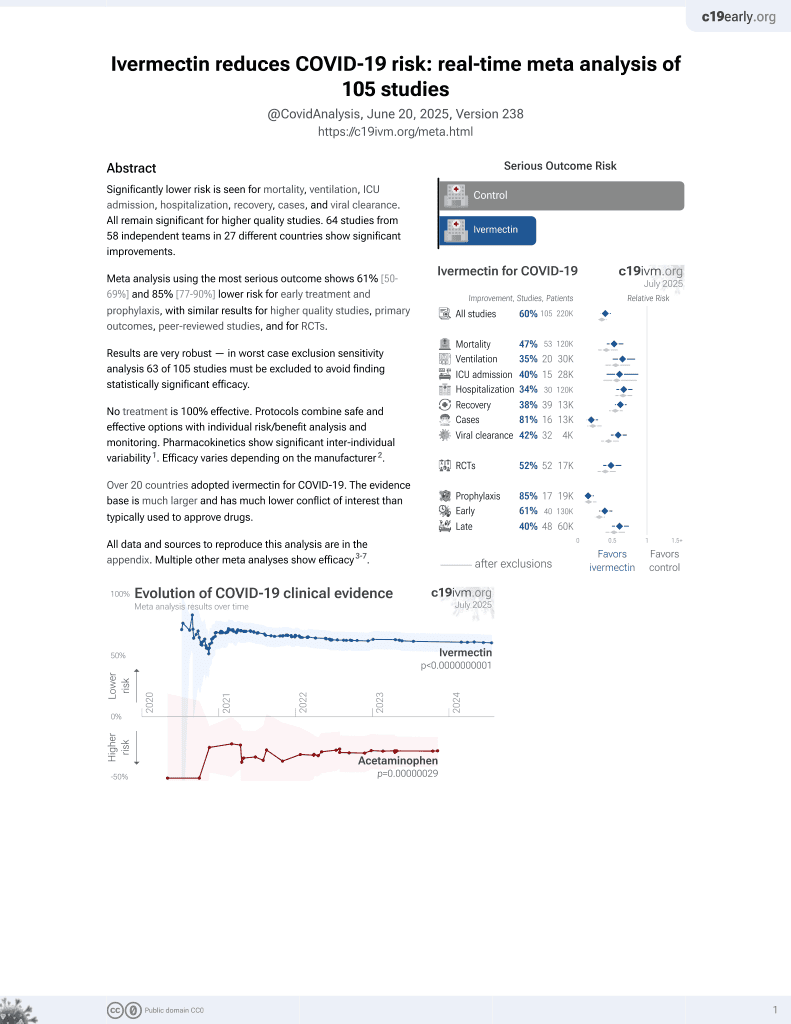
Hospitalization 56% improvement lower risk ← → higher risk Recovery, all sympto.. 31% Recovery, fever 81% Recovery, cough -33% Recovery, sore throat 60% Recovery, dyspnea 26% Recovery, pneumonia 33% Recovery, headache 40% Recovery, anosmia -46% Recovery, myalgia 22% Recovery, loss of taste 48% Recovery, fatigue 47% Recovery, dizziness 43% Viral load 62% Ivermectin  Mouawia et al.  EARLY TREATMENT RCT Is early treatment with ivermectin beneficial for COVID-19? RCT 126 patients in Lebanon (November - December 2021) Improved recovery (p=0.0072) and viral clearance (p<0.0001) c19early.org Mouawia et al., Trials, May 2026 0 0.5 1 1.5 2+ RR
Ivermectin for COVID-19
4th treatment shown to reduce risk in August 2020, now with p < 0.00000000001 from 106 studies, recognized in 24 countries.
No treatment is 100% effective. Protocols combine treatments.
6,500+ studies for 210+ treatments. c19early.org
RCT of 126 asymptomatic PCR+ patients with high viral load, showing improved recovery and significantly lower viral load with ivermectin treatment. All patients received zind and vitamin C.
The trial selected for patients with high viral load that were still asymptomatic - i.e., patients were treated early before significant progression and had received a high viral load, which may be favorable conditions for the strong viral load improvement seen.
This is the 54th COVID-19 RCT for ivermectin, which collectively show efficacy with p=0.000000052.
This is the 106th COVID-19 controlled study for ivermectin, which collectively show efficacy with p<0.0000000001.
risk of hospitalization, 55.6% lower, RR 0.44, p = 0.24, treatment 4 of 63 (6.3%), control 9 of 63 (14.3%), NNT 13, day 4.
risk of no recovery, 30.9% lower, RR 0.69, p = 0.007, treatment 63, control 63, all symptoms combined.
risk of no recovery, 81.2% lower, RR 0.19, p = 0.002, treatment 3 of 63 (4.8%), control 16 of 63 (25.4%), NNT 4.8, day 4, fever.
risk of no recovery, 33.3% higher, RR 1.33, p = 0.52, treatment 16 of 63 (25.4%), control 12 of 63 (19.0%), day 4, cough.
risk of no recovery, 60.0% lower, RR 0.40, p = 0.44, treatment 2 of 63 (3.2%), control 5 of 63 (7.9%), NNT 21, day 4, sore throat.
risk of no recovery, 26.3% lower, RR 0.74, p = 0.42, treatment 14 of 63 (22.2%), control 19 of 63 (30.2%), NNT 13, day 4, dyspnea.
risk of no recovery, 33.3% lower, RR 0.67, p = 0.74, treatment 4 of 63 (6.3%), control 6 of 63 (9.5%), NNT 32, day 4, pneumonia.
risk of no recovery, 40.0% lower, RR 0.60, p = 0.02, treatment 21 of 63 (33.3%), control 35 of 63 (55.6%), NNT 4.5, day 4, headache.
risk of no recovery, 46.2% higher, RR 1.46, p = 0.31, treatment 19 of 63 (30.2%), control 13 of 63 (20.6%), day 4, anosmia.
risk of no recovery, 22.2% lower, RR 0.78, p = 0.36, treatment 21 of 63 (33.3%), control 27 of 63 (42.9%), NNT 10, day 4, myalgia.
risk of no recovery, 48.0% lower, RR 0.52, p = 0.03, treatment 13 of 63 (20.6%), control 25 of 63 (39.7%), NNT 5.2, day 4, loss of taste.
risk of no recovery, 46.7% lower, RR 0.53, p = 0.02, treatment 16 of 63 (25.4%), control 30 of 63 (47.6%), NNT 4.5, day 4, fatigue.
risk of no recovery, 42.9% lower, RR 0.57, p = 0.53, treatment 4 of 63 (6.3%), control 7 of 63 (11.1%), NNT 21, day 4, dizziness.
viral load, 61.9% lower, relative load 0.38, p < 0.001, treatment 8.38 [7.56-9.2] n=63, control 3.19 [2.36-4.02] n=63, relative ΔCt, day 4.
Effect extraction follows pre-specified rules prioritizing more serious outcomes. Submit updates
Mouawia et al., 1 May 2026, Randomized Controlled Trial, Lebanon, peer-reviewed, mean age 40.1, 8 authors, study period November 2021 - December 2021, dosage 12mg single dose, <65kg - 9mg, 65-84kg - 12 mg, ≥85kg - 15 mg, trial ChiCTR2000033627. Contact: raadhoussamrh@gmail.com, houssam.raad@ul.edu.lb, houssein.mouawia@ul.edu.lb.
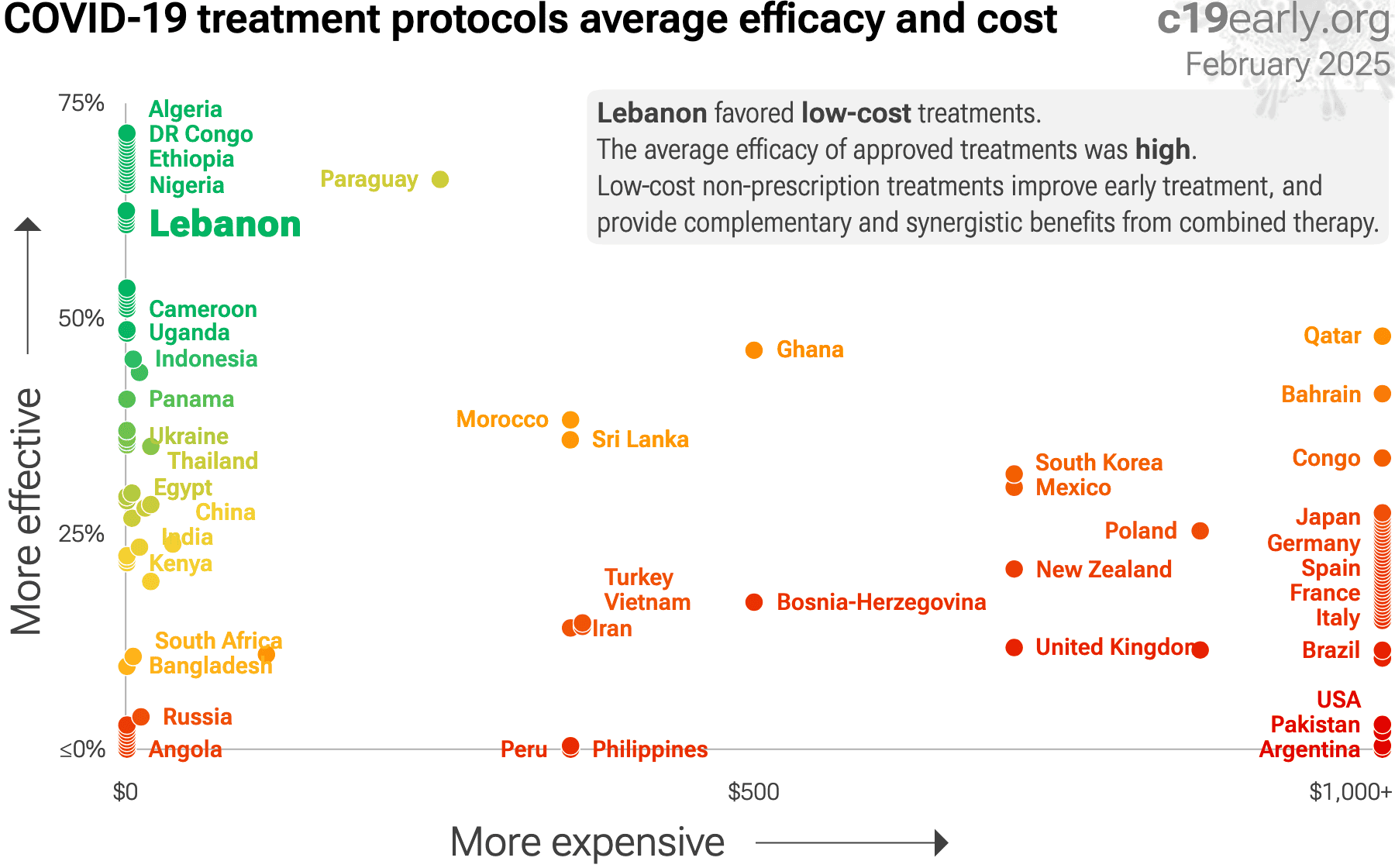
$0 $500 $1,000+ Efficacy vs. cost for COVID-19 treatment protocols c19early.org May 2026 Lebanon Pakistan United Kingdom USA Russia Argentina Sudan Angola Colombia Kenya Mozambique Peru Philippines Spain Vietnam Brazil France Italy China Uzbekistan Iran Nepal Bangladesh Ethiopia Ghana Germany Mexico South Korea Saudi Arabia Morocco Poland India Venezuela DR Congo Madagascar Thailand Uganda Egypt Nigeria Bolivia Taiwan Zambia Fiji Bosnia-Herzegovina Ukraine Côte d'Ivoire Bulgaria Greece Slovakia Singapore Iceland New Zealand Trinidad and Tobago Mongolia Czechia Israel Belarus North Macedonia Hong Kong Qatar Panama Serbia CAR Syria Lebanon favored low-cost treatments.The average efficacy of treatments was moderate.Low-cost treatments improve early treatment, andprovide complementary/synergistic benefits. More effective More expensive 75% 50% 25% ≤0%
$0 $500 $1,000+ Efficacy vs. cost for COVID-19treatment protocols worldwide c19early.org May 2026 Lebanon Pakistan United Kingdom USA Russia Argentina Sudan Angola Colombia Kenya Mozambique Peru Philippines Spain Vietnam Brazil France Japan China Uzbekistan Iran Nepal Bangladesh Ethiopia Ghana Germany Mexico South Korea Saudi Arabia Morocco Poland India Venezuela DR Congo Madagascar Thailand Uganda Egypt Nigeria Bolivia Taiwan Zambia Fiji Bosnia-Herzegovina Ukraine Côte d'Ivoire Eritrea Bulgaria Greece Slovakia Singapore Iceland New Zealand Mongolia Czechia Israel Belarus North Macedonia Hong Kong Qatar Panama Serbia CAR Paraguay Lebanon favored low-cost treatments.The average efficacy was moderate.Low-cost protocols improve early treatment,and add complementary/synergistic benefits. More effective More expensive 75% 50% 25% ≤0%
Please send us corrections, updates, or comments. c19early involves the extraction of 200,000+ datapoints from thousands of papers. Community updates help ensure high accuracy. Treatments and other interventions are complementary. All practical, effective, and safe means should be used based on risk/benefit analysis. No treatment or intervention is 100% available and effective for all current and future variants. We do not provide medical advice. Before taking any medication, consult a qualified physician who can provide personalized advice and details of risks and benefits based on your medical history and situation. IMA and WCH provide treatment protocols.
  or use drag and drop   
Submit