Vitamin B12 status and outcomes in patients admitted to intensive care unit with COVID-19: a three-group comparative analysis
Duygu Kayar Çalılı, Nihal Yüzbaşıoğlu, Demet Bölükbaşı, Fatih Seğmen, Deniz Erdem, Işıl Özkoçak Turan, Seval İzdeş
Journal of Health Sciences and Medicine, doi:10.32322/jhsm.1854699
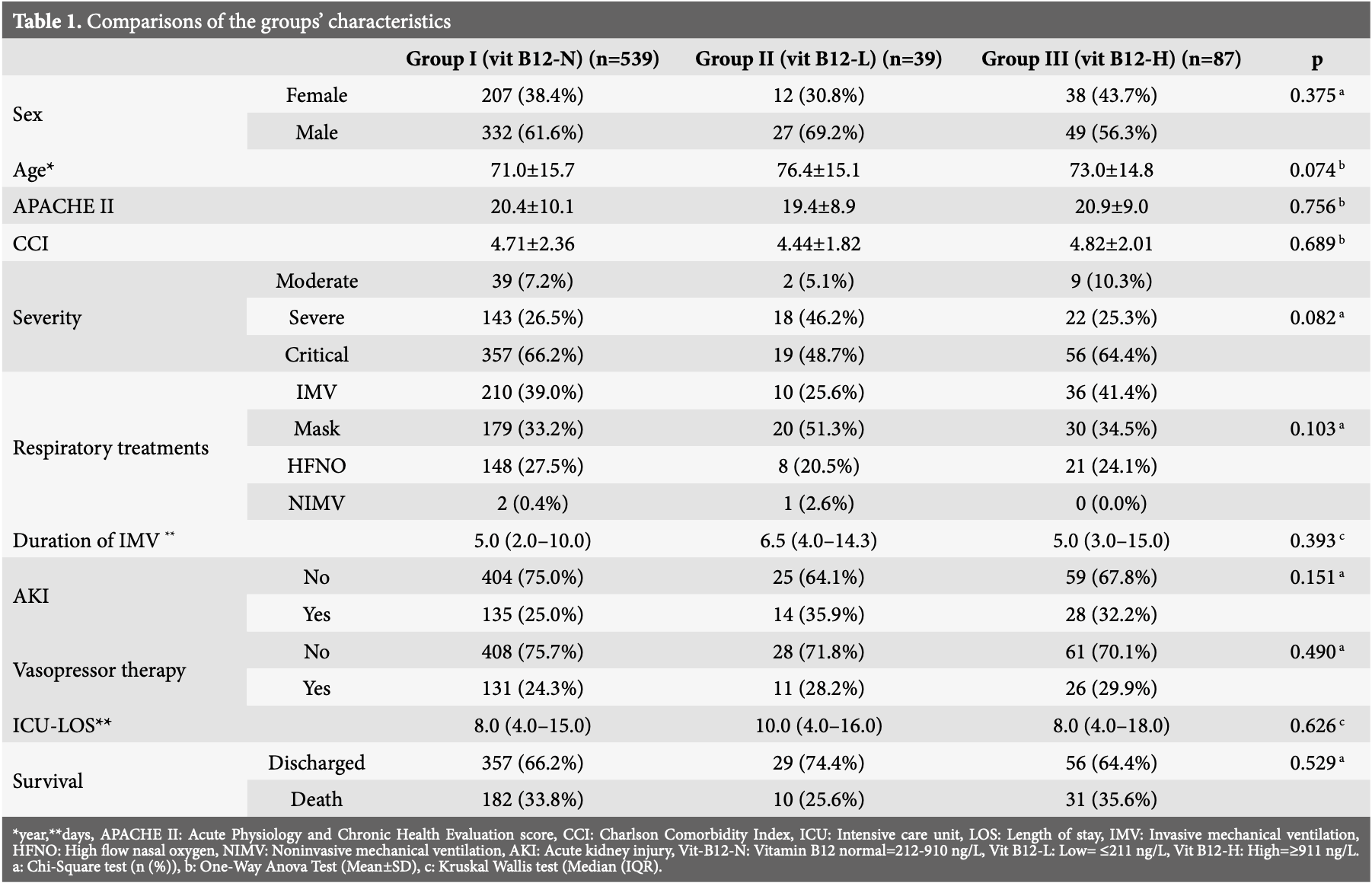
Aims: Vitamin B12 (Vit B12) plays important role in immune modulation. We aimed to compare clinical outcomes, laboratory findings, and survival rates among coronavirus disease 2019 (COVID-19) patients admitted to the intensive care unit (ICU) based on their vit B12 levels and to identify factors associated with mortality. Methods: This retrospective study examined ICU patients with COVID-19. Patients were categorized into three groups according to their vit B12 levels at ICU admission: normal (Vit B12-N), low (Vit B12-L) and high (Vit B12). The groups were compared in terms of patient characteristics, laboratory parameters, and survival outcomes. Additionally, the characteristics and laboratory values of the entire cohort were analyzed based on survival status. Results: A total of 665 patients were included (Vit B12-N: 539; Vit B12-L: 39; Vit B12-H: 87). There were no differences in disease severity, clinical characteristics, length of stay, and mortality between the groups (p>0.05). The high vit B12 group showed higher RDW and lower albumin levels compared with the normal vit B12 group (p<0.05). A higher Acute Physiology and Chronic Health Evaluation (APACHE) II score was found to be independently associated with increased mortality (p=0.000). Conclusion: Serum vit B12 levels at ICU admission were not associated with disease severity, clinical outcomes, or survival in critically ill patients with COVID-19. APACHE II score was the only variable independently associated with mortality. However, the observed relationships between vit B12 levels and RDW and albumin suggest the presence of complex metabolic interactions that require further investigation in prospective, multicenter studies.
Conflict of Interest The authors declare no conflicts of interest related to this study.
Financial Disclosure The authors received no financial support for the conduct or publication of this research.
Author Contributions
Concept
References
Akbar, Pranata, Wibowo, Lim, Sihite et al., The association between serum prealbumin and poor outcome in COVID-19-systematic review and meta-analysis, Eur Rev Med Pharmacol Sci,
doi:10.26355/eurrev_202105_25955Andrès, Serraj, Zhu, Vermorken, The pathophysiology of elevated vitamin B12 in clinical practice, QJM,
doi:10.1093/qjmed/hct051Batista, Cintra, Lucena, The role of vitamin B12 in viral infections: a comprehensive review of its relationship with the muscle-gut-brain axis and implications for SARS-CoV-2 infection, Nutr Rev,
doi:10.1093/nutrit/nuab092Battaglini, Lopes-Pacheco, Castro-Faria-Neto, Pelosi, Rocco, Laboratory biomarkers for diagnosis and prognosis in COVID-19, Front Immunol,
doi:10.3389/fimmu.2022.857573Damayanthi, Prabani, Nutritional determinants and COVID-19 outcomes of older patients with COVID-19: a systematic review, Arch Gerontol Geriatr,
doi:10.1016/j.archger.2021.104411Djordjevic, Milenkovic, Stojanovic, Vitamins, microelements and the immune system: current standpoint in the fight against coronavirus disease 2019, Br J Nutr,
doi:10.1017/S0007114522000083Domínguez-López, Kovatcheva, Casas, Higher circulating vitamin B12 is associated with lower levels of inflammatory markers in individuals at high cardiovascular risk and in naturally aged mice, J Sci Food Agric,
doi:10.1002/jsfa.12976Ersöz, Yılmaz, The association between micronutrient and hemogram values and prognostic factors in COVID-19 patients: a singlecenter experience from Turkey, Int J Clin Pract,
doi:10.1111/ijcp.14078Gamarra-Morales, Molina-López, Herrera-Quintana, Vázquez-Lorente, Planells, Folic acid and vitamin B12 as biomarkers of morbidity and mortality in patients with septic shock, Nutr Hosp,
doi:10.20960/nh.03505Guaní-Guerra, Torres-Murillo, Muñoz-Corona, Diagnostic accuracy of the RDW for predicting death in COVID-19, Medicina,
doi:10.3390/medicina58050613Gupta, The lactate and the lactate dehydrogenase in inflammatory diseases and major risk factors in COVID-19 patients, Inflammation,
doi:10.1007/s10753-022-01680-7Harb, Deckert, Bressenot, The deficit in folate and vitamin B12 triggers liver macrovesicular steatosis and inflammation in rats with dextran sodium sulfate-induced colitis, J Nutr Biochem,
doi:10.1016/j.jnutbio.2020.108415Itelman, Wasserstrum, Segev, Clinical characterization of 162 COVID-19 patients in Israel: preliminary report from a large tertiary center, Isr Med Assoc J
Kellum, Norbert, Aspelin, KDIGO clinical practice guideline for acute kidney injury, Kidney Int Suppl,
doi:10.1038/kisup.2012Lymperaki, Kazeli, Variti, Potential role of certain biomarkers such as vitamin B12, ROS, albumin, as early predictors for prognosis of COVID-19 outcomes, Medicines,
doi:10.3390/medicines9060036Moatasim, Kutkat, Osman, Potent antiviral activity of vitamin B12 against severe acute respiratory syndrome coronavirus 2, middle east respiratory syndrome coronavirus, and human coronavirus 229E, Microorganisms,
doi:10.3390/microorganisms11112777Oztas, Erdogan, Benzil, Nadar, Erel, A new inflammatory marker: vitamin B12, J Immunol Clin Microbiol
Richardson, Lovegrove, Nutritional status of micronutrients as a possible and modifiable risk factor for COVID-19: a UK perspective, Br J Nutr,
doi:10.1017/S000711452000330XRomain, Sviri, Linton, Stav, Van Heerden, The role of vitamin B12 in the critically ill-a review, Anaesth Intensive Care,
doi:10.1177/0310057X1604400410Seyedalinaghi, Shahidi, Mojdeganlou, The effect of macronutrient and micronutrient supplements on COVID-19: an umbrella review, J Health Popul Nutr,
doi:10.1186/s41043-024-00504-8Sezgin, Evaluation of serum vitamin B12 levels in patients with COVID-19 infection: a case-control study, J Med Biochem,
doi:10.5937/jomb0-42357Soohoo, Ahmadi, Qader, Association of serum vitamin B12 and folate with mortality in incident hemodialysis patients, Nephrol Dial Transplant,
doi:10.1093/ndt/gfw090Stabler, Vitamin B12
Taylor, Marson, Elhadi, Factors associated with mortality in patients with COVID-19 admitted to intensive care: a systematic review and meta-analysis, Anaesthesia,
doi:10.1111/anae.15532Tripathi, Singh, Zhou, Vitamin B12 and folate decrease inflammation and fibrosis in NASH by preventing syntaxin 17 homocysteinylation, J Hepatol,
doi:10.1016/j.jhep.2022.06.033Tuuminen, Sorsa, Tornudd, Poussa, Antila et al., The association between high sensitivity C-reactive protein and micronutrient levels: a cross-sectional analysis based on a laboratory database, Clin Nutr ESPEN,
doi:10.1016/j.clnesp.2019.06.011Ulloque-Badaracco, Alarcon-Braga, Association of vitamin B12, folate, and homocysteine with COVID-19 severity and mortality: a systematic review and meta-analysis, SAGE Open Med,
doi:10.1177/20503121241253957Valdez-Martínez, Márquez-González, Ramírez-Aldana, Bedolla, The controversial issue of hypervitaminosis B12 as prognostic factor of mortality: global lessons from a systematic review and meta-analysis, Nutrients,
doi:10.3390/nu17132184Wee, COVID-19's toll on the elderly and those with diabetes mellitus-is vitamin B12 deficiency an accomplice?, Med Hypotheses,
doi:10.1016/j.mehy.2020.110374DOI record:
{
"DOI": "10.32322/jhsm.1854699",
"ISSN": [
"2636-8579"
],
"URL": "http://dx.doi.org/10.32322/jhsm.1854699",
"abstract": "<jats:p xml:lang=\"en\">Aims: Vitamin B12 (Vit B12) plays important role in immune modulation. We aimed to compare clinical outcomes, laboratory findings, and survival rates among coronavirus disease 2019 (COVID-19) patients admitted to the intensive care unit (ICU) based on their vit B12 levels and to identify factors associated with mortality. Methods: This retrospective study examined ICU patients with COVID-19. Patients were categorized into three groups according to their vit B12 levels at ICU admission: normal (Vit B12-N), low (Vit B12-L) and high (Vit B12). The groups were compared in terms of patient characteristics, laboratory parameters, and survival outcomes. Additionally, the characteristics and laboratory values of the entire cohort were analyzed based on survival status.Results: A total of 665 patients were included (Vit B12-N: 539; Vit B12-L: 39; Vit B12-H: 87). There were no differences in disease severity, clinical characteristics, length of stay, and mortality between the groups (p&gt;0.05). The high vit B12 group showed higher RDW and lower albumin levels compared with the normal vit B12 group (p</jats:p>",
"accepted": {
"date-parts": [
[
2026,
2,
14
]
]
},
"author": [
{
"ORCID": "https://orcid.org/0000-0001-9251-3708",
"affiliation": [
{
"name": "ANKARA YILDIRIM BEYAZIT ÜNİVERSİTESİ, TIP FAKÜLTESİ"
}
],
"authenticated-orcid": false,
"family": "Kayar Çalılı",
"given": "Duygu",
"sequence": "first"
},
{
"ORCID": "https://orcid.org/0009-0005-2512-0556",
"affiliation": [
{
"name": "Adıyaman Training and Research Hospital"
}
],
"authenticated-orcid": false,
"family": "Yüzbaşıoğlu",
"given": "Nihal",
"sequence": "additional"
},
{
"ORCID": "https://orcid.org/0000-0003-2193-7655",
"affiliation": [
{
"name": "Ankara Bilkent City Hospital"
}
],
"authenticated-orcid": false,
"family": "Bölükbaşı",
"given": "Demet",
"sequence": "additional"
},
{
"ORCID": "https://orcid.org/0000-0002-9255-9084",
"affiliation": [
{
"name": "Ankara Bilkent City Hospital"
}
],
"authenticated-orcid": false,
"family": "Seğmen",
"given": "Fatih",
"sequence": "additional"
},
{
"ORCID": "https://orcid.org/0000-0002-9329-7485",
"affiliation": [
{
"name": "University of Health Sciences Ankara Bilkent City Hospital"
}
],
"authenticated-orcid": false,
"family": "Erdem",
"given": "Deniz",
"sequence": "additional"
},
{
"ORCID": "https://orcid.org/0000-0002-0405-0107",
"affiliation": [
{
"name": "University of Health Sciences Ankara Bilkent City Hospital"
}
],
"authenticated-orcid": false,
"family": "Özkoçak Turan",
"given": "Işıl",
"sequence": "additional"
},
{
"ORCID": "https://orcid.org/0000-0001-9856-2391",
"affiliation": [
{
"name": "ANKARA YILDIRIM BEYAZIT ÜNİVERSİTESİ, TIP FAKÜLTESİ"
}
],
"authenticated-orcid": false,
"family": "İzdeş",
"given": "Seval",
"sequence": "additional"
}
],
"container-title": "Journal of Health Sciences and Medicine",
"container-title-short": "J Health Sci Med / JHSM",
"content-domain": {
"crossmark-restriction": false,
"domain": []
},
"created": {
"date-parts": [
[
2026,
3,
19
]
],
"date-time": "2026-03-19T11:59:19Z",
"timestamp": 1773921559000
},
"deposited": {
"date-parts": [
[
2026,
3,
19
]
],
"date-time": "2026-03-19T11:59:23Z",
"timestamp": 1773921563000
},
"indexed": {
"date-parts": [
[
2026,
3,
19
]
],
"date-time": "2026-03-19T14:41:35Z",
"timestamp": 1773931295595,
"version": "3.50.1"
},
"is-referenced-by-count": 0,
"issue": "2",
"issued": {
"date-parts": [
[
2026,
3,
12
]
]
},
"journal-issue": {
"issue": "2",
"published-online": {
"date-parts": [
[
2026,
3,
12
]
]
}
},
"language": "en",
"member": "17352",
"original-title": [],
"page": "462-468",
"prefix": "10.32322",
"published": {
"date-parts": [
[
2026,
3,
12
]
]
},
"published-online": {
"date-parts": [
[
2026,
3,
12
]
]
},
"publisher": "Journal of Health Sciences and Medicine",
"reference": [
{
"DOI": "10.3389/fcimb.2024.1425547",
"doi-asserted-by": "crossref",
"key": "ref1",
"unstructured": "Guarienti FA, Gonçalves JIB, Gonçalves JB, et al. COVID-19: a multi-organ perspective. Front Cell Infect Microbiol. 2024;14:1425547. doi:10. 3389/fcimb.2024.1425547"
},
{
"DOI": "10.5483/BMBRep.2022.55.1.152",
"doi-asserted-by": "crossref",
"key": "ref2",
"unstructured": "Choi H, Shin EC. Hyper-inflammatory responses in COVID-19 and anti- inflammatory therapeutic approaches. BMB Rep. 2022;55(1):11-19. doi:10.5483/BMBRep.2022.55.1.152"
},
{
"DOI": "10.1186/s41043-024-00504-8",
"doi-asserted-by": "crossref",
"key": "ref3",
"unstructured": "SeyedAlinaghi S, Shahidi R, Mojdeganlou H, et al. The effect of macronutrient and micronutrient supplements on COVID-19: an umbrella review. J Health Popul Nutr. 2024;43(1):16. doi:10.1186/s41043-024-00504-8"
},
{
"DOI": "10.3390/microorganisms11112777",
"doi-asserted-by": "crossref",
"key": "ref4",
"unstructured": "Moatasim Y, Kutkat O, Osman AM, et al. Potent antiviral activity of vitamin B12 against severe acute respiratory syndrome coronavirus 2, middle east respiratory syndrome coronavirus, and human coronavirus 229E. Microorganisms. 2023;11(11):2777. doi:10.3390/microorganisms 11112777"
},
{
"DOI": "10.1177/20503121241253957",
"doi-asserted-by": "crossref",
"key": "ref5",
"unstructured": "Ulloque-Badaracco JR, Al-Kassab-Córdova A, Alarcon-Braga EA, et al. Association of vitamin B12, folate, and homocysteine with COVID-19 severity and mortality: a systematic review and meta-analysis. SAGE Open Med. 2024;12:20503121241253957. doi:10.1177/20503121241253957"
},
{
"DOI": "10.1016/B978-0-323-66162-1.00015-9",
"doi-asserted-by": "crossref",
"key": "ref6",
"unstructured": "Stabler SP. Vitamin B12. In: Marriott BP, Birt DF, Stallings VA, Yates AA, eds. Present knowledge in nutrition. 11th ed. Washington, DC: Elsevier. 2020."
},
{
"DOI": "10.1017/S0007114522000083",
"doi-asserted-by": "crossref",
"key": "ref7",
"unstructured": "Djordjevic B, Milenkovic J, Stojanovic D, et al. Vitamins, microelements and the immune system: current standpoint in the fight against coronavirus disease 2019. Br J Nutr. 2022;128(11):2131-2146. doi:10.1017/S0007114522000083"
},
{
"DOI": "10.1093/nutrit/nuab092",
"doi-asserted-by": "crossref",
"key": "ref8",
"unstructured": "Batista KS, Cintra VM, Lucena PAF, et al. The role of vitamin B12 in viral infections: a comprehensive review of its relationship with the muscle-gut-brain axis and implications for SARS-CoV-2 infection. Nutr Rev. 2022;80(3):561-578. doi:10.1093/nutrit/nuab092"
},
{
"DOI": "10.1016/j.mehy.2020.110374",
"doi-asserted-by": "crossref",
"key": "ref9",
"unstructured": "Wee AKH. COVID-19's toll on the elderly and those with diabetes mellitus–is vitamin B12 deficiency an accomplice? Med Hypotheses. 2021;146:110374. doi:10.1016/j.mehy.2020.110374"
},
{
"DOI": "10.5937/jomb0-42357",
"doi-asserted-by": "crossref",
"key": "ref10",
"unstructured": "Sezgin Y. Evaluation of serum vitamin B12 levels in patients with COVID-19 infection: a case-control study. J Med Biochem. 2023;42(3): 524-529. doi:10.5937/jomb0-42357"
},
{
"key": "ref11",
"unstructured": "Oztas D, Erdogan S, Benzil A, Nadar O, Erel O. A new inflammatory marker: vitamin B12. J Immunol Clin Microbiol. 2019;4(1):1-12."
},
{
"DOI": "10.15557/PiMR.2020.0004",
"doi-asserted-by": "crossref",
"key": "ref12",
"unstructured": "World Health Organization. Clinical management of COVID-19: interim guidance, 27 May 2020. World Health Organization. License: CC BY-NC-SA 3.0 IGO. 2020. Available from: https://iris.who.int/handle/10665/332196"
},
{
"DOI": "10.1038/kisup.2012.1",
"doi-asserted-by": "crossref",
"key": "ref13",
"unstructured": "Kellum JAL, Norbert L, Aspelin P, et al. KDIGO clinical practice guideline for acute kidney injury. Kidney Int Suppl. 2012;2(1):1 138. doi: 10.1038/kisup.2012.1"
},
{
"DOI": "10.1177/0310057X1604400410",
"doi-asserted-by": "crossref",
"key": "ref14",
"unstructured": "Romain M, Sviri S, Linton DM, Stav I, Van Heerden PV. The role of vitamin B12 in the critically ill-a review. Anaesth Intensive Care. 2016; 44(4):447-452. doi:10.1177/0310057X1604400410"
},
{
"DOI": "10.1016/j.jnutbio.2020.108415",
"doi-asserted-by": "crossref",
"key": "ref15",
"unstructured": "Harb Z, Deckert V, Bressenot AM, et al. The deficit in folate and vitamin B12 triggers liver macrovesicular steatosis and inflammation in rats with dextran sodium sulfate-induced colitis. J Nutr Biochem. 2020;84: 108415. doi:10.1016/j.jnutbio.2020.108415"
},
{
"DOI": "10.1017/S000711452000330X",
"doi-asserted-by": "crossref",
"key": "ref16",
"unstructured": "Richardson DP, Lovegrove JA. Nutritional status of micronutrients as a possible and modifiable risk factor for COVID-19: a UK perspective. Br J Nutr. 2021;125(6):678-684. doi:10.1017/S000711452000330X"
},
{
"DOI": "10.1016/j.archger.2021.104411",
"doi-asserted-by": "crossref",
"key": "ref17",
"unstructured": "Damayanthi HDWT, Prabani KIP. Nutritional determinants and COVID-19 outcomes of older patients with COVID-19: a systematic review. Arch Gerontol Geriatr. 2021;95:104411. doi:10.1016/j.archger. 2021.104411"
},
{
"DOI": "10.1016/j.jhep.2022.06.033",
"doi-asserted-by": "crossref",
"key": "ref18",
"unstructured": "Tripathi M, Singh BK, Zhou J, et al. Vitamin B12 and folate decrease inflammation and fibrosis in NASH by preventing syntaxin 17 homocysteinylation. J Hepatol. 2022;77(5):1246-1255. doi:10.1016/j.jhep. 2022.06.033"
},
{
"DOI": "10.1002/jsfa.12976",
"doi-asserted-by": "crossref",
"key": "ref19",
"unstructured": "Domínguez-López I, Kovatcheva M, Casas R, et al. Higher circulating vitamin B12 is associated with lower levels of inflammatory markers in individuals at high cardiovascular risk and in naturally aged mice. J Sci Food Agric. 2024;104(2):875-882. doi:10.1002/jsfa.12976"
},
{
"DOI": "10.1093/qjmed/hct051",
"doi-asserted-by": "crossref",
"key": "ref20",
"unstructured": "Andrès E, Serraj K, Zhu J, Vermorken AJ. The pathophysiology of elevated vitamin B12 in clinical practice. QJM. 2013;106(6):505-515. doi: 10.1093/qjmed/hct051"
},
{
"DOI": "10.1093/ndt/gfw090",
"doi-asserted-by": "crossref",
"key": "ref21",
"unstructured": "Soohoo M, Ahmadi SF, Qader H, et al. Association of serum vitamin B12 and folate with mortality in incident hemodialysis patients. Nephrol Dial Transplant. 2017;32(6):1024-1032. doi:10.1093/ndt/gfw090"
},
{
"DOI": "10.20960/nh.03505",
"doi-asserted-by": "crossref",
"key": "ref22",
"unstructured": "Gamarra-Morales Y, Molina-López J, Herrera-Quintana L, Vázquez-Lorente H, Planells E. Folic acid and vitamin B12 as biomarkers of morbidity and mortality in patients with septic shock. Nutr Hosp. 2022; 39(2):247-255. doi:10.20960/nh.03505"
},
{
"DOI": "10.3390/medicines9060036",
"doi-asserted-by": "crossref",
"key": "ref23",
"unstructured": "Lymperaki E, Kazeli K, Variti G, et al. Potential role of certain biomarkers such as vitamin B12, ROS, albumin, as early predictors for prognosis of COVID-19 outcomes. Medicines (Basel). 2022;9(6):36. doi: 10.3390/medicines9060036"
},
{
"DOI": "10.1111/ijcp.14078",
"doi-asserted-by": "crossref",
"key": "ref24",
"unstructured": "Ersöz A, Yılmaz TE. The association between micronutrient and hemogram values and prognostic factors in COVID-19 patients: a single-center experience from Turkey. Int J Clin Pract. 2021;75(6):e14078. doi: 10.1111/ijcp.14078"
},
{
"key": "ref25",
"unstructured": "Itelman E, Wasserstrum Y, Segev A, et al. Clinical characterization of 162 COVID-19 patients in Israel: preliminary report from a large tertiary center. Isr Med Assoc J. 2020;22(5):271-274."
},
{
"DOI": "10.1111/anae.15532",
"doi-asserted-by": "crossref",
"key": "ref26",
"unstructured": "Taylor EH, Marson EJ, Elhadi M, et al. Factors associated with mortality in patients with COVID-19 admitted to intensive care: a systematic review and meta-analysis. Anaesthesia. 2021;76(9):1224-1232. doi:10. 1111/anae.15532"
},
{
"DOI": "10.1016/j.clnesp.2019.06.011",
"doi-asserted-by": "crossref",
"key": "ref27",
"unstructured": "Tuuminen T, Sorsa M, Tornudd M, Poussa T, Antila E, Jaakkola K. The association between high sensitivity C-reactive protein and micronutrient levels: a cross-sectional analysis based on a laboratory database. Clin Nutr ESPEN. 2019;33:283-289. doi:10.1016/j.clnesp.2019. 06.011"
},
{
"DOI": "10.3390/nu17132184",
"doi-asserted-by": "crossref",
"key": "ref28",
"unstructured": "Valdez-Martínez E, Márquez-González H, Ramírez-Aldana R, Bedolla M. The controversial issue of hypervitaminosis B12 as prognostic factor of mortality: global lessons from a systematic review and meta-analysis. Nutrients. 2025;17(13):2184. doi:10.3390/nu17132184"
},
{
"DOI": "10.11613/BM.2021.030501",
"doi-asserted-by": "crossref",
"key": "ref29",
"unstructured": "Palladino M. Complete blood count alterations in COVID-19 patients: a narrative review. Biochem Med (Zagreb). 2021;31(3):030501. doi:10. 11613/BM.2021.030501"
},
{
"DOI": "10.3389/fimmu.2022.857573",
"doi-asserted-by": "crossref",
"key": "ref30",
"unstructured": "Battaglini D, Lopes-Pacheco M, Castro-Faria-Neto HC, Pelosi P, Rocco PRM. Laboratory biomarkers for diagnosis and prognosis in COVID-19. Front Immunol. 2022;13:857573. doi:10.3389/fimmu.2022.857573"
},
{
"DOI": "10.1007/s10753-022-01680-7",
"doi-asserted-by": "crossref",
"key": "ref31",
"unstructured": "Gupta GS. The lactate and the lactate dehydrogenase in inflammatory diseases and major risk factors in COVID-19 patients. Inflammation. 2022;45(6):2091-2123. doi:10.1007/s10753-022-01680-7"
},
{
"DOI": "10.3390/medicina58050613",
"doi-asserted-by": "crossref",
"key": "ref32",
"unstructured": "Guaní-Guerra E, Torres-Murillo B, Muñoz-Corona C, et al. Diagnostic accuracy of the RDW for predicting death in COVID-19. Medicina (Kaunas). 2022;58(5):613. doi:10.3390/medicina58050613"
},
{
"key": "ref33",
"unstructured": "Akbar MR, Pranata R, Wibowo A, Lim MA, Sihite TA, Martha JW. The association between serum prealbumin and poor outcome in COVID-19-systematic review and meta-analysis. Eur Rev Med Pharmacol Sci. 2021;25(10):3879-3885. doi:10.26355/eurrev_202105_25955"
}
],
"reference-count": 33,
"references-count": 33,
"relation": {},
"resource": {
"primary": {
"URL": "https://dergipark.org.tr/en/doi/10.32322/jhsm.1854699"
}
},
"score": 1,
"short-title": [],
"source": "Crossref",
"subject": [],
"subtitle": [],
"title": "Vitamin B12 status and outcomes in patients admitted to intensive care unit with COVID-19: a three-group comparative analysis",
"type": "journal-article",
"volume": "9"
}