Abstract:
Observational study
Therapeutic effect of N-acetylcysteine in severe or critical coronavirus disease 2019 pneumonia: A retrospective cohort study
Xin Jin 1,# , Yu Zhao 2,# and Xiaofei Jiang 1
Abstract
Background: Severe or critical coronavirus disease 2019 pneumonia is associated with a high mortality rate and considerable treatment cost. Although a few reports have shown that N-acetylcysteine may shorten recovery time in patients with severe acute respiratory syndrome coronavirus 2 infection, its effect on mortality or disease progression in patients with severe or critical coronavirus disease 2019 pneumonia has not been investigated. This study aimed to evaluate the effect of N-acetylcysteine on mortality or disease progression, hospital stay, and hospitalization costs in patients with severe or critical coronavirus disease 2019 pneumonia.
Methods: This single-center, retrospective cohort study included 221 patients with severe or critical coronavirus disease 2019 pneumonia who were hospitalized at the Department of Respiratory and Critical Care Medicine, Huashan Hospital from December 2022 to January 2023. After 1:1 propensity score matching, 176 patients were divided into two groups based on whether oral N-acetylcysteine was administered for at least 3 days. Binary logistic regression was used to analyze the effect of N-acetylcysteine on mortality or disease progression, whereas its effect on 28- or 90-day mortality was analyzed using Cox regression.
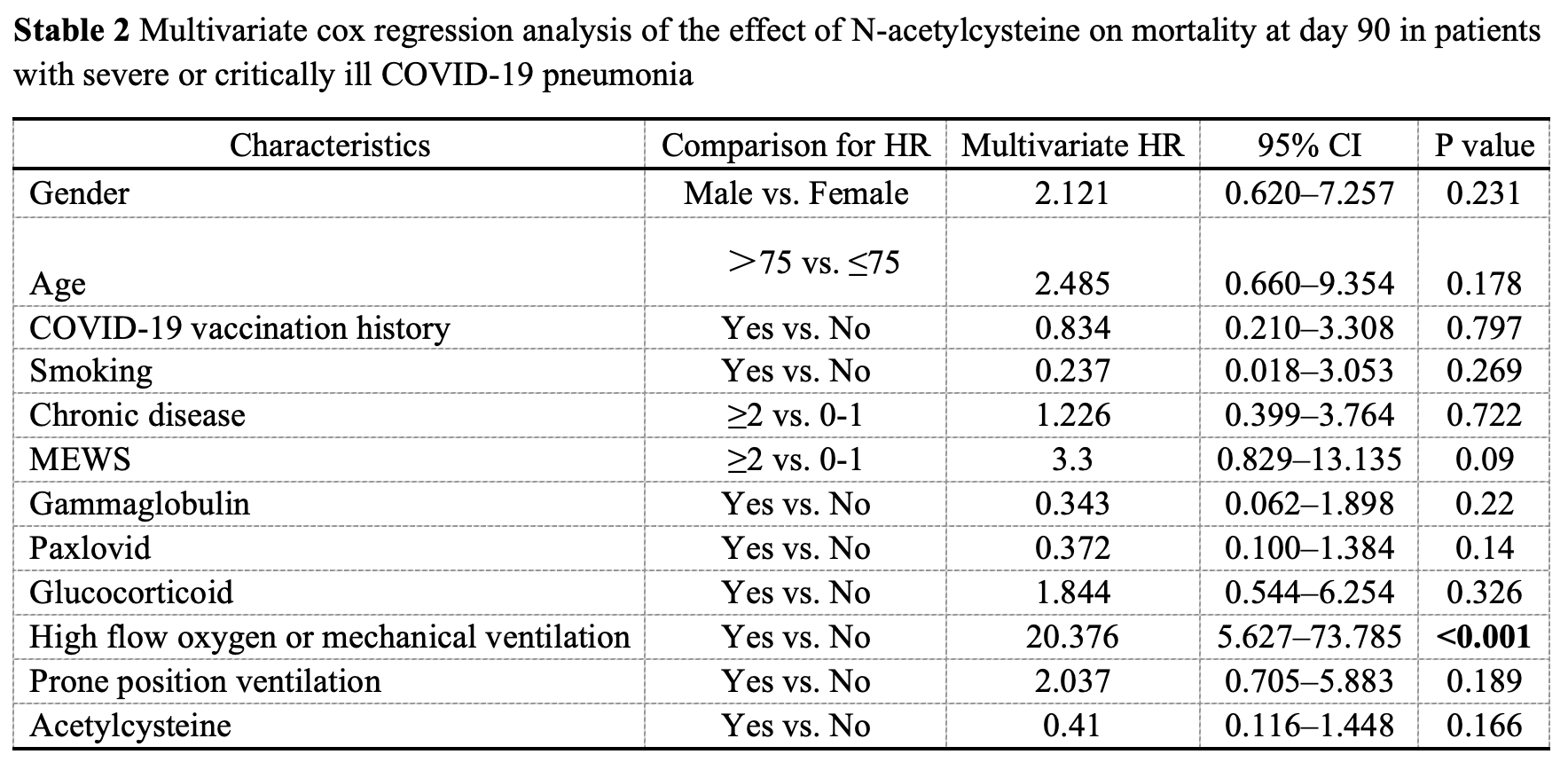
Results: Binary logistic regression analysis showed that N-acetylcysteine was associated with a reduced risk of the composite endpoint of mortality or disease progression during hospitalization (odds ratio = 0.288, 95% con fi dence interval: 0.147 -0.793, p = 0.011). However, N-acetylcysteine was not signi fi cantly associated with hospitalization costs, length of hospital stay, or the use of high- fl ow oxygen or mechanical ventilation. In addition, no signi fi cant association was observed between N-acetylcysteine use and 28- or 90-day mortality. Given the retrospective design and potential residual confounding, these fi ndings should be interpreted as exploratory.
Conclusions: In this retrospective cohort study, treatment with N-acetylcysteine for at least 3 days was associated with a possible reduction in mortality or disease progression during hospitalization in patients with severe or critical coronavirus disease 2019 pneumonia. Prospective studies are needed to con fi rm these observations.
Keywords
N-acetylcysteine, coronavirus disease 2019 pneumonia, severe acute respiratory syndrome coronavirus 2
Received: 18 January 2026; revised: 3 June 2026; accepted: 8 June 2026
1 Emergency Department, Huashan Hospital, Fudan University, China
2 Department of Pulmonary and Critical Care Medicine, Huashan Hospital, Fudan University, China
# These authors contributed equally to this study.
Corresponding author:
Xiaofei Jiang, Emergency Department, Huashan Hospital, Fudan University, No.12 Urumqi Middle Road, Shanghai, China. Email: sule\_jiang@126.com
Journal of International Medical Research 2026, Vol. 54(6) 1 -9 © The Author(s) 2026 Article reuse guidelines: sagepub.com/journals-permissions DOI: 10.1177/03000605261463447 journals.sagepub.com/home/imr
DOI record:
{
"DOI": "10.1177/03000605261463447",
"ISSN": [
"0300-0605",
"1473-2300"
],
"URL": "http://dx.doi.org/10.1177/03000605261463447",
"abstract": "<jats:sec>\n <jats:title>Background</jats:title>\n <jats:p>Severe or critical coronavirus disease 2019 pneumonia is associated with a high mortality rate and considerable treatment cost. Although a few reports have shown that N-acetylcysteine may shorten recovery time in patients with severe acute respiratory syndrome coronavirus 2 infection, its effect on mortality or disease progression in patients with severe or critical coronavirus disease 2019 pneumonia has not been investigated. This study aimed to evaluate the effect of N-acetylcysteine on mortality or disease progression, hospital stay, and hospitalization costs in patients with severe or critical coronavirus disease 2019 pneumonia.</jats:p>\n </jats:sec>\n <jats:sec>\n <jats:title>Methods</jats:title>\n <jats:p>This single-center, retrospective cohort study included 221 patients with severe or critical coronavirus disease 2019 pneumonia who were hospitalized at the Department of Respiratory and Critical Care Medicine, Huashan Hospital from December 2022 to January 2023. After 1:1 propensity score matching, 176 patients were divided into two groups based on whether oral N-acetylcysteine was administered for at least 3 days. Binary logistic regression was used to analyze the effect of N-acetylcysteine on mortality or disease progression, whereas its effect on 28- or 90-day mortality was analyzed using Cox regression.</jats:p>\n </jats:sec>\n <jats:sec>\n <jats:title>Results</jats:title>\n <jats:p>\n Binary logistic regression analysis showed that N-acetylcysteine was associated with a reduced risk of the composite endpoint of mortality or disease progression during hospitalization (odds ratio = 0.288, 95% confidence interval: 0.147–0.793,\n <jats:italic toggle=\"yes\">p</jats:italic>\n = 0.011). However, N-acetylcysteine was not significantly associated with hospitalization costs, length of hospital stay, or the use of high-flow oxygen or mechanical ventilation. In addition, no significant association was observed between N-acetylcysteine use and 28- or 90-day mortality. Given the retrospective design and potential residual confounding, these findings should be interpreted as exploratory.\n </jats:p>\n </jats:sec>\n <jats:sec>\n <jats:title>Conclusions</jats:title>\n <jats:p>In this retrospective cohort study, treatment with N-acetylcysteine for at least 3 days was associated with a possible reduction in mortality or disease progression during hospitalization in patients with severe or critical coronavirus disease 2019 pneumonia. Prospective studies are needed to confirm these observations.</jats:p>\n </jats:sec>",
"alternative-id": [
"10.1177/03000605261463447"
],
"article-number": "03000605261463447",
"author": [
{
"ORCID": "https://orcid.org/0009-0004-0924-2521",
"affiliation": [
{
"name": "Huashan Hospital, Fudan University"
}
],
"authenticated-orcid": false,
"family": "Jin",
"given": "Xin",
"role": [
{
"role": "author",
"vocabulary": "crossref"
}
],
"sequence": "first"
},
{
"affiliation": [
{
"name": "Huashan Hospital, Fudan University"
}
],
"family": "Zhao",
"given": "Yu",
"role": [
{
"role": "author",
"vocabulary": "crossref"
}
],
"sequence": "additional"
},
{
"affiliation": [
{
"name": "Huashan Hospital, Fudan University"
}
],
"family": "Jiang",
"given": "Xiaofei",
"role": [
{
"role": "author",
"vocabulary": "crossref"
}
],
"sequence": "additional"
}
],
"container-title": "Journal of International Medical Research",
"container-title-short": "J Int Med Res",
"content-domain": {
"crossmark-restriction": true,
"domain": [
"journals.sagepub.com"
]
},
"created": {
"date-parts": [
[
2026,
6,
27
]
],
"date-time": "2026-06-27T10:35:47Z",
"timestamp": 1782556547000
},
"deposited": {
"date-parts": [
[
2026,
6,
30
]
],
"date-time": "2026-06-30T20:14:47Z",
"timestamp": 1782850487000
},
"indexed": {
"date-parts": [
[
2026,
6,
30
]
],
"date-time": "2026-06-30T21:10:28Z",
"timestamp": 1782853828038,
"version": "3.54.5"
},
"is-referenced-by-count": 0,
"issue": "6",
"issued": {
"date-parts": [
[
2026,
6
]
]
},
"journal-issue": {
"issue": "6",
"published-print": {
"date-parts": [
[
2026,
6
]
]
}
},
"language": "en",
"license": [
{
"URL": "https://creativecommons.org/licenses/by-nc/4.0/",
"content-version": "vor",
"delay-in-days": 0,
"start": {
"date-parts": [
[
2026,
6,
1
]
],
"date-time": "2026-06-01T00:00:00Z",
"timestamp": 1780272000000
}
},
{
"URL": "https://journals.sagepub.com/page/policies/text-and-data-mining-license",
"content-version": "tdm",
"delay-in-days": 0,
"start": {
"date-parts": [
[
2026,
6,
1
]
],
"date-time": "2026-06-01T00:00:00Z",
"timestamp": 1780272000000
}
}
],
"link": [
{
"URL": "https://journals.sagepub.com/doi/pdf/10.1177/03000605261463447",
"content-type": "application/pdf",
"content-version": "vor",
"intended-application": "text-mining"
},
{
"URL": "https://journals.sagepub.com/doi/full-xml/10.1177/03000605261463447",
"content-type": "application/xml",
"content-version": "vor",
"intended-application": "text-mining"
},
{
"URL": "https://journals.sagepub.com/doi/pdf/10.1177/03000605261463447",
"content-type": "unspecified",
"content-version": "vor",
"intended-application": "similarity-checking"
}
],
"member": "179",
"original-title": [],
"prefix": "10.1177",
"published": {
"date-parts": [
[
2026,
6
]
]
},
"published-online": {
"date-parts": [
[
2026,
6,
27
]
]
},
"published-print": {
"date-parts": [
[
2026,
6
]
]
},
"publisher": "SAGE Publications",
"reference": [
{
"DOI": "10.1001/jama.2020.1585",
"doi-asserted-by": "publisher",
"key": "e_1_3_3_2_2"
},
{
"DOI": "10.1001/jama.2020.2648",
"doi-asserted-by": "publisher",
"key": "e_1_3_3_3_2"
},
{
"DOI": "10.1111/all.14657",
"doi-asserted-by": "publisher",
"key": "e_1_3_3_4_2"
},
{
"DOI": "10.1016/j.hjc.2020.05.007",
"doi-asserted-by": "publisher",
"key": "e_1_3_3_5_2"
},
{
"DOI": "10.1016/j.cytogfr.2020.05.002",
"doi-asserted-by": "publisher",
"key": "e_1_3_3_6_2"
},
{
"DOI": "10.1093/qjmed/hcad092",
"doi-asserted-by": "publisher",
"key": "e_1_3_3_7_2"
},
{
"DOI": "10.1016/j.bbadis.2021.166260",
"doi-asserted-by": "publisher",
"key": "e_1_3_3_8_2"
},
{
"DOI": "10.1038/s41580-021-00418-x",
"doi-asserted-by": "publisher",
"key": "e_1_3_3_9_2"
},
{
"DOI": "10.1186/s13054-020-03120-0",
"doi-asserted-by": "publisher",
"key": "e_1_3_3_10_2"
},
{
"DOI": "10.3389/fmolb.2020.588618",
"doi-asserted-by": "publisher",
"key": "e_1_3_3_11_2"
},
{
"DOI": "10.1161/CIRCRESAHA.120.317015",
"doi-asserted-by": "publisher",
"key": "e_1_3_3_12_2"
},
{
"DOI": "10.1016/j.jinorgbio.2021.111546",
"doi-asserted-by": "publisher",
"key": "e_1_3_3_13_2"
},
{
"DOI": "10.1016/j.cmet.2020.07.007",
"doi-asserted-by": "publisher",
"key": "e_1_3_3_14_2"
},
{
"DOI": "10.1155/2020/8844280",
"doi-asserted-by": "publisher",
"key": "e_1_3_3_15_2"
},
{
"article-title": "Therapeutic potential of N-acetyl cysteine (NAC) in preventing cytokine storm in COVID-19: review of current evidence",
"author": "Mohanty RR",
"first-page": "2802",
"journal-title": "Eur Rev Med Pharmacol Sci",
"key": "e_1_3_3_16_2",
"unstructured": "Mohanty RR, Padhy BM, Das S, et al. Therapeutic potential of N-acetyl cysteine (NAC) in preventing cytokine storm in COVID-19: review of current evidence. Eur Rev Med Pharmacol Sci 2021; 25: 2802–2807.",
"volume": "25",
"year": "2021"
},
{
"DOI": "10.2174/1570159X19666201230144109",
"doi-asserted-by": "publisher",
"key": "e_1_3_3_17_2"
},
{
"DOI": "10.1089/ars.2020.8247",
"doi-asserted-by": "publisher",
"key": "e_1_3_3_18_2"
},
{
"DOI": "10.1016/S0022-3565(25)38245-5",
"doi-asserted-by": "publisher",
"key": "e_1_3_3_19_2"
},
{
"article-title": "N-acetylcysteine efficacy in patients hospitalized with COVID-19 pneumonia: a systematic review and meta-analysis",
"author": "Paraskevas T",
"first-page": "41",
"journal-title": "Rom J Intern Med",
"key": "e_1_3_3_20_2",
"unstructured": "Paraskevas T, Kantanis A, Karalis I, et al. N-acetylcysteine efficacy in patients hospitalized with COVID-19 pneumonia: a systematic review and meta-analysis. Rom J Intern Med 2023; 61: 41–52.",
"volume": "61",
"year": "2023"
},
{
"article-title": "N-acetylcysteine as adjuvant therapy for hospitalized COVID-19 patients: a single-center prospective cohort study",
"author": "Afaghi S",
"first-page": "543",
"journal-title": "Caspian J Intern Med",
"key": "e_1_3_3_21_2",
"unstructured": "Afaghi S, Moghimi N, Malekpour Alamdari N, et al. N-acetylcysteine as adjuvant therapy for hospitalized COVID-19 patients: a single-center prospective cohort study. Caspian J Intern Med 2023; 14: 543–552.",
"volume": "14",
"year": "2023"
},
{
"DOI": "10.5455/javar.2023.j665",
"doi-asserted-by": "publisher",
"key": "e_1_3_3_22_2"
},
{
"DOI": "10.2147/JIR.S306849",
"doi-asserted-by": "publisher",
"key": "e_1_3_3_23_2"
},
{
"article-title": "N-Acetylcysteine and other sulfur-donors as a preventative and adjunct therapy for COVID-19",
"author": "du Preez HN",
"first-page": "4555490",
"journal-title": "Adv Pharmacol Pharm Sci",
"key": "e_1_3_3_24_2",
"unstructured": "du Preez HN, Aldous C, Kruger HG, et al. N-Acetylcysteine and other sulfur-donors as a preventative and adjunct therapy for COVID-19. Adv Pharmacol Pharm Sci 2022; 2022: 4555490.",
"volume": "2022",
"year": "2022"
},
{
"DOI": "10.3390/cells11203313",
"article-title": "Inhibition of the cell uptake of delta and omicron SARS-CoV-2 pseudoviruses by N-Acetylcysteine irrespective of the oxidoreductive environment",
"author": "La Maestra S",
"doi-asserted-by": "crossref",
"journal-title": "Cells",
"key": "e_1_3_3_25_2",
"unstructured": "La Maestra S, Garibaldi S, Balansky R, et al. Inhibition of the cell uptake of delta and omicron SARS-CoV-2 pseudoviruses by N-Acetylcysteine irrespective of the oxidoreductive environment. Cells 2022; 11: 3313.",
"volume": "11",
"year": "2022"
},
{
"DOI": "10.2174/18734316MTEyyNzY6y",
"doi-asserted-by": "publisher",
"key": "e_1_3_3_26_2"
},
{
"DOI": "10.1016/j.ejphar.2022.175392",
"doi-asserted-by": "publisher",
"key": "e_1_3_3_27_2"
},
{
"DOI": "10.1177/00368504221074574",
"doi-asserted-by": "publisher",
"key": "e_1_3_3_28_2"
},
{
"DOI": "10.1002/jmv.28393",
"doi-asserted-by": "publisher",
"key": "e_1_3_3_29_2"
},
{
"article-title": "COVID-19: pfizer’s paxlovid is 89% effective in patients at risk of serious illness, company reports",
"author": "Mahase E",
"journal-title": "BMJ",
"key": "e_1_3_3_30_2",
"unstructured": "Mahase E. COVID-19: pfizer’s paxlovid is 89% effective in patients at risk of serious illness, company reports. BMJ 2021; 375: n2713.",
"volume": "375",
"year": "2021"
},
{
"DOI": "10.1038/d41586-022-00919-5",
"doi-asserted-by": "publisher",
"key": "e_1_3_3_31_2"
},
{
"DOI": "10.1056/NEJMoa2208822",
"doi-asserted-by": "publisher",
"key": "e_1_3_3_32_2"
},
{
"DOI": "10.1007/s43440-021-00296-2",
"doi-asserted-by": "publisher",
"key": "e_1_3_3_33_2"
},
{
"DOI": "10.1183/23120541.00542-2021",
"doi-asserted-by": "publisher",
"key": "e_1_3_3_34_2"
},
{
"DOI": "10.1093/cid/ciaa1443",
"doi-asserted-by": "publisher",
"key": "e_1_3_3_35_2"
}
],
"reference-count": 34,
"references-count": 34,
"relation": {},
"resource": {
"primary": {
"URL": "https://journals.sagepub.com/doi/10.1177/03000605261463447"
}
},
"score": 1,
"short-title": [],
"source": "Crossref",
"subject": [],
"subtitle": [],
"title": "Therapeutic effect of N-acetylcysteine in severe or critical coronavirus disease 2019 pneumonia: A retrospective cohort study",
"type": "journal-article",
"update-policy": "https://doi.org/10.1177/sage-journals-update-policy",
"volume": "54"
}