Effectiveness of COVID-19 treatment with nirmatrelvir-ritonavir or molnupiravir among U.S. Veterans: target trial emulation studies with one-month and six-month outcomes
MD, MSc Kristina L Bajema, PhD Kristin Berry, PhD Elani Streja, PhD Nallakkandi Rajeevan, MS Yuli Li, PhD Lei Yan, PharmD Francesca Cunningham, MPH Denise M Hynes, MPH Mazhgan Rowneki, PhD, MHS Amy Bohnert, Edward J Boyko, MD, PhD Theodore J Iwashyna, PhD Matthew L Maciejewski, Thomas F Osborne, MD, MPH, MSc Elizabeth M Viglianti, PhD Mihaela Aslan, MPH, PhD Grant D Huang, BMBCh George N Ioannou
doi:10.1101/2022.12.05.22283134
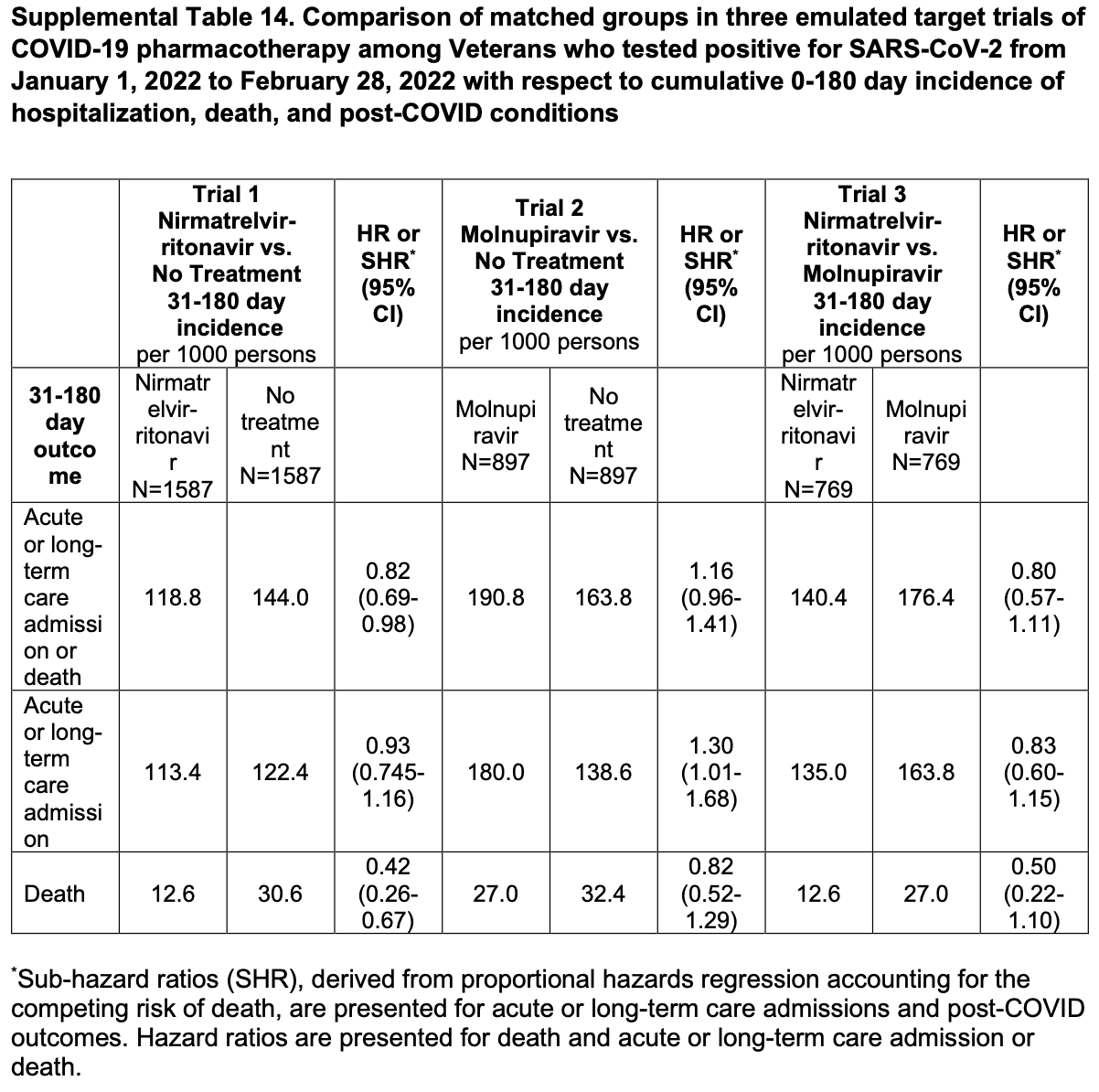
Background: Information about the effectiveness of oral antivirals in preventing short-and longterm COVID-19-related outcomes during the Omicron surge is limited. We sought to determine the effectiveness of nirmatrelvir-ritonavir and molnupiravir for the outpatient treatment of COVID-19. Methods: We conducted three retrospective target trial emulation studies comparing matched patient cohorts who received nirmatrelvir-ritonavir versus no treatment, molnupiravir versus no treatment, and nirmatrelvir-ritonavir versus molnupiravir in the Veterans Health Administration (VHA). Participants were Veterans in VHA care at risk for severe COVID-19 who tested positive for SARS-CoV-2 in the outpatient setting during January and February 2022. Primary outcomes included all-cause 30-day hospitalization or death and 31-180-day incidence of acute or longterm care admission, death, or post-COVID-19 conditions. For 30-day outcomes, we calculated unadjusted risk rates, risk differences, and risk ratios. For 31-180-day outcomes, we used unadjusted time-to-event analyses. Results: Participants were 90% male with median age 67 years and 26% unvaccinated. Compared to matched untreated controls, nirmatrelvir-ritonavir-treated participants (N=1,587) had a lower 30-day risk of hospitalization (27.10/1000 versus 41.06/1000, risk difference [RD] -13.97, 95% CI -23.85 to -4.09) and death (3.15/1000 versus 14.86/1000, ). Among persons who were alive at day 31, further significant reductions in 31-180-day incidence of hospitalization (sub-hazard ratio 1.07, 95% CI 0.83 to 1.37) or death (hazard ratio 0.61, 95% CI 0.35 to 1.08) were not observed. Molnupiravir-treated participants aged ≥65 years (n=543) had a lower combined 30-day risk of hospitalization or death (55.25/1000 versus 82.35/1000, . A statistically significant difference in 30-day or 31-180-day risk of hospitalization or death was not observed between matched nirmatrelvir-or molnupiravir-treated participants. Incidence of most post-COVID conditions was similar across comparison groups. Conclusions: Nirmatrelvir-ritonavir was highly effective in preventing 30-day hospitalization and death. Short-term benefit from molnupiravir was observed in older groups. Significant reductions in adverse outcomes from 31-180 days were not observed with either antiviral. for use under a CC0 license.
References
Adjei, Hong, Molinari, Bull-Otterson, Ajani et al., Mortality Risk Among Patients Hospitalized Primarily for COVID-19 During the Omicron and Delta Variant Pandemic Periods -United States, April 2020, MMWR Morb Mortal Wkly Rep
Aggarwal, Molina, Beaty, Bennett, Carlson et al., Real-world Use of Nirmatrelvir-Ritonavir in COVID-19 Outpatients During the Emergence of Omicron Variants BA, BA2
Al-Aly, Xie, Bowe, High-dimensional characterization of post-acute sequelae of COVID-19, Nature
Arbel, Sagy, Hoshen, Battat, Lavie et al., Nirmatrelvir Use and Severe Covid-19 Outcomes during the Omicron Surge, N Engl J Med
Austin, Cafri, Variance estimation when using propensity-score matching with replacement with survival or time-to-event outcomes, Stat Med
Bajema, Wang, Hynes, Rowneki, Hickok et al., Early Adoption of Anti-SARS-CoV-2 Pharmacotherapies Among US Veterans With Mild to Moderate COVID-19, January and February, JAMA Network Open
Bernal, Da Silva, Musungaie, Kovalchuk, Gonzalez et al., Molnupiravir for Oral Treatment of Covid-19 in Nonhospitalized Patients, N Engl J Med
Bernal, Da Silva, Musungaie, Kovalchuk, Gonzalez et al., Molnupiravir for Oral Treatment of Covid-19 in Nonhospitalized Patients, N Engl J Med
Butler, None
Dickerman, Gerlovin, Madenci, Kurgansky, Ferolito et al., Comparative Effectiveness of BNT162b2 and mRNA-1273 Vaccines in U.S. Veterans, N Engl J Med
Dryden-Peterson, Kim, Kim, Caniglia, Lennes et al., Nirmatrelvir plus ritonavir for early COVID-19 and hospitalization in a large US health system
Hammond, Leister-Tebbe, Gardner, Abreu, Wisemandle, Oral Nirmatrelvir for High-Risk, Nonhospitalized Adults with Covid-19, N Engl J Med
Hernán, Robins, Using Big Data to Emulate a Target Trial When a Randomized Trial Is Not Available, Am J Epidemiol
Ioannou, Locke, Green, Berry, Comparison of Moderna versus Pfizer-BioNTech COVID-19 vaccine outcomes: A target trial emulation study in the U.S. Veterans Affairs healthcare system, EClinicalMedicine
Ioannou, Locke, Green, Berry, Hare et al., Risk Factors for Hospitalization, Mechanical Ventilation, or Death Among 10 131 US Veterans With SARS-CoV-2 Infection, JAMA Netw Open
Ioannou, Locke, Hare, Bohnert, Boyko et al., COVID-19 Vaccination Effectiveness Against Infection or Death in a National U.S. Health Care System : A Target Trial Emulation Study, Ann Intern Med
Labrecque, Swanson, Target trial emulation: teaching epidemiology and beyond, Eur J Epidemiol
Lance, Csp-Cerc, VA Connecticut Healthcare System
Lewnard, Malden, Hong, Puzniak, Kim et al., Effectiveness of nirmatrelvir-ritonavir against hospital admission: a matched cohort study in a large US healthcare system
Maffucci, Va, Nicholas, Smith, Mph, VA Connecticut Healthcare System
Najjar-Debbiny, Gronich, Weber, Khoury, Amar et al., Effectiveness of Paxlovid in Reducing Severe COVID-19 and Mortality in High Risk Patients, Clin Infect Dis
Osborne, Veigulis, Arreola, Röösli, Curtin, Automated EHR score to predict COVID-19 outcomes at US Department of Veterans Affairs, PLoS One
Randall, Stern, Su, Pageshttps
Wong, Au, Lau, Lau, Cowling et al., Real-world effectiveness of molnupiravir and nirmatrelvir plus ritonavir against mortality, hospitalisation, and in-hospital outcomes among community-dwelling, ambulatory patients with confirmed SARS-CoV-2 infection during the omicron wave in Hong Kong: an observational study, Lancet
Xie, Bowe, Al-Aly, Burdens of post-acute sequelae of COVID-19 by severity of acute infection, demographics and health status, Nat Commun
Xie, Choi, Al-Aly, Nirmatrelvir and the Risk of Post-Acute Sequelae of COVID-19, medRxiv
Xie, Xu, Al-Aly, Risks of mental health outcomes in people with covid-19: cohort study, BMJ
Xie, Xu, Bowe, Al-Aly, Long-term cardiovascular outcomes of COVID-19, Nat Med
Yip, Lui, Lai, Wong, Tse et al., Impact of the use of oral antiviral agents on the risk of hospitalization in community COVID-19 patients, Clin Infect Dis
DOI record:
{
"DOI": "10.1101/2022.12.05.22283134",
"URL": "http://dx.doi.org/10.1101/2022.12.05.22283134",
"abstract": "<jats:p>Background: Information about the effectiveness of oral antivirals in preventing short- and long-term COVID-19-related outcomes during the Omicron surge is limited. We sought to determine the effectiveness of nirmatrelvir-ritonavir and molnupiravir for the outpatient treatment of COVID-19. Methods: We conducted three retrospective target trial emulation studies comparing matched patient cohorts who received nirmatrelvir-ritonavir versus no treatment, molnupiravir versus no treatment, and nirmatrelvir-ritonavir versus molnupiravir in the Veterans Health Administration (VHA). Participants were Veterans in VHA care at risk for severe COVID-19 who tested positive for SARS-CoV-2 in the outpatient setting during January and February 2022. Primary outcomes included all-cause 30-day hospitalization or death and 31-180-day incidence of acute or long-term care admission, death, or post-COVID-19 conditions. For 30-day outcomes, we calculated unadjusted risk rates, risk differences, and risk ratios. For 31-180-day outcomes, we used unadjusted time-to-event analyses. Results: Participants were 90% male with median age 67 years and 26% unvaccinated. Compared to matched untreated controls, nirmatrelvir-ritonavir-treated participants (N=1,587) had a lower 30-day risk of hospitalization (27.10/1000 versus 41.06/1000, risk difference [RD] -13.97, 95% CI -23.85 to -4.09) and death (3.15/1000 versus 14.86/1000, RD -11.71, 95% CI -16.07 to -7.35). Among persons who were alive at day 31, further significant reductions in 31-180-day incidence of hospitalization (sub-hazard ratio 1.07, 95% CI 0.83 to 1.37) or death (hazard ratio 0.61, 95% CI 0.35 to 1.08) were not observed. Molnupiravir-treated participants aged ≥65 years (n=543) had a lower combined 30-day risk of hospitalization or death (55.25/1000 versus 82.35/1000, RD -27.10, 95% CI -50.63 to -3.58). A statistically significant difference in 30-day or 31-180-day risk of hospitalization or death was not observed between matched nirmatrelvir- or molnupiravir-treated participants. Incidence of most post-COVID conditions was similar across comparison groups. Conclusions: Nirmatrelvir-ritonavir was highly effective in preventing 30-day hospitalization and death. Short-term benefit from molnupiravir was observed in older groups. Significant reductions in adverse outcomes from 31-180 days were not observed with either antiviral.</jats:p>",
"accepted": {
"date-parts": [
[
2022,
12,
6
]
]
},
"author": [
{
"ORCID": "http://orcid.org/0000-0002-3229-5590",
"affiliation": [],
"authenticated-orcid": false,
"family": "Bajema",
"given": "Kristina L.",
"sequence": "first"
},
{
"affiliation": [],
"family": "Berry",
"given": "Kristin",
"sequence": "additional"
},
{
"ORCID": "http://orcid.org/0000-0002-1261-0098",
"affiliation": [],
"authenticated-orcid": false,
"family": "Streja",
"given": "Elani",
"sequence": "additional"
},
{
"affiliation": [],
"family": "Rajeevan",
"given": "Nallakkandi",
"sequence": "additional"
},
{
"affiliation": [],
"family": "Li",
"given": "Yuli",
"sequence": "additional"
},
{
"affiliation": [],
"family": "Yan",
"given": "Lei",
"sequence": "additional"
},
{
"ORCID": "http://orcid.org/0000-0001-7924-8372",
"affiliation": [],
"authenticated-orcid": false,
"family": "Cunningham",
"given": "Francesca",
"sequence": "additional"
},
{
"ORCID": "http://orcid.org/0000-0002-6436-7157",
"affiliation": [],
"authenticated-orcid": false,
"family": "Hynes",
"given": "Denise M.",
"sequence": "additional"
},
{
"ORCID": "http://orcid.org/0000-0002-9213-5134",
"affiliation": [],
"authenticated-orcid": false,
"family": "Rowneki",
"given": "Mazhgan",
"sequence": "additional"
},
{
"affiliation": [],
"family": "Bohnert",
"given": "Amy",
"sequence": "additional"
},
{
"ORCID": "http://orcid.org/0000-0002-3695-192X",
"affiliation": [],
"authenticated-orcid": false,
"family": "Boyko",
"given": "Edward J.",
"sequence": "additional"
},
{
"ORCID": "http://orcid.org/0000-0002-4226-9310",
"affiliation": [],
"authenticated-orcid": false,
"family": "Iwashyna",
"given": "Theodore J.",
"sequence": "additional"
},
{
"ORCID": "http://orcid.org/0000-0003-1765-5938",
"affiliation": [],
"authenticated-orcid": false,
"family": "Maciejewski",
"given": "Matthew L.",
"sequence": "additional"
},
{
"ORCID": "http://orcid.org/0000-0002-8896-2487",
"affiliation": [],
"authenticated-orcid": false,
"family": "Osborne",
"given": "Thomas F.",
"sequence": "additional"
},
{
"ORCID": "http://orcid.org/0000-0002-7439-6322",
"affiliation": [],
"authenticated-orcid": false,
"family": "Viglianti",
"given": "Elizabeth M.",
"sequence": "additional"
},
{
"affiliation": [],
"family": "Aslan",
"given": "Mihaela",
"sequence": "additional"
},
{
"ORCID": "http://orcid.org/0000-0002-1217-0002",
"affiliation": [],
"authenticated-orcid": false,
"family": "Huang",
"given": "Grant D.",
"sequence": "additional"
},
{
"affiliation": [],
"family": "Ioannou",
"given": "George N.",
"sequence": "additional"
}
],
"container-title": [],
"content-domain": {
"crossmark-restriction": false,
"domain": []
},
"created": {
"date-parts": [
[
2022,
12,
7
]
],
"date-time": "2022-12-07T05:15:22Z",
"timestamp": 1670390122000
},
"deposited": {
"date-parts": [
[
2022,
12,
7
]
],
"date-time": "2022-12-07T05:15:22Z",
"timestamp": 1670390122000
},
"group-title": "Infectious Diseases (except HIV/AIDS)",
"indexed": {
"date-parts": [
[
2022,
12,
7
]
],
"date-time": "2022-12-07T06:15:11Z",
"timestamp": 1670393711776
},
"institution": [
{
"name": "medRxiv"
}
],
"is-referenced-by-count": 0,
"issued": {
"date-parts": [
[
2022,
12,
6
]
]
},
"link": [
{
"URL": "https://syndication.highwire.org/content/doi/10.1101/2022.12.05.22283134",
"content-type": "unspecified",
"content-version": "vor",
"intended-application": "similarity-checking"
}
],
"member": "246",
"original-title": [],
"posted": {
"date-parts": [
[
2022,
12,
6
]
]
},
"prefix": "10.1101",
"published": {
"date-parts": [
[
2022,
12,
6
]
]
},
"publisher": "Cold Spring Harbor Laboratory",
"reference-count": 0,
"references-count": 0,
"relation": {},
"resource": {
"primary": {
"URL": "http://medrxiv.org/lookup/doi/10.1101/2022.12.05.22283134"
}
},
"score": 1,
"short-title": [],
"source": "Crossref",
"subtitle": [],
"subtype": "preprint",
"title": "Effectiveness of COVID-19 treatment with nirmatrelvir-ritonavir or molnupiravir among U.S. Veterans: target trial emulation studies with one-month and six-month outcomes",
"type": "posted-content"
}