Review of four major biomolecular target sites for COVID-19 and possible inhibitors as treatment interventions
et al., Journal of Applied Pharmaceutical Science, doi:10.7324/JAPS.2021.110825, May 2021
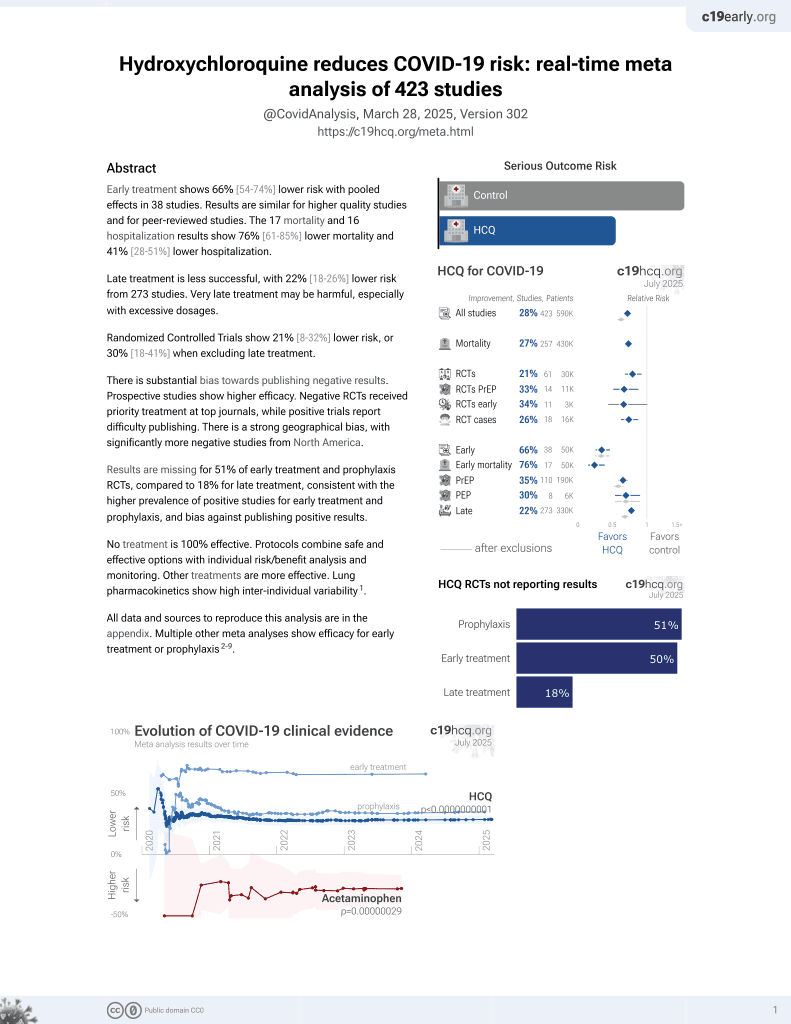
HCQ for COVID-19
1st treatment shown to reduce risk in
March 2020, now with p < 0.0000000001 from 425 studies, used in 59 countries.
No treatment is 100% effective.
Protocols combine treatments.
Review of major target sites in SARS-CoV-2 and the host organism along with potential inhibitors.

1.
Mothae et al., SARS-CoV-2 host-pathogen interactome: insights into more players during pathogenesis, Virology, doi:10.1016/j.virol.2025.110607.
2.
Monsalve et al., NETosis: A key player in autoimmunity, COVID-19, and long COVID, Journal of Translational Autoimmunity, doi:10.1016/j.jtauto.2025.100280.
3.
Xie et al., The role of reactive oxygen species in severe acute respiratory syndrome coronavirus 2 (SARS-COV-2) infection-induced cell death, Cellular & Molecular Biology Letters, doi:10.1186/s11658-024-00659-6.
4.
Gkioulekas et al., Use of hydroxychloroquine in multidrug protocols for SARS-CoV-2, Tasman Medical Journal, 6:4, tasmanmedicaljournal.com/2024/10/use-of-hydroxychloroquine-in-multidrug-protocols-for-sars-cov-2a/.
5.
Gortler et al., Those Published “17,000 Hydroxychloroquine Deaths” Never Happened, Brownstone Journal, brownstone.org/articles/those-published-17000-hydroxychloroquine-deaths-never-happened/.
6.
Boretti et al., Correct Use of HCQ Did Not Cause Extra Fatalities in COVID-19 Infection, Coronaviruses, doi:10.2174/0126667975327612240902104505.
7.
Gortler (B) et al., Trump’s 63 Million Doses of Hydroxychloroquine Could Have Been Great for America, Brownstone Journal, brownstone.org/articles/trumps-63-million-doses-of-hydroxychloroquine-could-have-been-great-for-america/.
8.
Enyeji et al., Effective Treatment of COVID-19 Infection with Repurposed Drugs: Case Reports, Viral Immunology, doi:10.1089/vim.2024.0034.
9.
Asaba et al., Interplay of TLR4 and SARS-CoV-2: Unveiling the Complex Mechanisms of Inflammation and Severity in COVID-19 Infections, Journal of Inflammation Research, doi:10.2147/jir.s474707.
10.
Scheim et al., Back to the Basics of SARS-CoV-2 Biochemistry: Microvascular Occlusive Glycan Bindings Govern Its Morbidities and Inform Therapeutic Responses, Viruses, doi:10.3390/v16040647.
11.
Ali et al., SARS-CoV-2 Syncytium under the Radar: Molecular Insights of the Spike-Induced Syncytia and Potential Strategies to Limit SARS-CoV-2 Replication, Journal of Clinical Medicine, doi:10.3390/jcm12186079.
12.
Brouqui et al., There is no such thing as a Ministry of Truth and why it is important to challenge conventional “wisdom” - A personal view, New Microbes and New Infections, doi:10.1016/j.nmni.2023.101155.
13.
Loo et al., Recent Advances in Inhaled Nanoformulations of Vaccines and Therapeutics Targeting Respiratory Viral Infections, Pharmaceutical Research, doi:10.1007/s11095-023-03520-1.
14.
Boretti (B), A., Pharmacotherapy for Covid-19 infection in the countries of the Cooperation Council for the Arab States, Journal of Taibah University Medical Sciences, doi:10.1016/j.jtumed.2021.08.005.
15.
Vigbedor et al., Review of four major biomolecular target sites for COVID-19 and possible inhibitors as treatment interventions, Journal of Applied Pharmaceutical Science, doi:10.7324/JAPS.2021.110825.
16.
Kaur et al., Folic acid as placebo in controlled clinical trials of hydroxychloroquine prophylaxis in COVID-19: Is it scientifically justifiable?, Medical Hypotheses, doi:10.1016/j.mehy.2021.110539.
17.
Raoult, D., Rational for meta-analysis and randomized treatment: the COVID-19 example, Clinical Microbiology and Infection, doi:10.1016/j.cmi.2020.10.012.
18.
Matada et al., A comprehensive review on the biological interest of quinoline and its derivatives, Bioorganic & Medicinal Chemistry, doi:10.1016/j.bmc.2020.115973.
19.
IHU, Natural history and therapeutic options for COVID-19, Expert Review of Clinical Immunology, www.mediterranee-infection.com/wp-content/uploads/2020/09/ERM-2020-0073.R1_Proof_hi.pdf.
20.
Hecel et al., Zinc(II)—The Overlooked Éminence Grise of Chloroquine’s Fight against COVID-19?, Pharmaceuticals, 13:9, 228, doi:10.3390/ph13090228.
21.
Li et al., Is hydroxychloroquine beneficial for COVID-19 patients?, Cell Death & Disease volume 11, doi:10.1038/s41419-020-2721-8.
22.
Goldstein, L., Hydroxychloroquine-based COVID-19 Treatment, A Systematic Review of Clinical Evidence and Expert Opinion from Physicians’ Surveys, Preprint, July 7, 2020, wattsupwiththat.com/2020/07/07/hydroxychloroquine-based-covid-19-treatment-a-systematic-review-of-clinical-evidence-and-expert-opinion-from-physicians-surveys/.
23.
Roussel et al., Influence of conflicts of interest on public positions in the COVID-19 era, the case of Gilead Sciences, New Microbes and New Infections, Volume 38
, doi:10.1016/j.nmni.2020.100710.
24.
Mo et al., Chloroquine phosphate: therapeutic drug for COVID-19, Journal of Southern Medical University, doi:10.12122/j.issn.1673-4254.2020.04.22.
25.
Gao et al., Update on Use of Chloroquine/Hydroxychloroquine to Treat Coronavirus Disease 2019 (COVID-19), Biosci Trends, May 21, 2020, 14:2, 156-158, doi:10.5582/bst.2020.03072.
26.
Derwand et al., Does zinc supplementation enhance the clinical efficacy of chloroquine/hydroxychloroquine to win today's battle against COVID-19?, Medical Hypotheses, doi:10.1016/j.mehy.2020.109815.
27.
Sahraei et al., Aminoquinolines against coronavirus disease 2019 (COVID-19): chloroquine or hydroxychloroquine, International Journal of Antimicrobial Agents, April 2020, 55:4, doi:10.1016/j.ijantimicag.2020.105945.
28.
Todaro et al., An Effective Treatment for Coronavirus (COVID-19), 3/13, github.com/covidtrial/info/raw/master/An%20Effective%20Treatment%20for%20Coronavirus%20(COVID-19).pdf.
Vigbedor et al., 8 May 2021, peer-reviewed, 8 authors.
Review of four major biomolecular target sites for COVID-19 and possible inhibitors as treatment interventions
Journal of Applied Pharmaceutical Science, doi:10.7324/japs.2021.110825
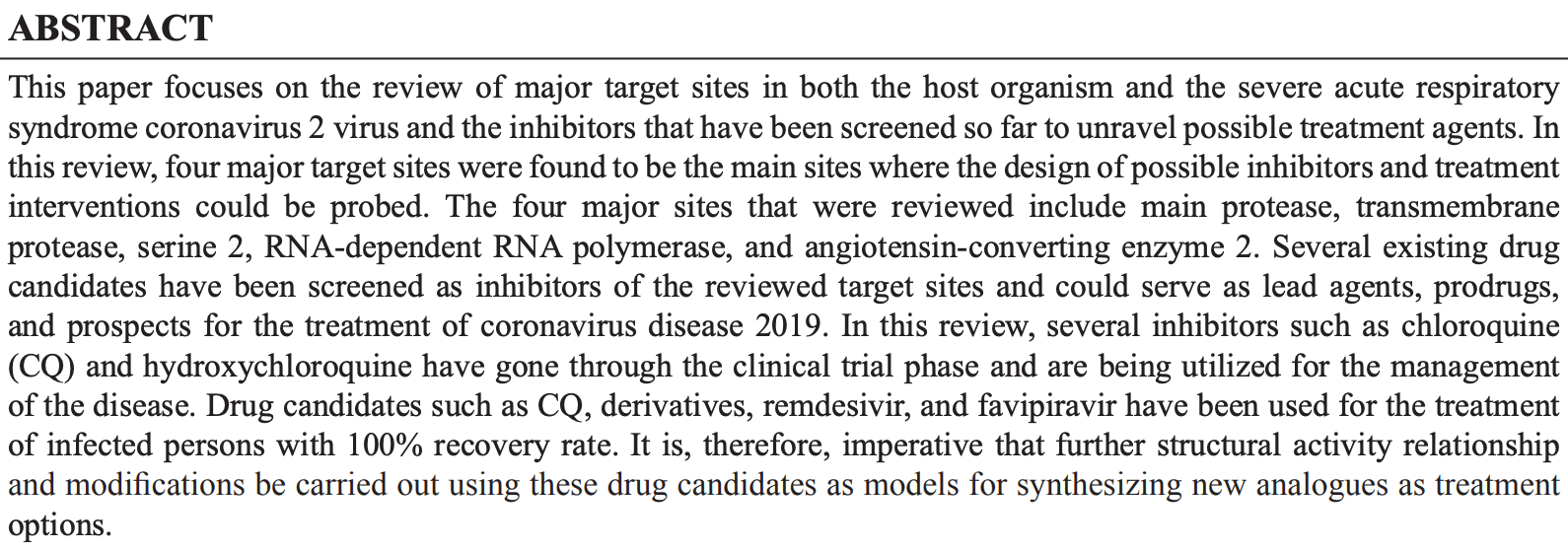
This paper focuses on the review of major target sites in both the host organism and the severe acute respiratory syndrome coronavirus 2 virus and the inhibitors that have been screened so far to unravel possible treatment agents. In this review, four major target sites were found to be the main sites where the design of possible inhibitors and treatment interventions could be probed. The four major sites that were reviewed include main protease, transmembrane protease, serine 2, RNA-dependent RNA polymerase, and angiotensin-converting enzyme 2. Several existing drug candidates have been screened as inhibitors of the reviewed target sites and could serve as lead agents, prodrugs, and prospects for the treatment of coronavirus disease 2019. In this review, several inhibitors such as chloroquine (CQ) and hydroxychloroquine have gone through the clinical trial phase and are being utilized for the management of the disease. Drug candidates such as CQ, derivatives, remdesivir, and favipiravir have been used for the treatment of infected persons with 100% recovery rate. It is, therefore, imperative that further structural activity relationship and modifications be carried out using these drug candidates as models for synthesizing new analogues as treatment options.
AUTHORS' CONTRIBUTIONS Vigbedor, B.Y. drafted the manuscript and was in charge of the supervision. Tettey, C.O., Essuman, E. K., and Kortei, N.K. drafted the manuscript. Osei-Owusu, J., Aniagyei, A., Kyere, I., and Boakye, A. A. conducted a critical revision of the manuscript.
CONFLICT OF INTEREST The authors report no financial or any other conflicts of interest in this work.
FUNDING The authors received no funding for the study. ETHICAL APPROVALS Not Applicable.
PUBLISHER'S NOTE This journal remains neutral with regard to jurisdictional claims in published institutional affiliation.
References
Biorxiv ; Wu, Liu, Yang, Zhang, Zhong et al., Review of four major biomolecular target sites for COVID-19 and possible inhibitors as treatment interventions
Cheng, Zhang, Xie, Jiang, Arnold et al., Chemical-informatics approach to COVID-19 drug discovery: Exploration of important fragments and data mining-based prediction of some hits from natural origins as main protease (Mpro) inhibitors, Journal of Molecular Structure
Goor, Tissue distribution of ACE2 protein, the functional receptor for SARS coronavirus. A first step in understanding SARS pathogenesis, J Pathol
Hoffmann, Kleine-Weber, Schroeder, Krüger, Herrler et al., SARS-CoV-2 cell entry depends on ACE2 and TMPRSS2 and is blocked by a clinically proven protease inhibitor, Cell
Kaufmann, Mcelrath, Lewis, Giudice, Letko et al., Hydroxychloroquine, a less toxic derivative of chloroquine, is effective in inhibiting SARS-CoV-2 infection in vitro
Verma, Kapoor, Das, Thakur, Potential inhibitors of SARS-CoV-2 main protease (Mpro) identified from the library of FDA approved drugs using molecular docking studies, Preprints, doi:10.20944/preprints202004.0149.v1WHO(2021).Covid19globalsituation
Vigbedor, None, Journal of Applied Pharmaceutical Science
Wong, Cregeen, Ajami, Petrosino, Evidence of recombination in coronaviruses implicating pangolin origins of nCoV
DOI record:
{
"DOI": "10.7324/japs.2021.110825",
"ISSN": [
"2231-3354"
],
"URL": "http://dx.doi.org/10.7324/JAPS.2021.110825",
"author": [
{
"affiliation": [],
"family": "Bright",
"given": "Vigbedor",
"sequence": "first"
},
{
"affiliation": [],
"family": "Clement Okraku",
"given": "Tettey",
"sequence": "additional"
},
{
"affiliation": [],
"family": "Edward Ken",
"given": "Essuman",
"sequence": "additional"
},
{
"affiliation": [],
"family": "Isaac",
"given": "Kyere",
"sequence": "additional"
},
{
"affiliation": [],
"family": "Albert",
"given": "Aniagyei",
"sequence": "additional"
},
{
"affiliation": [],
"family": "Nii Korley",
"given": "Kortei",
"sequence": "additional"
},
{
"affiliation": [],
"family": "Adjoa Agyemang",
"given": "Boakye",
"sequence": "additional"
},
{
"affiliation": [],
"family": "Jonathan",
"given": "Osei-Owusu",
"sequence": "additional"
}
],
"container-title": "Journal of Applied Pharmaceutical Science",
"container-title-short": "J Appl Pharm Sci",
"content-domain": {
"crossmark-restriction": false,
"domain": [
"japsonline.com"
]
},
"created": {
"date-parts": [
[
2021,
8,
8
]
],
"date-time": "2021-08-08T08:44:59Z",
"timestamp": 1628412299000
},
"deposited": {
"date-parts": [
[
2021,
8,
8
]
],
"date-time": "2021-08-08T08:45:40Z",
"timestamp": 1628412340000
},
"indexed": {
"date-parts": [
[
2022,
3,
29
]
],
"date-time": "2022-03-29T06:55:35Z",
"timestamp": 1648536935641
},
"is-referenced-by-count": 0,
"issued": {
"date-parts": [
[
2021,
8,
5
]
]
},
"link": [
{
"URL": "https://www.japsonline.com/admin/php/uploads/3439_pdf.pdf",
"content-type": "unspecified",
"content-version": "vor",
"intended-application": "similarity-checking"
}
],
"member": "4350",
"original-title": [],
"prefix": "10.7324",
"published": {
"date-parts": [
[
2021,
8,
5
]
]
},
"published-online": {
"date-parts": [
[
2021,
8,
5
]
]
},
"publisher": "Open Science Publishers LLP",
"reference-count": 0,
"references-count": 0,
"relation": {},
"resource": {
"primary": {
"URL": "https://www.japsonline.com/abstract.php?article_id=3439&sts=2"
}
},
"score": 1,
"short-title": [],
"source": "Crossref",
"subject": [],
"subtitle": [],
"title": "Review of four major biomolecular target sites for COVID-19 and possible inhibitors as treatment interventions",
"type": "journal-article",
"update-policy": "http://dx.doi.org/10.7324/japs.crossmark"
}