Folic acid as placebo in controlled clinical trials of hydroxychloroquine prophylaxis in COVID-19: Is it scientifically justifiable?
et al., Medical Hypotheses, doi:10.1016/j.mehy.2021.110539, Apr 2021
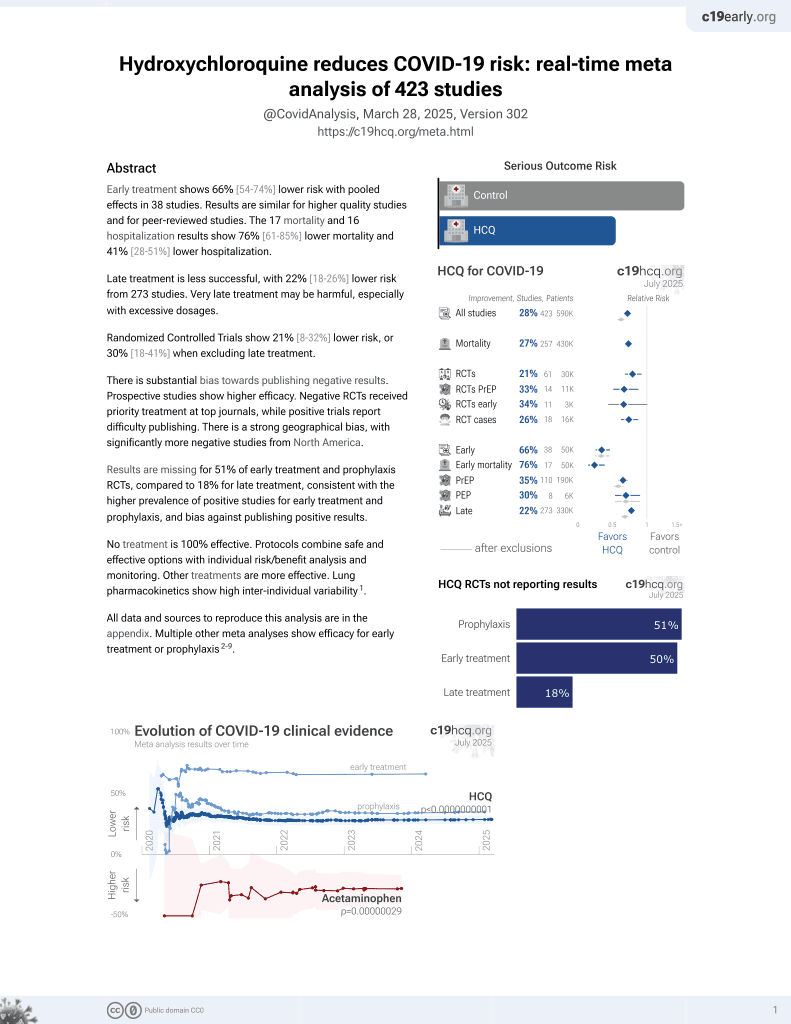
HCQ for COVID-19
1st treatment shown to reduce risk in
March 2020, now with p < 0.0000000001 from 425 studies, used in 59 countries.
No treatment is 100% effective.
Protocols combine treatments.
Authors suggest that folic acid is inappropriate as a placebo in clinical trials for COVID-19 because evidence suggests folic acid may have anti-COVID-19 effects. Specifically, folic acid is predicted to bind to multiple SARS-CoV-2 proteins, folic acid levels are lower in COVID-19 patients with severe disease, folic acid supplementation may help with COVID-19 associated hypertension and hyperhomocystinemia, and differences in a folic acid-related enzyme could impact COVID-19 geographical severity variation.

1.
Mothae et al., SARS-CoV-2 host-pathogen interactome: insights into more players during pathogenesis, Virology, doi:10.1016/j.virol.2025.110607.
2.
Monsalve et al., NETosis: A key player in autoimmunity, COVID-19, and long COVID, Journal of Translational Autoimmunity, doi:10.1016/j.jtauto.2025.100280.
3.
Xie et al., The role of reactive oxygen species in severe acute respiratory syndrome coronavirus 2 (SARS-COV-2) infection-induced cell death, Cellular & Molecular Biology Letters, doi:10.1186/s11658-024-00659-6.
4.
Gkioulekas et al., Use of hydroxychloroquine in multidrug protocols for SARS-CoV-2, Tasman Medical Journal, 6:4, tasmanmedicaljournal.com/2024/10/use-of-hydroxychloroquine-in-multidrug-protocols-for-sars-cov-2a/.
5.
Gortler et al., Those Published “17,000 Hydroxychloroquine Deaths” Never Happened, Brownstone Journal, brownstone.org/articles/those-published-17000-hydroxychloroquine-deaths-never-happened/.
6.
Boretti et al., Correct Use of HCQ Did Not Cause Extra Fatalities in COVID-19 Infection, Coronaviruses, doi:10.2174/0126667975327612240902104505.
7.
Gortler (B) et al., Trump’s 63 Million Doses of Hydroxychloroquine Could Have Been Great for America, Brownstone Journal, brownstone.org/articles/trumps-63-million-doses-of-hydroxychloroquine-could-have-been-great-for-america/.
8.
Enyeji et al., Effective Treatment of COVID-19 Infection with Repurposed Drugs: Case Reports, Viral Immunology, doi:10.1089/vim.2024.0034.
9.
Asaba et al., Interplay of TLR4 and SARS-CoV-2: Unveiling the Complex Mechanisms of Inflammation and Severity in COVID-19 Infections, Journal of Inflammation Research, doi:10.2147/jir.s474707.
10.
Scheim et al., Back to the Basics of SARS-CoV-2 Biochemistry: Microvascular Occlusive Glycan Bindings Govern Its Morbidities and Inform Therapeutic Responses, Viruses, doi:10.3390/v16040647.
11.
Ali et al., SARS-CoV-2 Syncytium under the Radar: Molecular Insights of the Spike-Induced Syncytia and Potential Strategies to Limit SARS-CoV-2 Replication, Journal of Clinical Medicine, doi:10.3390/jcm12186079.
12.
Brouqui et al., There is no such thing as a Ministry of Truth and why it is important to challenge conventional “wisdom” - A personal view, New Microbes and New Infections, doi:10.1016/j.nmni.2023.101155.
13.
Loo et al., Recent Advances in Inhaled Nanoformulations of Vaccines and Therapeutics Targeting Respiratory Viral Infections, Pharmaceutical Research, doi:10.1007/s11095-023-03520-1.
14.
Boretti (B), A., Pharmacotherapy for Covid-19 infection in the countries of the Cooperation Council for the Arab States, Journal of Taibah University Medical Sciences, doi:10.1016/j.jtumed.2021.08.005.
15.
Vigbedor et al., Review of four major biomolecular target sites for COVID-19 and possible inhibitors as treatment interventions, Journal of Applied Pharmaceutical Science, doi:10.7324/JAPS.2021.110825.
16.
Kaur et al., Folic acid as placebo in controlled clinical trials of hydroxychloroquine prophylaxis in COVID-19: Is it scientifically justifiable?, Medical Hypotheses, doi:10.1016/j.mehy.2021.110539.
17.
Raoult, D., Rational for meta-analysis and randomized treatment: the COVID-19 example, Clinical Microbiology and Infection, doi:10.1016/j.cmi.2020.10.012.
18.
Matada et al., A comprehensive review on the biological interest of quinoline and its derivatives, Bioorganic & Medicinal Chemistry, doi:10.1016/j.bmc.2020.115973.
19.
IHU, Natural history and therapeutic options for COVID-19, Expert Review of Clinical Immunology, www.mediterranee-infection.com/wp-content/uploads/2020/09/ERM-2020-0073.R1_Proof_hi.pdf.
20.
Hecel et al., Zinc(II)—The Overlooked Éminence Grise of Chloroquine’s Fight against COVID-19?, Pharmaceuticals, 13:9, 228, doi:10.3390/ph13090228.
21.
Li et al., Is hydroxychloroquine beneficial for COVID-19 patients?, Cell Death & Disease volume 11, doi:10.1038/s41419-020-2721-8.
22.
Goldstein, L., Hydroxychloroquine-based COVID-19 Treatment, A Systematic Review of Clinical Evidence and Expert Opinion from Physicians’ Surveys, Preprint, July 7, 2020, wattsupwiththat.com/2020/07/07/hydroxychloroquine-based-covid-19-treatment-a-systematic-review-of-clinical-evidence-and-expert-opinion-from-physicians-surveys/.
23.
Roussel et al., Influence of conflicts of interest on public positions in the COVID-19 era, the case of Gilead Sciences, New Microbes and New Infections, Volume 38
, doi:10.1016/j.nmni.2020.100710.
24.
Mo et al., Chloroquine phosphate: therapeutic drug for COVID-19, Journal of Southern Medical University, doi:10.12122/j.issn.1673-4254.2020.04.22.
25.
Gao et al., Update on Use of Chloroquine/Hydroxychloroquine to Treat Coronavirus Disease 2019 (COVID-19), Biosci Trends, May 21, 2020, 14:2, 156-158, doi:10.5582/bst.2020.03072.
26.
Derwand et al., Does zinc supplementation enhance the clinical efficacy of chloroquine/hydroxychloroquine to win today's battle against COVID-19?, Medical Hypotheses, doi:10.1016/j.mehy.2020.109815.
27.
Sahraei et al., Aminoquinolines against coronavirus disease 2019 (COVID-19): chloroquine or hydroxychloroquine, International Journal of Antimicrobial Agents, April 2020, 55:4, doi:10.1016/j.ijantimicag.2020.105945.
28.
Todaro et al., An Effective Treatment for Coronavirus (COVID-19), 3/13, github.com/covidtrial/info/raw/master/An%20Effective%20Treatment%20for%20Coronavirus%20(COVID-19).pdf.
Kaur et al., 30 Apr 2021, peer-reviewed, 7 authors.
Abstract: Medical Hypotheses 149 (2021) 110539
Contents lists available at ScienceDirect
Medical Hypotheses
journal homepage: www.elsevier.com/locate/mehy
Correspondence
Folic acid as placebo in controlled clinical trials of hydroxychloroquine prophylaxis in COVID-19:
Is it scientifically justifiable?
A R T I C L E I N F O
A B S T R A C T
Keywords
Hydroxychloroquine
Folic acid
COVID-19
Using folic acid (FA) as placebo complicates the interpretation of the findings of few RCTs evaluating safety and
efficacy of hydroxychloroquine prophylaxis in COVID-19. FA is found to bind to furin-protease and spike: ACE2
interface of SARS-CoV-2. In clinical studies, FA level was lowest among severe patients compared to mild and
moderate disease. A single controlled study reported the benefit of combination of folic acid with Pyridoxine &
cyanocobalamin in terms of clinical and laboratory cure parameters. One hypothesis associates the differences in
geographical variation of disease severity with prevalence of methyl tertahydrofolic acid reductase (MTHFR)
C677T polymorphism. Other possible domains, where FA is hypothesized to be beneficial are COVID-19 asso
ciated pulmonary hypertension and hyper-homocystinemia. So, scientific justification of using folic acid as
placebo in COVID-19 trials seems scientifically not credible and this may be one of the major factors for failure of
many agents. We need to be more careful in choosing our placebo especially when conducting a placebo
controlled trial.
Folic acid is being used as placebo in few RTCs of evaluating safety
and efficacy of hydroxychloroquine prophylaxis in COVID-19 [1].
However, one issue complicates the interpretation of the findings of
these trials. Folic acid is gradually coming up an anti-COVID-19 agent. in
a multimodal network-biology based study on SARS-CoV-2 human
interactome, folic acid was predicted as a top candidate for drug
repurposition (16th rank) [2] as agent for re-purposing against COVID19. In in-silico studies, folic acid is found to bind to NSP-13 [3], furin
[4], spike:ACE2 interface [5,6], PLPro [5], MPro [5] and NSP15 [5] of
SARS-CoV-2, which are important targets from drug design perspective.
5,10 methyltetrahydrofolate is converted to 5-methyl-tetrahydrofo
late by the enzyme methyl tertahydrofolic acid reductase (MTHFR)
and thus helps in providing methyl groups for recycling of homocysteine
to methionine. A single study hypothesized that the differences in
geographical variation of COVID-19 disease severity may be related to
the prevalence of (MTHFR) C677T popymorphism [7]. High dose folic
acid is again hypothesized as a potential treatment of pulmonary hy
pertension (even when associated with COVID-19) and folic acid may
help in the same by reversing uncoupling of eNOS and restoring NO
production [8].
NSP14 of SARS-CoV is a guanine N7-methyl-transferase and is
crucial for viral transmission and replication of SARS-CoV-2 and thus
SARS-CoV-2 may use host S-adenosyl methionine (SAM) for viral RNA
capping [9], utilization of which results in production of homocysteine,
which enhance ACE-2 activation [10] and SARS-CoV-2 may take help of
this enhanced activated ACE2 system to get entry to host cell [9]. High
homocysteine is reported in the context of severe COVID-19 also or
patients with progression of disease [11]. In clinical studies, folic acid is
known to lower the level of homocysteine. In COVID-19 also, in a single
controlled study, patients treated with Angiovit..
DOI record:
{
"DOI": "10.1016/j.mehy.2021.110539",
"ISSN": [
"0306-9877"
],
"URL": "http://dx.doi.org/10.1016/j.mehy.2021.110539",
"alternative-id": [
"S0306987721000578"
],
"article-number": "110539",
"assertion": [
{
"label": "This article is maintained by",
"name": "publisher",
"value": "Elsevier"
},
{
"label": "Article Title",
"name": "articletitle",
"value": "Folic acid as placebo in controlled clinical trials of hydroxychloroquine prophylaxis in COVID-19: Is it scientifically justifiable?"
},
{
"label": "Journal Title",
"name": "journaltitle",
"value": "Medical Hypotheses"
},
{
"label": "CrossRef DOI link to publisher maintained version",
"name": "articlelink",
"value": "https://doi.org/10.1016/j.mehy.2021.110539"
},
{
"label": "Content Type",
"name": "content_type",
"value": "simple-article"
},
{
"label": "Copyright",
"name": "copyright",
"value": "© 2021 Elsevier Ltd. All rights reserved."
}
],
"author": [
{
"affiliation": [],
"family": "Kaur",
"given": "Hardeep",
"sequence": "first"
},
{
"affiliation": [],
"family": "Sarma",
"given": "Phulen",
"sequence": "additional"
},
{
"affiliation": [],
"family": "Bhattacharyya",
"given": "Anusuya",
"sequence": "additional"
},
{
"affiliation": [],
"family": "Prajapat",
"given": "Manisha",
"sequence": "additional"
},
{
"affiliation": [],
"family": "Kumar",
"given": "Subodh",
"sequence": "additional"
},
{
"affiliation": [],
"family": "Prakash",
"given": "Ajay",
"sequence": "additional"
},
{
"affiliation": [],
"family": "Medhi",
"given": "Bikash",
"sequence": "additional"
}
],
"container-title": "Medical Hypotheses",
"container-title-short": "Medical Hypotheses",
"content-domain": {
"crossmark-restriction": true,
"domain": [
"clinicalkey.jp",
"clinicalkey.com",
"clinicalkey.es",
"clinicalkey.com.au",
"clinicalkey.fr",
"elsevier.com",
"sciencedirect.com"
]
},
"created": {
"date-parts": [
[
2021,
2,
21
]
],
"date-time": "2021-02-21T05:46:13Z",
"timestamp": 1613886373000
},
"deposited": {
"date-parts": [
[
2021,
3,
26
]
],
"date-time": "2021-03-26T12:08:43Z",
"timestamp": 1616760523000
},
"indexed": {
"date-parts": [
[
2023,
12,
28
]
],
"date-time": "2023-12-28T16:39:47Z",
"timestamp": 1703781587500
},
"is-referenced-by-count": 10,
"issued": {
"date-parts": [
[
2021,
4
]
]
},
"language": "en",
"license": [
{
"URL": "https://www.elsevier.com/tdm/userlicense/1.0/",
"content-version": "tdm",
"delay-in-days": 0,
"start": {
"date-parts": [
[
2021,
4,
1
]
],
"date-time": "2021-04-01T00:00:00Z",
"timestamp": 1617235200000
}
}
],
"link": [
{
"URL": "https://api.elsevier.com/content/article/PII:S0306987721000578?httpAccept=text/xml",
"content-type": "text/xml",
"content-version": "vor",
"intended-application": "text-mining"
},
{
"URL": "https://api.elsevier.com/content/article/PII:S0306987721000578?httpAccept=text/plain",
"content-type": "text/plain",
"content-version": "vor",
"intended-application": "text-mining"
}
],
"member": "78",
"original-title": [],
"page": "110539",
"prefix": "10.1016",
"published": {
"date-parts": [
[
2021,
4
]
]
},
"published-print": {
"date-parts": [
[
2021,
4
]
]
},
"publisher": "Elsevier BV",
"reference": [
{
"DOI": "10.1056/NEJMoa2016638",
"article-title": "A Randomized Trial of Hydroxychloroquine as Postexposure Prophylaxis for Covid-19",
"author": "Boulware",
"doi-asserted-by": "crossref",
"first-page": "517",
"issue": "6",
"journal-title": "N Engl J Med",
"key": "10.1016/j.mehy.2021.110539_b0005",
"volume": "383",
"year": "2020"
},
{
"key": "10.1016/j.mehy.2021.110539_b0010",
"unstructured": "Gysi DM, Valle ÍD, Zitnik M, Ameli A, Gan X, Varol O, et al. Network Medicine Framework for Identifying Drug Repurposing Opportunities for COVID-19. ArXiv:200407229 [Cs, q-Bio, Stat] 2020."
},
{
"DOI": "10.1016/j.ijbiomac.2020.09.138",
"article-title": "Evaluation of the potency of FDA-approved drugs on wild type and mutant SARS-CoV-2 helicase (Nsp13)",
"author": "Ugurel",
"doi-asserted-by": "crossref",
"first-page": "1687",
"journal-title": "Int J Biol Macromol",
"key": "10.1016/j.mehy.2021.110539_b0015",
"volume": "163",
"year": "2020"
},
{
"DOI": "10.26434/chemrxiv.12034980.v1",
"doi-asserted-by": "crossref",
"key": "10.1016/j.mehy.2021.110539_b0020",
"unstructured": "Sheybani Z, Dokoohaki MH, Negahdaripour M, Dehdashti M, Zolghadr H, Moghadami M, et al. The role of folic acid in the management of respiratory disease caused by COVID-19 2020. doi: 10.26434/chemrxiv.12034980.v1."
},
{
"DOI": "10.21203/rs.3.rs-31775/v1",
"doi-asserted-by": "crossref",
"key": "10.1016/j.mehy.2021.110539_b0025",
"unstructured": "In silico virtual screening-based study of nutraceuticals predicts the therapeutic potentials of folic acid and its derivatives against COVID-19 2020. doi: 10.21203/rs.3.rs-31775/v1."
},
{
"DOI": "10.1016/j.jmgm.2020.107716",
"article-title": "Virtual screening and molecular dynamics study of approved drugs as inhibitors of spike protein S1 domain and ACE2 interaction in SARS-CoV-2",
"author": "Prajapat",
"doi-asserted-by": "crossref",
"first-page": "107716",
"journal-title": "J Mol Graph Model",
"key": "10.1016/j.mehy.2021.110539_b0030",
"volume": "101",
"year": "2020"
},
{
"DOI": "10.1016/j.mehy.2020.110234",
"doi-asserted-by": "crossref",
"key": "10.1016/j.mehy.2021.110539_b0035",
"unstructured": "Life-threatening course in coronavirus disease 2019 (COVID-19)_ Is there a link to methylenetetrahydrofolic acid reductase (MTHFR) polymorphism and hyperhomocysteinemia? | Elsevier Enhanced Reader n.d. doi: 10.1016/j.mehy.2020.110234."
},
{
"DOI": "10.1016/j.mehy.2020.110142",
"article-title": "High dose folic acid is a potential treatment for pulmonary hypertension, including when associated with COVID-19 pneumonia",
"author": "Wiltshire",
"doi-asserted-by": "crossref",
"first-page": "110142",
"journal-title": "Med Hypotheses",
"key": "10.1016/j.mehy.2021.110539_b0040",
"volume": "143",
"year": "2020"
},
{
"DOI": "10.1111/dth.13871",
"doi-asserted-by": "crossref",
"key": "10.1016/j.mehy.2021.110539_b0045",
"unstructured": "Singh Y, Gupta G, Kazmi I, Al‐Abbasi FA, Negi P, Chellappan DK, et al. SARS CoV-2 aggravates cellular metabolism mediated complications in COVID-19 infection. Dermatologic Therapy n.d.;n/a:e13871. doi: 10.1111/dth.13871."
},
{
"article-title": "Homocysteine directly interacts and activates the angiotensin II type I receptor to aggravate vascular injury",
"author": "Li",
"issue": "1",
"journal-title": "Nat Commun",
"key": "10.1016/j.mehy.2021.110539_b0050",
"volume": "9",
"year": "2018"
},
{
"DOI": "10.18632/aging.102999",
"article-title": "Predictors for imaging progression on chest CT from coronavirus disease 2019 (COVID-19) patients",
"author": "Yang",
"doi-asserted-by": "crossref",
"first-page": "6037",
"issue": "7",
"journal-title": "Aging (Albany NY)",
"key": "10.1016/j.mehy.2021.110539_b0055",
"volume": "12",
"year": "2020"
},
{
"DOI": "10.14412/2074-2711-2020-3-82-86",
"article-title": "The first experience with Angiovit in the combination treatment of acute COVID-19 infection",
"author": "Boyko",
"doi-asserted-by": "crossref",
"first-page": "82",
"issue": "3",
"journal-title": "Neurol Neuropsychiatry Psychosomatics",
"key": "10.1016/j.mehy.2021.110539_b0060",
"volume": "12",
"year": "2020"
},
{
"article-title": "Clinical characterization of 162 COVID-19 patients in Israel: preliminary report from a large tertiary center",
"author": "Itelman",
"first-page": "271",
"journal-title": "Isr Med Assoc J",
"key": "10.1016/j.mehy.2021.110539_b0065",
"volume": "22",
"year": "2020"
}
],
"reference-count": 13,
"references-count": 13,
"relation": {},
"resource": {
"primary": {
"URL": "https://linkinghub.elsevier.com/retrieve/pii/S0306987721000578"
}
},
"score": 1,
"short-title": [],
"source": "Crossref",
"subject": [
"General Medicine"
],
"subtitle": [],
"title": "Folic acid as placebo in controlled clinical trials of hydroxychloroquine prophylaxis in COVID-19: Is it scientifically justifiable?",
"type": "journal-article",
"update-policy": "http://dx.doi.org/10.1016/elsevier_cm_policy",
"volume": "149"
}