Rational for meta-analysis and randomized treatment: the COVID-19 example
, D., Clinical Microbiology and Infection, doi:10.1016/j.cmi.2020.10.012, Jan 2021
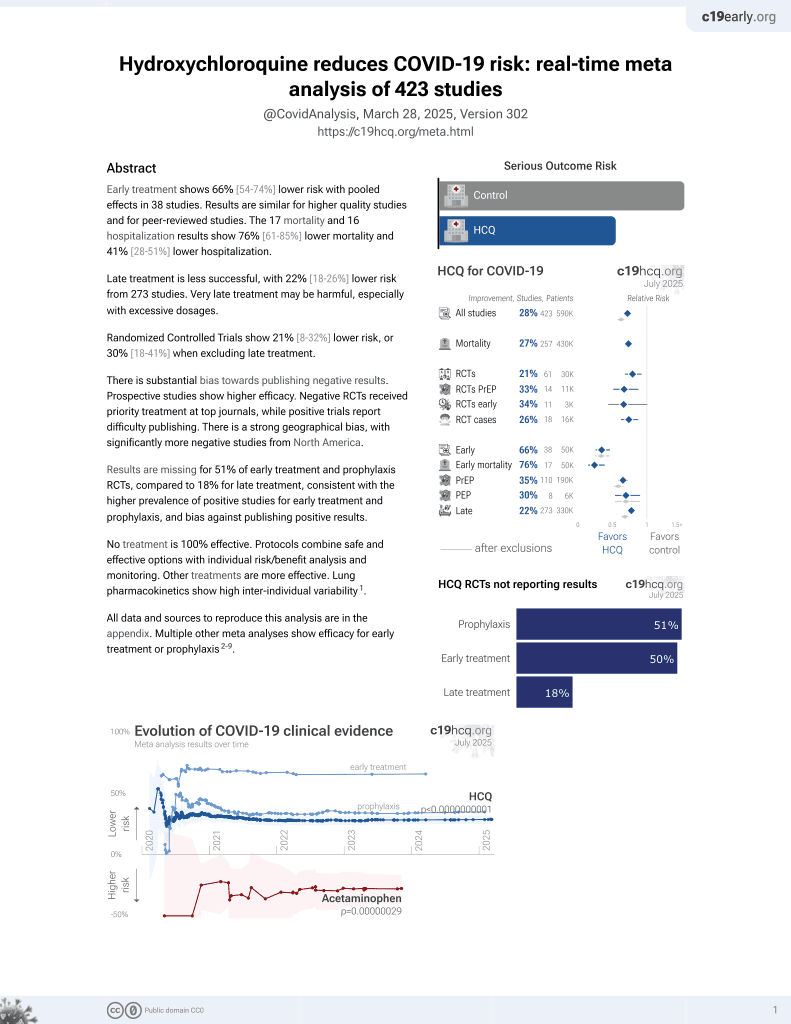
HCQ for COVID-19
1st treatment shown to reduce risk in
March 2020, now with p < 0.0000000001 from 425 studies, used in 59 countries.
No treatment is 100% effective.
Protocols combine treatments.

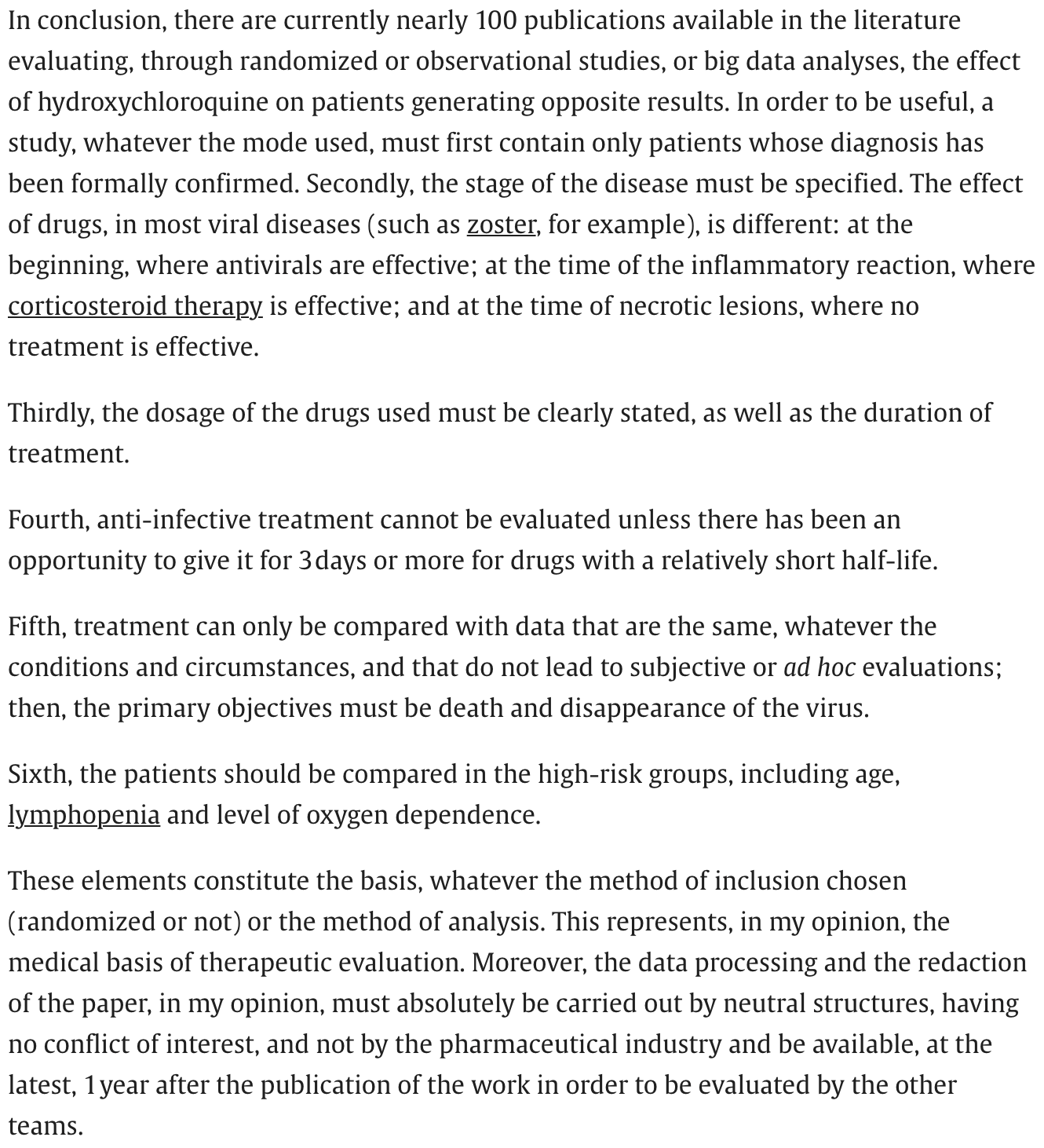
Discussion of the analysis of studies evaluating hydroxychloroquine for COVID-19. Author argues that several critical factors are often overlooked in clinical studies: confirmation of diagnosis, disease stage at treatment initiation, drug dosage and duration, adequate treatment time, objective outcome measures like death and viral clearance, and comparison of high-risk groups. Hydroxychloroquine studies yield contradictory results because these factors are inconsistently applied. Author challenges the dogma that randomized controlled trials are superior to observational studies, citing a Cochrane Library review of 1583 meta-analyses that failed to show such superiority. Meta-analyses themselves demonstrate discrepancies between different randomized studies, proving that these studies do not eliminate biases. Author advocates for neutral organizations without conflicts of interest to process data and publish papers, with data made available within a year for evaluation by other teams.

1.
Mothae et al., SARS-CoV-2 host-pathogen interactome: insights into more players during pathogenesis, Virology, doi:10.1016/j.virol.2025.110607.
2.
Monsalve et al., NETosis: A key player in autoimmunity, COVID-19, and long COVID, Journal of Translational Autoimmunity, doi:10.1016/j.jtauto.2025.100280.
3.
Xie et al., The role of reactive oxygen species in severe acute respiratory syndrome coronavirus 2 (SARS-COV-2) infection-induced cell death, Cellular & Molecular Biology Letters, doi:10.1186/s11658-024-00659-6.
4.
Gkioulekas et al., Use of hydroxychloroquine in multidrug protocols for SARS-CoV-2, Tasman Medical Journal, 6:4, tasmanmedicaljournal.com/2024/10/use-of-hydroxychloroquine-in-multidrug-protocols-for-sars-cov-2a/.
5.
Gortler et al., Those Published “17,000 Hydroxychloroquine Deaths” Never Happened, Brownstone Journal, brownstone.org/articles/those-published-17000-hydroxychloroquine-deaths-never-happened/.
6.
Boretti et al., Correct Use of HCQ Did Not Cause Extra Fatalities in COVID-19 Infection, Coronaviruses, doi:10.2174/0126667975327612240902104505.
7.
Gortler (B) et al., Trump’s 63 Million Doses of Hydroxychloroquine Could Have Been Great for America, Brownstone Journal, brownstone.org/articles/trumps-63-million-doses-of-hydroxychloroquine-could-have-been-great-for-america/.
8.
Enyeji et al., Effective Treatment of COVID-19 Infection with Repurposed Drugs: Case Reports, Viral Immunology, doi:10.1089/vim.2024.0034.
9.
Asaba et al., Interplay of TLR4 and SARS-CoV-2: Unveiling the Complex Mechanisms of Inflammation and Severity in COVID-19 Infections, Journal of Inflammation Research, doi:10.2147/jir.s474707.
10.
Scheim et al., Back to the Basics of SARS-CoV-2 Biochemistry: Microvascular Occlusive Glycan Bindings Govern Its Morbidities and Inform Therapeutic Responses, Viruses, doi:10.3390/v16040647.
11.
Ali et al., SARS-CoV-2 Syncytium under the Radar: Molecular Insights of the Spike-Induced Syncytia and Potential Strategies to Limit SARS-CoV-2 Replication, Journal of Clinical Medicine, doi:10.3390/jcm12186079.
12.
Brouqui et al., There is no such thing as a Ministry of Truth and why it is important to challenge conventional “wisdom” - A personal view, New Microbes and New Infections, doi:10.1016/j.nmni.2023.101155.
13.
Loo et al., Recent Advances in Inhaled Nanoformulations of Vaccines and Therapeutics Targeting Respiratory Viral Infections, Pharmaceutical Research, doi:10.1007/s11095-023-03520-1.
14.
Boretti (B), A., Pharmacotherapy for Covid-19 infection in the countries of the Cooperation Council for the Arab States, Journal of Taibah University Medical Sciences, doi:10.1016/j.jtumed.2021.08.005.
15.
Vigbedor et al., Review of four major biomolecular target sites for COVID-19 and possible inhibitors as treatment interventions, Journal of Applied Pharmaceutical Science, doi:10.7324/JAPS.2021.110825.
16.
Kaur et al., Folic acid as placebo in controlled clinical trials of hydroxychloroquine prophylaxis in COVID-19: Is it scientifically justifiable?, Medical Hypotheses, doi:10.1016/j.mehy.2021.110539.
17.
Raoult, D., Rational for meta-analysis and randomized treatment: the COVID-19 example, Clinical Microbiology and Infection, doi:10.1016/j.cmi.2020.10.012.
18.
Matada et al., A comprehensive review on the biological interest of quinoline and its derivatives, Bioorganic & Medicinal Chemistry, doi:10.1016/j.bmc.2020.115973.
19.
IHU, Natural history and therapeutic options for COVID-19, Expert Review of Clinical Immunology, www.mediterranee-infection.com/wp-content/uploads/2020/09/ERM-2020-0073.R1_Proof_hi.pdf.
20.
Hecel et al., Zinc(II)—The Overlooked Éminence Grise of Chloroquine’s Fight against COVID-19?, Pharmaceuticals, 13:9, 228, doi:10.3390/ph13090228.
21.
Li et al., Is hydroxychloroquine beneficial for COVID-19 patients?, Cell Death & Disease volume 11, doi:10.1038/s41419-020-2721-8.
22.
Goldstein, L., Hydroxychloroquine-based COVID-19 Treatment, A Systematic Review of Clinical Evidence and Expert Opinion from Physicians’ Surveys, Preprint, July 7, 2020, wattsupwiththat.com/2020/07/07/hydroxychloroquine-based-covid-19-treatment-a-systematic-review-of-clinical-evidence-and-expert-opinion-from-physicians-surveys/.
23.
Roussel et al., Influence of conflicts of interest on public positions in the COVID-19 era, the case of Gilead Sciences, New Microbes and New Infections, Volume 38
, doi:10.1016/j.nmni.2020.100710.
24.
Mo et al., Chloroquine phosphate: therapeutic drug for COVID-19, Journal of Southern Medical University, doi:10.12122/j.issn.1673-4254.2020.04.22.
25.
Gao et al., Update on Use of Chloroquine/Hydroxychloroquine to Treat Coronavirus Disease 2019 (COVID-19), Biosci Trends, May 21, 2020, 14:2, 156-158, doi:10.5582/bst.2020.03072.
26.
Derwand et al., Does zinc supplementation enhance the clinical efficacy of chloroquine/hydroxychloroquine to win today's battle against COVID-19?, Medical Hypotheses, doi:10.1016/j.mehy.2020.109815.
27.
Sahraei et al., Aminoquinolines against coronavirus disease 2019 (COVID-19): chloroquine or hydroxychloroquine, International Journal of Antimicrobial Agents, April 2020, 55:4, doi:10.1016/j.ijantimicag.2020.105945.
28.
Todaro et al., An Effective Treatment for Coronavirus (COVID-19), 3/13, github.com/covidtrial/info/raw/master/An%20Effective%20Treatment%20for%20Coronavirus%20(COVID-19).pdf.
Raoult et al., 31 Jan 2021, France, peer-reviewed, 1 author.
Contact: didier.raoult@gmail.com.
Abstract: Clinical Microbiology and Infection 27 (2021) 6e8
Contents lists available at ScienceDirect
Clinical Microbiology and Infection
journal homepage: www.clinicalmicrobiologyandinfection.com
Commentary
Rational for meta-analysis and randomized treatment: the COVID-19
example
Didier Raoult 1, 2, *
1)
2)
MEPHI, IRD, Aix Marseille Univ, AP-HM, Marseille, France
IHU-M
editerran
ee Infection, Marseille, France
a r t i c l e i n f o
Article history:
Received 21 September 2020
Received in revised form
9 October 2020
Accepted 13 October 2020
Available online 21 October 2020
Editor: L. Leibovici
My opinion is that hydroxychloroquine has become the symbol
of a struggle between practising physicians and methodologists [1],
and the Western world against the rest of the world [2]. This leads
to great confusion in the literature between, on the one hand, the
advocates of an empirical approach based on the sensitivity of
bacteria, viruses or parasites to anti-infectious agents in vitro and
the rational use of these anti-infectious agents in patients, and, on
the other hand, the analysts who, taking up the various studies, are
more specifically interested in the form of the studies to determine
the existence of biases. Recently, hydroxychloroquine, from my
point of view, became a paradigm of such conflict.
For example, when testing hydroxychloroquine, exclusion of
patients without confirmed diagnosis is for us a major issue. In
contrast, several studies do not consider this parameter to be
essential [3,4], including a large study testing the efficacy of
hydroxychloroquine prophylaxis [5]. This inclusion criterion is
mandatory for me. In addition, there are considerable differences in
dosing regimens as there is no standard dosing regimen: the Recovery Trial gave a theoretically toxic dosage at baseline (2.4 g),
others use 200 mg daily, while we prescribe, in my institute, 600
mg daily, as in Q fever or Whipple's disease [6]. Also, it is important
to compare the duration of treatment. Entering hospital data with a
hydroxychloroquine yes/no answer does not tell much about the
DOI of original article: https://doi.org/10.1016/j.cmi.2020.08.022.
dite
ranne
e Infection, Aix Marseille Universite
, Marseille, France.
* IHU Me
E-mail address: didier.raoult@gmail.com.
treatment. These are major problems with the inclusion criteria in
big data studies.
The stage of the disease at which treatment is given is critical.
Two reviews explain that there are four stages in the disease [6,7].
There is a first virological stage, when the antiviral drugs can be
effective, a second viro-immunological stage, when the immunological reaction aggravates the patient's condition and is associated
with abnormal coagulation phenomena including antiphospholipid antibodies [8], a third stage that is exclusively or
almost exclusively immune, also called the cytokine storm, and
finally a fourth stage, resulting from multiple pulmonary and
visceral injuries. Thus, each stage probably corresponds to different
therapeutic strategies. Finally, evaluation of the therapeutic efficiency in all infections of the lung is usually performed after 3 days
of treatment. Mixing patients of different stages, with different
doses and durations of treatment, may result in a false result known
as “Simpson's paradox” [9]: studying separate groups of patients
from the same study may result in opposite conclusions. Some
French studies exclude patients who are treated while they have
already been..
DOI record:
{
"DOI": "10.1016/j.cmi.2020.10.012",
"ISSN": [
"1198-743X"
],
"URL": "http://dx.doi.org/10.1016/j.cmi.2020.10.012",
"alternative-id": [
"S1198743X20306431"
],
"author": [
{
"affiliation": [],
"family": "Raoult",
"given": "Didier",
"sequence": "first"
}
],
"container-title": "Clinical Microbiology and Infection",
"container-title-short": "Clinical Microbiology and Infection",
"content-domain": {
"crossmark-restriction": false,
"domain": []
},
"created": {
"date-parts": [
[
2020,
10,
21
]
],
"date-time": "2020-10-21T15:42:02Z",
"timestamp": 1603294922000
},
"deposited": {
"date-parts": [
[
2022,
1,
8
]
],
"date-time": "2022-01-08T18:59:45Z",
"timestamp": 1641668385000
},
"indexed": {
"date-parts": [
[
2024,
7,
10
]
],
"date-time": "2024-07-10T04:42:02Z",
"timestamp": 1720586522410
},
"is-referenced-by-count": 6,
"issue": "1",
"issued": {
"date-parts": [
[
2021,
1
]
]
},
"journal-issue": {
"issue": "1",
"published-print": {
"date-parts": [
[
2021,
1
]
]
}
},
"language": "en",
"license": [
{
"URL": "https://www.elsevier.com/tdm/userlicense/1.0/",
"content-version": "tdm",
"delay-in-days": 0,
"start": {
"date-parts": [
[
2021,
1,
1
]
],
"date-time": "2021-01-01T00:00:00Z",
"timestamp": 1609459200000
}
},
{
"URL": "http://www.elsevier.com/open-access/userlicense/1.0/",
"content-version": "vor",
"delay-in-days": 365,
"start": {
"date-parts": [
[
2022,
1,
1
]
],
"date-time": "2022-01-01T00:00:00Z",
"timestamp": 1640995200000
}
}
],
"link": [
{
"URL": "https://api.elsevier.com/content/article/PII:S1198743X20306431?httpAccept=text/xml",
"content-type": "text/xml",
"content-version": "vor",
"intended-application": "text-mining"
},
{
"URL": "https://api.elsevier.com/content/article/PII:S1198743X20306431?httpAccept=text/plain",
"content-type": "text/plain",
"content-version": "vor",
"intended-application": "text-mining"
}
],
"member": "78",
"original-title": [],
"page": "6-8",
"prefix": "10.1016",
"published": {
"date-parts": [
[
2021,
1
]
]
},
"published-print": {
"date-parts": [
[
2021,
1
]
]
},
"publisher": "Elsevier BV",
"reference": [
{
"article-title": "Has the door closed on hydroxychloroquine for SARS-COV-2?",
"author": "Paul",
"journal-title": "Clin Microbiol Infect",
"key": "10.1016/j.cmi.2020.10.012_bib1",
"year": "2020"
},
{
"DOI": "10.1016/j.ejim.2020.06.020",
"article-title": "Chloroquine and COVID-19: a western medical and scientific drift?",
"author": "Million",
"doi-asserted-by": "crossref",
"first-page": "4",
"journal-title": "Eur J Intern Med",
"key": "10.1016/j.cmi.2020.10.012_bib2",
"volume": "78",
"year": "2020"
},
{
"author": "Recovery",
"key": "10.1016/j.cmi.2020.10.012_bib3",
"series-title": "Randomised evaluation of COVID-19 therapy (Recovery)",
"year": "2020"
},
{
"DOI": "10.7326/M20-4207",
"article-title": "Hydroxychloroquine in nonhospitalized adults with early COVID-19: a randomized trial",
"author": "Skipper",
"doi-asserted-by": "crossref",
"first-page": "623",
"journal-title": "Ann Intern Med",
"key": "10.1016/j.cmi.2020.10.012_bib4",
"volume": "173",
"year": "2020"
},
{
"DOI": "10.1056/NEJMoa2016638",
"article-title": "A randomized trial of hydroxychloroquine as postexposure prophylaxis for covid-19",
"author": "Boulware",
"doi-asserted-by": "crossref",
"first-page": "517",
"journal-title": "N Engl J Med",
"key": "10.1016/j.cmi.2020.10.012_bib5",
"volume": "383",
"year": "2020"
},
{
"DOI": "10.1080/1744666X.2021.1847640",
"article-title": "Natural history of COVID-19 and therapeutic options",
"author": "Gautret",
"doi-asserted-by": "crossref",
"journal-title": "Exp Rev Clin Immunol",
"key": "10.1016/j.cmi.2020.10.012_bib6",
"year": "2020"
},
{
"article-title": "Pathophysiological basis and rationale for early outpatient treatment of SARS-CoV-2 (COVID-19) infection",
"author": "McCullough",
"journal-title": "Am J Med",
"key": "10.1016/j.cmi.2020.10.012_bib7",
"volume": "7",
"year": "2020"
},
{
"DOI": "10.1002/art.41409",
"article-title": "Anti-cardiolipin IgG autoantibodies are an independent risk factor of COVID-19 severity",
"author": "Bertin",
"doi-asserted-by": "crossref",
"journal-title": "Arthritis Rheumatol",
"key": "10.1016/j.cmi.2020.10.012_bib8",
"year": "2020"
},
{
"DOI": "10.1038/s41591-019-0624-y",
"article-title": "Simpson’s paradox in proof-of-concept studies",
"author": "Janket",
"doi-asserted-by": "crossref",
"first-page": "1640",
"journal-title": "Nat Med",
"key": "10.1016/j.cmi.2020.10.012_bib9",
"volume": "25",
"year": "2019"
},
{
"DOI": "10.1136/bmj.m1844",
"article-title": "Clinical efficacy of hydroxychloroquine in patients with covid-19 pneumonia who require oxygen: observational comparative study using routine care data",
"author": "Mahévas",
"doi-asserted-by": "crossref",
"first-page": "m1844",
"journal-title": "BMJ",
"key": "10.1016/j.cmi.2020.10.012_bib10",
"volume": "369",
"year": "2020"
},
{
"DOI": "10.1016/j.tmaid.2020.101791",
"article-title": "Outcomes of 3,737 COVID-19 patients treated with hydroxychloroquine/azithromycin and other regimens in Marseille, France: a retrospective analysis",
"author": "Lagier",
"doi-asserted-by": "crossref",
"first-page": "101791",
"journal-title": "Travel Med Infect Dis",
"key": "10.1016/j.cmi.2020.10.012_bib11",
"volume": "36",
"year": "2020"
},
{
"author": "Kellerman",
"key": "10.1016/j.cmi.2020.10.012_bib12",
"series-title": "Conn’s current therapy",
"year": "2019"
},
{
"author": "Bennett",
"key": "10.1016/j.cmi.2020.10.012_bib13",
"series-title": "Mandell, Douglas, and Bennett’s principles and practice of infectious diseases",
"year": "2014"
},
{
"article-title": "Healthcare outcomes assessed with observational study designs compared with those assessed in randomized trials",
"author": "Anglemyer",
"journal-title": "Cochrane Syst Rev",
"key": "10.1016/j.cmi.2020.10.012_bib14",
"volume": "4",
"year": "2014"
},
{
"DOI": "10.1056/NEJMe1601510",
"article-title": "Clinical trial series",
"author": "Woodcock",
"doi-asserted-by": "crossref",
"first-page": "2167",
"journal-title": "N Engl J Med",
"key": "10.1016/j.cmi.2020.10.012_bib15",
"year": "2016"
},
{
"DOI": "10.1056/NEJMra1614394",
"article-title": "Evidence for health decision making – beyond randomized, controlled trials",
"author": "Frieden",
"doi-asserted-by": "crossref",
"first-page": "465",
"journal-title": "N Engl J Med",
"key": "10.1016/j.cmi.2020.10.012_bib16",
"volume": "377",
"year": "2017"
},
{
"author": "Bédécarrats",
"key": "10.1016/j.cmi.2020.10.012_bib17",
"series-title": "Randomized control trials in the field of development – a critical perspective",
"year": "2020"
},
{
"DOI": "10.1016/j.jclinepi.2011.01.005",
"article-title": "Treatments effects from randomized trials and propensity score analyses were similar in similar populations in an example from cardiac surgery",
"author": "Kuss",
"doi-asserted-by": "crossref",
"first-page": "1076",
"journal-title": "J Clin Epidemiol",
"key": "10.1016/j.cmi.2020.10.012_bib18",
"volume": "64",
"year": "2011"
},
{
"DOI": "10.1503/cjs.023410",
"article-title": "Meta-analytic comparison of randomized and nonrandomized studies of breast cancer surgery",
"author": "Edwards",
"doi-asserted-by": "crossref",
"first-page": "155",
"journal-title": "Can J Surg",
"key": "10.1016/j.cmi.2020.10.012_bib19",
"volume": "55",
"year": "2012"
},
{
"DOI": "10.1093/cid/ciz707",
"article-title": "Bouillabaisse or fish soup: the limitations of meta-analysis confronted to the inconsistency of fecal microbiota transplantation studies",
"author": "Lagier",
"doi-asserted-by": "crossref",
"first-page": "2454",
"journal-title": "Clin Infect Dis",
"key": "10.1016/j.cmi.2020.10.012_bib20",
"volume": "70",
"year": "2020"
},
{
"DOI": "10.1016/j.cmi.2020.08.022",
"article-title": "Effect of hydroxychloroquine with or without azithromycin on the mortality of COVID-19 patients: a systematic review and meta-analysis",
"author": "Fiolet",
"doi-asserted-by": "crossref",
"first-page": "19",
"journal-title": "Clin Microbiol Infect",
"key": "10.1016/j.cmi.2020.10.012_bib21",
"volume": "27",
"year": "2020"
},
{
"DOI": "10.1016/j.nmni.2020.100709",
"article-title": "Clinical efficacy of chloroquine derivatives in COVID-19 infection: comparative meta-analysis between the big data and the real world",
"author": "Million",
"doi-asserted-by": "crossref",
"first-page": "100709",
"journal-title": "New Microbe. New Infect",
"key": "10.1016/j.cmi.2020.10.012_bib22",
"volume": "38",
"year": "2020"
},
{
"DOI": "10.1007/s10654-012-9740-4",
"article-title": "Publication biases in probiotics",
"author": "Million",
"doi-asserted-by": "crossref",
"first-page": "885",
"journal-title": "Eur J Epidemiol",
"key": "10.1016/j.cmi.2020.10.012_bib23",
"volume": "27",
"year": "2012"
},
{
"DOI": "10.1007/s10654-010-9440-x",
"article-title": "The ongoing tyranny of statistical significance testing in biomedical research",
"author": "Stang",
"doi-asserted-by": "crossref",
"first-page": "225",
"journal-title": "Eur J Epidemiol",
"key": "10.1016/j.cmi.2020.10.012_bib24",
"volume": "25",
"year": "2010"
}
],
"reference-count": 24,
"references-count": 24,
"relation": {},
"resource": {
"primary": {
"URL": "https://linkinghub.elsevier.com/retrieve/pii/S1198743X20306431"
}
},
"score": 1,
"short-title": [],
"source": "Crossref",
"subject": [],
"subtitle": [],
"title": "Rational for meta-analysis and randomized treatment: the COVID-19 example",
"type": "journal-article",
"volume": "27"
}