Clinical Progression and Outcome of Hospitalized Patients Infected with SARS-CoV-2 Omicron Variant in Shanghai, China
Jiasheng Shao, Rong Fan, Jianrong Hu, Tiejun Zhang, Catherine Lee, Xuyuan Huang, Fei Wang, Haiying Liang, Ye Jin, Ying Jiang, Yanhua Gu, Gang Huang
Vaccines, doi:10.3390/vaccines10091409
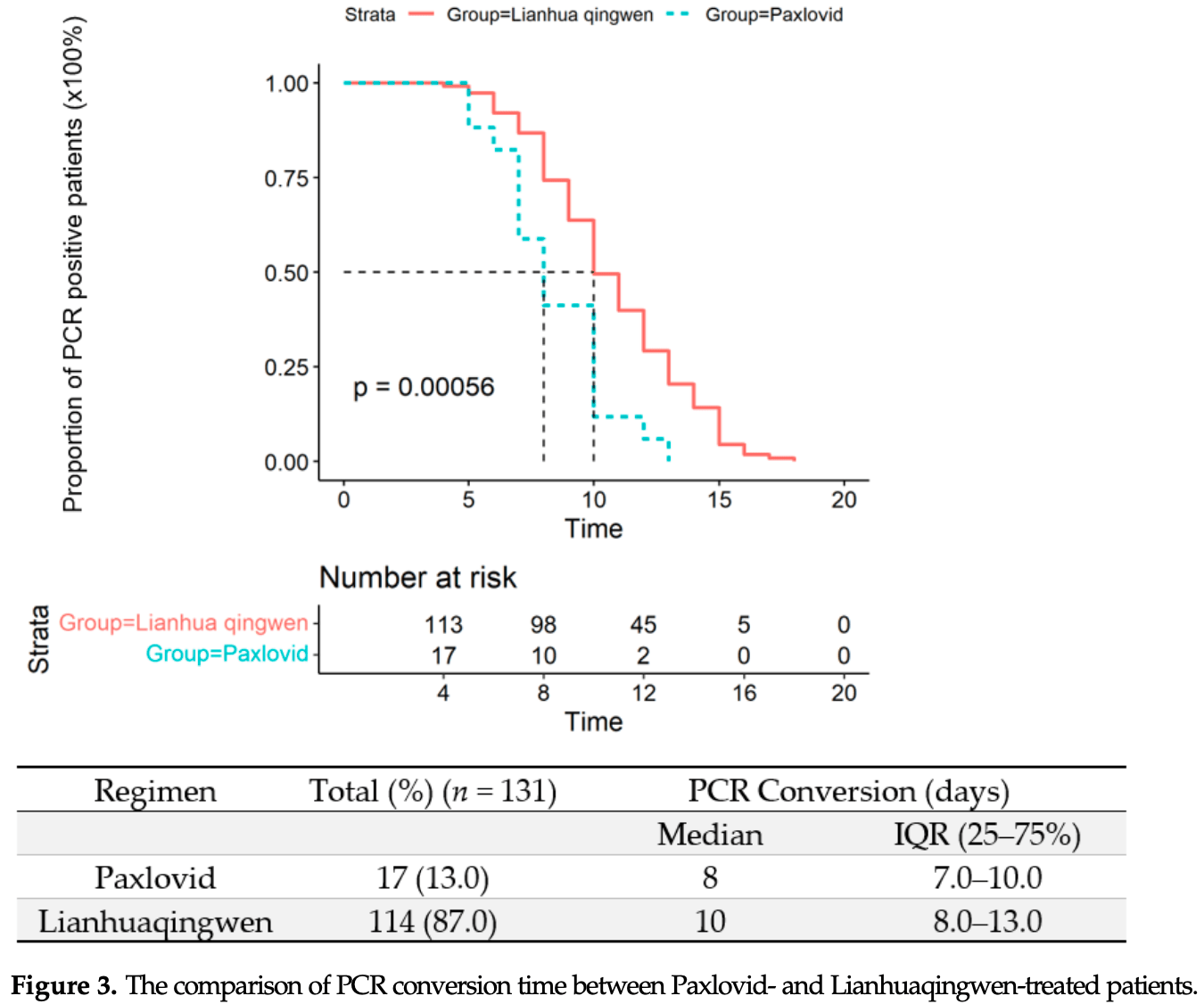
Background: Studies on the Omicron variant infection have generally been restricted to descriptions of its initial clinical and epidemiological characteristics. We investigated the timelinerelated progression and clinical outcome in hospitalized individuals with the Omicron variant. Methods: We conducted a retrospective, single-centered study including 226 laboratory-confirmed cases with the Omicron variant between 6 April and 11 May 2022 in Shanghai, China. The final date of follow-up was 30 May 2022. Results: Among 226 enrolled patients, the median age was 52 years, and 118 (52.2%) were female. The duration from onset of symptoms to hospitalization was 3 days (interquartile range (IQR): 2-4 days) for symptomatic patients. Cough occurred in 168 patients (74.3%). The median interval to negative reverse-transcriptase PCR tests of nasopharynx swab was 10 days ((IQR): 8-13 days). No radiographic progressions were found in 196 patients on the 7th day after onset of symptoms. The median duration of fever in all participants was 5 days (IQR: 4-6 days). The median PCR conversion time of Paxlovid-treated patients was 8 days (IQR: 7-10 days) compared with that of a traditional Chinese herb medicine lianhuaqingwen (10 days, IQR: 8-13 days) (p = 0.00056). Booster vaccination can significantly decrease the severity of Omicron infection when compared with unvaccinated patients (p = 0.009). In multivariate logistic analysis, erythrocyte sedimentation rate (ESR) (OR = 1.05) was independently related to the severity of the infection. Conclusions: The majority of clinical symptoms of Omicron infection were not severe. Early and aggressive administration of Paxlovid can significantly reduce the PCR conversion time. Booster vaccination should also be highly recommended in the population over 14 years old.
Factors Related to the Severity of the Infection To figure out factors that were associated with the severity of the disease, we compared clinical laboratory characters and vaccination status of asymptomatic (n = 4), mild (n = 180), and moderate (n = 41) patients. In univariate analysis, older age, comorbidity, lymphopenia, high levels of CRP, ESR, lactate, estimated glomerular filtration rate (e-GFR), low levels of albumin, and fewer vaccination doses are all associated with the severity of Omicron infection. In multivariate logistic analysis, ESR (OR = 1.05) was independently related to the severity of the infection (Table 3 ).
Discussion On 24 November 2021, the World Health Organization (WHO) announced a new variant of SARS-CoV-2 Omicron in South Africa, and 17 days later, the first case infected with Omicron in China was identified [15] . Recent investigations on the Omicron variant have described the epidemiologic characteristics, initial clinical, laboratory, and radiological findings [4, 6, 16] . To our knowledge, we are the first to describe the temporal clinical progression of Omicron variant infection to date. Our investigation has several distinguished features from current research. As one of the megacities and most important economic centers in China, the policy of "Dynamic zero" was implemented strictly in Shanghai. The whole city underwent completely lockdown during the pandemic outbreak since the end of March 2022 [17] . Under the policy of..
References
Abas, Marfuah, Idroes, Kusumawaty, Fatimawali, None
Anjos, Fiaccadori, Servian, Da Fonseca, Guilarde et al., SARS-CoV-2 loads in urine, sera and stool specimens in association with clinical features of COVID-19 patients, J. Clin. Virol. Plus,
doi:10.1016/j.jcvp.2021.100059Bennasrallah, Zemni, Dhouib, Sriha, Mezhoud et al., Factors associated with a prolonged negative conversion of viral RNA in patients with COVID-19, Int. J. Infect. Dis,
doi:10.1016/j.ijid.2021.02.089Butt, Dargham, Loka, Shaik, Chemaitelly et al., COVID-19 Disease Severity in Children Infected with the Omicron Variant, Clin. Infect. Dis,
doi:10.1093/cid/ciac275Guan, Ni, Hu, Liang, Ou et al., Clinical Characteristics of Coronavirus Disease 2019 in China, N. Engl. J. Med,
doi:10.1056/NEJMoa2002032Kim, Lee, Choi, Um, Lee et al., Clinical Characteristics of 40 Patients Infected With the SARS-CoV-2 Omicron Variant in Korea, J. Korean Med. Sci,
doi:10.3346/jkms.2022.37.e31Lee, Choe, Jeong, Kim, Kim et al., Importation and Transmission of SARS-CoV-2 B.1.1.529 (Omicron) Variant of Concern in Korea, J. Korean Med. Sci,
doi:10.3346/jkms.2021.36.e346Liang, Hui, Liu, Qiao, Li et al., Insights into forsythia honeysuckle (Lianhuaqingwen) capsules: A Chinese herbal medicine repurposed for COVID-19 pandemic, Phytomed. Plus,
doi:10.1016/j.phyplu.2021.100027Liu, Gao, Yuan, Yang, Shi et al., Efficacy and safety of herbal medicine (Lianhuaqingwen) for treating COVID-19: A systematic review and meta-analysis, Integr. Med. Res,
doi:10.1016/j.imr.2020.100644Martin, Dewitt, Russell, Sanchez-Pinto, Haendel et al., Acute Upper Airway Disease in Children With the Omicron (B.1.1.529) Variant of SARS-CoV-2-A Report from the US National COVID Cohort Collaborative, JAMA Pediatr,
doi:10.1001/jamapediatrics.2022.1110Maslo, Friedland, Toubkin, Laubscher, Akaloo et al., Characteristics and Outcomes of Hospitalized Patients in South Africa During the COVID-19 Omicron Wave Compared With Previous Waves, JAMA,
doi:10.1001/jama.2021.24868Mesfin, Chen, Bond, Lam, Cheung et al., Epidemiology of infections with SARS-CoV-2 Omicron BA.2 variant in Hong Kong, medRxiv,
doi:10.1101/2022.04.07.22273595Nhcotpsro, Notice on printing and distributing the COVID-19 Pneumonia Diagnosis and Treatment Plan (Ninth Trial Version
Park, Siyadatpanah, Alhumaydhi, Mahmud, Tallei, Can the SARS-CoV-2 Omicron Variant Confer Natural Immunity against COVID-19?, Molecules
Rossler, Riepler, Bante, Von Laer, Kimpel, SARS-CoV-2 Omicron Variant Neutralization in Serum from Vaccinated and Convalescent Persons, N. Engl. J. Med,
doi:10.1056/NEJMc2119236Runfeng, Yunlong, Jicheng, Weiqi, Qinhai et al., Lianhuaqingwen exerts anti-viral and anti-inflammatory activity against novel coronavirus (SARS-CoV-2), Pharmacol. Res,
doi:10.1016/j.phrs.2020.104761Shen, Li, Tu, Wu, Peng et al., Positive effects of Lianhuaqingwen granules in COVID-19 patients: A retrospective study of 248 cases, J. Ethnopharmacol,
doi:10.1016/j.jep.2021.114220Thakur, Ratho, Omicron, A new SARS-CoV-2 variant of concern mounting worldwide fear, J. Med. Virol,
doi:10.1002/jmv.27541Torjesen, Covid-19: Peak of viral shedding is later with omicron variant, Japanese data suggest, BMJ,
doi:10.1136/bmj.o89Wang, Yang, In the age of Omicron variant: Paxlovid raises new hopes of COVID-19 recovery, J. Med. Virol,
doi:10.1002/jmv.27540Widders, Broom, Broom, SARS-CoV-2: The viral shedding vs infectivity dilemma, Infect. Dis. Health
Yan, Zhang, Chen, Jiang, Liu et al., Characteristics of Viral Shedding Time in SARS-CoV-2 Infections: A Systematic Review and Meta-Analysis, Front. Public Health
DOI record:
{
"DOI": "10.3390/vaccines10091409",
"ISSN": [
"2076-393X"
],
"URL": "http://dx.doi.org/10.3390/vaccines10091409",
"abstract": "<jats:p>Background: Studies on the Omicron variant infection have generally been restricted to descriptions of its initial clinical and epidemiological characteristics. We investigated the timeline-related progression and clinical outcome in hospitalized individuals with the Omicron variant. Methods: We conducted a retrospective, single-centered study including 226 laboratory-confirmed cases with the Omicron variant between 6 April and 11 May 2022 in Shanghai, China. The final date of follow-up was 30 May 2022. Results: Among 226 enrolled patients, the median age was 52 years, and 118 (52.2%) were female. The duration from onset of symptoms to hospitalization was 3 days (interquartile range (IQR): 2–4 days) for symptomatic patients. Cough occurred in 168 patients (74.3%). The median interval to negative reverse-transcriptase PCR tests of nasopharynx swab was 10 days ((IQR): 8–13 days). No radiographic progressions were found in 196 patients on the 7th day after onset of symptoms. The median duration of fever in all participants was 5 days (IQR: 4–6 days). The median PCR conversion time of Paxlovid-treated patients was 8 days (IQR: 7–10 days) compared with that of a traditional Chinese herb medicine lianhuaqingwen (10 days, IQR: 8–13 days) (p = 0.00056). Booster vaccination can significantly decrease the severity of Omicron infection when compared with unvaccinated patients (p = 0.009). In multivariate logistic analysis, erythrocyte sedimentation rate (ESR) (OR = 1.05) was independently related to the severity of the infection. Conclusions: The majority of clinical symptoms of Omicron infection were not severe. Early and aggressive administration of Paxlovid can significantly reduce the PCR conversion time. Booster vaccination should also be highly recommended in the population over 14 years old.</jats:p>",
"alternative-id": [
"vaccines10091409"
],
"author": [
{
"affiliation": [],
"family": "Shao",
"given": "Jiasheng",
"sequence": "first"
},
{
"ORCID": "http://orcid.org/0000-0002-0814-0548",
"affiliation": [],
"authenticated-orcid": false,
"family": "Fan",
"given": "Rong",
"sequence": "additional"
},
{
"affiliation": [],
"family": "Hu",
"given": "Jianrong",
"sequence": "additional"
},
{
"affiliation": [],
"family": "Zhang",
"given": "Tiejun",
"sequence": "additional"
},
{
"affiliation": [],
"family": "Lee",
"given": "Catherine",
"sequence": "additional"
},
{
"affiliation": [],
"family": "Huang",
"given": "Xuyuan",
"sequence": "additional"
},
{
"affiliation": [],
"family": "Wang",
"given": "Fei",
"sequence": "additional"
},
{
"affiliation": [],
"family": "Liang",
"given": "Haiying",
"sequence": "additional"
},
{
"affiliation": [],
"family": "Jin",
"given": "Ye",
"sequence": "additional"
},
{
"affiliation": [],
"family": "Jiang",
"given": "Ying",
"sequence": "additional"
},
{
"affiliation": [],
"family": "Gu",
"given": "Yanhua",
"sequence": "additional"
},
{
"affiliation": [],
"family": "Huang",
"given": "Gang",
"sequence": "additional"
}
],
"container-title": "Vaccines",
"container-title-short": "Vaccines",
"content-domain": {
"crossmark-restriction": false,
"domain": []
},
"created": {
"date-parts": [
[
2022,
8,
31
]
],
"date-time": "2022-08-31T06:09:36Z",
"timestamp": 1661926176000
},
"deposited": {
"date-parts": [
[
2022,
8,
31
]
],
"date-time": "2022-08-31T07:10:13Z",
"timestamp": 1661929813000
},
"funder": [
{
"DOI": "10.13039/501100015377",
"award": [
"18DZ2260400"
],
"doi-asserted-by": "publisher",
"name": "Shanghai Key Laboratory of Molecular Imaging"
}
],
"indexed": {
"date-parts": [
[
2022,
8,
31
]
],
"date-time": "2022-08-31T07:41:17Z",
"timestamp": 1661931677965
},
"is-referenced-by-count": 0,
"issue": "9",
"issued": {
"date-parts": [
[
2022,
8,
28
]
]
},
"journal-issue": {
"issue": "9",
"published-online": {
"date-parts": [
[
2022,
9
]
]
}
},
"language": "en",
"license": [
{
"URL": "https://creativecommons.org/licenses/by/4.0/",
"content-version": "vor",
"delay-in-days": 0,
"start": {
"date-parts": [
[
2022,
8,
28
]
],
"date-time": "2022-08-28T00:00:00Z",
"timestamp": 1661644800000
}
}
],
"link": [
{
"URL": "https://www.mdpi.com/2076-393X/10/9/1409/pdf",
"content-type": "unspecified",
"content-version": "vor",
"intended-application": "similarity-checking"
}
],
"member": "1968",
"original-title": [],
"page": "1409",
"prefix": "10.3390",
"published": {
"date-parts": [
[
2022,
8,
28
]
]
},
"published-online": {
"date-parts": [
[
2022,
8,
28
]
]
},
"publisher": "MDPI AG",
"reference": [
{
"DOI": "10.2807/1560-7917.ES.2022.27.13.2200254",
"doi-asserted-by": "publisher",
"key": "ref1"
},
{
"DOI": "10.1002/jmv.27541",
"doi-asserted-by": "publisher",
"key": "ref2"
},
{
"DOI": "10.1007/s12098-022-04077-4",
"doi-asserted-by": "publisher",
"key": "ref3"
},
{
"DOI": "10.3346/jkms.2022.37.e31",
"doi-asserted-by": "publisher",
"key": "ref4"
},
{
"DOI": "10.3346/jkms.2021.36.e346",
"doi-asserted-by": "publisher",
"key": "ref5"
},
{
"DOI": "10.15585/mmwr.mm7050e1",
"doi-asserted-by": "publisher",
"key": "ref6"
},
{
"key": "ref7",
"unstructured": "COVID-19 Coronavirus Pandemic: Reported Cases and Deaths by Country or Territory\nhttps://www.worldometers.info/coronavirus/"
},
{
"article-title": "Shanghai Municipal Health Commission",
"key": "ref8",
"year": "2022"
},
{
"DOI": "10.1002/jmv.27540",
"doi-asserted-by": "publisher",
"key": "ref9"
},
{
"DOI": "10.1016/j.jep.2021.114220",
"doi-asserted-by": "publisher",
"key": "ref10"
},
{
"DOI": "10.1016/j.imr.2020.100644",
"doi-asserted-by": "publisher",
"key": "ref11"
},
{
"article-title": "Notice on printing and distributing the COVID-19 Pneumonia Diagnosis and Treatment Plan (Ninth Trial Version) 2022",
"author": "China NHCotPsRo",
"key": "ref12",
"year": "2022"
},
{
"DOI": "10.1056/NEJMoa2002032",
"doi-asserted-by": "publisher",
"key": "ref13"
},
{
"DOI": "10.1016/j.amjms.2021.01.004",
"doi-asserted-by": "publisher",
"key": "ref14"
},
{
"DOI": "10.22034/IJI.2022.94050.2278",
"doi-asserted-by": "publisher",
"key": "ref15"
},
{
"DOI": "10.1001/jama.2021.24868",
"doi-asserted-by": "publisher",
"key": "ref16"
},
{
"DOI": "10.1016/j.jinf.2022.04.017",
"doi-asserted-by": "publisher",
"key": "ref17"
},
{
"DOI": "10.1038/s41586-022-04479-6",
"doi-asserted-by": "publisher",
"key": "ref18"
},
{
"DOI": "10.21203/rs.3.rs-1191837/v1",
"doi-asserted-by": "publisher",
"key": "ref19"
},
{
"DOI": "10.1126/science.abd9149",
"doi-asserted-by": "publisher",
"key": "ref20"
},
{
"DOI": "10.1016/j.ijid.2021.02.089",
"doi-asserted-by": "publisher",
"key": "ref21"
},
{
"DOI": "10.1016/j.idh.2020.05.002",
"doi-asserted-by": "publisher",
"key": "ref22"
},
{
"DOI": "10.1038/s41591-020-0869-5",
"doi-asserted-by": "publisher",
"key": "ref23"
},
{
"DOI": "10.1136/bmj.o89",
"doi-asserted-by": "publisher",
"key": "ref24"
},
{
"DOI": "10.1016/j.jinf.2020.03.004",
"doi-asserted-by": "publisher",
"key": "ref25"
},
{
"DOI": "10.1038/d41586-022-00039-0",
"doi-asserted-by": "publisher",
"key": "ref26"
},
{
"DOI": "10.1038/d41586-022-00007-8",
"doi-asserted-by": "publisher",
"key": "ref27"
},
{
"DOI": "10.1016/j.phrs.2020.104761",
"doi-asserted-by": "publisher",
"key": "ref28"
},
{
"DOI": "10.1016/j.phyplu.2021.100027",
"doi-asserted-by": "publisher",
"key": "ref29"
},
{
"DOI": "10.1101/2022.04.07.22273595",
"doi-asserted-by": "publisher",
"key": "ref30"
},
{
"DOI": "10.1056/NEJMc2119236",
"doi-asserted-by": "publisher",
"key": "ref31"
},
{
"DOI": "10.3390/molecules27072221",
"doi-asserted-by": "publisher",
"key": "ref32"
},
{
"DOI": "10.1093/cid/ciac275",
"doi-asserted-by": "publisher",
"key": "ref33"
},
{
"DOI": "10.1001/jamapediatrics.2022.1110",
"doi-asserted-by": "publisher",
"key": "ref34"
},
{
"DOI": "10.3389/fpubh.2021.652842",
"doi-asserted-by": "publisher",
"key": "ref35"
},
{
"DOI": "10.1016/j.jcvp.2021.100059",
"doi-asserted-by": "publisher",
"key": "ref36"
},
{
"DOI": "10.1016/S2468-1253(20)30083-2",
"doi-asserted-by": "publisher",
"key": "ref37"
}
],
"reference-count": 37,
"references-count": 37,
"relation": {},
"resource": {
"primary": {
"URL": "https://www.mdpi.com/2076-393X/10/9/1409"
}
},
"score": 1,
"short-title": [],
"source": "Crossref",
"subject": [
"Pharmacology (medical)",
"Infectious Diseases",
"Drug Discovery",
"Pharmacology",
"Immunology"
],
"subtitle": [],
"title": "Clinical Progression and Outcome of Hospitalized Patients Infected with SARS-CoV-2 Omicron Variant in Shanghai, China",
"type": "journal-article",
"volume": "10"
}