Colchicine reduces COVID-19 risk: real-time meta-analysis of 54 studies (Version 67)
, Aug 2026
Colchicine for COVID-19
5th treatment shown to reduce risk in
September 2020, now with p = 0.0000049 from 54 studies.
No treatment is 100% effective. Protocols
combine treatments.
6,600+ studies for
220+ treatments. c19early.org
|


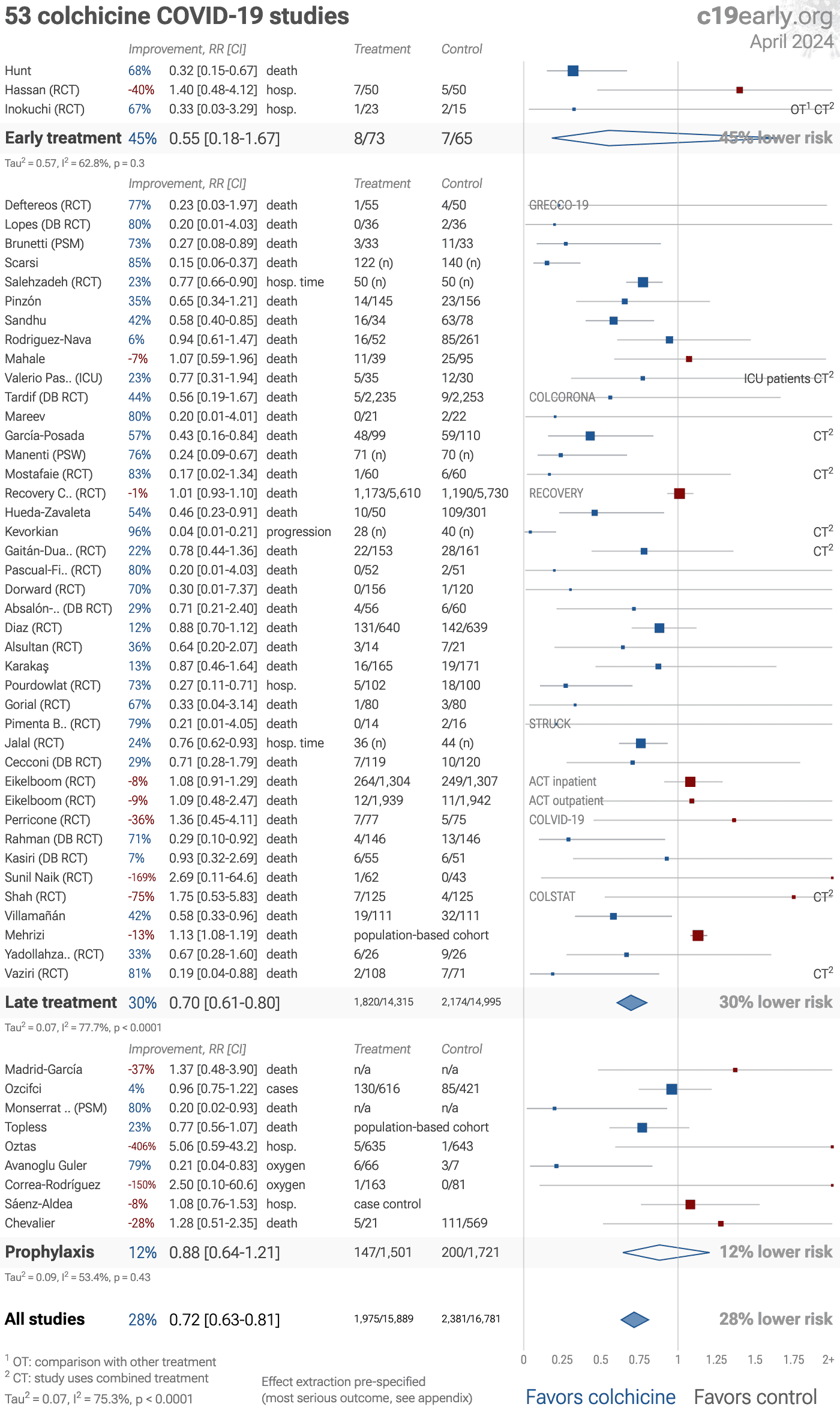
Significantly lower risk is seen for mortality, ICU admission, hospitalization, and recovery. 24 studies from 24 independent teams in 14 countries show significant benefit.
Meta-analysis using the most serious outcome reported shows 23% [14‑31%] lower risk. Results are similar for higher quality and peer-reviewed studies and worse for Randomized Controlled Trials. Clinical outcomes suggest benefit while viral and case outcomes do not, consistent with an intervention that aids the immune system or recovery but may have limited antiviral effects. Early treatment is more effective than late treatment.
Results are robust—in worst case exclusion sensitivity analysis 21 of 54 studies must be excluded before statistical significance is lost. Emergent results for the efficacy gradient across outcomes (p = 0.045) that match the biological mechanisms confirm efficacy.
Control Colchicine
RCT results are less favorable, however they are dominated by the very late stage RECOVERY RCT which is not generalizable to earlier usage.
No treatment is 100% effective. Protocols combine safe and effective options with individual risk/benefit analysis and monitoring. Other treatments are more effective. All data and sources to reproduce this analysis are in the appendix.
10 other meta-analyses show significant improvements with colchicine for mortality1-8, oxygen therapy8, hospitalization9, and severity10.
10 meta-analyses show significant improvements with colchicine for mortality1-8,
oxygen therapy8,
hospitalization9, and
severity10.

1.
Zein et al., Effect of colchicine on mortality in patients with COVID-19 – A systematic review and meta-analysis, Diabetes & Metabolic Syndrome: Clinical Research & Reviews, doi:10.1016/j.dsx.2022.102395.
2.
Rai et al., The Potential Role of Colchicine in Reducing Mortality and Mechanical Ventilation Rates in COVID-19 Infection: A Meta-analysis, Journal of Advances in Medicine and Medical Research, doi:10.9734/jammr/2022/v34i2031503.
3.
Elshafei et al., Colchicine use might be associated with lower mortality in COVID‐19 patients: A meta‐analysis, European Journal of Clinical Investigation, doi:10.1111/eci.13645.
4.
Lien et al., Repurposing Colchicine in Treating Patients with COVID-19: A Systematic Review and Meta-Analysis, Life, doi:10.3390/life11080864.
5.
Danjuma et al., Does Colchicine Reduce Mortality in Patients with Covid-19 Clinical Syndrome? An Umbrella Review of Published Meta-Analyses, Elsevier BV, doi:10.2139/ssrn.4447127.
6.
Salah et al., Meta-analysis of the Effect of Colchicine on Mortality and Mechanical Ventilation in COVID-19, The American Journal of Cardiology, doi:10.1016/j.amjcard.2021.02.005.
7.
Golpour et al., The effectiveness of Colchicine as an anti-inflammatory drug in the treatment of coronavirus disease 2019: Meta-analysis, International Journal of Immunopathology and Pharmacology, doi:10.1177/20587384211031763.
8.
Elshiwy et al., The role of colchicine in the management of COVID-19: a meta-analysis, BMC Pulmonary Medicine, doi:10.1186/s12890-024-03001-0.
Covid Analysis et al., Aug 2026, preprint, 1 author.