Abstract:
Article
Association of Serum Vitamin D and Hematological Parameters with SARS-CoV-2 PCR Positivity: A Combined Biomarker Approach in Asymptomatic Children
Mehmet Almacioglu 1, * , Ipek Kocer 1 and Demet Ari 2
- 1 Department of Medical Microbiology, Faculty of Medicine, Sanko University, 27060 Gaziantep, Turkey; ipek.kocer1@gmail.com
- 2 Department of Emergency Medicine, Faculty of Medicine, Kahramanmara¸ s Sütçü ˙ Imam University, 46100 Kahramanmara¸ s, Turkey; demetari@ksu.edu.tr
* Correspondence: almacioglu@icloud.com; Tel.: +90-532-798-79-84
Abstract
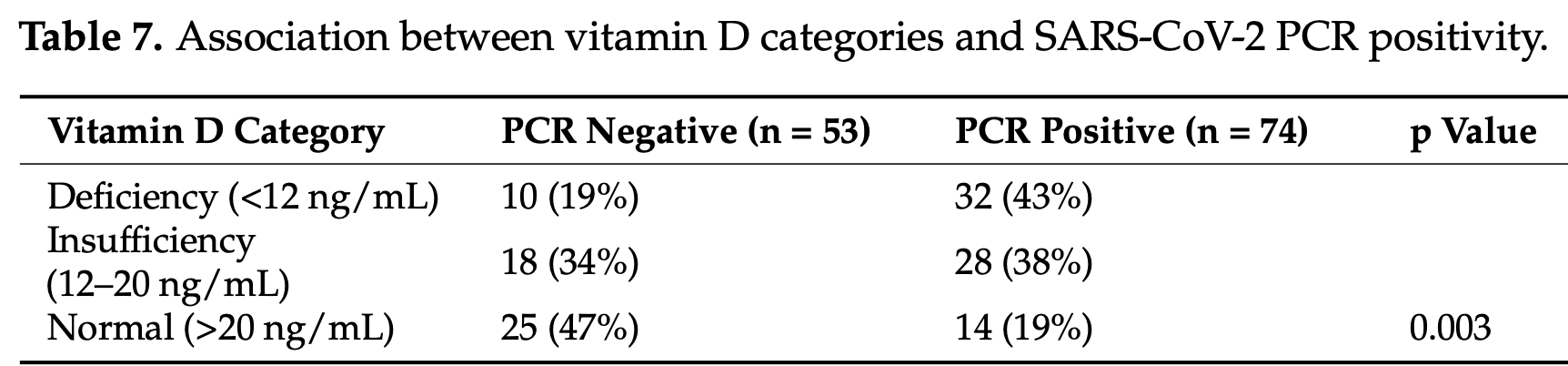
Vitamin D has been implicated in immune modulation and susceptibility to respiratory infections, including COVID-19. However, data in asymptomatic pediatric populations, particularly those with household exposure, remain limited. This study aimed to investigate the association between serum vitamin D levels and hematological parameters with SARS-CoV-2 PCR positivity in asymptomatic children, and to evaluate their potential role in early risk stratification. This retrospective study included 127 asymptomatic children (aged 2-18 years) with confirmed household exposure to COVID-19. Participants were classified as PCR-positive (n = 74) or PCR-negative (n = 53). Serum 25(OH)D3 levels and hematological parameters were analyzed. Univariate and multivariable logistic regression analyses were performed to identify independent predictors. Receiver operating characteristic (ROC) curve analysis was used to assess discriminative performance, and a combined multimarker model was constructed. Serum vitamin D levels were significantly lower in PCRpositive children compared to PCR-negative children (17 ± 8 vs. 27 ± 11 ng/mL, p = 0.001). White blood cell (p = 0.002), platelet (p = 0.01), and neutrophil counts (p = 0.01) were significantly reduced, while basophil counts were higher in PCR-positive children (p = 0.02). In multivariable analysis, vitamin D (OR: 0.87, 95% CI: 0.82-0.93, p < 0.001), platelet (p = 0.02), neutrophil (p = 0.02), and basophil counts (p = 0.01) remained independent predictors. ROC analysis showed that vitamin D had moderate discriminative performance (AUC: 0.75, 95% CI: 0.67-0.83), while platelet (AUC: 0.64), neutrophil (AUC: 0.61), and basophil (AUC: 0.62) counts showed modest performance. The combined multimarker model demonstrated improved predictive ability (AUC: 0.80, 95% CI: 0.72-0.88), with sensitivity of 71.6% and specificity of 68.2%. Additionally, vitamin D deficiency was significantly more frequent in PCR-positive children (43% vs. 19%, p = 0.003). Conclusions : Lower vitamin D levels and associated hematological alterations are independently associated with SARS-CoV-2 PCR positivity in asymptomatic children. A combined biomarker approach may improve early risk stratification using simple and routinely available parameters. Further prospective studies are needed to validate these findings and clarify the role of vitamin D in preventive strategies.
Keywords:
Vitamin D; SARS-CoV-2; children; combined biomarker; risk stratification
Academic Editors: Mariapaola Marino and Recep Dokuyucu
Received: 10 April 2026
Revised: 3 May 2026
Accepted: 4 May 2026
Published: 14 May 2026
Copyright:
© 2026 by the authors.
Licensee MDPI, Basel, Switzerland.
This article is an open access article
distributed under the terms and
conditions of the Creative Commons
Attribution (CC BY) license.
DOI record:
{
"DOI": "10.3390/ijms27104393",
"ISSN": [
"1422-0067"
],
"URL": "http://dx.doi.org/10.3390/ijms27104393",
"abstract": "<jats:p>Vitamin D has been implicated in immune modulation and susceptibility to respiratory infections, including COVID-19. However, data in asymptomatic pediatric populations, particularly those with household exposure, remain limited. This study aimed to investigate the association between serum vitamin D levels and hematological parameters with SARS-CoV-2 PCR positivity in asymptomatic children, and to evaluate their potential role in early risk stratification. This retrospective study included 127 asymptomatic children (aged 2–18 years) with confirmed household exposure to COVID-19. Participants were classified as PCR-positive (n = 74) or PCR-negative (n = 53). Serum 25(OH)D3 levels and hematological parameters were analyzed. Univariate and multivariable logistic regression analyses were performed to identify independent predictors. Receiver operating characteristic (ROC) curve analysis was used to assess discriminative performance, and a combined multimarker model was constructed. Serum vitamin D levels were significantly lower in PCR-positive children compared to PCR-negative children (17 ± 8 vs. 27 ± 11 ng/mL, p = 0.001). White blood cell (p = 0.002), platelet (p = 0.01), and neutrophil counts (p = 0.01) were significantly reduced, while basophil counts were higher in PCR-positive children (p = 0.02). In multivariable analysis, vitamin D (OR: 0.87, 95% CI: 0.82–0.93, p < 0.001), platelet (p = 0.02), neutrophil (p = 0.02), and basophil counts (p = 0.01) remained independent predictors. ROC analysis showed that vitamin D had moderate discriminative performance (AUC: 0.75, 95% CI: 0.67–0.83), while platelet (AUC: 0.64), neutrophil (AUC: 0.61), and basophil (AUC: 0.62) counts showed modest performance. The combined multimarker model demonstrated improved predictive ability (AUC: 0.80, 95% CI: 0.72–0.88), with sensitivity of 71.6% and specificity of 68.2%. Additionally, vitamin D deficiency was significantly more frequent in PCR-positive children (43% vs. 19%, p = 0.003). Conclusions: Lower vitamin D levels and associated hematological alterations are independently associated with SARS-CoV-2 PCR positivity in asymptomatic children. A combined biomarker approach may improve early risk stratification using simple and routinely available parameters. Further prospective studies are needed to validate these findings and clarify the role of vitamin D in preventive strategies.</jats:p>",
"alternative-id": [
"ijms27104393"
],
"author": [
{
"ORCID": "https://orcid.org/0000-0002-9882-6649",
"affiliation": [
{
"name": "Department of Medical Microbiology, Faculty of Medicine, Sanko University, 27060 Gaziantep, Turkey"
}
],
"authenticated-orcid": false,
"family": "Almacioglu",
"given": "Mehmet",
"sequence": "first"
},
{
"affiliation": [
{
"name": "Department of Medical Microbiology, Faculty of Medicine, Sanko University, 27060 Gaziantep, Turkey"
}
],
"family": "Kocer",
"given": "Ipek",
"sequence": "additional"
},
{
"ORCID": "https://orcid.org/0000-0001-8795-543X",
"affiliation": [
{
"name": "Department of Emergency Medicine, Faculty of Medicine, Kahramanmaraş Sütçü İmam University, 46100 Kahramanmaraş, Turkey"
}
],
"authenticated-orcid": false,
"family": "Ari",
"given": "Demet",
"sequence": "additional"
}
],
"container-title": "International Journal of Molecular Sciences",
"container-title-short": "IJMS",
"content-domain": {
"crossmark-restriction": false,
"domain": []
},
"created": {
"date-parts": [
[
2026,
5,
14
]
],
"date-time": "2026-05-14T16:27:56Z",
"timestamp": 1778776076000
},
"deposited": {
"date-parts": [
[
2026,
5,
14
]
],
"date-time": "2026-05-14T16:35:58Z",
"timestamp": 1778776558000
},
"indexed": {
"date-parts": [
[
2026,
5,
14
]
],
"date-time": "2026-05-14T17:13:29Z",
"timestamp": 1778778809072,
"version": "3.51.4"
},
"is-referenced-by-count": 0,
"issue": "10",
"issued": {
"date-parts": [
[
2026,
5,
14
]
]
},
"journal-issue": {
"issue": "10",
"published-online": {
"date-parts": [
[
2026,
5
]
]
}
},
"language": "en",
"license": [
{
"URL": "https://creativecommons.org/licenses/by/4.0/",
"content-version": "vor",
"delay-in-days": 0,
"start": {
"date-parts": [
[
2026,
5,
14
]
],
"date-time": "2026-05-14T00:00:00Z",
"timestamp": 1778716800000
}
}
],
"link": [
{
"URL": "https://www.mdpi.com/1422-0067/27/10/4393/pdf",
"content-type": "unspecified",
"content-version": "vor",
"intended-application": "similarity-checking"
}
],
"member": "1968",
"original-title": [],
"page": "4393",
"prefix": "10.3390",
"published": {
"date-parts": [
[
2026,
5,
14
]
]
},
"published-online": {
"date-parts": [
[
2026,
5,
14
]
]
},
"publisher": "MDPI AG",
"reference": [
{
"DOI": "10.2196/53214",
"doi-asserted-by": "crossref",
"key": "ref_1",
"unstructured": "Lundberg, A.L., Soetikno, A.G., Wu, S.A., Ozer, E., Welch, S.B., Liu, Y., Hawkins, C., Mason, M., Murphy, R., and Havey, R.J. (2025). Updated Surveillance Metrics and History of the COVID-19 Pandemic (2020–2023) in East Asia and the Pacific Region: Longitudinal Trend Analysis. JMIR Public Health Surveill., 11."
},
{
"DOI": "10.1017/S1368980024001861",
"doi-asserted-by": "crossref",
"key": "ref_2",
"unstructured": "Bournot, A.R., Darling, A.L., Givens, I.D., Lovegrove, J.A., Lanham-New, S.A., and Hart, K.H. (2024). Effect of vitamin D status and vitamin D supplementation on immune function and prevention of acute respiratory tract infections in dark-skinned individuals: A systematic review and meta-analysis. Public Health Nutr., 27."
},
{
"DOI": "10.1371/journal.pone.0303495",
"doi-asserted-by": "crossref",
"key": "ref_3",
"unstructured": "Jia, H., Sheng, F., Yan, Y., Liu, X., and Zeng, B. (2024). Vitamin D supplementation for prevention of acute respiratory infections in older adults: A systematic review and meta-analysis. PLoS ONE, 19."
},
{
"DOI": "10.1016/S2213-8587(24)00348-6",
"article-title": "Vitamin D supplementation to prevent acute respiratory infections: Systematic review and meta-analysis of stratified aggregate data",
"author": "Jolliffe",
"doi-asserted-by": "crossref",
"first-page": "307",
"journal-title": "Lancet Diabetes Endocrinol.",
"key": "ref_4",
"volume": "13",
"year": "2025"
},
{
"DOI": "10.3390/nu7064240",
"article-title": "Modulation of the immune response to respiratory viruses by vitamin D",
"author": "Greiller",
"doi-asserted-by": "crossref",
"first-page": "4240",
"journal-title": "Nutrients",
"key": "ref_5",
"volume": "7",
"year": "2015"
},
{
"DOI": "10.1155/2018/5813095",
"doi-asserted-by": "crossref",
"key": "ref_6",
"unstructured": "Rondanelli, M., Miccono, A., Lamburghini, S., Avanzato, I., Riva, A., Allegrini, P., Faliva, M.A., Peroni, G., Nichetti, M., and Perna, S. (2018). Self-Care for Common Colds: The Pivotal Role of Vitamin D, Vitamin C, Zinc, and Echinacea in Three Main Immune Interactive Clusters (Physical Barriers, Innate and Adaptive Immunity) Involved during an Episode of Common Colds-Practical Advice on Dosages and on the Time to Take These Nutrients/Botanicals in order to Prevent or Treat Common Colds. Evid. Based Complement. Alternat Med., 2018."
},
{
"DOI": "10.1016/S2213-8587(21)00051-6",
"article-title": "Vitamin D supplementation to prevent acute respiratory infections: A systematic review and meta-analysis of aggregate data from randomised controlled trials",
"author": "Jolliffe",
"doi-asserted-by": "crossref",
"first-page": "276",
"journal-title": "Lancet Diabetes Endocrinol.",
"key": "ref_7",
"volume": "9",
"year": "2021"
},
{
"DOI": "10.1016/j.eclinm.2026.103762",
"doi-asserted-by": "crossref",
"key": "ref_8",
"unstructured": "Jolliffe, D.A., Brustad, N., Chawes, B., Cooper, C., D’Angelo, S., Harvey, N.C., Litonjua, A.A., Moon, R., Morris, S.K., and Sluyter, J.D. (2025). Association between maternal vitamin D supplementation during pregnancy and the risk of acute respiratory infections in offspring: A systematic review and meta-analysis. eClinicalMedicine, 90, Correction in eClinicalMedicine 2026, 92, 103762. https://doi.org/10.1016/j.eclinm.2026.103762."
},
{
"DOI": "10.20944/preprints202003.0235.v2",
"doi-asserted-by": "crossref",
"key": "ref_9",
"unstructured": "Grant, W.B., Lahore, H., McDonnell, S.L., Baggerly, C.A., French, C.B., Aliano, J.L., and Bhattoa, H.P. (2020). Evidence that Vitamin D Supplementation Could Reduce Risk of Influenza and COVID-19 Infections and Deaths. Nutrients, 12."
},
{
"DOI": "10.1001/jamanetworkopen.2020.19722",
"doi-asserted-by": "crossref",
"key": "ref_10",
"unstructured": "Meltzer, D.O., Best, T.J., Zhang, H., Vokes, T., Arora, V., and Solway, J. (2020). Association of Vitamin D Status and Other Clinical Characteristics with COVID-19 Test Results. JAMA Netw. Open, 3."
},
{
"DOI": "10.1016/j.cell.2020.02.052",
"article-title": "SARS-CoV-2 Cell Entry Depends on ACE2 and TMPRSS2 and Is Blocked by a Clinically Proven Protease Inhibitor",
"author": "Hoffmann",
"doi-asserted-by": "crossref",
"first-page": "271",
"journal-title": "Cell",
"key": "ref_11",
"volume": "181",
"year": "2020"
},
{
"article-title": "Focus on Receptors for Coronaviruses with Special Reference to Angiotensin- Converting Enzyme 2 as a Potential Drug Target—A Perspective",
"author": "Magrone",
"first-page": "807",
"journal-title": "Endocr. Metab. Immune Disord. Drug Targets",
"key": "ref_12",
"volume": "20",
"year": "2020"
},
{
"DOI": "10.3390/jcm13216414",
"doi-asserted-by": "crossref",
"key": "ref_13",
"unstructured": "Pereckaite, L., Vaguliene, N., Vitkauskaite, A., Vitkauskiene, A., and Urboniene, D. (2024). Effect of Statins and Renin-Angiotensin-Aldosterone System Inhibitors on IL-6 Levels in COVID-19 Patients. J. Clin. Med., 13."
},
{
"DOI": "10.3390/biology13100831",
"doi-asserted-by": "crossref",
"key": "ref_14",
"unstructured": "Wimalawansa, S.J. (2024). Unveiling the Interplay-Vitamin D and ACE-2 Molecular Interactions in Mitigating Complications and Deaths from SARS-CoV-2. Biology, 13."
},
{
"DOI": "10.3390/cimb46080526",
"article-title": "The Role of Mannitol and Vitamin D in Ovarian Ischemia/Reperfusion Injury in Rats with Acute Abdominal",
"author": "Karateke",
"doi-asserted-by": "crossref",
"first-page": "8903",
"journal-title": "Curr. Issues Mol. Biol.",
"key": "ref_15",
"volume": "46",
"year": "2024"
},
{
"DOI": "10.3390/metabo14110620",
"doi-asserted-by": "crossref",
"key": "ref_16",
"unstructured": "Segmen, F., Aydemir, S., Kucuk, O., and Dokuyucu, R. (2024). The Roles of Vitamin D Levels, Gla-Rich Protein (GRP) and Matrix Gla Protein (MGP), and Inflammatory Markers in Predicting Mortality in Intensive Care Patients: A New Biomarker Link?. Metabolites, 14."
},
{
"DOI": "10.1074/jbc.M110.163790",
"article-title": "Lineage-specific effects of 1,25-dihydroxyvitamin D(3) on the development of effector CD4 T cells",
"author": "Palmer",
"doi-asserted-by": "crossref",
"first-page": "997",
"journal-title": "J. Biol. Chem.",
"key": "ref_17",
"volume": "286",
"year": "2011"
},
{
"DOI": "10.3389/fendo.2019.00910",
"doi-asserted-by": "crossref",
"key": "ref_18",
"unstructured": "Bouillon, R., Schuit, F., Antonio, L., and Rastinejad, F. (2019). Vitamin D Binding Protein: A Historic Overview. Front. Endocrinol., 10."
},
{
"DOI": "10.1016/S0140-6736(20)30628-0",
"article-title": "COVID-19: Consider cytokine storm syndromes and immunosuppression",
"author": "Mehta",
"doi-asserted-by": "crossref",
"first-page": "1033",
"journal-title": "Lancet",
"key": "ref_19",
"volume": "395",
"year": "2020"
},
{
"DOI": "10.1016/j.yexmp.2019.104269",
"doi-asserted-by": "crossref",
"key": "ref_20",
"unstructured": "Chou, H.C., and Chen, C.M. (2020). Cathelicidin attenuates hyperoxia-induced intestinal injury through inhibition of NF-kappaB activity in newborn rats. Exp. Mol. Pathol., 113."
},
{
"DOI": "10.3389/fimmu.2017.01570",
"doi-asserted-by": "crossref",
"key": "ref_21",
"unstructured": "Lambert, L., and Culley, F.J. (2017). Innate Immunity to Respiratory Infection in Early Life. Front. Immunol., 8."
},
{
"DOI": "10.3390/nu13010276",
"doi-asserted-by": "crossref",
"key": "ref_22",
"unstructured": "Bleakley, A.S., Licciardi, P.V., and Binks, M.J. (2021). Vitamin D Modulation of the Innate Immune Response to Paediatric Respiratory Pathogens Associated with Acute Lower Respiratory Infections. Nutrients, 13."
},
{
"DOI": "10.1371/journal.pone.0239252",
"doi-asserted-by": "crossref",
"key": "ref_23",
"unstructured": "Reddy, S.V., Kaufman, H.W., Niles, J.K., Kroll, M.H., Bi, C., and Holick, M.F. (2020). SARS-CoV-2 positivity rates associated with circulating 25-hydroxyvitamin D levels. PLoS ONE, 15."
},
{
"DOI": "10.1136/bmj.i6583",
"doi-asserted-by": "crossref",
"key": "ref_24",
"unstructured": "Martineau, A.R., Jolliffe, D.A., Hooper, R.L., Greenberg, L., Aloia, J.F., Bergman, P., Dubnov-Raz, G., Esposito, S., Ganmaa, D., and Ginde, A.A. (2017). Vitamin D supplementation to prevent acute respiratory tract infections: Systematic review and meta-analysis of individual participant data. BMJ, 356."
},
{
"DOI": "10.3390/pathogens9060493",
"doi-asserted-by": "crossref",
"key": "ref_25",
"unstructured": "Słomka, A., Kowalewski, M., and Żekanowska, E. (2020). Coronavirus Disease 2019 (COVID–19): A Short Review on Hematological Manifestations. Pathogens, 9."
},
{
"DOI": "10.1515/cclm-2020-0369",
"article-title": "Hematologic, biochemical and immune biomarker abnormalities associated with severe illness and mortality in coronavirus disease 2019 (COVID-19): A meta-analysis",
"author": "Henry",
"doi-asserted-by": "crossref",
"first-page": "1021",
"journal-title": "Clin. Chem. Lab. Med.",
"key": "ref_26",
"volume": "58",
"year": "2020"
},
{
"DOI": "10.1159/000510914",
"article-title": "Red Blood Cell Distribution Is a Significant Predictor of Severe Illness in Coronavirus Disease 2019",
"author": "Lippi",
"doi-asserted-by": "crossref",
"first-page": "360",
"journal-title": "Acta Haematol.",
"key": "ref_27",
"volume": "144",
"year": "2021"
},
{
"DOI": "10.1186/s12879-021-05792-7",
"doi-asserted-by": "crossref",
"key": "ref_28",
"unstructured": "Liu, Y., Tan, W., Chen, H., Zhu, Y., Wan, L., Jiang, K., Guo, Y., Tang, K., Xie, C., and Yi, H. (2021). Dynamic changes in lymphocyte subsets and parallel cytokine levels in patients with severe and critical COVID-19. BMC Infect. Dis., 21."
}
],
"reference-count": 28,
"references-count": 28,
"relation": {},
"resource": {
"primary": {
"URL": "https://www.mdpi.com/1422-0067/27/10/4393"
}
},
"score": 1,
"short-title": [],
"source": "Crossref",
"subject": [],
"subtitle": [],
"title": "Association of Serum Vitamin D and Hematological Parameters with SARS-CoV-2 PCR Positivity: A Combined Biomarker Approach in Asymptomatic Children",
"type": "journal-article",
"update-policy": "https://doi.org/10.3390/mdpi_crossmark_policy",
"volume": "27"
}