Abstract:
Citation: Abbas U, Laghari RN, Ahmed I, Musawwir UA, Riaz H, Anwar K, et al. (2026) Acute SARS-CoV-2 viral load and systemic inflammation are associated with neuropsychiatric and musculoskeletal symptoms in long COVID. PLoS One 21(4): e0346978. https://doi.org/10.1371/journal. pone.0346978
Editor: Kin Israel Notarte, Johns Hopkins School of Medicine: The Johns Hopkins University School of Medicine, UNITED STATES OF AMERICA
Received:
July 2, 2025
Accepted:
March 26, 2026
Published:
April 15, 2026
Copyright: © 2026 Abbas et al. This is an open access article distributed under the terms of the Creative Commons Attribution License, which permits unrestricted use, distribution, and reproduction in any medium, provided the original author and source are credited.
Data availability statement : The data analyzed in manuscript is owned by Dow University of Health Sciences. The data can be obtained from
RESEARCH ARTICLE
Acute SARS-CoV-2 viral load and systemic inflammation are associated with neuropsychiatric and musculoskeletal symptoms in long COVID
Uzair Abbas 1 * , Rabeel Nawaz Laghari 2 , Ishfaque Ahmed 3 , Usama Abdul Musawwir 1 , Hina Riaz 1 , Khadija Anwar 4 , Niaz Hussain 5 , Muhammad Mubeen 4 , Mahtab Khan 4 , Muhib Ullah Khalid 4 , Shizrah Ashraf 6
1 Department of Physiology, Dow University of Health Sciences, Karachi, Pakistan, 2 Department of Medicine, Indus Medical College Hospital, Tando Mohammad Khan, Pakistan, 3 Sindh Infectious Diseases Hospital and Research Center, Dow University of Health Sciences, Karachi, Pakistan, 4 Dow International Medical College, Dow University of Health Sciences, Karachi, Pakistan, 5 Bilawal Medical College, Liaquat University of Medical & Health Sciences, Jamshoro, Pakistan, 6 Fauji Foundation Hospital, Rawalpindi, Pakistan
[* uzair.abbas@duhs.edu.pk](mailto:uzair.abbas@duhs.edu.pk)
Abstract
Background
Long after recovery from acute-COVID illness, many patients show persistent multi-organ dysfunction consistent with Long COVID. Biochemical profile and measurements of inflammatory markers in these individuals can help to understand the underlying pathophysiology. This study aims to evaluate biochemical markers and their association with symptoms of Long COVID. We, in a retrospective analysis, also examined whether the Long COVID symptom persistence is associated with the SARS-CoV-2 viral load documented during the acute infection.
Methods
A total of 300 participants with previously diagnosed mild COVID-19 were recruited at 10 months post-infection. Brief clinical history was taken based on persistent symptoms after COVID-19 and categorized as Long COVID (n = 177) and controls group (n = 123) based on WHO defined criteria. Biochemical parameters in blood like complete blood count (RBC and WBC indices) were compared between the groups. Other measurements including inflammatory markers such as IL-6, IL-10, ferritin and C-reactive protein along with electrolytes, vitamin D3 and B12, and lipid profile, were also compared. SARS-CoV-2 viral load was assessed retrospectively. Data was analyzed through SPSS v.26.
irb@duhs.edu.pk for researchers who meet the criteria for access to confidential data.
Funding: The author(s) received no specific funding for this work.
Competing interests: The authors have declared that no competing interests exist.
Results
The findings of our study revealed that 59% (177) of individuals had symptoms of Long COVID. The most frequently reported..
DOI record:
{
"DOI": "10.1371/journal.pone.0346978",
"ISSN": [
"1932-6203"
],
"URL": "http://dx.doi.org/10.1371/journal.pone.0346978",
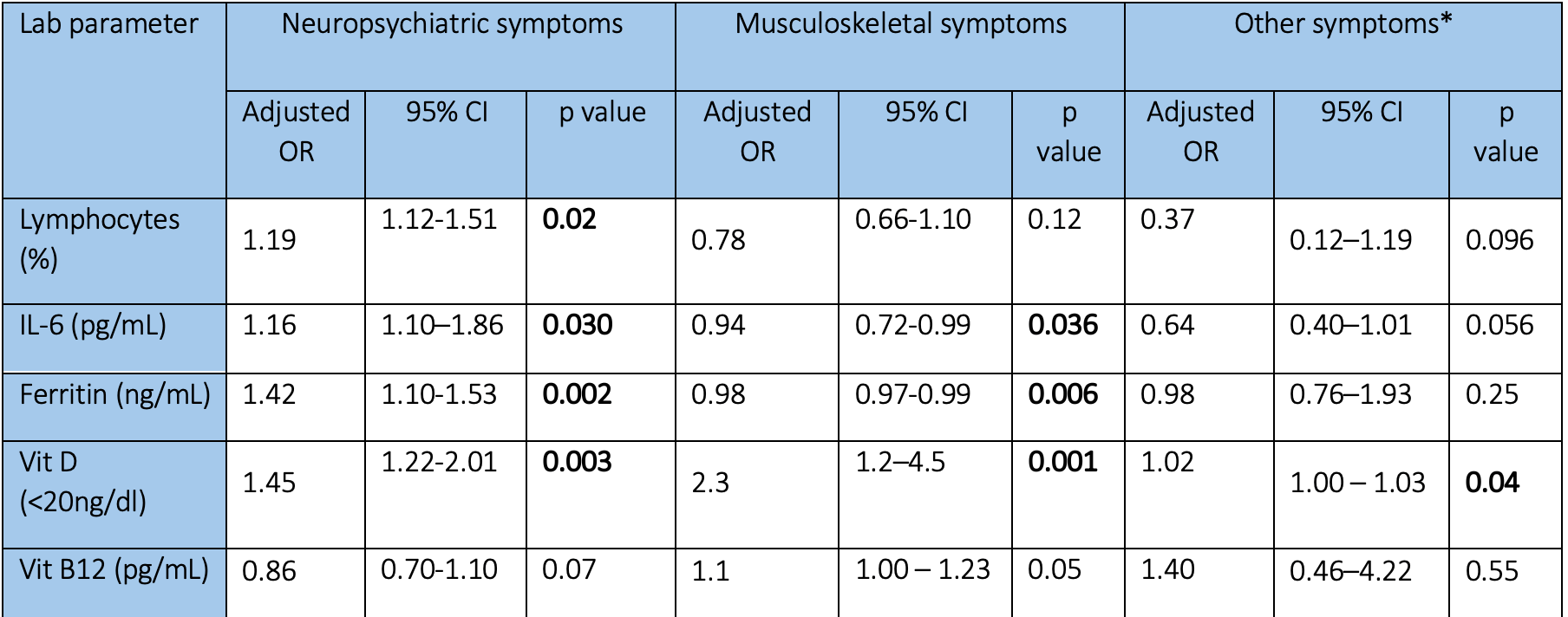
"abstract": "<jats:sec id=\"sec001\">\n <jats:title>Background</jats:title>\n <jats:p>Long after recovery from acute-COVID illness, many patients show persistent multi-organ dysfunction consistent with Long COVID. Biochemical profile and measurements of inflammatory markers in these individuals can help to understand the underlying pathophysiology. This study aims to evaluate biochemical markers and their association with symptoms of Long COVID. We, in a retrospective analysis, also examined whether the Long COVID symptom persistence is associated with the SARS-CoV-2 viral load documented during the acute infection.</jats:p>\n </jats:sec>\n <jats:sec id=\"sec002\">\n <jats:title>Methods</jats:title>\n <jats:p>A total of 300 participants with previously diagnosed mild COVID-19 were recruited at 10 months post-infection. Brief clinical history was taken based on persistent symptoms after COVID-19 and categorized as Long COVID (n = 177) and controls group (n = 123) based on WHO defined criteria. Biochemical parameters in blood like complete blood count (RBC and WBC indices) were compared between the groups. Other measurements including inflammatory markers such as IL-6, IL-10, ferritin and C-reactive protein along with electrolytes, vitamin D3 and B12, and lipid profile, were also compared. SARS-CoV-2 viral load was assessed retrospectively. Data was analyzed through SPSS v.26.</jats:p>\n </jats:sec>\n <jats:sec id=\"sec003\">\n <jats:title>Results</jats:title>\n <jats:p>The findings of our study revealed that 59% (177) of individuals had symptoms of Long COVID. The most frequently reported symptoms of Long COVID were related to neuropsychiatry (35%), followed by musculoskeletal system (32.2%). The Hemoglobin, RBC counts and MCHC were decreased in Long COVID as compared to control group (p < 0.05). While Lymphocytes, IL-6 and ferritin levels were raised in Long COVID group (p < 0.05). In multivariable logistic regression analyses adjusted for age and sex, neuropsychiatric symptoms were independently associated with higher lymphocyte counts (aOR 1.19, 95% CI 1.12–1.51), IL-6 (aOR 1.16, 95% CI 1.10–1.86), ferritin (aOR 1.42, 95% CI 1.10–1.53), and vitamin D deficiency (aOR 1.45, 95% CI 1.22–2.01). Musculoskeletal symptoms were strongly associated with vitamin D deficiency (aOR 2.30, 95% CI 1.20–4.50) and ferritin levels (aOR 0.98, 95% CI 0.97–0.99). Moreover, higher SARS-CoV-2 viral load (CT ≤ 20) during acute infection was also associated with neuropsychiatric and musculoskeletal symptoms of Long COVID.</jats:p>\n </jats:sec>\n <jats:sec id=\"sec004\">\n <jats:title>Conclusion</jats:title>\n <jats:p>We identified Long COVID in 59% of the participants, the highest reported percentage in studies in the middle-aged individuals. Compared to controls, we found differential biochemical markers in the Long COVID group indicating a different metabolic status in these individuals. Moreover, the association of raised inflammatory markers at ten months follow up and acute-phase SARS-CoV-2 viral load were also seen to be associated with musculoskeletal and neuropsychiatric symptoms of the Long COVID. These significant clinical and biochemical changes warrant thorough monitoring and follow-ups for extended time.</jats:p>\n </jats:sec>",
"author": [
{
"ORCID": "https://orcid.org/0000-0003-0517-247X",
"affiliation": [],
"authenticated-orcid": true,
"family": "Abbas",
"given": "Uzair",
"sequence": "first"
},
{
"affiliation": [],
"family": "Laghari",
"given": "Rabeel Nawaz",
"sequence": "additional"
},
{
"affiliation": [],
"family": "Ahmed",
"given": "Ishfaque",
"sequence": "additional"
},
{
"affiliation": [],
"family": "Musawwir",
"given": "Usama Abdul",
"sequence": "additional"
},
{
"affiliation": [],
"family": "Riaz",
"given": "Hina",
"sequence": "additional"
},
{
"affiliation": [],
"family": "Anwar",
"given": "Khadija",
"sequence": "additional"
},
{
"affiliation": [],
"family": "Hussain",
"given": "Niaz",
"sequence": "additional"
},
{
"affiliation": [],
"family": "Mubeen",
"given": "Muhammad",
"sequence": "additional"
},
{
"affiliation": [],
"family": "Khan",
"given": "Mahtab",
"sequence": "additional"
},
{
"affiliation": [],
"family": "Khalid",
"given": "Muhib Ullah",
"sequence": "additional"
},
{
"affiliation": [],
"family": "Ashraf",
"given": "Shizrah",
"sequence": "additional"
}
],
"container-title": "PLOS One",
"container-title-short": "PLoS One",
"content-domain": {
"crossmark-restriction": false,
"domain": [
"www.plosone.org"
]
},
"created": {
"date-parts": [
[
2026,
4,
15
]
],
"date-time": "2026-04-15T17:31:58Z",
"timestamp": 1776274318000
},
"deposited": {
"date-parts": [
[
2026,
4,
15
]
],
"date-time": "2026-04-15T17:32:05Z",
"timestamp": 1776274325000
},
"editor": [
{
"affiliation": [],
"family": "Notarte",
"given": "Kin Israel",
"sequence": "first"
}
],
"indexed": {
"date-parts": [
[
2026,
4,
15
]
],
"date-time": "2026-04-15T18:12:20Z",
"timestamp": 1776276740176,
"version": "3.50.1"
},
"is-referenced-by-count": 0,
"issue": "4",
"issued": {
"date-parts": [
[
2026,
4,
15
]
]
},
"journal-issue": {
"issue": "4",
"published-online": {
"date-parts": [
[
2026,
4,
15
]
]
}
},
"language": "en",
"license": [
{
"URL": "http://creativecommons.org/licenses/by/4.0/",
"content-version": "vor",
"delay-in-days": 0,
"start": {
"date-parts": [
[
2026,
4,
15
]
],
"date-time": "2026-04-15T00:00:00Z",
"timestamp": 1776211200000
}
}
],
"link": [
{
"URL": "https://dx.plos.org/10.1371/journal.pone.0346978",
"content-type": "unspecified",
"content-version": "vor",
"intended-application": "similarity-checking"
}
],
"member": "340",
"original-title": [],
"page": "e0346978",
"prefix": "10.1371",
"published": {
"date-parts": [
[
2026,
4,
15
]
]
},
"published-online": {
"date-parts": [
[
2026,
4,
15
]
]
},
"publisher": "Public Library of Science (PLoS)",
"reference": [
{
"key": "pone.0346978.ref001",
"unstructured": "JHU. COVID-19 Data Repository by the Center for Systems Science and Engineering (CSSE) at Johns Hopkins University: John Hopkins University; 2021 [Available from: https://github.com/CSSEGISandData/COVID-19"
},
{
"DOI": "10.1186/s12864-023-09539-3",
"article-title": "Sequential viral introductions and spread of BA.1 across Pakistan provinces during the Omicron wave",
"author": "AR Bukhari",
"doi-asserted-by": "crossref",
"first-page": "432",
"issue": "1",
"journal-title": "BMC Genomics",
"key": "pone.0346978.ref002",
"volume": "24",
"year": "2023"
},
{
"article-title": "Analysing the psychosocial and health impacts of long COVID in Pakistan: A cross sectional study",
"author": "M Khan",
"journal-title": "medRxiv",
"key": "pone.0346978.ref003",
"year": "2023"
},
{
"key": "pone.0346978.ref004",
"unstructured": "Control CfD, Prevention. Post-COVID conditions: information for healthcare providers. 2021."
},
{
"DOI": "10.1016/j.dsx.2021.04.007",
"article-title": "Long COVID: an overview",
"author": "A Raveendran",
"doi-asserted-by": "crossref",
"first-page": "869",
"issue": "3",
"journal-title": "Diabetes & Metabolic Syndrome: Clinical Research & Reviews",
"key": "pone.0346978.ref005",
"volume": "15",
"year": "2021"
},
{
"DOI": "10.1016/j.arcmed.2025.103286",
"article-title": "Biochemical Profile of Recovered Individuals with Mild COVID-19: A Cross-Sectional View at Two Different Time Points",
"author": "U Abbas",
"doi-asserted-by": "crossref",
"first-page": "103286",
"issue": "1",
"journal-title": "Arch Med Res",
"key": "pone.0346978.ref006",
"volume": "57",
"year": "2026"
},
{
"DOI": "10.4103/jpdtsm.jpdtsm_50_25",
"article-title": "Long-term Hepatic Sequelae of Mild Coronavirus Disease 2019: Elevated Liver Enzymes at 10-month Follow-up",
"author": "N Hussain",
"doi-asserted-by": "crossref",
"first-page": "148",
"issue": "2",
"journal-title": "Journal of Preventive, Diagnostic and Treatment Strategies in Medicine",
"key": "pone.0346978.ref007",
"volume": "4",
"year": "2025"
},
{
"DOI": "10.1186/s12879-024-09959-w",
"article-title": "Impact of SARS-CoV-2 viral load on restrictive spirometry patterns in mild COVID-19 recovered middle-aged individuals: a six-month prospective study",
"author": "U Abbas",
"doi-asserted-by": "crossref",
"first-page": "1089",
"issue": "1",
"journal-title": "BMC Infect Dis",
"key": "pone.0346978.ref008",
"volume": "24",
"year": "2024"
},
{
"DOI": "10.1038/s41591-021-01283-z",
"article-title": "Post-acute COVID-19 syndrome",
"author": "A Nalbandian",
"doi-asserted-by": "crossref",
"first-page": "601",
"issue": "4",
"journal-title": "Nat Med",
"key": "pone.0346978.ref009",
"volume": "27",
"year": "2021"
},
{
"article-title": "Post-acute COVID-19 syndrome",
"author": "A Nalbandian",
"first-page": "601",
"issue": "4",
"journal-title": "J Med Virol",
"key": "pone.0346978.ref010",
"volume": "27",
"year": "2021"
},
{
"article-title": "Biomarkers in long COVID-19: A systematic review",
"author": "YJ Lai",
"first-page": "1085988",
"journal-title": "J Fim",
"key": "pone.0346978.ref011",
"volume": "10",
"year": "2023"
},
{
"DOI": "10.1016/j.fct.2022.112901",
"article-title": "The prognostic role of micronutrient status and supplements in COVID-19 outcomes: A systematic review",
"author": "E Pechlivanidou",
"doi-asserted-by": "crossref",
"first-page": "112901",
"journal-title": "Food Chem Toxicol",
"key": "pone.0346978.ref012",
"volume": "162",
"year": "2022"
},
{
"DOI": "10.3390/v15020446",
"article-title": "Association between SARS-CoV-2 Viral Load and Patient Symptoms and Clinical Outcomes Using Droplet Digital PCR",
"author": "E Hastie",
"doi-asserted-by": "crossref",
"first-page": "446",
"issue": "2",
"journal-title": "Viruses",
"key": "pone.0346978.ref013",
"volume": "15",
"year": "2023"
},
{
"DOI": "10.1186/s43066-021-00144-1",
"article-title": "Long-term clinical and biochemical residue after COVID-19 recovery",
"author": "MA Gameil",
"doi-asserted-by": "crossref",
"first-page": "74",
"issue": "1",
"journal-title": "Egypt Liver J",
"key": "pone.0346978.ref014",
"volume": "11",
"year": "2021"
},
{
"DOI": "10.1056/NEJMcp2009249",
"article-title": "Mild or moderate Covid-19",
"author": "RT Gandhi",
"doi-asserted-by": "crossref",
"first-page": "1757",
"issue": "18",
"journal-title": "New England Journal of Medicine",
"key": "pone.0346978.ref015",
"volume": "383",
"year": "2020"
},
{
"key": "pone.0346978.ref016",
"unstructured": "Dow Diagnostic Research and Reference Laboratory 2025 [Available from: https://www.duhs.edu.pk/lab-tests-and-rates/"
},
{
"DOI": "10.47391/JPMA.7634",
"article-title": "Assessment of clinical spectrum of thrombocytopenia and its association with different disease states reported in Dow Diagnostic Reference and Research Lab (DDRRL)",
"author": "FF Abbas",
"doi-asserted-by": "crossref",
"first-page": "2375",
"issue": "12",
"journal-title": "J Pak Med Assoc",
"key": "pone.0346978.ref017",
"volume": "73",
"year": "2023"
},
{
"article-title": "Normal Reference Values of Complete Blood Count in Healthy Adult Population of Pakistan; A Multicentre Study",
"author": "N Mazhar",
"first-page": "3040",
"issue": "11",
"journal-title": "PJMHS",
"key": "pone.0346978.ref018",
"volume": "15",
"year": "2021"
},
{
"DOI": "10.1186/s12864-023-09539-3",
"article-title": "Sequential viral introductions and spread of BA.1 across Pakistan provinces during the Omicron wave",
"author": "AR Bukhari",
"doi-asserted-by": "crossref",
"first-page": "432",
"issue": "1",
"journal-title": "BMC Genomics",
"key": "pone.0346978.ref019",
"volume": "24",
"year": "2023"
},
{
"DOI": "10.1093/infdis/jiac136",
"article-title": "Global Prevalence of Post-Coronavirus Disease 2019 (COVID-19) Condition or Long COVID: A Meta-Analysis and Systematic Review",
"author": "C Chen",
"doi-asserted-by": "crossref",
"first-page": "1593",
"issue": "9",
"journal-title": "J Infect Dis",
"key": "pone.0346978.ref020",
"volume": "226",
"year": "2022"
},
{
"DOI": "10.1016/j.idnow.2022.02.005",
"article-title": "Long COVID-19 symptoms: Clinical characteristics and recovery rate among non-severe outpatients over a six-month follow-up",
"author": "S Seang",
"doi-asserted-by": "crossref",
"first-page": "165",
"issue": "3",
"journal-title": "Infect Dis Now",
"key": "pone.0346978.ref021",
"volume": "52",
"year": "2022"
},
{
"DOI": "10.1371/journal.pmed.1003773",
"article-title": "Incidence, co-occurrence, and evolution of long-COVID features: A 6-month retrospective cohort study of 273,618 survivors of COVID-19",
"author": "M Taquet",
"doi-asserted-by": "crossref",
"issue": "9",
"journal-title": "PLoS Med",
"key": "pone.0346978.ref022",
"volume": "18",
"year": "2021"
},
{
"DOI": "10.1001/jama.2020.12603",
"article-title": "Persistent Symptoms in Patients After Acute COVID-19",
"author": "A Carfì",
"doi-asserted-by": "crossref",
"first-page": "603",
"issue": "6",
"journal-title": "JAMA",
"key": "pone.0346978.ref023",
"volume": "324",
"year": "2020"
},
{
"DOI": "10.1016/j.cmi.2022.01.014",
"article-title": "Prevalence of post-acute COVID-19 syndrome symptoms at different follow-up periods: a systematic review and meta-analysis",
"author": "MS Alkodaymi",
"doi-asserted-by": "crossref",
"first-page": "657",
"issue": "5",
"journal-title": "Clin Microbiol Infect",
"key": "pone.0346978.ref024",
"volume": "28",
"year": "2022"
},
{
"article-title": "The oxygen dissociation curve of blood in COVID-19",
"author": "D Boening",
"journal-title": "American Journal of Physiology - Lung Cellular and Molecular Physiology",
"key": "pone.0346978.ref025",
"year": "2021"
},
{
"DOI": "10.3389/fphys.2021.825055",
"article-title": "Red Blood Cell Abnormalities as the Mirror of SARS-CoV-2 Disease Severity: A Pilot Study",
"author": "A Bouchla",
"doi-asserted-by": "crossref",
"first-page": "825055",
"journal-title": "Front Physiol",
"key": "pone.0346978.ref026",
"volume": "12",
"year": "2022"
},
{
"DOI": "10.1136/thoraxjnl-2020-215818",
"article-title": "“Long-COVID”: a cross-sectional study of persisting symptoms, biomarker and imaging abnormalities following hospitalisation for COVID-19",
"author": "S Mandal",
"doi-asserted-by": "crossref",
"first-page": "396",
"issue": "4",
"journal-title": "Thorax",
"key": "pone.0346978.ref027",
"volume": "76",
"year": "2021"
},
{
"DOI": "10.1186/s12931-020-01546-2",
"article-title": "Persisting alterations of iron homeostasis in COVID-19 are associated with non-resolving lung pathologies and poor patients’ performance: a prospective observational cohort study",
"author": "T Sonnweber",
"doi-asserted-by": "crossref",
"first-page": "276",
"issue": "1",
"journal-title": "Respir Res",
"key": "pone.0346978.ref028",
"volume": "21",
"year": "2020"
},
{
"DOI": "10.1016/j.ebiom.2023.104552",
"article-title": "Cellular and molecular biomarkers of long COVID: a scoping review",
"author": "E Espín",
"doi-asserted-by": "crossref",
"first-page": "104552",
"journal-title": "EBioMedicine",
"key": "pone.0346978.ref029",
"volume": "91",
"year": "2023"
},
{
"DOI": "10.1016/j.psyneuen.2021.105295",
"article-title": "Interleukin-6 as potential mediator of long-term neuropsychiatric symptoms of COVID-19",
"author": "N Kappelmann",
"doi-asserted-by": "crossref",
"first-page": "105295",
"journal-title": "Psychoneuroendocrinology",
"key": "pone.0346978.ref030",
"volume": "131",
"year": "2021"
},
{
"article-title": "Muscle dysfunction in the long coronavirus disease 2019 syndrome: Pathogenesis and clinical approach",
"author": "CC Silva",
"issue": "6",
"journal-title": "Muscle Nerve",
"key": "pone.0346978.ref031",
"volume": "32",
"year": "2022"
},
{
"DOI": "10.1210/clinem/dgad207",
"article-title": "Low Vitamin D Levels Are Associated With Long COVID Syndrome in COVID-19 Survivors",
"author": "L di Filippo",
"doi-asserted-by": "crossref",
"issue": "10",
"journal-title": "J Clin Endocrinol Metab",
"key": "pone.0346978.ref032",
"volume": "108",
"year": "2023"
},
{
"DOI": "10.3390/nu15173802",
"article-title": "Neuroimmunological Effect of Vitamin D on Neuropsychiatric Long COVID Syndrome: A Review",
"author": "T-B Chen",
"doi-asserted-by": "crossref",
"first-page": "3802",
"issue": "17",
"journal-title": "Nutrients",
"key": "pone.0346978.ref033",
"volume": "15",
"year": "2023"
},
{
"DOI": "10.2139/ssrn.5087381",
"doi-asserted-by": "crossref",
"key": "pone.0346978.ref034",
"unstructured": "Almulla AF, Thipakorn Y, Zhang Y, Maes MJ m. Elevated atherogenicity in long COVID: A systematic review and meta-analysis. 2025;2025:01. https://doi.org/06.25320068"
},
{
"DOI": "10.1038/s41392-021-00596-2",
"article-title": "Viral dynamics and antibody responses in people with asymptomatic SARS-CoV-2 infection",
"author": "Z Sui",
"doi-asserted-by": "crossref",
"first-page": "181",
"issue": "1",
"journal-title": "Signal Transduction and Targeted Therapy",
"key": "pone.0346978.ref035",
"volume": "6",
"year": "2021"
},
{
"article-title": "Neuroinflammation and COVID-19",
"author": "A Vanderheiden",
"first-page": "102608",
"journal-title": "Coin",
"key": "pone.0346978.ref036",
"volume": "76",
"year": "2022"
},
{
"DOI": "10.3390/biomedicines12071443",
"article-title": "Respiratory SARS-CoV-2 Infection Causes Skeletal Muscle Atrophy and Long-Lasting Energy Metabolism Suppression",
"author": "ST Homma",
"doi-asserted-by": "crossref",
"first-page": "1443",
"issue": "7",
"journal-title": "Biomedicines",
"key": "pone.0346978.ref037",
"volume": "12",
"year": "2024"
},
{
"DOI": "10.1007/s12024-021-00414-9",
"article-title": "Cytokine storm and histopathological findings in 60 cases of COVID-19-related death: from viral load research to immunohistochemical quantification of major players IL-1β, IL-6, IL-15 and TNF-α",
"author": "P Frisoni",
"doi-asserted-by": "crossref",
"first-page": "4",
"issue": "1",
"journal-title": "Forensic Sci Med Pathol",
"key": "pone.0346978.ref038",
"volume": "18",
"year": "2022"
}
],
"reference-count": 38,
"references-count": 38,
"relation": {},
"resource": {
"primary": {
"URL": "https://dx.plos.org/10.1371/journal.pone.0346978"
}
},
"score": 1,
"short-title": [],
"source": "Crossref",
"subject": [],
"subtitle": [],
"title": "Acute SARS-CoV-2 viral load and systemic inflammation are associated with neuropsychiatric and musculoskeletal symptoms in long COVID",
"type": "journal-article",
"update-policy": "https://doi.org/10.1371/journal.pone.corrections_policy",
"volume": "21"
}