Multi-Omics Integration Identifies MT2A as a Biomarker and a Candidate Host Target Linking Zinc Dysregulation to COVID-19 Mortality
et al., Targetome, doi:10.48130/targetome-0026-0006, Feb 2026
Zinc for COVID-19
2nd treatment shown to reduce risk in
July 2020, now with p = 0.00000013 from 40 studies, recognized in 23 countries.
No treatment is 100% effective.
Protocols combine treatments.
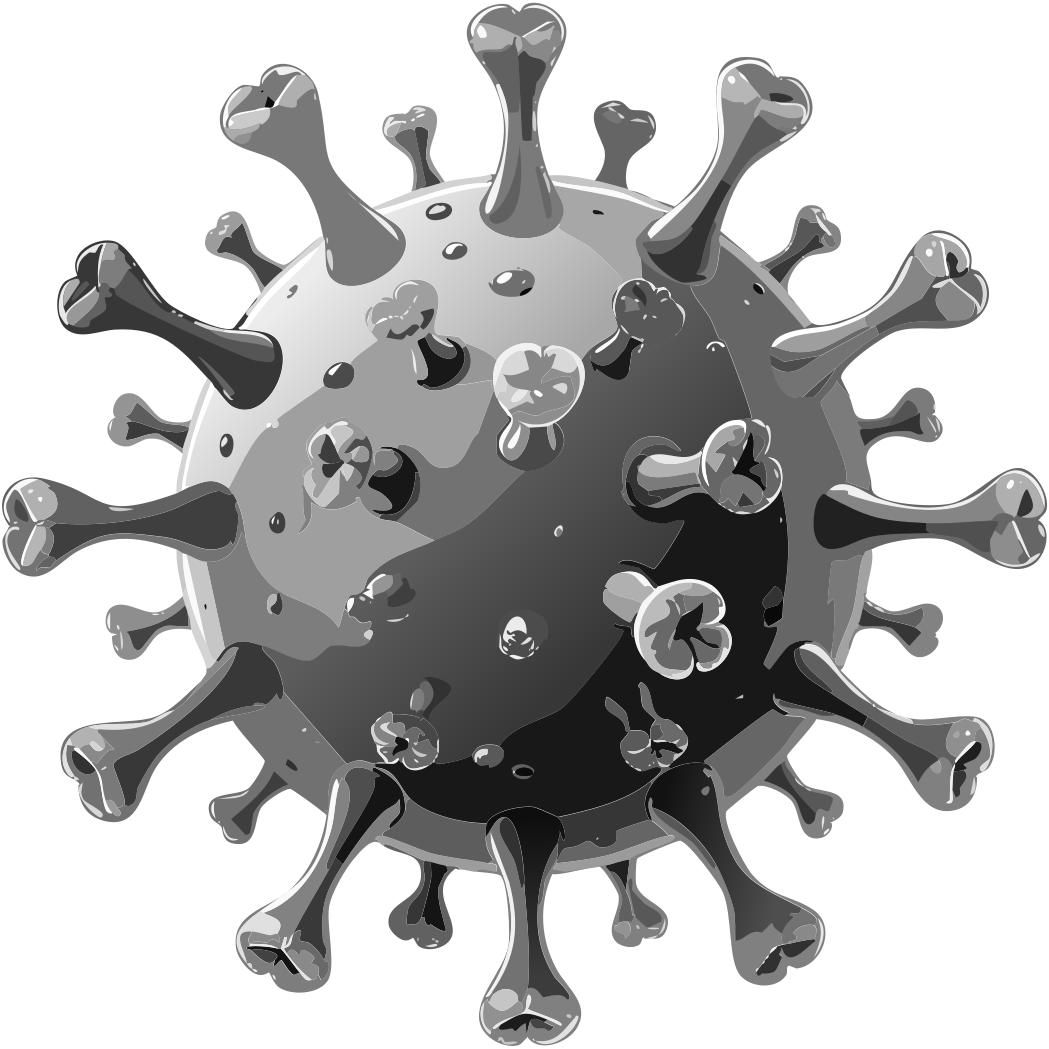
Meta-analysis and multi-omics study showing reduced mortality with zinc supplementation in hospitalized COVID-19 patients. Authors found that zinc treatment was associated with a significant reduction in mortality (OR 0.48) across seven studies involving 1,972 participants. Through the integration of single-cell and bulk RNA sequencing data from human blood and respiratory samples, authors identified Metallothionein 2A (MT2A) as a key zinc-regulatory protein that is upregulated in monocytes and macrophages during severe infection. MT2A expression was found to correlate with SARS-CoV-2 entry factors (TMPRSS2, CTSB, CTSL) and innate immune sensing pathways (TLR7, IFIH1), peaking early in the infection course. Authors propose MT2A as a biomarker for zinc-dysregulated immune stress and a potential host target for intervention.
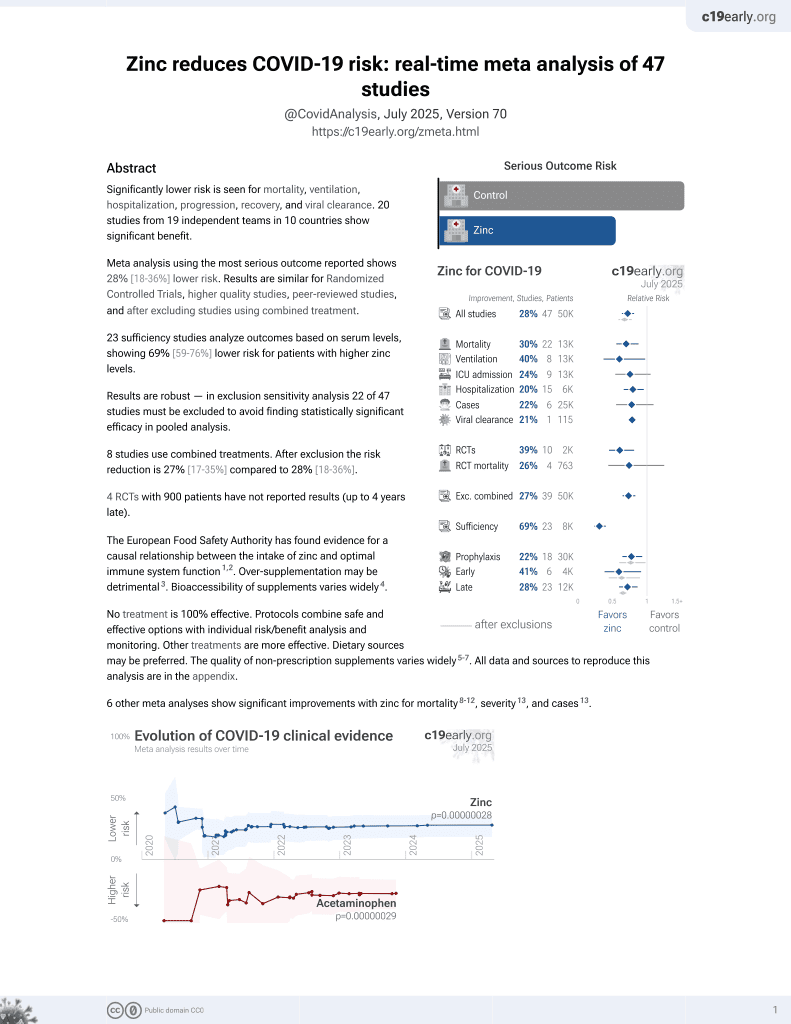
Currently there are 40 zinc treatment for COVID-19 studies, showing 35% lower mortality [17‑49%], 40% lower ventilation [-1‑65%], 28% lower ICU admission [-8‑51%], 24% lower hospitalization [5‑38%], and 22% fewer cases [-10‑45%].

1.
Tabatabaeizadeh, S., Zinc supplementation and COVID-19 mortality: a meta-analysis, European Journal of Medical Research, doi:10.1186/s40001-022-00694-z.
2.
Olczak-Pruc et al., The effect of zinc supplementation on the course of COVID-19 – A systematic review and meta-analysis, Annals of Agricultural and Environmental Medicine, doi:10.26444/aaem/155846.
3.
Xie et al., Micronutrient perspective on COVID-19: Umbrella review and reanalysis of meta-analyses, Critical Reviews in Food Science and Nutrition, doi:10.1080/10408398.2023.2174948.
4.
Abuhelwa, Z., Do Zinc Supplements Reduce Mortality in Patients with COVID-19?, Translation: The University of Toledo Journal of Medical Sciences, doi:10.46570/utjms.vol11-2023-749.
5.
Rheingold et al., Zinc Supplementation Associated With a Decrease in Mortality in COVID-19 Patients: A Meta-Analysis, Cureus, doi:10.7759/cureus.40231.
Li et al., 4 Feb 2026, peer-reviewed, 8 authors.
Abstract: ORIGINAL ARTICLE
Open Access
https://doi.org/10.48130/targetome-0026-0006
Targetome 2026, 2(0):
Multi-Omics Integration Identifies MT2A as a Biomarker and a
Candidate Host Target Linking Zinc Dysregulation to COVID-19
Mortality
Zhonghua Li1,2#, Siqi Hua1#, Shuangshuang Song1, Yixiang Luo3, Wei Qian2, Lina Liu4*, Jiahuang Li1* and Bo Zhu1*
1 School of Biopharmacy, China Pharmaceutical University, Nanjing 211198, China
2 Department of Biostatistics, School of Science, China Pharmaceutical University, Nanjing 211198, China
3 School of Basic Medicine and Clinical Pharmacy, China Pharmaceutical University, Nanjing 211198, China
4 Peter Gorer Department of Immunobiology, School of Immunology and Microbial Sciences, King's College London, London, SE1 9RT
# Authors contributed equally: Zhonghua Li, Siqi Hua
* Correspondence: lina.liu@kcl.ac.uk (Liu L); lijiah@cpu.edu.cn (Li J); zhubo@cpu.edu.cn (Zhu B)
Abstract
Identifying host programs that connect micronutrient biology to COVID-19 immunopathology may enable more precise host-directed strategies. Zinc
deficiency is linked to worse outcomes, yet the intracellular mediators that couple metal/redox stress to disease severity remain unclear. We performed a
PRISMA-guided meta-analysis of zinc supplementation in hospitalized COVID-19 (7 studies; 1972 participants) and observed reduced mortality (OR 0.48,
95% CI 0.36–0.64). While statistical heterogeneity was low, regimens varied substantially in formulation, elemental dose, route, and duration. We then
integrated single-cell and bulk transcriptomes across blood and respiratory compartments to map zinc-homeostasis programs across disease states. In a
large single-cell atlas (GSE158055; 1462702 cells from 196 individuals) spanning PBMC, bronchoalveolar lavage fluid, and sputum, and in bulk RNA-seq from
postmortem lung tissue (GSE183533) and longitudinal peripheral blood (GSE198449), MT2A showed the most reproducible association with disease severity
among metallothioneins and was enriched in myeloid lineages. Its associations were compartment- and state-dependent and involved SARS-CoV2–relevant entry/processing and innate-sensing programs, including TMPRSS2, CTSB/CTSL, and RNA-sensing pathways. In a longitudinal subset with
complete timepoints (n=9; days 0, 1, 8, and 12), MT2A peaked early after infection and declined thereafter, consistent with an inducible acute-phase
response. Together, these results prioritize MT2A as a cross-compartment marker of metal/redox immune stress and a testable host node for biomarkerguided stratification and intervention timing, pending perturbation-based causal validation.
Citation: Li Z, Hua S, Song S, Luo Y, Qian W, et al. 2026. Multi-Omics Integration Identifies MT2A as a Biomarker and a Candidate Host Target Linking Zinc
Dysregulation to COVID-19 Mortality. Targetome 2(0): https://doi.org/10.48130/targetome-0026-0006