Association of nirmatrelvir/ritonavir treatment on upper respiratory SARS-CoV-2 RT-PCR negative conversion rates among high-risk patients with COVID-19
PhD Hongyan Li, PhD Menghan Gao, MD Hailong You, MD Peng Zhang, MM Yuchen Pan, MD Nan Li, MD Ling Qin, MD Heyuan Wang, MD Dan Li, MD Yang Li, MD Hongmei Qiao, MD Lina Gu, MD Songbai Xu, MD Weiying Guo, MD Nanya Wang, MD Chaoying Liu, MD Pujun Gao, MD Junqi Niu, MD Jie Cao, MD Yang Zheng, Prof H Li
doi:10.1093/cid/ciac600/6649232
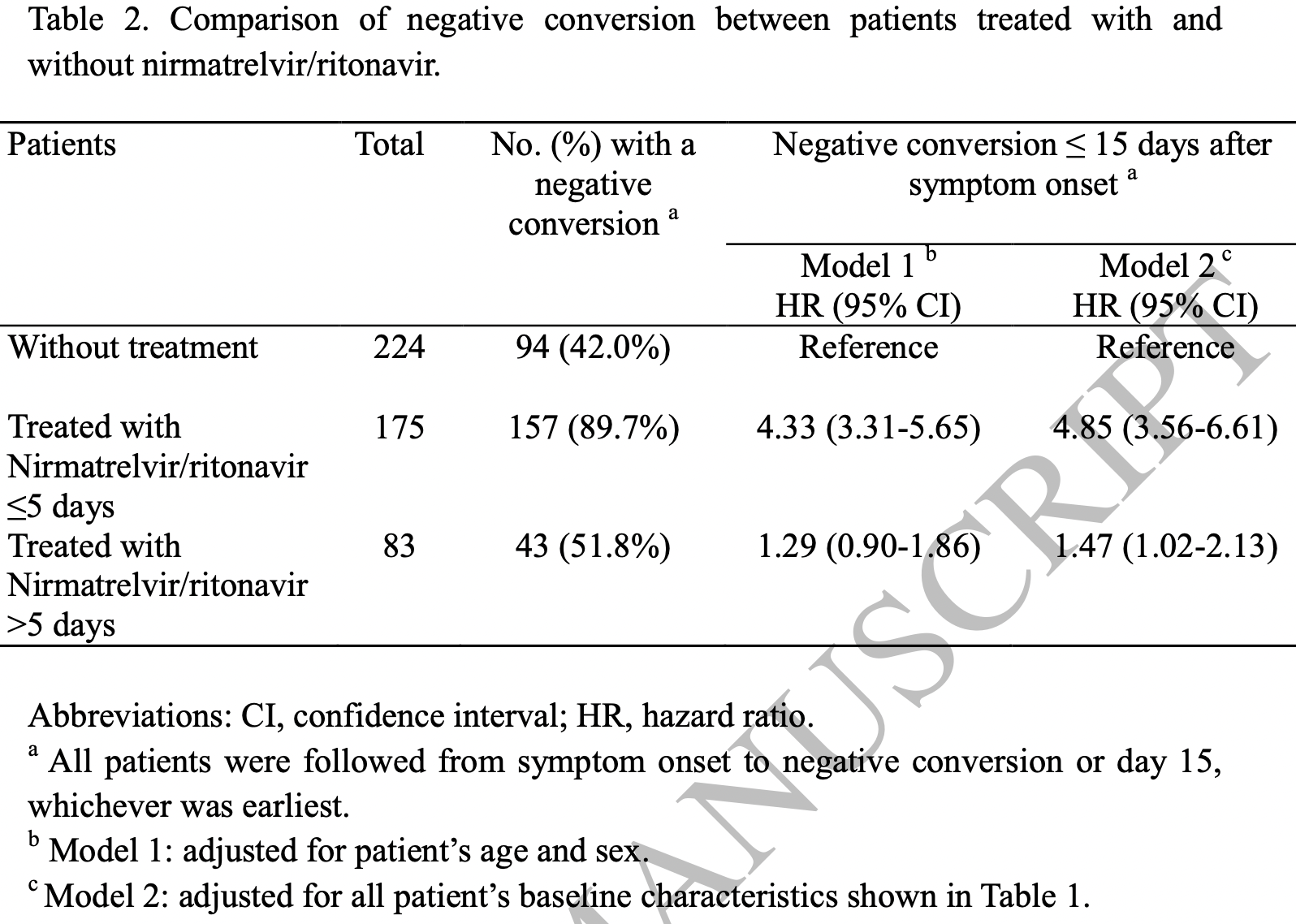
Background: Acceleration of negative respiratory conversion of SARS-CoV-2 in patients with coronavirus disease 2019 (COVID-19) might reduce viral transmission. Nirmatrelvir/ritonavir is a new antiviral agent recently approved for treatment of COVID-19 that has the potential to facilitate negative conversion. Methods: A cohort of hospitalized adult patients with mild-to-moderate COVID-19 who had a high-risk for progression to severe disease were studied. These patients presented with COVID-19 symptoms between March 5 and April 5, 2022. The time from positive to negative upper respiratory RT-PCR conversion was assessed by Kaplan-Meier plots and Cox proportional hazards regression with the adjustment for patients baseline demographic and clinical characteristics. Results: There were 258 patients treated with nirmatrelvir/ritonavir and 224 nontreated patients who had mild-to-moderate COVID-19. The median (interquartile range) time for patients who converted from positive to negative RT-PCR was 10 Conclusion: This cohort study of high-risk patients with mild-to-moderate COVID-19 found an association between nirmatrelvir/ritonavir treatment and accelerated negative RT-PCR respiratory SARS-CoV-2 conversion that might reduce the risk of viral shedding and disease transmission.
Conflict of Interest Disclosures: None reported. Funding/Support: None.
References
Anand, Ziebuhr, Wadhwani, Mesters, Hilgenfeld, Coronavirus main proteinase (3CLpro) structure: basis for design of anti-SARS drugs, Science
Barnett, Mehrotra, Landon, Covid-19 and the upcoming financial crisis in health care, NEJM Catalyst Innovations in Care Delivery
Borio, Bright, Emanuel, A National Strategy for COVID-19 Medical Countermeasures: Vaccines and Therapeutics, JAMA
Cevik, Kuppalli, Kindrachuk, Peiris, Virology, transmission, and pathogenesis of SARS-CoV-2
Charness, Gupta, Stack, Rapid Relapse of Symptomatic Omicron SARS-CoV-2 Infection Following Early Suppression with Nirmatrelvir/Ritonavir
Chowdhury, Luhar, Khan, Choudhury, Matin et al., Longterm strategies to control COVID-19 in low and middle-income countries: an options overview of community-based, non-pharmacological interventions, European journal of epidemiology
Docherty, Harrison, Green, Features of 20 133 UK patients in hospital with covid-19 using the ISARIC WHO Clinical Characterisation Protocol: prospective observational cohort study
Drew, Donnell, Leblanc, Mcmahon, Natin, The importance of cycle threshold values in interpreting molecular tests for SARS-CoV-2, Diagnostic microbiology and infectious disease
Gandhi, Malani, Rio, COVID-19 Therapeutics for Nonhospitalized Patients, JAMA
Gottlieb, Vaca, Paredes, Early remdesivir to prevent progression to severe Covid-19 in outpatients, New England Journal of Medicine
Hammond, Leister-Tebbe, Gardner, Oral nirmatrelvir for highrisk, nonhospitalized adults with COVID-19, New England Journal of Medicine
Hammond, Leister-Tebbe, Gardner, Oral nirmatrelvir for highrisk, nonhospitalized adults with COVID-19, New England Journal of Medicine
Harrison, Lin, Wang, Mechanisms of SARS-CoV-2 transmission and pathogenesis, Trends in immunology
He, Zeng, Xiao, When and How to Adjust Non-Pharmacological Interventions Concurrent with Booster Vaccinations Against COVID-19-Guangdong, China, 2022, China CDC Weekly
Kim, Garg, 'halloran, Risk factors for intensive care unit admission and in-hospital mortality among hospitalized adults identified through the US coronavirus disease 2019 (COVID-19)-associated hospitalization surveillance network (COVID-NET), Clinical Infectious Diseases
Kotecha, Light, Checcucci, Repurposing of drugs for Covid-19: a systematic review and meta-analysis, MedRxiv
Lamb, Nirmatrelvir Plus Ritonavir: First Approval, Drugs
Li, Wang, Lavrijsen, SARS-CoV-2 Omicron variant is highly sensitive to molnupiravir, nirmatrelvir, and the combination, Cell Research
Lim, Hor, Tay, Efficacy of Ivermectin treatment on disease progression among adults with mild to moderate COVID-19 and comorbidities: the I-TECH randomized clinical trial, JAMA Internal Medicine
Owen, Allerton, Anderson, An oral SARS-CoV-2 Mpro inhibitor clinical candidate for the treatment of COVID-19, Science
Ranganath, Horo, Challener, Rebound Phenomenon after Nirmatrelvir/Ritonavir Treatment of Coronavirus Disease-2019 in High-Risk Persons, Clinical Infectious Diseases
Rao, Manissero, Steele, Pareja, A systematic review of the clinical utility of cycle threshold values in the context of COVID-19, Infectious diseases and therapy
Rhee, Kanjilal, Baker, Klompas, Duration of severe acute respiratory syndrome coronavirus 2 (SARS-CoV-2) infectivity: when is it safe to discontinue isolation?, Clinical infectious diseases
Sevrioukova, Poulos, Structure and mechanism of the complex between cytochrome P4503A4 and ritonavir, Proceedings of the National Academy of Sciences
Singh, Toussi, Hackman, Innovative Randomized Phase 1 Study and Dosing Regimen Selection to Accelerate and Inform Pivotal COVID-19 Trial of Nirmatrelvir, Clinical Pharmacology & Therapeutics
Thakur, Dubey, Benitez, A systematic review and meta-analysis of geographic differences in comorbidities and associated severity and mortality among individuals with COVID-19, Scientific reports
Ullrich, Ekanayake, Otting, Nitsche, Main protease mutants of SARS-CoV-2 variants remain susceptible to nirmatrelvir, Bioorganic & Medicinal Chemistry Letters
Van Kampen, De Vijver, Fraaij, Duration and key determinants of infectious virus shedding in hospitalized patients with coronavirus disease-2019 (COVID-19), Nature communications
Vangeel, Chiu, Jonghe, Molnupiravir and Nirmatrelvir remain active against SARS-CoV-2 Omicron and other variants of concern, Antiviral Research
Verna, Alallon, Murakami, Analytical Performance of COVID-19 Detection Methods (RT-PCR): Scientific and Societal Concerns, Life
Wu, Mcgoogan, Characteristics of and important lessons from the coronavirus disease 2019 (COVID-19) outbreak in China: summary of a report of 72 314 cases from the Chinese Center for Disease Control and Prevention, jama
Yu, Cai, Deng, Projecting the impact of the introduction of SARS-CoV-2 Omicron variant in China in the context of waning immunity after vaccination
Zhang, Liang, Tang, Negative Conversion Rate of SARS-CoV-2
DOI record:
{
"DOI": "10.1093/cid/ciac600",
"ISSN": [
"1058-4838",
"1537-6591"
],
"URL": "http://dx.doi.org/10.1093/cid/ciac600",
"abstract": "<jats:title>Abstract</jats:title>\n <jats:sec>\n <jats:title>Background</jats:title>\n <jats:p>Acceleration of negative respiratory conversion of SARS-CoV-2 in patients with coronavirus disease 2019 (COVID-19) might reduce viral transmission. Nirmatrelvir/ritonavir is a new antiviral agent recently approved for treatment of COVID-19 that has the potential to facilitate negative conversion.</jats:p>\n </jats:sec>\n <jats:sec>\n <jats:title>Methods</jats:title>\n <jats:p>A cohort of hospitalized adult patients with mild-to-moderate COVID-19 who had a high-risk for progression to severe disease were studied. These patients presented with COVID-19 symptoms between March 5 and April 5, 2022. The time from positive to negative upper respiratory RT-PCR conversion was assessed by Kaplan-Meier plots and Cox proportional hazards regression with the adjustment for patients baseline demographic and clinical characteristics.</jats:p>\n </jats:sec>\n <jats:sec>\n <jats:title>Results</jats:title>\n <jats:p>There were 258 patients treated with nirmatrelvir/ritonavir and 224 non-treated patients who had mild-to-moderate COVID-19. The median (interquartile range) time for patients who converted from positive to negative RT-PCR was 10 days (7-12 days) in patients treated ≤5 days after symptom onset and 17 days (12-21 days) in non-treated patients, respectively. The proportions of patients with a negative conversion at day 15 were 89.7% and 42.0% in treated patients and non-treated patients, corresponding to a hazard ratio of 4.33 (95% CI, 3.31-5.65). Adjustment for baseline differences between the groups had little effect on the association. Subgroup analysis on treated patients suggests that time to negative conversion did not vary with the patients’ baseline characteristics.</jats:p>\n </jats:sec>\n <jats:sec>\n <jats:title>Conclusion</jats:title>\n <jats:p>This cohort study of high-risk patients with mild-to-moderate COVID-19 found an association between nirmatrelvir/ritonavir treatment and accelerated negative RT-PCR respiratory SARS-CoV-2 conversion that might reduce the risk of viral shedding and disease transmission.</jats:p>\n </jats:sec>",
"author": [
{
"affiliation": [
{
"name": "Nursing Department, The First Hospital of Jilin University , Changchun , China"
}
],
"family": "Li",
"given": "Hongyan",
"sequence": "first"
},
{
"affiliation": [
{
"name": "Department of Hepatobiliary and Pancreatic Surgery, The First Hospital of Jilin University , Changchun , China"
}
],
"family": "Gao",
"given": "Menghan",
"sequence": "additional"
},
{
"affiliation": [
{
"name": "Department of Pediatrics, First Hospital of Jilin University , Changchun , China"
}
],
"family": "You",
"given": "Hailong",
"sequence": "additional"
},
{
"affiliation": [
{
"name": "Department of Infectious Diseases, The First Hospital of Jilin University , Changchun , China"
}
],
"family": "Zhang",
"given": "Peng",
"sequence": "additional"
},
{
"affiliation": [
{
"name": "Department of Clinical Epidemiology, The First Hospital of Jilin University , Changchun , China"
}
],
"family": "Pan",
"given": "Yuchen",
"sequence": "additional"
},
{
"affiliation": [
{
"name": "Intensive Care Unit, The First Hospital of Jilin University , Changchun , China"
}
],
"family": "Li",
"given": "Nan",
"sequence": "additional"
},
{
"affiliation": [
{
"name": "Department of Cardiovascular Medicine, The First Hospital of Jilin University , Changchun , China"
}
],
"family": "Qin",
"given": "Ling",
"sequence": "additional"
},
{
"affiliation": [
{
"name": "Department of Endocrinology and Metabolism, The First Hospital of Jilin University , Changchun , China"
}
],
"family": "Wang",
"given": "Heyuan",
"sequence": "additional"
},
{
"affiliation": [
{
"name": "Department of Respiratory Medicine, The First Hospital of Jilin University , Changchun , China"
}
],
"family": "Li",
"given": "Dan",
"sequence": "additional"
},
{
"affiliation": [
{
"name": "Department of Respiratory Medicine, The First Hospital of Jilin University , Changchun , China"
}
],
"family": "Li",
"given": "Yang",
"sequence": "additional"
},
{
"affiliation": [
{
"name": "Department of Pediatric Respiratory Medicine, The First Hospital of Jilin University , Changchun , China"
}
],
"family": "Qiao",
"given": "Hongmei",
"sequence": "additional"
},
{
"affiliation": [
{
"name": "Intensive Care Unit, The First Hospital of Jilin University , Changchun , China"
}
],
"family": "Gu",
"given": "Lina",
"sequence": "additional"
},
{
"affiliation": [
{
"name": "Department of Neurosurgery, the First Hospital of Jilin University , Changchun , China"
}
],
"family": "Xu",
"given": "Songbai",
"sequence": "additional"
},
{
"affiliation": [
{
"name": "Department of Endocrinology and Metabolism, The First Hospital of Jilin University , Changchun , China"
}
],
"family": "Guo",
"given": "Weiying",
"sequence": "additional"
},
{
"affiliation": [
{
"name": "Cancer Center, the First Hospital of Jilin University , Changchun , China"
}
],
"family": "Wang",
"given": "Nanya",
"sequence": "additional"
},
{
"affiliation": [
{
"name": "Department of Respiratory Medicine, The First Hospital of Jilin University , Changchun , China"
}
],
"family": "Liu",
"given": "Chaoying",
"sequence": "additional"
},
{
"affiliation": [
{
"name": "Department of Hepatology, The First Hospital of Jilin University , Changchun , China"
}
],
"family": "Gao",
"given": "Pujun",
"sequence": "additional"
},
{
"affiliation": [
{
"name": "Department of Hepatology, Center of Infectious Disease and Pathogen Biology, Key laboratory of Organ Regeneration and Transplantation of the Ministry of Education, State Key Laboratory of Zoonotic Disease, The First Hospital of Jilin University , Changchun , China"
}
],
"family": "Niu",
"given": "Junqi",
"sequence": "additional"
},
{
"affiliation": [
{
"name": "Department of Neology, The First Hospital of Jilin University , Changchun , China"
}
],
"family": "Cao",
"given": "Jie",
"sequence": "additional"
},
{
"affiliation": [
{
"name": "Department of Cardiovascular Medicine, The First Hospital of Jilin University , Changchun , China"
}
],
"family": "Zheng",
"given": "Yang",
"sequence": "additional"
}
],
"container-title": "Clinical Infectious Diseases",
"content-domain": {
"crossmark-restriction": false,
"domain": []
},
"created": {
"date-parts": [
[
2022,
7,
23
]
],
"date-time": "2022-07-23T16:38:24Z",
"timestamp": 1658594304000
},
"deposited": {
"date-parts": [
[
2022,
7,
23
]
],
"date-time": "2022-07-23T16:38:24Z",
"timestamp": 1658594304000
},
"indexed": {
"date-parts": [
[
2022,
7,
23
]
],
"date-time": "2022-07-23T17:11:32Z",
"timestamp": 1658596292324
},
"is-referenced-by-count": 0,
"issued": {
"date-parts": [
[
2022,
7,
23
]
]
},
"language": "en",
"license": [
{
"URL": "https://creativecommons.org/licenses/by-nc-nd/4.0/",
"content-version": "am",
"delay-in-days": 0,
"start": {
"date-parts": [
[
2022,
7,
23
]
],
"date-time": "2022-07-23T00:00:00Z",
"timestamp": 1658534400000
}
}
],
"link": [
{
"URL": "https://academic.oup.com/cid/advance-article-pdf/doi/10.1093/cid/ciac600/45052937/ciac600.pdf",
"content-type": "application/pdf",
"content-version": "am",
"intended-application": "syndication"
},
{
"URL": "https://academic.oup.com/cid/advance-article-pdf/doi/10.1093/cid/ciac600/45052937/ciac600.pdf",
"content-type": "unspecified",
"content-version": "vor",
"intended-application": "similarity-checking"
}
],
"member": "286",
"original-title": [],
"prefix": "10.1093",
"published": {
"date-parts": [
[
2022,
7,
23
]
]
},
"published-online": {
"date-parts": [
[
2022,
7,
23
]
]
},
"publisher": "Oxford University Press (OUP)",
"reference-count": 0,
"references-count": 0,
"relation": {},
"resource": {
"primary": {
"URL": "https://academic.oup.com/cid/advance-article/doi/10.1093/cid/ciac600/6649232"
}
},
"score": 1,
"short-title": [],
"source": "Crossref",
"subject": [
"Infectious Diseases",
"Microbiology (medical)"
],
"subtitle": [],
"title": "Association of nirmatrelvir/ritonavir treatment on upper respiratory SARS-CoV-2 RT-PCR negative conversion rates among high-risk patients with COVID-19",
"type": "journal-article"
}