Hydroxychloroquine in Nonhospitalized Adults With Early COVID-19: A Randomized Trial
et al., Annals of Internal Medicine, doi:10.7326/M20-4207, NCT04308668, Jul 2020
Update: we have not received details for treatment delay. An author reports that treatment initiation time was not recorded1. Conflicting estimates are provided in a comment of the article and independent analysis, with reports indicating missing data in the dataset. Also see2 (companion PEP trial), and Pullen et al.3, which shows shipping delay for these trials of 19 - 68 hours. Only one third of participants completed enrollment weekdays between 8:00am and 4:00pm, with 44% outside of these hours during the week, and 22% during the weekend. With enrollment up to 4 days after symptom onset, this implies delivery 19 - 164 hours after onset (19 hours would require instantaneous enrollment).
~70 to 140 hour (inc. shipping) delayed outpatient treatment with HCQ showing lower hospitalization/death and faster recovery, but not reaching statistical significance. There was one hospitalized control death and one non-hospitalized HCQ death. It is unclear why there was a non-hospitalized death, external factors such as lack of standard care may be involved. Excluding that case results in one control death and zero HCQ deaths. Details for the hospitalizations and deaths such as medication adherence and treatment delay may be informative but are not provided.
The paper states the end point was changed to symptom severity because they would have required 6,000 participants. However, if the same event rates continued, they would hit 95% significance on the reduction in hospitalization after adding ~400 patients per arm.
Treatment is relatively late, ~70 to 140 hours after symptoms, including the shipping delay. The paper does not mention the shipping delay but partial details are provided in the study protocol. They are not clear but suggest no shipping on the weekends and a possible 12pm cutoff for same day dispensing and mailing. Assuming that enrollments were evenly distributed between 6am and 12am each day, we get an average of approximately 46 hours shipping delay. We have asked for shipping details and will update with more accurate values when available. In any case the treatment delay is relatively long and there is likely little overlap with the more typical delays used such as 0 - 36 hours for oseltamivir.
Research shows the treatment used in the control arm (folic acid in the USA which was most patients) may have significant efficacy for COVID-194,5, so the true effectiveness of HCQ may be higher than observed. Also see6. Kaur et al. note that folic acid is predicted to bind to multiple SARS-CoV-2 proteins, folic acid levels are lower in COVID-19 patients with severe disease, folic acid supplementation may help with COVID-19 associated hypertension and hyperhomocystinemia, and differences in a folic acid-related enzyme could impact COVID-19 geographical severity variation.
The paper compares 0 - 36 hour delayed treatment with oseltamivir (influenza) and ~70 to 140 hour delayed treatment with HCQ (COVID-19), noting that oseltamivir seemed more effective. However, a more comparable study is McLean (2015) who showed that 48 - 119 hour delayed treatment with oseltamivir has no effect. This suggests that HCQ is more effective than oseltamivir, and that HCQ may still have significant effect for some amount of delay beyond the delay where oseltamivir is effective.
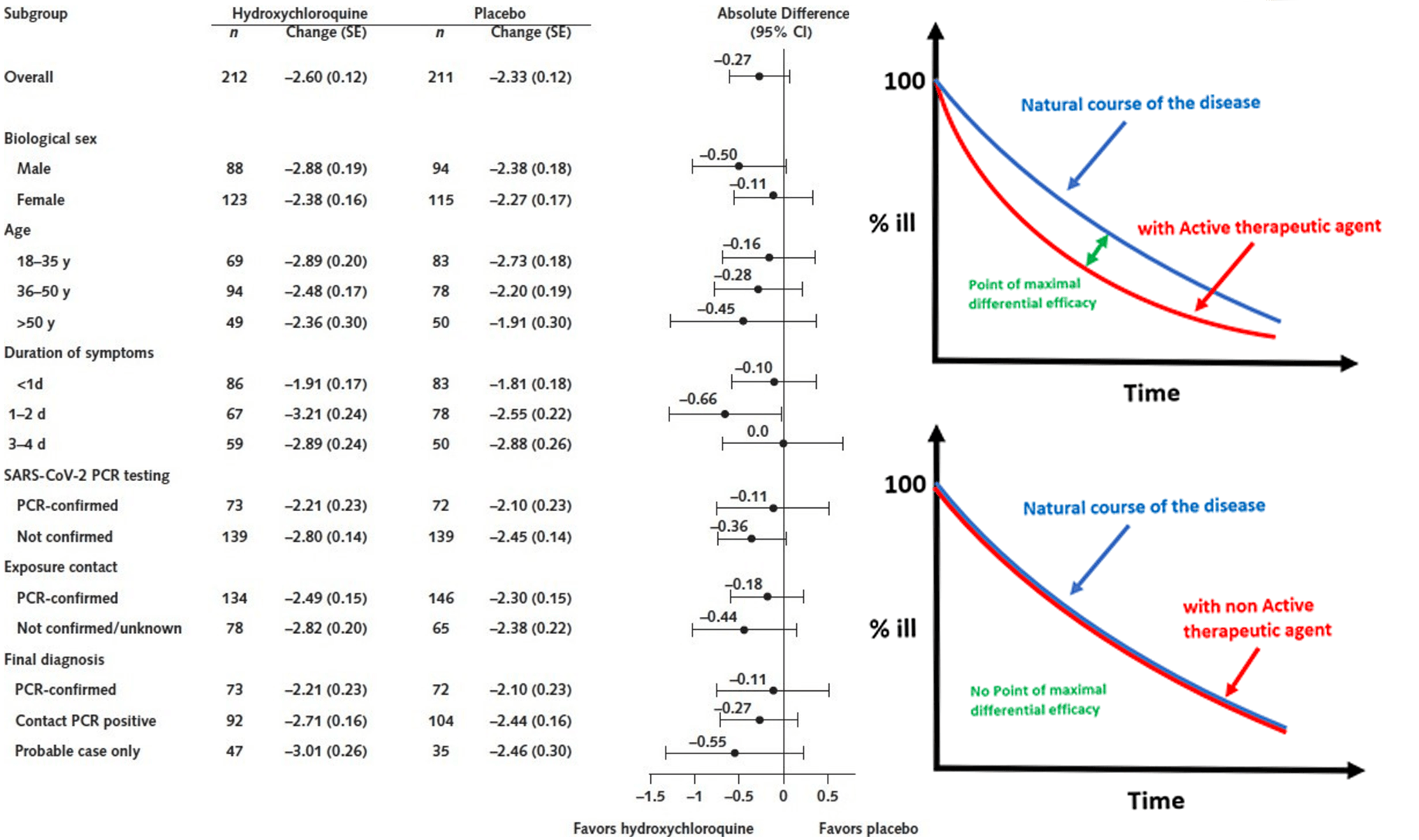
Patients in this study are relatively young and most recover without assistance. This reduces the room for a treatment to make improvements. The maximum improvement of an effective treatment would be expected before all patients approach recovery. Authors focus on the end result where most have recovered, but it is more informative to examine the curve and the point of maximum effectiveness. Authors did not collect data for every day but they do have interim results for days 3, 5, 10. The results are consistent with an effective treatment and show a statistically significant improvement, p = 0.05, at day 10 (other unreported days might show increased effectiveness).
Results also show a larger treatment effect for those >50, not statistically significant due to the small sample, but noted as COVID-19 risk dramatically increases with age. The effect may be more visible here because younger patients may on average have more mild cases with less room for improvement. In general patients in this study have relatively mild symptoms on average, limiting the chance to observe improvement.
The study relies on Internet surveys. Known fake surveys were submitted to the similar PEP trial and there could be an unknown number of undetected fake surveys in both trials. The study shows a high incidence of side effects in the placebo arm, which could be in part due to fake entries8.
The granularity change in the histograms of Figure S4 has raised questions8. Data on increasing severity, less affected by the lower bound where everyone has recovered, also supports effectiveness8.
Treatment delay reporting has changed from the companion PEP trial which reported results for enrollment delays 1, 2, 3, and 4 separately (and from which we can confirm a statistically significant delay-response relationship), while this trial combines 1-2 and 3-4, and adds <1. Since the two trials share reporting (some patients were moved between trials) the reason for the differences are not clear.
RCT of 423 patients with Internet surveys. Medication adherence was only 77% so the true effect of treatment is likely higher. Analysis of primarily low risk patients, authors note the results are not generalizable to the COVID high-risk population. We will update when hearing back on questions asked.
This trial has many serious issues:
HCQ for COVID-19
1st treatment shown to reduce risk in
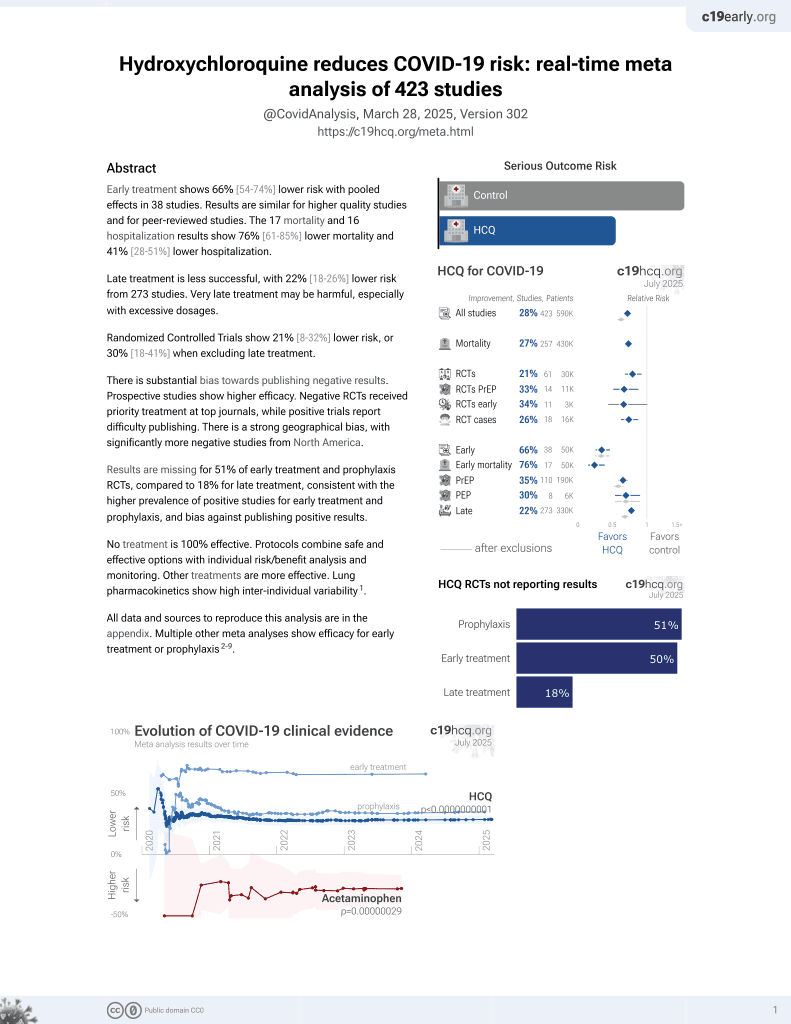
March 2020, now with p < 0.0000000001 from 424 studies, used in 59 countries.
No treatment is 100% effective. Protocols
combine treatments.
6,700+ studies for
220+ treatments. c19early.org
|
| CRITICAL | |
| CRITICAL | |
| CRITICAL | |
| CRITICAL | |
| CRITICAL | |
| CRITICAL | |
| CRITICAL | |
| CRITICAL | |
| CRITICAL | |
| SERIOUS | |
| SERIOUS | |
| SERIOUS | |
| SERIOUS | |
| SERIOUS | |
| SERIOUS | |
| MAJOR | |
| MAJOR | |
| MAJOR | |
| MAJOR | |
| MAJOR | |
| MAJOR | |
| MAJOR | |
| MAJOR | |
| MINOR | |
| MINOR |
CRITICALPrimary endpoint changed during trial.
The original primary endpoint was an ordinal clinical outcome of no hospitalization, hospitalization, ICU admission, or death. Authors changed this to longitudinal symptom severity mid-trial.
CRITICALStopping decision inconsistent with claimed statistical power.
After changing the primary endpoint to longitudinal symptom severity, authors state that at least 200 participants per group would provide 90% power to detect a 0.25-point difference, and that enrollment stopped because sufficient power had been achieved. However, the final estimate was -0.27 with 95% CI -0.61 to 0.07 and p=0.117. The observed difference (0.27) was larger than the difference the trial claimed 90% power to detect (0.25), but returned p>0.05.
CRITICAL68 participants excluded with significant non-random missingness.
Only 423 of 491 randomized participants were included in the primary symptom analysis. The 68 patients excluded differed substantially from the included participants in country, contact type, sex, race, randomization stratum, and baseline symptom prevalence. Excluded patients were systematically sicker at baseline. Losing the most symptomatic 14% of a symptom-severity trial affects both precision and generalizability.
CRITICALNon-significant results reported as evidence of no effect; CI includes meaningful benefit.
The abstract concludes 'Hydroxychloroquine did not substantially reduce symptom severity'. The 95% CI is -0.61 to +0.07, and the upper bound equals a 26% relative improvement (0.61/2.33). The discussion compares against oseltamivir at '25% to 35% relative reduction' and argues HCQ's effect is two-fold smaller, however the trial's own results do not exclude an oseltamivir-magnitude benefit. Day-14 persistent symptoms also favored treatment: 24% versus 30%, as did death/hospitalization: 2.2% vs. 4.3%, however authors conclude that HCQ did not substantially reduce symptom severity. Failure to reach p<0.05 does not establish no effect. Rather, the trial did not show a statistically significant benefit and is compatible with a range of treatment effects.
CRITICALBlinding failed in HCQ arm on a subjective self-reported endpoint.
The paper states 'masking was generally effective' in a sentence that immediately concedes 'with adverse effects markedly differing between groups'. Among participants willing to guess, 87% in the HCQ arm guessed correctly versus 54% in the placebo arm. Adverse effects were 43% versus 22% (p<0.001), a plausible unblinding mechanism. Bang blinding index would be strongly positive in one arm and near zero in the other, i.e., there was differential unblinding.
CRITICALTime from symptom onset to first dose was not measured or reported.
The trial's stated hypothesis is that 'starting hydroxychloroquine therapy within the first few days of symptoms' alters disease course. The reported time quantities - inclusion criterion, baseline strata, and the a priori 'duration of antecedent symptoms' subgroup - are with respect to enrollment, not to the actual treatment time. The study drug was couriered after a pharmacy cut-off (~4pm Mon-Fri, ~2pm Sat), adding at minimum one day. The duration strata (<1, 1-2, 3-4 days) are therefore not strata of time-to-treatment and overlap substantially, attenuating any true time-dependent effect toward the null. The dataset variable t2drugstart reportedly ranges from -1 to 49 with 222 records >10 days - impossible values for a trial requiring ≤4 days of symptoms.
CRITICALProtocol never amended to reflect mid-trial change.
The protocol and registry primary outcome was a WHO 4-level ordinal severity scale at day 14 analysed with proportional odds. VAS symptom severity at days 5 and 14 was secondary outcome #6, pre-specified for analysis by t-test among symptomatic participants only. The published primary endpoint is the change in VAS severity over 14 days from a 5-timepoint mixed model across the whole cohort with zeros imputed for the asymptomatic - a different estimand, population, and method. The protocol was posted 6 May 2020, twelve days after the DSMB approved the change and on the day enrollment stopped, and still presents the ordinal scale as primary with no amendment. Authors cite this protocol as their design reference.
CRITICALInternally impossible rows in Supplement Table 5.
Row 'With symptoms' (n=207/206): arm CIs of -3.15 to -2.08 and -2.87 to -1.80 have half-widths 0.535, implying SE 0.273 and σ ≈ 3.9. The difference CI in the same row (-0.62, 0.07) implies SE(diff) = 0.176, per-arm SE ≈0.124, σ ≈ 1.79. The arm intervals are ~4.4x too wide to be consistent with the difference interval beside them. Row 'Adjusted for Country and Strata': the HCQ CI (-2.81, -2.07) is asymmetric about the stated mean of -2.39, impossible for a Wald interval; and the stated means give a difference of -0.22 while the row reports -0.27 and 12.4% relative. The row also reports the identical CI to the primary analysis but a different p value (0.122 vs. 0.117).
CRITICALSupplement Table 6 diagnostic-test counts conflict with main text.
Table S6 shows, among the 423 primary-endpoint participants: 122 positive (28.8%), 42 negative (9.9%), 44 pending, 215 not done. However the main table and text give 145 PCR-positive participants (73 + 72), and the discussion states 'only 16% of participants contributing data to the primary end point had a confirmed negative result on a PCR test' - 16% of 423 is ~68, versus 42 (9.9%) in Table S6. Footnote 2 ('First iteration of survey combined negatives and not done') explains an undercount of negatives but reconciles neither 122 versus 145 nor 42 versus ~68. The 16% figure is important because the discussion uses it to argue that misclassification is bounded by known PCR false-negative rates, and this forms the basis for defending the enrollment of epidemiologically linked patients without confirmed infection.
SERIOUSModified ITT excluding never-dosed participants not reported; may change results.
The '<75% (0-14 tablets)' adherence stratum has 22 HCQ and 13 placebo participants who never took a single tablet (Table S2/S3: 157+8+16+22=203; 165+38=203). There is no sensitivity analysis excluding them. Reconstructing arm means among day-5 responders: HCQ (165x2.57 + 38x2.70)/203 = -2.594; placebo (169x2.15 + 25x3.18)/194 = -2.283; difference -0.311. Under the assumption that never-starters carry their stratum means, removal gives HCQ -2.581 and placebo -2.218, a difference of -0.363, which at SE ≈0.18 corresponds to p ≈ 0.045.
SERIOUSHospitalization outcome reported only as a p value, with no effect estimate or interval.
The secondary hospitalization-or-death outcome is reported as 5/231 (HCQ) versus 10/234 (placebo), 'p = 0.29'. No relative risk or confidence interval is given anywhere in the paper. The RR = 0.51 (95% CI 0.18 to 1.46); for COVID-related events only (4 versus 8), RR ≈ 0.51. The point estimate is a 49% relative reduction - almost exactly the 50% the trial was originally designed to detect - with an interval so wide the trial is uninformative in either direction.
SERIOUSPrespecified subgroup not reported for primary outcome.
Protocol v1.36 lists pre-planned subgroup #3 as 'Exposure in healthcare worker versus household contact', for both trials. The paper reports baseline characteristics by contact type (Table S6) but no primary-outcome analysis by contact type, and the paper's list of a priori subgroups omits it, citing a non-public 'Version 1.0' of the protocol.
SERIOUSDocumented pattern of dataset and methods errors, including uncorrected published methods description.
The correspondence record establishes that the public PEP dataset medication list was wrong, with baseline medications replaced by day-5/14 follow-up values (30 Aug and 4 Sep 2020); a typo in the NEJM Table S8 zinc counts (9 Sep 2020); and, the PI stated on 18 Sep 2020 that the one-line PPE/risk-score description was 'incorrect', that the risk score definition changed three times mid-trial (17 Mar, 19 Mar, 3 Apr) without disclosure, and that 'we will notify the journal of this'. On 11 Sep 2020 author also stated: 'I notice a problem with two of the variable coding as well, that needs clarification.' Four dataset versions circulated Aug-Nov 2020, without a known changelog.
SERIOUSDataset has unresolved reproducibility and data-dictionary questions.
External review of the released dataset identified difficulty reproducing the 423-person primary cohort, inconsistent or unclear loss-to-follow-up coding, unexpected timing-variable ranges, ambiguous blank versus zero symptom values, mismatched variable tallies, missing dictionary variables, and other coding issues. Queries submitted 11 Nov 2020 and unresolved in the record: t2drugstart has a minimum of -1 and a maximum of 49, with 222 records exceeding 10 days, in a trial requiring ≤4 days of symptoms; ptstatus category 4 is undefined and 112 records are coded 'withdrew consent' against 2 in the withdraw variable; survey_date_000 decodes to 1959-60; lastsurveydt appears in the dictionary but not the data; t2suvery_003 is misspelled; the 423 primary-endpoint participants cannot be identified unambiguously (candidate variables give 69, 73 and 73 exclusions rather than 68); and 1 participant is coded pregnant against 0 in the published table.
SERIOUSData sharing statement not honored as written.
The published statement reads: 'The following data will be made available beginning 22 July 2020: deidentified participant data, data dictionary... These data will be made available for open access (restrictions: none).' In practice release was around 11 Nov 2020, ~16 weeks late. The PI further stated on 6 Oct 2020 that 'Data not included in published trial manuscript(s) that are the focus of ongoing manuscripts by my team are not obligated to be released to you before publication of those manuscripts.'
MAJORStratum treated earliest shows the largest effect; not discussed.
The 99 participants who were asymptomatic at consent and became symptomatic on day 1 - those whose first dose was close to symptom onset, the closest available approximation to the trial's stated hypothesis - show the largest relative difference in the paper: -0.52 point, 34.9% relative, p = 0.092 (Table S5, 'New Symptoms on Day 1'). This appears only as an unlabelled sensitivity-analysis row in the supplement and is not mentioned in the main paper. A trial designed to test early treatment should discuss the stratum treated earliest.
MAJORAveraging change to day 14 may dilute effect concentrated in acute phase.
In a cohort where 77% are aged ≤50 and roughly 70-76% are symptom-free by day 14, an endpoint averaging change across days 3-14 will dilute a treatment that accelerates resolution without significantly changing the endpoint state. An area-under-the-symptom-curve or time-to-sustained-resolution endpoint would have more power.
MAJORTreatment-delay results pooled into broad bins despite finer underlying data.
The treatment trial reported effects for <1 day, 1-2 days, and 3-4 days, although the underlying symptom-duration data distinguished <1, 1, 2, 3, and 4 days. The PEP trial used different day-specific timing presentation. The broader bins obscure whether there is a monotonic delay-response relationship.
MAJORParticipants exceeding stated symptom-duration eligibility included.
The study specified enrollment with 4 or fewer days of symptoms, yet the paper states that six participants had more than 4 days of symptoms by randomization.
MAJORLargest interim symptom-severity separation nominally significant at day 10.
At day 10, the adjusted symptom-severity difference favored HCQ by about -0.42 points with 95% CI approximately -0.86 to 0.00 and p=0.050, before the groups converged somewhat by day 14.
MAJORJustification for abandoning hospitalization endpoint incorrect.
Authors states that approximately 6,000 participants would have been required to retain the original serious-clinical-outcome endpoint. However the observed hospitalization/death rates were about 2.2% with HCQ versus 4.3% with placebo, RR 0.51. If those observed rates continued, conventional statistical significance would have been reached with ~540 patients per arm.
MAJORYoung low-risk population creates strong self-recovery and ceiling effects.
Participants were relatively young, most had no chronic medical conditions, and hospitalization and mortality were uncommon. Most participants recovered regardless of treatment by the end of follow-up.
MAJORPost-randomization adherence comparisons were used to discount a favorable subgroup.
Among participants taking at least 75% of study medication, HCQ showed statistically favorable symptom-severity difference versus placebo. Authors discounted this partly because highly adherent HCQ participants did not improve more than poorly adherent HCQ participants. However, adherence is a post-randomization variable - adherent-versus-nonadherent comparisons are confounded by prognosis, tolerance, motivation, disease course, and other factors. The adherent HCQ-versus-adherent placebo comparison is not fully protected by randomization after conditioning on adherence. A complier-average causal effect analysis would be more relevant.
MINORMultiple undocumented denominators for the same follow-up visits.
Symptom-severity denominators (Figure 4, Figure S3, Table S4) differ from symptom-presence denominators (Figure S2, main text) at day 3 (151 versus 150, HCQ) and day 5 (204 versus 203, HCQ). The masking assessment reports 194 HCQ and 182 placebo day-14 completers against 201 and 194 for symptom data at the same visit, differences of 7 and 12 with no explanation.
MINORTwo incompatible symptom-duration partitions and an undefined 'within 1 day'.
The main Table and Figure 5 use strata {<1, 1-2, 3-4 days} while Supplement Table 6 uses {<1, 1, 2, 3, 4}. The authors' statement that '56% (236 of 423) of participants enrolled within 1 day of symptom onset' is never defined and does not correspond to a single stratum in either partition, rather it corresponds to <1 (169) plus 1 day (67) = 236 (55.8%), i.e., 0 or 1 day, or <2 days.
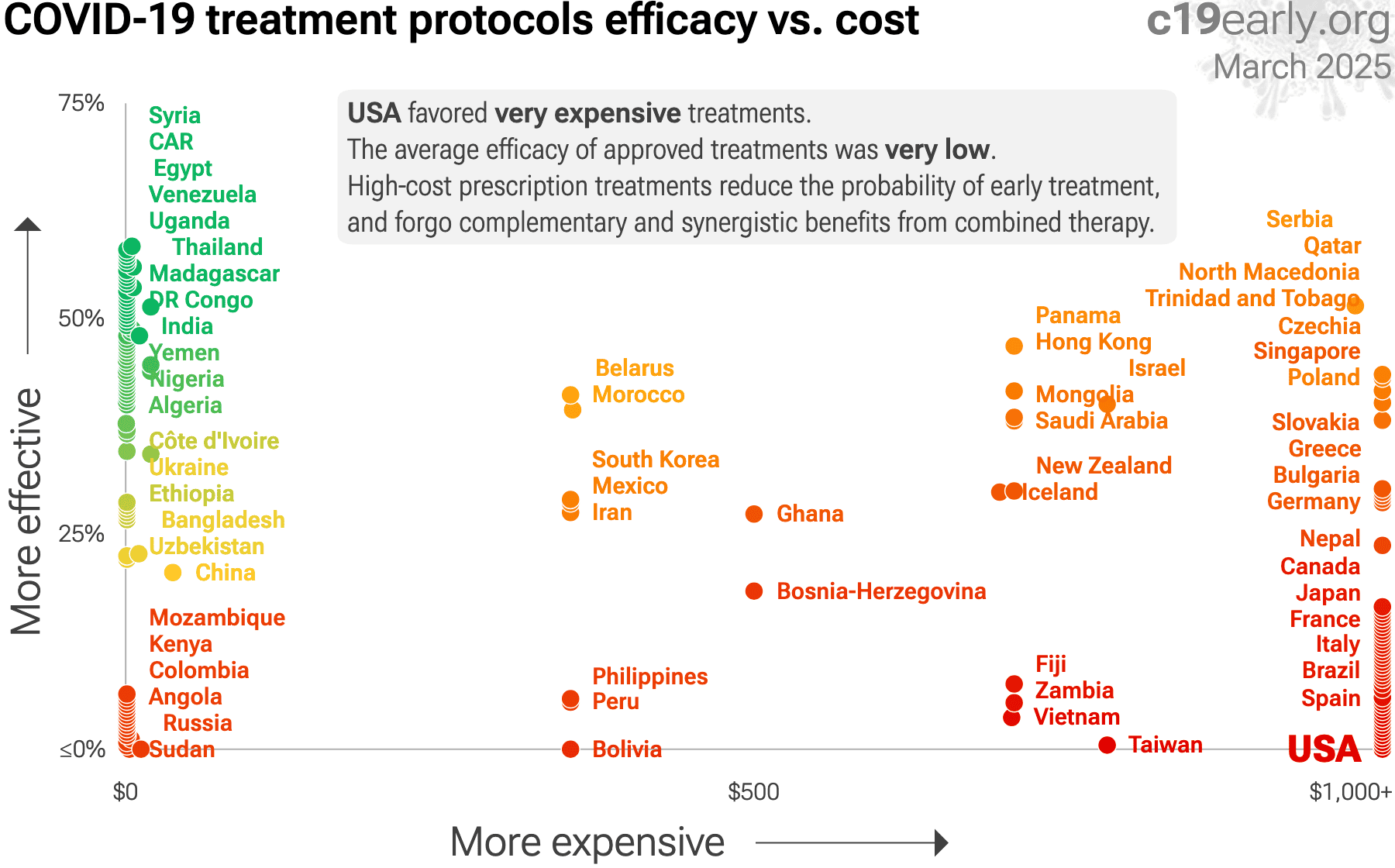
Standard of Care (SOC) for COVID-19 in the study country,
the USA, is very poor with very low average efficacy for approved treatments11.
Only expensive, high-profit treatments were approved for early treatment. Low-cost treatments were excluded, reducing the probability of early treatment due to access and cost barriers, and eliminating complementary and synergistic benefits seen with many low-cost treatments.
|
risk of death/hospitalization, 36.7% lower, RR 0.63, p = 0.58, treatment 5 of 231 (2.2%), control 8 of 234 (3.4%), NNT 80, COVID-19 adjudicated hospitalization/death.
|
|
risk of hospitalization, 49.4% lower, RR 0.51, p = 0.38, treatment 4 of 231 (1.7%), control 8 of 234 (3.4%), NNT 59, COVID-19 adjudicated hospitalization.
|
|
risk of death/hospitalization, 49.4% lower, RR 0.51, p = 0.29, treatment 5 of 231 (2.2%), control 10 of 234 (4.3%), NNT 47, all hospitalization/death.
|
|
risk of hospitalization, 59.5% lower, RR 0.41, p = 0.17, treatment 4 of 231 (1.7%), control 10 of 234 (4.3%), NNT 39, all hospitalizations.
|
|
risk of no recovery at day 14, 20.0% lower, RR 0.80, p = 0.21, treatment 231, control 234.
|
| Effect extraction follows pre-specified rules prioritizing more serious outcomes. Submit updates |
4.
Deschasaux-Tanguy et al., Nutritional risk factors for SARS-CoV-2 infection: a prospective study within the NutriNet-Santé cohort, BMC Medicine, doi:10.1186/s12916-021-02168-1.
5.
Farag et al., The Use of Folic acid as a Prophylaxis against COVID-19 among Healthcare Workers, Microbes and Infectious Diseases, doi:10.21608/mid.2022.170328.1405.
7.
Kaur et al., Folic acid as placebo in controlled clinical trials of hydroxychloroquine prophylaxis in COVID-19: Is it scientifically justifiable?, Medical Hypotheses, doi:10.1016/j.mehy.2021.110539.
8.
web.archive.org, web.archive.org/web/20200718182757/https://twitter.com/Covid19Crusher/status/1284515906375356416.
Skipper et al., 16 Jul 2020, Randomized Controlled Trial, USA, peer-reviewed, 24 authors, study period 17 March, 2020 - 20 May, 2020, dosage 800mg once, followed by 600mg in 6 to 8 hours, then 600mg daily for 4 more days, this trial compares with another treatment - results may be better when compared to placebo, trial NCT04308668 (history).
Hydroxychloroquine in Nonhospitalized Adults With Early COVID-19
Annals of Internal Medicine, doi:10.7326/m20-4207
Background: No effective oral therapy exists for early coronavirus disease 2019 . Objective: To investigate whether hydroxychloroquine could reduce COVID-19 severity in adult outpatients. Design: Randomized, double-blind, placebo-controlled trial conducted from 22 March through 20 May 2020. (ClinicalTrials .gov: NCT04308668) Setting: Internet-based trial across the United States and Canada (40 states and 3 provinces). Participants: Symptomatic, nonhospitalized adults with laboratoryconfirmed COVID-19 or probable COVID-19 and high-risk exposure within 4 days of symptom onset. Intervention: Oral hydroxychloroquine (800 mg once, followed by 600 mg in 6 to 8 hours, then 600 mg daily for 4 more days) or masked placebo. Measurements: Symptoms and severity at baseline and then at days 3, 5, 10, and 14 using a 10-point visual analogue scale. The primary end point was change in overall symptom severity over 14 days. Limitation: Only 58% of participants received SARS-CoV-2 testing because of severe U.S. testing shortages.
Conclusion: Hydroxychloroquine did not substantially reduce symptom severity in outpatients with early, mild COVID-19.
References
Beigel, Tomashek, Dodd, ACTT-1 Study Group Members. Remdesivir for the treatment of Covid-19 -preliminary report, N Engl J Med, doi:10.1056/NEJMoa2007764
Boulware, Pullen, Bangdiwala, Finding the dose for hydroxychloroquine prophylaxis for COVID-19: the desperate search for effectiveness, Clin Pharmacol Ther, doi:10.1056/NEJMoa2016638
Burke, Midgley, Dratch, Active monitoring of persons exposed to patients with confirmed COVID-19 -United States, January-February 2020, doi:10.15585/mmwr.mm6909e115
Cheng, Papenburg, Desjardins, Diagnostic testing for severe acute respiratory syndrome-related coronavirus 2: a narrative review, Ann Intern Med, doi:10.7326/M20-1301
Geleris, Sun, Platt, Observational study of roquine in hospitalized patients with Covid-19, N Engl J Med, doi:10.1056/NEJMoa2012410
Harris, Taylor, Minor, The REDCap consortium: building an international community of software platform partners, J Biomed Inform, doi:10.1016/j.jbi.2019.103208
Horby, Mafham, Linsell, Effect of hydroxychloroquine in hospitalized patients with COVID-19: preliminary results from a multi-centre, randomized, controlled trial. medRxiv, doi:10.1101/2020.07.15.2015185219
Kaptein, Jacobs, Langendries, Antiviral treatment of SARS-CoV-2-infected hamsters reveals a weak effect of favipiravir and a complete lack of effect for hydroxychloroquine. bioRxiv, mBio, doi:10.1101/2020.06.19.159053
Kucirka, Lauer, Laeyendecker, Variation in falsenegative rate of reverse transcriptase polymerase chain reactionbased SARS-CoV-2 tests by time since exposure, Ann Intern Med, doi:10.7326/M20-1495
Lother, Abassi, Agostinis, Post-exposure prophylaxis or pre-emptive therapy for severe acute respiratory syndrome coronavirus 2 (SARS-CoV-2): study protocol for a pragmatic randomizedcontrolled trial, Can J Anaesth, doi:10.1007/s12630-020-01684-7
Maisonnasse, Guedj, Contreras, Hydroxychloroquine in the treatment and prophylaxis of SARS-CoV-2 infection in nonhuman primates, doi:10.21203/rs.3.rs-27223/v1
Mcmichael, Currie, Clark, Public Health-Seattle and King County, EvergreenHealth, and CDC COVID-19 Investigation Team. Epidemiology of Covid-19 in a long-term care facility in King County, Washington, N Engl J Med, doi:10.1056/NEJMoa2005412
Million, Lagier, Gautret, Early treatment of COVID-19 patients with hydroxychloroquine and azithromycin: a retrospective analysis of 1061 cases in Marseille, France, Travel Med Infect Dis, doi:10.1016/j.tmaid.2020.101738
Nicholson, Aoki, Osterhaus, Efficacy and safety of oseltamivir in treatment of acute influenza: a randomised controlled trial. Neuraminidase Inhibitor Flu Treatment Investigator Group, Lancet
Okafor ; Pullen, Nicol, Hullsiek, Mackenzie, Zarychanski et al., Critical revision of the article for important intellectual content
Pastick, Okafor, Wang, Review: hydroxychloroquine and chloroquine for treatment of SARS-CoV-2 (COVID-19). Open Fo, rum Infect Dis, doi:10.1093/ofid/ofaa130
Ross, Wilson, Papillon-Ferland, COVID-SAFER: deprescribing guidance for hydroxychloroquine drug interactions in olderadults, doi:10.1111/jgs.1662325
Treanor, Hayden, Vrooman, Efficacy and safety of the oral neuraminidase inhibitor oseltamivir in treating acute influenza: a randomized controlled trial. US Oral Neuraminidase Study Group, JAMA
Wang, Zhang, Du, Remdesivir in adults with severe COVID-19: a randomised, double-blind, placebo-controlled, multicentre trial, Lancet, doi:10.1016/S0140-6736(20)31022-9
Yao, Ye, Zhang, In vitro antiviral activity and projection of optimized dosing design of hydroxychloroquine for the treatment of severe acute respiratory syndrome coronavirus 2 (SARS-CoV-2)
DOI record:
{
"DOI": "10.7326/m20-4207",
"ISSN": [
"0003-4819",
"1539-3704"
],
"URL": "http://dx.doi.org/10.7326/M20-4207",
"alternative-id": [
"10.7326/M20-4207"
],
"author": [
{
"ORCID": "http://orcid.org/0000-0002-0000-8876",
"affiliation": [
{
"name": "University of Minnesota, Minneapolis, Minnesota (C.P.S., K.A.P., N.W.E., A.S.B., M.A., S.M.L., D.A.W., E.C.O., M.F.P., M.R.N., A.A.N., K.H.H., R.R., D.R.B.)"
}
],
"authenticated-orcid": false,
"family": "Skipper",
"given": "Caleb P.",
"sequence": "first"
},
{
"ORCID": "http://orcid.org/0000-0002-1306-1713",
"affiliation": [
{
"name": "University of Minnesota, Minneapolis, Minnesota (C.P.S., K.A.P., N.W.E., A.S.B., M.A., S.M.L., D.A.W., E.C.O., M.F.P., M.R.N., A.A.N., K.H.H., R.R., D.R.B.)"
}
],
"authenticated-orcid": false,
"family": "Pastick",
"given": "Katelyn A.",
"sequence": "additional"
},
{
"ORCID": "http://orcid.org/0000-0003-1118-4194",
"affiliation": [
{
"name": "University of Minnesota, Minneapolis, Minnesota (C.P.S., K.A.P., N.W.E., A.S.B., M.A., S.M.L., D.A.W., E.C.O., M.F.P., M.R.N., A.A.N., K.H.H., R.R., D.R.B.)"
}
],
"authenticated-orcid": false,
"family": "Engen",
"given": "Nicole W.",
"sequence": "additional"
},
{
"ORCID": "http://orcid.org/0000-0003-0062-9434",
"affiliation": [
{
"name": "University of Minnesota, Minneapolis, Minnesota (C.P.S., K.A.P., N.W.E., A.S.B., M.A., S.M.L., D.A.W., E.C.O., M.F.P., M.R.N., A.A.N., K.H.H., R.R., D.R.B.)"
}
],
"authenticated-orcid": false,
"family": "Bangdiwala",
"given": "Ananta S.",
"sequence": "additional"
},
{
"ORCID": "http://orcid.org/0000-0001-9601-3006",
"affiliation": [
{
"name": "University of Minnesota, Minneapolis, Minnesota (C.P.S., K.A.P., N.W.E., A.S.B., M.A., S.M.L., D.A.W., E.C.O., M.F.P., M.R.N., A.A.N., K.H.H., R.R., D.R.B.)"
}
],
"authenticated-orcid": false,
"family": "Abassi",
"given": "Mahsa",
"sequence": "additional"
},
{
"ORCID": "http://orcid.org/0000-0001-6717-2614",
"affiliation": [
{
"name": "University of Minnesota, Minneapolis, Minnesota (C.P.S., K.A.P., N.W.E., A.S.B., M.A., S.M.L., D.A.W., E.C.O., M.F.P., M.R.N., A.A.N., K.H.H., R.R., D.R.B.)"
}
],
"authenticated-orcid": false,
"family": "Lofgren",
"given": "Sarah M.",
"sequence": "additional"
},
{
"affiliation": [
{
"name": "University of Minnesota, Minneapolis, Minnesota (C.P.S., K.A.P., N.W.E., A.S.B., M.A., S.M.L., D.A.W., E.C.O., M.F.P., M.R.N., A.A.N., K.H.H., R.R., D.R.B.)"
}
],
"family": "Williams",
"given": "Darlisha A.",
"sequence": "additional"
},
{
"ORCID": "http://orcid.org/0000-0003-1495-4596",
"affiliation": [
{
"name": "University of Minnesota, Minneapolis, Minnesota (C.P.S., K.A.P., N.W.E., A.S.B., M.A., S.M.L., D.A.W., E.C.O., M.F.P., M.R.N., A.A.N., K.H.H., R.R., D.R.B.)"
}
],
"authenticated-orcid": false,
"family": "Okafor",
"given": "Elizabeth C.",
"sequence": "additional"
},
{
"ORCID": "http://orcid.org/0000-0002-4644-7487",
"affiliation": [
{
"name": "University of Minnesota, Minneapolis, Minnesota (C.P.S., K.A.P., N.W.E., A.S.B., M.A., S.M.L., D.A.W., E.C.O., M.F.P., M.R.N., A.A.N., K.H.H., R.R., D.R.B.)"
}
],
"authenticated-orcid": false,
"family": "Pullen",
"given": "Matthew F.",
"sequence": "additional"
},
{
"ORCID": "http://orcid.org/0000-0001-5513-5509",
"affiliation": [
{
"name": "University of Minnesota, Minneapolis, Minnesota (C.P.S., K.A.P., N.W.E., A.S.B., M.A., S.M.L., D.A.W., E.C.O., M.F.P., M.R.N., A.A.N., K.H.H., R.R., D.R.B.)"
}
],
"authenticated-orcid": false,
"family": "Nicol",
"given": "Melanie R.",
"sequence": "additional"
},
{
"ORCID": "http://orcid.org/0000-0002-5622-5810",
"affiliation": [
{
"name": "University of Minnesota, Minneapolis, Minnesota (C.P.S., K.A.P., N.W.E., A.S.B., M.A., S.M.L., D.A.W., E.C.O., M.F.P., M.R.N., A.A.N., K.H.H., R.R., D.R.B.)"
}
],
"authenticated-orcid": false,
"family": "Nascene",
"given": "Alanna A.",
"sequence": "additional"
},
{
"ORCID": "http://orcid.org/0000-0002-2754-3473",
"affiliation": [
{
"name": "University of Minnesota, Minneapolis, Minnesota (C.P.S., K.A.P., N.W.E., A.S.B., M.A., S.M.L., D.A.W., E.C.O., M.F.P., M.R.N., A.A.N., K.H.H., R.R., D.R.B.)"
}
],
"authenticated-orcid": false,
"family": "Hullsiek",
"given": "Kathy H.",
"sequence": "additional"
},
{
"ORCID": "http://orcid.org/0000-0002-4867-2063",
"affiliation": [
{
"name": "Research Institute of the McGill University Health Centre and McGill University, Montréal, Quebec, Canada (M.P.C., E.G.M., T.C.L.)"
}
],
"authenticated-orcid": false,
"family": "Cheng",
"given": "Matthew P.",
"sequence": "additional"
},
{
"affiliation": [
{
"name": "M Health Fairview Investigational Drug Service Pharmacy, Minneapolis, Minnesota (D.L.)"
}
],
"family": "Luke",
"given": "Darlette",
"sequence": "additional"
},
{
"ORCID": "http://orcid.org/0000-0003-1927-2682",
"affiliation": [
{
"name": "University of Manitoba, Winnipeg, Manitoba, Canada (S.A.L., L.J.M., G.D., R.Z.)"
}
],
"authenticated-orcid": false,
"family": "Lother",
"given": "Sylvain A.",
"sequence": "additional"
},
{
"ORCID": "http://orcid.org/0000-0002-4794-9120",
"affiliation": [
{
"name": "University of Manitoba, Winnipeg, Manitoba, Canada (S.A.L., L.J.M., G.D., R.Z.)"
}
],
"authenticated-orcid": false,
"family": "MacKenzie",
"given": "Lauren J.",
"sequence": "additional"
},
{
"ORCID": "http://orcid.org/0000-0002-0879-9668",
"affiliation": [
{
"name": "University of Manitoba, Winnipeg, Manitoba, Canada (S.A.L., L.J.M., G.D., R.Z.)"
}
],
"authenticated-orcid": false,
"family": "Drobot",
"given": "Glen",
"sequence": "additional"
},
{
"ORCID": "http://orcid.org/0000-0001-7567-0816",
"affiliation": [
{
"name": "George & Fay Yee Centre for Healthcare Innovation, Winnipeg, Manitoba, Canada (L.E.K.)"
}
],
"authenticated-orcid": false,
"family": "Kelly",
"given": "Lauren E.",
"sequence": "additional"
},
{
"ORCID": "http://orcid.org/0000-0002-7522-0281",
"affiliation": [
{
"name": "University of Alberta, Edmonton, Alberta, Canada (I.S.S.)"
}
],
"authenticated-orcid": false,
"family": "Schwartz",
"given": "Ilan S.",
"sequence": "additional"
},
{
"ORCID": "http://orcid.org/0000-0001-9455-6138",
"affiliation": [
{
"name": "University of Manitoba, Winnipeg, Manitoba, Canada (S.A.L., L.J.M., G.D., R.Z.)"
}
],
"authenticated-orcid": false,
"family": "Zarychanski",
"given": "Ryan",
"sequence": "additional"
},
{
"ORCID": "http://orcid.org/0000-0003-0783-0624",
"affiliation": [
{
"name": "Research Institute of the McGill University Health Centre and McGill University, Montréal, Quebec, Canada (M.P.C., E.G.M., T.C.L.)"
}
],
"authenticated-orcid": false,
"family": "McDonald",
"given": "Emily G.",
"sequence": "additional"
},
{
"ORCID": "http://orcid.org/0000-0002-2267-4239",
"affiliation": [
{
"name": "Research Institute of the McGill University Health Centre and McGill University, Montréal, Quebec, Canada (M.P.C., E.G.M., T.C.L.)"
}
],
"authenticated-orcid": false,
"family": "Lee",
"given": "Todd C.",
"sequence": "additional"
},
{
"ORCID": "http://orcid.org/0000-0001-5531-0231",
"affiliation": [
{
"name": "University of Minnesota, Minneapolis, Minnesota (C.P.S., K.A.P., N.W.E., A.S.B., M.A., S.M.L., D.A.W., E.C.O., M.F.P., M.R.N., A.A.N., K.H.H., R.R., D.R.B.)"
}
],
"authenticated-orcid": false,
"family": "Rajasingham",
"given": "Radha",
"sequence": "additional"
},
{
"affiliation": [
{
"name": "University of Minnesota, Minneapolis, Minnesota (C.P.S., K.A.P., N.W.E., A.S.B., M.A., S.M.L., D.A.W., E.C.O., M.F.P., M.R.N., A.A.N., K.H.H., R.R., D.R.B.)"
}
],
"family": "Boulware",
"given": "David R.",
"sequence": "additional"
}
],
"container-title": "Annals of Internal Medicine",
"container-title-short": "Annals of Internal Medicine",
"content-domain": {
"crossmark-restriction": false,
"domain": []
},
"created": {
"date-parts": [
[
2020,
7,
16
]
],
"date-time": "2020-07-16T18:42:11Z",
"timestamp": 1594924931000
},
"deposited": {
"date-parts": [
[
2020,
10,
22
]
],
"date-time": "2020-10-22T15:57:53Z",
"timestamp": 1603382273000
},
"funder": [
{
"DOI": "10.13039/100000061",
"award": [
"D43TW009345"
],
"doi-asserted-by": "publisher",
"name": "Fogarty International Center"
},
{
"name": "Private Donors"
},
{
"DOI": "10.13039/100000862",
"doi-asserted-by": "publisher",
"name": "Doris Duke Charitable Foundation"
},
{
"DOI": "10.13039/100000060",
"award": [
"K08AI134262",
"K23AI138851",
"T32AI055433"
],
"doi-asserted-by": "publisher",
"name": "National Institute of Allergy and Infectious Diseases"
},
{
"DOI": "10.13039/100000025",
"award": [
"K23MH121220"
],
"doi-asserted-by": "publisher",
"name": "National Institute of Mental Health"
}
],
"indexed": {
"date-parts": [
[
2024,
4,
4
]
],
"date-time": "2024-04-04T21:14:08Z",
"timestamp": 1712265248235
},
"is-referenced-by-count": 394,
"issue": "8",
"issued": {
"date-parts": [
[
2020,
10,
20
]
]
},
"journal-issue": {
"issue": "8",
"published-print": {
"date-parts": [
[
2020,
10,
20
]
]
}
},
"language": "en",
"member": "4285",
"original-title": [],
"page": "623-631",
"prefix": "10.7326",
"published": {
"date-parts": [
[
2020,
10,
20
]
]
},
"published-print": {
"date-parts": [
[
2020,
10,
20
]
]
},
"publisher": "American College of Physicians",
"reference": [
{
"DOI": "10.1093/cid/ciaa237",
"doi-asserted-by": "publisher",
"key": "r1-M204207"
},
{
"DOI": "10.1093/ofid/ofaa130",
"doi-asserted-by": "publisher",
"key": "r2-M204207"
},
{
"DOI": "10.1016/j.tmaid.2020.101738",
"doi-asserted-by": "publisher",
"key": "r3-M204207"
},
{
"DOI": "10.1056/NEJMoa2012410",
"doi-asserted-by": "publisher",
"key": "r4-M204207"
},
{
"DOI": "10.1056/NEJMoa2007764",
"doi-asserted-by": "publisher",
"key": "r5-M204207"
},
{
"DOI": "10.1016/S0140-6736(20)31022-9",
"doi-asserted-by": "publisher",
"key": "r6-M204207"
},
{
"DOI": "10.1007/s12630-020-01684-7",
"doi-asserted-by": "publisher",
"key": "r7-M204207"
},
{
"DOI": "10.7326/M20-1495",
"doi-asserted-by": "publisher",
"key": "r8-M204207"
},
{
"DOI": "10.7326/M20-1301",
"doi-asserted-by": "publisher",
"key": "r9-M204207"
},
{
"DOI": "10.1056/NEJMoa2016638",
"doi-asserted-by": "publisher",
"key": "r11-M204207"
},
{
"DOI": "10.1002/cpt.1874",
"doi-asserted-by": "publisher",
"key": "r12-M204207"
},
{
"DOI": "10.1016/j.jbi.2019.103208",
"doi-asserted-by": "publisher",
"key": "r13-M204207"
},
{
"DOI": "10.15585/mmwr.mm6909e1",
"doi-asserted-by": "publisher",
"key": "r14-M204207"
},
{
"DOI": "10.1016/S0140-6736(00)02288-1",
"doi-asserted-by": "publisher",
"key": "r16-M204207"
},
{
"DOI": "10.1001/jama.283.8.1016",
"doi-asserted-by": "publisher",
"key": "r17-M204207"
},
{
"DOI": "10.1101/2020.07.15.20151852",
"doi-asserted-by": "publisher",
"key": "r18-M204207"
},
{
"DOI": "10.1101/2020.06.19.159053",
"doi-asserted-by": "publisher",
"key": "r20-M204207"
},
{
"DOI": "10.1128/mBio.01114-20",
"doi-asserted-by": "publisher",
"key": "r21-M204207"
},
{
"DOI": "10.21203/rs.3.rs-27223/v1",
"doi-asserted-by": "publisher",
"key": "r22-M204207"
},
{
"DOI": "10.1056/NEJMoa2005412",
"doi-asserted-by": "publisher",
"key": "r23-M204207"
},
{
"DOI": "10.1111/jgs.16623",
"doi-asserted-by": "publisher",
"key": "r24-M204207"
}
],
"reference-count": 21,
"references-count": 21,
"relation": {},
"resource": {
"primary": {
"URL": "https://www.acpjournals.org/doi/10.7326/M20-4207"
}
},
"score": 1,
"short-title": [],
"source": "Crossref",
"subject": [
"General Medicine",
"Internal Medicine"
],
"subtitle": [
"A Randomized Trial"
],
"title": "Hydroxychloroquine in Nonhospitalized Adults With Early COVID-19",
"type": "journal-article",
"volume": "173"
}