Limited impact of ivermectin on immune response and transcriptional profiles in mild COVID-19
et al., Scientific Reports, doi:10.1038/s41598-026-71991-4, Apr 2025 (preprint)
Ivermectin for COVID-19
4th treatment shown to reduce risk in
August 2020, now with p < 0.0000000001 from 106 studies, recognized in 24 countries.
No treatment is 100% effective.
Protocols combine treatments.
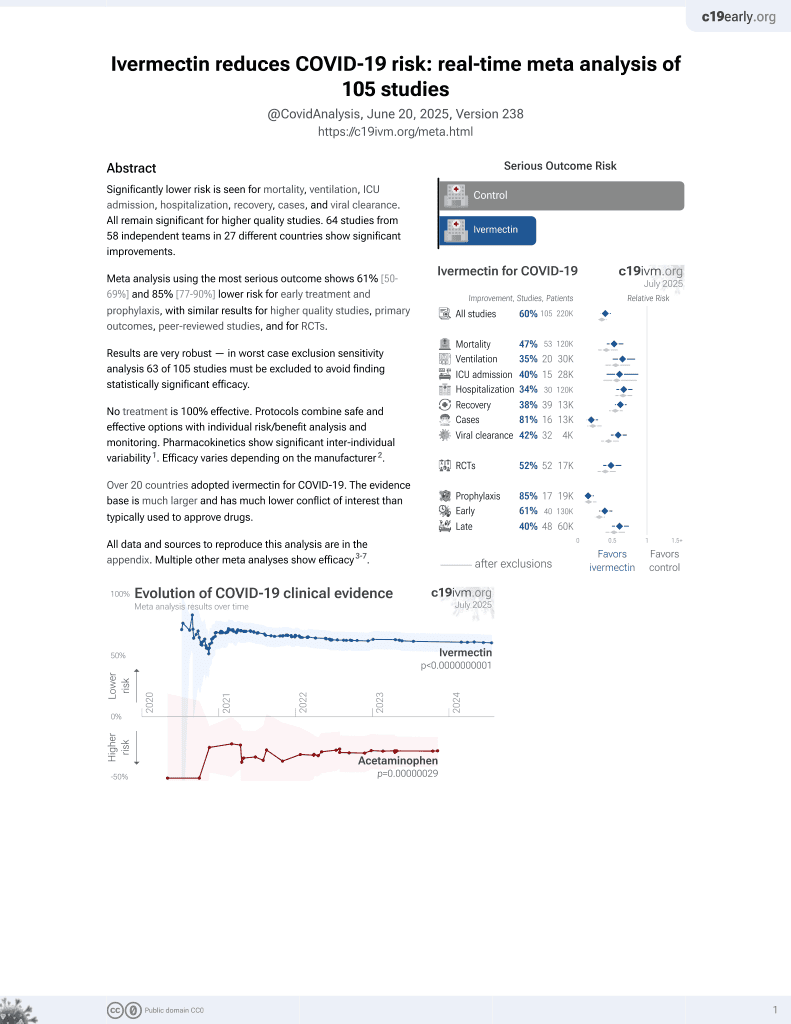
Secondary immunological analysis of the SAINT RCT, which reported lower viral loads and significantly shorter hyposmia/anosmia duration with ivermectin treatment. This secondary analysis found significantly higher anti-nucleocapsid IgG levels at days 4 and 7 and differences in blood transcriptional modules. The clinical implications of the immunological findings remain uncertain. The small sample size limits the ability to detect effects or exclude effects of meaningful magnitude.
Notable revisions to this paper reduce the prominence of favorable findings and weaken the reported statistical significance of a biological effect:
Favorable clinical findings were removed from the abstract: the preprint’s abstract and author summary report lower viral loads and significantly shorter hyposmia/anosmia duration. Neither appears in the revised abstract.
A T-cell finding originally reported as statistically significant after adjustment is described as non-significant after adjustment in the journal version. The original reports lower spike-specific naïve CD4+ T-cell frequencies with adjusted p=0.02. The revision retains p=0.02 but states the difference was non-significant after adjustment. Internal evidence supports 0.02 as the adjusted value: Figure 4 in both versions shows this comparison with two asterisks, defined as unadjusted p<0.01. The revised effect size r=0.61, sample size n=20, and formula r=Z/√N imply Z≈2.73 and an unadjusted two-sided p≈0.0064. Both support a raw p-value below 0.01 and are compatible with an adjusted value of 0.02. (The clinical meaning is uncertain - this could accompany a favorable response, such as reduced antigen exposure following antiviral activity or differentiation into effector/memory cells, but could also reflect reduced immune priming, altered cell distribution, or baseline variation).
The preprint and journal version provide contradicatory descriptions of day 1 values. The preprint reports that “Day 1 was excluded as treatment had just been given and no effect was expected," while the journal version states that day-1 samples were collected before treatment administration, and describes them as pre-dose baseline.
Excluding baseline from post-treatment outcomes does not require excluding it as an adjustment variable. The antibody/cytokine treatment-comparison models do not explicitly adjust for individual baseline measurements. This is significant with only 12 patients per arm and antibody differences apparent at baseline. The transcriptomic comparisons, by contrast, do explicitly adjust for baseline.
Ribes et al., 3 Apr 2025, Double Blind Randomized Controlled Trial, placebo-controlled, Spain, peer-reviewed, median age 26.0, 23 authors, study period 31 July, 2020 - 11 September, 2020.
Minimal impact of ivermectin on immune response and transcriptional profiles in naïve adults with mild COVID-19
doi:10.1101/2025.03.31.646276
Ivermectin (IVM), an antiparasitic drug, was repurposed to treat COVID-19 based on its in vitro antiviral effects. However, it was abandoned after multiple clinical trials reported a lack of efficacy. Immunomodulatory effects have been proposed but remain unclear, yet they may be relevant given IVM use for other infections. We assessed the IVM immunomodulatory effect in 24 participants from a clinical trial evaluating its potential to reduce COVID-19 transmission in mild cases within 48 hours of symptoms onset. The IVMtreated patients showed non-significant lower viral loads, and a significantly shorter duration of hyposmia/anosmia. We measured IgG, IgA, and IgM against five SARS-CoV-2 antigens, and 30 cytokines by Luminex, alongside whole blood RNA sequencing, pan-leukocyte immunophenotyping, and SARS-CoV-2-specific T cell analysis by flow cytometry from day 1 to day 28 post-treatment. All antibody responses increased from day 4, while 13 cytokines significantly decreased over time (adjusted p<0.05). IVM-treated patients had only significantly higher anti-nucleocapsid IgG levels at day 4 (adjusted p=0.041) and 7 (adjusted p=0.045) compared to placebo. SARS-CoV-2-specific CD4 + and CD8 + T cells increased over time, with significantly higher effector memory CD4 + T cells at day 7 compared to day 1 (p=0.027) and the only difference between groups was lower frequencies of spike-specific naïve CD4 + T cells at day 7 in IVM-treated participants (0.006% vs 0.036% p=0.02). Transcriptomic data showed downregulation of innate and antiviral blood transcriptional modules (BTMs) over time, with an increase in adaptive immune related BTMs. While no differential gene expression was detected, the IVM-treated had upregulated innate and downregulated T cell and cell cycle BTMs compared to placebo. Overall, our comprehensive longitudinal analysis of early immune responses in mild COVID-19 revealed no robust immunological effects of IVM, consistent with clinical trials results and suggesting a lack of efficacy of IVM in COVID-19 treatment. .
SUPPORTING INFORMATION CAPTIONS Supplementary Figures Supplementary Figure 1 . Kinetics of antibody levels to N antigen from human coronaviruses causing the common cold since day of treatment. Log-10 transformed levels (median fluorescence intensity, MFI) of IgA, IgG, and IgM against the N antigen of HKU1, NL63, OC43 and 229E coronaviruses measured in 24 patients across six time points (data from same individual are joined by lines). For each timepoint boxplots represent median and interquartile range MFI for ivermectin-treated patients (orange) and placebotreated patients (blue).
Supplementary Figure 2. Kinetics of cytokine concentrations since day of treatment. Levels (pg/mL) of cytokines measured in 24 patients across six time points (data from same individual are joined by lines). For each timepoint boxplots represent median and interquartile range pg/mL for ivermectin-treated patients (orange) and placebo-treated patients (blue). Represented are the 16 out of the 30 cytokines analyzed that did not show statistical differences between timepoints. 3 . Gating strategy for the AIM assay. Example of the flow cytometry staining and gating strategy for the AIM panel. Gates were previously defined using fluorescence minus one (FMO) controls. A. The time vs FSC-A gate was used to exclude any acquisition irregularities. FSC-H and FSC-A were used to discriminate singlets and SSC-A vs FSC-A to select lymphocytes. Monocytes, B cells and dead cells were excluded by selecting CD14..
References
Aleebrahim-Dehkordi, Molavi, Mokhtari, Deravi, Fathi et al., T helper type (Th1/Th2) responses to SARS-CoV-2 and influenza A (H1N1) virus: From cytokines produced to immune responses, Transpl Immunol, doi:10.1016/j.trim.2021.101495
Almendro-Vázquez, Laguna-Goya, Paz-Artal, Nair, Jergovic, Defending against SARS-CoV-2: The T cell perspective, doi:10.3389/fimmu.2023.1107803
Blakley, Rousseaux, Effect of ivermectin on the immune response in mice, Am J Vet Res
Bozkurt, Kaya, Yildirim, Yildiz, Gungor et al., The effect of multiple-dose ivermectin treatment on CD4+/CD8+ and the oxidative stress index in goats with udder viral papillomatosis, Res Vet Sci, doi:10.1016/j.rvsc.2023.02.006
Caly, Druce, Catton, Jans, Wagstaff, The FDA-approved drug ivermectin inhibits the replication of SARS-CoV-2 in vitro, Antiviral Res, doi:10.1016/J.ANTIVIRAL.2020.104787
Chaccour, Casellas, Blanco-Di Matteo, Pineda Nigo, Fernandez-Montero et al., The effect of early treatment with ivermectin on viral load, symptoms and humoral response in patients with nonsevere COVID-19: A pilot, double-blind, placebo-controlled, randomized clinical trial, EClinicalMedicine, doi:10.1016/j.eclinm.2020.100720
Chaccour, Ruiz-Castillo, Richardson, Moncunill, Casellas et al., The SARS-CoV-2 Ivermectin Navarra-ISGlobal Trial (SAINT) to Evaluate the Potential of Ivermectin to Reduce COVID-19 Transmission in low risk, non-severe COVID-19 patients in the first 48 hours after symptoms onset: A structured summary of a study protocol for a randomized control pilot trial, Trials, doi:10.1186/S13063-020-04421-Z
Choudhury, Das, Patra, Bhattacharya, Ghosh et al., Exploring the binding efficacy of ivermectin against the key proteins of SARS-CoV-2 pathogenesis: an in silico approach, Future Virol, doi:10.2217/FVL-2020-0342
Dan, Mateus, Kato, Hastie, Yu et al., Immunological memory to SARS-CoV-2 assessed for up to 8 months after infection, Science, doi:10.1126/SCIENCE.ABF4063/SUPPL_FILE/PAPV2.PDF
Dobaño, Vidal, Santano, Jiménez, Chi et al., Highly Sensitive and Specific Multiplex Antibody Assays To Quantify Immunoglobulins M, A, and G against SARS-CoV-2 Antigens, J Clin Microbiol, doi:10.1128/JCM.01731-20
Formiga, Leblanc, De Souza Rebouças, Farias, De Oliveira et al., Ivermectin: an award-winning drug with expected antiviral activity against COVID-19, Journal of Controlled Release, doi:10.1016/j.jconrel.2020.10.009
Galmiche, Cortier, Charmet, Schaeffer, Chény et al., SARS-CoV-2 incubation period across variants of concern, individual factors, and circumstances of infection in France: a case series analysis from the ComCor study, Lancet Microbe, doi:10.1016/S2666-5247(23)00005-8
Garcia-Basteiro, Moncunill, Tortajada, Vidal, Guinovart et al., Seroprevalence of antibodies against SARS-CoV-2 among health care workers in a large Spanish reference hospital, Nat Commun, doi:10.1038/s41467-020-17318-x
Grifoni, Weiskopf, Ramirez, Mateus, Dan et al., Targets of T Cell Responses to SARS-CoV-2 Coronavirus in Humans with COVID-19 Disease and Unexposed Individuals, Cell, doi:10.1016/J.CELL.2020.05.015
Gupta, Biswal, Panda, Ray, Rana, Binding mechanism and structural insights into the identified protein target of COVID-19 and importin-α with in-vitro effective drug ivermectin, J Biomol Struct Dyn, doi:10.1080/07391102.2020.1839564
Laing, Devaney, Ivermectin -Old Drug, New Tricks?, Trends Parasitol, doi:10.1016/J.PT.2017.02.004
Lehrer, Rheinstein, Ivermectin Docks to the SARS-CoV-2 Spike Receptor-binding Domain Attached to ACE2, Vivo, doi:10.21873/INVIVO.12134
Long, Tang, Shi, Li, Deng et al., Clinical and immunological assessment of asymptomatic SARS-CoV-2 infections, Nat Med, doi:10.1038/s41591-020-0965-6
Martins, Pasi, Litwin, Hill, Heterophile Antibody Interference in a Multiplexed Fluorescent Microsphere Immunoassay for Quantitation of Cytokines in Human Serum, Clinical and Vaccine Immunology, doi:10.1128/CDLI.11.2.325-329.2004
Moderbacher, Ramirez, Dan, Grifoni, Hastie et al., Antigen-Specific Adaptive Immunity to SARS-CoV-2 in Acute COVID-19 and Associations with Age and Disease Severity, Cell, doi:10.1016/J.CELL.2020.09.038
Moncunill, Mayor, Santano, Jiménez, Vidal et al., SARS-CoV-2 Seroprevalence and Antibody Kinetics among Health Care Workers in a Spanish Hospital after 3 Months of Follow-up, Journal of Infectious Diseases, doi:10.1093/infdis/jiaa696
Natama, Moncunill, Rovira-Vallbona, Sanz, Sorgho et al., Modulation of innate immune responses at birth by prenatal malaria exposure and association with malaria risk during the first year of life, BMC Med, doi:10.1186/s12916-018-1187-3
Ortega, Ribes, Vidal, Rubio, Aguilar et al., Seven-month kinetics of SARS-CoV-2 antibodies and role of pre-existing antibodies to human coronaviruses, Nat Commun, doi:10.1038/s41467-021-24979-9
Pedroso, Vaz, Netto, Souza, Deminco et al., Self-prescribed Ivermectin use is associated with a lower rate of seroconversion in health care workers diagnosed with COVID, in a dose-dependent response, Brazilian Journal of Infectious Diseases, doi:10.1016/J.BJID.2021.101603
Popp, Reis, Schießer, Hausinger, Stegemann et al., Ivermectin for preventing and treating COVID-19, Cochrane Database of Systematic Reviews, doi:10.1002/14651858.CD015017.PUB3
Rubio, Macià, Barrios, Vidal, Jiménez et al., High-resolution kinetics and cellular determinants of SARS-CoV-2 antibody response over two years after COVID-19 vaccination, Microbes Infect, doi:10.1016/j.micinf.2024.105423
Sajid, Iqbal, Muhammad, Iqbal, Immunomodulatory effect of various anti-parasitics: A review, Parasitology, doi:10.1017/S0031182005009108
Sajid, Iqbal, Muhammad, Sandhu, Khan et al., Effect of ivermectin on the cellular and humoral immune responses of rabbits, Life Sci, doi:10.1016/j.lfs.2007.02.025
Savanur, Effect of Ivermectin on Immune-Response in Rabbits Inoculated with Salmonella Antigen, Indian Veterinary Journal
Schulien, Kemming, Oberhardt, Wild, Seidel et al., Characterization of pre-existing and induced SARS-CoV-2-specific CD8+ T cells, Nat Med, doi:10.1038/s41591-020-01143-2
Sekine, Perez-Potti, Rivera-Ballesteros, Strålin, Gorin et al., Robust T cell immunity in convalescent individuals with asymptomatic or mild COVID-19, BioRxiv, doi:10.1101/2020.06.29.174888
Sette, Crotty, Adaptive immunity to SARS-CoV-2 and COVID-19, Cell, doi:10.1016/J.CELL.2021.01.007
Soboslay, Dreweck, Hoffmann, Luder, Heuschkel et al., Ivermectin-facilitated immunity in onchocerciasis. Reversal of lymphocytopenia, cellular anergy and deficient cytokine production after single treatment, Clin Exp Immunol
Stankiewicz, Cabaj, Moore, Millar, Chie, Influence of ivermectin on cellular and humoral immune responses of lambs
Steel, Lujan-Trangay, Gonzalez-Peralta, Flores, Nutman, Immunologic Responses to Repeated Ivermect in Treatmentin Patients with Onchocerciasis, J Infect Dis, doi:10.1093/infdis/164.3.581
Stephenson, Reynolds, Botting, Calero-Nieto, Morgan et al., Single-cell multi-omics analysis of the immune response in COVID-19, Nat Med, doi:10.1038/s41591-021-01329-2
Uhlir, Volf, Ivermectin: its effect on the immune system of rabbits and rats infested with ectoparasites
Venditto, Haydar, Latif, Gensel, Anstead et al., Immunomodulatory Effects of Azithromycin Revisited: Potential Applications to COVID-19, Front Immunol, doi:10.3389/fimmu.2021.574425
Ventre, Eres, Lenief, Albert, Rossio et al., Topical ivermectin improves allergic skin inflammation, Allergy, doi:10.1111/all.13118
Waterboer, Sehr, Pawlita, Suppression of non-specific binding in serological Luminex assays, J Immunol Methods, doi:10.1016/j.jim.2005.11.008
Wehbe, Wehbe, Iratni, Pintus, Zaraket et al., Repurposing Ivermectin for COVID-19: Molecular Aspects and Therapeutic Possibilities, Front Immunol, doi:10.3389/FIMMU.2021.663586/BIBTEX
Wilson, Reaves, Wolstenholme, Lack of detectable short-term effects of a single dose of ivermectin on the human immune system, Parasit Vectors, doi:10.1186/S13071-021-04810-6/FIGURES/4
Winheim, Rinke, Lutz, Reischer, Leutbecher et al., Impaired function and delayed regeneration of dendritic cells in COVID-19, PLoS Pathog, doi:10.1371/journal.ppat.1009742
Yang, Atkinson, Wang, Lee, Bogoyevitch et al., The broad spectrum antiviral ivermectin targets the host nuclear transport importin α/β1 heterodimer, Antiviral Res, doi:10.1016/j.antiviral.2020.104760
Zaidi, Dehgani-Mobaraki, The mechanisms of action of ivermectin against SARS-CoV-2-an extensive review, The Journal of Antibiotics, doi:10.1038/s41429-021-00491-6
Zhang, Song, Xiong, Ci, Li et al., Inhibitory effects of ivermectin on nitric oxide and prostaglandin E2 production in LPS-stimulated RAW 264.7 macrophages, Int Immunopharmacol, doi:10.1016/J.INTIMP.2008.12.016
Zheng, Tao, Cheng, Wang, Cheng et al., Efficacy of ivermectin for control of microfilaremia recurring after treatment with diethylcarbamazine. II. Immunologic changes following treatment, Am J Trop Med Hyg
Österberg, Falck-Jones, Vangeti, Åhlberg, Yu et al., Decreased levels and function of dendritic cells in blood and airways predict COVID-19 severity, Clin Transl Immunology, doi:10.1002/cti2.70026
DOI record:
{
"DOI": "10.1038/s41598-026-71991-4",
"ISSN": [
"2045-2322"
],
"URL": "http://dx.doi.org/10.1038/s41598-026-71991-4",
"alternative-id": [
"71991"
],
"assertion": [
{
"group": {
"label": "Article History",
"name": "ArticleHistory"
},
"label": "Received",
"name": "received",
"order": 1,
"value": "30 July 2025"
},
{
"group": {
"label": "Article History",
"name": "ArticleHistory"
},
"label": "Accepted",
"name": "accepted",
"order": 2,
"value": "14 September 2026"
},
{
"group": {
"label": "Article History",
"name": "ArticleHistory"
},
"label": "First Online",
"name": "first_online",
"order": 3,
"value": "1 October 2026"
},
{
"group": {
"label": "Declarations",
"name": "EthicsHeading"
},
"label": "Ethics approval and consent to participate",
"name": "Ethics",
"order": 1,
"value": "The protocol of the clinical trial has been described elsewhere\n 24\n . It was approved by the Spanish national ethics committee for drug research (Hospital Puerta de Hierro Majadahonda) and the Spanish Agency of Medicines and Medical Devices. All patients provided written informed consent and procedures were conducted in compliance with the latest version of the Helsinki Declaration and Good Clinical Practice."
},
{
"group": {
"label": "Declarations",
"name": "EthicsHeading"
},
"label": "Competing interests",
"name": "Ethics",
"order": 2,
"value": "P.S. is founder, scientific officer and stockholder of Parvus Therapeutics and receives funding from the company. He also has a consulting agreement with Sanofi. All other authors do not have any competing interest."
}
],
"author": [
{
"affiliation": [],
"family": "Ribes",
"given": "Marta",
"role": [
{
"role": "author",
"vocabulary": "crossref"
}
],
"sequence": "first"
},
{
"affiliation": [],
"family": "Canyelles",
"given": "Mar",
"role": [
{
"role": "author",
"vocabulary": "crossref"
}
],
"sequence": "additional"
},
{
"affiliation": [],
"family": "Torres",
"given": "Cèlia",
"role": [
{
"role": "author",
"vocabulary": "crossref"
}
],
"sequence": "additional"
},
{
"affiliation": [],
"family": "Rubio",
"given": "Rocío",
"role": [
{
"role": "author",
"vocabulary": "crossref"
}
],
"sequence": "additional"
},
{
"affiliation": [],
"family": "Vidal",
"given": "Marta",
"role": [
{
"role": "author",
"vocabulary": "crossref"
}
],
"sequence": "additional"
},
{
"affiliation": [],
"family": "Izquierdo",
"given": "Luis",
"role": [
{
"role": "author",
"vocabulary": "crossref"
}
],
"sequence": "additional"
},
{
"affiliation": [],
"family": "Blanco-Di Matteo",
"given": "Andrés",
"role": [
{
"role": "author",
"vocabulary": "crossref"
}
],
"sequence": "additional"
},
{
"affiliation": [],
"family": "Pineda",
"given": "Iñigo",
"role": [
{
"role": "author",
"vocabulary": "crossref"
}
],
"sequence": "additional"
},
{
"affiliation": [],
"family": "Fernandez-Montero",
"given": "Alejandro",
"role": [
{
"role": "author",
"vocabulary": "crossref"
}
],
"sequence": "additional"
},
{
"affiliation": [],
"family": "Jordan-Iborra",
"given": "Carlota",
"role": [
{
"role": "author",
"vocabulary": "crossref"
}
],
"sequence": "additional"
},
{
"affiliation": [],
"family": "Carmona-Torre",
"given": "Francisco",
"role": [
{
"role": "author",
"vocabulary": "crossref"
}
],
"sequence": "additional"
},
{
"affiliation": [],
"family": "Yuste",
"given": "José R.",
"role": [
{
"role": "author",
"vocabulary": "crossref"
}
],
"sequence": "additional"
},
{
"affiliation": [],
"family": "Del Pozo",
"given": "Jose L.",
"role": [
{
"role": "author",
"vocabulary": "crossref"
}
],
"sequence": "additional"
},
{
"affiliation": [],
"family": "Reina",
"given": "Gabriel",
"role": [
{
"role": "author",
"vocabulary": "crossref"
}
],
"sequence": "additional"
},
{
"affiliation": [],
"family": "Sadaba",
"given": "Belen",
"role": [
{
"role": "author",
"vocabulary": "crossref"
}
],
"sequence": "additional"
},
{
"affiliation": [],
"family": "Fernández-Alonso",
"given": "Mirian",
"role": [
{
"role": "author",
"vocabulary": "crossref"
}
],
"sequence": "additional"
},
{
"affiliation": [],
"family": "Santamaria",
"given": "Pere",
"role": [
{
"role": "author",
"vocabulary": "crossref"
}
],
"sequence": "additional"
},
{
"affiliation": [],
"family": "Carolis",
"given": "Carlo",
"role": [
{
"role": "author",
"vocabulary": "crossref"
}
],
"sequence": "additional"
},
{
"affiliation": [],
"family": "Aguilar",
"given": "Ruth",
"role": [
{
"role": "author",
"vocabulary": "crossref"
}
],
"sequence": "additional"
},
{
"affiliation": [],
"family": "Macià",
"given": "Dídac",
"role": [
{
"role": "author",
"vocabulary": "crossref"
}
],
"sequence": "additional"
},
{
"affiliation": [],
"family": "Chaccour",
"given": "Carlos",
"role": [
{
"role": "author",
"vocabulary": "crossref"
}
],
"sequence": "additional"
},
{
"affiliation": [],
"family": "Dobaño",
"given": "Carlota",
"role": [
{
"role": "author",
"vocabulary": "crossref"
}
],
"sequence": "additional"
},
{
"affiliation": [],
"family": "Moncunill",
"given": "Gemma",
"role": [
{
"role": "author",
"vocabulary": "crossref"
}
],
"sequence": "additional"
}
],
"container-title": "Scientific Reports",
"container-title-short": "Sci Rep",
"content-domain": {
"crossmark-restriction": false,
"domain": [
"link.springer.com"
]
},
"created": {
"date-parts": [
[
2026,
10,
1
]
],
"date-time": "2026-10-01T21:05:57Z",
"timestamp": 1790888757000
},
"deposited": {
"date-parts": [
[
2026,
10,
1
]
],
"date-time": "2026-10-01T21:05:58Z",
"timestamp": 1790888758000
},
"funder": [
{
"DOI": "10.13039/501100003030",
"award": [
"AGAUR-FI_B 01022"
],
"award-info": [
{
"award-number": [
"AGAUR-FI_B 01022"
]
}
],
"doi-asserted-by": "publisher",
"id": [
{
"asserted-by": "publisher",
"id": "10.13039/501100003030",
"id-type": "DOI"
}
],
"name": "Agència de Gestió d'Ajuts Universitaris i de Recerca"
},
{
"award": [
"PERIS SLT017/20/000224"
],
"award-info": [
{
"award-number": [
"PERIS SLT017/20/000224"
]
}
],
"name": "Health Department, Catalan Government"
},
{
"DOI": "10.13039/100014440",
"award": [
"PID2021-125493OB-I00"
],
"award-info": [
{
"award-number": [
"PID2021-125493OB-I00"
]
}
],
"doi-asserted-by": "publisher",
"id": [
{
"asserted-by": "publisher",
"id": "10.13039/100014440",
"id-type": "DOI"
}
],
"name": "Ministerio de Ciencia, Innovación y Universidades"
},
{
"DOI": "10.13039/100014440",
"award": [
"RYC 2020-029886-I/AEI/10.13039/501100011033"
],
"award-info": [
{
"award-number": [
"RYC 2020-029886-I/AEI/10.13039/501100011033"
]
}
],
"doi-asserted-by": "publisher",
"id": [
{
"asserted-by": "publisher",
"id": "10.13039/100014440",
"id-type": "DOI"
}
],
"name": "Ministerio de Ciencia, Innovación y Universidades"
}
],
"indexed": {
"date-parts": [
[
2026,
10,
1
]
],
"date-time": "2026-10-01T21:56:06Z",
"timestamp": 1790891766587,
"version": "4.1.0"
},
"is-referenced-by-count": 0,
"issued": {
"date-parts": [
[
2026,
10,
1
]
]
},
"language": "en",
"license": [
{
"URL": "https://creativecommons.org/licenses/by-nc-nd/4.0",
"content-version": "tdm",
"delay-in-days": 0,
"start": {
"date-parts": [
[
2026,
10,
1
]
],
"date-time": "2026-10-01T00:00:00Z",
"timestamp": 1790812800000
}
},
{
"URL": "https://creativecommons.org/licenses/by-nc-nd/4.0",
"content-version": "am",
"delay-in-days": 0,
"start": {
"date-parts": [
[
2026,
10,
1
]
],
"date-time": "2026-10-01T00:00:00Z",
"timestamp": 1790812800000
}
}
],
"link": [
{
"URL": "https://www.nature.com/articles/s41598-026-71991-4",
"content-type": "text/html",
"content-version": "vor",
"intended-application": "text-mining"
}
],
"member": "297",
"original-title": [],
"prefix": "10.1038",
"published": {
"date-parts": [
[
2026,
10,
1
]
]
},
"published-online": {
"date-parts": [
[
2026,
10,
1
]
]
},
"publisher": "Springer Science and Business Media LLC",
"reference-count": 0,
"references-count": 0,
"relation": {},
"resource": {
"primary": {
"URL": "https://www.nature.com/articles/s41598-026-71991-4"
}
},
"score": 1,
"short-title": [],
"source": "Crossref",
"subject": [],
"subtitle": [],
"title": "Limited impact of ivermectin on immune response and transcriptional profiles in mild COVID-19",
"type": "journal-article",
"update-policy": "https://doi.org/10.1007/springer_crossmark_policy"
}