Real-world clinical outcomes of treatment with casirivimab-imdevimab among patients with mild-to-moderate coronavirus disease 2019 during the Delta variant pandemic
Yasuhito Suzuki, MD Yoko Shibata, Hiroyuki Minemura, Takefumi Nikaido, Yoshinori Tanino, Atsuro Fukuhara, Ryuzo Kanno, Hiroyuki Saito, Shuzo Suzuki, Taeko Ishii, Yayoi Inokoshi, Eiichiro Sando, Hirofumi Sakuma, Tatsuho Kobayashi, Hiroaki Kume, Masahiro Kamimoto, Hideko Aoki, Akira Takama, Takamichi Kamiyama, Masaru Nakayama, Kiyoshi Saito, Koichi Tanigawa, Masahiko Sato, Toshiyuki Kanbe, Norio Kanzaki, Teruhisa Azuma, Keiji Sakamoto, Yuichi Nakamura, Hiroshi Otani, Mitsuru Waragai, Shinsaku Maeda, Tokiya Ishida, Keishi Sugino, Yasuhiko Tsukada, Ryuki Yamada, Riko Sato, Takumi Omuna, Hikaru Tomita, Mikako Saito, Natsumi Watanabe, Mami Rikimaru, Takaya Kawamata, Takashi Umeda, Julia Morimoto, Ryuichi Togawa, Yuki Sato, Junpei Saito, Kenya Kanazawa, Ken Iseki
doi:10.1101/2021.12.19.21268078
This real-world retrospective study demonstrates the contribution of treatment with casirivimab-imdevimab to the prevention of deterioration in patients with mild-to-All rights reserved. No reuse allowed without permission. perpetuity.
References
Abu-Raddad, Chemaitelly, Butt, Effectiveness of the BNT162b2 Covid-19 Vaccine against the B.1.1.7 and B.1.351 Variants, The New England journal of medicine
Austin, Optimal caliper widths for propensity-score matching when estimating differences in means and differences in proportions in observational studies, Pharmaceutical statistics
Baum, Fulton, Wloga, Antibody cocktail to SARS-CoV-2 spike protein prevents rapid mutational escape seen with individual antibodies, Science
Bernal, Andrews, Gower, Effectiveness of Covid-19 Vaccines against the B.1.617.2 (Delta) Variant, The New England journal of medicine
Ganesh, Philpot, Bierle, Real-World Clinical Outcomes of Bamlanivimab and Casirivimab-Imdevimab Among High-Risk Patients With Mild to Moderate Coronavirus Disease 2019, The Journal of infectious diseases
Gottlieb, Nirula, Chen, Effect of Bamlanivimab as Monotherapy or in Combination With Etesevimab on Viral Load in Patients With Mild to Moderate COVID-19: A Randomized Clinical Trial, Jama
Hu, Peng, Wang, Emerging SARS-CoV-2 variants reduce neutralization sensitivity to convalescent sera and monoclonal antibodies, Cellular & molecular immunology
Huang, Yang, Xu, Xu, Liu, Structural and functional properties of SARS-CoV-2 spike protein: potential antivirus drug development for COVID-19, Acta pharmacologica Sinica
Ito, Piantham, Nishiura, Predicted dominance of variant Delta of SARS-CoV-2 before Tokyo Olympic Games, Japan, Euro surveillance : bulletin Europeen sur les maladies transmissibles = European communicable disease bulletin
Korber, Fischer, Gnanakaran, Tracking Changes in SARS-CoV-2 Spike: Evidence that D614G Increases Infectivity of the COVID-19 Virus, Cell
Kumar, Banu, Sasikala, Effectiveness of REGEN-COV antibody cocktail against the B.1.617.2 (delta) variant of SARS-CoV-2: A cohort study, Journal of internal medicine
Planas, Veyer, Baidaliuk, Reduced sensitivity of SARS-CoV-2 variant Delta to antibody neutralization, Nature
Polack, Thomas, Kitchin, Safety and Efficacy of the BNT162b2 mRNA Covid-19
Razonable, Pawlowski, Horo, Casirivimab-Imdevimab treatment is associated with reduced rates of hospitalization among high-risk patients with mild to moderate coronavirus disease-19, EClinicalMedicine
Shiba, Kawahara, Using Propensity Scores for Causal Inference: Pitfalls and Tips, Journal of epidemiology
Shibata, Minemura, Suzuki, Development and external validation of the DOAT and DOATS scores: simple decision support tools to identify disease progression among nonelderly patients with mild/moderate COVID-19
Taylor, Adams, Hufford, De La Torre, Winthrop et al., Neutralizing monoclonal antibodies for treatment of COVID-19, Nature reviews Immunology
The_Official_Website_Of_Fukushima_Prefecture, Confirmed cases of COVID-19 in Fukushima
The_Official_Website_Of_Fukushima_Prefecture, The variant of COVID-19 in Fukushima from
Uriu, Kimura, Shirakawa, Neutralization of the SARS-CoV-2 Mu Variant by Convalescent and Vaccine Serum, The New England journal of medicine
Vaccine, None, The New England journal of medicine
Verderese, Stepanova, Lam, Neutralizing Monoclonal Antibody Treatment Reduces Hospitalization for Mild and Moderate COVID-19: A Real-World Experience, Clinical infectious diseases
Wang, Nair, Liu, Antibody resistance of SARS-CoV-2 variants B.1.351 and B.1.1.7, Nature
Weinreich, Sivapalasingam, Norton, REGN-COV2, a Neutralizing Antibody Cocktail, in Outpatients with Covid-19, The New England journal of medicine
Wilhelm, Toptan, Pallas, Antibody-Mediated Neutralization of Authentic SARS-CoV
Yamamoto, Wada, Ichikawa, Evaluation of Biomarkers of Severity in Patients with COVID-19 Infection, J Clin Med
DOI record:
{
"DOI": "10.1101/2021.12.19.21268078",
"URL": "http://dx.doi.org/10.1101/2021.12.19.21268078",
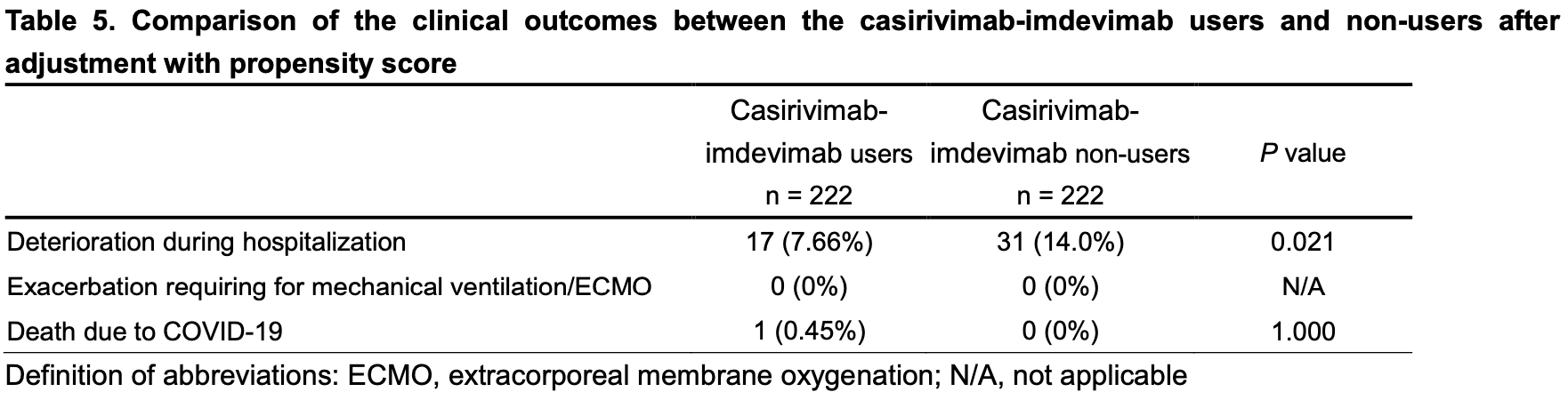
"abstract": "<jats:p>Background: Mutations of severe acute respiratory syndrome coronavirus 2 (SARS-CoV-2) may reduce the efficacy of neutralizing monoclonal antibody therapy against coronavirus disease 2019 (COVID-19). We here evaluated the efficacy of casirivimab-imdevimab in patients with mild-to-moderate COVID-19 during the Delta variant surge in Fukushima Prefecture, Japan.\nMethods: We enrolled 949 patients with mild-to-moderate COVID-19 who were admitted to hospital between July 24, 2021 and September 30, 2021. Clinical deterioration after admission was compared between casirivimab-imdevimab users (n = 314) and non-users (n = 635). \nResults: The casirivimab-imdevimab users were older (P < 0.0001), had higher body temperature (≥ 38 degree) (P < 0.0001) and greater rates of history of cigarette smoking (P = 0.0068), hypertension (P = 0.0004), obesity (P < 0.0001), and dyslipidemia (P < 0.0001) than the non-users. Multivariate logistic regression analysis demonstrated that receiving casirivimab-imdevimab was an independent factor for preventing deterioration (odds ratio 0.448; 95% confidence interval 0.263 to 0.763; P = 0.0023). Furthermore, in 222 patients who were selected from each group after matching on the propensity score, deterioration was significantly lower among those receiving casirivimab-imdevimab compared to those not receiving casirivimab-imdevimab (7.66% vs 14.0%; p = 0.021).\nConclusion: This real-world study demonstrates that casirivimab-imdevimab contributes to the prevention of deterioration in COVID-19 patients after hospitalization during a Delta variant surge.</jats:p>",
"accepted": {
"date-parts": [
[
2021,
12,
21
]
]
},
"author": [
{
"affiliation": [],
"family": "Suzuki",
"given": "Yasuhito",
"sequence": "first"
},
{
"affiliation": [],
"family": "Shibata",
"given": "Yoko",
"sequence": "additional"
},
{
"affiliation": [],
"family": "Minemura",
"given": "Hiroyuki",
"sequence": "additional"
},
{
"affiliation": [],
"family": "Nikaido",
"given": "Takehumi",
"sequence": "additional"
},
{
"affiliation": [],
"family": "Tanino",
"given": "Yoshinori",
"sequence": "additional"
},
{
"affiliation": [],
"family": "Fukuhara",
"given": "Atsuro",
"sequence": "additional"
},
{
"affiliation": [],
"family": "Kanno",
"given": "Ryuzo",
"sequence": "additional"
},
{
"affiliation": [],
"family": "Saito",
"given": "Hiroyuki",
"sequence": "additional"
},
{
"affiliation": [],
"family": "Suzuki",
"given": "Shuzo",
"sequence": "additional"
},
{
"affiliation": [],
"family": "Ishii",
"given": "Taeko",
"sequence": "additional"
},
{
"affiliation": [],
"family": "Inokoshi",
"given": "Yayoi",
"sequence": "additional"
},
{
"affiliation": [],
"family": "Sando",
"given": "Eiichiro",
"sequence": "additional"
},
{
"affiliation": [],
"family": "Sakuma",
"given": "Hirofumi",
"sequence": "additional"
},
{
"affiliation": [],
"family": "Kobayashi",
"given": "Tatsuho",
"sequence": "additional"
},
{
"affiliation": [],
"family": "Kume",
"given": "Hiroaki",
"sequence": "additional"
},
{
"affiliation": [],
"family": "Kamimoto",
"given": "Masahiro",
"sequence": "additional"
},
{
"affiliation": [],
"family": "Aoki",
"given": "Hideko",
"sequence": "additional"
},
{
"affiliation": [],
"family": "Takama",
"given": "Akira",
"sequence": "additional"
},
{
"affiliation": [],
"family": "Kamiyama",
"given": "Takamichi",
"sequence": "additional"
},
{
"affiliation": [],
"family": "Nakayama",
"given": "Masaru",
"sequence": "additional"
},
{
"affiliation": [],
"family": "Saito",
"given": "Kiyoshi",
"sequence": "additional"
},
{
"affiliation": [],
"family": "Tanigawa",
"given": "Koichi",
"sequence": "additional"
},
{
"affiliation": [],
"family": "Sato",
"given": "Masahiko",
"sequence": "additional"
},
{
"affiliation": [],
"family": "Kanbe",
"given": "Toshiyuki",
"sequence": "additional"
},
{
"affiliation": [],
"family": "Kanzaki",
"given": "Norio",
"sequence": "additional"
},
{
"affiliation": [],
"family": "Azuma",
"given": "Teruhisa",
"sequence": "additional"
},
{
"affiliation": [],
"family": "Sakamoto",
"given": "Keiji",
"sequence": "additional"
},
{
"affiliation": [],
"family": "Nakamura",
"given": "Yuichi",
"sequence": "additional"
},
{
"affiliation": [],
"family": "Otani",
"given": "Hiroshi",
"sequence": "additional"
},
{
"affiliation": [],
"family": "Waragai",
"given": "Mitsuru",
"sequence": "additional"
},
{
"affiliation": [],
"family": "Maeda",
"given": "Shinsaku",
"sequence": "additional"
},
{
"affiliation": [],
"family": "Ishida",
"given": "Tokiya",
"sequence": "additional"
},
{
"affiliation": [],
"family": "Sugino",
"given": "Keishi",
"sequence": "additional"
},
{
"affiliation": [],
"family": "Tsukada",
"given": "Yasuhiko",
"sequence": "additional"
},
{
"affiliation": [],
"family": "Yamada",
"given": "Ryuki",
"sequence": "additional"
},
{
"affiliation": [],
"family": "Sato",
"given": "Riko",
"sequence": "additional"
},
{
"affiliation": [],
"family": "Omuna",
"given": "Takumi",
"sequence": "additional"
},
{
"affiliation": [],
"family": "Tomita",
"given": "Hikaru",
"sequence": "additional"
},
{
"affiliation": [],
"family": "Saito",
"given": "Mikako",
"sequence": "additional"
},
{
"affiliation": [],
"family": "Watanabe",
"given": "Natsumi",
"sequence": "additional"
},
{
"affiliation": [],
"family": "Rikimaru",
"given": "Mami",
"sequence": "additional"
},
{
"affiliation": [],
"family": "Kawamata",
"given": "Takaya",
"sequence": "additional"
},
{
"affiliation": [],
"family": "Umeda",
"given": "Takashi",
"sequence": "additional"
},
{
"affiliation": [],
"family": "Morimoto",
"given": "Julia",
"sequence": "additional"
},
{
"affiliation": [],
"family": "Togawa",
"given": "Ryuichi",
"sequence": "additional"
},
{
"affiliation": [],
"family": "Sato",
"given": "Yuki",
"sequence": "additional"
},
{
"affiliation": [],
"family": "Saito",
"given": "Junpei",
"sequence": "additional"
},
{
"affiliation": [],
"family": "Kanazawa",
"given": "Kenya",
"sequence": "additional"
},
{
"affiliation": [],
"family": "Iseki",
"given": "Ken",
"sequence": "additional"
}
],
"container-title": [],
"content-domain": {
"crossmark-restriction": false,
"domain": []
},
"created": {
"date-parts": [
[
2021,
12,
22
]
],
"date-time": "2021-12-22T03:45:14Z",
"timestamp": 1640144714000
},
"deposited": {
"date-parts": [
[
2021,
12,
22
]
],
"date-time": "2021-12-22T03:45:14Z",
"timestamp": 1640144714000
},
"group-title": "Infectious Diseases (except HIV/AIDS)",
"indexed": {
"date-parts": [
[
2021,
12,
22
]
],
"date-time": "2021-12-22T06:54:21Z",
"timestamp": 1640156061532
},
"institution": [
{
"name": "medRxiv"
}
],
"is-referenced-by-count": 0,
"issued": {
"date-parts": [
[
2021,
12,
21
]
]
},
"link": [
{
"URL": "https://syndication.highwire.org/content/doi/10.1101/2021.12.19.21268078",
"content-type": "unspecified",
"content-version": "vor",
"intended-application": "similarity-checking"
}
],
"member": "246",
"original-title": [],
"posted": {
"date-parts": [
[
2021,
12,
21
]
]
},
"prefix": "10.1101",
"published": {
"date-parts": [
[
2021,
12,
21
]
]
},
"publisher": "Cold Spring Harbor Laboratory",
"reference-count": 0,
"references-count": 0,
"relation": {},
"score": 1,
"short-container-title": [],
"short-title": [],
"source": "Crossref",
"subtitle": [],
"subtype": "preprint",
"title": [
"Real-world clinical outcomes of treatment with casirivimab-imdevimab among patients with mild-to-moderate coronavirus disease 2019 during the Delta variant pandemic"
],
"type": "posted-content"
}