An open-label, multicentre, randomised, adaptive platform trial of the safety and efficacy of several therapies, including antiviral therapies, versus control in mild/moderate cases of COVID-19
Control patients were assigned to paracetamol as needed for fever or pain, however treatment patients were also allowed to take paracetamol as needed for fever or pain.
Results with concurrent controls are only provided for nitazoxanide/ciclesonide. Other groups only have comparisons with the full control group. The full control group continues beyond the time of most arms, including patients at later times when COVID-19 risk was lower, therefore results may underestimate efficacy.
The nitazoxanide/ciclesonide concurrent controls are closer in time than the full group for ivermectin/ASAQ and fluoxetine/budesonide and may be a more appropriate comparison. The control group in this case shows worse results. We currently use the full control group results to be conservative.
Authors indicate that the data is available however it is not available as of May 2026.
This study is excluded in the after exclusion results of meta-analysis:
significant confounding by time possible.
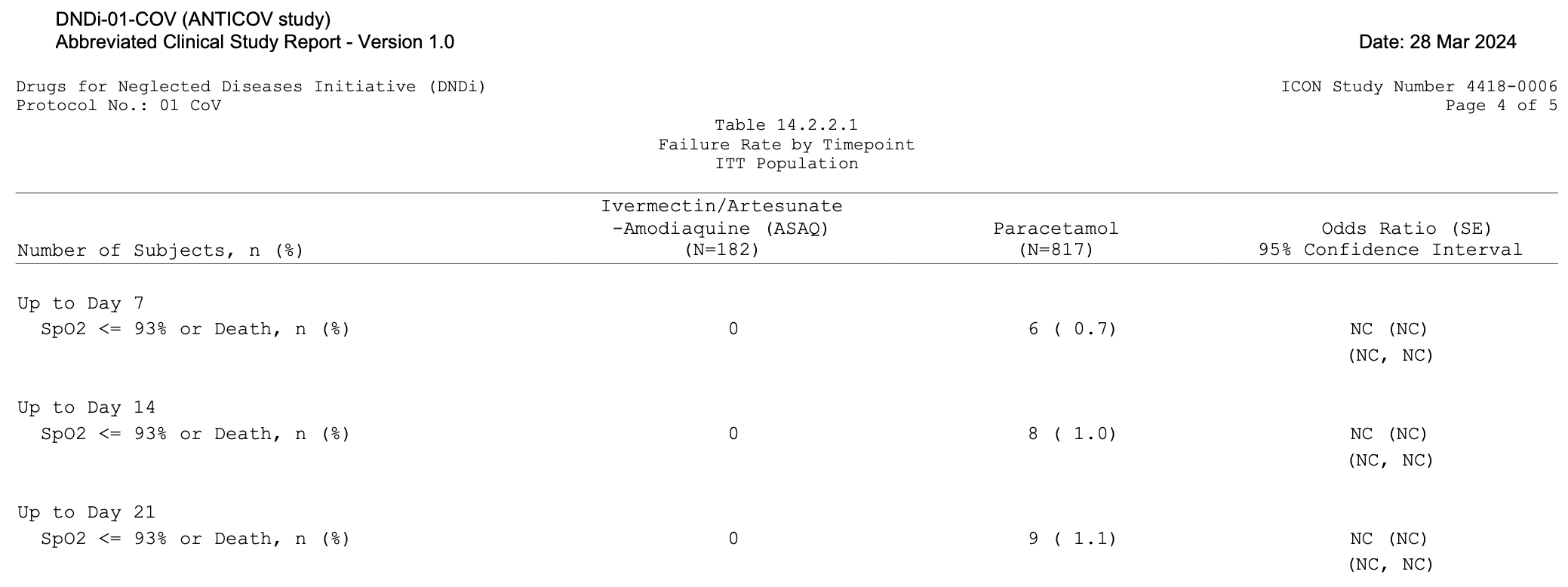
risk of progression, 19.7% higher, RR 1.20, p = 0.87, treatment 1 of 77 (1.3%), control 9 of 817 (1.1%), odds ratio converted to relative risk, SpO2 ≤93 or death, day 21, Table 14.2.2.1.
risk of hospitalization, 11.6% lower, RR 0.88, p = 1.00, treatment 1 of 77 (1.3%), control 12 of 817 (1.5%), NNT 588, COVID-19 hospitalization, day 21, Table 14.2.2.13.
Strub-Wourgaft et al., 28 Mar 2024, Randomized Controlled Trial, multiple countries, preprint, 12 authors, this trial compares with another treatment - results may be better when compared to placebo, ANTICOV trial.
Abstract: DNDi-01-COV (ANTICOV study)
Abbreviated Clinical Study Report - Version 1.0
Date: 28 Mar 2024
Abbreviated Clinical Study Report
An open-label, multicentre, randomised, adaptive
platform trial of the safety and efficacy
of several therapies, including antiviral therapies,
versus control in mild/moderate cases of COVID-19
Short Title
Name of product(s)
Indication
Phase
Study Design
Consortium Coordinator
Consortium Coordinator’s
Responsible Medical Officer
Sponsors in each country
with at least one participant
screened
Study Initiation
Study completion
Study Report Date
ANTICOV
Hydroxychloroquine sulphate; lopinavir/ritonavir ;
nitazoxanide/ciclesonide; ivermectin/artesunateamodiaquine; fluoxetine/budesonide; paracetamol
Mild/moderate infection in outpatients with Severe Acute
Respiratory Syndrome Coronavirus-2 (SARS-CoV-2)
Phase III
Multicentre, multiple-country, randomised, open-label,
adaptive, platform clinical study in adult patients with
confirmed coronavirus disease 2019 (COVID-19)
diagnosis and presenting with viral syndrome
DNDi, 15 chemin Camille-Vidart, 1202 Geneva,
Switzerland (until 01 March 2021: 15 chemin
Louis-Dunant, 1202 Geneva, Switzerland)
Phone: +41 22 906 9230
Dr Nathalie Strub-Wourgaft
Burkina Faso, Guinea: Inserm/ANRS (France)
Democratic Republic of the Congo, Kenya, and Sudan:
DNDi (Switzerland)
Ethiopia: Institute of Tropical Medicine (Belgium)
Ghana: Bernhard-Nocht-Institut für Tropenmedizin
(Germany)
Ivory Coast: Centre Suisse de Recherches Scientifiques
(Ivory Coast)
Mali: Centre for Vaccine Development (Mali)
Mozambique: ISGlobal (Spain)
Tanzania: Ifakara Health Institute (Tanzania)
Brazil: Cardresearch (Sponsor of Together Trial, Brazil)
Date
21 September 2020
21 December 2022
28 March 2024
This study was performed in compliance with Good Clinical Practices (GCP),
including the archiving of essential documents
CSR Template_Version 1.0_ 11 Apr 2008 – Updated 26 Aug 2020
Page 1 of 1569
1570
DNDi-01-COV (ANTICOV study)
Abbreviated Clinical Study Report - Version 1.0
Date: 28 Mar 2024
2. SYNOPSIS
Name of Coordinating Sponsor:
Drugs for Neglected Diseases initiative
(DNDi)
Name of Active Ingredients:
Hydroxychloroquine sulphate;
lopinavir/ritonavir; nitazoxanide/ciclesonide;
ivermectin/artesunate-amodiaquine;
fluoxetine/budesonide;
paracetamol (control)
Name of Finished Products:
Marketed formulations of the
investigational products
Title of Study: An open-label, multicentre, randomised, adaptive platform trial of the
safety and efficacy of several therapies, including antiviral therapies, versus control in
mild/moderate cases of COVID-19
Investigators: 12 Coordinating Principal Investigators in 12 countries
Study Centre(s): 26 sites (with screened patients) in 12 countries: 11 African countries
(Burkina Faso, Democratic Republic of the Congo [DRC], Ethiopia, Ghana, Guinea,
Ivory Coast, Kenya, Mali, Mozambique, Sudan, and Tanzania) + Brazil
Publication (Reference): None
Studied Period (years):
First Patient First Visit: 21 Sep 2020
Last Patient Last Visit: 21 Dec 2022
Phase of Development: Phase III
Objectives: The overall objective was to determine the efficacy and safety of various
treatment regimens in outpatients with mild/moderate coronavirus disease 2019
(COVID-19) to prevent the need for hospitalisation for specialised care due to severe
progression of the disease.
Primary Objective:
• To compare the efficacy of alternative treatment strategies versus (vs) control on the
risk of progression..