Relationship Between Serum Metabolites of Carotenoids, Vitamin A, Vitamin E, and Clinical Parameters in COVID‐19 Patients
et al., Journal of Nutrition and Metabolism, doi:10.1155/jnme/9664019, Jan 2026
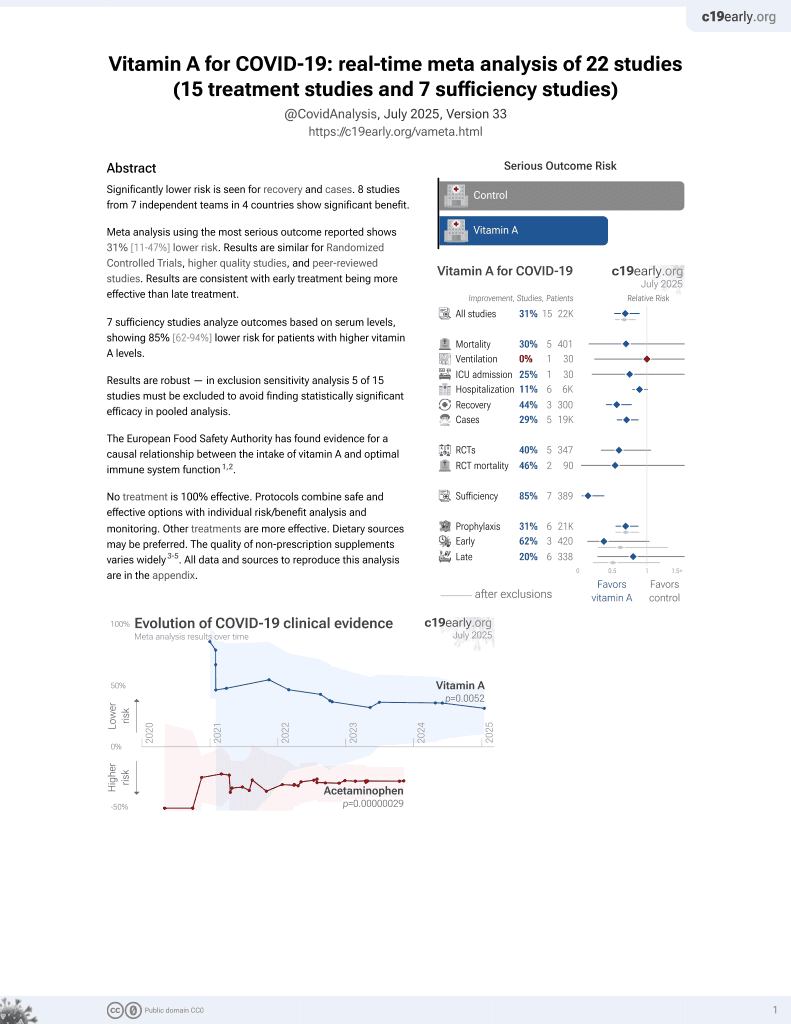
Vitamin A for COVID-19
No treatment is 100% effective.
Protocols combine treatments.
Retrospective 44 hospitalized COVID-19 patients (23 moderate, 21 severe) and 39 healthy controls showing significant depletion of carotenoids, vitamin A, and vitamin E in COVID-19 patients compared to healthy controls, but no significant difference in these micronutrient levels between moderate and severe disease.

Ozpinar et al., 31 Jan 2026, Germany, peer-reviewed, 10 authors, study period 1 June, 2020 - 31 August, 2020.
Contact: forian.schweigert@uni-potsdam.de.
Abstract: RESEARCH ARTICLE
[OPEN ACCESS](https://doi.org/10.1155/jnme/9664019)
Relationship Between Serum Metabolites of Carotenoids, Vitamin A, Vitamin E, and Clinical Parameters in COVID-19 Patients
Aysel Ozpinar 1,2 | Ceyda Sonmez 2 | Aleyna Baltacioglu 2 | Osman Acar 1 | Meltem Kilercik 1,2 | Mustafa Cetiner 3 | Mustafa Serteser 1 | Jens Raila 4 | Muhittin A. Serdar 1,2 | Florian J. Schweigert 4
Correspondence:
[Florian J. Schweigert (florian.schweigert@uni-potsdam.de)](mailto:florian.schweigert@uni-potsdam.de)
Received: 4 May 2025 | Revised: 25 December 2025 | Accepted: 28 January 2026
Academic Editor: Sancha Vale
Keywords: antioxidants | carotenoids | COVID-19 | inflammation | oxidative stress | RBP4 | tocopherols | vitamin A | vitamin E
ABSTRACT
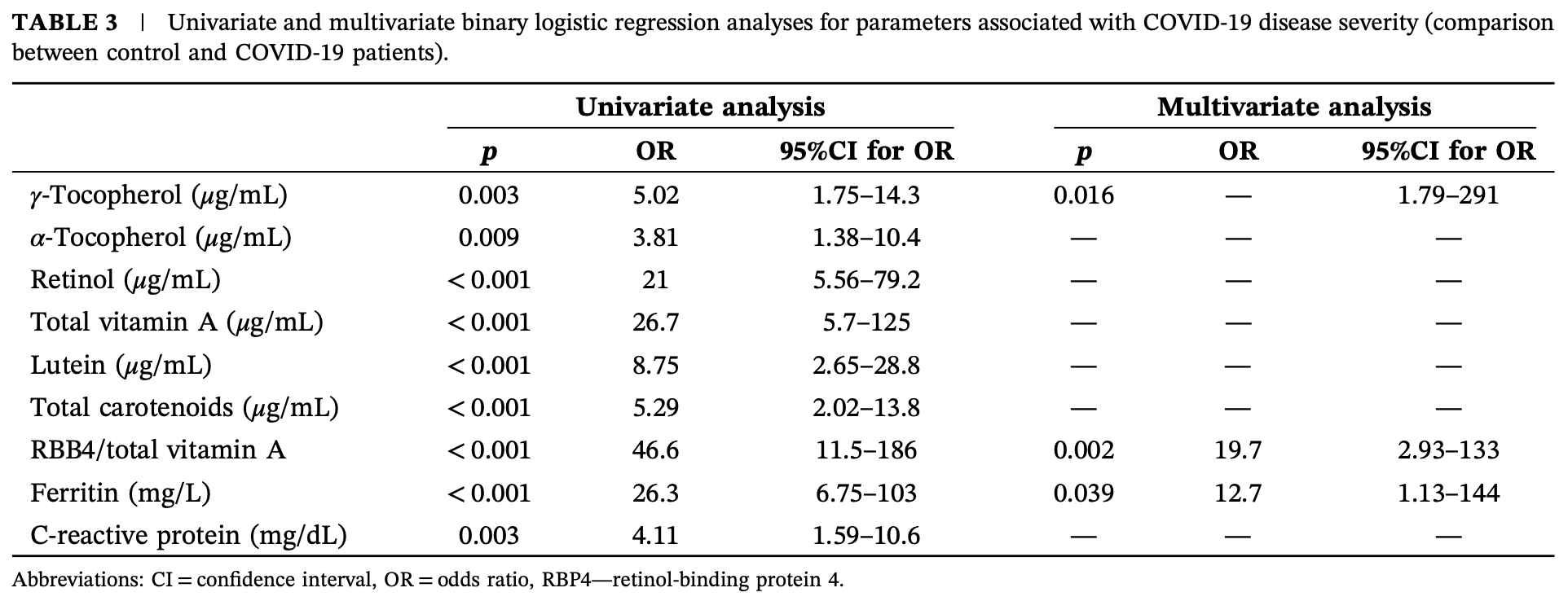
Oxidative stress and inflammation play central roles in the immunopathogenesis of COVID-19. In this study, we investigated whether circulating carotenoids, retinol, and vitamin E metabolites can distinguish COVID-19 patients from healthy controls and discriminate disease severity. We analyzed 44 hospitalized COVID-19 patients (23 with moderate disease and 21 with severe disease) and 39 healthy controls recruited from the same hospitals. Plasma concentrations of individual carotenoids, retinol, total vitamin A, vitamin E ( γ -tocopherol, α -tocopherol), retinol-binding protein 4 (RBP4), transthyretin (TTR), complete blood count parameters, and clinical chemistry and inflammatory markers were determined and statistically analyzed. Compared with healthy controls, COVID-19 patients had significantly lower concentrations of vitamin E, retinol, total vitamin A, lutein, total carotenoids, and TTR and higher levels of inflammatory markers. In multivariate logistic regression, the RBP4/total vitamin A ratio, γ -tocopherol, and ferritin emerged as independent factors differentiating COVID-19 patients from healthy controls. Within the patient group, antioxidant micronutrient levels did not differ significantly between moderate and severe COVID-19, whereas inflammatory markers, such as C-reactive protein, ferritin, and the neutrophil-to-lymphocyte ratio, increased with severity. These data indicate that although carotenoids, vitamin A, and vitamin E are markedly depleted during COVID-19, they do not stratify disease severity, whereas the RBP4/total vitamin A ratio, γ -tocopherol, and ferritin may serve as useful biomarkers for distinguishing COVID-19 from health.
1 | Introduction
The COVID-19 pandemic, caused by severe acute respiratory syndrome coronavirus 2 (SARS-CoV-2), has emerged as a significant global health crisis. As of 2024, over 700 million confirmed cases and more than 7 million deaths have been reported worldwide (World Health Organization [WHO], 2024). The clinical manifestations of COVID-19 vary widely, ranging from asymptomatic infections to severe respiratory distress and multiorgan failure [1]. In severe cases, the disease can lead to acute respiratory distress syndrome (ARDS), a life-threatening condition characterized by alveolar damage and respiratory collapse, which significantly increases mortality risk [2]. One of the primary mechanisms underlying COVID-19 severity is the
This is an open access article under the terms of the Creative Commons Attribution License, which permits use, distribution and reproduction in any medium, provided the original work is properly cited.
Copyright © 2026 Aysel Ozpinar et al. Journal of Nutrition and Metabolism published by John Wiley &..
DOI record:
{
"DOI": "10.1155/jnme/9664019",
"ISSN": [
"2090-0724",
"2090-0732"
],
"URL": "http://dx.doi.org/10.1155/jnme/9664019",
"abstract": "<jats:p>Oxidative stress and inflammation play central roles in the immunopathogenesis of COVID‐19. In this study, we investigated whether circulating carotenoids, retinol, and vitamin E metabolites can distinguish COVID‐19 patients from healthy controls and discriminate disease severity. We analyzed 44 hospitalized COVID‐19 patients (23 with moderate disease and 21 with severe disease) and 39 healthy controls recruited from the same hospitals. Plasma concentrations of individual carotenoids, retinol, total vitamin A, vitamin E (γ‐tocopherol, α‐tocopherol), retinol‐binding protein 4 (RBP4), transthyretin (TTR), complete blood count parameters, and clinical chemistry and inflammatory markers were determined and statistically analyzed. Compared with healthy controls, COVID‐19 patients had significantly lower concentrations of vitamin E, retinol, total vitamin A, lutein, total carotenoids, and TTR and higher levels of inflammatory markers. In multivariate logistic regression, the RBP4/total vitamin A ratio, γ‐tocopherol, and ferritin emerged as independent factors differentiating COVID‐19 patients from healthy controls. Within the patient group, antioxidant micronutrient levels did not differ significantly between moderate and severe COVID‐19, whereas inflammatory markers, such as C‐reactive protein, ferritin, and the neutrophil‐to‐lymphocyte ratio, increased with severity. These data indicate that although carotenoids, vitamin A, and vitamin E are markedly depleted during COVID‐19, they do not stratify disease severity, whereas the RBP4/total vitamin A ratio, γ‐tocopherol, and ferritin may serve as useful biomarkers for distinguishing COVID‐19 from health.</jats:p>",
"alternative-id": [
"10.1155/jnme/9664019"
],
"article-number": "9664019",
"assertion": [
{
"group": {
"label": "Publication History",
"name": "publication_history"
},
"label": "Received",
"name": "received",
"order": 0,
"value": "2025-05-04"
},
{
"group": {
"label": "Publication History",
"name": "publication_history"
},
"label": "Accepted",
"name": "accepted",
"order": 2,
"value": "2026-01-28"
},
{
"group": {
"label": "Publication History",
"name": "publication_history"
},
"label": "Published",
"name": "published",
"order": 3,
"value": "2026-03-21"
}
],
"author": [
{
"ORCID": "https://orcid.org/0000-0002-7399-4929",
"affiliation": [],
"authenticated-orcid": false,
"family": "Ozpinar",
"given": "Aysel",
"sequence": "first"
},
{
"ORCID": "https://orcid.org/0009-0008-7816-3615",
"affiliation": [],
"authenticated-orcid": false,
"family": "Sonmez",
"given": "Ceyda",
"sequence": "additional"
},
{
"ORCID": "https://orcid.org/0009-0001-0275-3634",
"affiliation": [],
"authenticated-orcid": false,
"family": "Baltacioglu",
"given": "Aleyna",
"sequence": "additional"
},
{
"ORCID": "https://orcid.org/0009-0001-2087-2629",
"affiliation": [],
"authenticated-orcid": false,
"family": "Acar",
"given": "Osman",
"sequence": "additional"
},
{
"ORCID": "https://orcid.org/0000-0001-6837-8892",
"affiliation": [],
"authenticated-orcid": false,
"family": "Kilercik",
"given": "Meltem",
"sequence": "additional"
},
{
"ORCID": "https://orcid.org/0000-0002-4420-6452",
"affiliation": [],
"authenticated-orcid": false,
"family": "Cetiner",
"given": "Mustafa",
"sequence": "additional"
},
{
"ORCID": "https://orcid.org/0000-0001-7868-7613",
"affiliation": [],
"authenticated-orcid": false,
"family": "Serteser",
"given": "Mustafa",
"sequence": "additional"
},
{
"ORCID": "https://orcid.org/0000-0003-3481-0792",
"affiliation": [],
"authenticated-orcid": false,
"family": "Raila",
"given": "Jens",
"sequence": "additional"
},
{
"ORCID": "https://orcid.org/0000-0002-3014-748X",
"affiliation": [],
"authenticated-orcid": false,
"family": "Serdar",
"given": "Muhittin A.",
"sequence": "additional"
},
{
"ORCID": "https://orcid.org/0000-0001-7103-2438",
"affiliation": [],
"authenticated-orcid": false,
"family": "Schweigert",
"given": "Florian J.",
"sequence": "additional"
}
],
"container-title": "Journal of Nutrition and Metabolism",
"container-title-short": "Journal of Nutrition and Metabolism",
"content-domain": {
"crossmark-restriction": true,
"domain": [
"onlinelibrary.wiley.com"
]
},
"created": {
"date-parts": [
[
2026,
3,
21
]
],
"date-time": "2026-03-21T08:16:57Z",
"timestamp": 1774081017000
},
"deposited": {
"date-parts": [
[
2026,
3,
27
]
],
"date-time": "2026-03-27T13:13:17Z",
"timestamp": 1774617197000
},
"editor": [
{
"affiliation": [],
"family": "Vale",
"given": "Sancha",
"sequence": "additional"
}
],
"indexed": {
"date-parts": [
[
2026,
3,
27
]
],
"date-time": "2026-03-27T14:16:31Z",
"timestamp": 1774620991833,
"version": "3.50.1"
},
"is-referenced-by-count": 0,
"issue": "1",
"issued": {
"date-parts": [
[
2026,
1
]
]
},
"journal-issue": {
"issue": "1",
"published-print": {
"date-parts": [
[
2026,
1
]
]
}
},
"language": "en",
"license": [
{
"URL": "https://creativecommons.org/licenses/by/4.0/",
"content-version": "vor",
"delay-in-days": 79,
"start": {
"date-parts": [
[
2026,
3,
21
]
],
"date-time": "2026-03-21T00:00:00Z",
"timestamp": 1774051200000
}
},
{
"URL": "http://doi.wiley.com/10.1002/tdm_license_1.1",
"content-version": "tdm",
"delay-in-days": 0,
"start": {
"date-parts": [
[
2026,
1,
1
]
],
"date-time": "2026-01-01T00:00:00Z",
"timestamp": 1767225600000
}
}
],
"link": [
{
"URL": "https://onlinelibrary.wiley.com/doi/pdf/10.1155/jnme/9664019",
"content-type": "application/pdf",
"content-version": "vor",
"intended-application": "text-mining"
},
{
"URL": "https://onlinelibrary.wiley.com/doi/full-xml/10.1155/jnme/9664019",
"content-type": "application/xml",
"content-version": "vor",
"intended-application": "text-mining"
},
{
"URL": "https://onlinelibrary.wiley.com/doi/pdf/10.1155/jnme/9664019",
"content-type": "unspecified",
"content-version": "vor",
"intended-application": "similarity-checking"
}
],
"member": "311",
"original-title": [],
"prefix": "10.1155",
"published": {
"date-parts": [
[
2026,
1
]
]
},
"published-online": {
"date-parts": [
[
2026,
3,
21
]
]
},
"published-print": {
"date-parts": [
[
2026,
1
]
]
},
"publisher": "Wiley",
"reference": [
{
"DOI": "10.1056/nejmoa2001316",
"doi-asserted-by": "publisher",
"key": "e_1_2_12_1_2"
},
{
"author": "Nile S. H.",
"key": "e_1_2_12_2_2",
"volume-title": "COVID-19: Pathogenesis, Cytokine Storm and Therapeutic Potential of Interferons",
"year": "2020"
},
{
"author": "Mehta P.",
"key": "e_1_2_12_3_2",
"volume-title": "COVID-19: Consider Cytokine Storm Syndromes and Immunosuppression",
"year": "2020"
},
{
"DOI": "10.1134/S0006297920120068",
"doi-asserted-by": "publisher",
"key": "e_1_2_12_4_2"
},
{
"DOI": "10.3746/PNF.2021.26.3.241",
"doi-asserted-by": "publisher",
"key": "e_1_2_12_5_2"
},
{
"DOI": "10.1016/j.cellsig.2021.110121",
"doi-asserted-by": "publisher",
"key": "e_1_2_12_6_2"
},
{
"DOI": "10.1038/s41577-020-0346-x",
"doi-asserted-by": "publisher",
"key": "e_1_2_12_7_2"
},
{
"DOI": "10.1172/jci.insight.140329",
"doi-asserted-by": "publisher",
"key": "e_1_2_12_8_2"
},
{
"DOI": "10.3389/fimmu.2023.1275001",
"doi-asserted-by": "publisher",
"key": "e_1_2_12_9_2"
},
{
"DOI": "10.14744/nci.2022.00947",
"doi-asserted-by": "publisher",
"key": "e_1_2_12_10_2"
},
{
"DOI": "10.1152/ajpheart.00096.2023",
"doi-asserted-by": "publisher",
"key": "e_1_2_12_11_2"
},
{
"DOI": "10.1016/j.biopha.2003.12.006",
"doi-asserted-by": "publisher",
"key": "e_1_2_12_12_2"
},
{
"DOI": "10.1016/j.biopha.2022.113625",
"doi-asserted-by": "publisher",
"key": "e_1_2_12_13_2"
},
{
"DOI": "10.1089/vim.2020.0330",
"doi-asserted-by": "publisher",
"key": "e_1_2_12_14_2"
},
{
"DOI": "10.3390/cimb46070429",
"doi-asserted-by": "publisher",
"key": "e_1_2_12_15_2"
},
{
"DOI": "10.3390/nu10111614",
"doi-asserted-by": "crossref",
"key": "e_1_2_12_16_2",
"unstructured": "LeeG. Y.andHanS. N. The Role of Vitamin E in Immunity 2018 MDPI AG https://doi.org/10.3390/nu10111614 2-s2.0-85056052324."
},
{
"DOI": "10.1007/s10654-004-5760-z",
"doi-asserted-by": "publisher",
"key": "e_1_2_12_17_2"
},
{
"DOI": "10.1038/sj.ki.5002372",
"doi-asserted-by": "publisher",
"key": "e_1_2_12_18_2"
},
{
"DOI": "10.3390/nu13072173",
"doi-asserted-by": "publisher",
"key": "e_1_2_12_19_2"
},
{
"DOI": "10.1024/0300-9831.73.6.423",
"doi-asserted-by": "publisher",
"key": "e_1_2_12_20_2"
},
{
"article-title": "Retinol and Carotenoid Plasma Concentrations are Influenced by the Inflammation-Associated Acute-Phase Response",
"author": "Schweigert F. J.",
"first-page": "55",
"journal-title": "International Journal Of Health, Environment And Research",
"key": "e_1_2_12_21_2",
"volume": "29",
"year": "2001"
},
{
"author": "Georgieva E.",
"key": "e_1_2_12_22_2",
"volume-title": "COVID-19 Complications: Oxidative Stress, Inflammation, and Mitochondrial and Endothelial Dysfunction",
"year": "2023"
},
{
"author": "Jomova K.",
"key": "e_1_2_12_23_2",
"volume-title": "Reactive Oxygen Species, Toxicity, Oxidative Stress, and Antioxidants: Chronic Diseases and Aging",
"year": "2023"
},
{
"DOI": "10.1111/1440-1681.13354",
"doi-asserted-by": "publisher",
"key": "e_1_2_12_24_2"
},
{
"DOI": "10.1002/iub.1976",
"doi-asserted-by": "publisher",
"key": "e_1_2_12_25_2"
},
{
"author": "Anand R.",
"key": "e_1_2_12_26_2",
"volume-title": "Disease Prevention and Treatment Using β-Carotene: The Ultimate Provitamin A",
"year": "2022"
}
],
"reference-count": 26,
"references-count": 26,
"relation": {},
"resource": {
"primary": {
"URL": "https://onlinelibrary.wiley.com/doi/10.1155/jnme/9664019"
}
},
"score": 1,
"short-title": [],
"source": "Crossref",
"subject": [],
"subtitle": [],
"title": "Relationship Between Serum Metabolites of Carotenoids, Vitamin A, Vitamin E, and Clinical Parameters in COVID‐19 Patients",
"type": "journal-article",
"update-policy": "https://doi.org/10.1002/crossmark_policy",
"volume": "2026"
}