Zinc use is associated with improved outcomes in COVID-19: results from the CRUSH-COVID registry

Mayberry et al., Critical Care Medicine, doi:10.1097/01.ccm.0000807104.82650.d6, Dec 2021
Early treatmentRetrospective · 2,028 patients · USA · Mar 2020 – Apr 2021
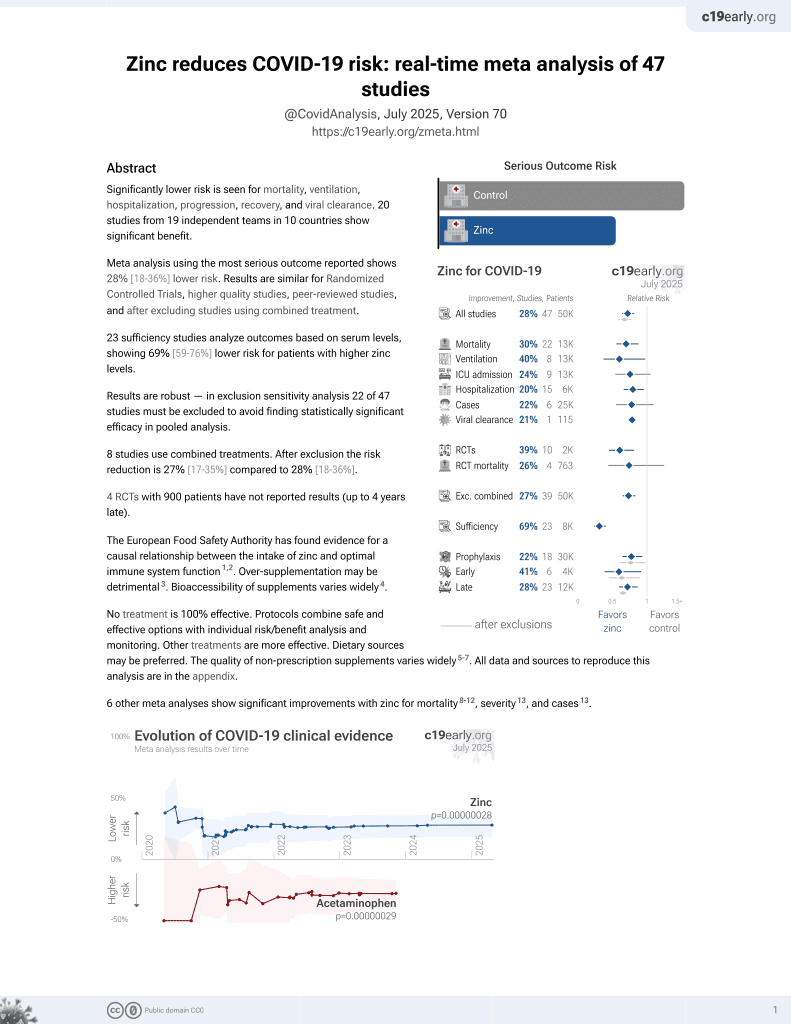
Zinc for COVID-19
Lower mortality and ventilation
p < 0.0001 (mortality) and p < 0.0001 (ventilation)

Zinc for COVID-19

2nd treatment shown to reduce risk in July 2020, now with p = 0.00000013 from 40 studies, recognized in 23 countries.

No treatment is 100% effective.
Protocols combine treatments.

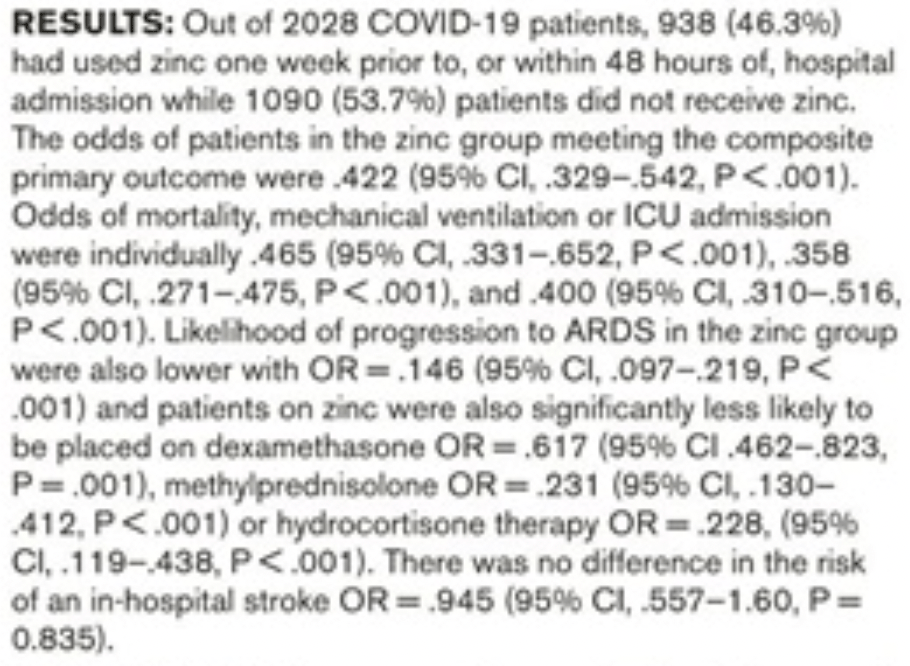
Retrospective 2,028 COVID patients in the USA, showing significantly lower mortality, ventilation, ICU admission, and progression to ARDS with zinc use, defined as at least one dose from one week prior to admission to 48 hours after admission.
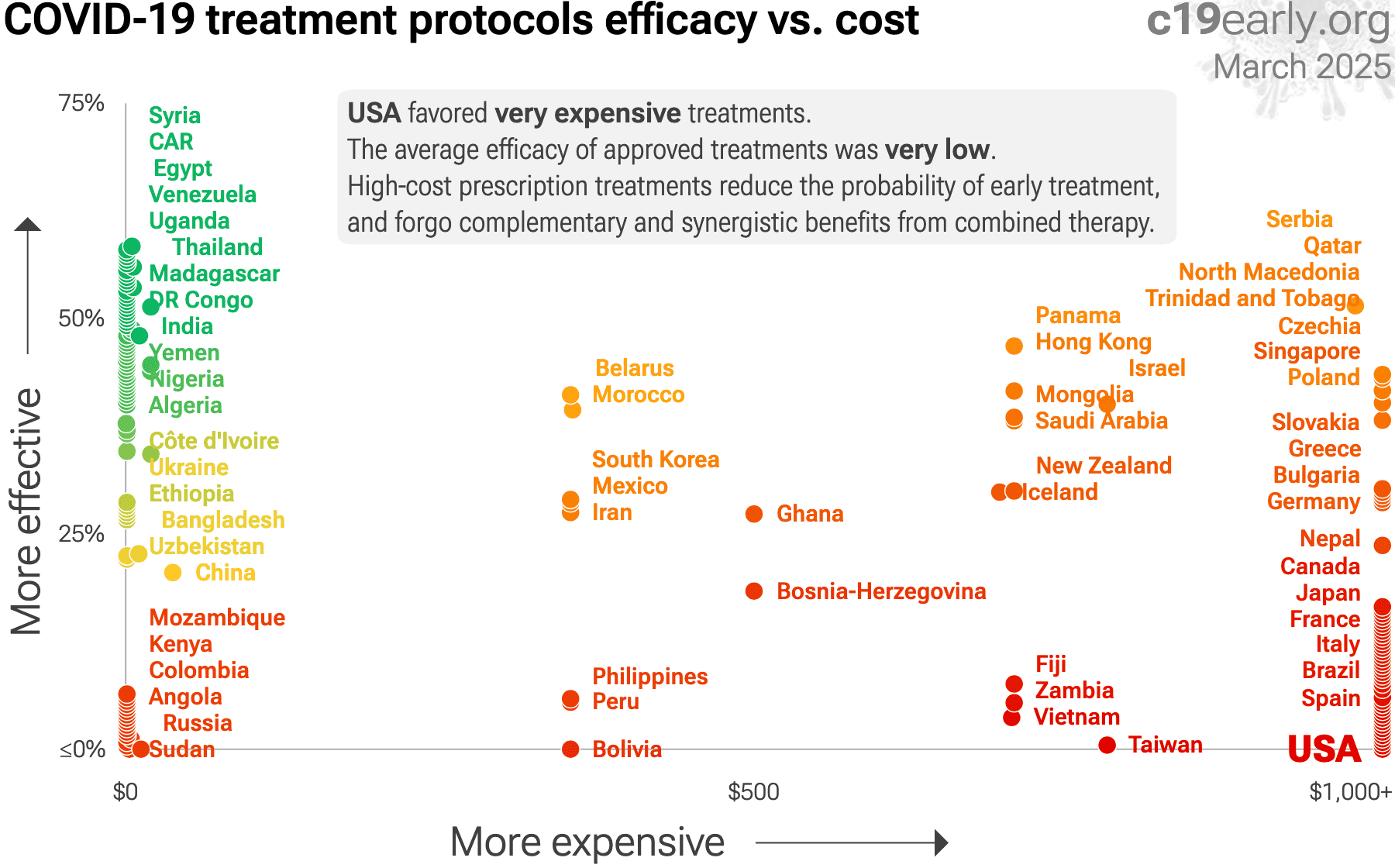
Standard of Care (SOC) for COVID-19 in the study country, the USA, is very poor with very low average efficacy for approved treatments1. Only expensive, high-profit treatments were approved for early treatment. Low-cost treatments were excluded, reducing the probability of early treatment due to access and cost barriers, and eliminating complementary and synergistic benefits seen with many low-cost treatments.
OutcomeImprovementEffect · pTreatmentControl
risk of death 53.5% lower · OR 0.47 · p < 0.001*** 53.5% lowerOR 0.47p < 0.001*** 938 1,090 treatment 938, control 1,090adjusted per studyRR approximated with ORmultivariable
risk of mechanical ventilation 64.2% lower · OR 0.36 · p < 0.001*** 64.2% lowerOR 0.36p < 0.001*** 938 1,090 treatment 938, control 1,090adjusted per studyRR approximated with ORmultivariable
risk of ICU admission 60.0% lower · OR 0.40 · p < 0.001*** 60.0% lowerOR 0.40p < 0.001*** 938 1,090 treatment 938, control 1,090adjusted per studyRR approximated with ORmultivariable
death/ventilation/ICU 57.8% lower · OR 0.42 · p < 0.001*** 57.8% lowerOR 0.42p < 0.001*** 938 1,090 treatment 938, control 1,090adjusted per studyRR approximated with ORmultivariableprimary outcome
progression to ARDS 85.4% lower · OR 0.15 · p < 0.001*** 85.4% lowerOR 0.15p < 0.001*** 938 1,090 treatment 938, control 1,090adjusted per studyRR approximated with ORmultivariable

Effect extraction follows pre-specified rules prioritizing more serious outcomes. Submit updates. *** p < 0.001

Mayberry et al., 16 Dec 2021, retrospective, USA, peer-reviewed, 14 authors, study period March 2020 - April 2021.
$0 $500 $1,000+ Efficacy vs. cost for COVID-19 treatment protocols c19early.org November 2026 USA Angola Colombia Kenya Mozambique Myanmar South Africa Peru Philippines Vietnam Japan Argentina Nepal Iran Bangladesh Ethiopia Ghana Germany Mexico South Korea United Kingdom Saudi Arabia Algeria Morocco Yemen Poland Uzbekistan India China Venezuela DR Congo Madagascar Thailand Uganda Egypt Nigeria Taiwan Fiji Zambia Bosnia-Herzegovina Jordan Georgia Switzerland Dominican Republic Bolivia Côte d'Ivoire Eritrea Togo Bulgaria Greece Slovakia Iceland New Zealand Trinidad and Tobago Mongolia Czechia Belarus Israel Haiti North Macedonia Hong Kong Qatar Panama Serbia USA favored high-profit treatments.The average efficacy of treatments was very low.High-cost protocols reduce early treatment, andforgo complementary/synergistic benefits. More effective More expensive 75% 50% 25% ≤0%
$0 $500 $1,000+ Efficacy vs. cost for COVID-19treatment protocols worldwide c19early.org November 2026 USA Angola Colombia Kenya Mozambique Myanmar South Africa Peru Philippines Vietnam Japan Argentina Nepal Iran Bangladesh Ethiopia Ghana Germany Mexico South Korea United Kingdom Saudi Arabia Algeria Morocco Yemen Poland Uzbekistan India China Venezuela DR Congo Madagascar Thailand Uganda Egypt Taiwan Fiji Zambia Jordan Georgia Switzerland Dominican Rep. Bolivia Côte d'Ivoire Eritrea Togo Sri Lanka Bulgaria Greece Slovakia New Zealand Trinidad and Tobago Mongolia Czechia Belarus Israel North Macedonia Hong Kong Qatar Panama Serbia USA favored high-profit treatments.The average efficacy was very low.High-cost protocols reduce early treatment,and forgo complementary/synergistic benefits. More effective More expensive 75% 50% 25% ≤0%
DOI record: { "DOI": "10.1097/01.ccm.0000807104.82650.d6", "ISSN": [ "0090-3493" ], "URL": "http://dx.doi.org/10.1097/01.ccm.0000807104.82650.d6", "author": [ { "affiliation": [], "family": "Mayberry", "given": "Miles", "sequence": "first" }, { "affiliation": [], "family": "Chow", "given": "Jonathan", "sequence": "additional" }, { "affiliation": [], "family": "Park", "given": "Paul", "sequence": "additional" }, { "affiliation": [], "family": "Harris", "given": "Lynnette", "sequence": "additional" }, { "affiliation": [], "family": "Saha", "given": "Amit", "sequence": "additional" }, { "affiliation": [], "family": "Levine", "given": "Andrea", "sequence": "additional" }, { "affiliation": [], "family": "Smischney", "given": "Nathan", "sequence": "additional" }, { "affiliation": [], "family": "Wieruszewski", "given": "Patrick", "sequence": "additional" }, { "affiliation": [], "family": "Meena", "given": "Nikhil", "sequence": "additional" }, { "affiliation": [], "family": "Yamane", "given": "David", "sequence": "additional" }, { "affiliation": [], "family": "Jackson", "given": "Amanda", "sequence": "additional" }, { "affiliation": [], "family": "Kethireddy", "given": "Shravan", "sequence": "additional" }, { "affiliation": [], "family": "Wiepking", "given": "Matthew", "sequence": "additional" }, { "affiliation": [], "family": "Khanna", "given": "Ashish", "sequence": "additional" } ], "container-title": [ "Critical Care Medicine" ], "content-domain": { "crossmark-restriction": false, "domain": [] }, "created": { "date-parts": [ [ 2021, 12, 16 ] ], "date-time": "2021-12-16T20:06:47Z", "timestamp": 1639685207000 }, "deposited": { "date-parts": [ [ 2021, 12, 21 ] ], "date-time": "2021-12-21T12:16:45Z", "timestamp": 1640089005000 }, "indexed": { "date-parts": [ [ 2021, 12, 22 ] ], "date-time": "2021-12-22T06:50:45Z", "timestamp": 1640155845018 }, "is-referenced-by-count": 0, "issn-type": [ { "type": "print", "value": "0090-3493" } ], "issue": "1", "issued": { "date-parts": [ [ 2021, 12, 16 ] ] }, "journal-issue": { "issue": "1", "published-print": { "date-parts": [ [ 2022 ] ] } }, "language": "en", "link": [ { "URL": "https://journals.lww.com/10.1097/01.ccm.0000807104.82650.d6", "content-type": "unspecified", "content-version": "vor", "intended-application": "similarity-checking" } ], "member": "276", "original-title": [], "page": "81-81", "prefix": "10.1097", "published": { "date-parts": [ [ 2021, 12, 16 ] ] }, "published-online": { "date-parts": [ [ 2021, 12, 16 ] ] }, "published-print": { "date-parts": [ [ 2022, 1 ] ] }, "publisher": "Ovid Technologies (Wolters Kluwer Health)", "reference-count": 0, "references-count": 0, "relation": {}, "score": 1, "short-container-title": [], "short-title": [], "source": "Crossref", "subject": [ "Critical Care and Intensive Care Medicine" ], "subtitle": [], "title": [ "195: ZINC USE IS ASSOCIATED WITH IMPROVED OUTCOMES IN COVID-19: RESULTS FROM THE CRUSH-COVID REGISTRY" ], "type": "journal-article", "volume": "50" }