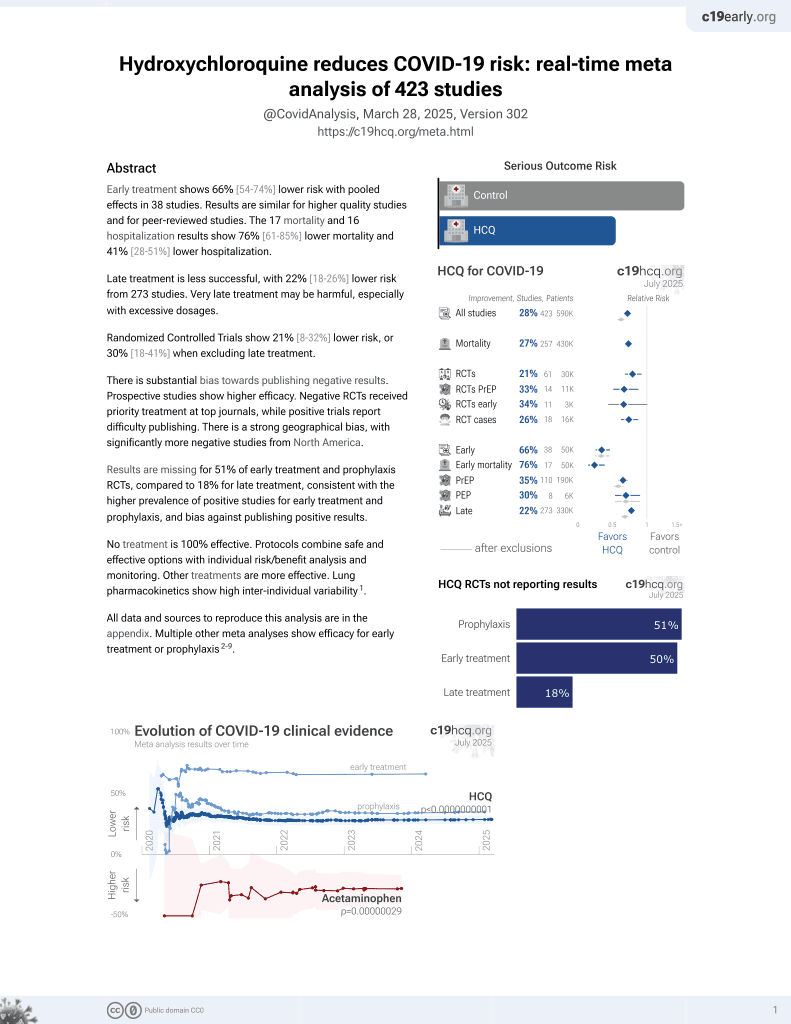
Hydroxychloroquine has no effect on SARS-CoV-2 load in nasopharynx of patients with mild form of COVID-19
Alexey Komissarov, Ivan Molodtsov, Oxana Ivanova, Elena Maryukhnich, Svetlana Kudryavtseva, Alexey Mazus, Evgeniy Nikonov, MD Elena Vasilieva
doi:10.1101/2020.06.30.20143289
Due to the constantly growing numbers of COVID-19 infections and death cases attempts were undertaken to find drugs with anti SARS-CoV-2 activity among ones already approved for other pathologies. In the framework of such attempts, in a number of in vitro, as well as in vivo, models it was shown that hydroxychloroquine (HCQ) has an effect against SARS-CoV-2. While there was not enough clinical data to support the use of HCQ, several countries including Russia have included HCQ in treatment protocols for infected patients and for prophylactic. Here, we evaluated the SARS-CoV-2 RNA in nasopharynx swabs from infected patients in mild conditions and compared the viral RNA load dynamics between patients receiving HCQ and control group without antiviral pharmacological therapy. We found statistically significant relationship between maximal RNA quantity and patients' deteriorating medical conditions, as well as confirmed the arterial hypertension to be a risk factor for people with COVID-19. However, we showed that HCQ therapy neither shortened the viral shedding period nor reduced the virus RNA load.
References
Hashem, Therapeutic use of chloroquine and hydroxychloroquine in covid-19 and other viral infections: A narrative review. Travel medicine and infectious disease
Huang, Covid-19 patients with hypertension have more severe disease: A multicenter retrospective observational study, Hypertension Research
Liu, Hydroxychloroquine, a less toxic derivative of chloroquine, is effective in inhibiting sars-cov-2 infection in vitro, Cell discovery
Pan, Zhang, Yang, Poon, Wang, Viral load of sars-cov-2 in clinical samples, The Lancet Infectious Diseases
Yao, In vitro antiviral activity and projection of optimized dosing design of hydroxychloroquine for the treatment of severe acute respiratory syndrome coronavirus 2 (sars-cov-2). Clinical infectious diseases : an official publication of the Infectious Diseases Society of America
Yu, Quantitative detection and viral load analysis of sars-cov-2 in infected patients. Clinical infectious diseases : an official publication of the Infectious Diseases Society of America
Zhou, Clinical course and risk factors for mortality of adult inpatients with covid-19 in wuhan, china: A retrospective cohort study, The Lancet
Zou, Sars-cov-2 viral load in upper respiratory specimens of infected patients, New England Journal of Medicine
DOI record:
{
"DOI": "10.1101/2020.06.30.20143289",
"URL": "http://dx.doi.org/10.1101/2020.06.30.20143289",
"abstract": "<jats:title>Abstract</jats:title><jats:p>Due to the constantly growing numbers of COVID-19 infections and death cases attempts were undertaken to find drugs with anti SARS-CoV-2 activity among ones already approved for other pathologies. In the framework of such attempts, in a number of in vitro, as well as in vivo, models it was shown that hydroxychloroquine (HCQ) has an effect against SARS-CoV-2. While there was not enough clinical data to support the use of HCQ, several countries including Russia have included HCQ in treatment protocols for infected patients and for prophylactic. Here, we evaluated the SARS-CoV-2 RNA in nasopharynx swabs from infected patients in mild conditions and compared the viral RNA load dynamics between patients receiving HCQ and control group without antiviral pharmacological therapy. We found statistically significant relationship between maximal RNA quantity and patients’ deteriorating medical conditions, as well as confirmed the arterial hypertension to be a risk factor for people with COVID-19. However, we showed that HCQ therapy neither shortened the viral shedding period nor reduced the virus RNA load.</jats:p>",
"accepted": {
"date-parts": [
[
2020,
9,
16
]
]
},
"author": [
{
"affiliation": [],
"family": "Komissarov",
"given": "Alexey",
"sequence": "first"
},
{
"affiliation": [],
"family": "Molodtsov",
"given": "Ivan",
"sequence": "additional"
},
{
"affiliation": [],
"family": "Ivanova",
"given": "Oxana",
"sequence": "additional"
},
{
"affiliation": [],
"family": "Maryukhnich",
"given": "Elena",
"sequence": "additional"
},
{
"affiliation": [],
"family": "Kudryavtseva",
"given": "Svetlana",
"sequence": "additional"
},
{
"affiliation": [],
"family": "Mazus",
"given": "Alexey",
"sequence": "additional"
},
{
"affiliation": [],
"family": "Nikonov",
"given": "Evgeniy",
"sequence": "additional"
},
{
"affiliation": [],
"family": "Vasilieva",
"given": "Elena",
"sequence": "additional"
}
],
"container-title": [],
"content-domain": {
"crossmark-restriction": false,
"domain": []
},
"created": {
"date-parts": [
[
2020,
7,
3
]
],
"date-time": "2020-07-03T16:42:12Z",
"timestamp": 1593794532000
},
"deposited": {
"date-parts": [
[
2021,
12,
15
]
],
"date-time": "2021-12-15T15:07:17Z",
"timestamp": 1639580837000
},
"group-title": "Infectious Diseases (except HIV/AIDS)",
"indexed": {
"date-parts": [
[
2024,
3,
1
]
],
"date-time": "2024-03-01T23:10:30Z",
"timestamp": 1709334630492
},
"institution": [
{
"name": "medRxiv"
}
],
"is-referenced-by-count": 1,
"issued": {
"date-parts": [
[
2020,
7,
3
]
]
},
"link": [
{
"URL": "https://syndication.highwire.org/content/doi/10.1101/2020.06.30.20143289",
"content-type": "unspecified",
"content-version": "vor",
"intended-application": "similarity-checking"
}
],
"member": "246",
"original-title": [],
"posted": {
"date-parts": [
[
2020,
7,
3
]
]
},
"prefix": "10.1101",
"published": {
"date-parts": [
[
2020,
7,
3
]
]
},
"publisher": "Cold Spring Harbor Laboratory",
"reference": [
{
"DOI": "10.1093/cid/ciaa237",
"article-title": "In vitro antiviral activity and projection of optimized dosing design of hydroxychloroquine for the treatment of severe acute respiratory syndrome coronavirus 2 (sars-cov-2)",
"doi-asserted-by": "crossref",
"first-page": "732",
"journal-title": "Clinical infectious diseases: an official publication of the Infectious Diseases Society of America.",
"key": "2021021207400923000_2020.06.30.20143289v2.1",
"volume": "71",
"year": "2020"
},
{
"DOI": "10.1038/s41421-020-0156-0",
"article-title": "Hydroxychloroquine, a less toxic derivative of chloroquine, is effective in inhibiting sars-cov-2 infection in vitro",
"doi-asserted-by": "crossref",
"first-page": "16",
"journal-title": "Cell discovery.",
"key": "2021021207400923000_2020.06.30.20143289v2.2",
"volume": "6",
"year": "2020"
},
{
"DOI": "10.1016/j.tmaid.2020.101735",
"article-title": "Therapeutic use of chloroquine and hydroxychloroquine in covid-19 and other viral infections: A narrative review",
"doi-asserted-by": "crossref",
"first-page": "101735",
"journal-title": "Travel medicine and infectious disease.",
"key": "2021021207400923000_2020.06.30.20143289v2.3",
"volume": "35",
"year": "2020"
},
{
"DOI": "10.1016/S1473-3099(20)30113-4",
"doi-asserted-by": "publisher",
"key": "2021021207400923000_2020.06.30.20143289v2.4"
},
{
"DOI": "10.1056/NEJMc2001737",
"doi-asserted-by": "publisher",
"key": "2021021207400923000_2020.06.30.20143289v2.5"
},
{
"DOI": "10.1093/cid/ciaa345",
"article-title": "Quantitative detection and viral load analysis of sars-cov-2 in infected patients",
"doi-asserted-by": "crossref",
"first-page": "793",
"journal-title": "Clinical infectious diseases: an official publication of the Infectious Diseases Society of America.",
"key": "2021021207400923000_2020.06.30.20143289v2.6",
"volume": "71",
"year": "2020"
},
{
"DOI": "10.1016/SO140-6736(20)30566-3",
"doi-asserted-by": "publisher",
"key": "2021021207400923000_2020.06.30.20143289v2.7"
},
{
"DOI": "10.1038/s41440-020-0485-2",
"article-title": "Covid-19 patients with hypertension have more severe disease: A multicenter retrospective observational study",
"doi-asserted-by": "crossref",
"first-page": "824",
"journal-title": "Hypertension Research.",
"key": "2021021207400923000_2020.06.30.20143289v2.8",
"volume": "43",
"year": "2020"
}
],
"reference-count": 8,
"references-count": 8,
"relation": {
"is-preprint-of": [
{
"asserted-by": "subject",
"id": "10.1371/journal.pone.0246396",
"id-type": "doi"
}
]
},
"resource": {
"primary": {
"URL": "http://medrxiv.org/lookup/doi/10.1101/2020.06.30.20143289"
}
},
"score": 1,
"short-title": [],
"source": "Crossref",
"subtitle": [],
"subtype": "preprint",
"title": "Hydroxychloroquine has no effect on SARS-CoV-2 load in nasopharynx of patients with mild form of COVID-19",
"type": "posted-content"
}