In Silico Evaluation of Ten Monoclonal Antibodies Neutralization Power of SARS-CoV-2 Variants EG.5, BA.2.86 and JN.1
, D., MDPI AG, doi:10.20944/preprints202408.1340.v1, Aug 2024
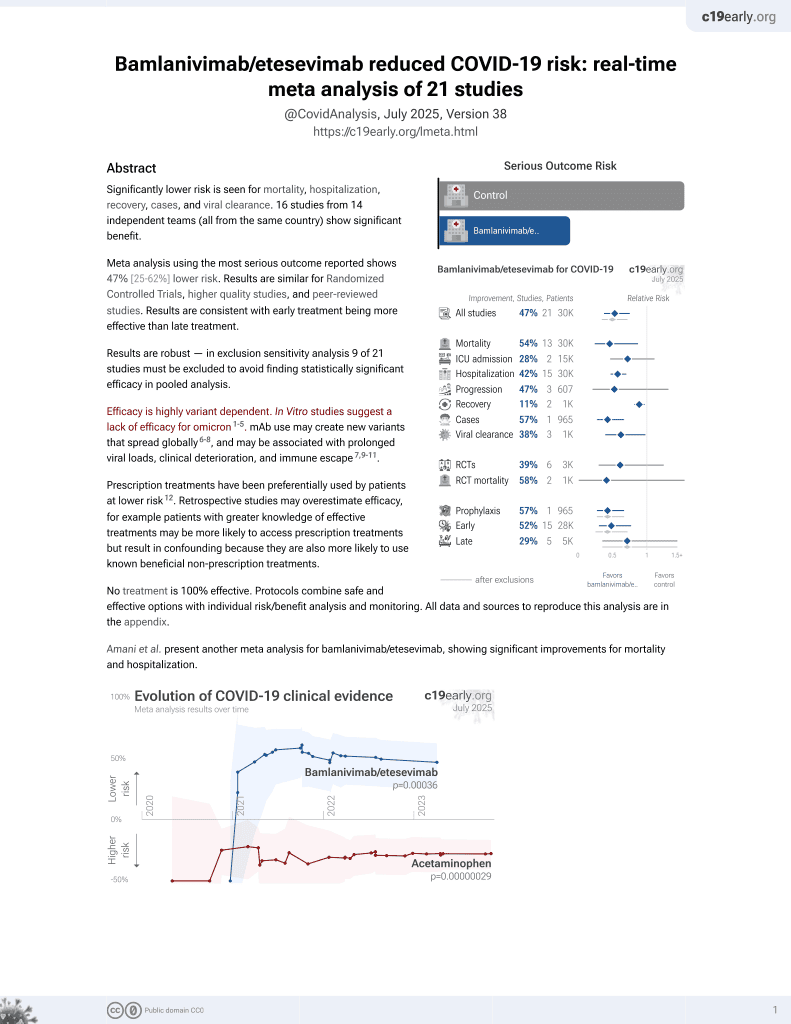
Bamlanivimab/etesevimab for COVID-19
24th treatment shown to reduce risk in
May 2021, now with p = 0.00049 from 22 studies, recognized in 11 countries.
Efficacy is variant dependent.
No treatment is 100% effective.
Protocols combine treatments.
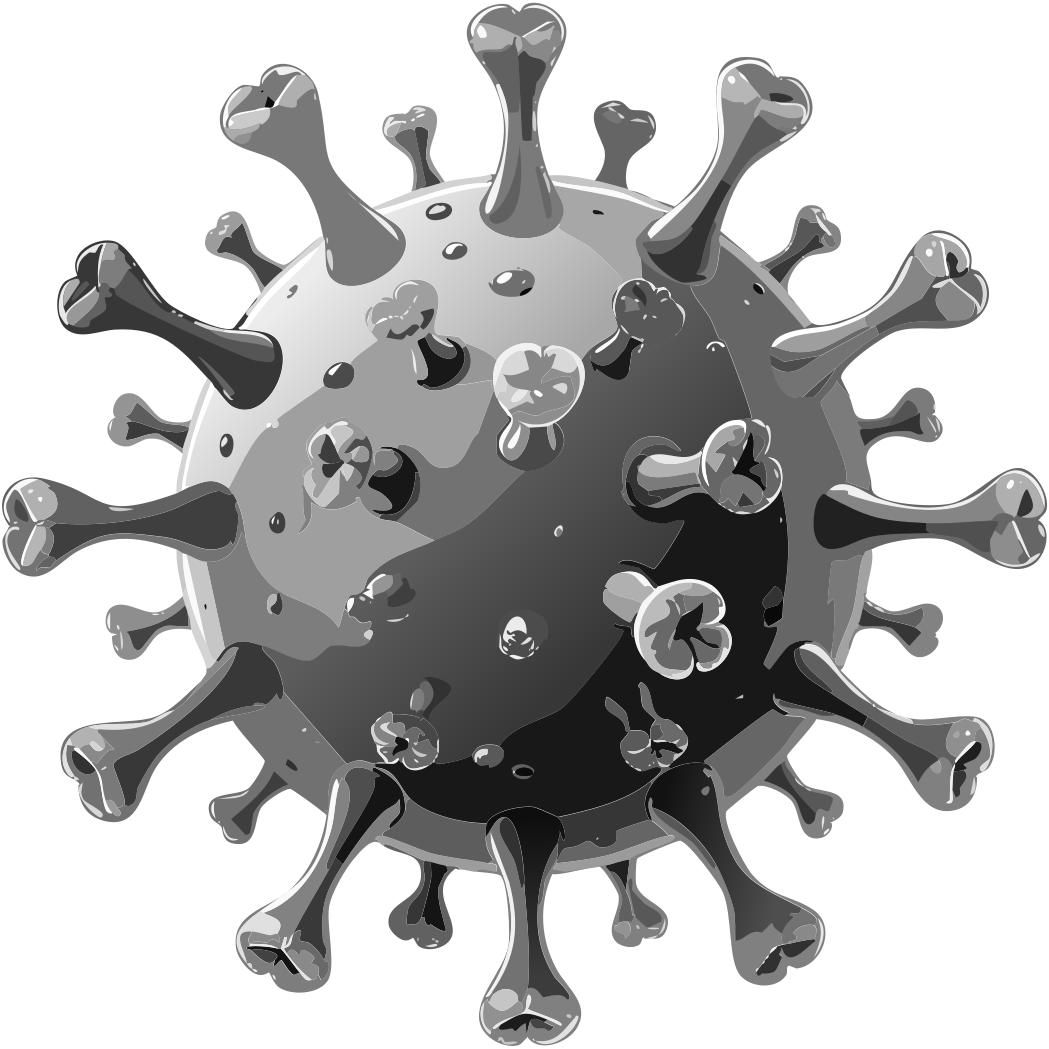
In silico study evaluating the neutralization power of 10 monoclonal antibodies (9 previously EUA-granted, 1 under clinical investigation) against SARS-CoV-2 variants EG.5, BA.2.86, and JN.1. Most available neutralizing antibodies have significantly reduced binding affinity against the new variants, indicating broad immune escape.
Study covers tixagevimab/cilgavimab, casirivimab/imdevimab, bamlanivimab/etesevimab, sotrovimab, regdanvimab, and bebtelovimab.

Ashoor et al., 19 Aug 2024, Bahrain, preprint, 1 author.
Contact: danana@agu.edu.bh.
In silico studies are an important part of preclinical research, however results may be very different in vivo.
Abstract: Preprints.org is a free multidiscipline platform providing preprint service that
is dedicated to making early versions of research outputs permanently available and citable. Preprints posted at Preprints.org appear in Web of Science, Crossref, Google Scholar, Scilit, Europe PMC.
Preprints.org
Copyright: This is an open access article distributed under the Creative Commons
Attribution License which permits unrestricted use, distribution, and reproduction in any medium, provided the original work is properly cited.
Article
Not peer-reviewed version
In Silico Evaluation of Ten Monoclonal Antibodies Neutralization Power of SARS-CoV-2 Variants EG.5, BA.2.86 and JN.1
[Dana N. Ashoor *](https://sciprofiles.com/profile/1313763)
Posted Date: 19 August 2024
doi: 10.20944/preprints202408.1340.v1
Keywords: In Silico; Monoclonal; Antibodies; COVID-19; EG.5; BA.2.86; JN.1; Neutralization power; AntiSARS-CoV-2; Variants
Disclaimer/Publisher's Note: The statements, opinions, and data contained in all publications are solely those of the individual author(s) and contributor(s) and not of MDPI and/or the editor(s). MDPI and/or the editor(s) disclaim responsibility for any injury to people or property resulting from any ideas, methods, instructions, or products referred to in the content.
Article
In Silico Evaluation of Ten Monoclonal Antibodies Neutralization Power of SARS -CoV -2 Variants EG.5, BA.2.86 and JN.1
Dana N. Ashoor
Department of Molecular Medicine, College of Medicine and Health Sciences, Arabian Gulf University, PO Box 26671. Manama, Kingdom of Bahrain; danana@agu.edu.bh; Tel: +973 -17239875
Abstract: The current globally dominant SARS -CoV -2 variants are showing immune escape and reduced susceptibility to antiviral drugs. Therefore, agencies responsible for drug evaluation and regulation such as the FDA and EMA are revising their emergency authorization use of several COVID -19 neutralizing antibodies. These MAbs proved to be unlikely effective against new variants especially Omicron descendants and several pharmaceutical companies are pursuing the development of more potent neutralizing antibodies. To address this issue, w e used In Silico method we previously developed to assess 10 anti -SARS -CoV -2 antibodies propensity to neutralize the new Omicron's subvariants EG.5, BA.2.86 and JN.1, based on comparative binding affinity of 3D generated models and previous experimental and clinical observations. Nine of these MAbs were once granted emergency use authorization, and one is currently under clinical investigation. The results showed that one antibody showed a marked increase of the binding energy for EG.5 compared to two antibodies that showed a significant increase with Pirola (BA.2.86) and JN.1. This data indicates that the new SARS -CoV -2 variant escapes neutralization of most of the available therapeutic NAbs. Furthermore, the data showed new potential therapeutic MAbs combination that could be effective for the treatment countermeasure of the new Omicron's descendants or potential novel variants.
Keywords: In Silico ; monoclonal; antibodies; COVID -19; EG.5; BA.2.86; JN.1; neutralization power; Anti -SARS -CoV -2; variants
DOI record:
{
"DOI": "10.20944/preprints202408.1340.v1",
"URL": "http://dx.doi.org/10.20944/preprints202408.1340.v1",
"abstract": "<jats:p>The current globally dominant SARS-CoV-2 variants are showing immune escape and reduced susceptibility to antiviral drugs. Therefore, agencies responsible for drug evaluation and regulation such as the FDA and EMA are revising their emergency authorization use of several COVID-19 neutralizing antibodies. These MAbs proved to be unlikely effective against new variants especially Omicron descendants and several pharmaceutical companies are pursuing the development of more potent neutralizing antibodies. To address this issue, we used In Silico method we previously developed to assess 10 anti-SARS-CoV-2 antibodies propensity to neutralize the new Omicron’s subvariants EG.5, BA.2.86 and JN.1, based on comparative binding affinity of 3D generated models and previous experimental and clinical observations. Nine of these MAbs were once granted emergency use authorization, and one is currently under clinical investigation. The results showed that one antibody showed a marked increase of the binding energy for EG.5 compared to two antibodies that showed a significant increase with Pirola (BA.2.86) and JN.1. This data indicates that the new SARS-CoV-2 variant escapes neutralization of most of the available therapeutic NAbs. Furthermore, the data showed new potential therapeutic MAbs combination that could be effective for the treatment countermeasure of the new Omicron’s descendants or potential novel variants.</jats:p>",
"accepted": {
"date-parts": [
[
2024,
8,
19
]
]
},
"author": [
{
"ORCID": "https://orcid.org/0000-0002-0376-6859",
"affiliation": [],
"authenticated-orcid": false,
"family": "Ashoor",
"given": "Dana N.",
"sequence": "first"
}
],
"container-title": [],
"content-domain": {
"crossmark-restriction": false,
"domain": []
},
"created": {
"date-parts": [
[
2024,
8,
20
]
],
"date-time": "2024-08-20T01:25:23Z",
"timestamp": 1724117123000
},
"deposited": {
"date-parts": [
[
2024,
8,
20
]
],
"date-time": "2024-08-20T01:27:40Z",
"timestamp": 1724117260000
},
"group-title": "Biology and Life Sciences",
"indexed": {
"date-parts": [
[
2025,
2,
21
]
],
"date-time": "2025-02-21T01:34:25Z",
"timestamp": 1740101665625,
"version": "3.37.3"
},
"is-referenced-by-count": 0,
"issued": {
"date-parts": [
[
2024,
8,
19
]
]
},
"license": [
{
"URL": "http://creativecommons.org/licenses/by/4.0",
"content-version": "unspecified",
"delay-in-days": 0,
"start": {
"date-parts": [
[
2024,
8,
19
]
],
"date-time": "2024-08-19T00:00:00Z",
"timestamp": 1724025600000
}
}
],
"member": "1968",
"original-title": [],
"posted": {
"date-parts": [
[
2024,
8,
19
]
]
},
"prefix": "10.20944",
"published": {
"date-parts": [
[
2024,
8,
19
]
]
},
"publisher": "MDPI AG",
"reference-count": 0,
"references-count": 0,
"relation": {},
"resource": {
"primary": {
"URL": "https://www.preprints.org/manuscript/202408.1340/v1"
}
},
"score": 1,
"short-title": [],
"source": "Crossref",
"subject": [],
"subtitle": [],
"subtype": "preprint",
"title": "In Silico Evaluation of Ten Monoclonal Antibodies Neutralization Power of SARS-CoV-2 Variants EG.5, BA.2.86 and JN.1",
"type": "posted-content"
}
ashoor2