Preclinical and Clinical Evidence on Chloroquine or Hydroxychloroquine in Covid‐19
, D., Clinical and Translational Science, doi:10.1111/cts.70622, May 2026
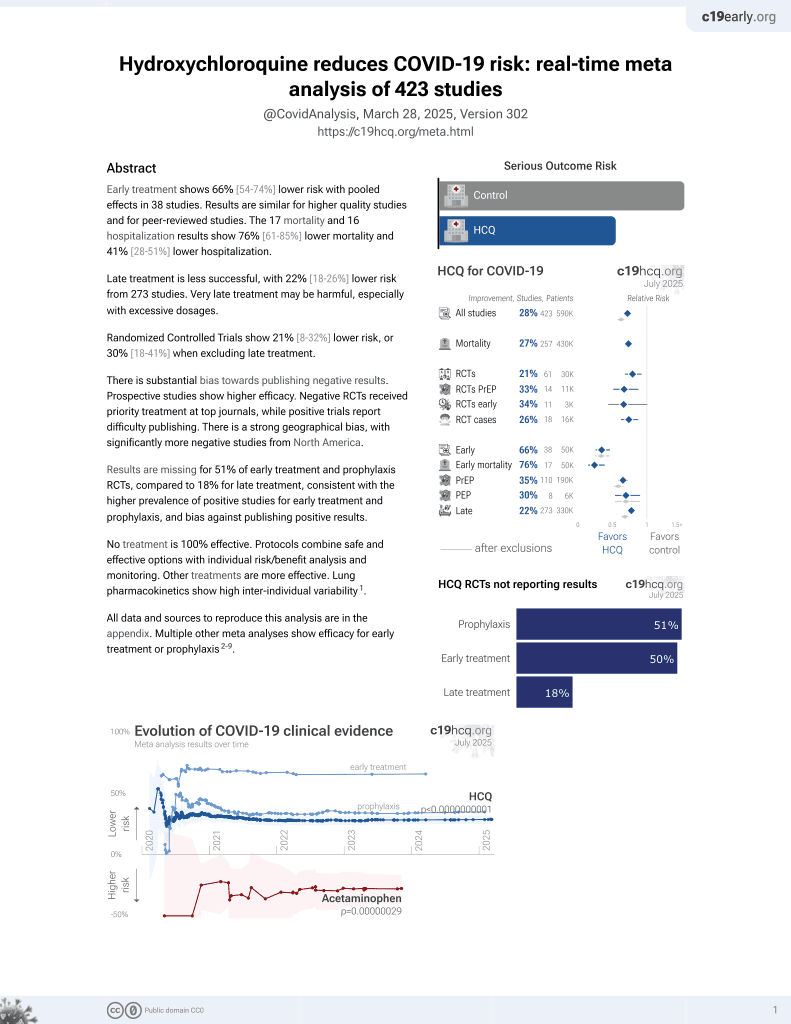
HCQ for COVID-19
1st treatment shown to reduce risk in
March 2020, now with p < 0.0000000001 from 425 studies, used in 59 countries.
No treatment is 100% effective.
Protocols combine treatments.
Discussion of preclinical and clinical evidence for CQ/HCQ in COVID-19. Author challenges claims that CQ/HCQ could not work in human respiratory cells, noting that TMPRSS2 is only co-expressed in ~20% of ACE2-carrying cells, with cathepsin L remaining a relevant target. The author highlights positive ex vivo and animal model data that were overlooked, and critiques the reliance on a retracted study and an outdated meta-analysis to support an "ineffective and harmful" conclusion. Citing the COPCOV double-blind RCT and an updated meta-analysis of ~12 trials, author argues that CQ/HCQ for prophylaxis may reduce PCR-confirmed COVID-19 positivity by approximately half with no excess adverse events. Author notes that trials focusing on hospitalized patients are not the most appropriate setting for viral entry inhibitors.

Pasquier et al., 31 May 2026, peer-reviewed, 1 author.
Contact: pasquierdiego@gmail.com.
Abstract:
Preclinical and Clinical Evidence on Chloroquine or Hydroxychloroquine in Covid- 19
Diego Pasquier
Independent Researcher, Neuchâtel, Switzerland
Correspondence: Diego Pasquier (pasquierdiego@gmail.com)
Received: 17 March 2026 | Accepted: 8 April 2026
Ben Ghezala and colleagues present an enlightening discussion on why certain drugs evaluated in Covid- 19 had low priors due to weak preclinical data, pointing out that pharmacology should play a more central role in selecting candidates for clinical trials [1].
One of the examples discussed, namely chloroquine or hydroxychloroquine (CQ/HCQ), deserves more nuance. A common argument was that the in vitro activity in VERO cells may be a false positive due to phospholipidosis, or that these drugs could not possibly have worked in humans since the mechanism for viral entry in respiratory cells is via TMPRSS2. It was suggested that this explains the lack of activity in ex vivo and animal models, and that the drugs proved ineffective and harmful in humans.
The virus entering human cells via TMPRSS2 only is inexact for the latter is co- expressed in a relatively small subset (about 20%) of human respiratory cells that carry the ACE2 receptor [2]. Cathepsin L could therefore also constitute a relevant target for drugs like CQ or HCQ. There has been evidence for antiviral activity in some ex vivo models of human lung tissue cells (see e.g., Ref. [2]). There was also at least one clearly positive animal model. Shang and colleagues found that, in humanized mice, a high dose of CQ given early was associated with a substantial reduction of the virus in the lungs, preventing lesions from occurring [3].
To suggest that HCQ proved only ineffective and harmful in humans, the sources cited are the retracted study of Pradelle and colleagues and an outdated meta- analysis of observational studies by Fiolet and colleagues, whose result on HCQ + AZI (a mortality increase) was not reproduced in more complete systematic reviews that reported no association [4]. These data focus on hospitalized patients, which is not the most promising phase for viral entry inhibitors.
The largest randomized trial on CQ/HCQ in Covid- 19, together with an updated meta- analysis of a dozen trials, has indeed found a benefit for prevention [5]. There was a modest reduction of suspected Covid- 19 and a more pronounced effect on PCRconfirmed cases. Altogether, it appears that a low daily dose of 150 mg of CQ or HCQ base for prophylaxis may have reduced PCR positivity by about half with no excess adverse events and no safety concerns.
Funding
The author has nothing to report.
Conflicts of Interest
The author declares no conflicts of interest.
References
1. I. Ben Ghezala, N. Peiffer- Smadja, C. Solas, A. Nougairède, F. Touret, and M. Bardou, 'How Can Pharmacology Help us Overcome the Challenges of Drug Repositioning as Antivirals to Treat Emerging Pathogens? The Example of Covid- 19,' Clinical and Translational Science 19 (2026): e70505.
2. J. Grau- Expósito, D. Perea, M. Suppi, et al., 'Evaluation of SARSCoV- 2 Entry, Inflammation and New Therapeutics in Human Lung Tissue Cells,' PLoS Pathogens 18 (2022): e1010171.
3. C. Shang, X. Zhuang, H. Zhang, et al., 'Inhibitors of Endosomal Acidification Suppress SARS- CoV- 2 Replication and Relieve Viral Pneumonia in hACE2 Transgenic Mice,' Virology Journal 18 (2021): 46.
This is an open..
DOI record:
{
"DOI": "10.1111/cts.70622",
"ISSN": [
"1752-8054",
"1752-8062"
],
"URL": "http://dx.doi.org/10.1111/cts.70622",
"alternative-id": [
"10.1111/cts.70622"
],
"article-number": "e70622",
"assertion": [
{
"group": {
"label": "Publication History",
"name": "publication_history"
},
"label": "Received",
"name": "received",
"order": 0,
"value": "2026-03-17"
},
{
"group": {
"label": "Publication History",
"name": "publication_history"
},
"label": "Accepted",
"name": "accepted",
"order": 2,
"value": "2026-04-08"
},
{
"group": {
"label": "Publication History",
"name": "publication_history"
},
"label": "Published",
"name": "published",
"order": 3,
"value": "2026-05-31"
}
],
"author": [
{
"ORCID": "https://orcid.org/0000-0002-5418-6379",
"affiliation": [
{
"name": "Independent Researcher Neuchâtel Switzerland"
}
],
"authenticated-orcid": false,
"family": "Pasquier",
"given": "Diego",
"role": [
{
"role": "author",
"vocabulary": "crossref"
}
],
"sequence": "first"
}
],
"container-title": "Clinical and Translational Science",
"container-title-short": "Clinical Translational Sci",
"content-domain": {
"crossmark-restriction": true,
"domain": [
"ascpt.onlinelibrary.wiley.com"
]
},
"created": {
"date-parts": [
[
2026,
5,
31
]
],
"date-time": "2026-05-31T15:24:08Z",
"timestamp": 1780241048000
},
"deposited": {
"date-parts": [
[
2026,
6,
22
]
],
"date-time": "2026-06-22T04:51:20Z",
"timestamp": 1782103880000
},
"indexed": {
"date-parts": [
[
2026,
6,
22
]
],
"date-time": "2026-06-22T05:47:02Z",
"timestamp": 1782107222370,
"version": "3.54.5"
},
"is-referenced-by-count": 0,
"issue": "6",
"issued": {
"date-parts": [
[
2026,
5,
31
]
]
},
"journal-issue": {
"issue": "6",
"published-print": {
"date-parts": [
[
2026,
6
]
]
}
},
"language": "en",
"license": [
{
"URL": "http://creativecommons.org/licenses/by-nc-nd/4.0/",
"content-version": "vor",
"delay-in-days": 0,
"start": {
"date-parts": [
[
2026,
5,
31
]
],
"date-time": "2026-05-31T00:00:00Z",
"timestamp": 1780185600000
}
},
{
"URL": "http://doi.wiley.com/10.1002/tdm_license_1.1",
"content-version": "tdm",
"delay-in-days": 0,
"start": {
"date-parts": [
[
2026,
5,
31
]
],
"date-time": "2026-05-31T00:00:00Z",
"timestamp": 1780185600000
}
}
],
"link": [
{
"URL": "https://ascpt.onlinelibrary.wiley.com/doi/pdf/10.1111/cts.70622",
"content-type": "application/pdf",
"content-version": "vor",
"intended-application": "text-mining"
},
{
"URL": "https://ascpt.onlinelibrary.wiley.com/doi/full-xml/10.1111/cts.70622",
"content-type": "application/xml",
"content-version": "vor",
"intended-application": "text-mining"
},
{
"URL": "https://ascpt.onlinelibrary.wiley.com/doi/pdf/10.1111/cts.70622",
"content-type": "unspecified",
"content-version": "vor",
"intended-application": "similarity-checking"
}
],
"member": "311",
"original-title": [],
"prefix": "10.1111",
"published": {
"date-parts": [
[
2026,
5,
31
]
]
},
"published-online": {
"date-parts": [
[
2026,
5,
31
]
]
},
"published-print": {
"date-parts": [
[
2026,
6
]
]
},
"publisher": "Wiley",
"reference": [
{
"DOI": "10.1111/cts.70505",
"doi-asserted-by": "publisher",
"key": "e_1_2_1_4_2_1"
},
{
"DOI": "10.1371/journal.ppat.1010171",
"doi-asserted-by": "publisher",
"key": "e_1_2_1_4_3_1"
},
{
"DOI": "10.1186/s12985-021-01515-1",
"doi-asserted-by": "publisher",
"key": "e_1_2_1_4_4_1"
},
{
"DOI": "10.1080/20477724.2021.1936818",
"doi-asserted-by": "publisher",
"key": "e_1_2_1_4_5_1"
},
{
"DOI": "10.1371/journal.pmed.1004428",
"doi-asserted-by": "publisher",
"key": "e_1_2_1_4_6_1"
}
],
"reference-count": 5,
"references-count": 5,
"relation": {},
"resource": {
"primary": {
"URL": "https://ascpt.onlinelibrary.wiley.com/doi/10.1111/cts.70622"
}
},
"score": 1,
"short-title": [],
"source": "Crossref",
"subject": [],
"subtitle": [],
"title": "Preclinical and Clinical Evidence on Chloroquine or Hydroxychloroquine in Covid‐19",
"type": "journal-article",
"update-policy": "https://doi.org/10.1002/crossmark_policy",
"volume": "19"
}