Ursodeoxycholic Acid Attenuates B Cell Susceptibility to SARS-CoV-2 Spike Protein by Interfering Its Binding to ACE2
et al., Biomolecules & Therapeutics, doi:10.4062/biomolther.2025.149, Oct 2025
In vitro study showing that ursodeoxycholic acid (UDCA) reduces SARS-CoV-2 spike protein binding to ACE2 and protects B cells from enhanced susceptibility caused by bisphenol A (BPA) exposure.

Park et al., 17 Oct 2025, USA, peer-reviewed, 2 authors.
Contact: eunyimoon@gmail.com, eunyimoon@sejong.ac.kr.
In vitro studies are an important part of preclinical research, however results may be very different in vivo.
Ursodeoxycholic Acid Attenuates B Cell Susceptibility to SARS-CoV-2 Spike Protein by Interfering Its Binding to ACE2
Biomolecules & Therapeutics, doi:10.4062/biomolther.2025.149
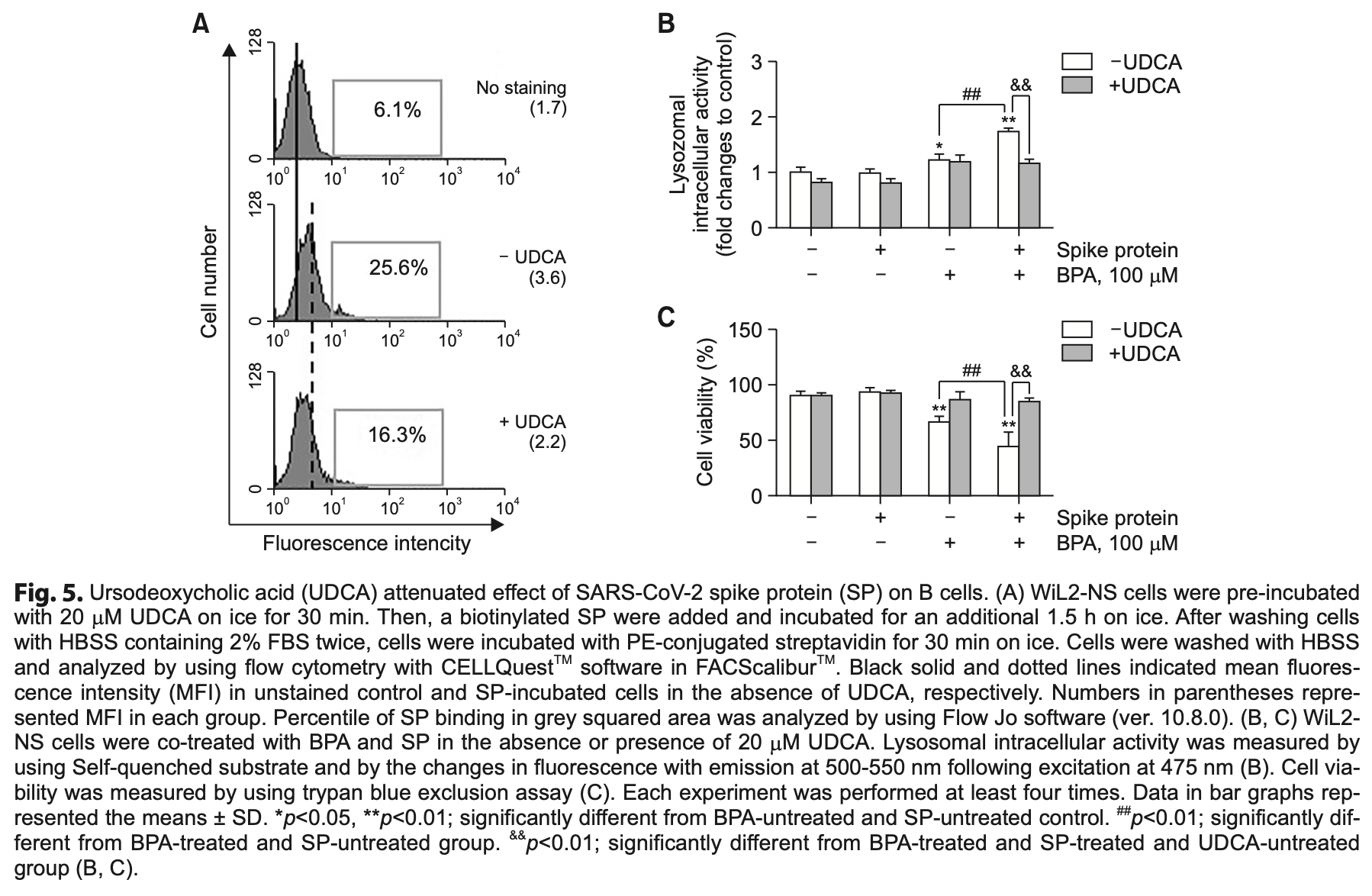
B cells are essential for the defense against various infectious agents including severe acute respiratory syndrome coronavirus 2 (SARS-Cov-2) causing coronavirus disease 2019 . COVID-19 is caused by interaction of the spike protein (SP) with the receptor-binding domain (RBD) and its receptor, angiotensin converting enzyme 2 (ACE2). Bisphenol A (BPA), a plasticizer and endocrine-disrupting chemical, can enter the human body through several exposure routes. Previously, we reported human B cell death by BPA treatment via autophagy induction. Here, we investigated whether the exposure to BPA affects B cell susceptibility to SP of COVID-19 and how to interfere the interaction of SP and ACE2. We observed an increase in ACE2 gene expression in human B cells by BPA treatment and more SP binding in BPA-treated B cells. Our data also showed more B cell death accompanying increased autophagic puncta count and lysosomal intracellular activity by co-treatment with BPA and SP compared to those in BPA treatment alone. Ursodeoxycholic acid (UDCA) reduced SP binding in B cells in BPA-exposed B cells. UDCA treatment also inhibited B cell death and lysosomal enzyme activity which were enhanced by co-treatment of BPA and SP. Taken together, results demonstrate that BPA-exposed B cells are more susceptible to COVID-19. It also suggests that UDCA could be protective to SP-responding B cells exposed to BPA.
CONFLICT OF INTEREST The authors declare no competing financial and non-financial interests.
AUTHOR CONTRIBUTIONS SJP settled down and conducted the experiments, and wrote primary manuscript. EYM planed main idea of the study, analyzed the results, corrected the manuscript, and supported SJP to provide reagents, materials and analysis tools. All authors reviewed the manuscript.
References
Abdelkader, Safar, Salem, Ursodeoxycholic acid ameliorates apoptotic cascade in the rotenone model of Parkinson's disease: modulation of mitochondrial perturbations, Mol. Neurobiol
Canales, Perez-Campos, Mayoral, Hernandez-Huerta, Sanchez Navarro et al., Interaction of Spike protein and lipid membrane of SARS-CoV-2 with Ursodeoxycholic acid, an in-silico analysis, Sci. Rep
Carino, Moraca, Fiorillo, Marchiano, Sepe et al., Hijacking SARS-CoV-2/ACE2 receptor interaction by natural and semi-synthetic steroidal agents acting on functional pockets on the receptor binding domain, Front. Chem
Costello, Waller, Smith, Mells, Wong et al., Ursodeoxycholic acid and severe COVID-19 outcomes in a cohort study using the OpenSAFELY platform, Commun. Med. (Lond.)
Dilillo, Horikawa, Tedder, B-lymphocyte effector functions in health and disease, Immunol. Res
Eki̇ci̇, Ozkaraca, Ataseven, Ursodeoxycholic acid ameliorates paclitaxel-induced hepatic injury in rats: evaluation of oxidative and DNA damage, apoptosis and autophagy, Acta Vet. Hung
Geahlen, Getting Syk: spleen tyrosine kinase as a therapeutic target, Trends Pharmacol. Sci
Hagey, Crombie, Espinosa, Carey, Igimi et al., Ursodeoxycholic acid in the Ursidae: biliary bile acids of bears, pandas, and related carnivores, J. Lipid Res
Halajian, Leblanc, Gee, Colpitts, Activation of TLR4 by viral glycoproteins: a double-edged sword? Front, Microbiol
Hoffmann, Kleine-Weber, Schroeder, Kruger, Herrler et al., SARS-CoV-2 cell entry depends on ACE2 and TMPRSS2 and is blocked by a clinically proven protease inhibitor, Cell
Hyun, Reduced autophagy in 5-fluorouracil resistant colon cancer cells, Biomol. Ther. (Seoul)
Itakura, Mizushima, Characterization of autophagosome formation site by a hierarchical analysis of mammalian Atg proteins, Autophagy
Jang, Lee, Yoon, Kang, Moon, Bisphenol A and its substitutes regulate human B cell survival via Nrf2 expression, Environ. Pollut
Kalampokis, Yoshizaki, Tedder, IL-10-producing regulatory B cells (B10 cells) in autoimmune disease, Arthritis Res. Ther
Kim, Cho, Kim, Kim, Ursodeoxycholic acid inhibits the proliferation of colon cancer cells by regulating oxidative stress and cancer stem-like cell growth, PLoS One
Lapenna, Ciofani, Festi, Neri, Pierdomenico et al., Antioxidant properties of ursodeoxycholic acid, Biochem. Pharmacol
Lee, Kim, Yeom, Noh, Jeong et al., Association between ursodeoxycholic acid and clinical outcomes in patients with COVID-19 infection: population-based cohort study, JMIR Public Health Surveill
Lee, Lee, Gye, Moon, Genotoxicity and glucose tolerance induction by acetyltriethylcitrate, substitute plasticizer compared to di(2-ethylhexyl)phthalate, Sci. Rep
Li, Berardi, Li, Farzan, Dormitzer et al., Conformational states of the severe acute respiratory syndrome coronavirus spike protein ectodomain, J. Virol
Lukivskaya, Zavodnik, Knas, Buko, Antioxidant mechanism of hepatoprotection by ursodeoxycholic acid in experimental alcoholic steatohepatitis, Adv. Med. Sci
Mahapatra, Mishra, Behera, Patil, Gewirtz et al., The lysosome as an imperative regulator of autophagy and cell death, Cell. Mol. Life Sci
Marino, Niso-Santano, Baehrecke, Kroemer, Self-consumption: the interplay of autophagy and apoptosis, Nat. Rev. Mol. Cell. Biol
Masters-Waage, Jha, Reb, COVID-19, coronavirus, Wuhan virus, or China virus? Understanding how to "do no harm" when naming an infectious disease, Front. Psychol
Miyaguchi, Mori, Ursodeoxycholic acid (UDCA) suppresses liver interleukin 2 mRNA in the cholangitis model, Hepatogastroenterology
Mroz, Harvey, Ursodeoxycholic acid inhibits ENaC and Na/K pump activity to restore airway surface liquid height in cystic fibrosis bronchial epithelial cells, Steroids
Mustajab, Kwamboka, Khan, Song, Lee et al., Immunologic responses to an extracellular vesicle-based vaccine expressing the full suite of SARS-CoV-2 structural proteins, Vaccine
Niu, Li, Xu, Sun, Gan et al., Ursodeoxycholic acid protects against lung injury induced by fat embolism syndrome, J. Cell. Mol. Med
Niu, Xu, Zhang, Sun, Gan et al., Ursodeoxycholic acid stimulates alveolar fluid clearance in LPSinduced pulmonary edema via ALX/cAMP/PI3K pathway, J. Cell. Physiol
Park, Jang, Moon, Bisphenol A-induced autophagy ameliorates human B cell death through Nrf2-mediated regulation of Atg7 and Beclin1 expression by Syk activation. Ecotoxicol, Environ. Saf
Paumgartner, Beuers, Ursodeoxycholic acid in cholestatic liver disease: mechanisms of action and therapeutic use revisited, Hepatology
Shi, Kong, Ma, Zhang, Jiang, Effects of ursodeoxycholic acid on the liver plasma membrane fluidity, hepatic glutathione concentration, hepatic estrogen receptors and progesterone receptors in pregnant rats with ethinylestradiol and progesterone induced intrahepatic cholestasis, Zhonghua Fu Chan Ke Za Zhi
Song, Hu, Yu, Zhao, Zhao et al., Little to no expression of angiotensin-converting enzyme-2 on most human peripheral blood immune cells but highly expressed on tissue macrophages, Cytometry A
Tao, Qiu, Fu, Lin, Lei et al., Angiotensin-converting enzyme 2 activator diminazene aceturate prevents lipopolysaccharide-induced inflammation by inhibiting MAPK and NF-kappaB pathways in human retinal pigment epithelium, J. Neuroinflammation
Thuy, Bao, Moon, Ursodeoxycholic acid ameliorates cell migration retarded by the SARS-CoV-2 spike protein in BEAS-2B human bronchial epithelial cells, Biomed. Pharmacother
Willart, Van Nimwegen, Grefhorst, Hammad, Moons et al., Ursodeoxycholic acid suppresses eosinophilic airway inflammation by inhibiting the function of dendritic cells through the nuclear farnesoid X receptor, Allergy
Wu, Lao, Xu, Wang, Tan et al., Guttiferone K induces autophagy and sensitizes cancer cells to nutrient stress-induced cell death, Phytomedicine
Wu, Zhao, Guo, Yu, Wu et al., Ursodeoxycholic acid alleviates nonalcoholic fatty liver disease by inhibiting apoptosis and improving autophagy via activating AMPK, Biochem. Biophys. Res. Commun
Xiao, Dimitrov, The SARS-CoV S glycoprotein, Cell. Mol. Life Sci
Yang, Klionsky, Mammalian autophagy: core molecular machinery and signaling regulation, Curr. Opin. Cell Biol
Yao, Kang, Piao, Ryu, Fernando et al., None
Ye, Zhang, Chen, Wu, Chen et al., Ursodeoxycholic acid alleviates experimental liver fibrosis involving inhibition of autophagy, Life Sci
Yoshino, Yamaki, Yanagisawa, Takano, Hayashi et al., Effects of bisphenol A on antigen-specific antibody production, proliferative responses of lymphoid cells, and TH1 and TH2 immune responses in mice, Br. J. Pharmacol
Youinou, Taher, Pers, Mageed, Renaudineau, B lymphocyte cytokines and rheumatic autoimmune disease, Arthritis Rheum
Yu, Chen, Tooze, Autophagy pathway: cellular and molecular mechanisms, Autophagy
Yurino, Ishikawa, Sato, Akadegawa, Ito et al., Endocrine disruptors (environmental estrogens) enhance autoantibody production by B1 cells, Toxicol. Sci
Zahra, Sisu, Silva, De Aguiar Greca, Randeva et al., Is there a link between bisphenol A (BPA), a key endocrine disruptor, and the risk for SARS-CoV-2 infection and severe COVID-19?, J. Clin. Med
Zhou, Yang, Wang, Hu, Zhang et al., A pneumonia outbreak associated with a new coronavirus of probable bat origin, Nature
Zhu, Zhang, Wang, Li, Yang et al., A novel coronavirus from patients with pneumonia in China, N. Engl. J. Med
DOI record:
{
"DOI": "10.4062/biomolther.2025.149",
"ISSN": [
"1976-9148",
"2005-4483"
],
"URL": "http://dx.doi.org/10.4062/biomolther.2025.149",
"alternative-id": [
"10.4062/biomolther.2025.149"
],
"assertion": [
{
"URL": "http://www.biomolther.org/journal/view.html?doi=10.4062/biomolther.2025.149",
"group": {
"label": "Full text available at:",
"name": "multiple_resolution"
},
"label": "Biomolecules & Therapeutics",
"name": "the_journal",
"value": "http://www.biomolther.org/journal/view.html?doi=10.4062/biomolther.2025.149"
},
{
"group": {
"label": "Publication History",
"name": "publication_history"
},
"label": "Received",
"name": "received",
"order": 0,
"value": "2025-08-05"
},
{
"group": {
"label": "Publication History",
"name": "publication_history"
},
"label": "Revised",
"name": "revised",
"order": 1,
"value": "2025-08-25"
},
{
"group": {
"label": "Publication History",
"name": "publication_history"
},
"label": "Accepted",
"name": "accepted",
"order": 2,
"value": "2025-08-27"
},
{
"group": {
"label": "Publication History",
"name": "publication_history"
},
"label": "Online First",
"name": "published",
"order": 3,
"value": "2025-10-17"
},
{
"group": {
"label": "Publication History",
"name": "publication_history"
},
"label": "Published",
"name": "published",
"order": 4,
"value": "2025-11-01"
},
{
"group": {
"label": "Copyright and Licensing",
"name": "Copyright_and_licensing"
},
"label": "Copyright",
"name": "copyright",
"value": "© 2025 The Korean Society of Applied Pharmacology"
},
{
"explanation": {
"URL": "http://creativecommons.org/licenses/by-nc/4.0/"
},
"group": {
"label": "Copyright and Licensing",
"name": "Copyright_and_licensing"
},
"label": "License",
"name": "license",
"value": "This is an Open Access article distributed under the terms of the Creative Commons Attribution Non-Commercial License (http://creativecommons.org/licenses/by-nc/4.0/) which permits unrestricted non-commercial use, distribution, and reproduction in any medium, provided the original work is properly cited."
}
],
"author": [
{
"affiliation": [
{
"name": "Department of Integrative Bioscience and Biotechnology, Sejong University, Seoul 05006, Republic of Korea"
}
],
"family": "Park",
"given": "So-Jeong",
"sequence": "first"
},
{
"affiliation": [
{
"name": "Department of Integrative Bioscience and Biotechnology, Sejong University, Seoul 05006, Republic of Korea"
}
],
"family": "Moon",
"given": "Eun-Yi",
"sequence": "additional"
}
],
"container-title": "Biomolecules & Therapeutics",
"container-title-short": "Biomol Ther (Seoul)",
"content-domain": {
"crossmark-restriction": true,
"domain": [
"www.biomolther.org"
]
},
"created": {
"date-parts": [
[
2025,
10,
17
]
],
"date-time": "2025-10-17T02:14:59Z",
"timestamp": 1760667299000
},
"deposited": {
"date-parts": [
[
2025,
11,
10
]
],
"date-time": "2025-11-10T05:28:59Z",
"timestamp": 1762752539000
},
"funder": [
{
"DOI": "10.13039/501100003725",
"award": [
"RS-2023-00244570"
],
"award-info": [
{
"award-number": [
"RS-2023-00244570"
]
}
],
"doi-asserted-by": "publisher",
"id": [
{
"asserted-by": "publisher",
"id": "10.13039/501100003725",
"id-type": "DOI"
}
],
"name": "National Research Foundation of Korea"
},
{
"DOI": "10.13039/501100014188",
"award": [
"RS-2023-00244570"
],
"award-info": [
{
"award-number": [
"RS-2023-00244570"
]
}
],
"doi-asserted-by": "publisher",
"id": [
{
"asserted-by": "publisher",
"id": "10.13039/501100014188",
"id-type": "DOI"
}
],
"name": "Ministry of Science and ICT"
}
],
"indexed": {
"date-parts": [
[
2025,
11,
10
]
],
"date-time": "2025-11-10T05:30:55Z",
"timestamp": 1762752655529,
"version": "build-2065373602"
},
"is-referenced-by-count": 0,
"issue": "6",
"issued": {
"date-parts": [
[
2025,
10,
17
]
]
},
"journal-issue": {
"issue": "6",
"published-print": {
"date-parts": [
[
2025,
11,
1
]
]
}
},
"language": "en",
"license": [
{
"URL": "http://creativecommons.org/licenses/by-nc/4.0/",
"content-version": "tdm",
"delay-in-days": 0,
"start": {
"date-parts": [
[
2025,
10,
17
]
],
"date-time": "2025-10-17T00:00:00Z",
"timestamp": 1760659200000
}
}
],
"link": [
{
"URL": "https://pdf.medrang.co.kr/BT2/2025/033/BT033-06-1064.pdf",
"content-type": "unspecified",
"content-version": "tdm",
"intended-application": "text-mining"
},
{
"URL": "https://pdf.medrang.co.kr/BT2/2025/033/BT033-06-1064.pdf",
"content-type": "unspecified",
"content-version": "vor",
"intended-application": "similarity-checking"
}
],
"member": "2506",
"original-title": [],
"page": "1064-1072",
"prefix": "10.4062",
"published": {
"date-parts": [
[
2025,
10,
17
]
]
},
"published-online": {
"date-parts": [
[
2025,
10,
17
]
]
},
"published-print": {
"date-parts": [
[
2025,
11,
1
]
]
},
"publisher": "The Korean Society of Applied Pharmacology",
"reference": [
{
"DOI": "10.1007/s12035-014-9043-8",
"doi-asserted-by": "publisher",
"key": "ref1"
},
{
"DOI": "10.3389/fchem.2020.572885",
"doi-asserted-by": "publisher",
"key": "ref2"
},
{
"DOI": "10.1038/s43856-024-00664-y",
"doi-asserted-by": "publisher",
"key": "ref3"
},
{
"DOI": "10.1007/s12026-010-8189-3",
"doi-asserted-by": "publisher",
"key": "ref4"
},
{
"DOI": "10.1556/004.2025.01155",
"doi-asserted-by": "publisher",
"key": "ref5"
},
{
"DOI": "10.1016/j.tips.2014.05.007",
"doi-asserted-by": "publisher",
"key": "ref6"
},
{
"DOI": "10.1016/S0022-2275(20)35109-9",
"doi-asserted-by": "publisher",
"key": "ref7"
},
{
"DOI": "10.3389/fmicb.2022.1007081",
"doi-asserted-by": "publisher",
"key": "ref8"
},
{
"DOI": "10.1016/j.cell.2020.02.052",
"doi-asserted-by": "publisher",
"key": "ref9"
},
{
"DOI": "10.4161/auto.6.6.12709",
"doi-asserted-by": "publisher",
"key": "ref10"
},
{
"DOI": "10.1016/j.envpol.2019.113907",
"doi-asserted-by": "publisher",
"key": "ref11"
},
{
"DOI": "10.1186/ar3907",
"doi-asserted-by": "publisher",
"key": "ref12"
},
{
"DOI": "10.1371/journal.pone.0181183",
"doi-asserted-by": "publisher",
"key": "ref13"
},
{
"DOI": "10.1016/S0006-2952(02)01391-6",
"doi-asserted-by": "publisher",
"key": "ref14"
},
{
"DOI": "10.2196/59274",
"doi-asserted-by": "publisher",
"key": "ref15"
},
{
"DOI": "10.1038/s41598-019-48599-y",
"doi-asserted-by": "publisher",
"key": "ref16"
},
{
"DOI": "10.1128/JVI.02744-05",
"doi-asserted-by": "publisher",
"key": "ref17"
},
{
"key": "ref18",
"unstructured": "Lukivskaya, O., Zavodnik, L., Knas, M. and Buko, V. (2006) Antioxidant mechanism of hepatoprotection by ursodeoxycholic acid in experimental alcoholic steatohepatitis. <i>Adv. Med. Sci.</i> <b>51</b>, 54-59."
},
{
"DOI": "10.1007/s00018-021-03988-3",
"doi-asserted-by": "publisher",
"key": "ref19"
},
{
"DOI": "10.1038/nrm3735",
"doi-asserted-by": "publisher",
"key": "ref20"
},
{
"DOI": "10.3389/fpsyg.2020.561270",
"doi-asserted-by": "publisher",
"key": "ref21"
},
{
"key": "ref22",
"unstructured": "Miyaguchi, S. and Mori, M. (2005) Ursodeoxycholic acid (UDCA) suppresses liver interleukin 2 mRNA in the cholangitis model. <i>Hepatogastroenterology</i> <b>52</b>, 596-602."
},
{
"DOI": "10.1016/j.steroids.2019.108461",
"doi-asserted-by": "publisher",
"key": "ref23"
},
{
"DOI": "10.1016/j.vaccine.2025.127407",
"doi-asserted-by": "publisher",
"key": "ref24"
},
{
"DOI": "10.1111/jcmm.15985",
"doi-asserted-by": "publisher",
"key": "ref25"
},
{
"DOI": "10.1002/jcp.28602",
"doi-asserted-by": "publisher",
"key": "ref26"
},
{
"DOI": "10.1016/j.ecoenv.2023.115061",
"doi-asserted-by": "publisher",
"key": "ref27"
},
{
"DOI": "10.1053/jhep.2002.36088",
"doi-asserted-by": "publisher",
"key": "ref28"
},
{
"DOI": "10.1038/s41598-021-01705-5",
"doi-asserted-by": "publisher",
"key": "ref29"
},
{
"key": "ref30",
"unstructured": "Shi, Q. Y., Kong, B. H., Ma, K. D., Zhang, X. L. and Jiang, S. (2003) Effects of ursodeoxycholic acid on the liver plasma membrane fluidity, hepatic glutathione concentration, hepatic estrogen receptors and progesterone receptors in pregnant rats with ethinylestradiol and progesterone induced intrahepatic cholestasis. <i>Zhonghua Fu Chan Ke Za Zhi</i> <b>38</b>, 680-682."
},
{
"DOI": "10.1002/cyto.a.24285",
"doi-asserted-by": "publisher",
"key": "ref31"
},
{
"DOI": "10.1186/s12974-016-0489-7",
"doi-asserted-by": "publisher",
"key": "ref32"
},
{
"DOI": "10.1016/j.biopha.2022.113021",
"doi-asserted-by": "publisher",
"key": "ref33"
},
{
"DOI": "10.1111/all.12019",
"doi-asserted-by": "publisher",
"key": "ref34"
},
{
"DOI": "10.1016/j.phymed.2015.06.008",
"doi-asserted-by": "publisher",
"key": "ref35"
},
{
"DOI": "10.1016/j.bbrc.2020.05.128",
"doi-asserted-by": "publisher",
"key": "ref36"
},
{
"DOI": "10.1007/s00018-004-4257-y",
"doi-asserted-by": "publisher",
"key": "ref37"
},
{
"DOI": "10.1016/j.ceb.2009.11.014",
"doi-asserted-by": "publisher",
"key": "ref38"
},
{
"DOI": "10.4062/biomolther.2016.069",
"doi-asserted-by": "publisher",
"key": "ref39"
},
{
"DOI": "10.1016/j.lfs.2019.117175",
"doi-asserted-by": "publisher",
"key": "ref40"
},
{
"DOI": "10.1038/sj.bjp.0705166",
"doi-asserted-by": "publisher",
"key": "ref41"
},
{
"DOI": "10.1002/art.24665",
"doi-asserted-by": "publisher",
"key": "ref42"
},
{
"DOI": "10.1080/15548627.2017.1378838",
"doi-asserted-by": "publisher",
"key": "ref43"
},
{
"DOI": "10.1093/toxsci/kfh179",
"doi-asserted-by": "publisher",
"key": "ref44"
},
{
"DOI": "10.3390/jcm9103296",
"doi-asserted-by": "publisher",
"key": "ref45"
},
{
"DOI": "10.1038/s41586-020-2012-7",
"doi-asserted-by": "publisher",
"key": "ref46"
},
{
"DOI": "10.1056/NEJMoa2001017",
"doi-asserted-by": "publisher",
"key": "ref47"
}
],
"reference-count": 47,
"references-count": 47,
"relation": {},
"resource": {
"primary": {
"URL": "http://www.biomolther.org/journal/view.html?doi=10.4062/biomolther.2025.149"
}
},
"score": 1,
"short-title": [],
"source": "Crossref",
"subject": [],
"subtitle": [],
"title": "Ursodeoxycholic Acid Attenuates B Cell Susceptibility to SARS-CoV-2 Spike Protein by Interfering Its Binding to ACE2",
"type": "journal-article",
"update-policy": "https://doi.org/10.4062/crossmark_policy",
"volume": "33"
}