Effect of Cationic Surfactants on the Molecular Organization of the Simplified Model Lipid Envelope of SARS-CoV-2 Virus─Insights from the Langmuir Monolayer and Liposome Studies
et al., Langmuir, doi:10.1021/acs.langmuir.6c00207, Mar 2026
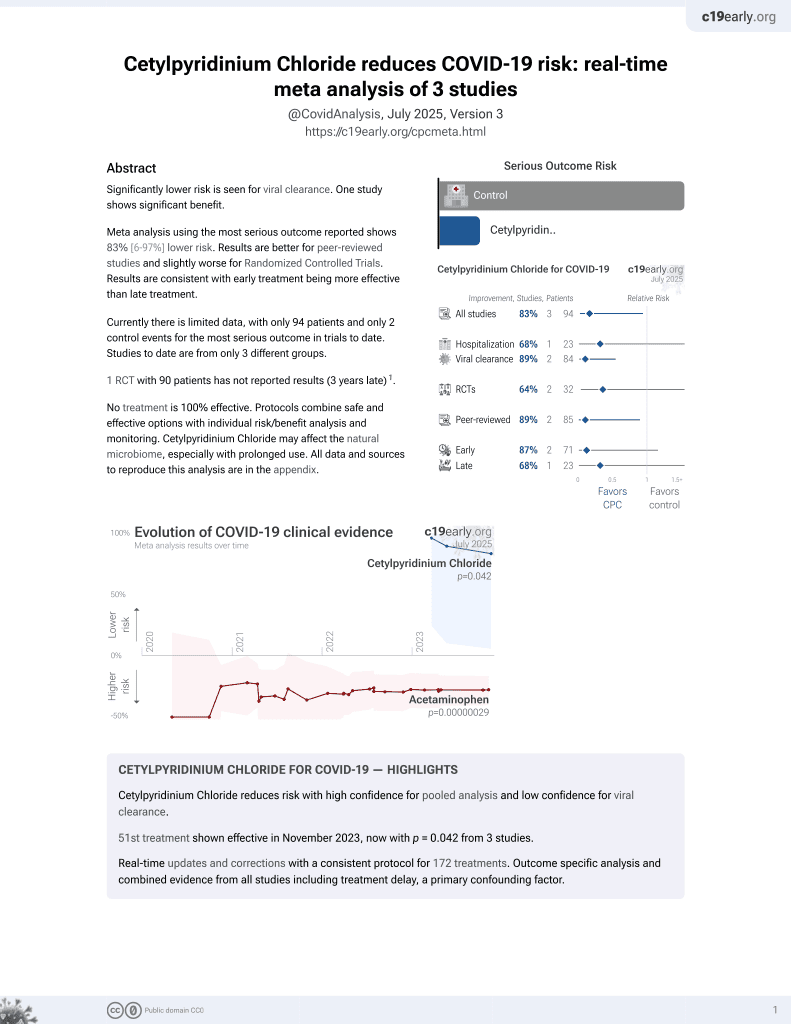
Cetylpyridinium Chloride for COVID-19
Lower risk for recovery and viral clearance.
No treatment is 100% effective.
Protocols combine treatments.
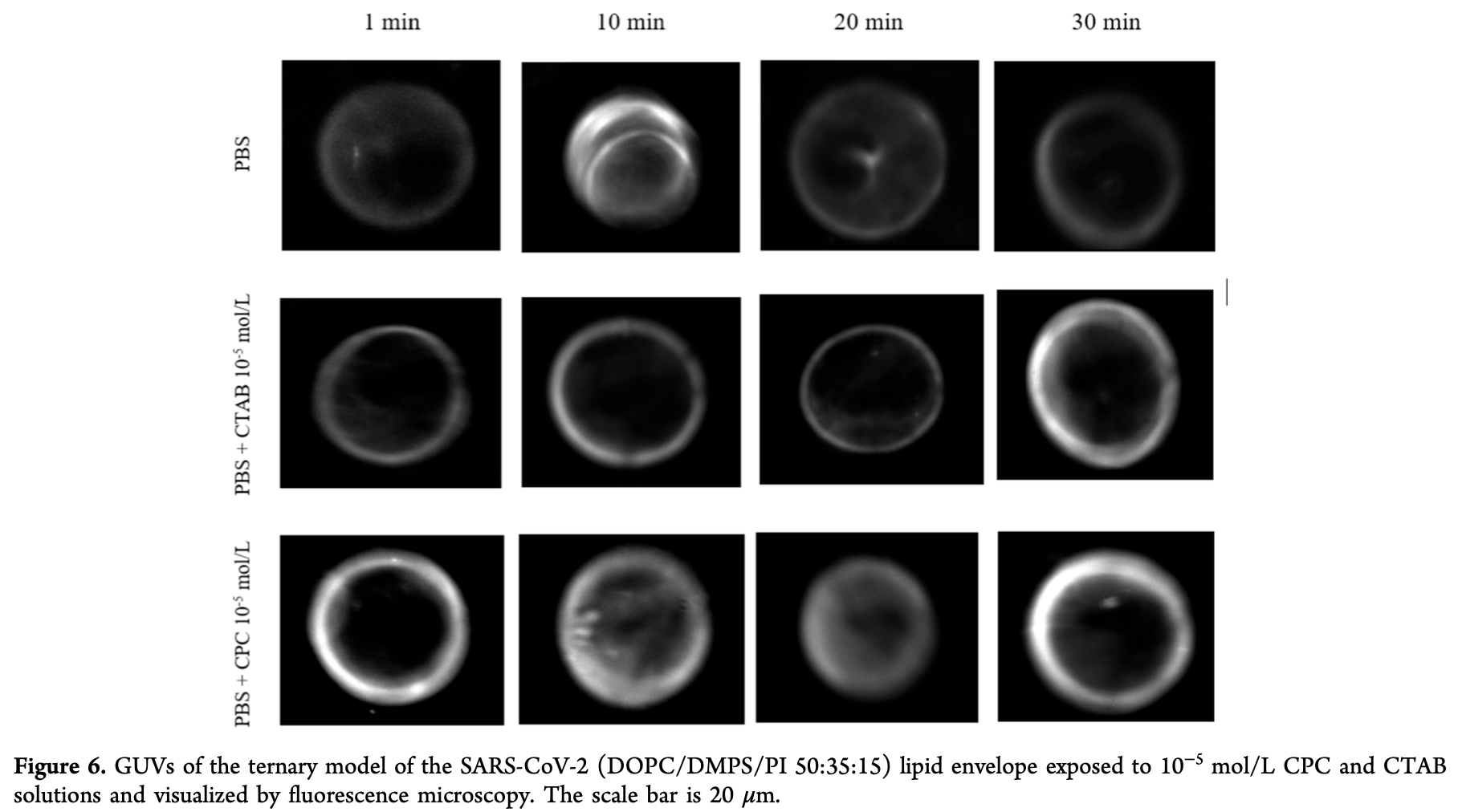
In vitro study showing potential antiviral benefit with cetylpyridinium chloride (CPC) through the destabilization of simplified SARS-CoV-2 lipid envelope models. Authors found that CPC, a cationic surfactant commonly used in mouthwashes and disinfecting agents, effectively penetrates and disrupts lipid layers mimicking the viral envelope even at concentrations below its critical micelle concentration. Due to its planar, aromatic headgroup, CPC incorporates deeply into the lipid bilayer, leading to decreased monolayer stability, increased liposome hydrodynamic diameter, and altered zeta potential.
This study shows why CPC works better than a similar compound like cetyltrimethylammonium bromide (CTAB) - specifically, that CPC's flat, aromatic headgroup acts like a wedge to penetrate the lipid layer, while CTAB's bulky headgroup gets stuck on the surface.

Mierzejewska et al., 17 Mar 2026, Poland, peer-reviewed, 2 authors.
Contact: dorota.matyszewska@chem.uw.edu.pl.
In vitro studies are an important part of preclinical research, however results may be very different in vivo.
Abstract: This article is licensed under CC-BY-NC-ND 4.0
pubs.acs.org/Langmuir
Article
Effect of Cationic Surfactants on the Molecular Organization of the
Simplified Model Lipid Envelope of SARS-CoV‑2 Virus�Insights
from the Langmuir Monolayer and Liposome Studies
Marta Mierzejewska and Dorota Matyszewska*
See https://pubs.acs.org/sharingguidelines for options on how to legitimately share published articles.
Cite This: https://doi.org/10.1021/acs.langmuir.6c00207
ACCESS
Metrics & More
Read Online
Article Recommendations
* Supporting Information
sı
ABSTRACT: In this study, we compare the physicochemical
interactions of cationic surfactants, cetyltrimethylammonium
bromide (CTAB) and cetylpyridinium chloride (CPC), at
concentrations lower than their CMC with model systems
mimicking the lipidic content of the SARS-CoV-2 envelope in
terms of the charge of polar heads and the composition of acyl
chains. The DOPC/DMPS/PI 50:35:15 (molar ratio) Langmuir
monolayers treated as 2D models exhibited increased fluidity and a
shift of surface pressure−area per molecule isotherms toward larger
areas upon surfactant interaction. Liposomes (3D models) showed
an increase in hydrodynamic diameter and changes in zeta
potential in the presence of CTAB and CPC. These effects were
observed both in water and PBS buffer (pH 7.4), while in PBS the
changes were more pronounced in the monolayer systems and surfactant-dependent for liposomes. Additionally, giant unilamellar
vesicles (GUVs) were prepared and visualized using fluorescence microscopy to follow shape fluctuations and rapid changes in
fluorescence intensity upon exposure to surfactants. Despite the electrostatic attractions governing the lipid envelope-surfactant
interactions, the differences in the interaction mechanisms arise from the molecular structure of the polar headgroups of surfactants:
CPC is more likely to effectively penetrate into the lipid layers due to its planar, aromatic headgroup, while CTAB’s bulky polar head
leads to its accumulation close to the lipid surface. These findings provide new insights into molecular-level interactions between
low-concentration cationic surfactants and more exact models of viral lipid envelopes and may serve as a basis for the development of
mutation-independent antiviral strategies targeting the lipid components of enveloped viruses.
■
protein (E).7 Coronaviruses show a high tendency for genetic
recombination and mutations, leading to new strains that are
often resistant to previously effective antiviral treatments,
which are based on highly selective drugs that target viral
proteins essential for replication. The progressing resistance of
SARS-CoV-2 virus creates a need for a deeper understanding
of the physicochemical properties of its lipid envelope, which is
characterized by an increased amount of negatively charged
lipids, including phosphatidylinositol (PI) and phosphatidylserine (PS).3 The negatively charged viral lipid envelope can
be treated as a potential target for selected cationic compounds
such as, e.g., cationic surfactants, since envelope disintegration
resulting from the exposure could lead to the reduction of the
virus infectivity.
DOI record:
{
"DOI": "10.1021/acs.langmuir.6c00207",
"ISSN": [
"0743-7463",
"1520-5827"
],
"URL": "http://dx.doi.org/10.1021/acs.langmuir.6c00207",
"alternative-id": [
"10.1021/acs.langmuir.6c00207"
],
"article-number": "acs.langmuir.6c00207",
"author": [
{
"ORCID": "https://orcid.org/0009-0003-0957-7674",
"affiliation": [
{
"name": "Faculty of Chemistry, Biological and Chemical Research Centre, University of Warsaw, Żwirki i Wigury 101, 02089 Warsaw, Poland"
}
],
"authenticated-orcid": true,
"family": "Mierzejewska",
"given": "Marta",
"sequence": "first"
},
{
"ORCID": "https://orcid.org/0000-0002-5088-6829",
"affiliation": [
{
"name": "Faculty of Chemistry, Biological and Chemical Research Centre, University of Warsaw, Żwirki i Wigury 101, 02089 Warsaw, Poland"
}
],
"authenticated-orcid": true,
"family": "Matyszewska",
"given": "Dorota",
"sequence": "additional"
}
],
"container-title": "Langmuir",
"container-title-short": "Langmuir",
"content-domain": {
"crossmark-restriction": false,
"domain": []
},
"created": {
"date-parts": [
[
2026,
3,
17
]
],
"date-time": "2026-03-17T17:27:37Z",
"timestamp": 1773768457000
},
"deposited": {
"date-parts": [
[
2026,
3,
17
]
],
"date-time": "2026-03-17T17:43:24Z",
"timestamp": 1773769404000
},
"funder": [
{
"DOI": "10.13039/501100004281",
"award": [
"2023/50/E/ST4/00137"
],
"award-info": [
{
"award-number": [
"2023/50/E/ST4/00137"
]
}
],
"doi-asserted-by": "publisher",
"id": [
{
"asserted-by": "publisher",
"id": "10.13039/501100004281",
"id-type": "DOI"
}
],
"name": "Narodowe Centrum Nauki"
}
],
"indexed": {
"date-parts": [
[
2026,
3,
17
]
],
"date-time": "2026-03-17T21:07:56Z",
"timestamp": 1773781676445,
"version": "3.50.1"
},
"is-referenced-by-count": 0,
"issued": {
"date-parts": [
[
2026,
3,
17
]
]
},
"language": "en",
"license": [
{
"URL": "https://creativecommons.org/licenses/by-nc-nd/4.0/",
"content-version": "vor",
"delay-in-days": 0,
"start": {
"date-parts": [
[
2026,
3,
17
]
],
"date-time": "2026-03-17T00:00:00Z",
"timestamp": 1773705600000
}
}
],
"link": [
{
"URL": "https://pubs.acs.org/doi/pdf/10.1021/acs.langmuir.6c00207",
"content-type": "application/pdf",
"content-version": "vor",
"intended-application": "unspecified"
},
{
"URL": "https://pubs.acs.org/doi/pdf/10.1021/acs.langmuir.6c00207",
"content-type": "unspecified",
"content-version": "vor",
"intended-application": "similarity-checking"
}
],
"member": "316",
"original-title": [],
"prefix": "10.1021",
"published": {
"date-parts": [
[
2026,
3,
17
]
]
},
"published-online": {
"date-parts": [
[
2026,
3,
17
]
]
},
"publisher": "American Chemical Society (ACS)",
"reference": [
{
"DOI": "10.1371/journal.pone.0015874",
"doi-asserted-by": "publisher",
"key": "ref1/cit1"
},
{
"DOI": "10.1371/journal.ppat.1003297",
"doi-asserted-by": "publisher",
"key": "ref2/cit2"
},
{
"DOI": "10.1016/j.jlr.2022.100208",
"doi-asserted-by": "publisher",
"key": "ref3/cit3"
},
{
"DOI": "10.1021/acsinfecdis.5b00040",
"doi-asserted-by": "publisher",
"key": "ref4/cit4"
},
{
"DOI": "10.1073/pnas.90.11.5181",
"author": "Aloia R. C.",
"doi-asserted-by": "crossref",
"first-page": "5181",
"journal-title": "Proc. Natl. Acad. Sci. U. S. A.",
"key": "ref5/cit5",
"volume": "90",
"year": "1993"
},
{
"DOI": "10.1016/j.envint.2020.105730",
"doi-asserted-by": "publisher",
"key": "ref6/cit6"
},
{
"DOI": "10.1002/jmv.26424",
"doi-asserted-by": "publisher",
"key": "ref7/cit7"
},
{
"DOI": "10.1039/B208499F",
"doi-asserted-by": "publisher",
"key": "ref8/cit8"
},
{
"DOI": "10.15415/jptrm.2013.11004",
"doi-asserted-by": "publisher",
"key": "ref9/cit9"
},
{
"DOI": "10.1017/S0033583508004721",
"doi-asserted-by": "publisher",
"key": "ref10/cit10"
},
{
"DOI": "10.1016/j.tibs.2012.11.005",
"doi-asserted-by": "publisher",
"key": "ref11/cit11"
},
{
"DOI": "10.1016/j.colsurfb.2022.112885",
"doi-asserted-by": "publisher",
"key": "ref12/cit12"
},
{
"DOI": "10.1016/j.bpj.2013.06.007",
"doi-asserted-by": "publisher",
"key": "ref13/cit13"
},
{
"DOI": "10.1021/acs.langmuir.4c00174",
"doi-asserted-by": "publisher",
"key": "ref14/cit14"
},
{
"DOI": "10.1063/5.0135251",
"doi-asserted-by": "publisher",
"key": "ref15/cit15"
},
{
"DOI": "10.1016/j.jcis.2024.02.088",
"doi-asserted-by": "publisher",
"key": "ref16/cit16"
},
{
"DOI": "10.1021/acs.jpcb.3c05531",
"doi-asserted-by": "publisher",
"key": "ref17/cit17"
},
{
"DOI": "10.1021/mp9000662",
"doi-asserted-by": "publisher",
"key": "ref18/cit18"
},
{
"DOI": "10.1016/j.cis.2014.02.013",
"doi-asserted-by": "publisher",
"key": "ref19/cit19"
},
{
"DOI": "10.1016/j.bbamem.2014.08.023",
"doi-asserted-by": "publisher",
"key": "ref20/cit20"
},
{
"DOI": "10.1016/j.molliq.2022.118805",
"doi-asserted-by": "publisher",
"key": "ref21/cit21"
},
{
"DOI": "10.1016/j.chemphyslip.2022.105236",
"doi-asserted-by": "publisher",
"key": "ref22/cit22"
},
{
"author": "Gaines G. L.",
"key": "ref23/cit23",
"volume-title": "Insoluble Monolayers at Liquid-Gas Interfaces",
"year": "1966"
},
{
"author": "Harkins W. D.",
"key": "ref24/cit24",
"volume-title": "The Physical Chemistry of Surface Films",
"year": "1952"
},
{
"author": "Davies J. T.",
"edition": "2",
"key": "ref25/cit25",
"volume-title": "Interfacial Phenomena",
"year": "1961"
},
{
"DOI": "10.1016/0001-8686(93)80029-b",
"doi-asserted-by": "publisher",
"key": "ref26/cit26"
},
{
"DOI": "10.1016/S0022-2836(65)80093-6",
"doi-asserted-by": "publisher",
"key": "ref27/cit27"
},
{
"DOI": "10.1016/j.molliq.2025.126977",
"doi-asserted-by": "publisher",
"key": "ref28/cit28"
},
{
"DOI": "10.1104/pp.70.5.1405",
"doi-asserted-by": "publisher",
"key": "ref29/cit29"
},
{
"DOI": "10.1016/0005-2736(94)90253-4",
"doi-asserted-by": "publisher",
"key": "ref30/cit30"
},
{
"DOI": "10.1016/j.jconrel.2016.06.017",
"doi-asserted-by": "publisher",
"key": "ref31/cit31"
},
{
"DOI": "10.1039/dc9868100303",
"doi-asserted-by": "publisher",
"key": "ref32/cit32"
},
{
"DOI": "10.2147/IJN.S60674",
"doi-asserted-by": "publisher",
"key": "ref33/cit33"
},
{
"DOI": "10.1021/la970272o",
"doi-asserted-by": "publisher",
"key": "ref34/cit34"
},
{
"DOI": "10.3390/membranes11010053",
"doi-asserted-by": "publisher",
"key": "ref35/cit35"
},
{
"DOI": "10.1016/j.bbamem.2016.01.012",
"doi-asserted-by": "publisher",
"key": "ref36/cit36"
},
{
"DOI": "10.1016/S1874-5679(00)80007-0",
"doi-asserted-by": "crossref",
"key": "ref37/cit37",
"unstructured": "Lyklema, J.\n Gibbs Monolayers\n ; Academic Press, 2000; pp 4.1–4.101."
},
{
"DOI": "10.1016/0021-9797(68)90093-3",
"doi-asserted-by": "publisher",
"key": "ref38/cit38"
},
{
"DOI": "10.1021/la501008x",
"doi-asserted-by": "publisher",
"key": "ref39/cit39"
},
{
"DOI": "10.1038/s41598-021-82852-7",
"doi-asserted-by": "publisher",
"key": "ref40/cit40"
},
{
"DOI": "10.1021/jp809062x",
"doi-asserted-by": "publisher",
"key": "ref41/cit41"
},
{
"DOI": "10.1021/acs.langmuir.3c01328",
"doi-asserted-by": "publisher",
"key": "ref42/cit42"
},
{
"DOI": "10.1021/acsami.5b06781",
"doi-asserted-by": "publisher",
"key": "ref43/cit43"
},
{
"DOI": "10.1002/smsc.202500060",
"doi-asserted-by": "publisher",
"key": "ref44/cit44"
},
{
"DOI": "10.1016/j.chemphyslip.2025.105473",
"doi-asserted-by": "publisher",
"key": "ref45/cit45"
},
{
"DOI": "10.20411/pai.v2i2.200",
"doi-asserted-by": "publisher",
"key": "ref46/cit46"
}
],
"reference-count": 46,
"references-count": 46,
"relation": {},
"resource": {
"primary": {
"URL": "https://pubs.acs.org/doi/10.1021/acs.langmuir.6c00207"
}
},
"score": 1,
"short-title": [],
"source": "Crossref",
"subject": [],
"subtitle": [],
"title": "Effect of Cationic Surfactants on the Molecular Organization of the Simplified Model Lipid Envelope of SARS-CoV-2 Virus─Insights from the Langmuir Monolayer and Liposome Studies",
"type": "journal-article"
}