Assessment of nasal and sinus nitric oxide output using single-breath humming exhalations
et al., European Respiratory Journal, doi:10.1183/09031936.03.00017903, Aug 2003
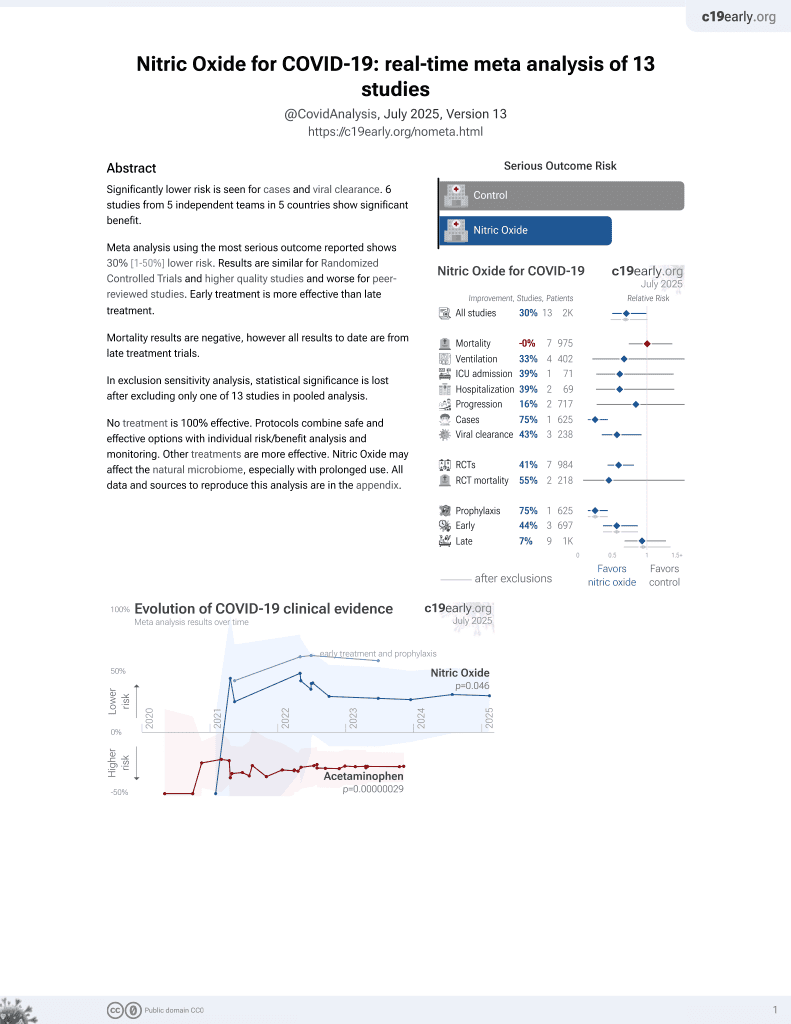
Nitric Oxide for COVID-19
43rd treatment shown to reduce risk in
June 2022, now with p = 0.013 from 14 studies, recognized in 10 countries.
No treatment is 100% effective.
Protocols combine treatments.

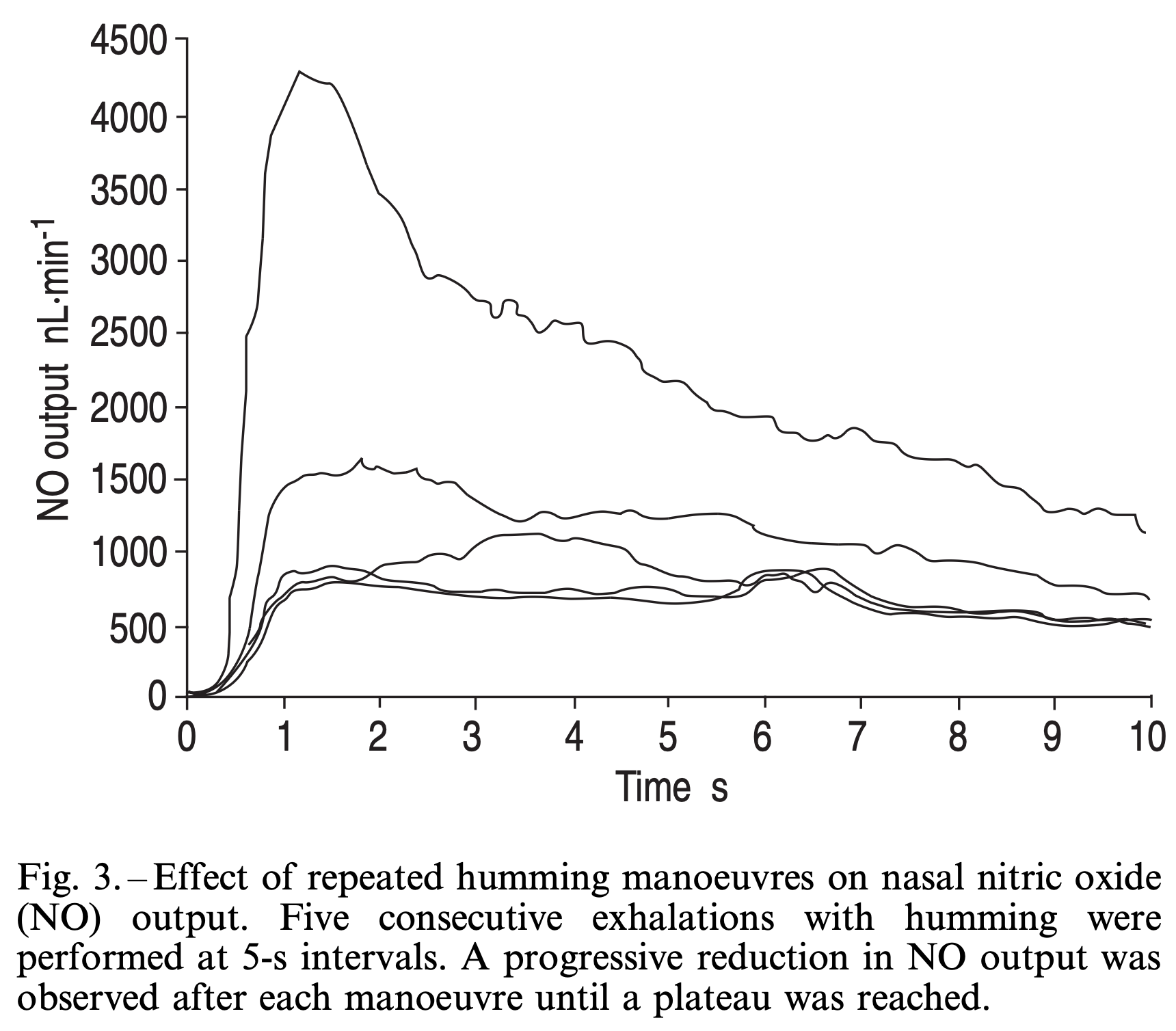
Physiological study of 10 healthy volunteers and a sinus/nasal model characterizing nasal nitric oxide (NO) output during humming exhalations. Humming caused a ~5-fold increase in nasal NO output compared to silent exhalation (2,233 vs. 471 nL/min), driven primarily by rapid washout of NO from the paranasal sinuses rather than increased mucosal NO production.

Maniscalco et al., 1 Aug 2003, Sweden, peer-reviewed, 5 authors.
Contact: jon.lundberg@fyfa.ki.se.
Abstract: ## Assessment of nasal and sinus nitric oxide output using single-breath humming exhalations
M. Maniscalco * ,# , E. Weitzberg } , J. Sundberg z , M. Sofia # , J.O. Lundberg *
Assessment of nasal and sinus nitric oxide output using single-breath humming exhalations. M. Maniscalco, E. Weitzberg, J. Sundberg, M. Sofia, J.O. Lundberg. # ERS Journals Ltd 2003.
ABSTRACT: Nasal nitric oxide (NO) levels increase greatly during humming compared to silent exhalation. In this study, the physiological and anatomical factors that regulate NO release during humming have been characterised in 10 healthy subjects and in a model of the sinus and the nose.
Single-breath humming caused a large initial peak in nasal NO output, followed by a progressive decline. The NO peak decreased in a step-wise manner during repeated consecutive humming manoeuvres but recovered completely after a silent period of 3 min. Topical nasal application of an NO synthase inhibitor reduced nasal NO by w 50% but had no effect on the increase evoked by humming. Silently exhaled nasal NO measured immediately after repeated humming manoeuvres was between 5-50% lower than basal silent NO exhalation, suggesting variable continuous contribution from the sinuses to nasal NO. Among the factors known to influence normal sinus ventilation, ostium size was the most critical during humming, but humming frequency was also of importance.
In conclusion, humming results in a large increase in nasal nitric oxide, which is caused by a rapid gas exchange in the paranasal sinuses. Combined nasal nitric oxide measurement with and without humming could be of use to estimate sinus ventilation and to better separate nasal mucosal nitric oxide output from sinus nitric oxide in health and disease.
Eur Respir J 2003; 22: 323-329.
Nitric oxide (NO) is released into the airway lumen [1], in particular in the upper airways [2-4]. The exact origin of NO found in nasal air and the relative contribution from different sources within the nasal airways are not known. The paranasal sinuses are major sources of NO in adult healthy subjects [5] and the concentrations in a healthy sinus may be very high, ranging 5-20 parts per million (ppm) [5]. The sinuses communicate with the nasal cavity through the ostia and the rate of gas exchange between these cavities is dependent on several factors, such as the size of the ostia, the volume of the sinus, the nasal airflow and intra-nasal pressure [6, 7]. Proper ventilation is essential for maintenance of sinus integrity, and blockage of the ostium is a central event in the pathogenesis of sinusitis [8, 9]. During normal ventilation, the time required to exchange all air in the sinuses is y 30 min, with large inter-individual variation [7, 10]. Sinus ventilation is much slower in patients with sinus disorders [10].
Recently, the current authors have shown that nasal NO levels increase greatly during humming compared to normal silent nasal exhalation, probably by speeding up the sinus gas exchange, thereby increasing nasal NO output [11]. In a twocompartment model of the nose and sinus the authors demonstrated that pulsating airflow, created by humming, causes a dramatic increase in gas exchange between these cavities [11].
In the current study the authors wanted to further characterise nasal NO during humming, and to explore the various factors that determine gas exchange between the
*Dept of Physiology and Pharmacology, Karolinska Institutet, } Dept of..
DOI record:
{
"DOI": "10.1183/09031936.03.00017903",
"ISSN": [
"0903-1936",
"1399-3003"
],
"URL": "http://dx.doi.org/10.1183/09031936.03.00017903",
"abstract": "<jats:p>Nasal nitric oxide (NO) levels increase greatly during humming compared to silent exhalation. In this study, the physiological and anatomical factors that regulate NO release during humming have been characterised in 10 healthy subjects and in a model of the sinus and the nose.</jats:p><jats:p>Single-breath humming caused a large initial peak in nasal NO output, followed by a progressive decline. The NO peak decreased in a step-wise manner during repeated consecutive humming manoeuvres but recovered completely after a silent period of 3 min. Topical nasal application of an NO synthase inhibitor reduced nasal NO by >50% but had no effect on the increase evoked by humming. Silently exhaled nasal NO measured immediately after repeated humming manoeuvres was between 5–50% lower than basal silent NO exhalation, suggesting variable continuous contribution from the sinuses to nasal NO. Among the factors known to influence normal sinus ventilation, ostium size was the most critical during humming, but humming frequency was also of importance.</jats:p><jats:p>In conclusion, humming results in a large increase in nasal nitric oxide, which is caused by a rapid gas exchange in the paranasal sinuses. Combined nasal nitric oxide measurement with and without humming could be of use to estimate sinus ventilation and to better separate nasal mucosal nitric oxide output from sinus nitric oxide in health and disease.</jats:p>",
"accepted": {
"date-parts": [
[
2003,
4,
24
]
]
},
"alternative-id": [
"10.1183/09031936.03.00017903"
],
"author": [
{
"affiliation": [],
"family": "Maniscalco",
"given": "M.",
"sequence": "first"
},
{
"affiliation": [],
"family": "Weitzberg",
"given": "E.",
"sequence": "additional"
},
{
"affiliation": [],
"family": "Sundberg",
"given": "J.",
"sequence": "additional"
},
{
"affiliation": [],
"family": "Sofia",
"given": "M.",
"sequence": "additional"
},
{
"affiliation": [],
"family": "Lundberg",
"given": "J.O.",
"sequence": "additional"
}
],
"container-title": "European Respiratory Journal",
"container-title-short": "Eur Respir J",
"content-domain": {
"crossmark-restriction": false,
"domain": []
},
"created": {
"date-parts": [
[
2003,
7,
29
]
],
"date-time": "2003-07-29T21:02:12Z",
"timestamp": 1059512532000
},
"deposited": {
"date-parts": [
[
2025,
2,
24
]
],
"date-time": "2025-02-24T05:42:16Z",
"timestamp": 1740375736000
},
"indexed": {
"date-parts": [
[
2026,
3,
26
]
],
"date-time": "2026-03-26T22:35:07Z",
"timestamp": 1774564507341,
"version": "3.50.1"
},
"is-referenced-by-count": 85,
"issue": "2",
"issued": {
"date-parts": [
[
2003,
8
]
]
},
"journal-issue": {
"issue": "2",
"published-online": {
"date-parts": [
[
2003,
8,
1
]
]
},
"published-print": {
"date-parts": [
[
2003,
8
]
]
}
},
"language": "en",
"link": [
{
"URL": "https://syndication.highwire.org/content/doi/10.1183/09031936.03.00017903",
"content-type": "unspecified",
"content-version": "vor",
"intended-application": "similarity-checking"
}
],
"member": "81",
"original-title": [],
"page": "323-329",
"prefix": "10.1183",
"published": {
"date-parts": [
[
2003,
8
]
]
},
"published-online": {
"date-parts": [
[
2003,
8,
1
]
]
},
"published-print": {
"date-parts": [
[
2003,
8
]
]
},
"publisher": "European Respiratory Society (ERS)",
"reference": [
{
"DOI": "10.1016/0006-291X(91)91268-H",
"doi-asserted-by": "publisher",
"key": "2024101810240927000_22.2.323.1"
},
{
"DOI": "10.1183/09031936.93.06091368",
"doi-asserted-by": "crossref",
"first-page": "1368",
"journal-title": "Eur Respir J",
"key": "2024101810240927000_22.2.323.2",
"volume": "6",
"year": "1993"
},
{
"DOI": "10.1016/S0140-6736(94)91465-6",
"doi-asserted-by": "publisher",
"key": "2024101810240927000_22.2.323.3"
},
{
"DOI": "10.1183/09031936.94.07081501",
"doi-asserted-by": "publisher",
"key": "2024101810240927000_22.2.323.4"
},
{
"DOI": "10.1038/nm0495-370",
"doi-asserted-by": "publisher",
"key": "2024101810240927000_22.2.323.5"
},
{
"first-page": "432",
"journal-title": "Acta Otolaryngol",
"key": "2024101810240927000_22.2.323.6",
"volume": "78",
"year": "1975"
},
{
"DOI": "10.1046/j.1365-2281.2001.00312.x",
"doi-asserted-by": "publisher",
"key": "2024101810240927000_22.2.323.7"
},
{
"first-page": "S829",
"journal-title": "J Allergy Clin Immunol",
"key": "2024101810240927000_22.2.323.8",
"volume": "99",
"year": "1997"
},
{
"DOI": "10.1016/0091-6749(92)90161-T",
"doi-asserted-by": "publisher",
"key": "2024101810240927000_22.2.323.9"
},
{
"DOI": "10.1177/000348940111000713",
"doi-asserted-by": "crossref",
"first-page": "667",
"journal-title": "Ann Otol Rhinol Laryngol",
"key": "2024101810240927000_22.2.323.10",
"volume": "110",
"year": "2001"
},
{
"DOI": "10.1164/rccm.200202-138BC",
"doi-asserted-by": "publisher",
"key": "2024101810240927000_22.2.323.11"
},
{
"key": "2024101810240927000_22.2.323.12",
"unstructured": "Durrant JD, Lovrinic JH. Bases of Hearing Science, 3rd EdWilliams and Wilkins, Baltimore, 1995;: p. 60."
},
{
"DOI": "10.1164/ajrccm.160.6.ats8-99",
"doi-asserted-by": "publisher",
"key": "2024101810240927000_22.2.323.13"
},
{
"DOI": "10.1136/thx.54.10.947",
"doi-asserted-by": "crossref",
"first-page": "947",
"journal-title": "Thorax",
"key": "2024101810240927000_22.2.323.14",
"volume": "54",
"year": "1999"
},
{
"DOI": "10.1034/j.1399-3003.2000.16b09.x",
"doi-asserted-by": "publisher",
"key": "2024101810240927000_22.2.323.15"
},
{
"DOI": "10.1001/jama.289.3.302-a",
"doi-asserted-by": "publisher",
"key": "2024101810240927000_22.2.323.16"
},
{
"DOI": "10.3109/03009737409178402",
"doi-asserted-by": "crossref",
"first-page": "177",
"journal-title": "Upsala J Med Sci",
"key": "2024101810240927000_22.2.323.17",
"volume": "79",
"year": "1974"
},
{
"DOI": "10.1152/jappl.2001.91.5.1924",
"doi-asserted-by": "crossref",
"first-page": "1924",
"journal-title": "J Appl Physiol",
"key": "2024101810240927000_22.2.323.18",
"volume": "91",
"year": "2001"
},
{
"DOI": "10.1152/jappl.1998.84.4.1217",
"doi-asserted-by": "crossref",
"first-page": "1217",
"journal-title": "J Appl Physiol",
"key": "2024101810240927000_22.2.323.19",
"volume": "84",
"year": "1998"
},
{
"DOI": "10.1034/j.1399-3003.1999.13b15.x",
"doi-asserted-by": "publisher",
"key": "2024101810240927000_22.2.323.20"
},
{
"DOI": "10.1152/jappl.1998.85.2.405",
"doi-asserted-by": "crossref",
"first-page": "405",
"journal-title": "J Appl Physiol",
"key": "2024101810240927000_22.2.323.21",
"volume": "85",
"year": "1998"
},
{
"first-page": "197",
"journal-title": "J Otolaryngol",
"key": "2024101810240927000_22.2.323.22",
"volume": "28",
"year": "1999"
},
{
"DOI": "10.1183/09031936.02.00273502",
"doi-asserted-by": "publisher",
"key": "2024101810240927000_22.2.323.23"
},
{
"DOI": "10.1136/adc.75.4.323",
"doi-asserted-by": "publisher",
"key": "2024101810240927000_22.2.323.24"
},
{
"DOI": "10.1136/thorax.57.7.586",
"doi-asserted-by": "publisher",
"key": "2024101810240927000_22.2.323.25"
},
{
"DOI": "10.1046/j.1365-2222.1997.d01-522.x",
"doi-asserted-by": "publisher",
"key": "2024101810240927000_22.2.323.26"
},
{
"DOI": "10.1016/S0091-6749(97)70195-7",
"doi-asserted-by": "publisher",
"key": "2024101810240927000_22.2.323.27"
},
{
"DOI": "10.1016/S0091-6749(96)80154-0",
"doi-asserted-by": "publisher",
"key": "2024101810240927000_22.2.323.28"
},
{
"DOI": "10.1034/j.1399-3003.1999.13b14.x",
"doi-asserted-by": "publisher",
"key": "2024101810240927000_22.2.323.29"
},
{
"DOI": "10.1046/j.1365-2362.2001.00825.x",
"doi-asserted-by": "publisher",
"key": "2024101810240927000_22.2.323.30"
},
{
"DOI": "10.1067/mai.2000.109269",
"doi-asserted-by": "publisher",
"key": "2024101810240927000_22.2.323.31"
},
{
"DOI": "10.1016/S1081-1206(10)63473-4",
"doi-asserted-by": "crossref",
"first-page": "6",
"journal-title": "Ann Allergy Asthma Immunol",
"key": "2024101810240927000_22.2.323.32",
"volume": "77",
"year": "1996"
}
],
"reference-count": 32,
"references-count": 32,
"relation": {},
"resource": {
"primary": {
"URL": "https://publications.ersnet.org/lookup/doi/10.1183/09031936.03.00017903"
}
},
"score": 1,
"short-title": [],
"source": "Crossref",
"subject": [],
"subtitle": [],
"title": "Assessment of nasal and sinus nitric oxide output using single-breath humming exhalations",
"type": "journal-article",
"volume": "22"
}