Safety and Efficacy of Ivermectin for the Prevention and Treatment of COVID-19: A Double-Blinded Randomized Placebo-Controlled Study
et al., Antibiotics, doi:10.3390/antibiotics11060796, Jun 2022
Low-risk RCT in Thailand with zero mortality, reporting no significant
differences with the addition of ivermectin to favipiravir treatment. The study as
reported does not make sense as detailed below.
All participants had suspected COVID-19 and authors assigned 536 PCR- at
baseline to a prophylaxis study where the only outcome tested was cases. However 62% were
already symptomatic at baseline. Since PCR has a high false negative rate in the first few
days, many patients may already have COVID-19. It is not logical to study prophylaxis of
cases with already symptomatic patients - analyzing progression and clinical outcomes
would make sense, and authors did collect this data, however they report only case
results. The reported time to PCR+ is also not informative because patients were
instructed to do an antigen test only if there were new symptoms (followed by a PCR
test).
For both prophylaxis and treatment, authors note: “All participant
without evaluable outcomes and drop-out participant were considered as having a poor
outcome”, and “...assumed all participants who withdraw or do not take the study
drug, and those in the prevention study who do not perform the second NP swab, have a poor
outcome.” This is not logical - for example patients that recover quickly may be more
likely to drop out or have missing data. Worst-case imputation biases results towards the
null. In this case a very high percentage of events for both prophylaxis and treatment
outcomes were imputed with an implausible mechanism.
100% of the 4 ivermectin patients that did not receive the treatment (which
may be because they dropped out) were reported as hospitalized (compared to 2% overall).
The actual number of patients imputed cannot be determined from the paper - the number of
patients "without evaluable outcomes" is not reported. Dyspnea was ~2x more prevalent in
the ivermectin group (9.2% vs. 4.7%), suggesting incomparable groups for serious
outcomes.
No trial registration could be found. The protocol published with the paper
uses past tense in several places, as if written after trial completion. Authors have not
responded to any issues or to a request for data.
This trial has multiple critical issues:
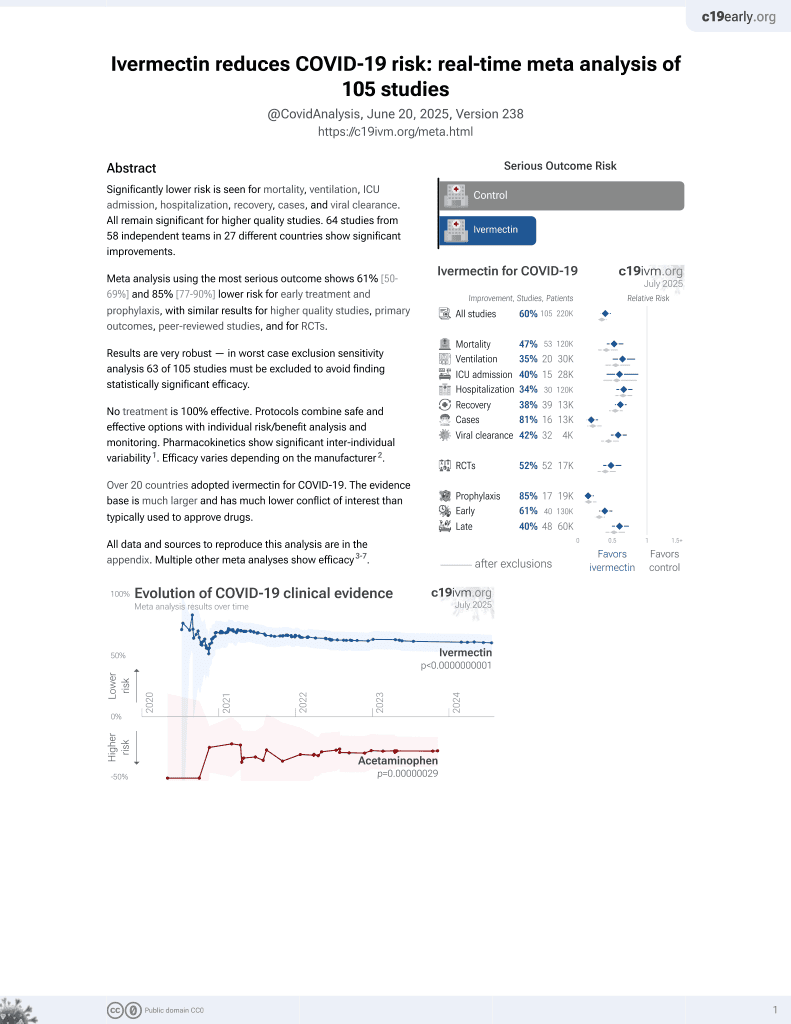
Ivermectin for COVID-19
4th treatment shown to reduce risk in
August 2020, now with p < 0.0000000001 from 106 studies, recognized in 24 countries.
No treatment is 100% effective.
Protocols combine treatments.
| CRITICAL | |
| CRITICAL | |
| CRITICAL | |
| CRITICAL | |
| CRITICAL | |
| CRITICAL | |
| CRITICAL | |
| CRITICAL | |
| CRITICAL | |
| CRITICAL | |
| CRITICAL | |
| CRITICAL | |
| CRITICAL | |
| CRITICAL | |
| CRITICAL | |
| CRITICAL | |
| CRITICAL | |
| CRITICAL | |
| CRITICAL | |
| CRITICAL | |
| CRITICAL | |
| CRITICAL | |
| CRITICAL | |
| CRITICAL | |
| SERIOUS | |
| SERIOUS | |
| SERIOUS | |
| SERIOUS | |
| SERIOUS | |
| SERIOUS | |
| SERIOUS | |
| SERIOUS | |
| SERIOUS | |
| SERIOUS | |
| SERIOUS | |
| SERIOUS | |
| SERIOUS | |
| SERIOUS | |
| MAJOR | |
| MAJOR | |
| MAJOR | |
| MAJOR | |
| MAJOR | |
| MAJOR | |
| MAJOR | |
| MAJOR | |
| MAJOR | |
| MAJOR | |
| MINOR | |
| MINOR | |
| MINOR | |
| MINOR | |
| MINOR | |
| MINOR |
Responses: authors have not responded to any of these issues.
CRITICALProphylaxis enrolled mostly symptomatic patients.
Infections were detected under a symptom-triggered protocol among people who were mostly already symptomatic. All 983 patients presented with suspected COVID-19. Allocation to prophylaxis or treatment was based on a single baseline RT-PCR result. Of the 536 assigned to prophylaxis, 62% were already symptomatic at baseline. RT-PCR has a high false negative rate in the first few days - many patients were likely already infected. With 26 mITT events, the false negative patients that were already infected may be several times larger. Patients already infected at baseline may be later identified as cases, but cannot have infection prevented. Already infected patients bias results towards the null.
CRITICALProphylaxis did not report clinical outcomes although they were collected.
The only reported outcome for prophylaxis was a binary infection endpoint: no progression, hospitalization, symptom resolution, or WHO-score outcome is reported, despite identical phone follow-up at days 3, 7, 14 and 28, and despite these outcomes being collected and reported for the treatment cohort. 62% were symptomatic at baseline, all suspected and many likely with SARS-CoV-2. For patients already infected symptom progression and resolution are meaningful, while cases is not.
CRITICALProphylaxis ascertainment confounding.
The prophylaxis study reports median time to a positive SARS-CoV-2 test, but participants were not tested at regular intervals. They were instructed to perform an antigen test when new symptoms developed or, if asymptomatic, at day 14, and to perform PCR testing for a positive antigen result. The observed time to positivity depends on when symptoms prompted testing, antigen-test sensitivity, and when confirmatory PCR was obtained, rather than directly measuring the time of infection. Testing is notably unclear for the 62% symptomatic at enrollment, and depending on the actual rules or patient interpretation, the baseline symptom imbalance may significantly affect case ascertainment. Detection is therefore also conditional on baseline symptoms rather than on infection timing. The reported time-to-positive figures are uninterpretable as time to infection.
CRITICALIllogical worst-case imputation of dropouts and missing data.
Authors report that 'all participant [sic] without evaluable outcomes and drop-out participant [sic] were considered as having a poor outcome.' This is illogical - for example, participants that recover quickly may be more likely to drop out or have missing data. Healthy patients have less motivation to perform follow-up testing. Worst-case imputation therefore biases results toward harm. Assigning these patients as failures assigns an event probability of 1.0 to a group with an observed background event rate ~5%, a roughly twenty-fold difference. A very high percentage of events were imputed with an implausible mechanism. There is no way to know how many participants had imputed worse-case data, but even considering the known drop-out/non-initiating patients, the imputation may be highly significant and alter the direction of the results.
CRITICALThe population the worst-case rule applies to is never reported and cannot be determined.
The methods state that 'all participant [sic] without evaluable outcomes and drop-out participant [sic] were considered as having a poor outcome', but the paper never reports the total number of worst-case imputations. Numbers are provided for non-initiators and drop-outs, but there is no count for patients without evaluable outcomes. Table S3 shows that missing data varied during the trial - for example at least one placebo patient lost at day 7 returned at day 14.
CRITICALPost-hoc protocol document; common use of past tense contradicts date.
The protocol published with the paper reports 'Version 1.0, July 2021'. The text of the protocol contradicts this date. Section 3.7.3 states participants and investigators 'remained unaware of the assigned treatment until all participants had undergone their 28-day follow-up visit' - describing a completed event that cannot have been written before ~December 2021. The same paragraph mixes three tenses: 'The pharmacist assigns the letter A or B... and prepared visually matched pills... and sequentially numbered the treatment packs... The letter and randomized number will be labeled... and the tablet bags were dispensed in sequential order as participants were recruited.' Section 3.3 uses 'were required' and 'were needed' for sample size; Section 3.11 uses 'The ITT population comprised... and applied a worst-case scenario that assumed...'. PDF metadata shows the file was author as 'pakpoom phoompoung' with the date matching the paper's publication date.
CRITICALNo prospective trial registration despite established practice in research group.
There is no ClinicalTrials.gov, TCTR, or ISRCTN identifier in the abstract, methods, protocol, or appendix, and no registry record could be found. ICMJE recommendations, the Declaration of Helsinki, and MDPI all require prospective registration. Registration practice and infrastructure existed within the authors' group: trial NCT04435587 (history) (IDRA-COVID19), an ivermectin versus HCQ plus darunavir/ritonavir trial in asymptomatic COVID-19 at Siriraj Hospital, was prospectively registered on 15 June 2020, and lists Nasikarn Angkasekwinai and Methee Chayakulkeeree as site sub-investigators. Both are authors of this paper and Angkasekwinai is the principal investigator.
CRITICALTable 4 denominators do not match reported sample sizes; per-timepoint attrition undisclosed.
Table 4's mITT section shows n=229 and n=214, but the percentages are computed on shrinking denominators. For example, day-14 desaturation reported as 6 (2.7%) is actually 6/224 once the Table S3 body-weight data are summed (5/206 + 1/18); 6/229 would be 2.6%. The patients missing ascertainment are not reported in the text, table, or CONSORT diagram. The trial assigns patients without evaluable outcomes as failures, while omitting the count of such patients.
CRITICALITT hospitalization result driven by imputed hospitalizations.
Hospitalization changes from 4/229 vs 4/214 in mITT to 8/233 vs 4/214 in ITT. The four additional ivermectin hospitalizations exactly equal the four ivermectin participants excluded from mITT. Therefore up to 50% of ivermectin ITT hospitalizations appear to be generated by the missing/non-treatment outcome rule rather than observed hospitalizations, which represents a very large change and flips the point estimate. This is a lower bound because there is no way to know how many participants had imputed worse-case data.
CRITICALWorst-case ITT rule applied selectively.
Methods 2.5 and protocol 3.11 state that non-takers, withdrawals, and prevention patients not providing a second swab were all considered to have poor outcomes. The rule was applied to hospitalization and to symptom resolution, but not to oxygen desaturation for example. While pre-imputation data cannot be reconstructed from the paper, selective application is unusual, and could be an indication of application where desired, for example to avoid inconvenient outcomes.
CRITICALStated 400-600 µg/kg/d dose unattainable in many participants.
The protocol dosing table caps at 6 tablets/day (36 mg) with an open-ended top weight band - the achievable mg/kg falls monotonically above 90 kg. At 142.5 kg (the maximum weight in Table 1) it is 253 µg/kg - approximately the standard antiparasitic dose that the paper's own discussion argues is inadequate.
CRITICALImpossible age standard deviation in Supplementary Table S4.
Supplementary Table S4 reports age 38.3 years with SD 40.4 in the day-7 symptomatic group, despite participant ages being restricted to roughly 18-72 years. This is mathematically incompatible with the reported mean and age range.
CRITICALImpossible and mutually contradictory p-values in Table S3.
For BW >90 kg, oxygen desaturation is reported as 0/19 versus 0/22 with p=0.676 at day 3 and p=0.435 at day 7. A comparison of zero events against zero events cannot produce these values. Figures are identical to the whole-cohort mITT p-values in Table 4, suggesting that they were copied down the column. For duration ≥3 days, 0/90 vs. 2/80 is reported as p=1.0 at day 7 while Fisher's exact test gives 0.22.
CRITICALVaccine-naive proportion misstated in direction of the paper's framing.
Section 3.2 states that 21.5% of treatment-study participants were COVID-19 vaccine-naive. Table 3 shows 112/447 (25.1%) with no previous vaccination; 21.5% is the proportion who had completed a vaccine course (96/447).
CRITICALMain text asserts no day-7 predictors; supplementary table reports two.
Section 3.2 concludes 'no factors associated with favorable outcomes in participants who had an absence of all symptoms on day 7 could be identified (Table S4)'. Table S4 reports weight (66.9 vs 70.0 kg, p=0.044) and baseline WHO score (8.1% vs 14.6% score 1, p=0.037) as significant, with gender at p=0.056 and age at p=0.068.
CRITICALTreatment and prevention denominators reversed in Table S5.
Supplementary Table S5 labels n=253/272 as the treatment cohort and n=229/214 as the prevention cohort, while the actual mITT sizes are the reverse. The reported percentages are calculated using the reversed denominators, and the resulting cohort-specific figures are repeated in the paper.
CRITICALRequiring all symptoms to resolve hides faster recovery of most symptoms.
A single symptom not resolving hides any effect against all other symptoms. For example, consider symptoms where recovery involves tissue repair or resolution of inflammation, and not just stopping viral replication, such as anosmia and cough - these control the recovery date regardless of any treatment effect against other symptoms. Notably cough was common and was the slowest resolving symptom as detailed below.
CRITICALTreatment adverse effects are considered to be unresolved COVID symptoms.
The symptom list includes vomiting and diarrhea - known ivermectin adverse effects. Because recovery requires all symptoms to resolve, drug-induced GI symptoms delay the endpoint in the treatment arm only. This may bias results towards harm.
CRITICALApproximately 2x baseline imbalance in dyspnea.
Baseline dyspnea was 9.0% for treatment versus 4.7% for placebo, ~2x imbalance. Dyspnea is a stronger marker of respiratory disease severity than most other symptoms and is directly related to clinically important outcomes such as oxygen desaturation, hospitalization, and WHO progression. The trial reports unadjusted treatment comparisons, so the baseline severity imbalance biases against teatment. Other baseline variables also lean in the same direction: hospital location at enrollment 9.0% vs. 5.6%, cough 55.4% vs. 45.3%, and fewer ivermectin participants were asymptomatic at baseline. With very few observed hospitalizations, the baseline severity difference may significantly alter the outcome.
CRITICALSignificant baseline imbalance in cough, unadjusted, aligned with primary outcome.
Cough at baseline was 129/233 (55.4%) in the ivermectin arm versus 97/214 (45.3%) in placebo, p=0.037. The primary outcome 'absence of all symptoms' is sensitive to baseline symptom burden, and cough is the slowest-resolving symptom in Figure S1 (still 15.3% at day 14 in the treatment arm). No covariate adjustment is performed anywhere in the paper. Further, including symptoms where recovery involves tissue repair or resolution of inflammation, and not just stopping viral replication - such as cough - biases results towards the null. Because cough may be less amenable to antiviral treatment, the large difference in baseline cough may be a very significant confounder. Fig. S1 shows the slowest resolution for cough.
CRITICALEntire day-14 symptom-resolution gap may be attributable to baseline cough imbalance.
At day 14 the treatment study reports symptom resolution of 76.0% ivermectin vs 82.2% placebo, a 6.2 point gap that is the paper's main treatment finding. Figure S1 shows a similar gap in residual cough at day 14. Cough was imbalanced at baseline before any drug was given: 129/233 (55.4%) vs 97/214 (45.3%), p=0.037.
CRITICALBaseline WHO scores contradict baseline admission status.
Table 3 reports 33 patients (7.4%) as already admitted to hospital at enrollment, yet baseline WHO clinical progression scores are only 1 (n=52) or 2 (n=395), with no participant scoring 3 or above.
CRITICALComposition of primary symptom endpoint missing and partly unknowable.
'Absence of all symptoms' is a primary endpoint, but authors never states which symptoms it covers. The list appears only in the protocol (sections 3.7.4 and 3.10): fever, runny nose, cough, sore throat, chest pain, dyspnea, diarrhea, vomiting, and loss of taste and/or smell. Baseline tables record an 'others' symptom category present in 126/447 (28.2%) of treatment participants and imbalanced 70 (30.0%) vs 56 (26.2%). Whether 'other' symptoms counted toward 'all symptoms' cannot be determined from the paper. Both have issues. If 'other' counted, the primary endpoint depends on an open-ended free-text field and the baseline imbalance runs against treatment. If 'other' did not count, then 'absence of all symptoms' is inaccurate. The endpoint also has no severity threshold and no minimum duration, for example a mild residual cough present only on the assessment day scores the same as severe dyspnea.
CRITICALSymptom-resolution denominators show no attrition while same-visit desaturation denominators do.
In Table 4's mITT data the symptom-resolution rows have denominators of 229 and 214 at days 3, 7 and 14, implying complete outcome ascertainment at every timepoint. The oxygen desaturation data for the same participants at the same timepoints do not: reconstructing from Table S3 gives ivermectin 229, 227, 224 and placebo 214, 211, 212. Both endpoints were collected in the same scheduled phone contact. Either symptom data were obtained from participants whose oxygen saturation was not, or participants missing at those contacts were silently scored as having unresolved symptoms. The second explanation is more likely, since a participant unreachable by phone provides no data of either kind.
SERIOUSRecovery includes participants already asymptomatic at baseline.
The treatment cohort included 12% of participants who were asymptomatic at enrollment, however 'absence of all symptoms' at days 3, 7 and 14 is analyzed as a primary treatment outcome across the full cohort. The placebo arm started with a larger proportion already asymptomatic.
SERIOUSAny single unblinding event unblinds the entire trial.
Protocol section 3.7.3 shows the pharmacist assigned the letter A or B to each participant, labelled the ivermectin and placebo bags with that letter and a sequential number, and was the only person who knew which letter corresponded to the active drug. Because the same two codes identify allocation across all 983 participants a single unblinding event unblinds the entire trial. An investigator or participant identifying a characteristic side effect, or any pharmacy or dispensing disclosure, unblinds every participant simultaneously. Standard practice uses unique codes for each participant or blocked codes. The side effects observed in the trial suggest that essentially all observent staff aware of the A/B labels would be effectively unblinded.
SERIOUSHospitalization endpoint undefined for participants hospitalized at baseline.
The treatment study primary endpoint 'hospitalization due to clinical progression within 14 days' is not defined for the 33 participants (7.4%) already in hospital at enrollment. The paper does not state whether such participants were excluded from the endpoint, counted as events, required to escalate care to qualify, or counted for discharge-and-readmission.
SERIOUSProphylaxis ITT event counts do not reconcile with stated missing-swab rule.
Prophylaxis results change from 12/253 vs 14/272 in mITT to 18/259 vs 19/277 in ITT. The added events match participants excluded from mITT, while the paper separately reports that three ivermectin and two placebo mITT participants failed to perform follow-up NP testing. Under the protocol, missing the second NP swab should itself generate a poor ITT outcome, yet these additional events are not apparent in the ITT totals.
SERIOUSLargest effect estimate in subgroup targeted by conclusion is not mentioned.
Table S2 shows the fully-immune prevention subgroup as 1/73 (1.4%) ivermectin vs 6/90 (6.7%) placebo, RR approximately 0.21 (95% CI 0.03 to 1.67), p=0.131. This is the largest point estimate reported. Section 3.1 reports that 'there were no differences in the proportion of participants with a positive RT-PCR when analyzed by the contact duration, body weight, and vaccination status'. That is accurate on statistical significance but omits the point estimate entirely. The paper's conclusion is specifically restricted to 'populations with a high rate of COVID-19 vaccination', which is this subgroup.
SERIOUSNo time-to-resolution analysis despite data being collected.
The treatment study reports only cross-sectional symptom prevalence at fixed days 3, 7 and 14. No survival, time-to-resolution, or AUC analysis is presented. A treatment that accelerates recovery without changing the day-14 proportion is invisible to this design. Figure S1 contains the underlying per-symptom, per-timepoint data, and the protocol specifies collection of symptom presence and absence at each contact - the analysis was available but not performed.
SERIOUSTreatment outcomes reported without effect estimates or confidence intervals.
Table 4 reports treatment outcomes primarily as arm-specific percentages and p-values, without relative effect estimates or confidence intervals. This obscures the extreme imprecision of clinically important outcomes. For hospitalization, the mITT result is 4/229 versus 4/214, RR 0.93 [0.24-3.70], which is compatible with both a large benefit and substantial harm. Presenting only p-values can make these results appear more conclusively null than they are.
SERIOUSBaseline symptom count higher in ivermectin arm; never tabulated.
Summing the symptom prevalences in Table 3 gives ~2.40 symptoms per participant in the ivermectin arm versus ~2.20 in placebo, or 2.68 versus 2.53 among symptomatic participants only - roughly 9% higher in the ivermectin arm. These are lower bounds, since the 'others' free-text category may contain more than one symptom per participant. No total symptom count, symptom-burden score, or multi-symptom cross-tabulation is reported. For an endpoint requiring every symptom to resolve, baseline symptom count is directly relevant.
SERIOUSRecovery-driven attrition plausible, consequential, and never examined.
Participants who recover are more likely to stop responding to phone follow-up - missingness is unlikely to be at random. No baseline comparison of dropouts versus completers is provided.
SERIOUSConclusion asserts absence of effect from underpowered null.
The conclusion states that ivermectin 'should not be used for preventing SARS-CoV-2 infection'. The prevention result is 12/253 versus 14/272, giving RR 0.92 with 95% CI 0.43 to 1.95 — compatible with a 57% reduction or a 95% increase. The trial was underpowered. Hospitalization (RR 0.93, CI 0.24 to 3.70) and mortality (0 versus 0, a declared primary outcome that yielded no information) are similarly uninformative.
SERIOUSFunctional unblinding due to side-effects.
The treatment study primary outcomes are participant-reported symptoms collected by phone. No blinding-success questionnaire was administered and no assessment of blinding integrity is reported.
SERIOUSTreatment event rate far below rate used for power.
The treatment sample-size calculation assumed an oxygen desaturation rate of 30% in control and 15% with treatment, but the observed day 14 rates were only ~1.9% and 2.7%. The assumed control event rate was about 16 times higher than observed.
SERIOUSOxygen desaturation undefined for participants already desaturated at enrollment.
The treatment primary endpoint is oxygen desaturation, defined as saturation below 96% or a fall of at least 3% after exertion. Table 3 shows saturation below 96% at baseline in 6 participants. The paper does not state whether such participants were excluded as not at risk, counted as events, or required to deteriorate further to qualify. The choice of rule changes the direction of the result.
SERIOUSNo per-protocol analysis despite 10.7% partial compliance and weight-capped dosing.
Only ITT and mITT populations are reported. In the treatment study 48/447 (10.7%) were classed as partially compliant, and 99/983 (10.1%) overall. On a three-day course, 'partial compliance' can mean a single dose of three, but the paper never defines the threshold or reports the distribution of doses taken. Combined with dosing below stated for participants above 90 kg, the actual delivered dose is unknown for a substantial number of patients and is never analyzed.
MAJORProphylaxis analysis lacks stratification by baseline symptom status.
The prophylaxis cohort combines asymptomatic exposed participants with symptomatic PCR-negative participants, but the analyses do not separate these groups. Baseline symptom status is likely the most important variable for distinguishing true prophylaxis from treatment of possible early infection.
MAJORLoss of smell ~3x increase between baseline and day 3.
Figure S1 shows loss of smell or taste rising from 14.8% to 38.9% in the ivermectin arm and from 21.0% to 45.3% in placebo between baseline and day 3, making it the most prevalent symptom at day 3 in both arms before falling to 6.1% and 4.2% by day 14. The paper notes the day-3 peak but offers no explanation. Baseline symptoms were recorded in clinic by an investigator, whereas day 3 was collected by phone against an explicit symptom checklist, raising the possibility that the increase is partly an ascertainment artifact rather than genuine late-onset anosmia.
MAJORNo repeat viral sampling in the treatment study.
Cycle threshold was measured only at enrollment for treatment participants; no follow-up RT-PCR or viral load was collected at day 3, 7 or 14, and viral clearance is not among the endpoints. The trial therefore cannot distinguish between no antiviral effect and an antiviral effect that produced no significant clinical benefit in a young, largely vaccinated, low-event-rate population.
MAJORPotential contemporaneous institutional pressure against positive findings.
The trial was conducted during rapidly increasing regulatory and professional opposition to ivermectin, including a Thai FDA warning. This creates a potential asymmetric reputational or institutional incentive around interpretation of positive findings.
MAJORWHO progression score direction undefined and range implies inconsistent events.
The sign convention for 'change in WHO progression score from baseline' is never stated. Day 14 change is reported as 1 (-5, 1) in both arms — identical median and identical range, which is uninformative as presented. If positive denotes improvement, a change of -5 from a baseline score of 2 implies a participant reached WHO score 7 (intubation and mechanical ventilation), while no ventilation was reported, there were zero deaths, and a hospitalization rate of 1.7 to 1.9%.
MAJORDichotomization cut-points inconsistent between tables and text.
Illness duration is dichotomised as '<3 days' in Table 3 (219 participants) but '≤3 days' in Table S4 (300 participants). Cycle threshold is tabulated as '<20' and '≥20' in Table 3 but described in the text as '≤20'.
MAJORTreatment study cannot isolate an ivermectin effect.
97.5% of treatment-study participants received concomitant favipiravir, so the comparison is ivermectin plus favipiravir versus favipiravir alone. Authors claim this is immaterial because favipiravir lacks demonstrated benefit, however many studies do show benefit, with increased benefit for earlier treatment, although results are mixed and efficacy is contested.
MAJORPrevention endpoint under-ascertains infection.
Participants self-collected nasopharyngeal antigen tests only at day 14 or on developing new symptoms, with RT-PCR confirmation only if an antigen test was positive. Infections that arose and cleared between enrolment and day 14 in an asymptomatic participant would be missed entirely, and self-collected swabs are less sensitive. Table S2 further describes the outcome as 'positive RT-PCR or rapid antigen test', which does not match the Table 2 and methods definition of positive RT-PCR.
MAJORImplausibly low and homogeneous cycle-threshold standard deviations.
The six Ct standard deviations in Table 2 are 2.8, 3.0, 2.9, 3.0, 2.8 and 2.8 — a range of 0.2. The same study reports a baseline Ct SD of 5.3 in the treatment cohort (n=447). Testing the observed dispersion against sigma = 5.3 gives chi-square = 2.51, lower-tail p of approximately 0.02, occurring in both arms simultaneously.
MAJORCompliance tables have no category for participants who took no drug.
Tables 1, 3 and S1 classify all 983 participants as either 'full compliance' or 'partial compliance'. There is no non-compliance category, however 14 participants took no study drug at all.
MINORSign error on the prevention ITT risk difference.
Section 3.1 reports 'a difference of -0.09%' while Table 2 reports 0.09%.
MINORStated subgroup sample sizes do not match.
Table S2's footnote reports exposure-duration data for '483 participants (92%)' while the cells sum to 485. Table S4 shows contact duration 'n=313' against cells summing to 309, and illness duration 'n=394' for cells summing to 391.
MINORSafety figure reports broader adverse-event category as a specific symptom.
The abstract states 'The ivermectin group had a significantly higher proportion of transient blurred vision (5.6% vs. 0.6%; p < 0.001)'. The underlying figure is Table 5's 'Ocular problems' row (27/482 vs 3/486). Section 3.3 describes these as 'mainly blurred vision', so the 5.6% includes ocular events that were not blurred vision. The rate of blurred vision specifically is not reported anywhere.
MINORPercentage and rounding errors.
Table 1 reports ivermectin male as 110/259 = 42.2% where the correct value is 42.5%, leaving the column summing to 99.7%. Placebo male 116/277 is printed as 42.0% against a correct 41.9%.
MINORPercentages in the text use wrong denominator.
Section 3.2 states 'overall, 55.6% of participants had onset of symptoms ≤3 days before enrollment'; 55.6% is of the 394 symptomatic participants, and of all 447 the figure is 49%. Section 3.1 states 'most (85%) had previously received ≥1 dose' where the actual value is 451/536 = 84.1%.
Angkasekwinai et al., 12 Jun 2022, Double Blind Randomized Controlled Trial, placebo-controlled, Thailand, peer-reviewed, mean age 38.4, 9 authors, study period August 2021 - November 2021, dosage 400μg/kg days 1-3, 400-600µg/kg.
Contact: nasikarn@gmail.com (corresponding author), pinyo.rat@mahidol.ac.th, methee.cha@mahidol.ac.th, pakpoom.pho@mahidol.ac.th, pornpan.koo@mahidol.ac.th, walaiporn.wan@mahidol.ac.th, visanu.tha@mahidol.ac.th, sorawit.cha@mahidol.ac.th, varalak.sri@mahidol.ac.th, nasikarn.ang@mahidol.ac.th.
Safety and Efficacy of Ivermectin for the Prevention and Treatment of COVID-19: A Double-Blinded Randomized Placebo-Controlled Study
Antibiotics, doi:10.3390/antibiotics11060796
The safety and efficacy of ivermectin for the prevention and treatment of COVID-19 are still controversial topics. From August to November 2021, we conducted a double-blinded, randomized controlled trial at Siriraj Hospital, Thailand. Eligible participants were adults ≥ 18 years with suspected COVID-19 who underwent a SARS-CoV-2 RT-PCR test. After enrollment, the participants were randomized to receive either ivermectin (400-600 µg/kg/d) or placebo once daily for 3 days. Among 983 participants, 536 (54.5%) with a negative RT-PCR result were enrolled in the prevention study, and 447 (45.5%) with a positive RT-PCR result were enrolled in the treatment study. In the prevention study, the incidence of COVID-19 on Day 14 was similar between the ivermectin and the placebo group (4.7% vs. 5.2%; p = 0.844; ∆ = −0.4%; 95% CI; −4.3-3.5%). In the treatment study, there was no significant difference between the ivermectin and placebo group for any Day 14 treatment outcome: proportion with oxygen desaturation (2.7% vs. 1.9%; p = 0.75), change in WHO score from baseline (1 [−5, 1] vs. 1 [−5, 1]; p = 0.50), and symptom resolution (76% vs. 82.2%; p = 0.13). The ivermectin group had a significantly higher proportion of transient blurred vision (5.6% vs. 0.6%; p < 0.001). Our study failed to demonstrate the efficacy of a 3-day once daily of ivermectin for the prevention and treatment of COVID-19. The given regimen of ivermectin should not be used for either prevention or treatment of COVID-19 in populations with a high rate of COVID-19 vaccination.
Conflicts of Interest: The authors declare no conflict of interest.
References
Abd-Elsalam, Noor, Badawi, Khalaf, Esmail et al., Clinical study evaluating the efficacy of ivermectin in COVID-19 treatment: A randomized controlled study, J. Med. Virol, doi:10.1002/jmv.27122
Ahmed, Karim, Ross, Hossain, Clemens et al., A five-day course of ivermectin for the treatment of COVID-19 may reduce the duration of illness, Int. J. Infect. Dis, doi:10.1016/j.ijid.2020.11.191
Bartoletti, Azap, Barac, Bussini, Ergonul et al., ESCMID COVID-19 living guidelines: Drug treatment and clinical management, Clin. Microbiol. Infect, doi:10.1016/j.cmi.2021.11.007
Behera, Patro, Singh, Chandanshive, Ravikumar et al., Role of ivermectin in the prevention of SARS-CoV-2 infection among healthcare workers in India: A matched case-control study, PLoS ONE, doi:10.1371/journal.pone.0247163
Buonfrate, Chesini, Martini, Roncaglioni, Ojeda Fernandez et al., High-dose ivermectin for early treatment of COVID-19 (COVER study): A randomised, double-blind, multicentre, phase II, dose-finding, proof-of-concept clinical trial, Int. J. Antimicrob. Agents, doi:10.1016/j.ijantimicag.2021.106516
Caly, Druce, Catton, Jans, Wagstaff, The FDA-approved drug ivermectin inhibits the replication of SARS-CoV-2 in vitro, Antivir. Res, doi:10.1016/j.antiviral.2020.104787
Cavalcanti, Berwanger, Zampieri, Hydroxychloroquine with or without Azithromycin in Covid-19, N. Engl. J. Med
Guzzo, Furtek, Porras, Chen, Tipping et al., Safety, tolerability, and pharmacokinetics of escalating high doses of ivermectin in healthy adult subjects, J. Clin. Pharmacol, doi:10.1177/009127002401382731
Hassanipour, Arab-Zozani, Amani, Heidarzad, Fathalipour et al., The efficacy and safety of Favipiravir in treatment of COVID-19: A systematic review and meta-analysis of clinical trials, Sci. Rep, doi:10.1038/s41598-021-90551-6
Hellwig, Maia, COVID-19 prophylaxis? Lower incidence associated with prophylactic administration of ivermectin, Int. J. Antimicrob. Agents, doi:10.1016/j.ijantimicag.2020.106248
Hill, Ahmed, Asghar, Meta-Analysis of Randomized Trials of Ivermectin to Treat SARS-CoV-2 Infection
Hill, Mirchandani, Pilkington, Ivermectin for COVID-19: Addressing Potential Bias and Medical Fraud, Open Forum. Infect. Dis, doi:10.1093/ofid/ofab645
Krolewiecki, Lifschitz, Moragas, Travacio, Valentini et al., Antiviral effect of high-dose ivermectin in adults with COVID-19: A proof-of-concept randomized trial, EClinicalMedicine, doi:10.1016/j.eclinm.2021.100959
Lopez-Medina, Lopez, Hurtado, Davalos, Ramirez et al., Effect of Ivermectin on Time to Resolution of Symptoms Among Adults with Mild COVID-19: A Randomized Clinical Trial, JAMA, doi:10.1001/jama.2021.3071
Murray, Piot, The Potential Future of the COVID-19 Pandemic: Will SARS-CoV-2 Become a Recurrent Seasonal Infection?, JAMA, doi:10.1001/jama.2021.2828
Navarro, Camprubi, Requena-Mendez, Buonfrate, Giorli et al., Safety of high-dose ivermectin: A systematic review and meta-analysis, J. Antimicrob. Chemother
Popp, Stegemann, Metzendorf, Gould, Kranke et al., Ivermectin for preventing and treating COVID-19, Cochrane Database Syst. Rev, doi:10.1002/14651858.CD015017.pub2
Ravikirti, None
Rayner, Dron, Park, Decloedt, Cotton et al., Accelerating Clinical Evaluation of Repurposed Combination Therapies for COVID-19, Am. J. Trop. Med. Hyg, doi:10.4269/ajtmh.20-0995
Reis, Silva, Silva, Thabane, Milagres et al., Effect of Early Treatment with Ivermectin among Patients with Covid-19, N. Engl. J. Med, doi:10.1056/NEJMoa2115869
Roman, Burela, Pasupuleti, Piscoya, Vidal et al., Ivermectin for the treatment of COVID-19: A systematic review and meta-analysis of randomized controlled trials, Clin. Infect. Dis
Roy, Pattadar, Raj, Agarwal, Biswas et al., Evaluation of Ivermectin as a Potential Treatment for Mild to Moderate COVID-19: A Double-Blind Randomized Placebo Controlled Trial in Eastern India, J. Pharm. Pharm. Sci, doi:10.18433/jpps32105
Schmith, Zhou, Lohmer, The Approved Dose of Ivermectin Alone is not the Ideal Dose for the Treatment of COVID-19, Clin. Pharmacol. Ther, doi:10.1002/cpt.1889
Shoumann, Hegazy, Nafae, Ragab, Samra et al., Use of Ivermectin as a Potential Chemoprophylaxis for COVID-19 in Egypt: A Randomised Clinical Trial, J. Clin. Diagn. Res
Sirijatuphat, Suputtamongkol, Angkasekwinai, Horthongkham, Chayakulkeeree et al., Epidemiology, clinical characteristics, and treatment outcomes of patients with COVID-19 at Thailand's university-based referral hospital, BMC Infect. Dis, doi:10.1186/s12879-021-06081-z
Smit, Ochomo, Aljayyoussi, Kwambai, Abong'o et al., Safety and mosquitocidal efficacy of high-dose ivermectin when co-administered with dihydroartemisininpiperaquine in Kenyan adults with uncomplicated malaria (IVERMAL): A randomised, double-blind, placebo-controlled trial, Lancet Infect. Dis, doi:10.1016/S1473-3099(18)30163-4
Vallejos, Zoni, Bangher, Villamandos, Bobadilla et al., Ivermectin to prevent hospitalizations in patients with COVID-19 (IVERCOR-COVID19) a randomized, double-blind, placebo-controlled trial, BMC Infect. Dis, doi:10.1186/s12879-021-06348-5
Zhang, Song, Ci, An, Ju et al., Ivermectin inhibits LPS-induced production of inflammatory cytokines and improves LPS-induced survival in mice, Inflamm. Res, doi:10.1007/s00011-008-8007-8
DOI record:
{
"DOI": "10.3390/antibiotics11060796",
"ISSN": [
"2079-6382"
],
"URL": "http://dx.doi.org/10.3390/antibiotics11060796",
"abstract": "<jats:p>The safety and efficacy of ivermectin for the prevention and treatment of COVID-19 are still controversial topics. From August to November 2021, we conducted a double-blinded, randomized controlled trial at Siriraj Hospital, Thailand. Eligible participants were adults ≥ 18 years with suspected COVID-19 who underwent a SARS-CoV-2 RT-PCR test. After enrollment, the participants were randomized to receive either ivermectin (400–600 µg/kg/d) or placebo once daily for 3 days. Among 983 participants, 536 (54.5%) with a negative RT-PCR result were enrolled in the prevention study, and 447 (45.5%) with a positive RT-PCR result were enrolled in the treatment study. In the prevention study, the incidence of COVID-19 on Day 14 was similar between the ivermectin and the placebo group (4.7% vs. 5.2%; p = 0.844; Δ = −0.4%; 95% CI; −4.3–3.5%). In the treatment study, there was no significant difference between the ivermectin and placebo group for any Day 14 treatment outcome: proportion with oxygen desaturation (2.7% vs. 1.9%; p = 0.75), change in WHO score from baseline (1 [−5, 1] vs. 1 [−5, 1]; p = 0.50), and symptom resolution (76% vs. 82.2%; p = 0.13). The ivermectin group had a significantly higher proportion of transient blurred vision (5.6% vs. 0.6%; p < 0.001). Our study failed to demonstrate the efficacy of a 3-day once daily of ivermectin for the prevention and treatment of COVID-19. The given regimen of ivermectin should not be used for either prevention or treatment of COVID-19 in populations with a high rate of COVID-19 vaccination.</jats:p>",
"alternative-id": [
"antibiotics11060796"
],
"author": [
{
"ORCID": "http://orcid.org/0000-0001-5723-4877",
"affiliation": [],
"authenticated-orcid": false,
"family": "Angkasekwinai",
"given": "Nasikarn",
"sequence": "first"
},
{
"ORCID": "http://orcid.org/0000-0002-2964-6732",
"affiliation": [],
"authenticated-orcid": false,
"family": "Rattanaumpawan",
"given": "Pinyo",
"sequence": "additional"
},
{
"ORCID": "http://orcid.org/0000-0002-4582-4914",
"affiliation": [],
"authenticated-orcid": false,
"family": "Chayakulkeeree",
"given": "Methee",
"sequence": "additional"
},
{
"affiliation": [],
"family": "Phoompoung",
"given": "Pakpoom",
"sequence": "additional"
},
{
"affiliation": [],
"family": "Koomanachai",
"given": "Pornpan",
"sequence": "additional"
},
{
"affiliation": [],
"family": "Chantarasut",
"given": "Sorawit",
"sequence": "additional"
},
{
"affiliation": [],
"family": "Wangchinda",
"given": "Walaiporn",
"sequence": "additional"
},
{
"ORCID": "http://orcid.org/0000-0001-5311-7657",
"affiliation": [],
"authenticated-orcid": false,
"family": "Srinonprasert",
"given": "Varalak",
"sequence": "additional"
},
{
"affiliation": [],
"family": "Thamlikitkul",
"given": "Visanu",
"sequence": "additional"
}
],
"container-title": "Antibiotics",
"container-title-short": "Antibiotics",
"content-domain": {
"crossmark-restriction": false,
"domain": []
},
"created": {
"date-parts": [
[
2022,
6,
13
]
],
"date-time": "2022-06-13T02:37:20Z",
"timestamp": 1655087840000
},
"deposited": {
"date-parts": [
[
2022,
6,
13
]
],
"date-time": "2022-06-13T02:37:59Z",
"timestamp": 1655087879000
},
"funder": [
{
"DOI": "10.13039/501100013238",
"award": [
"D004039"
],
"doi-asserted-by": "publisher",
"name": "Faculty of Medicine Siriraj Hospital, Mahidol University"
}
],
"indexed": {
"date-parts": [
[
2022,
6,
13
]
],
"date-time": "2022-06-13T03:12:12Z",
"timestamp": 1655089932359
},
"is-referenced-by-count": 0,
"issue": "6",
"issued": {
"date-parts": [
[
2022,
6,
12
]
]
},
"journal-issue": {
"issue": "6",
"published-online": {
"date-parts": [
[
2022,
6
]
]
}
},
"language": "en",
"license": [
{
"URL": "https://creativecommons.org/licenses/by/4.0/",
"content-version": "vor",
"delay-in-days": 0,
"start": {
"date-parts": [
[
2022,
6,
12
]
],
"date-time": "2022-06-12T00:00:00Z",
"timestamp": 1654992000000
}
}
],
"link": [
{
"URL": "https://www.mdpi.com/2079-6382/11/6/796/pdf",
"content-type": "unspecified",
"content-version": "vor",
"intended-application": "similarity-checking"
}
],
"member": "1968",
"original-title": [],
"page": "796",
"prefix": "10.3390",
"published": {
"date-parts": [
[
2022,
6,
12
]
]
},
"published-online": {
"date-parts": [
[
2022,
6,
12
]
]
},
"publisher": "MDPI AG",
"reference": [
{
"key": "ref1",
"series-title": "WHO Coronavirus (COVID-19) Dashboard",
"year": "2022"
},
{
"DOI": "10.1001/jama.2021.2828",
"doi-asserted-by": "publisher",
"key": "ref2"
},
{
"DOI": "10.4269/ajtmh.20-0995",
"doi-asserted-by": "publisher",
"key": "ref3"
},
{
"DOI": "10.1016/j.antiviral.2020.104787",
"doi-asserted-by": "publisher",
"key": "ref4"
},
{
"DOI": "10.1007/s00011-008-8007-8",
"doi-asserted-by": "publisher",
"key": "ref5"
},
{
"DOI": "10.1002/14651858.CD015017.pub2",
"doi-asserted-by": "publisher",
"key": "ref6"
},
{
"DOI": "10.1093/jac/dkz524",
"doi-asserted-by": "publisher",
"key": "ref7"
},
{
"DOI": "10.1002/jmv.27122",
"doi-asserted-by": "publisher",
"key": "ref8"
},
{
"DOI": "10.1016/j.ijid.2020.11.191",
"doi-asserted-by": "publisher",
"key": "ref9"
},
{
"DOI": "10.18433/jpps32105",
"doi-asserted-by": "publisher",
"key": "ref10"
},
{
"DOI": "10.1371/journal.pone.0247163",
"doi-asserted-by": "publisher",
"key": "ref11"
},
{
"DOI": "10.1016/S1473-3099(20)30483-7",
"doi-asserted-by": "publisher",
"key": "ref12"
},
{
"DOI": "10.7860/JCDR/2021/46795.14529",
"doi-asserted-by": "publisher",
"key": "ref13"
},
{
"key": "ref14",
"unstructured": "Joint Intra-Action Review of the Public Health Response to COVID-19 in Thailand, 20–24 July 2020\n\t\t\t\thttps://www.who.int/docs/default-source/searo/thailand/iar-covid19-en.pdf"
},
{
"DOI": "10.1016/j.cmi.2021.11.007",
"doi-asserted-by": "publisher",
"key": "ref15"
},
{
"DOI": "10.1016/j.ijantimicag.2021.106516",
"doi-asserted-by": "publisher",
"key": "ref16"
},
{
"DOI": "10.1001/jama.2021.3071",
"doi-asserted-by": "publisher",
"key": "ref17"
},
{
"DOI": "10.1186/s12879-021-06348-5",
"doi-asserted-by": "publisher",
"key": "ref18"
},
{
"DOI": "10.1056/NEJMoa2115869",
"doi-asserted-by": "publisher",
"key": "ref19"
},
{
"DOI": "10.1093/ofid/ofab645",
"doi-asserted-by": "publisher",
"key": "ref20"
},
{
"DOI": "10.1038/s41598-021-90551-6",
"doi-asserted-by": "publisher",
"key": "ref21"
},
{
"DOI": "10.1016/S1473-3099(18)30163-4",
"doi-asserted-by": "publisher",
"key": "ref22"
},
{
"DOI": "10.1002/cpt.1889",
"doi-asserted-by": "publisher",
"key": "ref23"
},
{
"DOI": "10.1016/j.eclinm.2021.100959",
"doi-asserted-by": "publisher",
"key": "ref24"
},
{
"key": "ref25",
"unstructured": "https://ddc.moph.go.th/viralpneumonia/index.php"
},
{
"DOI": "10.1186/s12879-021-06081-z",
"doi-asserted-by": "publisher",
"key": "ref26"
},
{
"DOI": "10.1177/009127002401382731",
"doi-asserted-by": "publisher",
"key": "ref27"
},
{
"article-title": "Hydroxychloroquine with or without Azithromycin in Covid-19. Reply",
"author": "Cavalcanti",
"first-page": "191",
"journal-title": "N. Engl. J. Med.",
"key": "ref28",
"volume": "384",
"year": "2021"
},
{
"article-title": "Ivermectin for the treatment of COVID-19: A systematic review and meta-analysis of randomized controlled trials",
"author": "Roman",
"first-page": "e434",
"journal-title": "Clin. Infect. Dis.",
"key": "ref29",
"volume": "28",
"year": "2021"
},
{
"author": "Andrew Hill",
"key": "ref30",
"series-title": "Meta-Analysis of Randomized Trials of Ivermectin to Treat SARS-CoV-2 Infection",
"year": "2021"
},
{
"DOI": "10.1016/j.ijantimicag.2020.106248",
"doi-asserted-by": "publisher",
"key": "ref31"
}
],
"reference-count": 31,
"references-count": 31,
"relation": {},
"resource": {
"primary": {
"URL": "https://www.mdpi.com/2079-6382/11/6/796"
}
},
"score": 1,
"short-title": [],
"source": "Crossref",
"subject": [
"Pharmacology (medical)",
"Infectious Diseases",
"Microbiology (medical)",
"General Pharmacology, Toxicology and Pharmaceutics",
"Biochemistry",
"Microbiology"
],
"subtitle": [],
"title": "Safety and Efficacy of Ivermectin for the Prevention and Treatment of COVID-19: A Double-Blinded Randomized Placebo-Controlled Study",
"type": "journal-article",
"volume": "11"
}