Obedience to Authority in the COVID-19 Pandemic: Milgram's Lessons on Ivermectin Suppression
et al., figshare, doi:10.6084/m9.figshare.33941086, Sep 2026
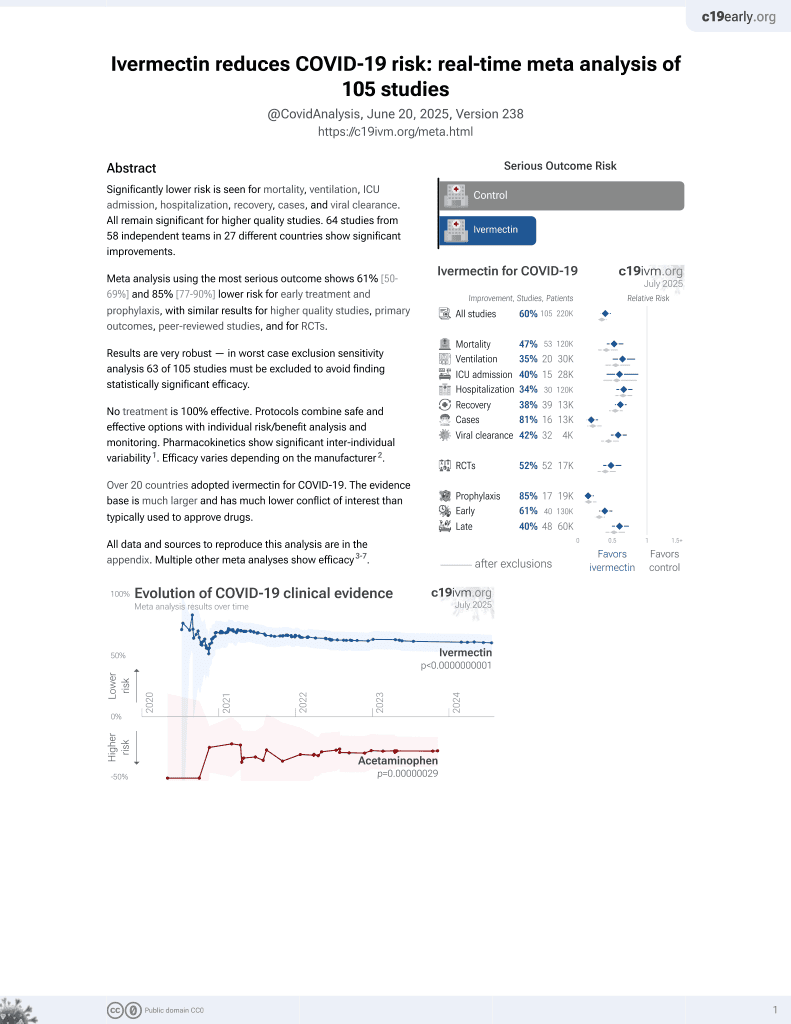
Ivermectin for COVID-19
4th treatment shown to reduce risk in
August 2020, now with p < 0.0000000001 from 106 studies, recognized in 24 countries.
No treatment is 100% effective.
Protocols combine treatments.
Application of Stanley Milgram's obedience experiments as a psychological framework to analyze the suppression of ivermectin and other drugs during the COVID-19 pandemic. Authors argue that deference to authority, diffusion of responsibility, and peer conformity led medical professionals and scientists to comply with institutional directives against ivermectin use, at the cost of patient lives. Authors argue that language framing (e.g., "misinformation," "anti-science," "horse medicine") was used to stigmatize dissent and suppress independent clinical judgment.

1.
Aldous et al., Obedience to Authority in the COVID-19 Pandemic: Milgram's Lessons on Ivermectin Suppression, figshare, doi:10.6084/m9.figshare.33941086.
2.
Reich, S., Methodological Analysis of Bias Risks in Adaptive Multi-Arm Platform Trials: A Case-Series from Three COVID-19 Studies, Center for Open Science, doi:10.31222/osf.io/h5kc8_v1.
3.
Mothae et al., SARS-CoV-2 host-pathogen interactome: insights into more players during pathogenesis, Virology, doi:10.1016/j.virol.2025.110607.
4.
Zhang et al., Rho-GTPases subfamily: cellular defectors orchestrating viral infection, Cellular & Molecular Biology Letters, doi:10.1186/s11658-025-00722-w.
5.
Saha et al., Inhaled Dry Powder of Antiviral Agents: A Promising Approach to Treating Respiratory Viral Pathogens, Viruses, doi:10.3390/v17020252.
6.
Ulloa-Aguilar et al., The Nucleolus and Its Interactions with Viral Proteins Required for Successful Infection, Cells, doi:10.3390/cells13181591.
7.
Enyeji et al., Effective Treatment of COVID-19 Infection with Repurposed Drugs: Case Reports, Viral Immunology, doi:10.1089/vim.2024.0034.
8.
Wimalawansa, S., Unlocking Insights: Navigating COVID-19 Challenges and Emulating Future Pandemic Resilience Strategies with Strengthening Natural Immunity, Heliyon, doi:10.1016/j.heliyon.2024.e34691.
9.
Shouman et al., SARS-CoV-2-associated lymphopenia: possible mechanisms and the role of CD147, Cell Communication and Signaling, doi:10.1186/s12964-024-01718-3.
10.
Mehraeen et al., Treatments for Olfactory Dysfunction in COVID-19: A Systematic Review, International Archives of Otorhinolaryngology, doi:10.1055/s-0044-1786046.
11.
Scheim et al., Back to the Basics of SARS-CoV-2 Biochemistry: Microvascular Occlusive Glycan Bindings Govern Its Morbidities and Inform Therapeutic Responses, Viruses, doi:10.3390/v16040647.
12.
Yagisawa et al., Global trends in clinical trials of ivermectin for COVID-19—Part 2, The Japanese Journal of Antibiotics, doi:10.11553/antibiotics.77.1_45.
13.
Liu et al., Crosstalk between neutrophil extracellular traps and immune regulation: insights into pathobiology and therapeutic implications of transfusion-related acute lung injury, Frontiers in Immunology, doi:10.3389/fimmu.2023.1324021.
14.
Scheim (B) et al., Sialylated Glycan Bindings from SARS-CoV-2 Spike Protein to Blood and Endothelial Cells Govern the Severe Morbidities of COVID-19, International Journal of Molecular Sciences, doi:10.3390/ijms242317039.
15.
Yemeke et al., Impact of the COVID-19 pandemic on the quality of medical products in Zimbabwe: a qualitative study based on key informant interviews with health system stakeholders, BMJ Open, doi:10.1136/bmjopen-2022-068923.
16.
Kory, P., The Global War on Ivermectin, International Covid Summit III, European Parliament, Brussels, covid19criticalcare.com/wp-content/uploads/2023/05/GLOBAL-WAR-ON-IVERMECTIN-PARLIAMENT.pdf.
17.
Babalola et al., The Place of Ivermectin in the Management of Covid-19: State of the Evidence, Medical Research Archives, doi:10.18103/mra.v11i4.3778.
18.
Loo et al., Recent Advances in Inhaled Nanoformulations of Vaccines and Therapeutics Targeting Respiratory Viral Infections, Pharmaceutical Research, doi:10.1007/s11095-023-03520-1.
19.
Scheim (C), D., From Cold to Killer: How SARS-CoV-2 Evolved without Hemagglutinin Esterase to Agglutinate and Then Clot Blood Cells, Center for Open Science, doi:10.31219/osf.io/sgdj2.
20.
Kory (B), P., The Criminal Censorship of Ivermectin's Efficacy By The High-Impact Medical Journals - Part 1, Pierre Kory’s Medical Musings, pierrekory.substack.com/p/the-criminal-censorship-of-ivermectins.
21.
Al-kuraishy et al., Central effects of Ivermectin in alleviation of Covid-19-induced dysautonomia, Current Drug Targets, doi:10.2174/1389450123666220810102406.
22.
Schwartz, E., Does ivermectin have a place in the treatment of mild Covid-19?, New Microbes and New Infections, doi:10.1016/j.nmni.2022.100989.
23.
Marques et al., Ivermectin as a possible treatment for COVID-19: a review of the 2022 protocols, Brazilian Journal of Biology, doi:10.1590/1519-6984.258325.
24.
Semiz, S., SIT1 transporter as a potential novel target in treatment of COVID-19, Biomolecular Concepts, doi:10.1515/bmc-2021-0017.
25.
Zaidi et al., The mechanisms of action of ivermectin against SARS-CoV-2—an extensive review, The Journal of Antibiotics, doi:10.1038/s41429-021-00491-6.
26.
Behl et al., CD147-spike protein interaction in COVID-19: Get the ball rolling with a novel receptor and therapeutic target, Science of The Total Environment, doi:10.1016/j.scitotenv.2021.152072.
27.
Low et al., Repositioning Ivermectin for Covid-19 treatment: Molecular mechanisms of action against SARS-CoV-2 replication, Biochimica et Biophysica Acta (BBA) - Molecular Basis of Disease, doi:10.1016/j.bbadis.2021.166294.
28.
Fordham et al., The uses and abuses of systematic reviews, OSF Preprints, doi:10.31219/osf.io/mp4f2.
29.
Kow et al., Pitfalls in Reporting Sample Size Calculation Across Randomized Controlled Trials Involving Ivermectin for the treatment of COVID-19, American Journal of Therapeutics, doi:10.1097/MJT.0000000000001441.
30.
Santin et al., Ivermectin: a multifaceted drug of Nobel prize-honored distinction with indicated efficacy against a new global scourge, COVID-19, New Microbes and New Infections, doi:10.1016/j.nmni.2021.100924.
31.
Adegboro et al., A review of the anti-viral effects of ivermectin, African Journal of Clinical and Experimental Microbiology, doi:10.4314/ajcem.v22i3.2.
32.
Turkia, M., A Continuation of a Timeline of Ivermectin-Related Events in the COVID-19 Pandemic [June 30, 2021], ResearchGate, doi:10.13140/RG.2.2.16973.36326.
33.
Jagiasi et al., Variation in therapeutic strategies for the management of severe COVID-19 in India- A nationwide cross-sectional survey, The International Journal of Clinical Practice, doi:10.1111/ijcp.14574.
34.
Lind et al., Increase in Outpatient Ivermectin Dispensing in the US During the COVID-19 Pandemic: A Cross-Sectional Analysis, Journal of General Internal Medicine, doi:10.1007/s11606-021-06948-6.
35.
Wang et al., Minimum manufacturing costs, national prices and estimated global availability of new repurposed therapies for COVID-19, medRxiv, doi:10.1101/2021.06.01.21258147.
36.
Kory (C) et al., Review of the Emerging Evidence Demonstrating the Efficacy of Ivermectin in the Prophylaxis and Treatment of COVID-19, American Journal of Therapeutics, doi:10.1097/MJT.0000000000001377.
37.
DiNicolantonio et al., Anti-inflammatory activity of ivermectin in late-stage COVID-19 may reflect activation of systemic glycine receptors, Open Heart, doi:10.1136/openhrt-2021-001655.
38.
Turkia (B), M., A timeline of ivermectin-related events in the COVID-19 pandemic, Research Gate, www.researchgate.net/publication/350610718_A_Timeline_of_Ivermectin-Related_Events_in_the_COVID-19_Pandemic_April_3_2021.
39.
Wehbe et al., Repurposing Ivermectin for COVID-19: Molecular Aspects and Therapeutic Possibilities, Front. Immunol., doi:10.3389/fimmu.2021.663586.
40.
Yagisawa (B) et al., Global trends in clinical studies of ivermectin in COVID-19, The Japanese Journal of Antibiotics, 74-1, Mar 2021, jja-contents.wdc-jp.com/pdf/JJA74/74-1-open/74-1_44-95.pdf.
41.
Jans et al., The broad spectrum host-directed agent ivermectin as an antiviral for SARS-CoV-2 ?, Biochemical and Biophysical Research Communications, doi:10.1016/j.bbrc.2020.10.042.
42.
Kory (D) et al., Review of the Emerging Evidence Demonstrating the Efficacy of Ivermectin in the Prophylaxis and Treatment of COVID-19, Frontiers in Pharmacology, doi:10.3389/fphar.2021.643369.
43.
Formiga et al., Ivermectin: an award-winning drug with expected antiviral activity against COVID-19, J. Control Release, doi:10.1016/j.jconrel.2020.10.009.
44.
Scheim (D), D., Ivermectin for COVID-19 Treatment: Clinical Response at Quasi-Threshold Doses Via Hypothesized Alleviation of CD147-Mediated Vascular Occlusion, SSRN, doi:10.2139/ssrn.3636557.
45.
Turkia (C), M., FLCCC Alliance MATH+ ascorbic acid and I-MASK+ ivermectin protocols for COVID-19 — a brief review, ResearchGate, www.researchgate.net/profile/Mika_Turkia/publication/345694745_FLCCC_Alliance_MATH_ascorbic_acid_and_I-MASK_ivermectin_protocols_for_COVID-19_-_A_Brief_Review/links/5fab010f4585150781078260/FLCCC-Alliance-MATH-ascorbic-acid-and-I-MASK-ivermectin-protocols-for-COVID-19-A-Brief-Review.pdf.
46.
Jans (B) et al., Ivermectin as a Broad-Spectrum Host-Directed Antiviral: The Real Deal?, Cells 2020, 9:9, 2100, doi:10.3390/cells9092100.
47.
Elkholy et al., Ivermectin: A Closer Look at a Potential Remedy, Cureus, doi:10.7759/cureus.10378.
48.
DiNicolantonio (B) et al., Ivermectin may be a clinically useful anti-inflammatory agent for late-stage COVID-19, Open Heart, doi:10.1136/openhrt-2020-001350.
49.
Vora et al., White paper on Ivermectin as a potential therapy for COVID-19, Indian Journal of Tuberculosis, doi:10.1016/j.ijtb.2020.07.031.
Aldous et al., 18 Sep 2026, peer-reviewed, 3 authors.
Contact: eleftherios.gkioulekas@utrgv.edu.
Abstract: ## Obedience to Authority in the COVID-19 Pandemic: Milgram's Lessons on Ivermectin Suppression
Colleen Aldous 1 , Ingbert Misselhorn 2 , Eleftherios Gkioulekas 3 , ∗
- 1 College of Health Sciences, University of KwaZulu-Natal, Durban 4041, South Africa
- 2 Retired, The Methodist Church of Southern Africa, Johannesburg, South Africa
- 3 School of Mathematical and Statistical Sciences, University of Texas Rio Grande Valley, Edinburg TX 78539, USA
- ∗ Corresponding author: Eleftherios Gkioulekas, University of Texas Rio Grande Valley, School of Mathematical and Statistical Sciences, 1201 West University Drive, Edinburg, TX 78539-2909; Email: eleftherios.gkioulekas@utrgv.edu
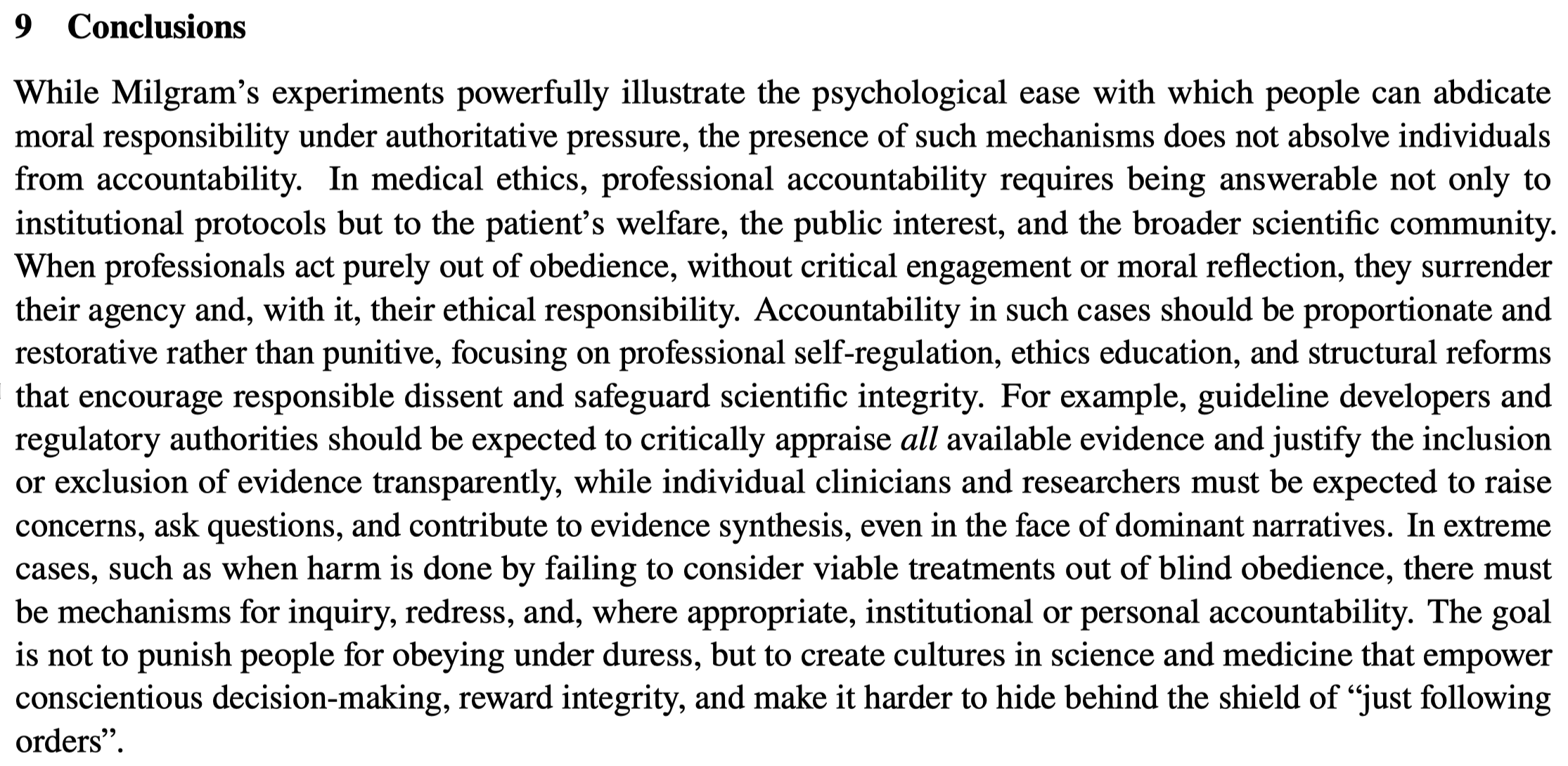
Abstract: The COVID-19 pandemic presented unprecedented challenges to public health policy, clinical decision-making, and scientific discourse. One of the most polarizing issues was the suppression of repurposed drugs, particularly ivermectin, despite early observational signals and biological plausibility. This commentary applies the psychological framework of Stanley Milgram's obedience experiments to explain how deference to authority, diffusion of responsibility, and peer conformity may have contributed to the widespread dismissal and active suppression of alternative COVID-19 treatments. Drawing on historical and institutional analysis, we argue that the medical and scientific community's obedience to regulatory and professional authorities, while understandable under crisis conditions, often stifles legitimate inquiry and ethical responsiveness. Language and framing, particularly the use of terms like 'misinformation', 'anti-science', and 'unproven cure' and the misuse of evidence-based medicine principles to suppress evidence, further reinforced compliance and marginalized dissent. We emphasize that while institutional guidance is vital during emergencies, it should not negate clinicians' and researchers' moral agency. The piece concludes with an ethical call to re-examine accountability in scientific decision-making and to foster professional environments that support critical engagement rather than rote adherence to top-down directives. By revisiting Milgram's insights, we highlight the enduring importance of vigilance against the psychological and systemic forces that can lead well-meaning professionals to suppress innovation and ethical action in times of crisis.
Keywords: COVID-19; ivermectin; SARS-CoV-2; Milgram experiment; obedience
DOI record:
{
"DOI": "10.6084/M9.FIGSHARE.33941086",
"URL": "https://figshare.com/articles/preprint/Obedience_to_Authority_in_the_COVID-19_Pandemic_Milgram_s_Lessons_on_Ivermectin_Suppression/33941086",
"abstract": "The COVID-19 pandemic presented unprecedented challenges to public health policy, clinical decision-making, and scientific discourse. One of the most polarizing issues was the suppression of repurposed drugs, particularly ivermectin, despite early observational signals and biological plausibility. This commentary applies the psychological framework of Stanley Milgram’s obedience experiments to explain how deference to authority, diffusion of responsibility, and peer conformity may have contributed to the widespread dismissal and active suppression of alternative COVID-19 treatments. Drawing on historical and institutional analysis, we argue that the medical and scientific community’s obedience to regulatory and professional authorities, while understandable under crisis conditions, often stifles legitimate inquiry and ethical responsiveness. Language and framing, particularly the use of terms like “misinformation”, “anti-science”, and “unproven cure” and the misuse of evidence-based medicine principles to suppress evidence, further reinforced compliance and marginalized dissent. We emphasize that while institutional guidance is vital during emergencies, it should not negate clinicians’ and researchers’ moral agency. The piece concludes with an ethical call to re-examine accountability in scientific decision-making and to foster professional environments that support critical engagement rather than rote adherence to top-down directives. By revisiting Milgram’s insights, we highlight the enduring importance of vigilance against the psychological and systemic forces that can lead well-meaning professionals to suppress innovation and ethical action in times of crisis.",
"author": [
{
"family": "Aldous",
"given": "Colleen"
},
{
"family": "Misselhorn",
"given": "Ingbert"
},
{
"family": "Gkioulekas",
"given": "Eleftherios"
}
],
"categories": [
"Infectious diseases",
"Medical ethics",
"Epistemology",
"Social psychology"
],
"copyright": "Creative Commons Attribution 4.0 International",
"id": "https://doi.org/10.6084/m9.figshare.33941086",
"issued": {
"date-parts": [
[
2026,
9,
19
]
]
},
"publisher": "figshare",
"title": "Obedience to Authority in the COVID-19 Pandemic: Milgram's Lessons on Ivermectin Suppression",
"type": "article"
}