Quercetin–bromelain supplementation and clinical outcomes of COVID-19: a randomized, double-blind, placebo-controlled trial in hospitalized patients in Tunisia

Gargouri et al., BMC Pharmacology and Toxicology, doi:10.1186/s40360-026-01257-2, Oct 2026
Late treatmentDouble-blind RCT · 244 patients · Tunisia
Bromelain for COVID-19
Outcome
Improvement
Relative Risk · 95% CI
Lower progression with bromelain + quercetin
p = 0.007
RCT 244 hospitalized, severely hypoxemic COVID-19 patients in Tunisia reporting lower respiratory deterioration with quercetin + bromelain. The trial was registered retrospectively in June 2024, two years after completion, and shows signs of outcome switching: the sample size was calculated for a reduction in mortality, and the introduction frames mortality and complications as the aim. The definition of respiratory deterioration (SpO₂ falling below 94%) cannot apply to most participants, whose mean baseline SpO₂ was ~79%, and the definition of escalation is unspecified. Event counts are difficult to reconcile: 93 deaths and 68 patients on NIV, but only 37 respiratory-deterioration events and 4 intubations. A co-author is affiliated with the product’s manufacturer and authors declare no competing interests.
This study is excluded in meta-analysis: multiple significant issues pending author response, see discussion.
OutcomeImprovementEffect · pTreatmentControl
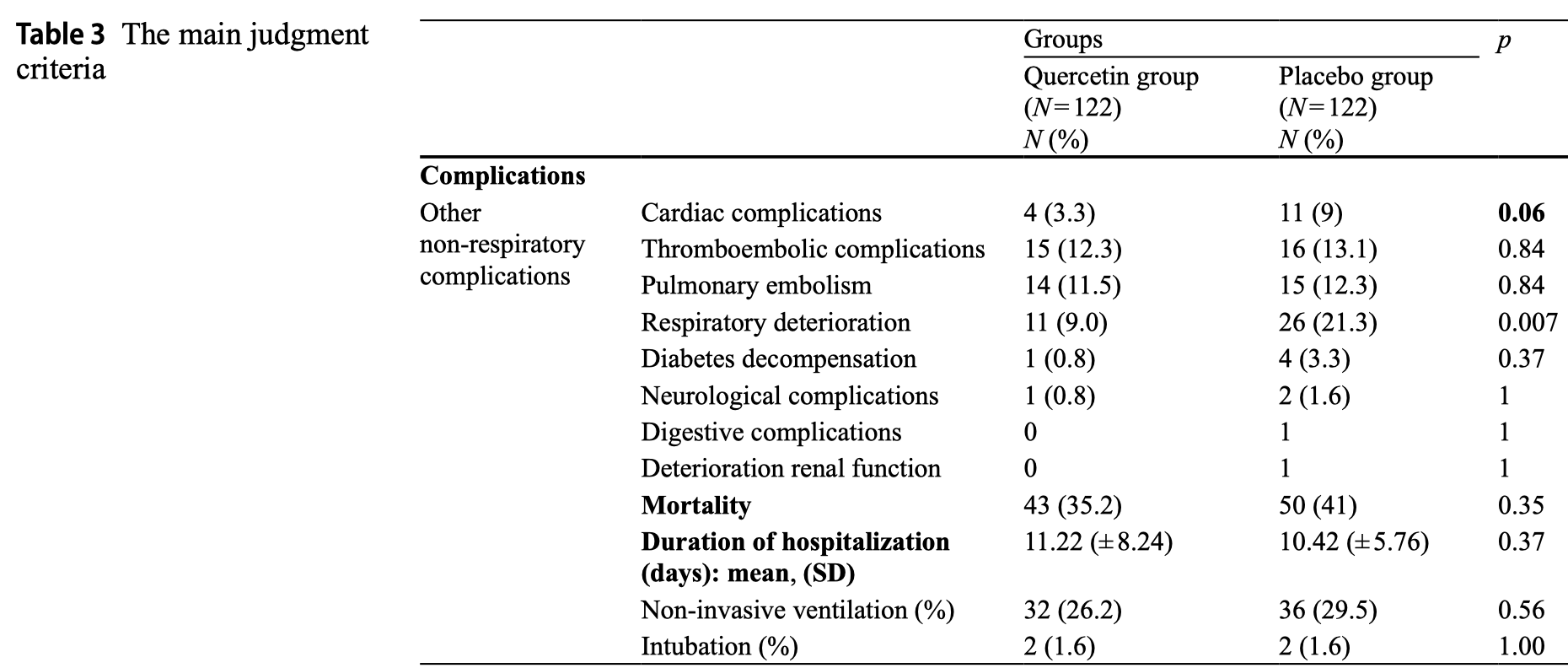
risk of death 14.0% lower · RR 0.86 · p = 0.43 14.0% lowerRR 0.86p = 0.43 43 of 122 (35.2%) 50 of 122 (41.0%) treatment 43 of 122 (35.2%), control 50 of 122 (41.0%)NNT 17
risk of mechanical ventilation 0.0% lower · RR 1.00 · p = 1.00 0.0% lowerRR 1.00p = 1.00 2 of 122 (1.6%) 2 of 122 (1.6%) treatment 2 of 122 (1.6%), control 2 of 122 (1.6%)
risk of progression 58.0% lower · RR 0.42 · p = 0.007** 58.0% lowerRR 0.42p = 0.007** 11 of 122 (9.0%) 26 of 122 (21.3%) treatment 11 of 122 (9.0%), control 26 of 122 (21.3%)respiratory deteriorationNNT 8.1
hospitalization time 7.7% higher · relative time 1.08 · p = 0.37 7.7% higherrelative time 1.08p = 0.37 mean 11.22 (±8.24) n=122 mean 10.42 (±5.76) n=122 mean 11.22 (±8.24) n=122, mean 10.42 (±5.76) n=122
Effect extraction follows pre-specified rules prioritizing more serious outcomes. Submit updates. ** p < 0.01

Gargouri et al., 13 Oct 2026, Double Blind Randomized Controlled Trial, Tunisia, peer-reviewed, 9 authors, this trial uses multiple treatments in the treatment arm (combined with quercetin) - results of individual treatments may vary.
$0 $500 $1,000+ Efficacy vs. cost for COVID-19 treatment protocols c19early.org November 2026 Tunisia Angola Colombia Kenya Mozambique Myanmar South Africa Peru Philippines USA Brazil France Italy Canada Pakistan Spain Vietnam Japan Nepal Iran Bangladesh Ethiopia Ghana Germany Mexico South Korea United Kingdom Saudi Arabia Morocco Poland Uzbekistan India China Venezuela DR Congo Madagascar Thailand Uganda Egypt Nigeria Taiwan Fiji Zambia Bosnia-Herzegovina Dominican Republic Bolivia Côte d'Ivoire Eritrea Togo Bulgaria Greece Slovakia Iceland New Zealand Trinidad and Tobago Mongolia Czechia Belarus Israel North Macedonia Hong Kong Qatar Panama Serbia Tunisia favored low-cost treatments.The average efficacy of treatments was moderate.Low-cost treatments improve early treatment, andprovide complementary/synergistic benefits. More effective More expensive 75% 50% 25% ≤0%
$0 $500 $1,000+ Efficacy vs. cost for COVID-19treatment protocols worldwide c19early.org November 2026 Tunisia Angola Colombia Kenya Mozambique Myanmar South Africa Peru Philippines USA Brazil France Italy Canada Pakistan Spain Vietnam Japan Iran Bangladesh Ethiopia Ghana Germany Mexico South Korea United Kingdom Saudi Arabia Morocco Poland Uzbekistan India China Venezuela DR Congo Madagascar Thailand Uganda Egypt Taiwan Fiji Zambia Dominican Rep. Bolivia Côte d'Ivoire Eritrea Togo Bulgaria Greece Slovakia New Zealand Trinidad and Tobago Mongolia Czechia Belarus Israel North Macedonia Hong Kong Qatar Panama Serbia Tunisia favored low-cost treatments.The average efficacy was moderate.Low-cost protocols improve early treatment,and add complementary/synergistic benefits. More effective More expensive 75% 50% 25% ≤0%
Late treatment
is less effective
