
Tixagevimab/cilgavimab for COVID-19: real-time meta-analysis of 20 studies (Version 33)
, Aug 2026
42nd treatment shown to reduce risk in
May 2022, now with p = 0.026 from 20 studies, recognized in 33 countries.
Efficacy is variant dependent.
Lower risk for hospitalization and cases.
No treatment is 100% effective. Protocols
combine treatments.
6,600+ studies for
220+ treatments. c19early.org
|

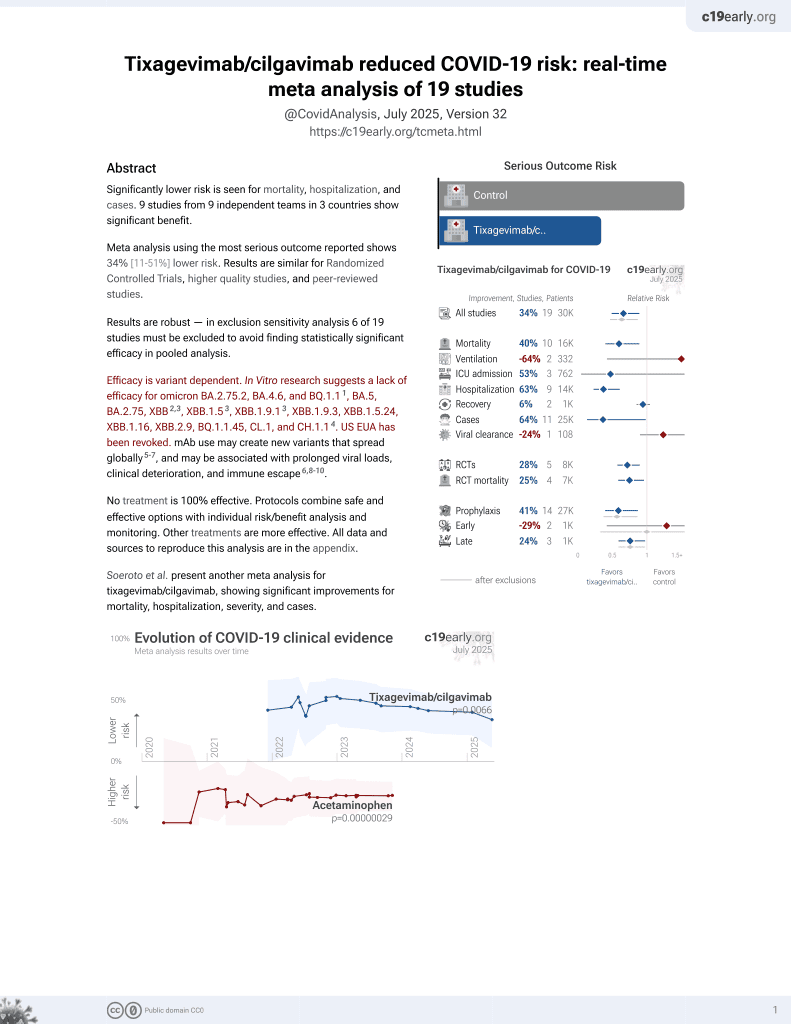
Significantly lower risk is seen for hospitalization and cases. 9 studies from 9 independent teams in 3 countries show significant benefit.
Meta-analysis using the most serious outcome reported shows 29% [4‑48%] lower risk. Results are similar for higher quality and peer-reviewed studies and slightly worse for Randomized Controlled Trials.
In worst case exclusion sensitivity analysis, statistical significance is lost after excluding 2 of 20 studies.
Control Tixagevimab/c..Tixagev../c..
Efficacy is variant dependent. In Vitro research suggests a lack of efficacy for omicron BA.2.75.2, BA.4.6, and BQ.1.11, BA.5, BA.2.75, XBB2,3, XBB.1.53, XBB.1.9.13, XBB.1.9.3, XBB.1.5.24, XBB.1.16, XBB.2.9, BQ.1.1.45, CL.1, and CH.1.14. US EUA has been revoked. mAb use may create new variants that spread globally5-7, and may be associated with increased risk of autoimmune disease8, prolonged viral loads, clinical deterioration, and immune escape6,9-13.
No treatment is 100% effective. Protocols combine safe and effective options with individual risk/benefit analysis and monitoring. Other treatments are more effective. Luxi et al. show higher risk of serious cardiac events. All data and sources to reproduce this analysis are in the appendix.
Soeroto et al. present another meta-analysis for tixagevimab/cilgavimab, showing significant improvements for mortality, hospitalization, severity, and cases.

Covid Analysis et al., Aug 2026, preprint, 1 author.