Abstract:
Original article
Scand J Work Environ Health Online-first -article https://doi.org/10.5271/sjweh.4318
Published online: 04 Aug 2026
Night work, sleep disruption and long-COVID risk: a population-based cohort study
by Papantoniou K, Espinosa A, Karachaliou M, Lassale C, Castaño-Vinyals G, Harding BN, De Matteis S, Straif K, Alonso-Nogués E, Dobaño C, Moncunill G, Blay N, Iraola-Guzmán S, de Cid R, Garcia-Aymerich J, Kogevinas M
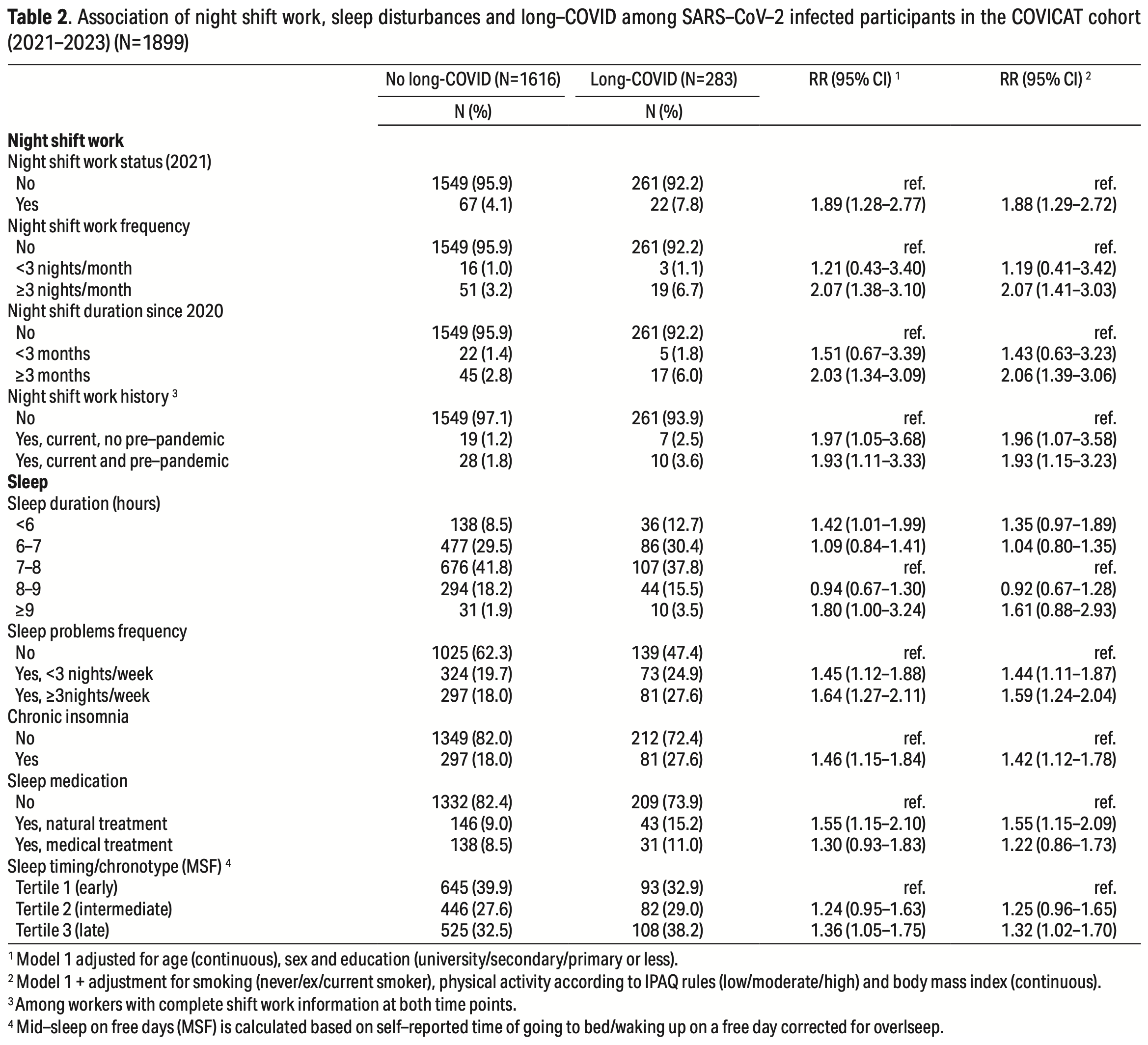
This prospective cohort study is the first to demonstrate that night shift work is associated with a higher risk of long-COVID. Furthermore, sleep disturbances emerged as independent risk factor for long-COVID. Concurrent exposure to night work and chronic insomnia synergistically amplified the risks. These findings provide new population-based evidence that circadian disruption and sleep disturbances may contribute to the progression from acute SARS-CoV-2 infection to chronic post-infection sequelae.
Affiliation: Medical University of Vienna, Center for Public Health, Department of Epidemiology, Spitalgasse 88, 1090, Vienna, Austria. kyriaki.papantoniou@meduniwien.ac.at
Refers to the following texts of the Journal: 2020;46(5):516-524 2025;51(4):298-311
Key terms: COVID-19; insomnia; long-COVID; night shift work; night work; SARS-Cov-2; shift work; sleep disruption; sleep disturbance
This article in PubMed: www.ncbi.nlm.nih.gov/pubmed/42550964
Additional material
Please note that there is additional material available belonging to this article on the Scandinavian Journal of Work, Environment & Health -website.
[This work is licensed under a Creative Commons Attribution 4.0 International License.](http://creativecommons.org/licenses/by/4.0/)
Scand J Work Environ Health - online first: 4 August 2026. doi:10.5271/sjweh.4318
Night work, sleep disruption and long-COVID risk: a population-based cohort study
by Kyriaki Papantoniou, PhD, 1, 2 Ana Espinosa, MSc, 2-4 Marianna Karachaliou, PhD, 5 Camille Lassale, PhD, 2, 4, 6 Gemma CastañoVinyals, PhD, 2-4 Barbara N Harding, PhD, 7 Sara De Matteis, PhD, 8 Kurt Straif, PhD, 2, 9 Eva Alonso-Nogués, PhD, 10 Carlota Dobaño, PhD, 2, 11 Gemma Moncunill, PhD, 2, 11 Natalia Blay, PhD, 12, 13 Susana Iraola-Guzmán, PhD, 12, 13 Rafael de Cid, PhD, 12, 13 Judith Garcia-Aymerich, PhD, 2, 3, 4 Manolis Kogevinas, PhD 2-4, 14
Papantoniou K, Espinosa A, Karachaliou M, Lassale C, Castaño-Vinyals G, Harding BN, De Matteis S, Straif K, Nogues EA, Dobaño C, Moncunill G, Blay N, Iraola-Guzmán S, de Cid R, Garcia-Aymerich J, Kogevinas M. Night work, sleep disruption and long-COVID risk: a population-based cohort study. Scand J Work Environ Health - online first.
Objective Circadian and sleep disruption may increase the risk and severity of SARS-CoV-2 infections, but the role of night shift work and disturbed sleep in the development of long-COVID remains inadequately investigated. We prospectively examined the association of night work and sleep disturbances with risk of long-COVID.
Methods We followed participants of the COVICAT study, a population-based cohort of adults in Catalonia, Spain between 2021 and 2023. Night shift work and sleep characteristics were assessed in 2021. Long-COVID was defined as the report of persistent symptoms (>3 months) after a SARS-CoV-2 infection. Poisson regression analysis was performed to evaluate the independent and joint effects of night shift work and sleep disturbances including..
DOI record:
{
"DOI": "10.5271/sjweh.4318",
"ISSN": [
"0355-3140",
"1795-990X"
],
"URL": "http://dx.doi.org/10.5271/sjweh.4318",
"alternative-id": [
"4318"
],
"author": [
{
"affiliation": [],
"family": "Papantoniou",
"given": "Kyriaki",
"role": [
{
"role": "author",
"vocabulary": "crossref"
}
],
"sequence": "first"
},
{
"affiliation": [],
"family": "Espinosa",
"given": "Ana",
"role": [
{
"role": "author",
"vocabulary": "crossref"
}
],
"sequence": "additional"
},
{
"affiliation": [],
"family": "Karachaliou",
"given": "Marianna",
"role": [
{
"role": "author",
"vocabulary": "crossref"
}
],
"sequence": "additional"
},
{
"affiliation": [],
"family": "Lassale",
"given": "Camille",
"role": [
{
"role": "author",
"vocabulary": "crossref"
}
],
"sequence": "additional"
},
{
"affiliation": [],
"family": "Castaño-Vinyals",
"given": "Gemma",
"role": [
{
"role": "author",
"vocabulary": "crossref"
}
],
"sequence": "additional"
},
{
"affiliation": [],
"family": "Harding",
"given": "Barbara N",
"role": [
{
"role": "author",
"vocabulary": "crossref"
}
],
"sequence": "additional"
},
{
"affiliation": [],
"family": "De Matteis",
"given": "Sara",
"role": [
{
"role": "author",
"vocabulary": "crossref"
}
],
"sequence": "additional"
},
{
"affiliation": [],
"family": "Straif",
"given": "Kurt",
"role": [
{
"role": "author",
"vocabulary": "crossref"
}
],
"sequence": "additional"
},
{
"affiliation": [],
"family": "Alonso-Nogués",
"given": "Eva",
"role": [
{
"role": "author",
"vocabulary": "crossref"
}
],
"sequence": "additional"
},
{
"affiliation": [],
"family": "Dobaño",
"given": "Carlota",
"role": [
{
"role": "author",
"vocabulary": "crossref"
}
],
"sequence": "additional"
},
{
"affiliation": [],
"family": "Moncunill",
"given": "Gemma",
"role": [
{
"role": "author",
"vocabulary": "crossref"
}
],
"sequence": "additional"
},
{
"affiliation": [],
"family": "Blay",
"given": "Natalia",
"role": [
{
"role": "author",
"vocabulary": "crossref"
}
],
"sequence": "additional"
},
{
"affiliation": [],
"family": "Iraola-Guzmán",
"given": "Susana",
"role": [
{
"role": "author",
"vocabulary": "crossref"
}
],
"sequence": "additional"
},
{
"affiliation": [],
"family": "de Cid",
"given": "Rafael",
"role": [
{
"role": "author",
"vocabulary": "crossref"
}
],
"sequence": "additional"
},
{
"affiliation": [],
"family": "Garcia-Aymerich",
"given": "Judith",
"role": [
{
"role": "author",
"vocabulary": "crossref"
}
],
"sequence": "additional"
},
{
"affiliation": [],
"family": "Kogevinas",
"given": "Manolis",
"role": [
{
"role": "author",
"vocabulary": "crossref"
}
],
"sequence": "additional"
}
],
"container-title": "Scandinavian Journal of Work, Environment & Health",
"container-title-short": "Scand J Work Environ Health",
"content-domain": {
"crossmark-restriction": false,
"domain": []
},
"created": {
"date-parts": [
[
2026,
8,
4
]
],
"date-time": "2026-08-04T19:34:01Z",
"timestamp": 1785872041000
},
"deposited": {
"date-parts": [
[
2026,
8,
4
]
],
"date-time": "2026-08-04T19:34:01Z",
"timestamp": 1785872041000
},
"indexed": {
"date-parts": [
[
2026,
8,
4
]
],
"date-time": "2026-08-04T19:50:01Z",
"timestamp": 1785873001242,
"version": "3.56.0"
},
"is-referenced-by-count": 0,
"issued": {
"date-parts": [
[
2026,
8,
4
]
]
},
"language": "en",
"member": "3229",
"original-title": [],
"prefix": "10.5271",
"published": {
"date-parts": [
[
2026,
8,
4
]
]
},
"published-online": {
"date-parts": [
[
2026,
8,
4
]
]
},
"publisher": "Scandinavian Journal of Work, Environment and Health",
"reference-count": 0,
"references-count": 0,
"relation": {},
"resource": {
"primary": {
"URL": "http://www.sjweh.fi/show_abstract.php?abstract_id=4318"
}
},
"score": 1,
"short-title": [],
"source": "Crossref",
"subject": [],
"subtitle": [],
"title": "Night work, sleep disruption and long-COVID risk: a population-based cohort study",
"type": "journal-article"
}