DOI record:
{
"DOI": "10.46393/27132129_2026_2_86-92",
"ISSN": [
"2713-2129"
],
"URL": "http://dx.doi.org/10.46393/27132129_2026_2_86-92",
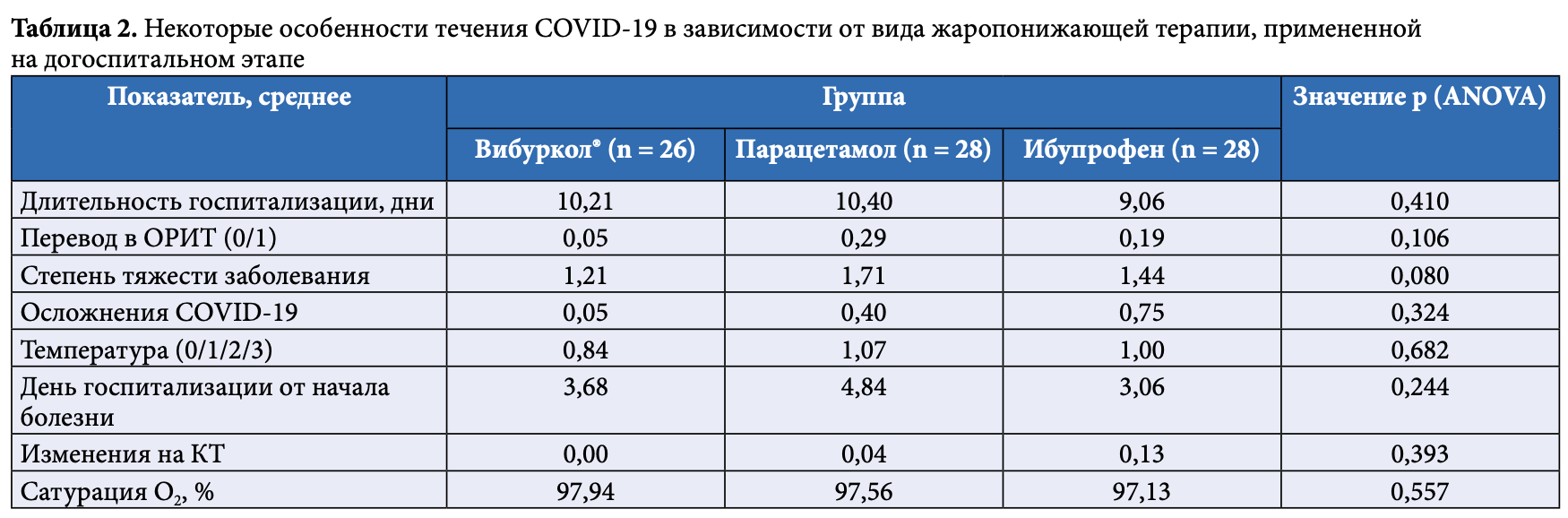
"abstract": "<jats:p>Проведено исследование, посвященное изучению клинических проявлений инфекции SARS-CoV-2 у детей первого года жизни в период 2021–2023 гг. Установлено, что течение заболевания преимущественно было легким, без летальных исходов. Тяжелые случаи ассоциировались с наличием коморбидной патологии и сопровождались характерными изменениями лабораторных маркеров воспаления, а также уровня D-димера. При сравнительном анализе трех групп пациентов, выделенных в зависимости от вида жаропонижающей терапии на догоспитальном этапе (Вибуркол®, парацетамол, ибупрофен), статистически значимых различий по большинству клинических и лабораторных показателей не выявлено, за исключением повышенного уровня D-димера в группе ибупрофена. Тенденции к более тяжелому течению и более высокой частоте перевода в отделение реанимации в группе парацетамола не достигли статистической значимости и, вероятно, связаны с исходным тяжелым состоянием пациентов. Полученные нами данные свидетельствуют об отсутствии прямого негативного влияния парацетамола, ибупрофена или Вибуркола на течение COVID-19 у младенцев. Результаты исследования подтверждают безопасность использования как традиционных жаропонижающих средств, так и гомеопатического препарата Вибуркол®, а также необходимость индивидуализированного подхода к симптоматическому лечению лихорадки у детей первого года жизни с расширением возможности применения препаратов биорегуляционной терапии.</jats:p>\n <jats:p>A study was conducted to examine the clinical manifestations of SARS-CoV-2 infection in children under one year of age in the period 2021–2023. It was found that the course of the infection was predominantly mild, with no fatalities. Severe cases were associated with the presence of comorbid pathology and were accompanied by characteristic changes in laboratory markers of inflammation, as well as changes in the level of D-dimer. In a comparative analysis of three groups of patients with different antipyretic therapy at the pre-hospital stage (Viburkol®, paracetamol, and ibuprofen), no statistically significant differences were found in most clinical and laboratory parameters, except for an elevated D-dimer level in the ibuprofen group. The trends towards a more severe course and the frequency of transfer to the intensive care unit in the paracetamol group did not reach statistical significance and are likely related to the initial severity of the patients' condition. The findings suggest that paracetamol, ibuprofen, or Viburcol® do not have a direct negative impact on the course of COVID-19 in infants. The study results confirm the safety of using both traditional antipyretics and the homeopathic drug Viburcol®, as well as the need for an individualized approach to the symptomatic treatment of fever in infants, with an emphasis on the use of bioregulatory therapy.</jats:p>",
"author": [
{
"affiliation": [
{
"name": "ФГБОУ ВО «Южно-Уральский государственный медицинский университет» Минздрава России"
}
],
"family": "Василькова",
"given": "Д.С.",
"role": [
{
"role": "author",
"vocabulary": "crossref"
}
],
"sequence": "first"
},
{
"affiliation": [
{
"name": "ФГБОУ ВО «Южно-Уральский государственный медицинский университет» Минздрава России"
}
],
"family": "Пищальников",
"given": "А.Ю.",
"role": [
{
"role": "author",
"vocabulary": "crossref"
}
],
"sequence": "first"
}
],
"container-title": "Фармакология & Фармакотерапия",
"content-domain": {
"crossmark-restriction": false,
"domain": []
},
"created": {
"date-parts": [
[
2026,
6,
7
]
],
"date-time": "2026-06-07T13:41:47Z",
"timestamp": 1780839707000
},
"deposited": {
"date-parts": [
[
2026,
6,
7
]
],
"date-time": "2026-06-07T13:44:05Z",
"timestamp": 1780839845000
},
"indexed": {
"date-parts": [
[
2026,
6,
7
]
],
"date-time": "2026-06-07T14:00:16Z",
"timestamp": 1780840816558,
"version": "3.54.1"
},
"is-referenced-by-count": 0,
"issue": "2",
"issued": {
"date-parts": [
[
2026,
5,
22
]
]
},
"journal-issue": {
"issue": "2",
"published-print": {
"date-parts": [
[
2026,
5,
22
]
]
}
},
"language": "ru",
"member": "25661",
"original-title": [],
"page": "86-92",
"prefix": "10.46393",
"published": {
"date-parts": [
[
2026,
5,
22
]
]
},
"published-print": {
"date-parts": [
[
2026,
5,
22
]
]
},
"publisher": "PROFMEDPRES LLC",
"reference": [
{
"DOI": "10.3345/cep.2023.00794",
"doi-asserted-by": "crossref",
"key": "1",
"unstructured": "Cimolai N. COVID-19 among infants: key clinical features and remaining controversies. Clin. Exp. Pediatr. 2024; 67 (1): 1–16."
},
{
"DOI": "10.1080/24694193.2021.1930288",
"doi-asserted-by": "crossref",
"key": "2",
"unstructured": "Taheri L., Gheiasi S.F., Taher M. et al. Clinical features of COVID-19 in newborns, infants, and children: a systematic review and meta-analysis. Compr. Child. Adolesc. Nurs. 2021; 45 (2): 137–155."
},
{
"DOI": "10.1016/j.arcped.2020.12.008",
"doi-asserted-by": "crossref",
"key": "3",
"unstructured": "Mansourian M., Ghandi Y., Habibi D., Mehrabi S. COVID-19 infection in children: a systematic review and meta-analysis of clinical features and laboratory findings. Arch. Pediatr. 2021; 28 (3): 242–248."
},
{
"DOI": "10.3389/fped.2020.591132",
"doi-asserted-by": "crossref",
"key": "4",
"unstructured": "Li B., Zhang S., Zhang R. et al. Epidemiological and clinical characteristics of COVID-19 in children: a systematic review and meta-analysis. Front. Pediatr. 2020; 8: 591132."
},
{
"DOI": "10.21037/apm-22-933",
"doi-asserted-by": "crossref",
"key": "5",
"unstructured": "Xiao F., Tang M., Yan K., Zhou W. Clinical features of infants with SARS-CoV-2 infection: a systematic review and meta-analysis. Ann. Palliat. Med. 2022; 11 (11): 3394–3408."
},
{
"DOI": "10.1136/archdischild-2023-326167",
"doi-asserted-by": "crossref",
"key": "6",
"unstructured": "Gale C., Sharkey D., Fitzpatrick K.E. et al. Neonatal complications of COVID-19 Collaborative Group. Characteristics and outcomes of neonates hospitalised with SARS-CoV-2 infection in the UK by variant: a prospective national cohort study. Arch. Dis. Child Fetal. Neonatal. Ed. 2024; 109 (3): 279–286."
},
{
"DOI": "10.1016/j.cmi.2020.06.003",
"doi-asserted-by": "crossref",
"key": "7",
"unstructured": "Rinott E., Kozer E., Shapira Y. et al. Ibuprofen use and clinical outcomes in COVID-19 patients. Clin. Microbiol. Infect. 2020; 26 (9): 1259.e5–1259.e7."
},
{
"key": "8",
"unstructured": "Drake T.M., Fairfield C.J., Pius R. et al. Non-steroidal anti-inflammatory drug use and outcomes of COVID-19 in the ISARIC Clinical Characterisation Protocol UK cohort: a matched, prospective cohort study. Lancet Rheumatol. 2021; 3 (7): e498–e506."
},
{
"DOI": "10.1016/j.chest.2020.03.040",
"doi-asserted-by": "crossref",
"key": "9",
"unstructured": "Sodhi M., Etminan M. Safety of ibuprofen in patients with COVID-19: causal or confounded? Chest. 2020; 158 (1): 55–56."
},
{
"DOI": "10.3390/healthcare12222309",
"doi-asserted-by": "crossref",
"key": "10",
"unstructured": "Bianconi A., Zauli E., Biagiotti C. et al. Paracetamol use and COVID-19 clinical outcomes: a meta-analysis. Healthcare (Basel). 2024; 12 (22): 2309."
},
{
"key": "11",
"unstructured": "Mittal R., Ni R., Patel A.P. COVID-19 among infants: key clinical features and remaining controversies. Global Pediatric Health. 2023; 10: 2333794X231219426. Available at: https://pmc.ncbi.nlm.nih.gov/articles/PMC10764668 (accessed 18.01.2026)."
},
{
"DOI": "10.1056/NEJMc2005073",
"doi-asserted-by": "crossref",
"key": "12",
"unstructured": "Lu X., Zhang L., Du H. et al. SARS-CoV-2 infection in children. N. Engl. J. Med. 2020; 382 (17): 1663–1665."
},
{
"DOI": "10.1136/archdischild-2020-319837",
"doi-asserted-by": "crossref",
"key": "13",
"unstructured": "Trevisanuto D., Cavallin F., Cavicchiolo M.E. et al. Coronavirus infection in neonates: a systematic review. Arch. Dis. Child Fetal. Neonatal Ed. 2021; 106 (3): 330–335."
},
{
"DOI": "10.1002/jmv.26208",
"doi-asserted-by": "crossref",
"key": "14",
"unstructured": "Ma X., Liu S., Chen L. et al. The clinical characteristics of pediatric inpatients with SARS-CoV-2 infection: a meta-analysis and systematic review. J. Med. Virol. 2021; 93 (1): 234–240."
},
{
"key": "15",
"unstructured": "Кукес И.В., Поздняков Д.И. Фармакодинамические свойства препарата Вибуркол® с позиции иммунофармакологии. Лекарственные средства и рациональная фармакотерапия. 2025; 1 (14): 17–25."
},
{
"key": "16",
"unstructured": "Gottwald R., Weiser M. Antihomotoxic treatment of agitation with and without fever in children; results of a post-marketing clinical study. Int. J. Biomed. Res. Ther. 1999; 28 (6): 308–312."
}
],
"reference-count": 16,
"references-count": 16,
"relation": {},
"resource": {
"primary": {
"URL": "https://pmp-agency.ru/ff2-2026/tpost/kpgvrozzp1-techenie-covid-19-u-detei-do-goda-v-zavi"
}
},
"score": 1,
"short-title": [],
"source": "Crossref",
"subject": [],
"subtitle": [
"Course of COVID-19 in children under one year of age depending on the type of antipyretic therapy at the pre-hospital stage"
],
"title": "Течение COVID-19 у детей до года в зависимости от вида жаропонижающей терапии на догоспитальном этапе",
"type": "journal-article"
}