Aspirin use and clinical outcomes in coronavirus disease 2019 (COVID-19) infection: A systematic review and meta-analysis
et al., Journal of Pharmacy & Pharmacognosy Research, doi:10.56499/jppres_14.5.2652, PROSPERO CRD42022361632, Sep 2026
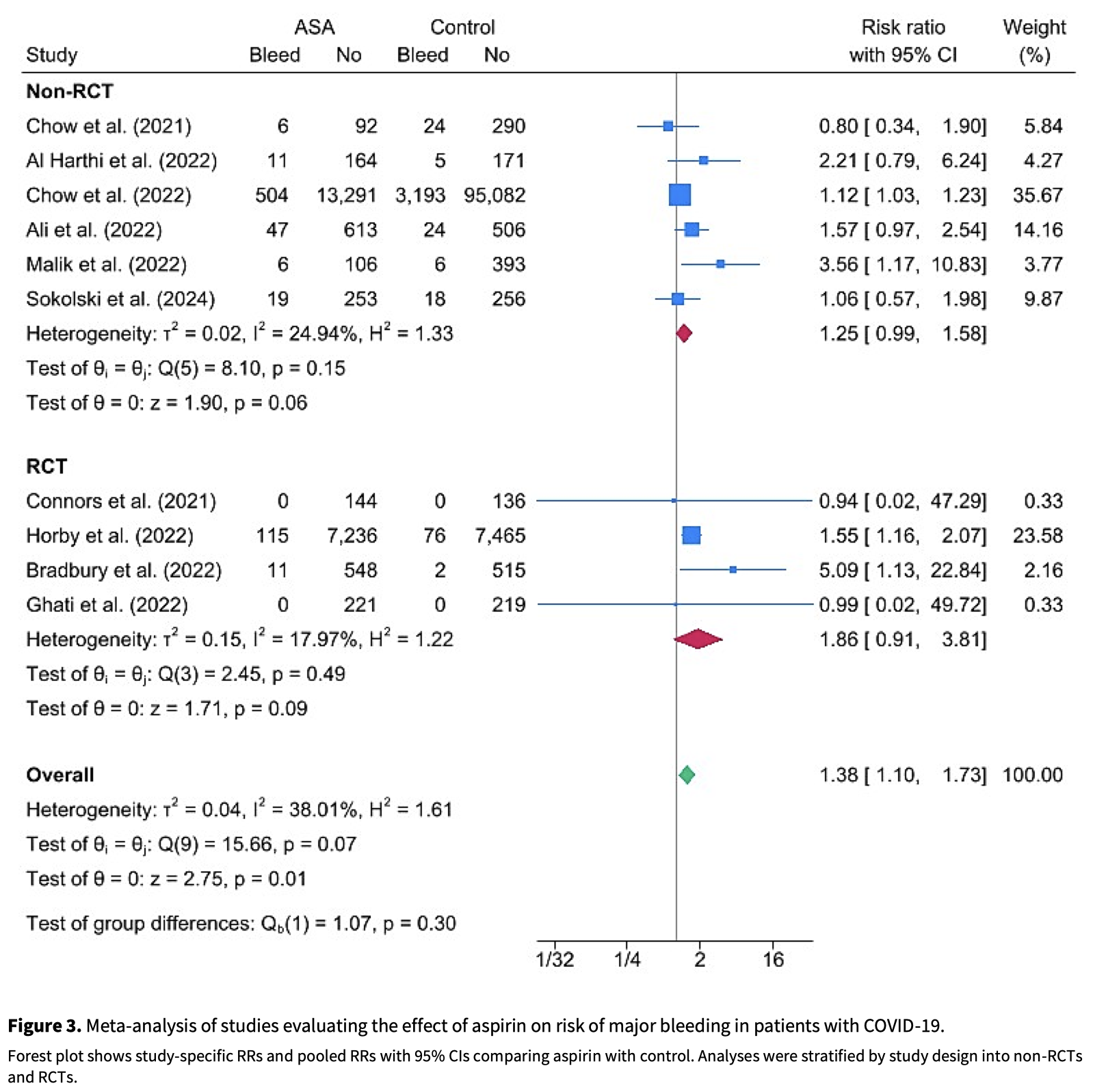
Systematic review and meta-analysis of 33 studies (5 RCTs and 28 observational studies, 187,224 participants). The RCT analysis (n=20,577) shows 5% lower mortality, without reaching statistical significance. Aspirin was associated with a 38% increased risk of major bleeding.
4 meta-analyses show significant improvements with aspirin for mortality1-3,
mechanical ventilation1, and
progression4.
Currently there are 79 aspirin for COVID-19 studies, showing 8% lower mortality [2‑14%], 5% lower ventilation [-5‑15%], 3% lower ICU admission [-11‑16%], 1% higher hospitalization [-4‑6%], and 5% fewer cases [-5‑14%].

1.
Banaser et al., A systematic review and meta-analysis on efficacy of low dose aspirin on the management of COVID-19, International Journal of Medicine in Developing Countries, doi:10.24911/IJMDC.51-1640383699.
2.
Srinivasan et al., Aspirin use is associated with decreased inpatient mortality in patients with COVID-19: A meta-analysis, American Heart Journal Plus: Cardiology Research and Practice, doi:10.1016/j.ahjo.2022.100191.
Bunditanukul et al., 1 Sep 2026, peer-reviewed, 7 authors, trial PROSPERO CRD42022361632.
Contact: bunchai.c@chula.ac.th.
Abstract:
https://jppres.com
DOI: https://doi.org/10.56499/jppres\_14.5.2652
Review
Aspirin use and clinical outcomes in coronavirus disease 2019 (COVID-19) infection: A systematic review and meta-analysis
[Uso de aspirina y desenlaces clínicos en la enfermedad por coronavirus de 2019 (COVID-19): revisión sistemática y metanálisis]
Krittin Bunditanukul 1 , Yotsaya Kunlamas 1 , Trai Tharnpanich 1 , Sirichai Chusiri 1 , Jiraphan Ritsamdang 1 , Chaisiri Wanlapakorn 2 , Bunchai Chongmelaxme 3,4,5*
1 Department of Pharmacy Practice, Faculty of Pharmaceutical Sciences, Chulalongkorn University, Phyathai Road, Pathumwan, Bangkok, 10330, Thailand. 2 Division of Cardiovascular Disease, Department of Medicine, Faculty of Medicine, Chulalongkorn University, Rama 4 Road, Pathumwan, Bangkok, 10330, Thailand.
3 Department of Social and Administrative Pharmacy, Faculty of Pharmaceutical Sciences, Chulalongkorn University, Bangkok, Thailand.
4 The Federation of Asian Pharmaceutical Associations (FAPA), College of Pharmacy, Bangkok, Thailand.
5 Revolution Health Research Consulting (RHRC) Group, Bangkok, Thailand.
*E-mail: bunchai.c@chula.ac.th
Abstract
Context : Aspirin has been proposed as an adjunctive therapy for COVID-19. However, its clinical benefit remains uncertain.
Aims : This systematic review and meta-analysis was conducted to evaluate whether aspirin use was associated with short-term all-cause mortality in adults with confirmed COVID-19.
Methods : The review was registered in PROSPERO (CRD42022361632). PubMed, Embase, the Cochrane Library, ClinicalTrials.gov, and Scopus were searched from inception to September 2024. Randomized controlled trials and non-randomized studies comparing aspirin plus standard care with standard care alone were included. Risk of bias was assessed using RoB 2 and ROBINS-I. Random-effects models were used to estimate pooled risk ratios or mean differences with 95% confidence intervals.
Results : Thirty-three studies were included. Thirty-one studies contributed to quantitative syntheses, and the primary mortality analysis was based on five randomized controlled trials. Aspirin use was not associated with reduced short-term all-cause mortality compared with control treatment (RR 0.95; 95% CI, 0.89-1.02). Aspirin use was associated with a significantly increased risk of major bleeding compared with control (RR 1.38, 95% CI 1.10 -1.73; p = 0.01). Evidence certainty was limited by risk of bias, heterogeneity in outcome definitions, and imprecision for some outcomes.
Conclusions : The available evidence does not support the routine use of aspirin for reducing short-term mortality. Furthermore, aspirin use may be associated with an increased risk of bleeding.
Keywords : aspirin; COVID-19; mortality; platelet aggregation inhibitors; SARS-CoV-2; treatment outcome.
Resumen
Contexto : Se ha propuesto la aspirina como tratamiento coadyuvante para la COVID-19. Sin embargo, su beneficio clínico sigue siendo incierto.
Objetivos : Esta revisión sistemática y metaanálisis se realizó para evaluar si el uso de aspirina se asociaba con la mortalidad por cualquier causa a corto plazo en adultos con COVID-19 confirmada.
Métodos: La revisión fue registrada en PROSPERO (CRD42022361632). Se realizaron búsquedas en PubMed, Embase, la Biblioteca Cochrane, ClinicalTrials.gov y Scopus desde el inicio de cada base de datos hasta septiembre de 2024. Se incluyeron ensayos controlados aleatorizados y estudios no aleatorizados que..
DOI record:
{
"DOI": "10.56499/jppres_14.5.2652",
"ISSN": [
"0719-4250"
],
"URL": "http://dx.doi.org/10.56499/jppres_14.5.2652",
"abstract": "<jats:p>Context: Aspirin has been proposed as an adjunctive therapy for COVID-19. However, its clinical benefit remains uncertain.\nAims: This systematic review and meta-analysis was conducted to evaluate whether aspirin use was associated with short-term all-cause mortality in adults with confirmed COVID-19.\nMethods: The review was registered in PROSPERO (CRD42022361632). PubMed, Embase, the Cochrane Library, ClinicalTrials.gov, and Scopus were searched from inception to September 2024. Randomized controlled trials and non-randomized studies comparing aspirin plus standard care with standard care alone were included. Risk of bias was assessed using RoB 2 and ROBINS-I. Random-effects models were used to estimate pooled risk ratios or mean differences with 95% confidence intervals.\nResults: Thirty-three studies were included. Thirty-one studies contributed to quantitative syntheses, and the primary mortality analysis was based on five randomized controlled trials. Aspirin use was not associated with reduced short-term all-cause mortality compared with control treatment (RR 0.95; 95% CI, 0.89-1.02). Aspirin use was associated with a significantly increased risk of major bleeding compared with control (RR 1.38, 95% CI 1.10–1.73; p = 0.01). Evidence certainty was limited by risk of bias, heterogeneity in outcome definitions, and imprecision for some outcomes. \nConclusions: The available evidence does not support the routine use of aspirin for reducing short-term mortality. Furthermore, aspirin use may be associated with an increased risk of bleeding.</jats:p>",
"author": [
{
"ORCID": "https://orcid.org/0000-0003-4835-0897",
"affiliation": [],
"authenticated-orcid": false,
"family": "Bunditanukul",
"given": "Krittin",
"role": [
{
"role": "author",
"vocabulary": "crossref"
}
],
"sequence": "first"
},
{
"ORCID": "https://orcid.org/0000-0003-4127-1213",
"affiliation": [],
"authenticated-orcid": false,
"family": "Kunlamas",
"given": "Yotsaya",
"role": [
{
"role": "author",
"vocabulary": "crossref"
}
],
"sequence": "additional"
},
{
"ORCID": "https://orcid.org/0000-0002-3172-5181",
"affiliation": [],
"authenticated-orcid": false,
"family": "Tharnpanich",
"given": "Trai",
"role": [
{
"role": "author",
"vocabulary": "crossref"
}
],
"sequence": "additional"
},
{
"ORCID": "https://orcid.org/0000-0001-9986-6784",
"affiliation": [],
"authenticated-orcid": false,
"family": "Chusiri",
"given": "Sirichai",
"role": [
{
"role": "author",
"vocabulary": "crossref"
}
],
"sequence": "additional"
},
{
"ORCID": "https://orcid.org/0009-0006-8996-5352",
"affiliation": [],
"authenticated-orcid": false,
"family": "Ritsamdang",
"given": "Jiraphan",
"role": [
{
"role": "author",
"vocabulary": "crossref"
}
],
"sequence": "additional"
},
{
"ORCID": "https://orcid.org/0000-0002-2574-3121",
"affiliation": [],
"authenticated-orcid": false,
"family": "Wanlapakorn",
"given": "Chaisiri",
"role": [
{
"role": "author",
"vocabulary": "crossref"
}
],
"sequence": "additional"
},
{
"ORCID": "https://orcid.org/0000-0002-7750-6961",
"affiliation": [],
"authenticated-orcid": false,
"family": "Chongmelaxme",
"given": "Bunchai",
"role": [
{
"role": "author",
"vocabulary": "crossref"
}
],
"sequence": "additional"
}
],
"container-title": "Journal of Pharmacy & Pharmacognosy Research",
"container-title-short": "JPPRes",
"content-domain": {
"crossmark-restriction": false,
"domain": []
},
"created": {
"date-parts": [
[
2026,
9,
12
]
],
"date-time": "2026-09-12T16:28:27Z",
"timestamp": 1789230507000
},
"deposited": {
"date-parts": [
[
2026,
9,
12
]
],
"date-time": "2026-09-12T16:28:28Z",
"timestamp": 1789230508000
},
"indexed": {
"date-parts": [
[
2026,
9,
12
]
],
"date-time": "2026-09-12T17:07:22Z",
"timestamp": 1789232842862,
"version": "build-2803163510"
},
"is-referenced-by-count": 0,
"issue": "5",
"issued": {
"date-parts": [
[
2026,
9,
1
]
]
},
"journal-issue": {
"issue": "5",
"published-online": {
"date-parts": [
[
2026,
9,
1
]
]
},
"published-print": {
"date-parts": [
[
2026,
9,
1
]
]
}
},
"member": "35741",
"original-title": [],
"page": "2652",
"prefix": "10.56499",
"published": {
"date-parts": [
[
2026,
9,
1
]
]
},
"published-online": {
"date-parts": [
[
2026,
9,
1
]
]
},
"published-print": {
"date-parts": [
[
2026,
9,
1
]
]
},
"publisher": "Garval Editorial Ltda.",
"reference-count": 0,
"references-count": 0,
"relation": {},
"resource": {
"primary": {
"URL": "https://jppres.com/jppres/aspirin-and-mortality-risk-in-covid-19/"
}
},
"score": 1,
"short-title": [],
"source": "Crossref",
"subject": [],
"subtitle": [],
"title": "Aspirin use and clinical outcomes in coronavirus disease 2019 (COVID-19) infection: A systematic review and meta-analysis",
"type": "journal-article",
"volume": "14"
}