Pediatric Use of Off‐Label Medicines and Nonevidence‐Based Supplements for COVID‐19: Findings From the 2015 Pelotas Birth Cohort Study (Brazil)
et al., Pharmacoepidemiology and Drug Safety, doi:10.1002/pds.70460, Aug 2026
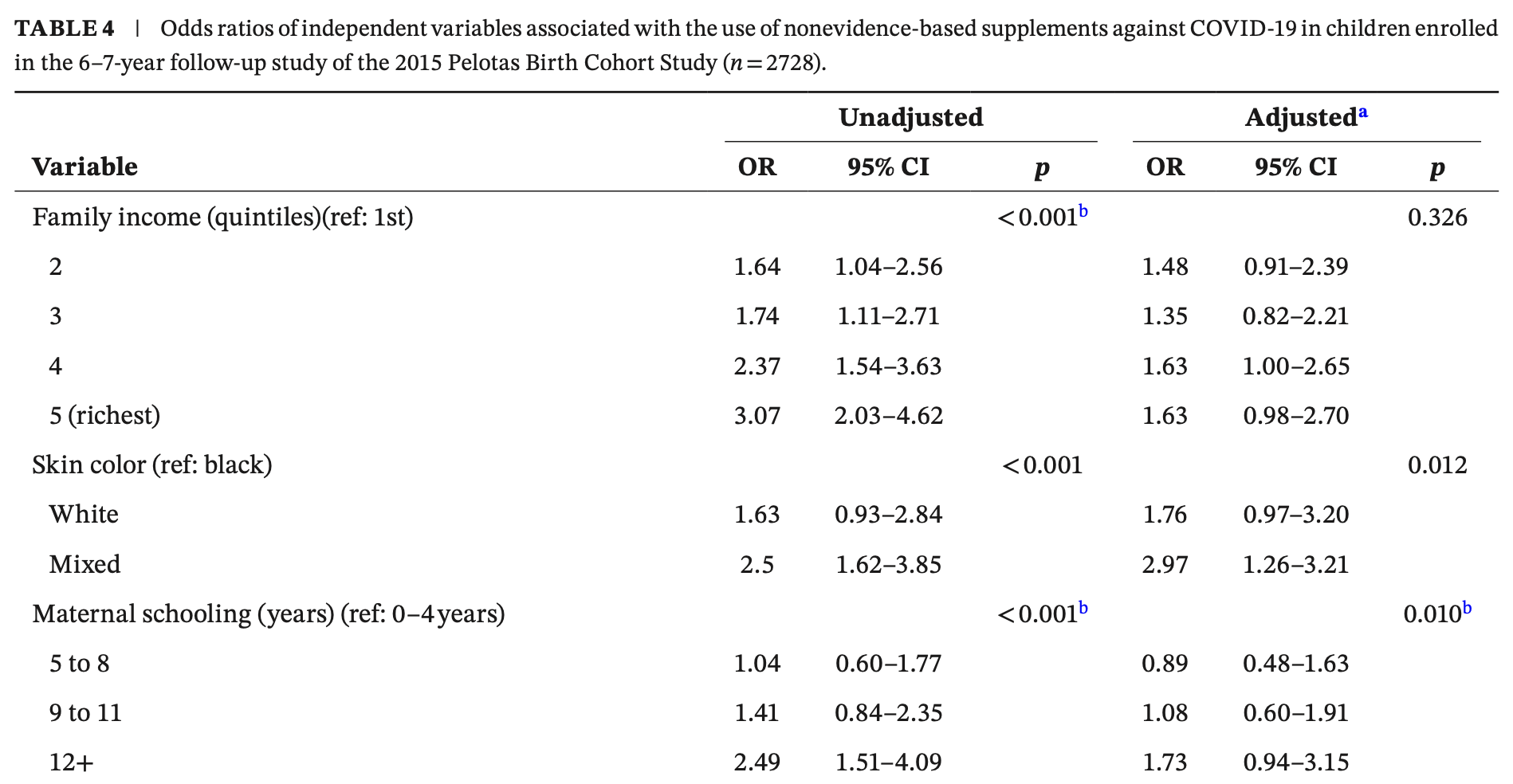
Analysis of 3,098 children in Brazil showing higher use of effective low-cost treatments for more highly educated individuals and with higher income.
Multiple studies show higher use of effective low-cost treatments for
healthcare professionals1-3 (and specifically those with more
experience4),
more highly educated
individuals2,5-13 ,
and with higher income4,7,10,11,13 .
Healthcare professionals also had lower risk than expected for COVID-1914,15, consistent with greater use of effective treatments.
This study looked at vitamin C, vitamin D, zinc, azithromycin, chloroquine/hydroxychloroquine, ivermectin, and nitazoxanide.
Authors call these treatments "nonevidence-based", without reviewing the over 800 clinical studies, which represents about 4 million hours of research by 12,000 scientists - evidence that shows significant efficacy for most of the treatments listed.
Currently there are 138 vitamin D treatment for COVID-19 studies, showing 39% lower mortality [32‑45%], 17% lower ventilation [-5‑35%], 45% lower ICU admission [28‑57%], 22% lower hospitalization [13‑30%], and 18% fewer cases [10‑25%].
Currently there are 40 zinc treatment for COVID-19 studies, showing 35% lower mortality [17‑49%], 40% lower ventilation [-1‑65%], 28% lower ICU admission [-8‑51%], 24% lower hospitalization [5‑38%], and 22% fewer cases [-10‑45%].
Currently there are 72 vitamin C for COVID-19 studies, showing 19% lower mortality [9‑27%], 16% lower ventilation [-1‑30%], 23% lower ICU admission [10‑34%], 19% lower hospitalization [7‑30%], and 3% fewer cases [-16‑19%].
Currently there are 38 HCQ for COVID-19 early treatment studies, showing 76% lower mortality [61‑85%], 67% lower ventilation [-710‑99%], 31% lower ICU admission [1‑53%], and 42% lower hospitalization [29‑52%].
Currently there are 106 ivermectin for COVID-19 studies, showing 47% lower mortality [34‑58%], 35% lower ventilation [17‑50%], 40% lower ICU admission [12‑58%], 34% lower hospitalization [21‑44%], and 79% fewer cases [69‑86%].
Currently there are 14 nitazoxanide for COVID-19 studies, showing 42% lower mortality [-24‑73%], 82% lower ventilation [24‑96%], 28% lower ICU admission [-21‑57%], 61% lower hospitalization [22‑80%], and 13% fewer cases [-31‑42%].

1.
Elayeh et al., Prevalence and predictors of self‐medication drugs to prevent or treat COVID‐19: Experience from a Middle Eastern country, International Journal of Clinical Practice, doi:10.1111/ijcp.14860.
2.
Sadio et al., Assessment of self-medication practices in the context of the COVID-19 outbreak in Togo, BMC Public Health, doi:10.1186/s12889-020-10145-1.
3.
Dantas et al., Automedicação no contexto de COVID-19, os perigos da prática e fatores associados, Research, Society and Development, doi:10.33448/rsd-v12i6.42039.
4.
Okoye et al., Self medication practices and its determinants in health care professionals during the coronavirus disease-2019 pandemic: cross-sectional study, International Journal of Clinical Pharmacy, doi:10.1007/s11096-021-01374-4.
5.
Arora et al., Global Dietary and Herbal Supplement Use during COVID-19—A Scoping Review, Nutrients, doi:10.3390/nu15030771.
6.
Ahmed et al., Behavioral preventive measures and the use of medicines and herbal products among the public in response to Covid-19 in Bangladesh: A cross-sectional study, PLOS ONE, doi:10.1371/journal.pone.0243706.
7.
Lam et al., A public survey of traditional, complementary and integrative medicine use during the COVID-19 outbreak in Hong Kong, PLOS ONE, doi:10.1371/journal.pone.0253890.
8.
Chellappan et al., Self-medication for prevention of COVID-19: a cross-sectional online survey among the general public in South India, INDIAN JOURNAL OF APPLIED RESEARCH, doi:10.36106/ijar/9209352.
9.
Mulder et al., Prevalence and predictive factors of complementary medicine use during the first wave of the COVID-19 pandemic of 2020 in the Netherlands, BMC Complementary Medicine and Therapies, doi:10.1186/s12906-022-03528-x.
10.
Wegbom et al., Self-Medication Practices and Associated Factors in the Prevention and/or Treatment of COVID-19 Virus: A Population-Based Survey in Nigeria, Frontiers in Public Health, doi:10.3389/fpubh.2021.606801.
11.
Aitafo et al., Self-Medication among Health Workers during the COVID-19 Pandemic in Southern Nigeria: Knowledge, Patterns, Practice and Associated Factors, International Journal of Health Sciences and Research, doi:10.52403/ijhsr.20220223.
12.
Grosman-Dziewiszek et al., Patterns of Dietary Supplement Use during the COVID-19 Pandemic in Poland: Focus on Vitamin D and Magnesium, Nutrients, doi:10.3390/nu16193225.
13.
Bertoldi et al., Pediatric Use of Off‐Label Medicines and Nonevidence‐Based Supplements for COVID‐19: Findings From the 2015 Pelotas Birth Cohort Study (Brazil), Pharmacoepidemiology and Drug Safety, doi:10.1002/pds.70460.
Bertoldi et al., 23 Aug 2026, Brazil, peer-reviewed, survey, 6 authors, study period November 2021 - December 2022.
Contact: andreadamaso.epi@gmail.com.
Abstract: ## Pharmacoepidemiology and Drug Safety
Pediatric Use of Off- Label Medicines and Nonevidence- Based Supplements for COVID- 19: Findings From the 2015 Pelotas Birth Cohort Study (Brazil)
Andréa Dâmaso Bertoldi 1 | Fernando Silva Guimarães 1 | Alexandra Crispim Boing 2 | Marysabel Pinto Telis Silveira 3 Pedro Curi Hallal 1,4 | Mariângela Freitas da Silveira 1
1 Postgraduate Program in Epidemiology, Federal University of Pelotas, Pelotas, Brazil | 2 Federal University of Santa Catarina, Florianópolis, Brazil | 3 Multicenter Postgraduate Program in Physiological Sciences, Federal University of Pelotas, Pelotas, Brazil | 4 University of Illinois UrbanaChampaign, Champaign, Illinois, USA
Correspondence: Andréa Dâmaso Bertoldi (andreadamaso.epi@gmail.com)
Received: 19 February 2026 | Revised: 5 August 2026 | Accepted: 11 August 2026
Keywords: cohort studies | COVID- 19 | off- label drug use | pediatrics
ABSTRACT
Purpose: Pediatric off- label medicine use increased during the COVID- 19 pandemic, exposing children to nonevidence- based treatments. We described the use of nonevidence- based COVID- 19 medicines and supplements among children from the 2015 Pelotas Birth Cohort, according to sociodemographic and health- related characteristics.
Methods: Data from the 6-7- year follow- up were analyzed. Mothers/caregivers reported children's use of nonevidence- based medicines (azithromycin, chloroquine/hydroxychloroquine, ivermectin, nitazoxanide) and supplements (vitamin C, vitamin D, and zinc) along with sociodemographic and health- related characteristics. Two scores were analyzed: (1) child's COVID- 19 burden score (considering negative experiences such as death or separation from a close person due to COVID- 19, and risk factors such as living with older adults or having asthma, bronchitis, or obesity) and (2) preventive behavior score (limited outdoor exposure during COVID- 19 and vaccine uptake against COVID- 19). Hierarchical logistic regression analyses were used to identify factors associated with nonevidence- based medicine and supplement use.
Results: Among 3098 children interviewed after COVID- 19 vaccines became available in the municipality, 13.9% (95% CI 12.7-15.2) used nonevidence- based medicines and supplements for COVID- 19. Overall, the use of nonevidence- based medicines and supplements increased with higher COVID- 19 burden scores and decreased with higher preventive behavior scores. Unvaccinated children had 2.57- fold higher odds of using off- label medicines than vaccinated children.
Conclusions: These findings highlight behavioral responses during a health emergency and suggest that public health policies should strengthen evidence- based risk communication and discourage inappropriate medicine use during future health emergencies.
1 | Introduction
The COVID- 19 pandemic marked a turning point for health misinformation (unreliable, shared information) and disinformation (deliberately misleading information) [1, 2], prompting the World Health Organization (WHO) to address the global impact and management of infodemics at the 1st Infodemiology Conference in 2020 [3]. In Brazil, health
This work was presented as an oral presentation at the II ISPE LATAM. Pharmacoepidemiology Congress; October 9-11, 2025; Sorocaba, Brazil.
This is an open access article under the terms of the Creative Commons Attribution License, which..
DOI record:
{
"DOI": "10.1002/pds.70460",
"ISSN": [
"1053-8569",
"1099-1557"
],
"URL": "http://dx.doi.org/10.1002/pds.70460",
"abstract": "<jats:title>ABSTRACT</jats:title>\n <jats:sec>\n <jats:title>Purpose</jats:title>\n <jats:p>Pediatric off‐label medicine use increased during the COVID‐19 pandemic, exposing children to nonevidence‐based treatments. We described the use of nonevidence‐based COVID‐19 medicines and supplements among children from the 2015 Pelotas Birth Cohort, according to sociodemographic and health‐related characteristics.</jats:p>\n </jats:sec>\n <jats:sec>\n <jats:title>Methods</jats:title>\n <jats:p>Data from the 6–7‐year follow‐up were analyzed. Mothers/caregivers reported children's use of nonevidence‐based medicines (azithromycin, chloroquine/hydroxychloroquine, ivermectin, nitazoxanide) and supplements (vitamin C, vitamin D, and zinc) along with sociodemographic and health‐related characteristics. Two scores were analyzed: (1) child's COVID‐19 burden score (considering negative experiences such as death or separation from a close person due to COVID‐19, and risk factors such as living with older adults or having asthma, bronchitis, or obesity) and (2) preventive behavior score (limited outdoor exposure during COVID‐19 and vaccine uptake against COVID‐19). Hierarchical logistic regression analyses were used to identify factors associated with nonevidence‐based medicine and supplement use.</jats:p>\n </jats:sec>\n <jats:sec>\n <jats:title>Results</jats:title>\n <jats:p>Among 3098 children interviewed after COVID‐19 vaccines became available in the municipality, 13.9% (95% CI 12.7–15.2) used nonevidence‐based medicines and supplements for COVID‐19. Overall, the use of nonevidence‐based medicines and supplements increased with higher COVID‐19 burden scores and decreased with higher preventive behavior scores. Unvaccinated children had 2.57‐fold higher odds of using off‐label medicines than vaccinated children.</jats:p>\n </jats:sec>\n <jats:sec>\n <jats:title>Conclusions</jats:title>\n <jats:p>These findings highlight behavioral responses during a health emergency and suggest that public health policies should strengthen evidence‐based risk communication and discourage inappropriate medicine use during future health emergencies.</jats:p>\n </jats:sec>",
"alternative-id": [
"10.1002/pds.70460"
],
"article-number": "e70460",
"assertion": [
{
"group": {
"label": "Publication History",
"name": "publication_history"
},
"label": "Received",
"name": "received",
"order": 0,
"value": "2026-02-19"
},
{
"group": {
"label": "Publication History",
"name": "publication_history"
},
"label": "Accepted",
"name": "accepted",
"order": 2,
"value": "2026-08-11"
},
{
"group": {
"label": "Publication History",
"name": "publication_history"
},
"label": "Published",
"name": "published",
"order": 3,
"value": "2026-08-23"
}
],
"author": [
{
"ORCID": "https://orcid.org/0000-0002-4680-3197",
"affiliation": [
{
"name": "Postgraduate Program in Epidemiology Federal University of Pelotas Pelotas Brazil"
}
],
"authenticated-orcid": false,
"family": "Bertoldi",
"given": "Andréa Dâmaso",
"role": [
{
"role": "author",
"vocabulary": "crossref"
}
],
"sequence": "first"
},
{
"ORCID": "https://orcid.org/0000-0002-7812-2660",
"affiliation": [
{
"name": "Postgraduate Program in Epidemiology Federal University of Pelotas Pelotas Brazil"
}
],
"authenticated-orcid": false,
"family": "Guimarães",
"given": "Fernando Silva",
"role": [
{
"role": "author",
"vocabulary": "crossref"
}
],
"sequence": "additional"
},
{
"ORCID": "https://orcid.org/0000-0001-7792-4824",
"affiliation": [
{
"name": "Federal University of Santa Catarina Florianópolis Brazil"
}
],
"authenticated-orcid": false,
"family": "Boing",
"given": "Alexandra Crispim",
"role": [
{
"role": "author",
"vocabulary": "crossref"
}
],
"sequence": "additional"
},
{
"ORCID": "https://orcid.org/0000-0002-6453-8534",
"affiliation": [
{
"name": "Multicenter Postgraduate Program in Physiological Sciences Federal University of Pelotas Pelotas Brazil"
}
],
"authenticated-orcid": false,
"family": "Silveira",
"given": "Marysabel Pinto Telis",
"role": [
{
"role": "author",
"vocabulary": "crossref"
}
],
"sequence": "additional"
},
{
"ORCID": "https://orcid.org/0000-0003-1470-6461",
"affiliation": [
{
"name": "Postgraduate Program in Epidemiology Federal University of Pelotas Pelotas Brazil"
},
{
"name": "University of Illinois Urbana‐Champaign Champaign Illinois USA"
}
],
"authenticated-orcid": false,
"family": "Hallal",
"given": "Pedro Curi",
"role": [
{
"role": "author",
"vocabulary": "crossref"
}
],
"sequence": "additional"
},
{
"ORCID": "https://orcid.org/0000-0002-2861-7139",
"affiliation": [
{
"name": "Postgraduate Program in Epidemiology Federal University of Pelotas Pelotas Brazil"
}
],
"authenticated-orcid": false,
"family": "da Silveira",
"given": "Mariângela Freitas",
"role": [
{
"role": "author",
"vocabulary": "crossref"
}
],
"sequence": "additional"
}
],
"container-title": "Pharmacoepidemiology and Drug Safety",
"container-title-short": "Pharmacoepidemiology and Drug",
"content-domain": {
"crossmark-restriction": true,
"domain": [
"onlinelibrary.wiley.com"
]
},
"created": {
"date-parts": [
[
2026,
8,
24
]
],
"date-time": "2026-08-24T03:04:21Z",
"timestamp": 1787540661000
},
"deposited": {
"date-parts": [
[
2026,
8,
24
]
],
"date-time": "2026-08-24T03:04:34Z",
"timestamp": 1787540674000
},
"funder": [
{
"DOI": "10.13039/501100004263",
"award": [
"PqG 21/2551–0002004‐0"
],
"award-info": [
{
"award-number": [
"PqG 21/2551–0002004‐0"
]
}
],
"doi-asserted-by": "publisher",
"id": [
{
"asserted-by": "publisher",
"id": "10.13039/501100004263",
"id-type": "DOI"
}
],
"name": "Fundação de Amparo à Pesquisa do Estado do Rio Grande do Sul"
},
{
"DOI": "10.13039/501100003593",
"award": [
"407813/2021–7"
],
"award-info": [
{
"award-number": [
"407813/2021–7"
]
}
],
"doi-asserted-by": "publisher",
"id": [
{
"asserted-by": "publisher",
"id": "10.13039/501100003593",
"id-type": "DOI"
}
],
"name": "Conselho Nacional de Desenvolvimento Científico e Tecnológico"
},
{
"DOI": "10.13039/501100003593",
"award": [
"406582/2021–1"
],
"award-info": [
{
"award-number": [
"406582/2021–1"
]
}
],
"doi-asserted-by": "publisher",
"id": [
{
"asserted-by": "publisher",
"id": "10.13039/501100003593",
"id-type": "DOI"
}
],
"name": "Conselho Nacional de Desenvolvimento Científico e Tecnológico"
},
{
"DOI": "10.13039/501100002322",
"doi-asserted-by": "publisher",
"id": [
{
"asserted-by": "publisher",
"id": "10.13039/501100002322",
"id-type": "DOI"
}
],
"name": "Coordenação de Aperfeiçoamento de Pessoal de Nível Superior"
}
],
"indexed": {
"date-parts": [
[
2026,
8,
24
]
],
"date-time": "2026-08-24T03:20:59Z",
"timestamp": 1787541659489,
"version": "build-2736575974"
},
"is-referenced-by-count": 0,
"issue": "9",
"issued": {
"date-parts": [
[
2026,
8,
23
]
]
},
"journal-issue": {
"issue": "9",
"published-print": {
"date-parts": [
[
2026,
9
]
]
}
},
"language": "en",
"license": [
{
"URL": "http://creativecommons.org/licenses/by/4.0/",
"content-version": "vor",
"delay-in-days": 0,
"start": {
"date-parts": [
[
2026,
8,
23
]
],
"date-time": "2026-08-23T00:00:00Z",
"timestamp": 1787443200000
}
},
{
"URL": "http://doi.wiley.com/10.1002/tdm_license_1.1",
"content-version": "tdm",
"delay-in-days": 0,
"start": {
"date-parts": [
[
2026,
8,
23
]
],
"date-time": "2026-08-23T00:00:00Z",
"timestamp": 1787443200000
}
}
],
"link": [
{
"URL": "https://onlinelibrary.wiley.com/doi/pdf/10.1002/pds.70460",
"content-type": "application/pdf",
"content-version": "vor",
"intended-application": "text-mining"
},
{
"URL": "https://onlinelibrary.wiley.com/doi/full-xml/10.1002/pds.70460",
"content-type": "application/xml",
"content-version": "vor",
"intended-application": "text-mining"
},
{
"URL": "https://onlinelibrary.wiley.com/doi/pdf/10.1002/pds.70460",
"content-type": "unspecified",
"content-version": "vor",
"intended-application": "similarity-checking"
}
],
"member": "311",
"original-title": [],
"prefix": "10.1002",
"published": {
"date-parts": [
[
2026,
8,
23
]
]
},
"published-online": {
"date-parts": [
[
2026,
8,
23
]
]
},
"published-print": {
"date-parts": [
[
2026,
9
]
]
},
"publisher": "Wiley",
"reference": [
{
"DOI": "10.1016/S0140‐6736(25)00094‐7",
"doi-asserted-by": "publisher",
"key": "e_1_2_11_2_1"
},
{
"DOI": "10.3934/publichealth.2022018",
"doi-asserted-by": "publisher",
"key": "e_1_2_11_3_1"
},
{
"DOI": "10.1016/S1473-3099(20)30565-X",
"article-title": "The COVID‐19 Infodemic",
"doi-asserted-by": "crossref",
"first-page": "875",
"issue": "8",
"journal-title": "Lancet Infectious Diseases",
"key": "e_1_2_11_4_1",
"volume": "20",
"year": "2020"
},
{
"DOI": "10.1016/j.lana.2021.100089",
"doi-asserted-by": "publisher",
"key": "e_1_2_11_5_1"
},
{
"author": "Ventura D.",
"key": "e_1_2_11_6_1",
"volume-title": "An Unprecedented Attack on Human Rights in Brazil: The Timeline of the Federal Government's Strategy to Spread COVID‐19",
"year": "2021"
},
{
"DOI": "10.1016/S0140‐6736(21)00141‐0",
"doi-asserted-by": "publisher",
"key": "e_1_2_11_7_1"
},
{
"DOI": "10.1590/0102‐311X00194121",
"doi-asserted-by": "publisher",
"key": "e_1_2_11_8_1"
},
{
"DOI": "10.1590/0102‐311XEN001022",
"doi-asserted-by": "publisher",
"key": "e_1_2_11_9_1"
},
{
"key": "e_1_2_11_10_1",
"unstructured": "Brazilian Health Regulatory Agency (Anvisa) “Resolution RDC No. 351 March 20 2020. Official Gazette of the Federative Republic of Brazil ”2020."
},
{
"author": "Brazilian Health Regulatory Agency (Anvisa)",
"key": "e_1_2_11_11_1",
"volume-title": "Resolution RDC No. 405, July 22, 2020. Establishes Control Measures for Medicines Containing Substances Listed in Annex I of This Resolution, Alone or in Combination, Due to the Public Health Emergency of International Concern related to SARS‐CoV‐2",
"year": "2020"
},
{
"author": "Brazilian Health Regulatory Agency (Anvisa)",
"key": "e_1_2_11_12_1",
"volume-title": "Resolution RDC No. 420, September 1, 2020. Provides for the Updating of Annex I of Collegiate Board Resolution (RDC) No. 405, July 22, 2020",
"year": "2020"
},
{
"DOI": "10.3390/ijerph181910447",
"doi-asserted-by": "publisher",
"key": "e_1_2_11_13_1"
},
{
"DOI": "10.4103/jfmpc.jfmpc_2583_20",
"doi-asserted-by": "publisher",
"key": "e_1_2_11_14_1"
},
{
"DOI": "10.1016/j.anpedi.2016.06.002",
"doi-asserted-by": "publisher",
"key": "e_1_2_11_15_1"
},
{
"DOI": "10.1590/1984‐0462/2024/42/2022137",
"doi-asserted-by": "publisher",
"key": "e_1_2_11_16_1"
},
{
"DOI": "10.1093/ije/dyx219",
"doi-asserted-by": "publisher",
"key": "e_1_2_11_17_1"
},
{
"DOI": "10.1093/ije/dyae048",
"doi-asserted-by": "publisher",
"key": "e_1_2_11_18_1"
},
{
"author": "Instituto Brasileiro de Geografia e Estatística",
"key": "e_1_2_11_19_1",
"volume-title": "Ethnic‐Racial Characteristics of the Population: Classifications and Identities",
"year": "2013"
},
{
"DOI": "10.1093/ije/26.1.224",
"doi-asserted-by": "publisher",
"key": "e_1_2_11_20_1"
},
{
"DOI": "10.1111/apa.15085",
"doi-asserted-by": "publisher",
"key": "e_1_2_11_21_1"
},
{
"DOI": "10.1590/1980‐549720200030",
"doi-asserted-by": "publisher",
"key": "e_1_2_11_22_1"
},
{
"DOI": "10.2174/1574884712666170317161935",
"doi-asserted-by": "publisher",
"key": "e_1_2_11_23_1"
},
{
"DOI": "10.1017/lap.2020.13",
"doi-asserted-by": "publisher",
"key": "e_1_2_11_24_1"
},
{
"DOI": "10.1016/j.lana.2022.100221",
"doi-asserted-by": "publisher",
"key": "e_1_2_11_25_1"
},
{
"DOI": "10.1186/s12889‐023‐16409‐w",
"doi-asserted-by": "publisher",
"key": "e_1_2_11_26_1"
},
{
"DOI": "10.11606/s1518‐8787.2021055003832",
"doi-asserted-by": "publisher",
"key": "e_1_2_11_27_1"
},
{
"DOI": "10.1016/j.vaccine.2024.07.006",
"doi-asserted-by": "publisher",
"key": "e_1_2_11_28_1"
},
{
"DOI": "10.1186/s12889‐019‐7269‐0",
"doi-asserted-by": "publisher",
"key": "e_1_2_11_29_1"
},
{
"DOI": "10.1590/1413‐812320222711.09282022",
"doi-asserted-by": "publisher",
"key": "e_1_2_11_30_1"
},
{
"DOI": "10.3390/diagnostics12071612",
"doi-asserted-by": "publisher",
"key": "e_1_2_11_31_1"
},
{
"DOI": "10.1016/j.ejphar.2020.173813",
"doi-asserted-by": "publisher",
"key": "e_1_2_11_32_1"
},
{
"key": "e_1_2_11_33_1",
"unstructured": "US Food and Drug Administration “Why You Should not Use Ivermectin to Treat or Prevent COVID‐19 ”accessed February 19 2026 https://www.fda.gov/consumers/consumer‐updates/why‐you‐should‐not‐use‐ivermectin‐treat‐or‐prevent‐covid‐19."
},
{
"DOI": "10.1056/NEJMc1917344",
"doi-asserted-by": "publisher",
"key": "e_1_2_11_34_1"
},
{
"DOI": "10.4269/ajtmh.17‐0042",
"doi-asserted-by": "publisher",
"key": "e_1_2_11_35_1"
},
{
"DOI": "10.1093/cid/ciaa237",
"doi-asserted-by": "publisher",
"key": "e_1_2_11_36_1"
},
{
"DOI": "10.1056/NEJM195804172581608",
"doi-asserted-by": "publisher",
"key": "e_1_2_11_37_1"
},
{
"DOI": "10.1161/CIR.0000000000000426",
"doi-asserted-by": "publisher",
"key": "e_1_2_11_38_1"
},
{
"DOI": "10.12998/wjcc.v10.i17.5541",
"doi-asserted-by": "publisher",
"key": "e_1_2_11_39_1"
},
{
"DOI": "10.1111/ijcp.13896",
"doi-asserted-by": "publisher",
"key": "e_1_2_11_40_1"
},
{
"DOI": "10.1136/lupus‐2021‐000496",
"doi-asserted-by": "publisher",
"key": "e_1_2_11_41_1"
},
{
"DOI": "10.1007/s43440‐021‐00316‐1",
"doi-asserted-by": "publisher",
"key": "e_1_2_11_42_1"
},
{
"DOI": "10.3389/fnut.2024.1465670",
"doi-asserted-by": "publisher",
"key": "e_1_2_11_43_1"
},
{
"DOI": "10.11606/s1518‐8787.2019053001263",
"doi-asserted-by": "publisher",
"key": "e_1_2_11_44_1"
},
{
"DOI": "10.3390/su132212900",
"doi-asserted-by": "publisher",
"key": "e_1_2_11_45_1"
},
{
"DOI": "10.1016/j.tjnut.2022.10.001",
"doi-asserted-by": "publisher",
"key": "e_1_2_11_46_1"
},
{
"DOI": "10.3389/fpos.2021.648082",
"doi-asserted-by": "publisher",
"key": "e_1_2_11_47_1"
},
{
"DOI": "10.3390/nu13010054",
"doi-asserted-by": "publisher",
"key": "e_1_2_11_48_1"
}
],
"reference-count": 47,
"references-count": 47,
"relation": {},
"resource": {
"primary": {
"URL": "https://onlinelibrary.wiley.com/doi/10.1002/pds.70460"
}
},
"score": 1,
"short-title": [],
"source": "Crossref",
"subject": [],
"subtitle": [],
"title": "Pediatric Use of Off‐Label Medicines and Nonevidence‐Based Supplements for\n <scp>COVID</scp>\n ‐19: Findings From the 2015 Pelotas Birth Cohort Study (Brazil)",
"type": "journal-article",
"update-policy": "https://doi.org/10.1002/crossmark_policy",
"volume": "35"
}