Association of In-Hospital Antimalarial–Macrolide Therapy With 3–6-Month Cardiac Electrophysiological Outcomes in Survivors of Severe COVID-19: A Matched Retrospective Cohort Study
et al., Research Square, doi:10.21203/rs.3.rs-11342547/v1, Oct 2026
Retrospective 86 severe COVID-19 survivors with 43 receiving combined HCQ/CQ plus azithromycin/clarithromycin treatment and 43 matched untreated patients, showing no significant difference in QTc prolongation or clinically significant arrhythmias at 3-6 months post-hospitalization.

Sharma et al., 14 Oct 2026, retrospective, Mexico, preprint, 11 authors, study period March 2020 - June 2020.
Abstract: Shubhang Sharma Sharma shubhang.sharma04@gmail.com
[S Research Square](https://doi.org/10.21203/rs.3.rs-11342547/v1)
Preprints are preliminary reports that have not undergone peer review.
They should not be considered conclusive, used to inform clinical practice, or referenced by the media as validated information.
Association of In-Hospital Antimalarial-Macrolide Therapy With 3-6-Month Cardiac Electrophysiological Outcomes in Survivors of Severe COVID-19: A Matched Retrospective Cohort Study
Shubhang Sharma Sharma
Instituto Nacional de Ciencias Médicas y Nutrición Salvador Zubirán
Julia Ramírez-González
Universidad Nacional Autónoma de México
Raúl Chávez-Fernández
Universidad Nacional Autónoma de México
Jaime Galindo-Uribe
Instituto Nacional de Ciencias Médicas y Nutrición Salvador Zubirán
Jaime Rivera-Figueroa
Instituto Nacional de Ciencias Médicas y Nutrición Salvador Zubirán
Gerardo Payro-Ramírez
Instituto Nacional de Ciencias Médicas y Nutrición Salvador Zubirán
Alejandra Hernández
Universidad Nacional Autónoma de México
Fátima Ramos-Pérez
Universidad Nacional Autónoma de México
Berenice Hernández-Franco
Universidad Nacional Autónoma de México
Diana Torres-Partida
Universidad Nacional Autónoma de México
Reyna Pacheco-Domínguez
Universidad Nacional Autónoma de México
Article
Keywords: COVID-19, hydroxychloroquine, chloroquine, macrolides, QT interval, arrhythmias, cardiac electrophysiology, heart rate variability
Posted Date:
October 14th, 2026
DOI: https://doi.org/10.21203/rs.3.rs-11342547/v1
License:
This work is licensed under a Creative Commons Attribution 4.0 International License.
Read Full License
Additional Declarations:
No competing interests reported.
Abstract
Background: During the early phase of the COVID-19 pandemic, antimalarial agents and macrolide antibiotics were widely used because of their proposed antiviral and immunomodulatory effects. However, their potential to prolong ventricular repolarization and increase the risk of arrhythmias raised concerns about their cardiac electrophysiological effects. Available evidence has predominantly focused on electrophysiological effects during acute treatment, whereas post-recovery outcomes remain less well characterized.
Objectives: To evaluate cardiac electrophysiological outcomes 3-6 months after hospitalization for severe COVID-19 pneumonia and compare these outcomes according to in-hospital exposure to combined antimalarial-macrolide therapy.
Methods: We conducted a retrospective matched cohort study including adults hospitalized for severe COVID-19 pneumonia between March and June 2020. Patients exposed to hydroxychloroquine or chloroquine in combination with azithromycin or clarithromycin were matched 1:1 by sex and age (±3 years) with patients who did not receive either drug class. Cardiovascular assessment 3-6 months after hospitalization included a 12-lead electrocardiogram and 24-hour Holter monitoring. QTc interval, conduction abnormalities, arrhythmias, and heart rate variability (HRV) were evaluated.
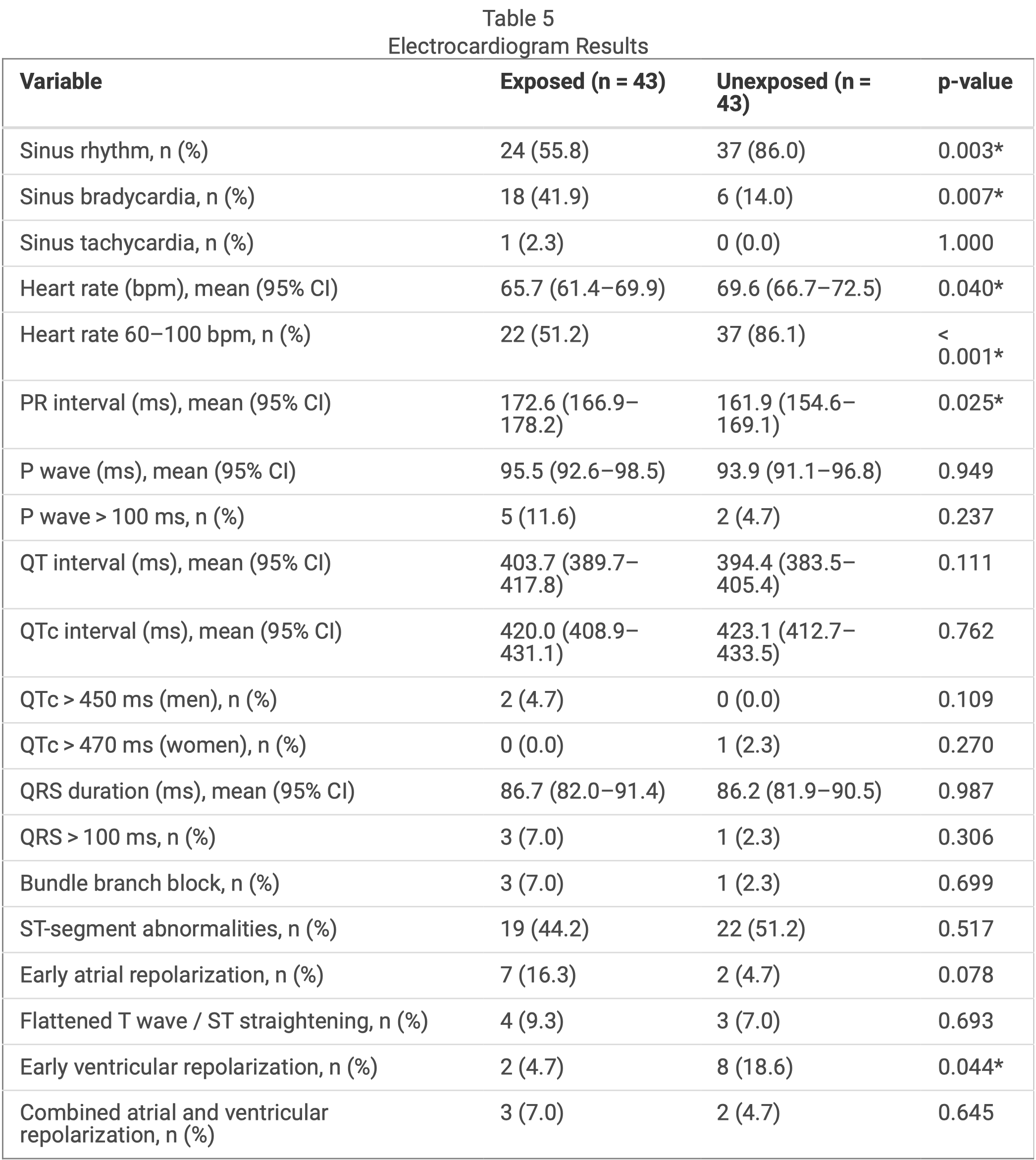
Results: Eighty-six patients were included (43 exposed and 43 unexposed). Follow-up QTc intervals were similar between groups (420.0 vs. 423.1 ms; p =0.762), and QTc prolongation was uncommon. No malignant ventricular arrhythmias or clinically significant conduction abnormalities were identified. Exposed patients had a higher prevalence of sinus bradycardia, a lower resting heart rate on electrocardiography, and higher HRV as..
DOI record:
{
"DOI": "10.21203/rs.3.rs-11342547/v1",
"URL": "http://dx.doi.org/10.21203/rs.3.rs-11342547/v1",
"abstract": "<title>Abstract</title>\n <p>\n <bold>Background:</bold>\n During the early phase of the COVID-19 pandemic, antimalarial agents and macrolide antibiotics were widely used because of their proposed antiviral and immunomodulatory effects. However, their potential to prolong ventricular repolarization and increase the risk of arrhythmias raised concerns about their cardiac electrophysiological effects. Available evidence has predominantly focused on electrophysiological effects during acute treatment, whereas post-recovery outcomes remain less well characterized.\n <bold>Objectives:</bold>\n To evaluate cardiac electrophysiological outcomes 3–6 months after hospitalization for severe COVID-19 pneumonia and compare these outcomes according to in-hospital exposure to combined antimalarial–macrolide therapy.\n <bold>Methods:</bold>\n We conducted a retrospective matched cohort study including adults hospitalized for severe COVID-19 pneumonia between March and June 2020. Patients exposed to hydroxychloroquine or chloroquine in combination with azithromycin or clarithromycin were matched 1:1 by sex and age (±3 years) with patients who did not receive either drug class. Cardiovascular assessment 3–6 months after hospitalization included a 12-lead electrocardiogram and 24-hour Holter monitoring. QTc interval, conduction abnormalities, arrhythmias, and heart rate variability (HRV) were evaluated.\n <bold>Results:</bold>\n Eighty-six patients were included (43 exposed and 43 unexposed). Follow-up QTc intervals were similar between groups (420.0 vs. 423.1 ms;\n <italic>p</italic>\n =0.762), and QTc prolongation was uncommon. No malignant ventricular arrhythmias or clinically significant conduction abnormalities were identified. Exposed patients had a higher prevalence of sinus bradycardia, a lower resting heart rate on electrocardiography, and higher HRV as assessed by the standard deviation of normal-to-normal intervals (SDNN). However, unexposed patients exhibited a greater inflammatory burden during hospitalization, more frequent intensive care unit admissions, and longer hospital stays.\n <bold>Conclusion:</bold>\n In this cohort of survivors of severe COVID-19, short-term in-hospital exposure to combined antimalarial–macrolide therapy was not associated with persistent QTc prolongation or clinically significant electrophysiological abnormalities at 3–6 months. Differences in heart rate and HRV should be interpreted with caution, given potential residual confounding due to acute disease severity.\n </p>",
"accepted": {
"date-parts": [
[
2026,
10,
12
]
]
},
"author": [
{
"affiliation": [
{
"name": "Instituto Nacional de Ciencias Médicas y Nutrición Salvador Zubirán"
}
],
"family": "Sharma",
"given": "Shubhang Sharma",
"role": [
{
"role": "author",
"vocabulary": "crossref"
}
],
"sequence": "first"
},
{
"affiliation": [
{
"name": "Universidad Nacional Autónoma de México"
}
],
"family": "Ramírez-González",
"given": "Julia",
"role": [
{
"role": "author",
"vocabulary": "crossref"
}
],
"sequence": "additional"
},
{
"affiliation": [
{
"name": "Universidad Nacional Autónoma de México"
}
],
"family": "Chávez-Fernández",
"given": "Raúl",
"role": [
{
"role": "author",
"vocabulary": "crossref"
}
],
"sequence": "additional"
},
{
"affiliation": [
{
"name": "Instituto Nacional de Ciencias Médicas y Nutrición Salvador Zubirán"
}
],
"family": "Galindo-Uribe",
"given": "Jaime",
"role": [
{
"role": "author",
"vocabulary": "crossref"
}
],
"sequence": "additional"
},
{
"affiliation": [
{
"name": "Instituto Nacional de Ciencias Médicas y Nutrición Salvador Zubirán"
}
],
"family": "Rivera-Figueroa",
"given": "Jaime",
"role": [
{
"role": "author",
"vocabulary": "crossref"
}
],
"sequence": "additional"
},
{
"affiliation": [
{
"name": "Instituto Nacional de Ciencias Médicas y Nutrición Salvador Zubirán"
}
],
"family": "Payro-Ramírez",
"given": "Gerardo",
"role": [
{
"role": "author",
"vocabulary": "crossref"
}
],
"sequence": "additional"
},
{
"affiliation": [
{
"name": "Universidad Nacional Autónoma de México"
}
],
"family": "Hernández",
"given": "Alejandra",
"role": [
{
"role": "author",
"vocabulary": "crossref"
}
],
"sequence": "additional"
},
{
"affiliation": [
{
"name": "Universidad Nacional Autónoma de México"
}
],
"family": "Ramos-Pérez",
"given": "Fátima",
"role": [
{
"role": "author",
"vocabulary": "crossref"
}
],
"sequence": "additional"
},
{
"affiliation": [
{
"name": "Universidad Nacional Autónoma de México"
}
],
"family": "Hernández-Franco",
"given": "Berenice",
"role": [
{
"role": "author",
"vocabulary": "crossref"
}
],
"sequence": "additional"
},
{
"affiliation": [
{
"name": "Universidad Nacional Autónoma de México"
}
],
"family": "Torres-Partida",
"given": "Diana",
"role": [
{
"role": "author",
"vocabulary": "crossref"
}
],
"sequence": "additional"
},
{
"affiliation": [
{
"name": "Universidad Nacional Autónoma de México"
}
],
"family": "Pacheco-Domínguez",
"given": "Reyna",
"role": [
{
"role": "author",
"vocabulary": "crossref"
}
],
"sequence": "additional"
}
],
"container-title": [],
"content-domain": {
"crossmark-restriction": false,
"domain": []
},
"created": {
"date-parts": [
[
2026,
10,
14
]
],
"date-time": "2026-10-14T09:30:02Z",
"timestamp": 1791970202000
},
"deposited": {
"date-parts": [
[
2026,
10,
16
]
],
"date-time": "2026-10-16T05:25:22Z",
"timestamp": 1792128322000
},
"group-title": "In Review",
"indexed": {
"date-parts": [
[
2026,
10,
16
]
],
"date-time": "2026-10-16T05:49:21Z",
"timestamp": 1792129761441,
"version": "4.4.0"
},
"institution": [
{
"name": "Research Square"
}
],
"is-referenced-by-count": 0,
"issued": {
"date-parts": [
[
2026,
10,
14
]
]
},
"license": [
{
"URL": "https://creativecommons.org/licenses/by/4.0/",
"content-version": "unspecified",
"delay-in-days": 0,
"start": {
"date-parts": [
[
2026,
10,
14
]
],
"date-time": "2026-10-14T00:00:00Z",
"timestamp": 1791936000000
}
}
],
"link": [
{
"URL": "https://www.researchsquare.com/article/rs-11342547/v1",
"content-type": "text/html",
"content-version": "vor",
"intended-application": "text-mining"
},
{
"URL": "https://www.researchsquare.com/article/rs-11342547/v1.html",
"content-type": "unspecified",
"content-version": "vor",
"intended-application": "similarity-checking"
}
],
"member": "297",
"original-title": [],
"posted": {
"date-parts": [
[
2026,
10,
14
]
]
},
"prefix": "10.21203",
"published": {
"date-parts": [
[
2026,
10,
14
]
]
},
"publisher": "Springer Science and Business Media LLC",
"reference": [
{
"DOI": "10.1186/1743-422X-2-69",
"article-title": "Chloroquine is a potent inhibitor of SARS coronavirus infection and spread",
"author": "Vincent MJ",
"doi-asserted-by": "publisher",
"first-page": "22",
"journal-title": "Virol. J.",
"key": "ref1",
"unstructured": "Vincent, M. J. et al. Chloroquine is a potent inhibitor of SARS coronavirus infection and spread. Virol. J. 22. 10.1186/1743-422X-2-69 (2005).",
"year": "2005"
},
{
"DOI": "10.1016/S1473-3099(03)00806-5",
"article-title": "Effects of chloroquine on viral infections: an old drug against today’s diseases",
"author": "Savarino A",
"doi-asserted-by": "publisher",
"first-page": "722",
"issue": "11",
"journal-title": "Lancet Infect. Dis.",
"key": "ref2",
"unstructured": "Savarino, A., Boelaert, J. R., Cassone, A., Majori, G. & Cauda, R. Effects of chloroquine on viral infections: an old drug against today’s diseases. Lancet Infect. Dis. 3 (11), 722. 10.1016/S1473-3099(03)00806-5 (2003).",
"volume": "3",
"year": "2003"
},
{
"DOI": "10.1038/s41422-020-0282-0",
"article-title": "Remdesivir and chloroquine effectively inhibit the recently emerged novel coronavirus (2019-nCoV) in vitro",
"author": "Wang M",
"doi-asserted-by": "publisher",
"first-page": "269",
"issue": "3",
"journal-title": "Cell. Res.",
"key": "ref3",
"unstructured": "Wang, M. et al. Remdesivir and chloroquine effectively inhibit the recently emerged novel coronavirus (2019-nCoV) in vitro. Cell. Res. 30 (3), 269–271. 10.1038/s41422-020-0282-0 (2020).",
"volume": "30",
"year": "2020"
},
{
"DOI": "10.1093/cid/ciaa237",
"article-title": "In Vitro Antiviral Activity and Projection of Optimized Dosing Design of Hydroxychloroquine for the Treatment of Severe Acute Respiratory Syndrome Coronavirus 2 (SARS-CoV-2)",
"author": "Yao X",
"doi-asserted-by": "publisher",
"first-page": "732",
"issue": "15",
"journal-title": "Clin. Infect. Dis.",
"key": "ref4",
"unstructured": "Yao, X. et al. In Vitro Antiviral Activity and Projection of Optimized Dosing Design of Hydroxychloroquine for the Treatment of Severe Acute Respiratory Syndrome Coronavirus 2 (SARS-CoV-2). Clin. Infect. Dis. 71 (15), 732–739. 10.1093/cid/ciaa237 (2020).",
"volume": "71",
"year": "2020"
},
{
"DOI": "10.1016/j.ijantimicag.2020.106053",
"article-title": "Macrolides and viral infections: focus on azithromycin in COVID-19 pathology",
"author": "Pani A",
"doi-asserted-by": "publisher",
"first-page": "106053",
"issue": "2",
"journal-title": "Int. J. Antimicrob. Agents",
"key": "ref5",
"unstructured": "Pani, A., Lauriola, M., Romandini, A. & Scaglione, F. Macrolides and viral infections: focus on azithromycin in COVID-19 pathology. Int. J. Antimicrob. Agents. 56 (2), 106053. 10.1016/j.ijantimicag.2020.106053 (2020).",
"volume": "56",
"year": "2020"
},
{
"DOI": "10.1038/S41591-020-1051-917",
"author": "Valle DM",
"doi-asserted-by": "publisher",
"key": "ref6",
"unstructured": "Del Valle, D. M. et al. An inflammatory cytokine signature predicts COVID-19 severity and survival. Nat Med. (2020). 1;26(10):1636–43 10.1038/S41591-020-1051-917",
"year": "2020"
},
{
"DOI": "10.5582/BST.2020.01047",
"article-title": "Chloroquine phosphate has shown apparent efficacy in treatment of COVID-19 associated pneumonia in clinical studies",
"author": "Gao J",
"doi-asserted-by": "publisher",
"issue": "1",
"journal-title": "Biosci. Trends",
"key": "ref7",
"unstructured": "Gao, J., Tian, Z., Yang, X. & Breakthrough Chloroquine phosphate has shown apparent efficacy in treatment of COVID-19 associated pneumonia in clinical studies. Biosci. Trends. 14 (1). 10.5582/BST.2020.01047 (2020).",
"volume": "14",
"year": "2020"
},
{
"DOI": "10.1056/nejmoa2012410",
"article-title": "Observational Study of Hydroxychloroquine in Hospitalized Patients with Covid-19",
"author": "Geleris J",
"doi-asserted-by": "publisher",
"first-page": "2411",
"issue": "25",
"journal-title": "N Engl. J. Med.",
"key": "ref8",
"unstructured": "Geleris, J. et al. Observational Study of Hydroxychloroquine in Hospitalized Patients with Covid-19. N Engl. J. Med. 382 (25), 2411–2418. 10.1056/nejmoa2012410 (2020).",
"volume": "382",
"year": "2020"
},
{
"DOI": "10.1038/nature04710",
"article-title": "hERG potassium channels and cardiac arrhythmia",
"author": "Sanguinetti MC",
"doi-asserted-by": "publisher",
"first-page": "463",
"issue": "7083",
"journal-title": "Nature",
"key": "ref9",
"unstructured": "Sanguinetti, M. C. & Tristani-Firouzi, M. hERG potassium channels and cardiac arrhythmia. Nature 440 (7083), 463–469. 10.1038/nature04710 (2006).",
"volume": "440",
"year": "2006"
},
{
"DOI": "10.1007/s12551-022-00929-7",
"author": "TeBay C",
"doi-asserted-by": "publisher",
"first-page": "353",
"key": "ref10",
"unstructured": "TeBay, C., Hill, A. P. & Windley, M. J. Metabolic and electrolyte abnormalities as risk factors in drug-induced long QT syndrome. Biophysical Reviews p. 353–367 (Springer Science and Business Media Deutschland GmbH, 2022). 10.1007/s12551-022-00929-7",
"volume-title": "Metabolic and electrolyte abnormalities as risk factors in drug-induced long QT syndrome. Biophysical Reviews",
"year": "2022"
},
{
"DOI": "10.1161/CIR.0000000000000905",
"article-title": "Drug-Induced Arrhythmias: A Scientific Statement From the American Heart Association",
"author": "Tisdale JE",
"doi-asserted-by": "publisher",
"first-page": "E214",
"issue": "15",
"journal-title": "Circulation",
"key": "ref11",
"unstructured": "Tisdale, J. E. et al. Drug-Induced Arrhythmias: A Scientific Statement From the American Heart Association. Circulation 142 (15), E214–E233. 10.1161/CIR.0000000000000905 (2020).",
"volume": "142",
"year": "2020"
},
{
"DOI": "10.1161/CIRCEP.120.008719",
"article-title": "Cardiac Arrhythmias in COVID-19 Infection",
"author": "Kochav SM",
"doi-asserted-by": "publisher",
"first-page": "E008719",
"issue": "6",
"journal-title": "Circ. Arrhythm. Electrophysiol.",
"key": "ref12",
"unstructured": "Kochav, S. M. et al. Cardiac Arrhythmias in COVID-19 Infection. Circ. Arrhythm. Electrophysiol. 13 (6), E008719. 10.1161/CIRCEP.120.008719 (2020).",
"volume": "13",
"year": "2020"
},
{
"DOI": "10.1111/jce.14594",
"article-title": "Incidence and determinants of QT interval prolongation in COVID-19 patients treated with hydroxychloroquine and azithromycin",
"author": "Maraj I",
"doi-asserted-by": "publisher",
"first-page": "1904",
"issue": "8",
"journal-title": "J. Cardiovasc. Electrophysiol.",
"key": "ref13",
"unstructured": "Maraj, I. et al. Incidence and determinants of QT interval prolongation in COVID-19 patients treated with hydroxychloroquine and azithromycin. J. Cardiovasc. Electrophysiol. 31 (8), 1904–1907. 10.1111/jce.14594 (2020).",
"volume": "31",
"year": "2020"
},
{
"DOI": "10.1001/JAMACARDIO.2020.1787",
"article-title": "Assessment of QT Intervals in a Case Series of Patients with Coronavirus Disease 2019 (COVID-19) Infection18 Treated with Hydroxychloroquine Alone or in Combination with Azithromycin in an Intensive Care Unit",
"author": "Bessière F",
"doi-asserted-by": "publisher",
"first-page": "1067",
"issue": "9",
"journal-title": "JAMA Cardiol.",
"key": "ref14",
"unstructured": "Bessière, F. et al. Assessment of QT Intervals in a Case Series of Patients with Coronavirus Disease 2019 (COVID-19) Infection18 Treated with Hydroxychloroquine Alone or in Combination with Azithromycin in an Intensive Care Unit. JAMA Cardiol. 5 (9), 1067–1069. 10.1001/JAMACARDIO.2020.1787 (2020).",
"volume": "5",
"year": "2020"
},
{
"DOI": "10.1038/s41591-020-0888-2",
"article-title": "The QT interval in patients with COVID-19 treated with hydroxychloroquine and azithromycin",
"author": "Chorin E",
"doi-asserted-by": "publisher",
"first-page": "808",
"issue": "6",
"journal-title": "Nat. Med.",
"key": "ref15",
"unstructured": "Chorin, E. et al. The QT interval in patients with COVID-19 treated with hydroxychloroquine and azithromycin. Nat. Med. 26 (6), 808–809. 10.1038/s41591-020-0888-2 (2020).",
"volume": "26",
"year": "2020"
},
{
"DOI": "10.1093/infdis/jiac136",
"article-title": "Global Prevalence of Post-Coronavirus Disease 2019 (COVID-19) Condition or Long COVID: A Meta-Analysis and Systematic Review",
"author": "Chen C",
"doi-asserted-by": "publisher",
"first-page": "1593",
"issue": "9",
"journal-title": "J. Infect. Dis.",
"key": "ref16",
"unstructured": "Chen, C. et al. Global Prevalence of Post-Coronavirus Disease 2019 (COVID-19) Condition or Long COVID: A Meta-Analysis and Systematic Review. J. Infect. Dis. 226 (9), 1593–1607. 10.1093/infdis/jiac136 (2022).",
"volume": "226",
"year": "2022"
},
{
"DOI": "10.3389/FPHAR.2021.687007",
"article-title": "Molecular Insights Into the Gating Kinetics of the Cardiac hERG Channel, Illuminated by Structure and Molecular Dynamics",
"author": "Zequn Z",
"doi-asserted-by": "publisher",
"journal-title": "Front. Pharmacol.",
"key": "ref17",
"unstructured": "Zequn, Z. & Jiangfang, L. Molecular Insights Into the Gating Kinetics of the Cardiac hERG Channel, Illuminated by Structure and Molecular Dynamics. Front. Pharmacol. 12 10.3389/FPHAR.2021.687007 (2021).",
"volume": "12",
"year": "2021"
},
{
"DOI": "10.1161/CIRCOUTCOMES.113.000152",
"article-title": "Development and validation of a risk score to predict QT interval prolongation in hospitalized patients",
"author": "Tisdale JE",
"doi-asserted-by": "publisher",
"first-page": "479",
"issue": "4",
"journal-title": "Circ. Cardiovasc. Qual. Outcomes",
"key": "ref18",
"unstructured": "Tisdale, J. E. et al. Development and validation of a risk score to predict QT interval prolongation in hospitalized patients. Circ. Cardiovasc. Qual. Outcomes. 6 (4), 479–487. 10.1161/CIRCOUTCOMES.113.000152 (2013).",
"volume": "6",
"year": "2013"
},
{
"DOI": "10.1001/jamacardio.2020.1017",
"article-title": "Cardiovascular Implications of Fatal Outcomes of Patients With Coronavirus Disease 2019 (COVID-19)",
"author": "Guo T",
"doi-asserted-by": "publisher",
"first-page": "811",
"issue": "7",
"journal-title": "JAMA Cardiol.",
"key": "ref19",
"unstructured": "Guo, T. et al. Cardiovascular Implications of Fatal Outcomes of Patients With Coronavirus Disease 2019 (COVID-19). JAMA Cardiol. 5 (7), 811–818. 10.1001/jamacardio.2020.1017 (2020).",
"volume": "5",
"year": "2020"
},
{
"DOI": "10.1001/jamacardio.2020.183419",
"article-title": "Risk of QT Interval Prolongation Associated with Use of Hydroxychloroquine with or without Concomitant Azithromycin among Hospitalized Patients Testing Positive for Coronavirus Disease 2019 (COVID-19)",
"author": "Mercuro NJ",
"doi-asserted-by": "publisher",
"first-page": "1036",
"issue": "9",
"journal-title": "JAMA Cardiol.",
"key": "ref20",
"unstructured": "Mercuro, N. J. et al. Risk of QT Interval Prolongation Associated with Use of Hydroxychloroquine with or without Concomitant Azithromycin among Hospitalized Patients Testing Positive for Coronavirus Disease 2019 (COVID-19). JAMA Cardiol. 5 (9), 1036–1041. 10.1001/jamacardio.2020.183419 (2020).",
"volume": "5",
"year": "2020"
},
{
"DOI": "10.1001/JAMA.2020.8630",
"article-title": "Association of Treatment With Hydroxychloroquine or Azithromycin With In-Hospital Mortality in Patients With COVID-19 in New York State",
"author": "Rosenberg ES",
"doi-asserted-by": "publisher",
"first-page": "2493",
"issue": "24",
"journal-title": "JAMA",
"key": "ref21",
"unstructured": "Rosenberg, E. S. et al. Association of Treatment With Hydroxychloroquine or Azithromycin With In-Hospital Mortality in Patients With COVID-19 in New York State. JAMA 323 (24), 2493–2502. 10.1001/JAMA.2020.8630 (2020).",
"volume": "323",
"year": "2020"
},
{
"DOI": "10.1161/CIRCULATIONAHA.120.047293",
"article-title": "COVID-19, Arrhythmic Risk, and Inflammation: Mind the Gap!",
"author": "Lazzerini PE",
"doi-asserted-by": "publisher",
"first-page": "7",
"issue": "1",
"journal-title": "Circulation",
"key": "ref22",
"unstructured": "Lazzerini, P. E., Boutjdir, M. & Capecchi, P. L. COVID-19, Arrhythmic Risk, and Inflammation: Mind the Gap! Circulation 142 (1), 7–9. 10.1161/CIRCULATIONAHA.120.047293 (2020).",
"volume": "142",
"year": "2020"
},
{
"DOI": "10.1038/s41577-018-0098-z",
"article-title": "Cardioimmunology of arrhythmias: the role of autoimmune and inflammatory cardiac channelopathies",
"author": "Lazzerini PE",
"doi-asserted-by": "publisher",
"first-page": "63",
"issue": "1",
"journal-title": "Nat. Rev. Immunol.",
"key": "ref23",
"unstructured": "Lazzerini, P. E., Laghi-Pasini, F., Boutjdir, M. & Capecchi, P. L. Cardioimmunology of arrhythmias: the role of autoimmune and inflammatory cardiac channelopathies. Nat. Rev. Immunol. 19 (1), 63–64. 10.1038/s41577-018-0098-z (2019).",
"volume": "19",
"year": "2019"
},
{
"DOI": "10.1016/j.hrthm.2015.05.027",
"article-title": "Hydroxychloroquine reduces heart rate by modulating the hyperpolarization-activated current If: Novel electrophysiological insights and therapeutic potential",
"author": "Capel RA",
"doi-asserted-by": "publisher",
"first-page": "2186",
"issue": "10",
"journal-title": "Heart Rhythm",
"key": "ref24",
"unstructured": "Capel, R. A. et al. Hydroxychloroquine reduces heart rate by modulating the hyperpolarization-activated current If: Novel electrophysiological insights and therapeutic potential. Heart Rhythm. 12 (10), 2186–2194. 10.1016/j.hrthm.2015.05.027 (2015).",
"volume": "12",
"year": "2015"
},
{
"DOI": "10.7861/CLINMED.2020-0896",
"article-title": "Autonomic dysfunction in ‘long COVID’: rationale, physiology and management strategies. Clinical Medicine",
"author": "Dani M",
"doi-asserted-by": "publisher",
"first-page": "E63",
"issue": "1",
"journal-title": "J. R. Coll. Physicians Lond.",
"key": "ref25",
"unstructured": "Dani, M. et al. Autonomic dysfunction in ‘long COVID’: rationale, physiology and management strategies. Clinical Medicine. J. R. Coll. Physicians Lond. 21 (1), E63–E67. 10.7861/CLINMED.2020-0896 (2021).",
"volume": "21",
"year": "2021"
},
{
"DOI": "10.1038/s41598-021-93546-520",
"article-title": "Clinical characterization of dysautonomia in long COVID-19 patients",
"author": "Barizien N",
"doi-asserted-by": "publisher",
"issue": "1",
"journal-title": "Sci. Rep.",
"key": "ref26",
"unstructured": "Barizien, N. et al. Clinical characterization of dysautonomia in long COVID-19 patients. Sci. Rep. 11 (1). 10.1038/s41598-021-93546-520 (2021).",
"volume": "11",
"year": "2021"
},
{
"DOI": "10.3389/FCVM.2023.1093053",
"article-title": "COVID-19 and atrial fibrillation: Intercepting lines",
"author": "Donniacuo M",
"doi-asserted-by": "publisher",
"first-page": "1093053",
"journal-title": "Front. Cardiovasc. Med.",
"key": "ref27",
"unstructured": "Donniacuo, M. et al. COVID-19 and atrial fibrillation: Intercepting lines. Front. Cardiovasc. Med. 10, 1093053. 10.3389/FCVM.2023.1093053 (2023).",
"volume": "10",
"year": "2023"
},
{
"DOI": "10.1016/S0140-6736(20)30566-3",
"article-title": "Clinical course and risk factors for mortality of adult inpatients with COVID-19 in Wuhan, China: a retrospective cohort study",
"author": "Zhou F",
"doi-asserted-by": "publisher",
"first-page": "1054",
"issue": "10229",
"journal-title": "Lancet",
"key": "ref28",
"unstructured": "Zhou, F. et al. Clinical course and risk factors for mortality of adult inpatients with COVID-19 in Wuhan, China: a retrospective cohort study. Lancet 395 (10229), 1054–1062. 10.1016/S0140-6736(20)30566-3 (2020).",
"volume": "395",
"year": "2020"
},
{
"DOI": "10.1111/JTH.14768",
"article-title": "Abnormal coagulation parameters are associated with poor prognosis in patients with novel coronavirus pneumonia",
"author": "Tang N",
"doi-asserted-by": "publisher",
"first-page": "844",
"issue": "4",
"journal-title": "J. Thromb. Haemost",
"key": "ref29",
"unstructured": "Tang, N., Li, D., Wang, X. & Sun, Z. Abnormal coagulation parameters are associated with poor prognosis in patients with novel coronavirus pneumonia. J. Thromb. Haemost. 18 (4), 844–847. 10.1111/JTH.14768 (2020).",
"volume": "18",
"year": "2020"
},
{
"DOI": "10.1038/S41591-021-01283-Z",
"article-title": "Post-acute COVID-19 syndrome",
"author": "Nalbandian A",
"doi-asserted-by": "publisher",
"first-page": "601",
"issue": "4",
"journal-title": "Nat. Med.",
"key": "ref30",
"unstructured": "Nalbandian, A. et al. Post-acute COVID-19 syndrome. Nat. Med. 27 (4), 601–615. 10.1038/S41591-021-01283-Z (2021).",
"volume": "27",
"year": "2021"
},
{
"DOI": "10.1016/J.JACBTS.2022.12.004",
"article-title": "Fir(e)ing the Rhythm: Inflammatory Cytokines and Cardiac Arrhythmias",
"author": "Lazzerini PE",
"doi-asserted-by": "publisher",
"first-page": "728",
"issue": "6",
"journal-title": "JACC Basic. Transl Sci.",
"key": "ref31",
"unstructured": "Lazzerini, P. E., Abbate, A., Boutjdir, M. & Capecchi, P. L. Fir(e)ing the Rhythm: Inflammatory Cytokines and Cardiac Arrhythmias. JACC Basic. Transl Sci. 8 (6), 728. 10.1016/J.JACBTS.2022.12.004 (2023).",
"volume": "8",
"year": "2023"
}
],
"reference-count": 31,
"references-count": 31,
"relation": {},
"resource": {
"primary": {
"URL": "https://www.researchsquare.com/article/rs-11342547/v1"
}
},
"score": 1,
"short-title": [],
"source": "Crossref",
"subject": [],
"subtitle": [],
"subtype": "preprint",
"title": "Association of In-Hospital Antimalarial–Macrolide Therapy With 3–6-Month Cardiac Electrophysiological Outcomes in Survivors of Severe COVID-19: A Matched Retrospective Cohort Study",
"type": "posted-content"
}
Late treatment
is less effective
is less effective

sharma6