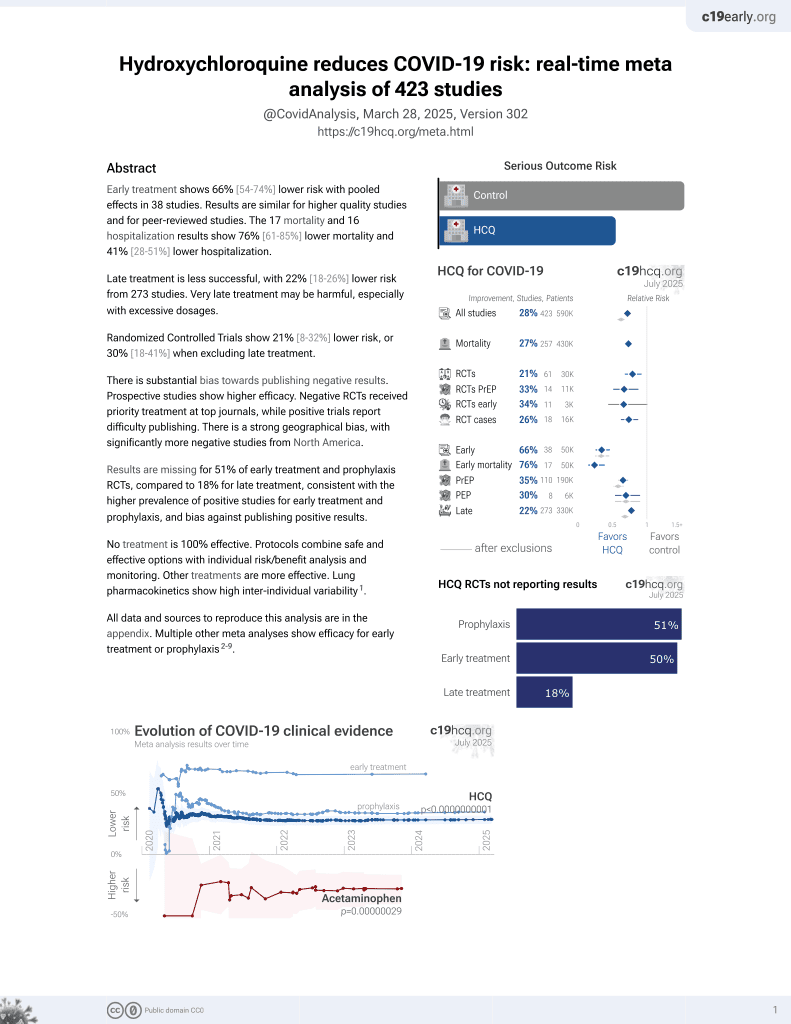
HCQ for COVID-19
1st treatment shown to reduce risk in
March 2020, now with p < 0.0000000001 from 426 studies, used in 59 countries.
No treatment is 100% effective.
Protocols combine treatments.

Retrospective 424 consecutive patients in France showing that HCQ+AZ treatment was safe for early stage COVID-19 treatment with the protocol used, which excluded 11 patients for contraindications.
Treatment contraindications were the presence of severe structural or electrical heart disease, QTc >500ms, hypokalaemia, or other drugs prolonging QTc that could not be interrupted. Electrocardiogram and QTc was evaluated at admission and re-evaluated after 48 hours of the initial prescription.

Million et al., 17 Mar 2023, retrospective, France, preprint, mean age 46.3, 7 authors, study period 3 March, 2020 - 5 April, 2020.
Contact: matthieumillion@gmail.com.
Cardiovascular Safety of Hydroxychloroquine-Azithromycin in 424 COVID-19 Patients
doi:10.20944/preprints202303.0325.v1
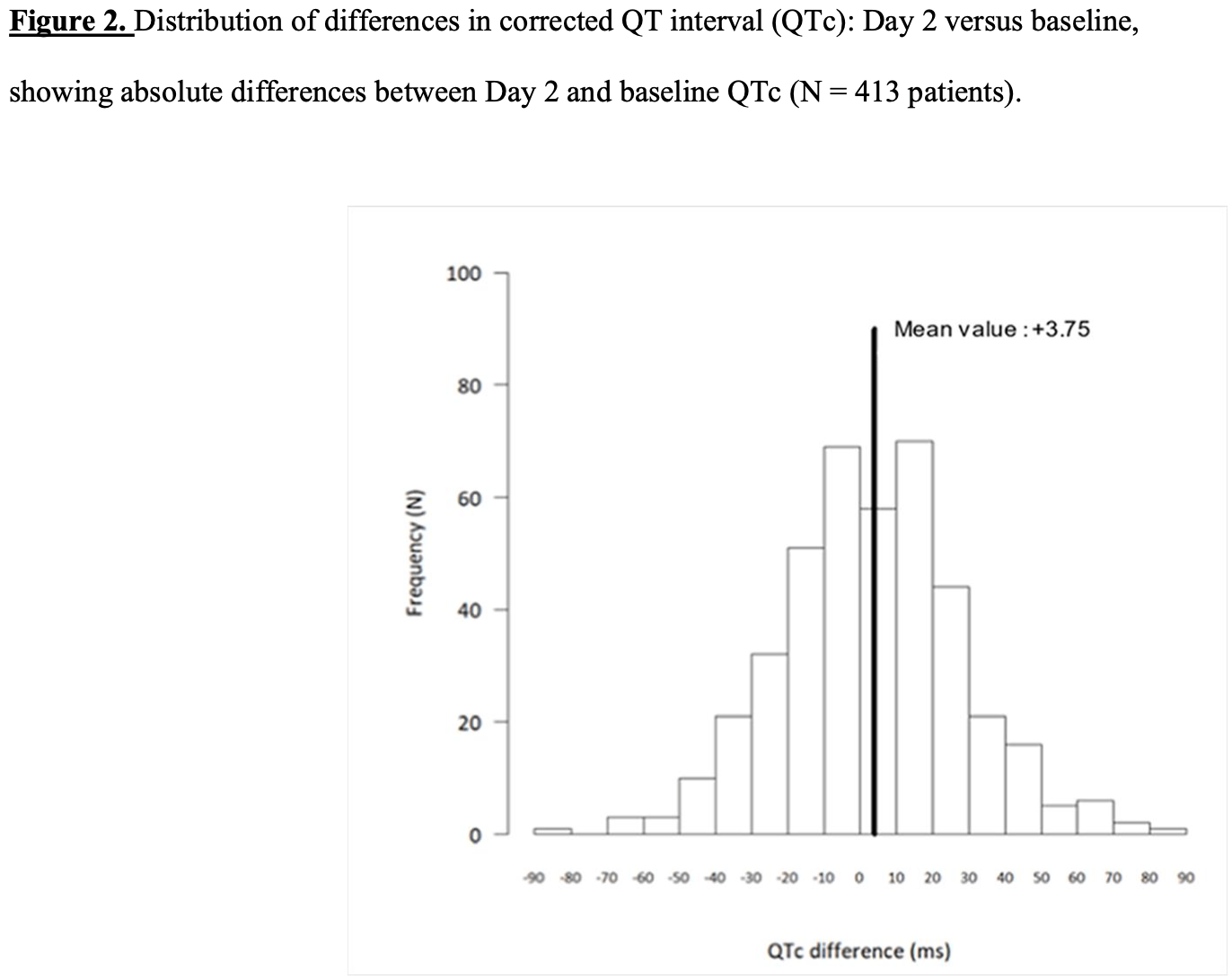
Background: Hydroxychloroquine (HCQ) combined with azithromycin (AZM) has been widely administered to patients with COVID-19 despite scientific controversies. In particular the potential to prolong cardiac repolarisation by using this combination has been discussed. Materials and methods: We report a pragmatic and simple safety approach which we implemented in the first patients treated for COVID-19 in our center early 2020. Treatment contraindications were the presence of severe structural or electrical heart disease, baseline corrected QT interval (QTc) >500 ms, hypokalaemia, or other drugs prolonging QTc that could not be interrupted. Electrocardiogram and QTc was evaluated at admission and re-evaluated after 48 hours of the initial prescription. Results: Among 424 consecutive adults (mean age 46.3 ± 16.1 years; 216 women), 21.5% patients were followed in conventional wards and 78.5% in a day-care unit. A total of 11 patients (2.6%) had contraindications to HCQ-AZ combination. In the remaining 413 treated patients, there were no arrhythmic events in any patient during the 10-day treatment regimen. QTc was slightly but statistically significantly prolonged by 3.75 ± 25.4 ms after two days (p=0.003). Ten patients (2.4%) developed QTc prolongation >60 ms, and none had QTc >500 ms. Conclusions: This report does not aim to contribute to knowledge of the efficacy of treating COVID-19 with HCQ-AZ. However, a simple initial assessment of patient medical history, ECG and kalemia identifies contraindicated patients and enables the safe treatment by HCQ-AZ of COVID-19 patients. QTprolonging anti-infective drugs can be used safely in acute lifethreatening infections, provided that a strict protocol and close collaboration between infectious disease specialists and rhythmologists is applied. Disclaimer/Publisher's Note: The statements, opinions, and data contained in all publications are solely those of the individual author(s) and contributor(s) and not of MDPI and/or the editor(s). MDPI and/or the editor(s) disclaim responsibility for any injury to people or property resulting from any ideas, methods, instructions, or products referred to in the content.
Conflicts of Interest: None of the authors declare have any conflicts of interest to declare.
References
Bessière, Roccia, Delinière, Charrière, Chevalier et al., Assessment of QT intervals in a case series of patients with coronavirus disease 2019 (COVID-19) infection treated with hydroxychloroquine alone or in combination with azithromycin in an intensive care unit, JAMA Cardiol, doi:10.1001/jamacardio.2020.1787
Brouqui, Drancourt, Raoult, On behalf of the IHU Task Force. COVID-19 Management at IHU Méditerranée Infection: A One-Year Experience, J Clin Med, doi:10.3390/jcm10132881
Cavalcanti, Zampieri, Rosa, Azevedo, Veiga et al., Hydroxychloroquine with or without Azithromycin in Mild-to-Moderate Covid-19, N Engl J Med
Chatre, Roubille, Vernhet, Jorgensen, Pers, Cardiac Complications Attributed to Chloroquine and Hydroxychloroquine: A Systematic Review of the Literature, Drug Saf
Chen, Li, Song, Hu, Su et al., Hypokalemia and clinical implications in patients with coronavirus disease, MedRxiv
Chorin, Dai, Shulman, Wadhwani, Bar-Cohen et al., The QT interval in patients with COVID-19 treated with hydroxychloroquine and azithromycin, Nat Med, doi:10.1038/s41591-020-0888-2
Costedoat-Chalumeau, Hulot, Amoura, Leroux, Lechat et al., Heart conduction disorders related to antimalarials toxicity: an analysis of electrocardiograms in 85 patients treated with hydroxychloroquine for connective tissue diseases, Rheumatology
Fossa, Wisialowski, Duncan, Deng, Dunne, Azithromycin/Chloroquine combination does not increase cardiac instability despite an increase in monophasic action potential duration in the anesthetized guinea pig, Am J Trop Med Hyg
Gasperetti, Biffi, Duru, Schiavone, Ziacchi et al., Arrhythmic safety of hydroxychloroquine in COVID-19 patients from different clinical settings, Europace, doi:10.1093/europace/euaa216
Gautret, Million, Jarrot, Camoin-Jau, Colson et al., Natural history of COVID-19 and therapeutic options, Expert Rev Clin Immunol, doi:10.1080/1744666X.2021.1847640
Geleris, Sun, Platt, Zucker, Baldwin et al., Observational Study of Hydroxychloroquine in Hospitalized Patients with Covid-19, N Engl J Med
Haeusler, Chan, Guérin, White, The arrhythmogenic cardiotoxicity of the quinoline and structurally related antimalarial drugs: a systematic review, BMC Medicine
Hancox, Hasnain, Vieweg, Crouse, Baranchuk, Azithromycin, cardiovascular risks, QTc interval prolongation, torsade de pointes, and regulatory issues: A narrative review based on the study of case reports, Ther Adv Infect Dis
Lagier, Million, Cortaredona, Delorme, Colson et al., Outcomes of 2111 COVID-19 Hospitalized Patients Treated with Hydroxychloroquine/Azithromycin and Other Regimens in Marseille, France, 2020: A Monocentric Retrospective Analysis, Ther Clin Risk Manag, doi:10.2147/TCRM.S364022
Liao, Wang, Kang, Novel coronavirus infection during the 2019-2020 epidemic: preparing intensive care units-The experience in Sichuan Province, China, Intensive Care Med, doi:10.1007/s00134-020-05954-2
Maille, Wilkin, Million, Rességuier, Franceschi et al., Smartwatch electrocardiogram and artificial intelligence for assessing cardiac-rhythm safety of drug therapy in the COVID-19 pandemic. The QT-logs study, Int J Cardiol, doi:10.1016/j.ijcard.2021.01.002
Million, Lagier, Gautret, Colson, Fournier et al., Early treatment of COVID-19 patients with hydroxychloroquine and azithromycin: A retrospective analysis of 1061 cases in Marseille, France, Travel Med Infect Dis, doi:10.1016/j.tmaid.2020.101738
Million, Lagier, Tissot-Dupont, Ravaux, Dhiver et al., Early combination therapy with hydroxychloroquine and azithromycin reduces mortality in 10,429 COVID-19 outpatients, Rev Cardiovasc Med, doi:10.31083/j.rcm2203116
O'connell, Bradley, Abbas, Williamson, Rusia et al., Hydroxychloroquine/Azithromycin therapy and QT prolongation in hospitalized patients with COVID-19, JACC Clin Electrophysiol
Ray, Murray, Hall, Arbogast, Stein, Azithromycin and the risk of cardiovascular death, N Engl J Med
Roden Dan, Harrington, Poppas, Andrea, Considerations for drug interactions on QTc in exploratory COVID-19 treatment, Circulation
Self, Semler, Leither, Casey, Angus et al., Effect of Hydroxychloroquine on Clinical Status at 14 Days in Hospitalized Patients With COVID-19: A Randomized Clinical Trial, JAMA
Tang, Cao, Han, Wang, Chen et al., Hydroxychloroquine in patients with mainly mild to moderate coronavirus disease 2019: open label, randomised controlled trial, BMJ
Vandenberk, Vandael, Robyns, Vandenberghe, Garweg et al., Which QT correction formulae to use for QT monitoring?, J Am Heart Assoc
DOI record:
{
"DOI": "10.20944/preprints202303.0325.v1",
"URL": "http://dx.doi.org/10.20944/preprints202303.0325.v1",
"abstract": "<jats:p>Background Hydroxychloroquine (HCQ) combined with azithromycin (AZM) has been widely administered to patients with COVID-19 despite scientific controversies. In particular the potential to prolong cardiac repolarisation by using this combination has been discussed. Materials and methods We report a pragmatic and simple safety approach which we implemented in the first patients treated for COVID-19 in our center early 2020. Treatment contraindications were the presence of severe structural or electrical heart disease, baseline corrected QT interval (QTc) &gt;500 ms, hypokalaemia, or other drugs prolonging QTc that could not be interrupted. Electrocardiogram and QTc was evaluated at admission and re-evaluated after 48 hours of the initial prescription. Results Among 424 consecutive adults (mean age 46.3 &plusmn; 16.1 years; 216 women). Patients were followed in conventional wards (21.5%) or in a day-care unit (78.5%). A total of 11 patients (2.6%) had contraindications to HCQ-AZ combination. In the remaining 413 treated patients, there were no arrhythmic events in any patient during the 10-day treatment regimen. QTc was slightly but statistically significantly prolonged by 3.75 &plusmn; 25.4 ms after two days (p=0.003). Ten patients (2.4%) developed QTc prolongation &gt;60 ms, and none had QTc &gt;500 ms. Conclusions This report do not aim to contribute to knowledge of the efficacy of treating COVID-19 with HCQ-AZ. However, a simple initial assessment of patient medical history, ECG and kalaemia identifies contraindicated patients and enables the safe treatment by HCQ-AZ of COVID-19 patients. QT-prolonging anti-infective drugs can be used safely in acute life-threatening infections, provided that a strict protocol and close collaboration between infectious disease specialists and rhythmologists are followed.</jats:p>",
"accepted": {
"date-parts": [
[
2023,
3,
15
]
]
},
"author": [
{
"ORCID": "http://orcid.org/0000-0002-5556-6947",
"affiliation": [],
"authenticated-orcid": false,
"family": "Million",
"given": "Matthieu",
"sequence": "first"
},
{
"affiliation": [],
"family": "Lagier",
"given": "Jean-Christophe",
"sequence": "additional"
},
{
"ORCID": "http://orcid.org/0000-0001-7007-7247",
"affiliation": [],
"authenticated-orcid": false,
"family": "Hourdain",
"given": "Jérôme",
"sequence": "additional"
},
{
"affiliation": [],
"family": "Franceschi",
"given": "Frédéric",
"sequence": "additional"
},
{
"affiliation": [],
"family": "Deharo",
"given": "Jean-Claude",
"sequence": "additional"
},
{
"affiliation": [],
"family": "Parola",
"given": "Philippe",
"sequence": "additional"
},
{
"ORCID": "http://orcid.org/0000-0002-6125-2805",
"affiliation": [],
"authenticated-orcid": false,
"family": "Brouqui",
"given": "Philippe",
"sequence": "additional"
}
],
"container-title": [],
"content-domain": {
"crossmark-restriction": false,
"domain": []
},
"created": {
"date-parts": [
[
2023,
3,
20
]
],
"date-time": "2023-03-20T00:38:56Z",
"timestamp": 1679272736000
},
"deposited": {
"date-parts": [
[
2023,
3,
20
]
],
"date-time": "2023-03-20T00:39:18Z",
"timestamp": 1679272758000
},
"group-title": "LIFE SCIENCES",
"indexed": {
"date-parts": [
[
2023,
3,
20
]
],
"date-time": "2023-03-20T01:11:26Z",
"timestamp": 1679274686757
},
"is-referenced-by-count": 0,
"issued": {
"date-parts": [
[
2023,
3,
17
]
]
},
"license": [
{
"URL": "http://creativecommons.org/licenses/by/4.0",
"content-version": "unspecified",
"delay-in-days": 0,
"start": {
"date-parts": [
[
2023,
3,
17
]
],
"date-time": "2023-03-17T00:00:00Z",
"timestamp": 1679011200000
}
}
],
"member": "1968",
"original-title": [],
"posted": {
"date-parts": [
[
2023,
3,
17
]
]
},
"prefix": "10.20944",
"published": {
"date-parts": [
[
2023,
3,
17
]
]
},
"publisher": "MDPI AG",
"reference-count": 0,
"references-count": 0,
"relation": {},
"resource": {
"primary": {
"URL": "https://www.preprints.org/manuscript/202303.0325/v1"
}
},
"score": 1,
"short-title": [],
"source": "Crossref",
"subtitle": [],
"subtype": "preprint",
"title": "Cardiovascular Safety of Hydroxychloroquine-Azithromycin in 424 COVID-19 Patients",
"type": "posted-content"
}